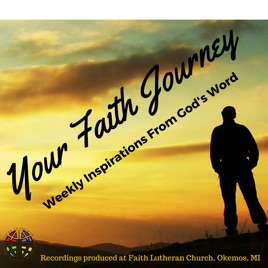
Advertise on podcast: Your Faith Journey - Finding God Through Words, Song and Praise
Rating
4from
This podcast has
300 episodes
Language
EnglishPublisher
Faith Lutheran Church, Okemos, MIExplicit
No
Date created
2016/02/17
Latest episode
2026/09/27
Average duration
10 min.
Release period
4 days
Description
All of us are on a journey of faith in our lives. At Faith Lutheran Church in Okemos, Michigan we bring people one a journey of faith each week and share that journey with the world.
Unlock Your Faith Journey - Finding God Through Words, Song and Praise podcast Email contact info,
Listeners & Audience details
Email contact information
Direct podcast contact details

Listeners
Audience numbers & engagement insights

Audience details
Podcast Insights

Social media
Check Your Faith Journey - Finding God Through Words, Song and Praise social media presence

Podcast episodes
Check latest episodes from Your Faith Journey - Finding God Through Words, Song and Praise podcast
Leaning on the Everlasting Arms
2026/09/27
Today, we had a special musical performance of Leaning on the Everlasting Arms, a performance of the Chancel Choir at Faith Lutheran Church in Okemos, Michigan.
Published Under License From Essential Music Publishing, LLC
This Is Amazing Grace
2026/09/27
Today, we had a special musical performance of This Is Amazing Grace, a performance of the Praise Team at Faith Lutheran Church in Okemos, Michigan.
Published Under License From Essential Music Publishing, LLC
You Might Also Like: No Magic Pill with Blake Mycoskie
2026/09/27
Introducing 100% Sobriety, Male Loneliness, and Healing Parental Wounds | Karamo Brown from No Magic Pill with Blake Mycoskie.
Follow the show: No Magic Pill with Blake Mycoskie
In this episode of No Magic Pill, Blake sits down with TV host, culture expert, and author Karamo Brown (Queer Eye) for a deeply honest conversation on vulnerability, male mental health, and the power of radical self-acceptance. Karamo shares his journey from social work to television, opening up about discovering he had a nine-year-old son at age 25, facing brutal career rejection, and breaking free from the cultural conditioning that tells men to hide their pain.
Together, Blake and Karamo explore the distinction between "giving up" a habit versus actively choosing health, why so many men struggle with hidden loneliness, and how practical tools—like monthly "friendship audits" and shoulder-to-shoulder conversations—can help create genuine connection and lasting peace.
Enough Foundation's mission is to spread reminders in every form — bracelets, messages, actions, community — until feeling ENOUGH becomes the cultural default. To learn more, visit weareenough.co.
Produced, Directed, and Cinematography by Wubetu Shimelash / IG: Wubetu Shimelash
Disclaimer: No purchase necessary. While supplies last. Visit http://www.weareenough.co/rules for full terms.
More information on Blake’s other projects here:
Morning Water
Morning Water is a daily hydration formula that restores energy, balance, and performance with essential electrolytes, minerals, and nutrients in one simple routine.
To learn more, visit morningwater.co and use code NOMAGICPILL for 25% off your first order.
SONIA
Sonia is a conversational AI companion designed for emotional support. Through voice and text, it offers guided wellbeing sessions, including meditations, journaling, personalized recommendations, and practical exercises.
To learn more, visit www.soniahealth.com and download it on the App Store.
MOOVLAB
At MOOVLAB, we bring health and wellness to your workday.
MOOVLAB - the answer to sitting is moving.
To learn more, visit www.moovlab.com
Follow Blake on Instagram and stay up to date with Lemonada on Facebook and Instagram.
For a list of current sponsors and discount codes for this and every other Lemonada show, go to lemonadamedia.com/sponsors.
Joining Lemonada Premium is a great way to support our show and get bonus content. Subscribe today at lemonadapremium.com.
Subscribe to Spotify Premium to watch ad-free video.
Disclaimer: This episode is for informational and entertainment purposes only and is not intended as medical advice. Always consult a qualified healthcare professional regarding any medical questions or concerns you may have.
Learn more about your ad choices. Visit megaphone.fm/adchoices
DISCLAIMER: Please note, this is an independent podcast episode not affiliated with, endorsed by, or produced in conjunction with the host podcast feed or any of its media entities. The views and opinions expressed in this episode are solely those of the creators and guests. For any concerns, please reach out to [email protected].
Sermon - 9/27/26
2026/09/26
Year A – Pentecost 18; Lectionary 26 – September 27, 2026
Pastor Megan Floyd
Ezekiel 18:1-4, 25-32
Philippians 2:1-13
Matthew 21:23-32
Grace and peace to you from God, our Creator, from the Holy Spirit, our Sustainer, and from Jesus Christ, who has everything to say about the possibility of turning back toward God. Amen.
***
Jesus is in the temple, and he has already turned the place upside down.
Let me position us within the timeline.
Jesus rode into Jerusalem the day before on a donkey, crowds shouting Hosanna, the whole city in an uproar. Then he walked straight into the temple and drove out the money changers.
He healed the people who came looking for him there. He let little children shout that he was the Son of David, out loud, right in front of everyone.
So now the chief priests and elders have come to confront him. "By what authority are you doing these things?" They're not asking because they're curious. …They are trying to trap him into a blasphemy charge.
But Jesus doesn't take the bait. He answers their trap with a question of his own, about John's baptism, and it pins them so cleanly that they refuse to answer at all. "We do not know," they say… which everyone in the crowd knows is a lie.
And then, still looking right at them, Jesus tells a story.
***
A man has two sons. He tells the first, "Go work in the vineyard today." The son says nope. …But later, he changes his mind, and he goes to work in the vineyard.
The man tells the second son the same thing. This one says, "Yes, sir, I will go." But he doesn't go.
Jesus asks the authorities the obvious question: which one did what the father wanted?
They answer correctly, because the answer is obvious: the first one. The one who said no, and then went anyway.
And Jesus says to them, "Truly I tell you, the tax collectors and the prostitutes are going into the kingdom of God ahead of you."
That is not a gentle sentence. Jesus is telling the most religiously credentialed people in the room that the people they look down on... the people whose lives they consider disqualifying... are ahead of them in line.
Not because the tax collectors and prostitutes were righteous. But because they were capable of turning. …they were capable of hearing something true and letting it change them.
***
So I want to sit with that word "turning" for a moment, because I think it's the whole sermon, if we let it be.
But before we get there, I want to be honest about something. When I read this text, what I can't help thinking about is not the first son, or even the second son.
It's the people standing in the temple that day who are so sure of their own righteousness that they couldn't hear an invitation to turn… even when it was standing right in front of them, teaching in their temple.
And I think about how much harm gets done by people who say yes, Lord, yes, …but they never go to the vineyard. I think about the harm caused by those who wear the language of faith like armor… instead of letting it change anything about how they treat people.
We've all seen it. Some of us have lived it.
Whole movements have built themselves on saying yes loudly. Purity culture promised protection and instead left a generation of young people, mostly young women, carrying shame about their own bodies that had nothing to do with the God who made those bodies and called them good.
Prosperity gospel promised blessings of wealth and power… and instead told people in real poverty that their suffering was their fault… from a lack of faith.
Real people have been hurt... turned away from church, turned away from God... by religion that said yes, Lord… but never went to the vineyard.
Most of our ELCA churches have a sign out front somewhere that says, All Are Welcome. We have one… and I believe we mean it. But this text asks something harder than believing it. It asks: does our life, together, actually match what we say at the door?
***
Here's the thing, though. I don't want to leave us standing in that indictment, because I don't think that's where Jesus leaves the authorities either… The door doesn't close on them… It stays open.
That's the whole point of the parable... it's not who's disqualified, but who's still capable of turning.
And that includes every one of us who has ever said yes… ever sang it in a hymn, or written it on a pledge card, or promised it at a baptismal font… it includes every one of us who has ever said yes, but then not gone to the vineyard that week.
This is where Ezekiel is saying something beautiful, in a text I don't want us to rush past.
The people of Israel had a proverb: "The parents have eaten sour grapes, and the children's teeth are set on edge." In other words: we're stuck with the sins that came before us. Nothing to be done.
And God, through Ezekiel, rejects that proverb completely. Everyone belongs to me, God says. The soul that sins is the one who dies... not the child for the parent… and not the parent for the child.
And then God says something that sounds less like judgment and more like pleading: "I have no pleasure in the death of anyone... Turn, then, and live."
That is not the voice of a God building a case against us. That is the voice of a God who wants, more than anything, for us to turn around.
***
So what does turning actually look like? Paul gives us a picture of it in Philippians, and it's worth noticing what he doesn't say.
He doesn't say: turn around by feeling sufficiently guilty. …He says… "let the same mind be in you that was in Christ Jesus," who emptied himself, took the form of a servant, and humbled himself.
Turning, in Paul's picture, isn't mainly about correcting your theology. Turning… is about where your life points. Whether it bends inward toward yourself… or outward, toward others.
That's not an abstract concept either. I think of Colby Martin, a pastor who spent his first decade in evangelical ministry fully within a tradition that excluded LGBTQ+ people… the same tradition he'd been raised in.
He said yes to that tradition for years. But… then he changed his mind... and it cost him his job at the church he'd been serving. He wrote about this turn in his book called UnClobber, which I've had on display at the prayer table.
He intentionally worked back through the very passages that had been used to justify exclusion, and came out the other side convinced that Scripture, read honestly, calls the church toward a wider table, not a narrower one.
I think, too, of Monte Mader, an online writer and social media person that, I think, Angie introduced me to.
She's very open about growing up steeped in a very different kind of Christianity than the one we practice here... one tangled up with nationalism and control.
She shares her journey about the slow, costly work of unlearning it… and leaning instead into what she understands as Jesus' actual invitation, which is love… not fear or control. It's always love.
Neither of those turns were easy. They both came with incredible loss. But that's what it looks like to be the first son... to say no, or to have lived a kind of no for years… and then to go to the vineyard anyway.
***
Here's the good news underneath all of this, though… the very same good news Ezekiel is practically begging us to hear… the door back to the vineyard has never closed.
Not for the authorities in the temple. Not for the people harmed by religion that said yes and never showed up. Not for the ones who did the harming.
And not for us… not for any among us who said yes years ago and hasn't gone yet to the vineyard.
God has no pleasure in the death of anyone. Only in the turning. Only in the going.
So may we be a people willing to turn... a people who are honest about where we've said yes, but then stayed home.
May we be open to the same mind that was in Christ… a servant-shaped mind that is pointed outward.
And may we trust that whenever we finally head for the vineyard… however late it may be, or however long we said no first, that God, who loves us, is not counting the hours.
They're just glad we're going.
Amen.
10,000 Reasons
2026/09/13
Today, we had a special musical performance of 10,000 Reasons, a performance of the Chancel Choir at Faith Lutheran Church in Okemos, Michigan.
Published Under License From Essential Music Publishing, LLC
Sermon - 9/13/26
2026/09/13
Year A — Pentecost 16; Lectionary 24 — September 13, 2026
Pastor Megan Floyd
Genesis 50:15-21
Matthew 18:21-35
Grace and peace to you from God, our Creator, from the Holy Spirit, our Sustainer, and from Jesus Christ, who teaches us to forgive as we have been forgiven. Amen.
***
Joseph had every reason to destroy his brothers.
They sold him. Into slavery. As a teenager. They faked his death and let their father grieve him for years. Now, decades later, their father is dead, and the brothers are terrified... because Joseph finally has all the power, and they have none.
So… they send him a message... maybe even a fabricated one... claiming their father's dying wish was that Joseph forgive them. And then they throw themselves at his feet and offer to become his slaves.
And here's what I want us to notice this morning about that: nobody is forcing Joseph to forgive them.
He could have said no. He had every reason — legal, political, emotional — to let his brothers rot. Instead... he weeps. And he says, "Do not be afraid... even though you intended to do harm to me, God intended it for good... so have no fear."
Joseph forgives... but notice, he doesn't pretend the harm didn't happen. He names it. "You intended to do harm to me." He forgives with his eyes wide open.
And that... that is exactly the kind of forgiveness Peter is asking Jesus about in our text today from Matthew's gospel.
***
"Lord, if another member of the church sins against me, how often should I forgive?" Peter asks. "As many as seven times?"
Seven is generous. Seven is Peter showing off a little.
Jesus says, "Not seven times, but… I tell you, seventy-seven times."
That number isn't a number. It's Jesus reaching back into Genesis, to a man named Lamech, who boasted that if someone hurt him, he'd take revenge seventy-sevenfold (Genesis 4:24). Jesus takes Lamech's formula for vengeance... and flips it, on purpose, into a formula for mercy.
Forgiveness, Jesus is saying, is not a quantity. The moment we're counting, we're still playing Lamech's game.
So, Jesus tells a parable. Not "forgiveness is like this"... but "the kingdom of heaven may be compared to this." Jesus is describing an entire climate. A whole way of being alive together.
A servant owes his king ten thousand talents. A talent was about six thousand days' wages, so this is sixty million days of labor. It's not a real number. It's meant to be unimaginable.
And the king, moved by pity, doesn't just extend the payment plan. He cancels the whole thing. Sixty million days of debt... gone.
That same servant walks out and finds someone who owes him one hundred denarii... a real, repayable amount... and has him thrown into prison.
When the king hears what's happened, he is not amused.
***
Here's a word from the scholar O. Wesley Allen Jr. that gets at what's happening in that moment: "Upon hearing of the slave's refusal to offer a small amount of grace after having received an extraordinary amount of grace, the king recalls the slave and revokes the forgiveness of his immense debt...
This image is not offered as some literal reference to eschatological punishment. It is meant to show the level of God's offense at one not forgiving as he or she has been forgiven."
Eschatological is just a fancy word for "end times"... "final judgment." Allen isn't saying this is a preview of what happens to you on judgment day. He's saying: this is how seriously God takes it when we withhold the mercy we've been given.
It would be easy to hear that and think: so… God's mercy has a two-strike limit? But that's not it. Parables paint in broad strokes — this one isn't a threat about eternal bookkeeping. It's about resonance... the deep, built-in connection between the mercy we receive and the mercy we're willing to extend.
Jesus said it plainly, back in the Sermon on the Mount: "Forgive us our debts, as we forgive our debtors." …or trespasses… or sins… Not and then we forgive… but As we forgive. Those two things are wound together.
***
Now... Jesus says "the kingdom of heaven may be compared to" this story, not "the church is." Those two things are connected, but they are not the same.
The church is not yet the fully realized reign of God. We are a rehearsal space for it... practicing, imperfectly, for the world God is bringing. When we forgive one another here, we get a taste of what it will be to live fully inside God's mercy. We don't arrive there on our own. But we can practice.
And this grace Jesus describes is extraordinary. Extravagant. It cancels sixty million days of debt in a single sentence.
But remember... extravagant grace is not cheap grace. Cheap grace says the harm didn't matter, isn't worth naming or grieving. That's not what Joseph did with his brothers, and it's not what the king does either — the debt is named before it's forgiven. Extravagant grace looks straight at the wound and forgives anyway.
And I also need to say this plainly… I need to say it every time this comes up in our texts… forgiveness is not the same thing as staying in a place of harm. It is not permission to remain in an abusive relationship, or excuse harm, or skip accountability.
Joseph's brothers had to face him... they had to reckon with what they'd done... before any reconciliation happened. Forgiveness releases us from the prison of bitterness. …But, it does not require handing the keys of our safety back to whoever has hurt us.
***
So… I've been thinking about this a lot… it's always interesting when the lectionary hands us texts that seem pointed in a cultural moment. Friday was September 11th... and on that night, several of us were at Okemos High School's first home football game, watching our kids in the marching band. …Such a wholesome, American thing to do.
And on that day, my Facebook feed was filled with people remembering exactly where they were twenty-five years ago... the fear, the grief, the moment the ground shifted under all of us.
I will also… never forget that day. I remember exactly where I was.
But so many of the memories shared this week weren't only about the horror of that morning. Several remembered how, in those first hours and days, there was a real effort to sort fact from rumor before reacting.
Others commented on how neighbors showed up for neighbors... strangers sheltered strangers who couldn't get home, thousands lined up for hours to give blood, and people risked their own safety to pull others from the wreckage.
September 11th was a day of immeasurable loss — and in the years that followed, we lost even more people to the toxins released when the towers fell. That grief is real, and enormous. But so is what our neighbors did for one another.
The truth is, "never forget" and "forever blame an entire people" are two very different things. Neighbors who share a faith, or a language, or a skin tone with the men who committed that violence are still, twenty-five years later, paying a price for something they didn't do.
That's not remembrance. That's Lamech's math... seventy-sevenfold… world without end.
Grief is real, and it deserves to be honored. But grief that curdles into bitterness starts looking for a target, and it doesn't much care whether the target is guilty.
I watched a video this week from a young man whose father died in the towers. His plea to his neighbors wasn't for more vigilance, or more suspicion. He asked us to let the memory of that day guide us back toward the love people showed one another in the months right after... toward abundant love, instead of wretched hate.
Twenty-five years out, we get to ask harder questions... about what fed the flames of extremism, about who has borne the cost of our fear. We get to remember honestly… and forgive anyway. Not because the horror wasn't real. It was. But because bitterness doesn't loosen its grip on us... it tightens it.
To truly honor the people we lost, and the people who ran toward danger to help others... the way forward is forgiveness. Putting down the bitterness, and turning that same energy toward building a kinder, more welcoming world for everyone.
***
That's the whole thing, isn't it? Forgiveness and mercy build an ecosystem, same as love does. What we extend to one another doesn't stay contained. A community that practices mercy becomes a community that lives inside mercy. And a community that hoards grudges… ends up living there instead.
We ask God, every time we pray the prayer Jesus taught us, to "forgive us our sins, as we forgive those who sin against us." We are asking God to build in us the very ecosystem of mercy we hope to live inside.
So may we forgive... not seven times, but seventy-seven... not because the wrong didn't matter, but because we, too, have been forgiven a debt we could never repay.
And may we, like Joseph, choose it... freely, with our eyes open... until, little by little, mercy becomes the air we breathe.
Amen.
Se tu m'ami, se sospiri
2026/09/06
Today, we had a special musical performance of Se tu m'ami, se sospiri by Giovanni Battista Pergolesi, arr Theodore Baker and sun by soloist Cody Boyan, and a piano solo from Owen Thompson at Faith Lutheran Church in Okemos, Michigan.
Published Under License From Essential Music Publishing, LLC
Sermon - 9-6-26
2026/09/06
Year A – Creation in Christ – September 6, 2026
Pastor Megan Floyd
Genesis 1:1-2:4a
Psalm 148
Acts 17:22a, 24-28
John 1:1-5
Grace and peace to you from God, our Creator, from the Holy Spirit, who gives life to all creation, and from Jesus Christ, through whom all things were made. Amen.
***
Today is a little unusual… because today, we are celebrating something that is both very old… and very new.
We are celebrating the Feast of Creation in Christ… officially, it lands on September 1, but we observe it in worship on the first Sunday following that day.
It is very old… because Christians have been praying about creation on this day for centuries.
And very new… because this is the first year we are celebrating it as a new festival in the Revised Common Lectionary… which is the three-year cycle of scripture readings and celebrations that guide our church calendar.
So… what exactly are we doing? Where did this come from? …And why are we suddenly celebrating the Feast of Creation in Christ?
Well… I'm so glad you asked! …The story begins in the Eastern Orthodox Church.
For centuries, September 1 has carried a particular significance in the Byzantine Christian tradition. Since at least the seventh century, it has symbolized the beginning of creation… and it became the opening of the Byzantine liturgical year.
So… the beginning of the church year was connected with the beginning of God's creative work.
"In the beginning…" Genesis begins that way… and John begins his Gospel the same way. … "In the beginning was the Word…"
And so, in 1989, Ecumenical Patriarch Dimitrios of Constantinople made an extraordinary invitation.
He invited the entire Christian world to come together every September 1 in prayer… to give thanks to God for the gift of creation… and to pray for its protection and salvation.
And something began to happen. Churches around the world began taking up that invitation. Christians from different traditions began praying for creation together.
And eventually, September 1 became associated not only with an ancient Orthodox observance, but with a growing ecumenical movement of Christians caring for creation and giving thanks to the Creator.
Then, in recent years, Christians from different traditions began asking a question: Could this ancient Eastern Christian observance become something the whole church could share?
So… Christians began meeting together. Orthodox Christians… Lutherans… Catholics… Anglicans… Methodists… Reformed Christians… and Christians from many other traditions.
Thirteen Christian world communions and ecumenical bodies participated in the conversations.
And some of those conversations happened in Assisi… the hometown of St. Francis… a place already deeply associated with Christian love for creation. …This became known as the Assisi Process.
They prayed… listened… and studied. And they asked a theological question that is really at the heart of what we're doing today: What does creation have to do with Jesus Christ?
And the answer is… everything. …But this is not simply a Christian version of Earth Day. …This feast is bigger than all of that. …This is a feast of Christ.
That's why the official name is not simply "Creation." It is… "Creation in Christ."
When we say "Creation in Christ," We are saying that the one we meet in Jesus Christ is not a stranger to creation. …Christ does not arrive late in the story.
Jesus doesn't suddenly appear in Bethlehem and begin God's work of salvation.
John tells us: "In the beginning was the Word. And the Word was with God. And the Word was God. …And all things came into being through him."
All things. …Before Bethlehem… before the manger… before the cross and the empty tomb… Christ was there. …The eternal Word of God… through whom all things came into being.
Creation is not a prelude to the Christian story… but is, in fact, where the Christian story begins.
Genesis tells us that in the beginning, the earth was formless and empty… and darkness covered the face of the deep. And then God speaks. "Let there be light." And there is light. God speaks… and creation responds.
And then God separates, gathers, names, and blesses. …And again and again… God looks at what has been made… and calls it good.
And then the Spirit of God moves over the waters… the Hebrew word is ruach… it means wind… breath… Spirit. God speaks… the Spirit moves… and creation comes into being.
And so even here, at the very beginning, we have learned to see the mystery of the Trinity. God creates... the Word speaks creation into being… and the Spirit gives life.
And yet… Genesis is not giving us a complete doctrine of the Trinity… that comes later, as the church reflects on the whole story of Scripture and on the life, death, and resurrection of Jesus.
But once we know that story… we begin to see something that was there all along. Because Creation reveals something about the God who creates.
The God we meet in Scripture is not solitary. …God is relationship… and love… God is Father, Son, and Holy Spirit. …And creation itself is the work of that Triune God.
And our Psalm today doesn't simply tell humans to praise God… It calls everything to praise. The sun, moon, and stars… the waters… the mountains… the trees… the wild animals... even the turkey buzzards that live around this church…and finally… us.
Praise the Lord! The whole of creation is caught up in worship… And that is one of the things this feast… this festival… is inviting us to remember.
We are not standing outside of creation looking in… we are creatures within creation. …We are part of the song.
And Paul says something similar in Athens… when he tells the people there that the God he proclaims is the God who made heaven and earth, and that this God does not live in a temple made by human hands.
And yet… God is not far from us… because… in God… we live and move and have our being.
The God who created everything is not distant from what God has made. …God is both beyond creation… and intimately present within it.
And that means creation itself can become a kind of revelation. …Not because creation is God… we do not worship the trees… but we worship the God who made them.
And when we look at creation… we can begin to see something about the One who made it. We see beauty… and relationship… and abundance… and interdependence. …We see life giving way to more life.
And in all of this, we begin to glimpse the God whose very life… is love.
I think this is part of what makes it so beautiful that Christians from the East and the West are celebrating this festival… together.
Somewhere in the world right now, Orthodox Christians are praying these prayers… and somewhere else, Methodists are hearing these same Scriptures… and somewhere else, an Anglican congregation is singing a hymn to praise Creation.
All different faith traditions… all giving thanks for creation… in different languages… and using different liturgies… but all praising the same Creator… all confessing the same Christ… all receiving the same Spirit.
That is… beautiful!
And while it's true that being ecumenical won't solve all of our disagreements… it does help us discover what we already share.
There is one creation… one human family… one Creator… one Spirit… and one Christ… through whom all things were made.
And Creation is not merely something God made a long time ago… Creation is ongoing… and God continues to meet us through created things.
Because creation is not just the beginning of our story with God, but it is also the beginning of God's saving work for us.
God creates a world… and God loves what God has made… and so when that creation becomes broken… God does not abandon it. …When we become broken… God does not abandon us.
Instead… the Word becomes flesh… and Christ enters our world… enters our suffering… our sin… and our death. …and he carries all of it to the cross.
And then… on the third day… he rises… because the God who said in the beginning, "Let there be light"… speaks again into the darkness of death… and there is life.
So today, as we raise our voices in praise with Christian siblings all around the world… we also celebrate together… that the one through whom all things were made… is the same one who is still making all things new.
The Creator has become our Redeemer.
The Word has become flesh.
The Spirit continues to give us the breath of life.
And in Christ… all of creation, including us, is being gathered back into the love of God… this day and always.
Amen.
Solfeggietto
2026/08/30
Today, we had a special musical performance of Solfeggietto, a piano solo from Owen Thompson at Faith Lutheran Church in Okemos, Michigan.
Published Under License From Essential Music Publishing, LLC
Sermon - 8/30/36
2026/08/29
Year A – Pentecost 14; Lectionary 22 – August 30, 2026
Pastor Megan Floyd
Romans 12:9-21
Matthew 16:21-28
Grace and peace to you from God, our Creator, from the Holy Spirit, our Sustainer, and from Jesus Christ, who shows us how to live in an ecosystem of love. Amen.
***
Have you ever tried to grow something?
Maybe a garden or a houseplant. Maybe you've just tried to keep one of those little plants from the grocery store alive for more than a month. I'm personally not so good at this.
But if you've ever done it, you know something important: A plant does not live by itself.
It needs water, sunlight, healthy soil… and it needs other plants and organisms around it… because it is connected to everything else around it.
Just as a tree in a forest isn't just a tree. …Its roots hold soil in place…the leaves provide shade… the branches provide homes for animals… the fallen leaves become nutrients for the soil. …and the water that falls on that tree eventually becomes part of streams and rivers.
And if you take away even just one part of that ecosystem, the whole ecosystem changes.
We are also part of an ecosystem… and not just a biological ecosystem. We are part of a human ecosystem… Our lives are connected to one another.
What we do affects other people… How we treat the stranger affects the community… How we respond to suffering affects the people around us.
Whether we forgive or retaliate …welcome or exclude… it affects the people around us.
And ultimately, our human ecosystem is part of the same ecosystem as the trees and rivers and soil and creatures that surround us. We are not separate from creation. …We are creatures within creation.
And this gives us a helpful way to understand Paul's words for us this morning… because Romans 12 sounds like a very long Christian to-do list.
Love genuinely… Hate what is evil… Hold fast to what is good… Love one another… Serve the Lord…Rejoice in hope.
Be patient in suffering… Persevere in prayer… Contribute to the needs of others… Extend hospitality to strangers… Bless those who persecute you… Rejoice with those who rejoice… Weep with those who weep.
Live in harmony… Don't be haughty… Don't repay evil for evil… and… overcome evil with good.
I can't help but hear all this and think: um… Lord, where do I start?
I read an excellent commentary this week by Rev. Melissa Earley, and she makes an important observation… Paul isn't giving us a checklist for holiness… He's actually describing what she calls… an ecosystem of love.
And that is a very different thing… in an ecosystem, everything is connected, so rather than having a checklist, we have… a series of relationships.
Hope strengthens perseverance… perseverance sends us back to prayer… prayer changes the way we see suffering… humility makes harmony possible… mutual affection makes generosity possible… generosity strengthens community… hospitality creates relationships with people who were strangers.
And genuine love… the kind of love that flows from God… is what holds the whole thing together. Paul is describing what happens when God's love takes root in a community. This is not something we ourselves can manufacture.
Because remember, following Christ doesn't mean we become perfect people…
There will be days when we are impatient… or selfish… or afraid… days when we would rather keep the stranger at a distance… or days when somebody hurts us and our first instinct is to hurt them back.
And that's exactly why we trust the love that comes from God to guide us in the way of Christ… to teach us to recognize the difference between our will… and God's will.
Last week, Jesus asked his disciples:
"Who do you say that I am?" …Peter gave the right answer, "You are the Messiah."…but this week, we discover that Peter had a very different idea about what being the Messiah was supposed to mean.
Jesus tells his disciples that he will suffer, be rejected, and be killed… and then rise again. …And Peter says, No, Jesus… That is not how this is supposed to work.
Peter thought he understood God's will… he had an idea about what the Messiah should do, and Jesus tells him that his idea is wrong.
Jesus says, "Get behind me, Satan!" …Follow me… follow my way, not your way… Stop trying to make God's way conform to your way.
But… we do this too, don't we? We make assumptions about what God's will must be… We decide what kind of people God must love… or who deserves compassion… or who belongs… or what kind of suffering God should prevent.
We decide what a faithful Christian life should look like. …And then Jesus comes along and says, no… follow me… just follow me… and let me show you… and then… he says something even harder… Take up your cross and follow me.
Because the way of Christ is not the way of self-protection… it is the way of self-giving love… And self-giving love is vulnerable.
Rev. Dr. Luke Powery points out something wonderfully uncomfortable about Paul's call to hospitality… he reminds us that hospitality contains the possibility of hostility.
When we welcome another person, we don't know exactly what will happen… They might welcome us back, but… they might not. They might appreciate our kindness… but they also might take advantage of it.
Love does not come with a guarantee, and Jesus knew that. …The cross is proof of that. …Jesus lived a life of radical welcome, radical compassion, radical love… and it led him to the cross.
So no… God's love is not a promise that we will never be hurt… but living according to God's love means being willing to risk being hurt… because love is stronger than fear.
But I want to be clear about something here… This does not mean that following Jesus requires us to remain in situations where we are being abused or harmed.
Jesus' call to love is not a command to accept abuse… and sometimes the most loving thing we can do is establish a boundary… sometimes protecting the vulnerable is what love requires.
But even when love requires courage, boundaries, or difficult choices… we are still called to resist the temptation to answer evil with more evil… we are called to find another way. …Christ's way.
And that brings us back to the ecosystem… Think about what happens in a forest when one part begins to break down. …The trees become stressed. …the soil dries out… insects and disease become more prevalent… wildfires become more destructive… and water moves differently through the land.
Eventually, the damage spreads and the whole system becomes less sustainable for life. …And human communities work the same way.
When fear replaces hospitality, the ecosystem suffers. …When contempt replaces mutual affection… when poverty is ignored… when racism divides us… the ecosystem suffers.
When we treat creation as something separate from ourselves—as nothing more than a resource to consume—the ecosystem suffers… and eventually, the damage comes back to all of us… because there is no "somebody else's" ecosystem.
There is only our shared home.
…and more than that, it all belongs to God.
This is why creation care isn't some extra activity that we can choose if we happen to be interested in environmental issues… it actually flows from the same love that calls us to care for our neighbors.
If we love our neighbor, then we care about the water they drink and the air they breathe. …And if we love God's creation, we remember that our neighbors are part of it… and so are we.
Human life and the life of creation are not two separate systems. …We are one ecosystem.
So rather than hearing Paul's words as a checklist to guide our Christian living… we can instead hear them as the framework for an ecosystem of love… and consider how we contribute to it.
Do I make people feel welcome? …do I offer grace and connection? …hospitality and hope?
And when we look at the world God has entrusted to us… are we guided by love to leave behind a world that can sustain life? …Are we making room for our neighbors… and for the creatures with whom we share this earth?
We won't do it perfectly... that's not the point… and God's love does not depend on our perfection… instead, God's grace invites us to rise every morning and begin again… to wake up and turn back toward the way of Christ.
Because ecosystems are living things… they grow and change… they can be damaged… but they can also be restored. …a forest can begin again… a stream can be renewed… a community can heal… a relationship can be repaired.
And a church can be a place where God's love is so deeply rooted that it changes everything around it.
So… remember Peter. …He knew the right answer to the question, but Jesus showed him that knowing the answer wasn't enough. The real question was what Peter would do with that answer.
And so… Yes, Jesus is the Messiah… the Christ… and because that is true… then we love… and we welcome… and we forgive… we care for the stranger… we refuse to answer evil with more evil… we care for the earth that God has made… and we risk love… even though love makes us vulnerable.
Because this is the way of Jesus… the way and the will of Christ.
Not a checklist… and not a promise that we will never be hurt… But… an ecosystem of love… and every act of love adds life to it… And I believe that by God's grace, all those little acts begin to connect like roots reaching into the soil…
…and trees giving shade… people giving hope… neighbors caring for neighbors… strangers becoming friends… with God's love moving through it all… Until one day we look a
Shall We Gather At The River
2026/08/23
Today, we had a special musical performance of Shall We Gather At The River, a summer ensemble performance with Brenda Kopf, Tammy Heilman, Addie Thompson and Rich Weingartner on handbells at Faith Lutheran Church in Okemos, Michigan.
Published Under License From Essential Music Publishing, LLC
Sermon - 8/23/26
2026/08/23
Year A – Pentecost 13; Lectionary 21 – August 23, 2026
Pastor Megan Floyd
Matthew 16:13-20
Grace and peace to you from God, our Creator, from the Holy Spirit, our Sustainer, and from Jesus Christ, who guides us in our understanding of who he is for us. Amen.
***
There is a question at the center of today's Gospel that I think Jesus continues to ask us, even now… "Who do you say that I am?"
He's not asking, "Who does your pastor or your church say that I am?" or even, "Who does scripture say that I am?"
Jesus is asking his disciples: "But who do you say that I am?" …And so, this morning, I want us to sit with that question. Who do we say Jesus is?
Our Gospel takes us to Caesarea Philippi, a place where this question carries some significant political weight.
Caesarea Philippi was a place filled with competing claims about power and divinity. It was associated with the worship of the god Pan, and it bore the name of Caesar. It was, in many ways, a place where people were being reminded of who was supposed to be in charge.
And it is there, surrounded by all these competing claims, that Jesus asks his disciples: "Who do you say that I am?"
Peter answers: "You are the Messiah, the Son of the living God." God in heaven revealed that answer to Peter… he gets it right… and Jesus tells him so…
But what I actually find so encouraging is that Peter gets the answer right before he fully understands what that answer means.
Because just a few verses later… which we'll dig into next week… Jesus begins explaining what it means for him to be the Messiah… he tells the disciples that he must go to Jerusalem, suffer, be killed, and be raised again.
And Peter says… nope. Peter understands "Messiah" to mean victory… power… glory… and success.
Jesus understands "Messiah" to mean… the way of the cross.
Peter confesses Jesus correctly before he understands Jesus correctly. And, I don't know about you, but I find that kind of human fumbling incredibly comforting… because I think that is where many of us live.
We come here, to church. We worship together. We pray together. We sing together. We hear God's Word and share in the holy meal together. We participate in the ministry and life of Faith Lutheran Church.
And we confess our faith through the words of the creeds.
Yet, I know that it is unrealistic to say that every person here fully understands and trusts Jesus… or feels completely certain about every aspect of their faith at every moment.
That isn't human… and we're all human.
Sure, there are moments when we are completely on board… when our faith feels alive and vibrant… when God's presence seems unmistakable… when we look around and think, "Yes. This is it. I know what I believe."
And then there are those other moments… those moments when we have questions… and doubts. …Moments when something happens that makes us push back against what we have been taught.
Moments when we say, "God… I don't understand this." …Moments when the teachings of Jesus ask something difficult of us, and we aren't sure we want to go there.
Because confessing Jesus as the Christ isn't simply an intellectual exercise. …If we really believe Jesus is who we say he is, then that truth has consequences. …If Jesus is Lord, then our lives are shaped by that confession.
If Jesus is the one who reveals God's love to us, then we are called to live lives shaped by that same love… and if Jesus teaches us to love our neighbors, including those who are difficult to love, then we have to wrestle with what that means.
If Jesus reveals God's grace, then we have to consider what it means to extend grace to other people—and to ourselves.
If Jesus reveals that every human being is beloved by God, then we have to learn to see that divine image in people we might otherwise overlook… dismiss… or even fear.
That is not always easy. … and Peter discovered that very quickly. He was perfectly willing to confess Jesus as Messiah. But when Jesus explained what that actually meant, Peter wanted to push back. …but Jesus didn't give up on him.
That's also comforting… and it's a reminder that our God is fully of mercy.
Jesus didn't cast out Peter… he kept walking with him… kept teaching him… and loving him. …And eventually Peter's understanding deepened.
The same is true for us. We don't come to church because we have everything figured out. …Quite the opposite! …we come because we don't. …We come because we are still learning… still becoming.
We come because something in us longs to know God more deeply. One of our hymns in the All Creation Sings book sets the words of this longing to a haunting tune… I find it beautiful… The chorus is this…
There is a longing in our hearts, O Lord, for you to reveal yourself to us. …There is a longing in our hearts for love we only find in you, our God. (ACS 1078)
We keep showing up because somewhere inside us, we sense that there is something more. …We sense the presence of the Divine all around us—in creation, in beauty, in music, in acts of kindness, in forgiveness, in the stranger, in the person sitting beside us.
And we want to draw closer to that presence. …We want to understand it. …We want to learn. …We want to deepen the relationship.
And that is the work of a lifetime. …Faith is not a box we check off. We don't reach a certain level of understanding and say, "Well, that's done. I guess I can move on."
There is always more. …God is always more. …God's full being is simply too much for us to comprehend in this life. …And that's okay. That's good!
So, remember always… to yourself some grace. Give yourself permission to be a person of faith who still has questions. …who sometimes feels absolutely certain… and sometimes not so much.
Give yourself permission to be like Peter. …Because the good news is that Jesus can work with Peter. …And Jesus can work with us.
And also know… that this is one of the reasons we say the creed together.
…When we stand together and join with the saints from every time and place, confessing the words of the creed… we aren't simply informing God about what we believe. …God already knows what's in our hearts.
We do this… because we are reminding one another… and we are reminding ourselves.
We are saying out loud, together, "This is the story we are part of. This is the truth toward which we are turning our lives."
And there is something powerful about saying those words together… Even when we don't feel them completely. …Even when our understanding is incomplete, or when our faith is fragile… someone beside us is saying those same words…
…and we say them with them… and then together, we carry the confession. Not alone… but always together. That is what it means to be the body of Christ.
Sometimes your faith carries me… and sometimes my faith carries you. …Sometimes we are the ones who are certain, and sometimes we are the ones who need someone else to remind us.
And together we keep walking. …Together we keep learning what it means to confess Jesus as the Christ.
So… let's return to Jesus' question. "Who do you say that I am?" If Jesus were standing here among us today, asking you… What would you say?
I can only tell you my answer. For me, I would say…
Jesus, you are my redemption and salvation. You gave me everything… your whole life, and you hold me in love and care, even when I do not deserve it.
You walk with me through the dark valleys, and you celebrate with me on the joyful mountaintops.
You encourage me to live into a life of love and grace and mercy… a life that you yourself demonstrated for us… even knowing that I will never get it perfectly right.
And in doing so, you help me understand that living according to your will brings your kingdom closer… heaven on earth …This way of living allows the divine light that is in all people… including in me… to shine.
And when that light shines in all of us, the whole world becomes brighter. Jesus, you are the light, and Lord, I want to live in that light.
You are the truth, and Lord, I want to live in your truth. …And so, Jesus, in you I place my trust and my love.
That's my answer. …What's yours?
Amen.
Special Music - Blessed Be Your Name
2026/08/10
Today, we had a special musical performance of Blessed Be Your Name, a summer ensemble performance at Faith Lutheran Church in Okemos, Michigan.
Published Under License From Essential Music Publishing, LLC
When God's Love Won't Let Go
2026/08/10
Year A – Pentecost 11; Lectionary 19 – August 9, 2026
Pastor Megan Floyd
Romans 10:5-15
Grace and peace to you from God, our Creator, from the Holy Spirit, our Sustainer, and from Jesus Christ, our Redeemer. Amen.
***
There is something in this passage from Romans that has always troubled me.
You may have heard these words used as a kind of spiritual ultimatum: "If you confess with your lips that Jesus is Lord and believe in your heart that God raised him from the dead, you will be saved." (Rom 10:9)
I've heard those words used to frighten people: Have you said the right words? Do you really believe? What if your faith isn't strong enough? What if you haven't confessed properly?
But that way of hearing this passage makes salvation sound like something we accomplish. Something we have to get right.
And I do not believe that is the gospel.
We do not have agency over our own salvation.
We don't save ourselves by believing hard enough… And we don't save ourselves by saying the right words.
Salvation is God's work… as are grace and mercy…
And thanks be to God for that! …because that means our salvation does not depend upon our ability to get God to love us, for God has already acted.
In Jesus Christ, God has already come among us... Christ has already died and risen… and God's grace is already being poured out.
And that is where Paul takes us in this passage: "The word is near you, on your lips and in your heart."
Not far away or hidden behind some spiritual achievement… or locked behind a gate that we have to figure out how to open.
The Word is near us… Therefore, the kingdom of heaven is near us… because Christ is near us. Always.
And I think the great spiritual challenge of our lives is not figuring out how to make God come closer… but rather… learning to recognize that God is already here.
God's closeness comforts me, but it has been especially comforting over this past week of turmoil.
Many of us are carrying sadness and anger because Meschac, a young man this congregation helped after he came to our country… was taken into custody by ICE last Sunday morning.
He is kind and generous, and exactly the sort of person we want beside us in our neighborhoods and communities. And yet… he has been caught up in a system that treats human beings as problems to be removed… rather than neighbors to be loved.
It is hard, in moments like this, to see the kingdom of God, and to believe that Christ is near when humanity's cruelty is so very present.
But… this is why Paul's words matter.
The Word is near… Christ is near.
And Christ is especially near to our friend and neighbor whose dignity is being denied.
Our calling is not to manufacture the kingdom of heaven. It is to wake up to it.
Jesus spent his ministry opening people's eyes. He showed them that the kingdom of God was not merely some distant destination after death.
God's reign was breaking into the world already—in healing, forgiveness, mercy, radical welcome and reconciliation, and of course… through love for our neighbor.
And when Jesus says, "Love God, and love your neighbor as yourself," he is showing us what it looks like to live with our eyes open.
This is where our confession of faith comes into play…
Yes, we want to confess with our lips that Jesus is Lord, and yes, we want to believe it in our hearts.
But not because those words are a password that gets us into heaven.
We confess Christ because saying it opens our hearts to the reality that is already here. We confess Christ because faith gives us eyes to recognize what God is already doing.
We confess Christ because when Christ becomes close to our hearts, our lives begin to change.
Our obedience to God's will does not purchase God's grace… it is how we respond to God's grace.
Lois Neeves recently gave me a book called Sitting at the Feet of Rabbi Jesus, and the authors put this beautifully:
"Disobedience [to the way of Christ] is a problem, but it can also be an opportunity. If half-heartedness has been stunting your growth, you can reverse its downward pull by repenting and asking God to help you respond to him with renewed trust and obedience. As you do, you may find yourself enjoying unprecedented spiritual growth as God opens up new channels for grace to flow into your life.
The way we understand Jesus' words about the kingdom is critical to the kind of life we will live. If we think that the 'kingdom of heaven' is simply about Christ's second coming or about going to heaven when we die, we'll be tempted to become passive and complacent.
But if Jesus' kingdom is a living, dynamic reality—a reality that is right now steadily advancing against the kingdom of darkness—that's a different story. As followers of Christ, our obedience is vital because it is a catalyst for the Spirit's work, making us more like Jesus so that his reign can spread across the whole earth."
Let me summarize that: our obedience does not make God's kingdom come. God is already at work in our lives.
But our obedience to God's will and God's ways can help us see it… and our lives can become a way through which God's love can reach someone else.
When we refuse to look away from our neighbor's suffering, when we welcome the stranger and the immigrant, when we stand with someone who is afraid, when we speak up against cruelty, when we forgive, when we feed, when we shelter, when we love—we are not earning our place in God's kingdom.
We are living as people who have discovered that the kingdom is already here.
This is the freedom of the gospel.
We don't have to control God. We can't, actually.
Nor do we have to secure our salvation. We can't do that either.
And we don't have to be afraid that we haven't done enough… because God has already done what we could never do.
And because we are freed from having to save ourselves… we are free to love... Free to serve… Free to stand beside our neighbor who is being harmed and offer protection.
We are free to let God's Word become as close to us as our own hearts and as natural to us as the words we speak.
So… the question for us this morning is not, "Have I done enough to get into heaven?"
But rather, "Where is Christ already here, and am I awake enough to see him?"
Because, my friends, Christ is here. Christ is near to you, always.
And the kingdom of heaven is not merely something waiting for us at the end of our lives.
It is God's living presence among us now.
And every time we love God by loving our neighbor… every time mercy becomes visible through our lives… every time we choose compassion over cruelty… we discover that God's love is not only around us, but moving through us.
God is already here… already loving us… and already redeeming all of creation.
And our calling is simply—and profoundly—to wake up, to recognize that holy grace, and to let it flow through our lives and out into the world.
It will be challenging at times… but we don't have to do this alone… because… p God is with us.
Amen.
Special Music - Come to the Water
2026/08/02
Today, we had a special musical performance of Come to the Water, a summer ensemble performance at Faith Lutheran Church in Okemos, Michigan.
Published Under License From Essential Music Publishing, LLC
Podcast reviews
Read Your Faith Journey - Finding God Through Words, Song and Praise podcast reviews
Namagrove 2020/01/06
Gods word is the way.
It’s always beautiful to keep god close to your heart, so having a podcast to bring the sermon to you when you need one and/or can’t make it on Sunday...
Podcast sponsorship advertising
Start advertising on Your Faith Journey - Finding God Through Words, Song and Praise relevant audience podcasts
You may also like to advertise on these Podcasts

4.916161609
The Kristian Harloff Show
Kristian Harloff

4.917101543
DarrenDaily On-Demand
Darren Hardy LLC

4.6221632000
Mark Levin Podcast
Cumulus Podcast Network

4.737121980
The Eric Metaxas Show
Metaxas Media

4.682401276
The Daily Beast Podcast
The Daily Beast, Joanna Coles

4.834891999
Conservative Review with Daniel Horowitz
Blaze Podcast Network

4.87687824
Monsters Among Us
Derek Hayes | Audioboom Studios

4.827571695
Earn Your Happy
Lori Harder | YAP Media

4.549052000
The Daily Stoic
Daily Stoic | Backyard Ventures
4.847052000
Pat Gray Unleashed
Blaze Podcast Network