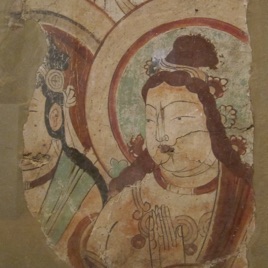
Advertise on podcast: Barbarians at the Gate
Rating
4.8from
This podcast has
102 episodes
Language
EnglishPublisher
Barbarians at the GateExplicit
No
Date created
2016/06/01
Latest episode
2026/02/10
Average duration
37 min.
Release period
16 days
Description
A semi-serious deep dive into Chinese history and culture broadcast from Beijing and hosted by Jeremiah Jenne and David Moser.
Unlock Barbarians at the Gate podcast Email contact info,
Listeners & Audience details
Email contact information
Direct podcast contact details

Listeners
Audience numbers & engagement insights

Audience details
Podcast Insights

Podcast episodes
Check latest episodes from Barbarians at the Gate podcast
Barbarians at the Gate x By Their Own Compass: Emily Hahn's Shanghai
2026/02/10
Welcome to a special episode of Barbarians at the Gate. David and Jeremiah are off this week preparing for Chinese New Year, but as a special gift to our listeners, we are cross-posting this bonus episode about the life and China travels of the American writer Emily "Mickey" Hahn. This episode is from By Their Own Compass, a podcast looking at historical travelers and past journeys co-hosted by Jeremiah with travel expert Sarah Keenlyside.
Emily Hahn partied with poets (and her pet gibbon) at Shanghai soirees. Wrote biographies while dodging bombs in wartime Chongqing, and did her best to keep herself and her family alive in Japanese-occupied Hong Kong. Along the way, she became famous (some might add “notorious”) for her affairs, including with Chinese writer Sinmay Zau (Shao Xunmei 邵洵美) and the head of British intelligence in Hong Kong, Charles Boxer.
Mickey lived through some of China’s most tumultuous moments. While many foreigners experienced these events, Mickey gave her readers an unvarnished look at what was happening, with a style all her own.
We hope you enjoy this special bonus episode. Follow By Their Own Compass at bytheirowncompass.com or search for By Their Own Compass on Apple Podcasts, Spotify, or where you get your podcasts.
Links:
Books referenced in the episode
China to Me by Emily HahnNobody Said Not To Go by Ken Cuthbertson (biography of Emily Hahn)I Wonder as I Wander: An Autobiographical Journey by Langston HughesThe Soong Sisters by Emily Hahn
Tours & Resources:
Historic Shanghai - walking tours (Patrick Cranley and Tina Kanagarathnam)
Further Reading:
Her Lotus Year: China, the Roaring Twenties, and the Making of Wallis Simpson by Paul FrenchHong Kong Holiday by Emily HahnNo Hurry to Get Home: A Memoir by Emily HahnMr Pan by Emily Hahn
Lost in Thailand: The New Chinese Diaspora from Bangkok to Addis Ababa
2026/01/27
It’s high season in Thailand. The weather is perfect. But look around the hotel lobbies and the night markets, and you’ll notice something missing: the tour buses.
For the last decade, Thailand bet the house on Chinese mass tourism. Now, that wager is looking shaky. The numbers are down, and the reasons go deeper than just a sluggish post-COVID economy.
On this episode, David dials in from Addis Ababa and we are joined by travel writer Thomas Bird (author of Harmony Express), global strategist Yajun Zhang to try and figure out where everyone went and where Chinese travelers are going next.
We look at the "scam center" panic that’s terrifying parents on WeChat, the shift from package tours to solo travel, and why a new generation of Chinese tourists might be skipping Bangkok for Singapore.
Plus, we look at how the Chinese diaspora is changing the sound of the region—literally. From the streets of Bangkok to the markets of Addis Ababa, is Mandarin replacing English as the default second language of the Global South?
In this episode:
The Hangover: Thailand’s pivot from GI R&R spot to Chinese holiday destination—and the current crash.
The Fear Factor: How viral stories about kidnappings and scam compounds are killing the vibe for mainland travelers.
The New Traveler: Why the "flag-following" tour groups are being replaced by digital nomads and independent explorers.
Diaspora Voices: Comparing the Chinese communities in Southeast Asia with the newer waves arriving in Africa.
Perilous Prognostications for China in 2026
2026/01/13
Following a tumultuous 2025, we gallop into the Year of the Horse. Tradition says it should be a year of dynamism and progress, but which way is the stampede heading?
To help us read the tea leaves, we welcome back our occasional co-host, Zhang Yajun. As a global strategist and former innovation lead at the World Economic Forum, Yajun has spent over 16 years translating complex shifts—from AI to cultural narratives—for international audiences. She joins us to look past the headlines and offer a reality check on where China’s policies, social fabric, and daily life are actually going in 2026.
Topics include:
The Student Exodus: After American student numbers hit historic lows, can China lure them back? Is the "China Dream" for foreign talent dead, or can the country overcome deep-seated geopolitical friction to become a destination for career-building again?
The AI Reality Check: Beyond the state-level hype, how is Artificial Intelligence reshaping the rhythm of the street? We look at how aggressive government promotion of the sector is filtering down to everyday life.
The Death of the Dining Room: The delivery apps are winning. As take-out replaces the communal table, restaurants are closing at an alarming rate. Are we witnessing the end of China’s boisterous, public food culture?
Character Amnesia: As digital input methods proliferate, muscle memory is fading. With fewer people able to write by hand, will the Ministry of Education double down on rote discipline, or is the era of handwritten Chinese officially over?
Yajun Zhang, Global Strategy & Innovation Leader | AI & XR for Policy | East–West Connector
LinkedIn: https://www.linkedin.com/in/yajun-zhang-strategist/
YouTube: https://www.youtube.com/@yajun_zhang
Substack: https://yajunzhang.substack.com/
Barbarians Remix: Horse Racing, History, and the Final Champion's Day in Old Shanghai
2025/12/30
Champions Day in the city of Shanghai, November 1941.
The world was at war, but the clubhouse at the Shanghai Race Club (now People's Park) was packed with owners and punters cheering on the pony. The funeral of Shanghai's richest widow, Liza Hardoon, was a spectacle that filled the streets of the International Settlement. Japanese occupiers and their Chinese collaborators came together in a bizarre ritual to celebrate the birthday of revolutionary leader Sun Yat-sen. The opening of a new movie featuring, of all subjects, Charlie Chan had folks lining up at the local cinema box office.
The world had changed, but the "Lone Island" of Shanghai persisted, as it had since becoming a treaty port a century earlier.
In this encore episode from 2020, historian James Carter joins us to discuss his fascinating book Champions Day: The End of Old Shanghai. Carter brings to life the vivid tableau of an era coming to an end. By the end of the year, Japanese authorities would take control of Shanghai and the city would never again be the same.
What did the end of the colonial era mean for Shanghai and its residents? Why were race tracks such powerful symbols?
Join us as we discuss the history of horse racing, colonialism, and the last days of Old Shanghai.
The Dowager and the Dynasty
2025/12/16
How does a teenage girl from Beijing’s hutongs end up ruling the world’s largest empire—without ever technically sitting on the throne? In this episode, Jeremiah traces the improbable ascent of Empress Dowager Cixi, who entered the Forbidden City as a minor concubine and departed as the most powerful woman in Chinese history.
The story begins in imperial catastrophe: the Xianfeng Emperor dies in the wake of the humiliating looting of the Summer Palace, leaving behind a four-year-old son and a power vacuum waiting to be filled. Cixi, her fellow empress dowager Ci’an, and Prince Gong move quickly to take control, using the child emperor as both symbol and shield. Jeremiah explains the peculiar constitutional fiction known as “ruling from behind the curtain” (垂帘听政), a political maneuver that allowed Cixi and Ci’an to steer the empire while officially remaining in the shadows.
When Cixi’s own son, the Tongzhi Emperor, dies at eighteen, she executes another audacious maneuver—installing her young nephew, the Guangxu Emperor, ensuring that the throne remains occupied by someone conveniently underage. For a brief period—one hundred days, to be exact—Guangxu confers with intellectuals like Kang Youwei and Liang Qichao, planning an ambitious series of bureaucratic and military reforms. Cixi, unconvinced that constitutional monarchy and radical modernization were viable at the time, pulls the plug.
Jeremiah and David examine the mystery surrounding the death of Zhenfei, the Pearl Concubine, as well as the lingering question of whether the Guangxu Emperor was poisoned by his aunt. Finally, we weigh the verdict of history: was Cixi a ruthless “Dragon Lady” who strangled China’s chances at modernity—or a pragmatic, formidable ruler judged by a double standard?
Barbarians at the Gate x China Books Review: From Heaven Lake
2025/11/14
In 1981, the Indian writer and poet Vikram Seth traveled from Nanjing, where he was studying literature, to his hometown of Delhi. Moving by train across China to Gansu, then hitchhiking southwest through Qinghai and Tibet, it was an itinerary that makes sense when a traveler has a surfeit of curiosity but a shortage of funds. Armed with half-decent Mandarin, a fistful of foreign exchange certificates, and a scrap of paper authorizing his route, he negotiated China just as it was emerging from the Maoist era. No WeChat. No Trip.com. No Google Translate. Just a student improvising his way home as the date on his travel pass crept ever closer: fording rivers in rickety trucks, suffering altitude sickness, dealing with roadside thieves and the occasional military checkpoint.
From Heaven Lake, the book that came out of that trip, still hits hard. It’s sharp, observant, funny in places, bleak in others. A snapshot of a country trying to reinvent itself while one traveler tries to get home before his paperwork expires.
In this Barbarians at the Gate crossover with China Books Review, Jeremiah sits down with Alexander Boyd to talk about Seth’s strange, scrappy journey, what travel in China looked like in 1981, and how a writer from India saw things Western visitors of the same era tended to miss in the early 1980s.
The Destruction of the Old Summer Palace
2025/10/29
Yuanmingyuan, the "Garden of Perfect Brightness," commonly referred to as the Old Summer Palace, was a Qing Dynasty imperial residence comprised of hundreds of buildings, halls, gardens, temples, artificial lakes, and landscapes, covering a land area five times that of the Forbidden City and eight times the size of Vatican City. This expansive compound, once referred to by Victor Hugo as "one of the wonders of the world," now exists only as a sprawl of scattered ruins on the northern outskirts of Beijing, having been thoroughly burned and looted by the French and British over three days in October 1860, in the aftermath of the Second Opium War.
The razed remnants of the glorious gardens have been left in place by the Chinese government as an outdoor museum of China's "Century of Humiliation" at the hands of foreign powers. On the 160th (now 165th) anniversary of the destruction of Yuanmingyuan, Jeremiah and David discuss the political and cultural clashes that led to the action, the significance of the incident for China's national self-image, and the government's attempts to repatriate the massive amounts of looted artifacts found scattered among the museums of Europe and the West. The conversation also explores the changing symbolic significance of the ruins in the context of a rejuvenated and economically powerful China.
The Voyages of Zheng He
2025/10/16
It’s just two guys talking China's naval history. In this episode, David and Jeremiah dig into the story of Zheng He, the 15th-century admiral who took China's treasure fleets halfway around the world as Western Europe was just starting to figure out ocean navigation.
Here's a Muslim eunuch who went from prisoner to running the emperor's treasure fleets. The man brought giraffes home as diplomatic gifts and offered up Sri Lankan kings as trophies to his boss. His fleets dwarfed anything Europe had, yet China wasn't really interested in claiming territory, just showing up, trading, and reminding everyone who ran the seas. Then Beijing killed the whole program. Just like that. Done.
Why'd they stop? That's the question. Because when China bailed on blue-water sailing, Portugal and Spain filled the gap. Different game plan entirely.
Flash forward to 2025, David is in Addis Ababa this month watching Chinese construction projects in Ethiopia and he's drawing lines between Zheng He's trade missions and today's Belt and Road. Same waters, same connections, five centuries apart.
What can a eunuch, a giraffe, and a fleet of enormous ships can teach us about the history of globalization?
Barbarians at the Gate x China Books Review: The Records of the Grand Historian
2025/09/29
Picture this: You’re 45 years old, halfway through writing the definitive history of your civilization. Writing this history is the family business, and you’ve made a promise to your dying father to finish his work no matter what, when your boss, who happens to be the Emperor of China, gives you a choice. You can be executed or, if that doesn’t work for your schedule, how about castration?
Sima Qian picked door number two.
If you enjoyed this tale of commitment, consider subscribing or supporting the Substack. Your subscription will cost far less than what Sima Qian paid. We promise.
In this special episode of Barbarians at the Gate, Jeremiah teams up with China Books Review’s Associate Editor Alexander Boyd to dig into the story of history’s most committed writer. Sima Qian didn’t just compile China’s first great historical work—he literally sacrificed his manhood to complete it after defending a friend got him sideways with Emperor Han Wudi.
Jeremiah and Alexander explore what it means to speak truth to power when the consequences are real, why Sima Qian’s model of moral courage feels especially relevant in our current moment of “spiritual castrations,” and whether anyone today has the stones (so to speak) to make that kind of sacrifice for their work.
Sometimes the classics hit different when the world’s gone sideways.
Barbarians Remix: Seeking News, Making China
2025/09/16
In this encore episode of Barbarians at the Gate, first broadcast in March 2024, John Alekna talks about his fascinating new book Seeking News, Making China: Information Technology and the Emergence of Mass Society. In 20th-century China, the gradual importation and development of information technology had an enormous impact on the way news was disseminated and accessed by the general public. When radio first appeared in the early 1920s, fewer than 8 in 1,000 people had access to newspapers, whereas by the Mao period hundreds of millions of citizens were receiving daily news and information via radio, TV, and shortwave technology.
This book provides an enlightening “meta-historical” account of the evolving communications technologies that fueled the May Fourth Movement, KMT and CCP propaganda campaigns during WWII, and the mass information campaigns of the Mao era, such as the Cultural Revolution. The book describes how the various interlocking information technologies, infrastructure, and communication channels—what Alekna calls the “newsscape”—affected popular opinion, politics, and state power.
John Alekna is an Assistant Professor in the History of Science, Technology, and Medicine at Peking University.
AI-Laoshi Will See You Now
2025/08/31
Teachers are an excitable lot prone to excessive consumption of caffeine and loudly proclaiming that [Insert New Technology Here] will doom a generation to intellectual oblivion. Whether it was television, computers, the Internet, Wikipedia, or now AI, we've seen this panic before.
But in this episode, Jeremiah and David try to do a few deep knee bends and discuss what AI actually means for Chinese language learning. How do we teach when near-perfect translations are waiting on students' phones? How do we integrate AI into our work while putting guardrails on classroom use?
AI might be the greatest learning tool since Pleco, but how do we keep the focus on connecting with actual humans, not impressing silicon tutors? An episode for language teachers, students, and anyone wondering if robots will eventually make them fluent in Mandarin.
Calling all China nerds and Sinology Geeks
2025/08/14
Where are our nerds at? David Moser is on summer holiday, and stepping into David's seat for this episode is literary translator Brendan O'Kane. It takes about two minutes for Jeremiah and Brendan to go off the rails, over the edge, and back to the Amilal Courtyard in Beijing ca. 2010 (if you know, you know).
In this wide-ranging conversation, Brendan and Jeremiah rate different levels of dynastic decline on the "f*****y" scale, Brendan reads a translation from Chinese philosopher Mencius, there's discussion of how to best gloss "laowai," if Xi Jinping is "president," "chairman," or something else entirely, a quick debate on whether Matteo Ricci had an eidetic memory or was just really, really smart, and Brendan's adventures battling ICE.
Come with us for a wild ride of Sinological geekdom and summer-style freeflow scholarship.
Barbarians Remix: The Year of the Boxers with historian Jeffrey Wasserstrom
2025/07/29
Jeremiah and David are joined by Jeffrey Wasserstrom, historian of modern China and a longtime interpreter of the country’s shifting place in the world. Originally recorded in 2020, this conversation revisits the Boxer War of 1900—not through the usual lens of siege and rescue, but by examining what followed: the punitive occupation, the fractured international memory, and the long shadow cast by a global media frenzy.
Wasserstrom’s reading reframes the Boxers not as an isolated burst of anti-foreign violence, but as part of a cycle of uprisings and reprisals that shaped modern China’s encounter with the West. He discusses why the term “Boxer Rebellion” obscures more than it reveals, and why “Year of the Boxers” may be a better way to understand the crisis—and its aftershocks.
The episode also explores deeper patterns in Chinese history, including the 60-year cyclical mindset that links 1900 to 1960 and, by some accounts, to 2020. It’s a conversation about repetition, media distortion, and the uneasy symmetry between violence and remembrance.
Is America Beginning to Look More Like China?
2025/07/15
In this episode we chat with Shanghai-based author and editor Jacob Dreyer, a China watcher who writes with great insight and nuance about the shifting landscape of China-US relations. We touch on questions such as: Is the China model of governance outperforming Western liberal democracy? Is China winning the AI and technology wars? (Spoiler alert: That ship has sailed.) How do the architecture and logic of surveillance and information control systems differ between the U.S. and China? Is the current China-US geopolitical chill drifting toward a hot war? And finally, we unpack the question posed in Jacob’s guest op-ed in the New York Times: Is Trump’s America beginning to look more like China?
Raiders, Rulers, and Traders: The Horse and the Rise of Empires
2025/07/01
This week on the podcast, we explore the role of the horse in Chinese culture with author David Chaffetz, whose new book Raiders, Rulers, and Traders traces the sweeping impact of horse domestication across world civilizations. Chaffetz explains how equestrian cultures not only transformed warfare and mobility in China, but also reshaped the very boundaries of empire and cultural identity. Our conversation follows China’s long and complex relationship with the horse, from defending against nomadic cavalry along the northern frontier to importing prized horses through Silk Road diplomacy. Chaffetz recounts the challenges faced by Chinese dynasties in breeding horses to match the superior mounts of Mongol raiders. We also explore the echoes of China’s horse culture preserved in relics, from paintings and artifacts to the horse statues unearthed among the Terracotta Warriors.
Podcast reviews
Read Barbarians at the Gate podcast reviews
SoloPocono 2018/03/27
Characters talking about characters
I, personally, think it’s much ado about nothing. Of course, as a 58yr old former medical professional, now severely disabled and house-bound for the...
Podcast sponsorship advertising
Start advertising on Barbarians at the Gate relevant audience podcasts
You may also like to advertise on these Podcasts
4.41176102
The Micah Hanks Program
Micah Hanks

4.361851452
Reality Steve Podcast
Reality Steve

4.82423705
The Brian Buffini Show
Brian Buffini
4.8284295
Brave New Teaching: A Podcast for High School and Middle School Teachers
Marie Morris & Amanda Cardenas, Secondary ELA Teachers
4.526112
Great Company with Jamie Laing
Jampot Productions

4.828103
NFL Best Bets
NFL Betting, Fantasy Points, Sports Gambling, Betting, NFL

4.919193
Certified Wrench Podcast
Colton McCormack

4.830802000
The Quote of the Day Show | Daily Motivational Talks
Sean Croxton

4.1263500
Locked On Astros - Daily Podcast On The Houston Astros
Locked On Podcast Network, Eric Huysman, Bret Chancey

3.72701207
Elon Musk Podcast
Stage Zero