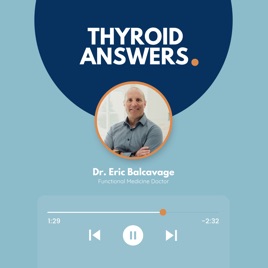
Advertise on podcast: Thyroid Answers Podcast
Rating
4.6from
This podcast has
100 episodes
Language
EnglishPublisher
Dr. Eric BalcavageExplicit
No
Date created
2016/12/23
Latest episode
2026/04/21
Average duration
50 min.
Release period
7 days
Description
Thyroid Answers podcast is focused on providing answers to the most common question people who have a thyroid problems and thyroid symptoms need and want answers to. The podcast is hosted by Dr Eric Balcavage and Dr Erica Riggleman. Both are doctors of functional medicine, chiropractors and certified nutrition specialists. Their practices focus on helping people with thyroid conditions improve their symptoms and regain their health using functional medicine.
Unlock Thyroid Answers Podcast podcast Email contact info,
Listeners & Audience details
Email contact information
Direct podcast contact details

Listeners
Audience numbers & engagement insights

Audience details
Podcast Insights

Podcast episodes
Check latest episodes from Thyroid Answers Podcast podcast
Episode 227: Why Your Metabolism Isn't Broken (And Why You're Still Tired)
2026/04/21
Episode 227: Why Your Metabolism Isn't Broken (And Why You're Still Tired)
If you're struggling with fatigue, low energy, or a "slow metabolism," you've probably been told the same thing: Something must be wrong.
Your thyroid is low.
Your mitochondria aren't working.
You must be deficient in something.
So the solution becomes: take more thyroid hormone, add more supplements, and try to boost metabolism.
But what if that entire model is wrong?
In this episode of the Thyroid Answers Podcast, Dr. Eric Balcavage explains why low energy and sluggish metabolism are often not signs of broken physiology, but adaptive responses to stress and reduced capacity.
You'll learn how your body actually produces energy, the difference between aerobic and anaerobic metabolism, and why your body may intentionally slow down metabolic output when it perceives stress.
Dr. Balcavage also breaks down how physiologic and perceived stress impact mitochondrial function, why reduced T3 may be protective rather than dysfunctional, and how common lab interpretations often lead to the wrong treatment strategy.
If you've been trying to "fix" your metabolism but still feel exhausted, this episode will help you understand what your body is actually doing, and why pushing it harder may be making things worse.
Learn More About Dr. Eric Balcavage
Dr. Eric Balcavage is the co-author of The Thyroid Debacle and the creator of:
• State-Based Medicine™
• The Adaptive Thyroid Model™
• The Strategic Thyroid Solution™
His work focuses on helping patients and practitioners understand thyroid physiology through the lens of metabolic stress, adaptation, and whole-body regulation.
Resources
Website:
https://www.drericbalcavage.com
Instagram:
https://www.instagram.com/drericbalcavage
Episode 226: Why Thyroid Medication Rarely Fixes Fatigue
2026/04/14
Why Thyroid Medication Rarely Fixes Fatigue
Many people struggling with fatigue are told the same thing: your thyroid must be low.
And if thyroid hormone controls metabolism, then increasing thyroid medication should restore energy… right?
But thousands of patients discover something confusing. Their thyroid labs improve after starting medication, yet the fatigue remains. In some cases, the exhaustion actually gets worse.
In this episode of the Thyroid Answers Podcast, Dr. Eric Balcavage explains why thyroid medication often fails to resolve fatigue and what may actually be driving low energy levels in the body.
You'll learn why fatigue is often not caused by a simple thyroid hormone deficiency, why reduced T4-to-T3 conversion may be an adaptive response, and how metabolic capacity—not just hormone levels—determines how much energy your body can produce.
Dr. Balcavage also breaks down the three most common thyroid treatment traps, explains why lab values can be misleading, and shares the better questions patients and practitioners should be asking when fatigue persists despite "optimized" thyroid labs.
If you've been chasing lab numbers while still struggling with exhaustion, this episode will help you understand the deeper physiology behind thyroid fatigue and why restoring metabolic capacity is often the real solution.
Learn More About Dr. Eric Balcavage
Dr. Eric Balcavage is the co-author of The Thyroid Debacle and the creator of:
• State-Based Medicine™
• The Adaptive Thyroid Model™
• The Strategic Thyroid Solution™
His work focuses on helping practitioners and patients better understand thyroid physiology, metabolic stress, and the root causes behind chronic health conditions.
Resources Website: https://www.drericbalcavage.com
Instagram: https://www.instagram.com/drericbalcavage
To receive the Thyroid Labs Decoded guide, send Dr. Balcavage a DM on Instagram with the word LABS or request it through the contact form on the website.
Episode 225: Fatigue - Why Being Tired Doesn't Always Mean Your Thyroid Is Low
2026/04/07
Fatigue: Why Being Tired Doesn't Always Mean Your Thyroid Is Low Most people believe fatigue means one thing: their thyroid must be low. So thyroid labs are checked. Medication is prescribed.
And sometimes energy improves… at least temporarily.
But what if fatigue isn't actually a thyroid problem?
In this episode of the Thyroid Answers Podcast, Dr. Eric Balcavage explains why fatigue is often misunderstood and why simply increasing thyroid hormone rarely solves the problem long-term.
Fatigue is not always caused by a lack of thyroid hormone. More often, it reflects a mismatch between the demands placed on the body and the body's capacity to produce energy.
When the body's capacity to generate energy falls behind the stress and demand placed on it, fatigue becomes the signal that something deeper is happening.
In this episode, Dr. Balcavage breaks down the physiology behind fatigue, how thyroid hormone fits into the picture, and why focusing only on thyroid labs often misses the bigger story.
In This Episode, You'll Learn • Why fatigue is often a capacity problem, not simply a thyroid problem
• How the body converts food energy into cellular energy
• Why reduced T3 levels can sometimes reflect adaptive physiology
• How stress and metabolic demand influence thyroid hormone signaling
• Why thyroid medication can temporarily improve fatigue but fail to solve the underlying issue
• The critical difference between pushing metabolism harder and restoring the body's capacity
Who This Episode Is For This episode is especially helpful for people who:
• Feel exhausted despite normal thyroid labs
• Are taking thyroid medication but still struggle with fatigue
• Have been told their fatigue is caused by thyroid dysfunction
• Want to better understand how energy production actually works in the body
Listen If You've Ever Thought • "My labs look normal but I'm still exhausted."
• "Why didn't thyroid medication fix my fatigue?"
• "Is low T3 the reason I'm tired?"
• "Why does fatigue keep coming back?"
Connect With Dr. Eric Balcavage Website: https://www.drbalcavage.com
Instagram: https://www.instagram.com/drericbalcavage
Facebook: https://www.facebook.com/drericbalcavage
YouTube: https://www.youtube.com/@drericbalcavage
Thyroid Answers Podcast If you enjoyed this episode, be sure to subscribe, leave a review, and share it with someone who may be struggling with thyroid issues or chronic fatigue.
Topics discussed: thyroid fatigue, hypothyroidism fatigue, why thyroid medication doesn't fix fatigue, low T3 fatigue, reverse T3 fatigue, chronic fatigue thyroid, thyroid hormone metabolism, fatigue and mitochondria, thyroid stress physiology.
Episode 224: Iron Deficiency or Defense? Understanding Low Iron and Ferritin
2026/03/31
Iron: Deficiency or Defense? Understanding Low Iron and Ferritin Many people are told they are iron deficient simply because their iron or ferritin levels appear low on a blood test. But iron physiology is far more complex than most people realize.
In this episode of the Thyroid Answers Podcast, Dr. Eric Balcavage breaks down one of the most misunderstood areas of lab testing: iron status. Fatigue, hair loss, cold intolerance, brain fog, slow metabolism, and even thyroid symptoms are often blamed on iron deficiency. When labs show low iron or low ferritin, the common response is iron supplements or iron infusions. But low iron in the blood does not always mean the body is truly deficient. In many cases, the body is intentionally regulating iron as part of an inflammatory response.
Dr. Balcavage explains the difference between true iron deficiency and anemia of inflammation, why ferritin is often misunderstood, and how markers like soluble transferrin receptor can help clarify whether the body truly needs iron or is simply regulating it differently.
Understanding these patterns can help prevent unnecessary iron supplementation and help identify the real reason symptoms may be occurring.
In This Episode You'll Learn • Why many people are incorrectly told they are iron-deficient
• The difference between true iron deficiency and anemia of inflammation
• What ferritin actually represents and why it is often misunderstood
• What iron, TIBC, iron saturation, and ferritin really measure
• How iron levels relate to red blood cell markers like hemoglobin, MCV, and RDW
• The role of soluble transferrin receptor in identifying true iron deficiency
• Why iron supplementation sometimes helps—and sometimes makes people feel worse
• Why iron labs must be interpreted as patterns rather than isolated numbers
Key Concepts Discussed Iron metabolism
Ferritin interpretation
Soluble transferrin receptor
Iron deficiency vs anemia of inflammation
Iron regulation and inflammation
Red blood cell indices and iron physiology
Fatigue and low iron labs
Thyroid symptoms and iron metabolism
Who This Episode Is For This episode may be helpful if you:
• Have been told your ferritin is low
• Have been diagnosed with iron deficiency
• Are taking iron supplements but still feel fatigued
• Have symptoms like fatigue, hair loss, cold intolerance, or brain fog
• Want to better understand how iron is regulated in the body
About Dr. Eric Balcavage Dr. Eric Balcavage is the co-author of The Thyroid Debacle and the creator of State Based Medicine™, The Adaptive Thyroid Model™, and The Strategic Thyroid Solution™.
Through his clinical work, research, and teaching, Dr. Balcavage focuses on helping both patients and practitioners understand the deeper physiology behind chronic symptoms, thyroid dysfunction, and metabolic adaptation so they can move beyond symptom management and toward true recovery.
Resources Learn more about Dr. Eric Balcavage: www.drericbalcavage.com
Episode 223: Why Thyroid "Optimization" Often Makes People Worse
2026/03/24
Why does adding T3 change one person's life, temporarily help another, and make a third feel worse almost immediately?
In this episode, we explore the real reason thyroid optimization doesn't work the same for everyone. The issue isn't the tool. It's the state.
Health is capacity. Optimization strategies require capacity. And when capacity isn't present, adding demand can amplify strain instead of restoring resilience.
In this episode, you'll learn:
The difference between physiologic optimization and optimization strategies
Why reduced T3 may represent adaptive physiology in certain states
How the body shifts between resilience, chronic strain, and overload
Why the same thyroid strategy produces three different outcomes
Why chasing lab numbers without identifying state often leads to volatility
If you've tried adjusting thyroid medication, optimizing free T3, or narrowing lab ranges and still feel unstable, this episode will help you understand why.
If you'd like help identifying the state your body is operating in and determining whether stabilization, load reduction, or optimization is appropriate, you can schedule a discovery call using this link: https://l.bttr.to/LGjGk
Episode 222: WHY DOING THE RIGHT THINGS DOESN'T WORK
2026/03/17
If you've been doing everything you were told should help — taking supplements, exercising, optimizing labs, pushing harder — and instead you feel worse, this episode explains why.
Human physiology does not operate in one constant mode. It shifts between different states depending on load, stress, and available capacity. Most recovery and optimization strategies assume the body is in a resilient, regenerative state. But many people with chronic symptoms are not. They're operating in chronic strain or overload, where the body is prioritizing stability and defense, not repair and regeneration.
In this episode, Dr. Eric Balcavage explains:
Why doing more often leads to less tolerance, more reactivity, and slower recovery
How physiologic states (resilient, chronic strain, overload) change what your body can handle
Why well-intentioned strategies like supplements, hormones, detoxes, and intense exercise can backfire
The difference between feeling better and actually recovering
What actually has to change for recovery to begin
This is not a motivation talk or a protocol episode. It's a clear explanation of what's happening in your body — and why recovery requires changing the state, not just adding more strategies.
Episode 221: Why Low Free T3 Often Doesn't Need to Be "Fixed"
2026/03/10
The conversation around T3 is one of the most confusing — and divisive — topics in thyroid care.
Conventional medicine often ignores T3 entirely.
Integrative and functional medicine frequently treats free T3 as the number that must be optimized at all costs.
Patients are left stuck in the middle, unsure who to trust, what their labs actually mean, and whether a "low" free T3 is something that needs to be fixed.
In this episode of Thyroid Answers, Dr. Eric Balcavage breaks down what free T3 really represents, where T3 actually comes from, and why lower free T3 is often an adaptive, protective response, not a sign of failure or deficiency.
You'll learn:
Where T3 actually comes from — and why most of it isn't made by the thyroid
The difference between thyroid homeostasis and thyroid allostasis
Why the body intentionally reduces T4-to-T3 conversion under strain
How free T3 and total T3 tell different stories — and why both matter
Why raising free T3 can feel better short-term but worsen physiology long-term
When lower free T3 is actually the body's solution, not the problem
How to ask better questions instead of chasing numbers
This episode is not about protocols or "optimizing labs."
It's about understanding state, adaptation, and recovery — so you stop fighting your physiology and start working with it.
Episode 220: Why Doing More Is Making You Worse — And Why Recovery Usually Starts With Less
2026/03/03
Why Doing More Is Making You Worse — And Why Recovery Usually Starts With Less
If you've been dealing with persistent thyroid symptoms and feel like you're doing everything right — supplements, medications, protocols, lifestyle changes — but still aren't getting better, this episode is for you.
In this episode of Thyroid Answers, Dr. Eric Balcavage explores why "doing more" so often feels like the right answer — and why that approach frequently leads to more strain, not recovery.
We unpack how escalation happens, why added support can quietly increase physiologic cost, and how compensation can look like progress while actually pushing recovery further away. You'll learn why supplements, thyroid medications, hormones, antimicrobials, and mold protocols can all follow the same pattern when applied to a system already under load.
Most importantly, we shift the conversation away from fixing symptoms and toward understanding physiologic state — including what recovery actually looks like, how to reduce load, and how to respond differently to what your body is telling you.
This episode is not about doing nothing.
It's about doing something different.
In this episode, you'll learn: • Why more effort often creates more strain
• How compensation masquerades as healing
• Why thyroid medication and supplements can stop working over time
• What "reducing load" actually means
• How to tell what state your body is in
• What to focus on when you stop chasing symptoms
• What early recovery really looks like — and why people miss it
Next steps: If you're interested in a different model of functional medicine care focused on recovery rather than escalation, you can request a discovery call through my website.
If you want to start reducing your load on your own, message "Blueprint" on Instagram or email [email protected] to get access to the Thyroid Recovery Blueprint, which walks through the key fitness factors that influence recovery and helps you identify where load is accumulating in your system.
Episode 219: T3-Based Thyroid Medication — Mistakes, Misunderstandings, and Miscommunication
2026/02/24
T3-based thyroid medications, including desiccated thyroid extract and combination T4/T3 therapy, are some of the most misunderstood and controversial tools in thyroid care.
Some patients feel dramatically better.
Others feel briefly improved, then crash.
Labs often look "optimized," yet long-term recovery stalls.
So what's actually happening?
In this episode of Thyroid Answers, Dr. Eric Balcavage breaks down the most common mistakes, misunderstandings, and miscommunication surrounding T3-based thyroid therapy — and explains why outcomes vary so widely between patients.
You'll learn:
Why so many people end up on T3 or desiccated thyroid in the first place
The real physiologic arguments clinicians use to justify T3 therapy
What a healthy human thyroid gland actually produces — and why that matters
Where most of the body's T3 really comes from
Why "poor conversion" is often an adaptive response, not a defect
Why lowering reverse T3 doesn't necessarily mean recovery
Why T3 helps some people and destabilizes others
The difference between managing symptoms and restoring physiology
This episode reframes T3 therapy through the lens of physiologic state, not just lab values — and explains why adding more thyroid hormone can sometimes push the body further away from recovery.
If you've ever wondered whether T3 is helping you, hurting you, or simply masking deeper issues, this conversation will give you a clearer framework for understanding what's really going on.
Episode 218: Why T3 Works for Some People — and Hurts Others
2026/02/17
Why does T3 feel life-changing for some people — and destabilizing for others?
In this episode of Thyroid Answers, Dr. Eric Balcavage explains why the answer isn't about the medication itself, but about the physiologic state of the person receiving it.
You'll learn why T3 can support recovery in some cases and create symptom volatility in others, and why labeling T3 as "good" or "bad" misses the real issue entirely.
This episode introduces a clear, state-based framework:
Resiliency — regeneration and adaptive capacity
Chronic strain — long-term repair and compensation
Overload — defensive, survival-focused physiology
Dr. Balcavage explains how T3 interacts differently in each state, why adding T3 can suppress TSH and reduce T4 reserves, and why labs can look better even as physiology becomes less stable.
Topics Covered T3 medication benefits and risks
Physiologic state and thyroid response
Why T3 works for some but not others
TSH suppression and T4 reserve depletion
Adaptive vs forced thyroid output
Why thyroid research produces mixed results
This episode is essential for anyone taking T3, considering T3, or trying to understand why thyroid medication responses vary so dramatically.
Episode 217: Why Reduced T4-to-T3 Conversion Is Not the Problem!
2026/02/10
One of the most common explanations patients hear when they don't feel well on thyroid medication is this:
"You're not converting T4 to T3."
In this episode of Thyroid Answers, Dr. Eric Balcavage explains why reduced T4-to-T3 conversion is usually not the problem—and why treating it as a defect often leads to aggressive thyroid medication strategies that stabilize labs but destabilize physiology.
You'll learn:
What T4-to-T3 "conversion" actually is—and why it's regulated, not broken
Why clinicians often label symptoms as "poor conversion"
How stress, inflammation, infection, sleep disruption, under-fueling, illness, excess T4, and even aging can intentionally reduce T3 production
Why adding T3 often backfires and creates symptom volatility
How to interpret thyroid labs in context instead of chasing "optimal" numbers
Ande More ... This episode reframes reduced conversion as an adaptive signal, not a failure—and explains why true thyroid recovery depends on changing the conditions the body is responding to, not forcing output with medication.
Reverse T3, T3 Uptake, and Thyroid Antibodies - What They Mean, What They Don't
2026/02/03
Why do so many people still feel hypothyroid when their labs look "normal"?
In this episode of Thyroid Answers, Dr. Eric Balcavage completes the thyroid lab conversation by addressing three of the most misunderstood tests in thyroid care: reverse T3, T3 uptake, and thyroid antibodies.
You'll learn:
What reverse T3 actually represents—and why it rises or falls
Why high reverse T3 does not mean blocked T3 receptors
How T3 medication lowers reverse T3 by suppressing T4, not by improving physiology
What the T3 uptake test measures and why it still matters
Why free T4 and free T3 can be misleading without total hormone levels
How binding proteins, estrogen, liver function, inflammation, and medications affect interpretation
What thyroid antibodies do—and do not—tell us about thyroid damage and disease activity
This episode is essential listening if you've been told your thyroid is "optimized," yet symptoms persist—or if you're trying to understand why thyroid medications work for some people and cause instability for others.
This discussion sets the stage for the February series on thyroid medication physiology, including T4-only therapy, T3 therapy, combination therapy, and desiccated thyroid.
Episode 215: Total T3 And Free T3 - What They Mean, What They Don't, and Why Treating T3 often backfires
2026/01/27
T3 is the most talked-about thyroid hormone — and the most misunderstood.
In this episode of the Thyroid Answers Podcast, Dr. Eric Balcavage breaks down Total T3 and Free T3 using a clear, Q&A-style format to address the most common questions, mistakes, and treatment traps patients and clinicians fall into.
You'll learn:
What T3 actually represents — and what it does not
The difference between Total T3 and Free T3 (and why you need both)
Why low T3 is often an adaptive response, not a deficiency
Why adding T3 medication can help short-term but worsen physiology long-term
Why "chasing Free T3" is one of the biggest mistakes in functional medicine
How stress, inflammation, illness, dieting, and medications alter T3 levels
Why labs can improve while patients feel worse
How to interpret T3 correctly within the full thyroid panel
This episode is essential listening if:
You've been told your T3 is "low-normal" but still feel terrible
You feel better on T3 medication at first — then worse
Your labs look good, but your symptoms don't match
You want to understand thyroid physiology beyond numbers and ranges
🎁 Free Resource:
If you want a clear, practical guide to understanding thyroid labs, comment LABS and I'll send you my Thyroid Labs Decoded eBook.
Episode 214: Total T4 vs Free T4 - What They Mean, And Why You Need Both!
2026/01/20
Most thyroid patients are told their labs are "normal" because their Free T4 is in range, yet they still feel exhausted, cold, foggy, and unwell.
In this episode, Dr. Eric Balcavage breaks down one of the most misunderstood areas of thyroid testing: Total T4 vs Free T4, what each test actually measures, why doctors often run only one, and why relying on a single value leaves millions of people stuck without answers.
This is a Q&A-style episode, answering the real questions patients ask every day, including:
What Total T4 really tells us about thyroid hormone availability
Why Free T4 alone can be misleading
How stress, inflammation, and adaptation affect these values
Why "normal T4" doesn't always mean normal thyroid function
When thyroid medication helps — and when it makes things worse
If you've been told your thyroid labs look fine, but you don't feel fine, this episode will help you understand what your labs are actually saying, and what they're not.
👉 Want help interpreting your thyroid labs?
Comment LABS to receive my free Thyroid Labs Decoded eBook.
Episode 213: AI Is Giving Health Advice—But Does It Understand Your Body?
2026/01/13
AI is quickly becoming part of health care. Patients are using ChatGPT and other AI tools to interpret symptoms, labs, genetics, and decide what to do next—often before they ever talk to a clinician.
But here's the real question: Does AI actually understand the human body—or is it just organizing data without context?
In this episode, Dr. Eric Balcavage is joined by Dr. Cam McDonald, a global leader in precision health and AI, and Susan Robbins, an epigenetic human performance coach, to explore the promises, limitations, and hidden assumptions behind AI-driven health advice.
Together, they unpack:
What AI does well in health care—and where it can go wrong Why more data doesn't always lead to better health decisions How genetics, epigenetics, and body measurements can inform care—but don't tell the whole story The difference between managing numbers and supporting recovery Why optimization isn't always healing When doing less may actually be the most precise approach This conversation is especially important for anyone dealing with chronic symptoms, thyroid issues, anxiety, fatigue, or feeling overwhelmed by conflicting health advice. AI isn't the enemy—but what it assumes about health matters more than most people realize.
🎧 Whether you're a patient trying to make sense of AI health advice or a clinician navigating this new landscape, this episode will help you think more clearly about what true personalized care really means.
Guest Information:
Dr. CAM MCDONALD BIO: Dr Cam McDonald is a global leader in precision health, AI, and human performance who's redefining how we understand health, wellbeing, and behaviour in the modern world. As the CEO of the Precision Health Alliance and a Fellow of the Australasian Society of Lifestyle Medicine, Dr Cam combines deep scientific expertise with an engaging, down-to-earth communication style that makes complex ideas practical and inspiring. An Accredited Exercise Physiologist, Dietitian, and PhD researcher, Dr Cam has spent over two decades translating the science of epigenetics, AI, and personalised health into real-world systems that improve how people live, learn, and lead. Through platforms like ShaeWellness and Shae Group, his work helps organisations, practitioners, and individuals use technology to unlock human potential, prevent burnout, and create sustainable high performance. He's been featured on ABC Radio, Channel 7 News, and major conferences around the world, sharing the stage with thought leaders including the Dalai Lama and Deepak Chopra. Whether he's speaking to scientists, CEOs, or educators, Dr Cam brings a rare blend of rigour, humour, and humanity, showing how AI and precision health are not the future—they're the tools we can use right now to live and lead better. Website for health professionals - https://precisionhealthalliance.org/contact/
Susan Robbins is a retired law enforcement officer turned certified epigenetic human performance coach and personalized health expert, with over a decade of coaching experience and a specialization in epigenetics since 2019. After facing chronic Lyme disease, autoimmune, and gadolinium deposition disease, she discovered the transformative power of epigenetics—the science of how lifestyle and environment influence genetic expression—and has dedicated her career to helping others optimize their health through a deeply personalized approach. Using DNA testing, the cutting-edge PH360 platform, and epigenetic age testing, Susan guides clients to align every aspect of their lifestyle with their unique genetic and epigenetic blueprint, unlocking sustainable, long-term vitality and wellness. To bring personalized health to the forefront and make this science accessible, she created the podcast Everyday Epigenetics: Raw. Real. Relatable., a platform designed to break down complex epigenetic concepts into practical, relatable conversations that empower listeners to take control of their health journey with clarity and confidence.
Website: https://healthyawakening.co
Podcast: https://everydayepigenetics.co
Instagram: susanrobbins_epigeneticcoach
#AIHealth #PrecisionHealth #PersonalizedMedicine #HealthAnxiety #ThyroidHealth #ChronicIllness #FunctionalMedicine #Epigenetics #HealthTechnology #WellnessTruth #HealthData #StressAndHealth #HealingNotHacking #Overwhelmed
Podcast reviews
Read Thyroid Answers Podcast podcast reviews
Hslw613 2025/08/29
Finally getting answers
Thank you Dr. Eric! Your podcast has been a lifesaver. I’ve learned so much! I’ve struggled with Hashimoto’s for 20 years and doctors have always j...
AnnmarieAmerican 2025/05/16
Mental health thyroid connection
Wow! Never considered that the current state of my mind or body would directly affect supplements etc, that I’m supposedly taking to fix my condition...
999listen 2025/05/25
Talks over the guest a bit much
I agree with another 3 star review about Eric talking over and arguing with the guest speaker in the interview excessively many times. I really want t...
Heidi 987 2025/04/10
Enlightening, eye opening, and inspiring!
To say I learn so much from this podcast feels like such an understatement. It seems like every episode triggers a lightbulb moment, and makes me feel...
lolo****hoho 2025/04/29
Host argued with guest most of show
Wow I listen to podcasts with guests all the time. This one really bothered me. He asks for her story then argued and said she was confusing it when...
FootballFanGLL 2024/09/09
Terrific Thyroid Info!
This podcast explains SO many reasons why your thyroid may not be operating optimally. The info you get here you likely won’t hear anywhere else - and...
Malysahh 2024/07/11
Best thyroid podcast available!
Dr. Eric is a genius. This is one of the most informative podcasts I’ve ever found. I’m obsessed and listen to almost every episode. I’ve also read ov...
vkapp5 2024/04/20
Episode with Tara Quintanar
Excellent content.. The conversation around being over prescribed and over medicated is my favorite subject of your discussions. Whether is sex hormon...
Boban48 2024/03/26
Need more structure
I am a scientist and i understand is important to know mechanisms however this podcast do no have structure. Doctor should not contradict himself and ...
taps sports sucks123456789 2023/07/26
Let your guests speak
The information can be really great. But, it feels like you are trying to outsmart each of your guests and you end up talking more and explaining more...
Podcast sponsorship advertising
Start advertising on Thyroid Answers Podcast relevant audience podcasts
You may also like to advertise on these Podcasts

4.8285583
No Other Pod - Sporting Kansas City and the Kansas City Current
KC Sports Network

54420
Pet Health Cafe'
Talk 4 Media

4.65106
Call To Stage with Amber Davies
Amber Davies/W!ZARD Studios

510164
Famous Lost Words
Bell Media

4.73220
Gritos en la Noche
Gritos en la Noche

3.54419
Business Punk – How to Hack
Business Punk

4.8633
BreakUp Club
Ricarda Hofmann; Irina Schlauch

54219
Panthers Insider
Audacy
4.7189100
WTF - Stories and Advice
Caroline Cranshaw and Daryl Gove

4.85268
Everything Fab Four
Kenneth Womack