1241946146
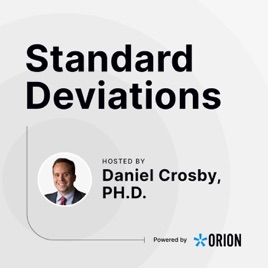
Standard Deviations with Dr. Daniel Crosby

Advertise on podcast: Standard Deviations with Dr. Daniel Crosby

Rating
★★★★★
4.8
from
163 reviews
This podcast has
331 episodes
Language
English
Explicit
No
Date created
2017/05/29
Latest episode
2026/10/01
Average duration
31 min.
Release period
7 days

Description

The Standard Deviations podcast is a weekly production that looks at money, mind and meaning, all through a psychological lens. Each week, psychologist and New York Times bestselling author Dr. Daniel Crosby interviews a fascinating new guest, experts in everything from finance to literature to wellness. Each guest provides listeners with three concrete ways to apply what was learned that week, ensuring that weekly listening becomes part of a path to a richer life. Episodes are brief, research-based, and designed to fit perfectly within your commute time. So, tune in for practical news that will help you make more, think more and be more. Learn more by following Dr. Daniel @danielcrosby or visit the website at www.standarddeviationspod.com/ Standard Deviations is presented by Orion.

Unlock Standard Deviations with Dr. Daniel Crosby podcast Email contact info,
Listeners & Audience details

Email contact information

Direct podcast contact details

Listeners

Audience numbers & engagement insights

Audience details

Podcast Insights

Podcast episodes

Check latest episodes from Standard Deviations with Dr. Daniel Crosby podcast


Ryan Eisenman - Making Private Markets More Accessible
2026/10/01
Tune in to hear: What did Ryan see about the way people were managing private investments that made him think his company Arch needed to exist? How does Ryan think the constant feedback and news around public markets affects investors and can the relative quiet of private markets give us a different experience from a behavioral perspective? What can the longer time horizon of private markets teach us about patience, conviction, how to invest and delayed gratification? For investors who rely exclusively on public markets, what sorts of exposure might they be missing from their portfolio? What role should private markets play in filling these potential gaps in exposure? What are Ryan’s thoughts around who should have access to private markets? What role can tech play in making private market investing more equitable? Does the Arch diligence tool ever tell investors to run far away from certain investments? Should the technique used to vet private companies differ in a meaningful way from the way investors and advisors vet public companies?  Do some of the constraints around investing in private companies (e.g. the project just beginning to break ground) lead to more optimal or suboptimal investor behavior?  What is Ryan’s prediction for the future of private markets? What is something that someone has done for Ryan, or something that he has experienced, that has fundamentally changed how he thinks about showing up for the people around him? Links Ryan Eisenman on LinkedIn Ryan Eisenman on Twitter Arch Connect with Us Meet Dr. Daniel Crosby Check Out All of Orion’s Podcasts Power Your Growth with Orion Disclosures: These show notes may contain links to third-party websites. Any links to such third-party websites are provided solely as a convenience to you and not as an endorsement by Orion of the content on such third-party websites, or any affiliation or association with its operators. Orion is not responsible for the content of linked third-party websites, including, without limitation, any link contained in a linked website, or any changes or updates to a linked website, and do not make any representations regarding the information, services, products or accuracy of any material contained on such third-party websites. Compliance Code: 2522-U-26243
John Crawford IV - The Case for Value and Dividend Investing: Building Wealth, Income and Resilience
2026/09/24
Tune in to hear: What is one thing that the investment community has made more complicated than it needs to be, in John’s opinion? How does an oldschool, value and dividend focused shop like John’s get folks interested in this style of investing that is so well supported but seems to almost be forgotten in the present day? Has John found that when clients have an income element to their portfolio, they are more settled and more able to stay the course? How does Crawford Investment Counsel think about risk reduction in a portfolio, both behaviorally and otherwise? Does John look at things like beta, or is he looking exclusively at absolutely fundamental things in terms of the quality of the company? Where in a company’s lifecycles does Crawford Investment Counsel look and why do they believe this is a source of potential alpha? How does Crawford Investment Counsel ensure that they never stray from their first principles in difficult times? What in particular has John done to raise gentle, kind and grateful children in a world where children of means can sometimes act entitled? If John was approached by a 30 year old investor today, and they were asking for one piece of personal financial advice, what would he tell them? Links Crawford Investment Counsel Connect with Us Meet Dr. Daniel Crosby Check Out All of Orion’s Podcasts Power Your Growth with Orion Disclosures: These show notes may contain links to third-party websites. Any links to such third-party websites are provided solely as a convenience to you and not as an endorsement by Orion of the content on such third-party websites, or any affiliation or association with its operators. Orion is not responsible for the content of linked third-party websites, including, without limitation, any link contained in a linked website, or any changes or updates to a linked website, and do not make any representations regarding the information, services, products or accuracy of any material contained on such third-party websites. Compliance Code: 2521-U-26243
Matt Halloran - Shut Up and Listen
2026/09/17
Tune in to hear: If Matt could take one lesson from his former life as a therapist and impart it to all the advisors that he serves, what would that lesson be? What compelled Matt to write his new book, Shut the F Up and Listen, and why did he think this message was particularly important in this moment we are in? The impulse to listen in order to respond, or to listen in order to solve a problem, is a really human impulse. How can we move beyond this and begin listening just for the sake of listening? What does it look like when one enters a conversation with intent and how does that look different from more opportunistic forms of listening? How can advisors best read what’s not being said in the room, through body language or otherwise, while remaining sensitive?  How would Matt advise advisors to think about creating the optimal conditions for psychological safety in their offices? Is there ever a time that advisors should be more directive with their clients? Links Matt Halloran on LinkedIn Matt Halloran on Instagram Shut the F Up and Listen Connect with Us Meet Dr. Daniel Crosby Check Out All of Orion’s Podcasts Power Your Growth with Orion Disclosures: These show notes may contain links to third-party websites. Any links to such third-party websites are provided solely as a convenience to you and not as an endorsement by Orion of the content on such third-party websites, or any affiliation or association with its operators. Orion is not responsible for the content of linked third-party websites, including, without limitation, any link contained in a linked website, or any changes or updates to a linked website, and do not make any representations regarding the information, services, products or accuracy of any material contained on such third-party websites. Compliance Code: 2499-U-26243
Jay Mooreland - The Emotional Investor: Behavioral Finance, Investor Psychology & Making Better Decisions in Market Downturns
2026/09/10
Tune in to hear: Where’s the current interest and momentum in Behavioral Finance and where does Jay see it going next? Why are investors so bad at affective forecasting (i.e. imagining how they’ll actually behave during a major market downturn)? How can we get investors and advisors to “buy an umbrella when the sun is shining?” Why does taking action during market downturns feel so right and what practically can we do, as financial advisors, to try and keep people from taking action? Are there any ways that Jay thinks AI and technology may help us make better decisions going forward, or does he think it's all bad news? What does success look like, from a behavioral perspective, if we are never going to rid ourselves of emotion? Links Jay Mooreland on LinkedIn Behavioral Advisor Academy The Emotional Investor Book Connect with Us Meet Dr. Daniel Crosby Check Out All of Orion’s Podcasts Power Your Growth with Orion Disclosures: These show notes may contain links to third-party websites. Any links to such third-party websites are provided solely as a convenience to you and not as an endorsement by Orion of the content on such third-party websites, or any affiliation or association with its operators. Orion is not responsible for the content of linked third-party websites, including, without limitation, any link contained in a linked website, or any changes or updates to a linked website, and do not make any representations regarding the information, services, products or accuracy of any material contained on such third-party websites. Compliance Code: 2443-U-26233
Dr. Daniel Crosby - The Psychology of Wealth Transfer and Why Inheriting Wealth Changes More Than Just a Balance Sheet
2026/09/03
Tune in to hear: Why do we need to begin to think about wealth in more qualitative terms with the upcoming Great Wealth Transfer? How can we better prepare heirs to understand their newfound relationship with wealth? Why does successful, multi-generational wealth preservation depend on more than investment performance? According to studies, what factors are key for the preservation of wealth across generations? What are the four invisible inheritances that accompany the inheritance of wealth? What is behavioral capital, and why do we inherit this long before we inherit financial capital? What is relational capital, and why is this a form of invisible inheritance? What are some of the crucial psychological differences between earned wealth and received wealth? Links The Soul of Wealth Connect with Us Meet Dr. Daniel Crosby Check Out All of Orion’s Podcasts Power Your Growth with Orion Disclosures: These show notes may contain links to third-party websites. Any links to such third-party websites are provided solely as a convenience to you and not as an endorsement by Orion of the content on such third-party websites, or any affiliation or association with its operators. Orion is not responsible for the content of linked third-party websites, including, without limitation, any link contained in a linked website, or any changes or updates to a linked website, and do not make any representations regarding the information, services, products or accuracy of any material contained on such third-party websites. Compliance Code: 2442-U-26233
Alex Edmans - The Madness of Markets
2026/08/27
Tune in to hear: If markets are as mad as Alex and Dr. Crosby suggest, why do we still see that most active managers have such a difficult time trying to beat markets? When Alex tells stories about how sporting events or the weather might move the market, is there any signal there for the average investor or is he simply making a broader point about how our emotions may color the way we think about markets? Alex subdivides our behaviorally biased reactions to markets into overreaction, underreaction and misreaction. What do each of these look like practically for investors? Is wokeness the reason the market keeps ignoring evidence for important behavioral data, like employee satisfaction? What is Alex’s take on AI and where does he think we are on the spectrum between true revolution and mania? Is there a behavior that looks like discipline, but is really just bias wearing a better suit? If someone was to use Alex’s upcoming book as a mirror into their own behavior, what is one practical thing that they could do to better understand themselves and do a self-audit? Links The Madness of Markets (Pre-order) Alex Edmans on LinkedIn Alex Edman’s Website Connect with Us Meet Dr. Daniel Crosby Check Out All of Orion’s Podcasts Power Your Growth with Orion Disclosures: These show notes may contain links to third-party websites. Any links to such third-party websites are provided solely as a convenience to you and not as an endorsement by Orion of the content on such third-party websites, or any affiliation or association with its operators. Orion is not responsible for the content of linked third-party websites, including, without limitation, any link contained in a linked website, or any changes or updates to a linked website, and do not make any representations regarding the information, services, products or accuracy of any material contained on such third-party websites. Compliance Code: 2336-U-26223
Adam Cockerham - Your Money and Your Mind
2026/08/20
Tune in to hear: Does Adam believe that most people have a money problem, or a meaning problem that money simply reveals? What are some signs that someone is trying to solve a meaning problem with money and what would Adam counsel them to do instead if they saw this in themselves? How does Adam define financial freedom in a more nuanced way than the layman’s concept of financial freedom? What is some evidence that money has moved from a servant role to a master role in someone’s life, and what would Adam have them do to right that ship? Where does the scarcity mindset come from for wealthy individuals, and what does Adam think should be done about it? How does Adam counsel people to make positive social comparisons when it is so easy to feel bad about ourselves in the era of social media? For people looking to loosen attachment, what are the practical means by which they can bring that about? How can contemplating our own mortality make us better investors and better stewards of our wealth? Links Adam Cockerham on LinkedIn Your Money and Your Mind Adam’s Website Connect with Us Meet Dr. Daniel Crosby Check Out All of Orion’s Podcasts Power Your Growth with Orion Disclosures: These show notes may contain links to third-party websites. Any links to such third-party websites are provided solely as a convenience to you and not as an endorsement by Orion of the content on such third-party websites, or any affiliation or association with its operators. Orion is not responsible for the content of linked third-party websites, including, without limitation, any link contained in a linked website, or any changes or updates to a linked website, and do not make any representations regarding the information, services, products or accuracy of any material contained on such third-party websites. Compliance Code: 2335-U-26223
Kendra Wright - The Marketing Mistakes Holding Financial Advisors Back (And How to Fix Them)
2026/08/13
Tune in to hear: What is the biggest lie advisors tell themselves about why their growth may be stagnating or slower than they might like? What would Kendra say to advisors who are casting a really wide net about why they should drill down and create a more bespoke marketing funnel? When Kendra is looking at an advisor’s social media channels, what are some signs that their approach is effective and what are some signs that they may be missing the mark? Why is effective marketing just as much about repelling the clients you don’t want as it is about attracting the clients you do want? Why is it so scary to deviate from the herd and why do otherwise smart people tend to gravitate towards what seems safe and commonplace? Are there some groups that are routinely overlooked and underserved by advisors? Does Kendra hear pieces of conventional wisdom, around marketing, passed around the advisory community that make her cringe? What’s the difference between social marketing that might appeal to vanity metrics, like follows, versus the kind that’s driving real revenue? What’s the relationship and what’s the tension between strategy and tactics? In their marketing efforts, how can advisors appeal to this behavior layer of making people feel safe and let them get to know them? For advisors just getting started, what’s the first step for them to build a successful firm and a successful life? Links Kendra Wright on LinkedIn Rebel Media Agency Kendra Wright on Twitter Connect with Us Meet Dr. Daniel Crosby Check Out All of Orion’s Podcasts Power Your Growth with Orion Disclosures: These show notes may contain links to third-party websites. Any links to such third-party websites are provided solely as a convenience to you and not as an endorsement by Orion of the content on such third-party websites, or any affiliation or association with its operators. Orion is not responsible for the content of linked third-party websites, including, without limitation, any link contained in a linked website, or any changes or updates to a linked website, and do not make any representations regarding the information, services, products or accuracy of any material contained on such third-party websites. Compliance Code: 2268-U-26215
Christopher Norton - Financial Advisor Marketing: How to Build an Authentic Brand That Attracts the Right Clients
2026/08/06
Tune in to hear: What does the financial services industry get wrong about the role marketing and sales should play in an organization? How does Potomac approach marketing differently than other firms? If Christopher had to distill his marketing ethos down to 2-3 principles, what would those be? Why does Christopher believe that it is just as important to repel people as it is to attract them with your brand? Why is this brand authenticity so important? How can you turn your personal passions into a compelling story and draw for your brand? What is the real reason so many advisors shy away from content creation? The ostensible answer is that they are too busy, but is there often a deeper reason? How would Christopher encourage brands to be authentic, but to do so in a way that appears natural and not too overt or forced? If an advisor has very little brand recognition and wants to change this, what are one or two things that they can do and one or two things that they should ignore while trying to grow their brand? Links Christopher Norton on LinkedIn Potomac Connect with Us Meet Dr. Daniel Crosby Check Out All of Orion’s Podcasts Power Your Growth with Orion Disclosures: These show notes may contain links to third-party websites. Any links to such third-party websites are provided solely as a convenience to you and not as an endorsement by Orion of the content on such third-party websites, or any affiliation or association with its operators. Orion is not responsible for the content of linked third-party websites, including, without limitation, any link contained in a linked website, or any changes or updates to a linked website, and do not make any representations regarding the information, services, products or accuracy of any material contained on such third-party websites. Compliance Code: 2085-U-26196
Dr. Christine Whelan - Dr. Christine Whelan - Finding Your Purpose: What Actually Leads to a Meaningful Life?
2026/07/30
Tune in to hear: Why does Dr. Whelan think that purpose is something we build rather than something we discover? Also why, as a culture, do we view purpose more like an epiphany rather than something we actively construct? How are happiness and purpose distinguished and how should we optimize for one or the other? How did Plato’s philosophy separate the two and did he believe they were mutually exclusive on some level? Does Dr. Whelan think that we, as a society, over optimize for short-term, hedonic happiness and don’t focus enough on long-term eudemonic flourishing? How can we better recognize the purposeful things we are already doing in our lives? Why is taking a moment to acknowledge this so powerful? How do we keep this from becoming just another item on an already too full to-do list, another weight on our backs or another form of perfectionism? On the one hand, we know that service and living for others can bolster our purpose, but we also know this can be overextended at the expense of ourselves. How does Dr. Whelan propose that we better balance these two facets of purpose? When our values seem to be at odds with each other, how should we ascertain which values we should be prioritizing? Is there anything about happiness and living with purpose that Dr. Whelan has had a 180 on since dedicating herself so deeply to this research? Links Dr. Whelan’s Website Finding Your Purpose Dr. Christine Whelan on LinkedIn Dr. Christine Whelan on Instagram Connect with Us Meet Dr. Daniel Crosby Check Out All of Orion’s Podcasts Power Your Growth with Orion Disclosures: These show notes may contain links to third-party websites. Any links to such third-party websites are provided solely as a convenience to you and not as an endorsement by Orion of the content on such third-party websites, or any affiliation or association with its operators. Orion is not responsible for the content of linked third-party websites, including, without limitation, any link contained in a linked website, or any changes or updates to a linked website, and do not make any representations regarding the information, services, products or accuracy of any material contained on such third-party websites. Compliance Code: 2081-U-26196
Jamie Bosse - Investing for Tweens
2026/07/23
Tune in to hear: Why do tweens seem to fall between the cracks, in terms of products, advice and services aimed at them, and why did Jamie focus on this niche demographic for her new book? From a developmental perspective, what should parents and caregivers understand about how 10-14 year olds think, learn and make decisions? When thinking about jobs for teenagers, how should parents think about jobs that build work ethic and resilience versus higher paying jobs that might more effectively prepare them for the future? When you’re teaching your tweens about saving, investing and working, how should you incorporate education around gratitude and avoiding entitlement? Tweens are growing up with digital payments, investing apps, crypto, TikTok influencers etc - how does this change the parents’ responsibility and the way they should teach about financial literacy? How can we, as parents, examine our own money scripts before we start teaching the next generation? What mistakes does Jamie see parents making, when it comes to teaching tweens about money, and what would she have them do differently? If there’s one positive thing that every parent listening to this could implement to help their tween build a healthy relationship with money, what should that be? Links Jamie's Website Jamie Bosse on LinkedIn Money Boss Mom (Book) Investing For Tweens (Book) Connect with Us Meet Dr. Daniel Crosby Check Out All of Orion’s Podcasts Power Your Growth with Orion Disclosures: These show notes may contain links to third-party websites. Any links to such third-party websites are provided solely as a convenience to you and not as an endorsement by Orion of the content on such third-party websites, or any affiliation or association with its operators. Orion is not responsible for the content of linked third-party websites, including, without limitation, any link contained in a linked website, or any changes or updates to a linked website, and do not make any representations regarding the information, services, products or accuracy of any material contained on such third-party websites. Compliance Code: 2007-U-26188
Cullen Roche - Your Perfect Portfolio: Stop Chasing Returns and Start Building Better Portfolios
2026/07/16
Tune in to hear: Why does Cullen argue in his new book that there is no perfect portfolio and argues that we should be worrying more about process? How do we begin to move our clientele from this search for a silver bullet to start thinking about their portfolios in a more systematic, bespoke way? Why does Cullen believe that advisors should match assets to future liabilities rather than just chasing returns? From a behavioral perspective, why is this shift hard for investors to internalize at times? Do most “diversified portfolios” fail Cullen’s test of diversification? If a listener adopted Cullen’s investing framework, what would they likely do differently during a period of market stress compared to an average investor? Links Cullen Roche on Twitter Cullen Roche on LinkedIn Your Perfect Portfolio Discipline Funds Connect with Us Meet Dr. Daniel Crosby Check Out All of Orion’s Podcasts Power Your Growth with Orion Disclosures: These show notes may contain links to third-party websites. Any links to such third-party websites are provided solely as a convenience to you and not as an endorsement by Orion of the content on such third-party websites, or any affiliation or association with its operators. Orion is not responsible for the content of linked third-party websites, including, without limitation, any link contained in a linked website, or any changes or updates to a linked website, and do not make any representations regarding the information, services, products or accuracy of any material contained on such third-party websites. Compliance Code: 2000-U-26188
Derrick Kinney - Money Mindset, Building Wealth & The Good Money Revolution
2026/07/09
Tune in to hear: Why did Derrick Kinney leave behind his career as a financial advisor to become an author and public speaker? What does Derrick think money reveals about people that we may be slow to admit? How does Derrick suggest people get started with philanthropy if they’ve been hesitant for whatever reason? As people try to reorient their relationship with money, what are some rain clouds or obstacles they might run into and how can they better prepare for these? What is a belief about money that’s ostensibly responsible but that might lead us away from self-actualization and generosity? Links Derrick Kinney Derrick Kinney on LinkedIn Good Money Revolution Connect with Us Meet Dr. Daniel Crosby Check Out All of Orion’s Podcasts Power Your Growth with Orion Disclosures: These show notes may contain links to third-party websites. Any links to such third-party websites are provided solely as a convenience to you and not as an endorsement by Orion of the content on such third-party websites, or any affiliation or association with its operators. Orion is not responsible for the content of linked third-party websites, including, without limitation, any link contained in a linked website, or any changes or updates to a linked website, and do not make any representations regarding the information, services, products or accuracy of any material contained on such third-party websites. Compliance Code: 1952-U-26181
Neil Bage - This is Your Brain on Money
2026/07/02
Tune in to hear: What gives money such immense emotional power over us? Does Neil think that some of the problems people have with money come from them trying to treat it as this utilitarian thing rather than tapping into the deeper subtext of it? What does Neil think is the biggest mismatch between the brain we’ve inherited from our ancestral predecessors and the world we find ourselves navigating in the present day? What are one or two high-level tips for helping our old brains thrive in this new world? Why does Neil describe the brain as a prediction machine rather than a thinking machine? What are the implications of this on peoples’ financial decision making? What role does Neil think emotion should play in financial decision making? Should we ignore or embrace emotion? It also seems true that letting emotion lead our financial decision making too much is a mistake, so how do we strike a balance between emotion and rationality? Why does the human brain do such a poor job of relating to its future self? If Neil could correct one misunderstanding that financial advisors have about human behavior, what would it be? Links Neil Bage Substack LinkedIn Connect with Us Meet Dr. Daniel Crosby Check Out All of Orion’s Podcasts Power Your Growth with Orion Disclosures: These show notes may contain links to third-party websites. Any links to such third-party websites are provided solely as a convenience to you and not as an endorsement by Orion of the content on such third-party websites, or any affiliation or association with its operators. Orion is not responsible for the content of linked third-party websites, including, without limitation, any link contained in a linked website, or any changes or updates to a linked website, and do not make any representations regarding the information, services, products or accuracy of any material contained on such third-party websites. Compliance Code: 1954-U-26181
Ben Carlson - Risk and Reward
2026/06/25
Tune in to hear: How can we make the lessons of market history feel salient to present day investors? Is the South Sea Bubble Ben’s favorite historical anecdote around investing and money? What is the “now show Japan” mindset and how does it steer people awry? Both from the advisor perspective, and also the end-investor perspective, how do we get people to realize the value of doing nothing and passive investing? When Ben says there are two types of Bear Markets, what does he mean and how do they differ? What is Ben’s analogy about winning points versus winning matches between tennis and financial markets? Ben lays out the 20 things he believes about investing in the Epilogue of his new book. What is the 1 of these 20 things that he thinks is most important for investors and advisors to understand? Links A Wealth of Common Sense Ben Carlson on Twitter Ben Carlson on LinkedIn Animal Spirits Podcast Connect with Us Meet Dr. Daniel Crosby Check Out All of Orion’s Podcasts Power Your Growth with Orion Disclosures: These show notes may contain links to third-party websites. Any links to such third-party websites are provided solely as a convenience to you and not as an endorsement by Orion of the content on such third-party websites, or any affiliation or association with its operators. Orion is not responsible for the content of linked third-party websites, including, without limitation, any link contained in a linked website, or any changes or updates to a linked website, and do not make any representations regarding the information, services, products or accuracy of any material contained on such third-party websites. Compliance Code: 1730-U-26156

Podcast reviews

Read Standard Deviations with Dr. Daniel Crosby podcast reviews


4.8 out of 5
163 reviews
★★★★★
COapptation 2025/12/07
Weekly pearls of wisdom.
Very insightful. Daniel Crosby combines meaning, wellness, purpose, and finance to provide a comprehensive perspective on happiness, wholeness, and ...
★☆☆☆☆
julio.caesar 2025/05/02
Used to be great
This podcast used to offer insightful content, but it has taken a disappointing turn. Recent episodes feel unfocused and meandering, lacking the clar...
★★★★★
Loren Sherman 2023/09/20
Fascinating conversations
Daniel brings a unique expertise to the area of investment and behavioral psychology, sharing ideas in an easy to understand way for the everyday list...
★★★★★
conman12 2022/07/06
Great podcast for behavioral finance
There are lots of experts in the world. However, there are fewer who are really interesting to listen to. And then there are even fewer who are clever...
★★★★★
4frodo 2022/05/19
Insightful & Entertaining
This is an absolute favorite!
★★★★★
Kristin.Shea 2021/11/29
Love this podcast
Such practical and INTERESTING information. Dan is the best!
★★★★★
Heather Bo 2021/10/01
Fascinating Content!
An always informative yet entertaining mix of timely topics and knowlegdeable guests!
★★★★★
ASobering 2021/07/13
Such a wealth of knowledge! 🧠
This is one of the most insightful podcasts that I have ever come across! Daniel does such a great job of sharing his wisdom and I love how he leads m...
★★★★★
Holly Waxwing 2021/03/30
Favorite financial podcast
Dr. Daniel Crosby brings behavioral psychology insights on investing, the economy at large and retirement. Highly recommend for beginning investors or...
★★★★★
BeF(i)anatic 2021/03/30
Favorite BeFi podcast!
The Standard Deviations Podcast is my go to for behavioral finance insights. There’s such a great breadth of guests and something for everyone here.
check all reviews on apple podcasts

Podcast sponsorship advertising

Start advertising on Standard Deviations with Dr. Daniel Crosby relevant audience podcasts


What do you want to promote?