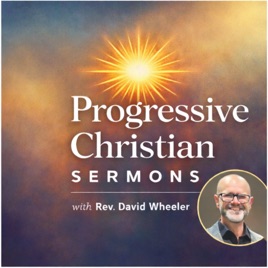
Advertise on podcast: Progressive Christian Sermons with Rev. David Wheeler
Rating
5from
This podcast has
299 episodes
Language
EnglishPublisher
Rev. David WheelerExplicit
No
Date created
2017/09/29
Latest episode
2026/10/01
Average duration
23 min.
Release period
8 days
Description
Expansive faith rooted in compassion, justice, and thoughtful engagement with scripture. Questions welcome. Doubt allowed. New sermons every week. Preaching from New Covenant Christian Church (Disciples of Christ) in Oklahoma City, Oklahoma.
Unlock Progressive Christian Sermons with Rev. David Wheeler podcast Email contact info,
Listeners & Audience details
Email contact information
Direct podcast contact details

Listeners
Audience numbers & engagement insights

Audience details
Podcast Insights

Podcast episodes
Check latest episodes from Progressive Christian Sermons with Rev. David Wheeler podcast
When the Poor Pay the Price (Part 3 of 4) of our Faith Was Never Supposed to be Silent Series
2026/10/01
When the Poor Pay the Price (Sermon: September 27, 2026)
Faith Was Never Supposed to Be Silent (Part 3 of 4)
Scripture Readings: Amos 8:4-7 | Amos 2:6-8
We often hear the phrase "follow the money," but what happens when following the money leads us straight to the people bearing the unseen cost?
In Part 3 of our series, Faith Was Never Supposed to Be Silent, we dive into the fierce economic critique of the prophet Amos. Nearly 3,000 years ago in the Northern Kingdom of Israel, Amos confronted merchants and leaders who kept the Sabbath on the outside while impatiently checking their watches, eager for religious observances to end so they could open the markets, cheat with false scales, shrink measurements, and sell the poor for a pair of sandals. In Amos 2, the indictment cuts even deeper: religious people were taking outer garments from the impoverished as collateral and using them as comfortable floor cushions beside holy altars.
Through the story of a grocery store balance sheet—contrasting the manager balancing utility costs and shrinking product sizes with a working single mother forced to decide what food to put back—we examine how economic decisions that look reasonable on paper carry devastating human costs in real life. When we look at Amos from the other side of the counter, his prophetic anger is not merely judgment; it is good news that God never overlooks the vulnerable.
Join us as we explore:
The Sabbath and the Scale: How Amos exposes religious performance that coexists comfortably with economic exploitation and deliberate deceit.
The Cost Behind the Bottom Line: Contrasting boardrooms and budget spreadsheets with the daily reality of families choosing between groceries, utilities, and rent.
Garments Beside the Altar: Why scripture condemns turning another person's suffering and desperation into our own religious comfort.
Good News for the Overlooked: Recognizing that God sees, names, and defends the dignity of every worker, parent, and neighbor who feels invisible.
Charity AND Justice: Why the church must feed hungry neighbors today through direct service while simultaneously asking the harder systemic question: Why are so many people hungry in a land of abundance?
Faith cannot stop when worship ends on Sunday morning. Step beyond the spreadsheet, see our neighbors through the eyes of God, and join in the holy work of building a community where everyone has enough.
When a Nation Loses Its Moral Center | Faith Was Never Supposed to Be Silent, Part 2
2026/09/23
How do we know when something has become morally crooked—especially when we've grown so accustomed to it that it looks perfectly normal?
In Part Two of Faith Was Never Supposed to Be Silent, Rev. David Wheeler explores one of the prophet Amos’s most unforgettable images: God holding a plumb line against the life of a nation. What Amos reveals may surprise us. God isn’t measuring only private morality. God is measuring the kind of society religious people are helping to build.
Through Amos 7:7–9, 5:10–15, and 3:9–10, we explore what happens when injustice becomes ordinary, truth becomes inconvenient, and people lose the ability to recognize what is right. Along the way, we discover how deeply Jesus stands within the Hebrew prophetic tradition—and why Christian faith must help us think theologically about public life.
The most dangerous crookedness may be the crookedness we have learned to call normal.
But the plumb line is not only an image of judgment. It may also be an invitation to grace, transformation, and the courage to imagine a different kind of world.
Preached September 20, 2026, at New Covenant Christian Church (Disciples of Christ), Oklahoma City.
When Elected Leaders Use God
2026/09/15
When Elected Leaders Use God
Scripture Readings: Amos 7:10-17 | Amos 5:21-24
What happens when faith gets too close to political power, and sacred language is used to shield rulers from accountability?
In Part 1 of our four-part series, Faith Was Never Supposed to Be Silent, we examine the ancient confrontation between the prophet Amos and Amaziah, the royal priest of Bethel. When Amos spoke out against systemic corruption and the mistreatment of the poor, Amaziah tried to silence him, declaring the temple to be "the King’s sanctuary and a temple of the kingdom". Somewhere along the way, the house of God had been co-opted to serve the interests of the crown.
Throughout history, politicians and leaders of all stripes have reached for the Bible, not necessarily to submit to its moral vision, but to borrow its sacred authority. But as Amos boldly proclaimed in Amos 5, God rejects performative worship that remains comfortable with injustice: "Let justice roll down like waters, and righteousness like an ever-flowing stream."
Join us as we explore:
The "King’s Sanctuary" vs. God’s House: How religious institutions risk losing their soul when they trade prophetic truth-telling for political access and cultural influence.
Guidance vs. Endorsement: Discerning the critical difference between political leaders genuinely asking for God’s guidance and weaponizing God’s name to claim divine endorsement.
Prophetic Preaching vs. Partisan Preaching: Why a truly biblical faith refuses to become campaign property for any party, holding leaders on the left and the right accountable to the standard of justice and human dignity.
Righteousness as Public Justice: Moving past privatized piety to reclaim the Hebrew scriptures' definition of righteousness as relational equity, protecting the vulnerable, and ensuring people are treated with dignity.
A Faith That Cannot Be Captured: Learning how to participate passionately in public life and vote with our values without surrendering our conscience or confusing any nation with the Kingdom of God.
The church does not belong to any empire, administration, or political party—we belong to God. Let us keep our faith free, our worship honest, and our voices clear as we seek the common good of all our neighbors.
John Lennon's song "Imagine"
2026/09/08
Imagine (Sermon: September 6, 2026)
Scripture Reading: Isaiah 11:1-9
What is the difference between escapist fantasy and a truly holy imagination?
In the finale of our summer sermon series, Songs That Changed the World, we explore John Lennon and Yoko Ono’s iconic 1971 anthem "Imagine" alongside the ancient prophet Isaiah’s vision of the "Peaceable Kingdom" in Isaiah 11. Long viewed with suspicion by traditional religious institutions for daring to imagine "no religion" and "no heaven," Lennon's gentle melody wrapped a radical political challenge in three minutes of sweet simplicity—questioning how borders, wealth, and dogmas have historically been weaponized to divide the human family.
Rather than dismissing this critique, we place it in dialogue with the prophet Isaiah, who spoke into a terrifying world under the shadow of the brutal Assyrian Empire. Isaiah didn’t imagine a sterile world where difference is erased; he imagined an empire transformed—a green shoot sprouting from a dead stump, where the wolf dwells with the lamb, predators lay down their hunger to dominate, and equity is restored to the vulnerable.
Join us as we explore:
Fantasy vs. Holy Imagination: Why escapist fantasy ignores the pain of reality, while holy imagination looks directly at the world's wounds and begins the work of transformation.
Subtraction vs. Transformation: Comparing Lennon’s question of what must disappear with Isaiah’s deeper question of what must be redeemed and reordered around justice.
The Peaceable Kingdom in Context: Honoring the original Jewish context of Isaiah 11 as a bold critique of political corruption, predatory power, and systemic injustice.
When Religion Needs Pruning: Acknowledging why religion that blesses cruelty, nationalism, and greed deserves to be challenged so that genuine, loving faith can grow in its place.
"Practice Resurrection": Drawing from Wendell Berry and everyday faithfulness to remember that peace doesn’t arrive overnight from kings or congress—it sprouts shoot by shoot, table by table, and neighbor by neighbor.
We may not fix the entire world in a day, but we can refuse to let cynicism have the final word. Keep the vision alive, stand beside the vulnerable, and practice the holy work of resurrection right where you are.
Coat Of Many Colors
2026/09/01
We added Dolly Parton's Coat of Many Colors to our Songs That Changed the World series in honor of her passing.
Coat of Many Colors
Scripture Reading: James 2:1-7
Who gets to decide what—or who—is truly valuable?
In this week's sermon from our summer series, Songs That Changed the World, we explore Dolly Parton’s deeply personal autobiographical classic, "Coat of Many Colors," alongside the piercing words of James 2 on the sin of favoritism. Stitched together from discarded rags by her mother in the mountains of East Tennessee, Dolly’s coat was mocked by schoolmates who only saw scraps and poverty. But where others saw deficiency, Dolly saw time, care, devotion, and love.
Centuries earlier, James challenged the early church with an uncomfortable reality check: what happens when someone in fine clothes and gold rings walks into your gathering, followed by someone in worn, dirty clothes? When we reserve our best seats for the influential while pushing the vulnerable to the margins, James warns that we have imported the world's broken hierarchies right into the sanctuary of God.
The Gospel consistently turns worldly price tags upside down. True faith does not measure human worth by wealth, appearance, or status—it looks through the eyes of love.
Join us as we discuss:
The Story Behind the Song: How Dolly Parton's childhood coat of scraps became a masterclass in seeing dignity where the world only sees poverty.
Price vs. Value: How culture constantly assigns monetary value to human lives, and why Jesus consistently upends those measuring sticks.
The Warning of James 2: Confronting the persistent temptation to practice partiality and flatter the powerful while sidelining those in need.
Giving a Better Story: Why one of the holiest ministries of a healthy church is telling people the truth about who they are—beloved, worthy, and never defined by their worst day or their bank balance.
Dignity at the Table: Recognizing that shared tables, food pantries, and mutual care are never just about calories—they are tangible declarations that no one is disposable.
You are far more than the patchwork of your past or the labels the world has handed you. Come as you are, take your place at the table, and discover a community where everyone belongs.
All You Need is Love
2026/08/25
All You Need Is Love
Scripture Readings: 1 John 4:7-9, 13-15, 18-21
Is "all you need is love" just a naive slogan on a bumper sticker, or is it the most radical, demanding criterion of the Gospel?
In Part 9 of our summer sermon series, Songs That Changed the World, we explore The Beatles' legendary 1967 anthem "All You Need Is Love" alongside the profound theological claims of 1 John 4. Broadcast to over 400 million viewers on the historic Our World satellite program during the height of the Vietnam War and deep global division, The Beatles didn't offer relationship advice—they offered a bold, countercultural message to a world at war.
Centuries earlier, writing to a Christian community fractured by internal arguments over who possessed the "real truth," the author of 1 John stripped away the theological jargon to establish the ultimate measuring stick of faith: "God is love, and those who abide in love abide in God."
Love is not sentimental softness or polite passivity; love is the home base from which we live, the standard by which all theology must be judged, and the tangible way God is made visible in a hurting world.
Join us as we explore:
Love as the Ultimate Test of Faith: Why correct doctrine, biblical knowledge, and theological debates mean nothing if they do not produce deeper, tangible love.
The Theological Litmus Test: Why an understanding of God that demands cruelty, exclusion, or dehumanization requires examining our theology, not abandoning our love.
Justice as Love in Public: Embracing Cornel West's reminder that justice is what love looks like in public—feeding the hungry, protecting vulnerable neighbors, and tearing down systems of harm.
Perfect Love Casting Out Fear: Understanding teleios (maturing love) not as flawless performance, but as a growing grace that refuses to let fear run the house or dictate how we treat our neighbors.
Living as "PR for God": Recognizing that whether we intend to or not, our everyday actions show the world what God is like—and committing to making that picture one of an ever-widening table.
We love because God first loved us. Step out of fear, make love your home base, and let your faith be known by the way you love your neighbor.
Happy
2026/08/18
Happy
Scripture Reading: Philippians 4:4-9
Can joy be commanded, or is there something deeper going on when scripture tells us to "rejoice always"?
In Part 8 of our summer sermon series, Songs That Changed the World, we explore Pharrell Williams’ universally infectious 2013 hit "Happy" alongside the Apostle Paul’s famous letter to the Philippians. While "Happy" radiates an undeniable, foot-tapping celebration of life, Pharrell actually wrote nine rejected songs before arriving at that melody out of creative exhaustion.
Centuries earlier, Paul wrote his famous instruction—"Rejoice in the Lord always; again I will say, Rejoice"—not from a sunny resort, but from behind prison bars under deep uncertainty. Paul was not offering a shallow slogan or demanding that hurting people paste on a fake smile. Instead, he was pointing to a profound distinction: happiness is a fleeting emotion, but joy is a resilient spiritual discipline and an act of resistance.
Join us as we explore:
Happiness vs. Joy: Why true joy does not require sadness to leave the room before it can enter, and how grief and laughter often sit at the very same table.
Training Our Attention (Philippians 4:8): In an economy built on capturing our attention through fear, outrage, and despair, what are we intentionally training our eyes and hearts to notice?
Joy as an Act of Resistance: How refusing cynicism and holding onto love declares to oppressive powers that they do not get to own all of us.
"We Put the Doors Back Up": Responding to the recent vandalism of our church lawn's rainbow welcome doors by cleaning, repainting, and setting them right back in place—because vandalism does not get to decide how wide God's welcome is.
A Shared Song: Remembering that joy was never meant to be a solo project; when your own heart is empty, the community is here to hold and carry joy for you until you can sing again.
If you are grieving, tired, or angry today, you don't have to manufacture happiness on command. Rest where you are, look for what is good and true, and let this community surround you with a joy strong enough to hold us all.
"Don't Stop Believin'", Songs That Changed the World Part 7 of 10
2026/08/11
Don't Stop Believin'
Scripture Reading: Romans 5:1-5
What happens when life gets heavy, certainty fades, and "just believing" feels difficult or overwhelming?
In Part 7 of our summer sermon series, Songs That Changed the World, we bring Journey’s classic 1981 rock anthem "Don't Stop Believin'" into conversation with Paul's deep reflections on grace, suffering, and hope in Romans 5:1-5. Journey’s anthem is famously written for "unfinished people living unfinished lives"—and it uniquely delays its famous title chorus until the very end of the song, mirroring how resolution, clarity, and healing so often come late in our real lives.
Drawing on the insights of New Testament scholar Marcus Borg, we explore how Christian faith is far richer than merely giving intellectual assent to a list of statements. True faith is about trust, loyalty, a new vision of reality, and giving our hearts to what we hold dear—or "be-loving". Losing certainty isn't the same as losing faith; often, it is simply losing arrogance and gaining deeper compassion.
Join us as we discuss:
The "Late Chorus" of Life: Why a delayed resolution isn't no resolution, and how Journey's song structure reminds us that hope travels through a long night before the chorus arrives.
Redefining "Belief": Exploring Marcus Borg's four Latin dimensions of faith—assensus (intellectual assent), fiducia (trust), fidelitas (fidelity), and visio (a way of seeing).
Faith as "Be-Loving": How the word believe connects to holding dear and giving our hearts to love, grace, and justice when certainty is unavailable.
Romans 5 & Tested Hope: Understanding Paul’s sequence of suffering producing endurance, character, and a hope that does not put us to shame because God's love is poured into our hearts.
When You Can't Sing the Chorus: How community holds hope for us when we are too exhausted to sing it ourselves.
When believing becomes hard, keep "be-loving" your neighbors, your children, and this wounded world. Let community carry you when your voice is weary, and trust that God's love is already poured out for you.
"Hallelujah" Sixth in our 10 part series-Songs That Changed the World
2026/08/04
Hallelujah
Scripture Reading: 2 Corinthians 12:7-10
What happens when our prayers don't lead to a neat, triumphant ending, but the thorn remains?
In this sermon, we explore Leonard Cohen's iconic song "Hallelujah" alongside the Apostle Paul’s famous passage on his "thorn in the flesh" in 2 Corinthians 12. Written over several grueling years and initially rejected by his record label as "unmarketable," Cohen’s song didn't become a global anthem through immediate success, but through a long journey of coming "undone".
Centuries earlier, Paul pleaded with God three times to remove a persistent, painful thorn. But rather than receiving an immediate cure, Paul heard a different word of promise: "My grace is sufficient for you, for power is made perfect in weakness."
In a world that equates power with domination, noise, and winning, the Gospel offers a radically different truth: grace does not promise to erase every struggle, but promises that no struggle can separate us from the love holding us together.
Join us as we discuss:
The Story Behind "Hallelujah": How Leonard Cohen’s masterwork—initially deemed unmarketable—captures the honest, complicated mix of faith, doubt, love, and grief in actual human life.
Paul's Unnamed Thorn: Why leaving the thorn unnamed in 2 Corinthians allows anyone carrying chronic pain, unanswered questions, or unbroken grief to find themselves in the story.
Grace in What Is Unfixed: Dismantling the harmful idea that unanswered prayers mean inadequate faith, and discovering a God who meets us right inside our unfinished, messy places.
Redefining Power and Strength: Contrasting the world's obsession with domination and retaliation against the Christ-like power made mature in vulnerability, service, and solidarity.
The Holy vs. The Broken Hallelujah: Why a "broken Hallelujah" is not an inferior praise, but often the holiest praise of all—a language of survival, endurance, and grace.
You don't need a polished, perfect story to offer praise. Whether your Hallelujah is a song of celebration or a quiet whisper of survival, grace is present, active, and holding you right here, right now.
A Change is Gonna Come
2026/07/28
A Change Is Gonna Come
Scripture Reading: Exodus 3:7-12
When the struggle for justice feels long and wearing, how do we hold onto hope without burning out?
In Part 5 of our summer sermon series, Songs That Changed the World, we explore Sam Cooke's timeless 1963 civil rights anthem, "A Change Is Gonna Come," alongside the calling of Moses at the burning bush in Exodus 3. Born out of painful personal experiences with segregation and humiliation in Louisiana, Cooke’s song didn't offer cheap optimism or easy answers; instead, it voiced a weary, bone-tired, yet stubborn hope from deep inside the struggle.
Centuries earlier, as the Israelites groaned under Pharaoh’s oppressive labor systems, God responded with three transformative verbs: "I have observed the misery of my people... I have heard their cry... I know their suffering." But God's deliverance didn't drop untouched from the sky—God turned to a reluctant, fugitive shepherd named Moses and said, "So come, I will send you to Pharaoh to bring my people out of Egypt."
When faced with massive systemic injustice, it is easy to feel overwhelmed, exhausted, and tempted to ask, "Who am I to make a difference?" But the Gospel reminds us that rest is not surrender, and we are never called to carry the weight of the world alone.
Join us as we discuss:
Hope from Inside the Struggle: Why Sam Cooke’s anthem continues to resonate, offering holy, persistent hope rather than artificial cheerfulness.
God’s Response to Suffering: Exploring the power of a God who sees, hears, and knows human pain, refusing to remain neutral or detached.
Understanding "Pharaoh" as a System: Recognizing how oppressive systems rely on wearing good people down into exhaustion, apathy, and powerlessness.
Rest Is Not Surrender: Giving ourselves permission to breathe, rest, and let others carry us when our strength runs low, knowing that God is not finished with our courage.
From "Who Am I?" to "I Will Be With You": Overcoming our feelings of inadequacy by trusting in God's presence and taking the next faithful, loving step right where we are.
You don't have to fix the whole world by yourself, but by God’s grace, you can take your rightful place in it. Rest when you must, lean on community, and step forward into the change God is bringing through us.
What's Going On
2026/07/21
What's Going On
Scripture Readings: Habakkuk 1:1-4; 2:1-4
When the world around us feels heavy with suffering, conflict, and injustice, how do we keep from shutting down?
In Part 4 of our summer sermon series, Songs That Changed the World, we bring Marvin Gaye’s iconic 1971 song "What's Going On" into conversation with the ancient prophet Habakkuk. Written during a season of deep national upheaval, war, and social unrest, Gaye’s song didn't begin with easy answers—it began with an honest, aching lament. Centuries earlier, Habakkuk cried out with that exact same question: "O Lord, how long shall I cry for help, and you will not listen?"
When headlines feel overwhelming, the temptation for compassionate people isn't always indifference; it is distance—retreating into powerlessness because we cannot fix everything ourselves. But both Habakkuk and the Gospel call us to a different posture: to stand at our watchpost, refuse to look away, and meet the world with stubborn, active love.
Join us as we discuss:
The Faithfulness of Lament: Why bringing our honest grief and hard questions to God is an act of deep trust, not a lack of faith.
Overcoming the Trap of Distance: How feeling small in the face of massive global and local suffering can tempt us into silence, and why small acts of courage still matter.
Restoring Human Connection: How Marvin Gaye’s lyrics ("Mother, mother... Brother, brother...") echo Jesus’s call to view every neighbor as family rather than a statistic or a threat.
Love as Disciplined Action: Why "only love can conquer hate" isn't passive sentimentality, but active advocacy, mutual care, shelter, and accountability.
Doing the Next Loving Thing: What it means to live by faithfulness—taking our rightful place, keeping watch, and doing the work of love right where we are.
We cannot carry the whole world, but by God’s grace, we are not helpless. Step out of isolation, draw near to your neighbors, and do the next loving thing that is yours to do.
"The Sound of Silence" Songs That Changed the World (Part 3 of 10)
2026/07/13
Guest Speaker: Rev. Anna Holloway
"The Sound of Silence"
Scripture Readings: Lamentations 2:14-19 | Deuteronomy 24:10-22
What happens when our cultural conversations and religious systems fall silent in the face of human suffering and systemic harm?
In this Sunday’s sermon, we confront the uncomfortable reality that silence in the face of injustice is never neutral—it is complicit. We bring together two powerful, contrasting texts: the agonizing grief of Lamentations and the radical, structural protections outlined in Deuteronomy. Lamentations offers a scathing critique of leaders and "false prophets" who chose the safety of comfortable silence, offering empty illusions rather than exposing the systemic iniquities affecting the community. Meanwhile, Deuteronomy brings our faith completely down to earth, demanding strict, daily economic protections for the hired servant, the resident alien, the orphan, and the widow.
When the world encourages us to look away or remain quiet to preserve our own comfort, the Gospel calls us to break the sound of silence, expose structural inequality, and ensure that our faith is measured by how we protect the dignity of the vulnerable.
Join us as we discuss:
The Danger of Complicit Silence: Exploring how Lamentations critiques religious and cultural systems that choose polite, deceptive peace over the uncomfortable work of exposing systemic injustice.
Economic Justice and Human Dignity: Diving into Deuteronomy's highly practical protections for the marginalized, from ensuring prompt, daily wages for hired servants to preserving the basic dignity of the poor.
Crying Out for the Streets: Reclaiming the urgent call to pour out our hearts like water and lift our hands on behalf of those experiencing hunger, neglect, and systemic abandonment at the head of every street.
Rolling Up Our Sleeves to Break the Silence: How practicing mutual care, advocating for local economic equity, and standing up for the marginalized are the real-world ways we turn our prayers into active, tangible justice.
God does not call us to a passive, quiet faith that ignores the structural struggles of our neighbors. Step out of comfortable complacency, lift your voice for systemic fairness, and rest in the love of a God who hears the cries of the oppressed and calls us to move into action.
"Bridge Over Troubled Water" Songs That Changed the World (Part 2 of 10)
2026/07/07
Bridge Over Troubled Water (Sermon: July 5, 2026)
Scripture Reading: Mark 2:1-12
What does it look like to be a bridge for someone when the waters of life get too deep, too rough, or completely impassable?
In this Sunday’s sermon, we dive into the powerful story of the paralyzed man in Capernaum. Confronted by a crowd so thick that access to healing seemed entirely blocked, his four friends refused to let a barrier turn into a dead end. Instead, they carried him, climbed a roof, tore it open, and lowered him right into the presence of Jesus. Mark notes a profound detail in the text: Jesus healed the man when He saw their faith.
Life frequently confronts us with obstacles that we simply cannot navigate alone. In those moments, the Gospel reminds us that we are called to be a "bridge over troubled water" for one another—breaking through barriers, dismantling obstacles, and carrying each other toward wholeness.
Join us as we discuss:
The Power of Collective Faith: How the faith of a community can carry, hold, and lift us up when our own strength and faith completely run dry.
Dismantling the Barriers: Looking at the radical lengths the four friends went to break through physical and social structures to ensure their neighbor wasn't left on the outside.
More Than a Physical Healing: Exploring why Jesus speaks a word of forgiveness first, addressing deep, internal fragmentation before telling the man to pick up his mat and walk.
Rolling Up Our Sleeves as a Bridge: How practicing mutual care, working for local structural equity, and tearing down systemic roofs in our neighborhoods are the real-world ways we carry one another today.
You were never meant to carry the heavy burdens of life entirely on your own, and you are surrounded by a community called to hold the ropes for you. Step out of isolation, trust the hands that are ready to help carry your mat, and rest in the healing love of a Savior who sees us and calls us whole.
"Born This Way" Songs that Changed The World (Part 1 of 10)
2026/06/30
Born This Way (Sermon: June 28, 2026)
Scripture Reading: Genesis 1:26-31
What does it mean to look in the mirror and truly believe that what you see is "very good"?
As we conclude Pride Month, we return to the very beginning of the sacred text—not to look through the lens of original sin, but to reclaim our original goodness. In this Sunday's sermon, we anchor ourselves in the creation account of Genesis, where God fashions humanity in the divine image (Imago Dei) and pronounces the vast, diverse spectrum of creation as holy, intentional, and completely good.
Far too often, religious spaces have conditioned people to believe they must fix, hide, or apologize for who they are to be accepted. But the creation story tells a radically different truth: You do not have to earn your sacred worth. You were intentionally crafted by a loving Creator who delights in your existence, and you were beautifully born this way.
Join us as we discuss:
The Full Spectrum of the Imago Dei: How the beautiful diversity of human identity reflects the infinite creativity of a expansive God.
Original Goodness over Original Shame: Reclaiming the truth that God’s first, most foundational word over your life is "Very Good."
Dismantling the Divine Mistake: Stepping away from theological frameworks that weaponize faith against identity, and resting instead in inherent belovedness.
Rolling Up Our Sleeves in Celebration: How embracing our own created goodness compels us to show up for our neighbors, fight for local equity, and build a community where everyone can safely live in their truth.
You are a masterpiece of divine poetry, exactly as you are. Step out of the shadows of shame, celebrate the unique reflection of the Divine that only you can bring to the world, and rest in the love of the One who made you.
Searchable Terms & Episode Summary
Primary Topic: Sunday sermon celebrating inherent human worth, LGBTQ+ inclusion, and the foundational goodness of creation.
Scripture Focus: The creation of humanity in the image of God (Genesis 1:26-31).
Community Connection: Concluding Pride Month with a message of original goodness, deep neighborly love, and authentic local inclusion.
Rescue
2026/06/23
We welcome a guest preacher today, Rev. Nancy Hodgkinson.
Rescue | Genesis 21:8–21
In this sermon, “Rescue,” we turn to the difficult and powerful story of Hagar and Ishmael in Genesis 21:8–21. Cast out into the wilderness, Hagar reaches the end of what she can see, only to discover that God has not abandoned her or her child. God hears the cry of the vulnerable, opens her eyes to what is life-giving, and makes a way where there seemed to be no way.
This message invites us to reconsider what divine rescue really looks like. Rescue may not always arrive as escape from every hardship, but as presence, provision, courage, and the opening of our eyes to the well already near us. For anyone who has felt pushed aside, unseen, excluded, or afraid, this sermon offers a reminder: God hears, God sees, and God remains present in the wilderness.
Rooted in a progressive Christian understanding of Scripture, this sermon reflects on radical love, divine compassion, and the God who stands with the vulnerable, the rejected, and the beloved.
Podcast reviews
Read Progressive Christian Sermons with Rev. David Wheeler podcast reviews
Podcast sponsorship advertising
Start advertising on Progressive Christian Sermons with Rev. David Wheeler relevant audience podcasts
You may also like to advertise on these Podcasts

4.7828513
The Home Service Expert Podcast
Tommy Mello: $200 Million Founder|Forbes, Inc., Entrepreneur Columnist

4.443351344
Something You Should Know
Mike Carruthers | OmniCast Media
4.7906254
Everything is Fine
Jennifer Romolini and Kim France

4.610758564
Serialously with Annie Elise
Annie Elise & Audioboom Studios

4.41171483
The Outlier Health Podcast
Matt Frazier, Matt Tullman, Isabelle Caputo, and Doug Hay

4.616078353
Giggly Squad
Hannah Berner & Paige DeSorbo

4.8219787
Imperfect Action
Steph Taylor
4.727398584
This Past Weekend w/ Theo Von
Theo Von

4.712982373
The Tim Dillon Show
The Tim Dillon Show
4.115921451
The Tucker Carlson Show
Tucker Carlson Network