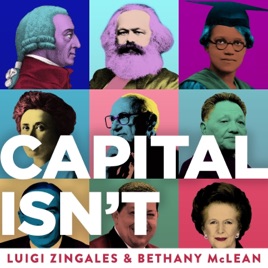
Advertise on podcast: Capitalisn't
Rating
4.5from
This podcast has
254 episodes
Language
EnglishExplicit
No
Date created
2017/12/18
Latest episode
2026/10/08
Average duration
52 min.
Release period
11 days
Description
We investigate how capitalism is—or more often isn’t—working in our world today. Hosted by economist Luigi Zingales and business journalist Bethany McLean, our podcast explains why capitalism can go wrong and what we can do to fix it. Send us your questions or comments by emailing [email protected] Cover photo attributions: https://www.chicagobooth.edu/research/stigler/about/capitalisnt.
Unlock Capitalisn't podcast Email contact info,
Listeners & Audience details
Email contact information
Direct podcast contact details

Listeners
Audience numbers & engagement insights

Audience details
Podcast Insights


Podcast episodes
Check latest episodes from Capitalisn't podcast
The Case That Could End Super PACs - ft. Larry Lessig
2026/10/08
Everyone blames Citizens United for super PACs. Harvard Law professor Lawrence Lessig says they're blaming the wrong case, and he is actually taking his argument to court. The ruling that actually created super PACs, he argues, is SpeechNow.org v. FEC, a D.C. Circuit decision issued two months after Citizens United that the Supreme Court has never reviewed.
In 2024, nearly 75% of the Maine’s voters approved a $5,000 cap on contributions to super PACs. A federal judge blocked it, and the challenge now sits with the First Circuit. A ruling for Maine would break with every appeals court that has considered the question and could put it before the Supreme Court ahead of the 2028 election.
Lessig joins hosts Bethany McLean and Luigi Zingales on this episode to make his case ahead of the decision. They also get into why the corruption that matters most in American politics isn't bribery, how the fundraising treadmill fills Congress with sycophants, and why transparency alone can leave you with a transparently corrupt system.
Connect with us:
📺 Subscribe to our YouTube Channel
📱 Follow Capitalisn’t on Instagram & TikTok
✉️ Email your questions and comments to [email protected]
Hosted by Simplecast, an AdsWizz company. See pcm.adswizz.com for information about our collection and use of personal data for advertising.
The Workplace Is a Dictatorship? - ft. Elizabeth Anderson
2026/09/24
At the center of our market economy sits an institution that runs more like a dictatorship. The firm you work for writes the rules and enforces them. There is no vote, no appeal, and no constitution. The only real remedy is to leave.
University of Michigan philosopher Elizabeth Anderson, author of "Private Government" and "Hijacked: How Neoliberalism Turned the Work Ethic Against Workers," argues we spent centuries building limits on rulers who held this much power over people's daily lives, and built almost nothing for the place where most of that life is actually spent.
"Hijacked: How Neoliberalism Turned the Work Ethic Against Workers and How Workers Can Take It Back": https://www.cambridge.org/core/books/hijacked/E7E4A7D850C1E7289BA7AAF910455136
"Private Government: How Employers Rule Our Lives": https://press.princeton.edu/books/hardcover/9780691176512/private-government?srsltid=AU7gw4XkqB24hl23B55i5Stpj4twB-lI8JX8SWqtj09h0AO22q1dBlGl
Connect with us:
📺 Subscribe to our YouTube Channel
📱 Follow Capitalisn’t on Instagram & TikTok
✉️ Email your questions and comments to [email protected]
Hosted by Simplecast, an AdsWizz company. See pcm.adswizz.com for information about our collection and use of personal data for advertising.
Why Congress Protects Car Dealers More Than Elon Musk - ft. Eric Zwick
2026/09/17
For every member of the Forbes 400, there are more than 4,000 private business owners worth at least $10 million. You probably have never heard of any of them.
They own the beer distributorship in your town, the dental group with four offices, the HVAC trucks that passed your house this morning. A decade inside anonymized IRS data turned up three million of them, and the version of that story running in many outlets this month is the hopeful one: fortunes still being built in unglamorous industries, far from the coasts, by people with no degree and no connections. The American Dream, alive and hiding in plain sight.
That is one part of what the data says. The other part is that the largest fortunes are concentrated where the law limits who can compete at all, and the owners have the political weight to keep it there. Whether the first part redeems the second is the entire argument here. The economist who found the numbers doesn’t know for sure whether it’s a good or worrying story.
Eric Zwick is the Joel F. Gemunder Professor of Economics and Finance at the University of Chicago Booth School of Business and co-author, with Owen Zidar of Princeton University, of “The Everywhere Millionaire: Who Is Really Rich in America and How They Got There”: https://us.macmillan.com/books/9781250378507/theeverywheremillionaire/
Connect with us:
📺 Subscribe to our YouTube Channel
📱 Follow Capitalisn’t on Instagram & TikTok
✉️ Email your questions and comments to [email protected]
Hosted by Simplecast, an AdsWizz company. See pcm.adswizz.com for information about our collection and use of personal data for advertising.
Can Capitalism Serve the Common Good? - ft. Mariana Mazzucato
2026/09/10
The drugs in your medicine cabinet were probably discovered on your dime, in a university lab, with NIH money. You don't hold the patent. You don't set the price. Same story with the touchscreen, the GPS and the voice assistant in your pocket.
The public often helps fund breakthroughs, while private companies claim all the profits. Economist Mariana Mazzucato thinks it’s time to renegotiate. In “The Common Good Economy: A New Compass”, she makes the case for reshaping markets around the common good.
Luigi Zingales and Bethany McLean press the uncomfortable question: can a government captured by business really be trusted to change the rules?
You can find “The Common Good Economy: A New Compass” here: https://marianamazzucato.com/books/the-common-good-economy/the-common-good-economy-us/
Mariana Mazzucato is a Professor at University College London, Founding Director of the UCL Institute for Innovation and Public Purpose and author of “The Common Good Economy: A New Compass”.
Connect with us:
📺 Subscribe to our YouTube Channel
📱 Follow Capitalisn’t on Instagram & TikTok
✉️ Email your questions and comments to [email protected]
Hosted by Simplecast, an AdsWizz company. See pcm.adswizz.com for information about our collection and use of personal data for advertising.
The One Thing That Could Decide If AI Takes Your Job - Ft. Luis Garicano
2026/08/27
AI is coming for your job; AI isn't coming for your job. Economist Luis Garicano thinks both camps are asking the wrong question.
In Messy Jobs: The Work That AI Cannot Reach, Garicano and co-authors Jin Li and Yanhui Wu argue that all knowledge work varies along a dimension of “messiness”, and that the jobs which survive won't be the ones that are hardest, but the messiest. Bethany McLean and Luigi Zingales press Garicano on where that framework holds and where it breaks.
Connect with us:
📺 Subscribe to our YouTube Channel
📱 Follow Capitalisn’t on Instagram & TikTok
✉️ Email your questions and comments to [email protected]
Hosted by Simplecast, an AdsWizz company. See pcm.adswizz.com for information about our collection and use of personal data for advertising.
Can Liberalism Survive This Kind of Capitalism? - ft. Daron Acemoglu
2026/08/13
For most of the last century liberal democracies offered a simple deal: the economy grows and, if you work hard, you get a fair shot at the rewards. According to 2024 Nobel Prize-winning economist Daron Acemoglu, that deal is broken.
Acemoglu joins Bethany McLean and Luigi Zingales to discuss his new book, What Happened to Liberal Democracy?, and why the system that delivered unprecedented freedom and prosperity abandoned the working class in favor of the college-educated elite.
Acemoglu makes the case that things will only get worse as AI is being designed to replace human labor, driving wage stagnation and economic anxiety. But he thinks we can still turn things around, and he brought his solutions to our podcast.
Connect with us:
📺 Subscribe to our YouTube Channel
📱 Follow Capitalisn’t on Instagram & TikTok
✉️ Email your questions and comments to [email protected]
Hosted by Simplecast, an AdsWizz company. See pcm.adswizz.com for information about our collection and use of personal data for advertising.
How Washington Privatized The Capital Market - ft. Renée Jones
2026/08/06
Amazon went public three years after it was founded. SpaceX stayed private for 24 years. What changed and why does it matter?
The standard story is that companies avoid an IPO because public markets carry too many government rules and too many lawyers looking to sue. Renee Jones, law professor, former SEC official, and author of the new book Untamed Unicorns: Why Startup Finance Is Broken and How to Fix It, makes the opposite case.
Jones argues what changed was the deregulation of private markets, driven by decades of industry lobbying. Due to decisions in Washington, companies became able to raise billions privately and there was no reason to go public . You could get the capital and keep total control, without ever having to disclose anything to regulators.
If you've never bought a share of a startup, you might assume none of this touches you. But most of the money flowing into these private markets comes from pension funds and retirement accounts, meaning ordinary savers are already invested in companies whose books they'll never see.
Connect with us:
📺 Subscribe to our YouTube Channel
📱 Follow Capitalisn’t on Instagram & TikTok
✉️ Email your questions and comments to [email protected]
Hosted by Simplecast, an AdsWizz company. See pcm.adswizz.com for information about our collection and use of personal data for advertising.
A Conservative's Attack On Neoliberalism - Ft. Chris Griswold
2026/07/30
The Republican Party is often associated with free-market fundamentalism, deregulation, and tax cuts. But a new faction on the right is challenging that consensus.
In this episode, Bethany and Luigi sit down with Chris Griswold, the Policy Director at American Compass. Drawing on Catholic social teaching, Griswold argues that we need to stop viewing our economy as a force of nature or an end unto itself, but a tool meant to serve human flourishing and dignity.
The conversation explores if the traditional neoliberal regime has failed working-class Americans, and whether policy should step in to channel capital toward productive uses. To fix our current system, Griswold argues we need to go back to a first-principles question: What is capitalism, or any economy for that matter, actually for?
Connect with us:
📺 Subscribe to our YouTube Channel
📱 Follow Capitalisn’t on Instagram & TikTok
✉️ Email your questions and comments to [email protected]
Hosted by Simplecast, an AdsWizz company. See pcm.adswizz.com for information about our collection and use of personal data for advertising.
Was The Constitution An Anti-Democratic Coup? - ft. Michael Klarman
2026/07/16
Were the foundations of American governance engineered to protect the wealthy? Harvard Law professor Michael Klarman argues that the US Constitution was actually a counter-revolutionary coup to constrain democracy rather than protect it.
This episode explores how debt, taxes, and money influenced the drafting of America's founding document. And whether a wealthy elite bypassed democratic institutions to secure their own financial interests and reduce populist power.
Connect with us:
📺 Subscribe to our YouTube Channel
📱 Follow Capitalisn’t on Instagram & TikTok
✉️ Email your questions and comments to [email protected]
Hosted by Simplecast, an AdsWizz company. See pcm.adswizz.com for information about our collection and use of personal data for advertising.
Our Personal Finance Mistakes Are The Industry's Profits - ft. John Campbell & Tarun Ramadorai
2026/07/02
Is personal finance rigged against ordinary people? Economists John Campbell and Tarun Ramadorai argue the system rewards the wealthy and financially savvy at the expense of everyone else.
Their book Fixed points to a troubling pattern: the fees you avoid by never overdrafting, or by refinancing on time, are paid for by people who don't, and they warn that the resulting resentment is fueling political discontent.
But there is a tension at the heart of their argument. They don't want the government running finance or setting prices, yet they call for far more muscular rules. So what exactly are they proposing, and why do they insist it would expand your choices rather than limit them?
Connect with us:
📺 Subscribe to our YouTube Channel
📱 Follow Capitalisn’t on Instagram & TikTok
✉️ Email your questions and comments to [email protected]
Hosted by Simplecast, an AdsWizz company. See pcm.adswizz.com for information about our collection and use of personal data for advertising.
Was Free Trade Ever Really Free? - ft. Fmr. Biden Trade Rep. Katherine Tai
2026/06/18
Free trade was never actually free? That's the case Katherine Tai, Joe Biden's former U.S. Trade Representative, brings Bethany McLean and Luigi Zingales this week.
For decades, the economic consensus treated free trade as an engine for cheaper goods and faster growth. But, Tai argues, this system actually relies on ignored externalities, allowing multinational corporations to reap the benefits of zero regulation while workers and the environment absorb the costs.
Zingales goes further, arguing the whole system isn't free trade at all, but something he calls “captured trade”. So who exactly is that trade free for and what exactly is it free from? Tai walks through the hidden machinery most people never see, and what she calls a plan for a worker-centered trade policy.
Connect with us:
📺 Subscribe to our YouTube Channel
📱 Follow Capitalisn’t on Instagram & TikTok
✉️ Email your questions and comments to [email protected]
Hosted by Simplecast, an AdsWizz company. See pcm.adswizz.com for information about our collection and use of personal data for advertising.
Why Corporations Always Win At The Supreme Court - ft. Adam Winkler
2026/06/04
Corporations are people in the eyes of the law. But how did that happen, and why does it hand them rights you don't have?
UCLA law professor Adam Winkler, author of "We the Corporations", traces a 200-year campaign by business to win the constitutional rights of human beings. Bethany McLean and Luigi Zingales press him on what Zingales calls an incredible trick. Corporations insist they're separate from their owners when that shields owners from blame, then argue they're like people when they want to spend on elections or dodge a rule.
Winkler traces how the Fourteenth Amendment, written after the Civil War to protect the newly freed, became a tool for railroads and banks instead. He even describes a lawyer who, by his account, lied to the Supreme Court, producing a journal he claimed proved the amendment was meant for corporations.
Zingales pushes on what comes next: could AI itself qualify for legal personhood, and would that shield big tech from blame? When we ask Winkler for a shred of hope that the long arc doesn't simply keep favoring business, the answer is far shorter and blunter than expected.
Connect with us:
📺 Subscribe to our YouTube Channel
📱 Follow Capitalisn’t on Instagram & TikTok
✉️ Email your questions and comments to [email protected]
Hosted by Simplecast, an AdsWizz company. See pcm.adswizz.com for information about our collection and use of personal data for advertising.
You Can't Buy Trust - ft. Wikipedia Co-Founder Jimmy Wales
2026/05/28
How does a free, decentralized, volunteer-run encyclopedia produce something more trusted than nearly any for-profit institution?
Luigi Zingales and Bethany McLean sit down with Wikipedia co-founder Jimmy Wales to explore how the platform organizes global knowledge.
The conversation unpacks how Wikipedia governs itself without a central authority, why consensus beats voting, and what the deliberate vagueness of its rules actually protects against.
But is artificial intelligence a looming threat to this system? Wales questions whether these new technologies can actually verify truth without the human feedback loops that correct traditional platforms.
Can the community-driven approach of Wikipedia teach the broader business world how to survive an era of deep digital skepticism? Tune in to discover if spontaneous human order is truly the ultimate defense against an automated future.
Connect with us:
📺 Subscribe to our YouTube Channel
📱 Follow Capitalisn’t on Instagram & TikTok
✉️ Email your questions and comments to [email protected]
Enjoying the show? Please leave us a rating and review on your favorite podcast player! Make sure to subscribe so you never miss an episode.
Hosted by Simplecast, an AdsWizz company. See pcm.adswizz.com for information about our collection and use of personal data for advertising.
Is Healthcare Making Capitalism Sick? - ft. Zack Cooper
2026/05/21
Are stagnant wages the hidden price tag of a broken healthcare system? On this week's Capitalisn't, Yale health economist Zack Cooper tells Bethany McLean and Luigi Zingales that the U.S. healthcare market is failing because of structural flaws like employer-sponsored insurance, which hides true costs from consumers. He argues this opaque system has quietly become one of the leading drivers of income inequality in America.
Cooper explains why standard economic principles break down in healthcare: in one of his studies, the average Manhattan patient drives past six cheaper MRI options to reach the one their doctor recommends. He also shows that when premiums rise equally across a workforce, companies are financially incentivized to lay off lower-wage workers to absorb the cost. And when hospitals acquire physician practices, doctor behavior shifts to maximize hospital revenue, significantly increasing rates of expensive, potentially unnecessary procedures like cesarean sections.
Looking ahead, Cooper argues the U.S. will soon face a stark choice to control costs. The system must either roll back employer-sponsored insurance to push more people into the individual market, or expand Medicare to bring more of the public under regulated pricing. If you've ever stared at a medical bill and wondered how those numbers got there, this episode is worth a listen.
Connect with us:
📺 Subscribe to our YouTube Channel
📱 Follow Capitalisn’t on Instagram & TikTok
✉️ Email your questions and comments to [email protected]
Enjoying the show? Please leave us a rating and review on your favorite podcast player! Make sure to subscribe so you never miss an episode.
Hosted by Simplecast, an AdsWizz company. See pcm.adswizz.com for information about our collection and use of personal data for advertising.
How “Muskism” Is Changing American Capitalism - ft. Quinn Slobodian
2026/05/07
For the better part of the 20th century, the American economy relied on the steady social peace of "Fordism"—an era of mass production and consumption that helped reconcile capitalism with democracy. Today, a radical new paradigm threatens to upend that equilibrium: "Muskism".
While conventional wisdom suggests that Silicon Valley billionaires are libertarians desperate to escape government oversight, historian Quinn Slobodian argues they actually want to achieve state symbiosis by turning the government into a dependent client. This vassalization of the state means private actors absorb critical public functions without any democratic constraints.
Discussing insights from his and co-author Ben Tarnoff's new book, Muskism: A Guide for the Perplexed, Slobodian unpacks how Elon Musk’s worldview is reshaping the global political economy. This episode also dives into the parallels between American tech supremacy and the Chinese economic model. Slobodian posits that the real vulnerability in the United States is not the excess of regulation that the Abundance agenda focuses on, but rather a failure to discipline capital.
Connect with us:
📺 Subscribe to our YouTube Channel
📱 Follow Capitalisn’t on Instagram & TikTok
✉️ Email your questions and comments to [email protected]
Hosted by Simplecast, an AdsWizz company. See pcm.adswizz.com for information about our collection and use of personal data for advertising.
Podcast reviews
Read Capitalisn't podcast reviews
HSamuelLind 2026/09/28
Sneering Elites
I used to really enjoy this show however it has recently veered into sneering elitist snark. The episodes on the “Everywhere Millionaire” and “Workpla...
Lee Esq 2026/08/14
US tax law changes
Sense the most senior executives receive performance compensation in the form of stock options, they pay no income tax.
We need to return to senior...
UCgrad 2026/07/10
Manifests muddy thinking
I love some of their guests but the hosts are not worthy. In their unself-critical muddy thinking, everything good in capitalism stems from the system...
UofC Optimistic Sceptic 2026/05/28
Wiki Truth?
Enjoy the show. However most recent episode (Wiki) seemed to ignore the bias in Wiki these days. Great example is origin of COVID:
The virus was der...
________________uh 2025/12/19
Why wouldn't anyone listen to this?
This show is just two clueless people making one illogical argument after another. How did these people graduate college? Why would anyone listen to t...
PHL132l 2025/05/27
A must-listen show for today’s times
Issues around corporate power and democracy are at the center stage of today’s world.
This show does an amazing job discussing the key topics at the...
Eric_Sow 2025/03/13
Essential Listening for Anyone Navigating Business, Brand, and Culture
As someone who works at the intersection of brand, marketing, and creative strategy, Capital Isn’t is an invaluable resource. Luigi Zingales and Betha...
Royce1629 2024/11/25
A good source to get the Neoliberal perspective.
Interesting topics, and informative. I don't agree with the hosts' perspective, but I think it's useful to hear what your political opponents have to ...
IFYTIT 2024/09/29
Hosts Live Outside The Arena
There’s nothing so absurd as what can be found in the theories of academics, excepting, perhaps, the narratives of journalists.
turquoiselemon 2024/08/31
A stupid person’s idea of a smart podcast
What a waste of some fine guests and an unnecessary platforming of thoroughly discredited ones
Podcast sponsorship advertising
Start advertising on Capitalisn't relevant audience podcasts
You may also like to advertise on these Podcasts

4.8815227
ArtCurious Podcast
Jennifer Dasal/ArtCurious
4.9328131392
REAL AF with Andy Frisella
Andy Frisella

48988554
20/20
ABC News
4.91363710
The Learning Leader Show With Ryan Hawk
Ryan Hawk
4.92109500
the bossbabe podcast
Natalie Ellis
4.3385361976
The Megyn Kelly Show
SiriusXM
4.947589407
The Shawn Ryan Show
Shawn Ryan
4.5185359
Who, When, Wow!
Tinkercast | Wondery

4.6687381111
Armchair Expert with Dax Shepard
Armchair Umbrella
4.9553972191
The MeidasTouch Podcast
MeidasTouch Network