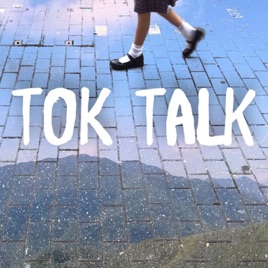
Advertise on podcast: TOK Talk
Rating
4.8from
This podcast has
53 episodes
Language
EnglishPublisher
Emily OsannExplicit
No
Date created
2018/10/18
Latest episode
2025/10/23
Average duration
29 min.
Release period
37 days
Description
an original podcast talking about Theory of Knowledge for teachers and students of TOK and other curious people...
Unlock TOK Talk podcast Email contact info,
Listeners & Audience details
Email contact information
Direct podcast contact details

Listeners
Audience numbers & engagement insights

Audience details
Podcast Insights

Podcast episodes
Check latest episodes from TOK Talk podcast
詮釋與知識 Interpretation as a reliable tool
2025/10/23
在知識的產生過程中,詮釋在多大程度上是一種可靠的工具?
在本期知識論清談中,我們有幸邀請到中國文化研究中心的張玉龍老師,他的深厚學識和獨到見解為我們的討論增添了無限光彩。張老師的專業背景使他能夠深入剖析詮釋與知識之間的複雜關係。他的思考不僅啟發了我們對知識本質的重新思考,也讓我們感受到詮釋在知識生成過程中的重要性和挑戰。期待大家收聽這期節目,感受張老師的智慧和魅力。
2026 TOK Essay Title 6: To what extent is interpretation a reliable tool in the production of knowledge? Answer with reference to history and one other area of knowledge.
In this episode of our TOK talk, we're pleased to welcome Dr. Zhang Yulong from the China Cultural Research Center. His deep knowledge and unique insights greatly enrich our discussion. Dr. Zhang's expertise enables him to analyze the complex relationship between interpretation and knowledge. His thoughts inspire us to rethink the nature of knowledge and highlight the importance and challenges of interpretation in the knowledge generation process. We look forward to everyone tuning in to experience Dr. Zhang's wisdom and charm.
Host: 孫秀東老師
Guest:張玉龍老師
萬物皆數 嘉賓介紹Everything is Numbers
2025/10/23
你在多大程度上認同「萬物皆數」這一論斷。是否萬物皆數,所有的知識和理解最終都可以用數字來詮釋和量化?甚至是本質上都是數學?這是一個值得深思的問題。為了探討這個有趣的話題,我們特別邀請了吳暇老師和張紫朗老師參加這一期的知識論清談。在討論中,兩位老師的對話既幽默又深刻,像是在一場智力的舞蹈中,讓人不禁想要跟著一起起舞。他們結合自身經驗探討了數學與知識之間的微妙關係,讓人耳目一新。不論是吳老師的風趣比喻,還是張老師的深邃見解,這場對話都讓我們重新思考了知識的本質。期待大家收聽這期節目,跟隨我們一起在知識的海洋中暢游,說不定會有意想不到的收穫哦!
To what extent do you agree with the claim that “all things are numbers” (Pythagoras)? Answer with reference to the arts and the human sciences. Is everything ultimately quantifiable, and can all knowledge be interpreted through numbers? Is everything, at its core, mathematical? This thought-provoking question is the focus of our latest epistemology discussion, featuring teachers Wu Xia and Zhang Tze Long.. Their dialogue is both humorous and insightful, akin to an intellectual dance that invites participation. They explore the nuanced relationship between mathematics and knowledge, offering fresh perspectives. Join us in this episode as we navigate the ocean of knowledge—who knows what unexpected insights you might discover!
Hosts: 孫秀東老師
Guests: 吳暇老師、張紫朗老師
知識與情境 Knowledge and Context
2025/10/23
在獲取知識的過程中,我們對某事物的理解程度是否僅能達到我們對該事物情境的理解程度?帶著這個問題,我們特意邀請了王紅櫻老師、張熙老師參與了這一期的知識論清談。期間老師們對於情境與知識的討論有趣有深刻,期待大家收聽。
In the acquisition of knowledge, can we only understand something to the extent that we understand its context?
Discuss with reference to two areas of knowledge. With this question, we invited Teachers Wang Hongying and Zhang Xi to join this session of our epistemology discussion. Their insights on context and knowledge were both interesting and profound. We hope everyone tunes in!
Hosts: 孫秀東老師
Guests: 王紅櫻老師、張熙老師
Power in the medium
2025/10/23
2026 TOK Essay Title 3: Is the power of knowledge determined by the way in which the knowledge is conveyed?
Discuss with reference to mathematics and one other area of knowledge. Can knowledge stand on its own, or does its impact entirely depend on the packaging? That is the provocative challenge of the 2026 TOK Essay Title 3: "Is the power of knowledge determined by the way in which the knowledge is conveyed?" This question is particularly complex when applied to Mathematics, where facts are absolute yet their transformative power often lies hidden behind specialized notation and formal proofs. To navigate this question, I’ve brought back one of our sharpest and most valued podcast guests to help us dissect how the delivery system shapes the destiny of knowledge.
Guest: Mr. Kevin Hoye (TOK & IB English Literature Teacher)
Music: Our school orchestra performance of Shostakovich, May 2025
Doubt is Central
2025/10/23
2026 TOK Essay Title 2: To what extent do you agree that doubt is central to the pursuit of knowledge? Answer with reference to two areas of knowledge.
This title seems to pick up in the middle of a debate about the nature of knowledge, and how it has shifted over time… particularly with the 21st century focus on STEM, and a scientific approach to knowledge. For me, as an art teacher, the idea that doubt is essential to the pursuit of knowledge is counter-intuitive, even corrosive; how can one create without a measure of belief? I recognized the deep, conflicting roles doubt plays in our two fields. To bridge that ideological gap and truly understand the scientific methodology, I pulled a brilliant Physics teacher away from his formulas and into a necessary conversation.
Guest: Mr. Saif Ullah (Physics Teacher)
Music: Julia Shi performing Claude Debussy, Feb 2025
Observation is essential but flawed
2025/10/23
2026 TOK Essay Title 1: In the production of knowledge, does it matter that observation is an essential but flawed tool? Discuss with reference to the natural sciences and one other area of knowledge. The premise of the 2026 TOK Essay Title 1—that observation, the bedrock of science, is also inherently flawed—demanded a rigorous inquiry. To understand the stakes, I sat down with a science expert to challenge the maxim, 'seeing 'is believing.' Our discussion was a deep dive into the mechanisms of scientific knowledge: how the very act of observation is shaped by the techniques and tools we use; what the true nature of these perceptual flaws is; and the intricate methods developed to 'correct' for human and technical bias. This conversation reveals why this foundational vulnerability is not a weakness to be hidden, but a critical, defining characteristic of the natural sciences.
Guest: Dr. Simon Griffin
Music: Rhea Ng and Delphine Wu, Feb 2025
TOK Essay Guidance with John Sprague
2025/10/20
A fantastic professional learning workshop this week at our school led to a follow-up conversation with John Sprague, renowned TOK textbook writer and teacher. We wanted to delve deeper into the practical strategies he uses to help students master their essays. One highlight for our teaching team was Sprague’s insightful framing of "knowledge communities." He helped us see that this concept is inherently inclusive: anyone involved with a subject—from a novice apprentice to a seasoned expert—is a vital part of that community. We realized this perspective could fundamentally change how students view their work. This podcast distills that transformative idea and other key wisdom from the workshop to benefit both TOK teachers and their students.
Guest: John Sprague
Music: Mary Ji performing Étude op.4 no.3 by Karol Szymanowski
Ever Improving Tools
2024/11/01
Title 4: Do the ever-improving tools of an area of knowledge always result in improved knowledge? Discuss with reference to two areas of knowledge
Guest: Dr. Simon Griffin
Sounds: Lamma beach
Finite Resources, Relentless Drive
2024/10/25
2025 TOK Essay Title 3: How can we reconcile the relentless drive to pursue knowledge with the finite resources we have available? Discuss with reference to the natural sciences and one other area of knowledge
Guest: Kevin Hoye
Sounds: Hong Kong Birds and Traffic in the morning
Do not ignore contradictory evidence
2024/10/25
2025 TOK Essay Title 1: Do historians and human scientists have an ethical obligation to follow the directive: “do not ignore contradictory evidence”? Discuss with reference to history and the human sciences.
Guest: Quinn Fontaine
Sounds: Sri Lankan rainforest in the morning
Fragile & Revered Knowledge
2024/10/25
2025 TOK Essay Title 2: Is our most revered knowledge more fragile than we assume it to be? Discuss with reference to the arts and one other area of knowledge
Guest: Janka van Jaarsveld
Sounds: Sri Lankan rainforest in the morning
Sense Of Wonder
2024/10/25
2025 TOK Essay Title 6: Does acquiring knowledge destroy our sense of wonder? Discuss with reference to two areas of knowledge
Guest: Bob Scheer
Sounds: Sri Lankan rainforest at midnight
Models are Wrong
2024/10/25
2025 TOK Essay Title 5: To what extent do you agree with the claim “all models are wrong, but some are useful” (attributed to George Box)? Discuss with reference to mathematics and one other area of knowledge.
Guest: Rob Bradshaw
Sounds: Sri Lankan street musicians
How do differing belief systems influence what we know? 不同的信仰体系如何影响我们的知识?
2024/08/07
不同的信仰体系如何影响我们的知识?
In this bilingual podcast, we explore the complex relationship between belief systems and our understanding of the world. We examine various belief frameworks, including the Judeo-Christian, Buddhist, Taoist, and Confucian traditions, to explore if it is even possible to fully recognize the extent to which our underlying beliefs influence what we know and how we act. Join us as we delve into a short, sweet, yet deep conversation about our value systems and understanding how they shape our knowledge about others and the world. We hope this gets you thinking as you go about your day, and give you a chance to consider: How do your values influence your knowledge?
Guests: Dr. Bill Mak, Sun Laoshi
Who Owns Knowledge?
2024/06/03
Prompt 29. Who owns knowledge?
LY’s first response: “Those who study, those who learn, those who share” is not a bad start. I wish this were the world we lived in, but somehow I think the answer is far more complicated and often influenced by power (for good and for bad) more than we care to acknowledge.
What is ownership? That it ‘belongs’ to you? Can knowledge even be owned?
Pioneers, inventors, artists, discoverers of new knowledge - do they own the knowledge they produce, create or discover? If whoever was first gets the credit, does that mean they own the knowledge? Once knowledge is shared, does it belong to other knowers that know it too? What knowledge belongs to the common good? Is knowing something the same as owning it? This discussion raised Issues of social responsibility that comes with creating and sharing (or not sharing) new knowledge.
After we think about the question: Who owns knowledge? So many other important questions get raised: What do we do with it? How do we care for it? …LY asks but “so what”? We discussed the ways we value original ideas in different cultures. Zooming out, thinking about the implications of ownership and access, but also the responsibility for protection and upkeep that comes with ownership. Is the onus on the creator or user of knowledge? In a sense, are both ‘owners’?
Links in this talk can be found at www.TOKTalk.org
Guests: Donna Gee, Liu Yu
Music: Hilary Ng playing in the hallway at school
Podcast sponsorship advertising
Start advertising on TOK Talk relevant audience podcasts
You may also like to advertise on these Podcasts

4.689261200
Get Sleepy: Sleep meditation and stories
Slumber Studios
4.79026375
Life is Short with Justin Long
Audible
4.714083346
Bad Friends
Bobby Lee & Andrew Santino
4.7124668
10 to Life
Annie Elise
4.76746460
Criminology
Emash Digital & Mike Ferguson, Mike Morford
4.87488968
The Dr. John Delony Show
Ramsey Network
4.512539657
RedHanded
RedHanded
4.8224671785
The Andrew Klavan Show
The Daily Wire
4.959721991
Legal AF by MeidasTouch
MeidasTouch Network
4.942001993
Chente Ydrach
Chente Ydrach