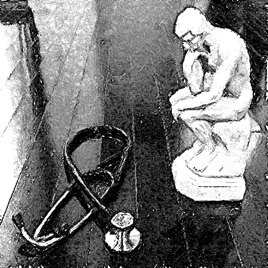
Advertise on podcast: Philosophers on Medicine
Rating
4.3from
This podcast has
17 episodes
Language
EnglishPublisher
Jonathan FullerExplicit
No
Date created
2019/01/09
Latest episode
2021/08/28
Average duration
-
Release period
75 days
Description
For the deepest problems in healthcare, philosophy is the best medicine. In this podcast series, Jonathan Fuller, MD, PhD (University of Toronto) speaks to philosophers about their work on medicine and healthcare. You will hear from philosophers on the meaning and reality of disease, on their skeptical worries about evidence-based medicine, on current movements and controversies that shake medicine to its philosophical foundations. Visit our website at www.philosophersonmedicine.com.
Unlock Philosophers on Medicine podcast Email contact info,
Listeners & Audience details
Email contact information
Direct podcast contact details

Listeners
Audience numbers & engagement insights

Audience details
Podcast Insights

Podcast episodes
Check latest episodes from Philosophers on Medicine podcast
Philosophy of Medicine on COVID-19
2021/08/28
During the COVID-19 pandemic, scientists and policymakers have responded with unprecedented solutions. The pandemic has also forced a rethinking of science, public health and their relationship to the public. How can philosophy of medicine help us respond to the fundamentally philosophical problems that this rethinking involves?
In May of 2021, I hosted a panel discussion with experts in health science, public health and philosophy titled Philosophy of Medicine on COVID-19. We talked about normal science and fast science; modeling and evidence in public health; science, uncertainty and decision-making; expertise and science communication; and the relationship between public health and the publics.
In today’s consultation, we revisit that conversation with Trisha Greenhalgh (University of Oxford), Ross Upshur (University of Toronto), Alex Broadbent (University of Johannesburg), Maya Goldenberg (University of Guelph), and Sang-Wook Yi (Hanyang University).
Race in epidemiology and medicine
2020/07/06
There is renewed research and attention to race in epidemiology and medicine, partly owing to developments in population genetics. Yet race is a contested category and poses philosophical questions about the reality of racial categories as well as the ethical and social-political implications of using them. For instance, is race a social construction; and if so, how do racial categories line up with the world? Perhaps more pressingly, should we be using racial categories in epidemiology and medicine in the first place?
Today’s consultation is with philosopher Sean Valles, Associate Professor at Michigan State University.
Medical Nihilism
2020/06/01
Medical Nihilism. Is it vestige of a bygone age in medicine beset with treatments like mercury and bloodletting? Or the proper conclusion of a line of argument about our current medical interventions citing problems with contemporary medical research? These problems include the complex pathophysiology of contemporary diseases, the malleability of medical research methods, the biased social nexus of medical research, and a small effect size crisis. Should we have low confidence on average in medical interventions today? And is this the kind of question that we can answer with a dose of data and philosophy?
Today’s consultation is with philosopher Jacob Stegenga, Reader in History and Philosophy of Science at the University of Cambridge.
Expert consensus in medicine
2020/05/04
In medicine, consensus statements abound. They’re issued by government agencies and professional societies as the official word on the science and practice of medicine. But what role does expert consensus serve? To summarize the evidence? To deliberate over decision-making? Or to command change? In an era of evidence-based medicine, is expert consensus going extinct? Or is it perhaps more important now than ever? Philosophers studying the social context of medical knowledge may have some answers.
Today’s consultation is with philosopher Miriam Solomon, Professor of Philosophy at Temple University.
The causes of disease
2020/03/02
The cause of tuberculosis is the germ Mycobacterium tuberculosis. Meanwhile, the causes of heart disease are variable: smoking, sedentary lifestyle, bad genes, and so on. Is this just a fact? Did the German microbiologist Robert Koch really discover that Mycobacterium tuberculosis is the cause of tuberculosis? According to some historians and philosophers, it’s more than just a matter of fact. It’s partly a conceptual choice of how we classify diseases, one with important implications for how epidemiology and medicine are practiced today. Thankfully, conceptual understanding and analysis is part of the scope of practice of a philosopher.
Today’s consultation is with philosopher Alex Broadbent, Professor of Philosophy at the University of Johannesburg.
Evidence-based medicine
2020/01/06
Evidence-based medicine or EBM was introduced in the early 1990s as a move to increase medicine’s uptake of published scientific evidence, especially evidence from clinical epidemiology. It is now the standard, such that its underlying philosophical ideas have become invisible to many. However, since its launch, evidence-based medicine has had its critics, including healthcare professionals and philosophers. Philosophers began to ask questions: what is ‘evidence’ according to evidence-based medicine? What justifies EBM’s confidence in some forms of evidence – namely, randomized trials and meta-analyses – over others like observational studies or evidence of biologic mechanisms? Evidence-based medicine led to a renaissance in philosophical attention towards medicine and medical evidence.
In today’s consultation, I speak with four philosophers of medicine: Ross Upshur, Jeremy Howick, Jacob Stegenga and John Worrall. Here’s my conversation with Ross Upshur, Professor in the Dalla Lana School of Public Heath at the University of Toronto.
Mental disorders and the DSM
2019/11/12
Mental disorders cause suffering for many and pose challenges for the psychiatric profession. Throughout history, the way that society and psychiatry have thought about mental disorders has changed greatly. One area of great difficulty and great change has been psychiatric classification – how psychiatry carves up the realm of mental illness into diagnostic categories. During the second half of the Twentieth Century, the Diagnostic and Statistical Manual of Mental Disorders, the DSM, became the bible of psychiatry, the most influential psychiatric classification system. But through its several editions, criticism has followed the DSM, which serves as a target for debates about how psychiatric diagnosis and research should be done. At the head of these debates have been several philosophers.
In today’s consultation, I speak with three philosophers of psychiatry: Rachel Cooper (Professor in the Department of Politics, Philosophy and Religion at Lancaster University), Jonathan Tsou (Associate Professor in the Department of Philosophy and Religious Studies at Iowa State University) and Kathryn Tabb (Assistant Professor of Philosophy at Bard College).
Primer on health and disease
2019/10/06
Health and disease are two concepts that dominate our lives. Analyzing these concepts has also dominated much of the discussion in the philosophy of medicine. Is health merely the absence of disease? Is disease a biological concept, a value-laden concept, or both? Why is it important that we dissect these concepts? Should we do away with them altogether, at least when it comes to the hard cases that generate controversy over who counts as healthy or diseased? In this episode, we provide a small primer on this big discussion.
Today’s consultation is with philosopher Marc Ereshefsky, Professor of Philosophy at the University of Calgary.
Clinical Judgment
2019/09/02
The mastery of clinical judgment is what separates the expert clinician from the novice. Yet clinical judgment remains somewhat obscure. Is it a tacit knowledge? Or one that can be formulated according to explicit rules? Is it a science? Or a virtue? Has it been replaced or its importance reduced by evidence-based medicine? Or will it soon be taken over from clinicians by intelligent machines? And what is clinical judgment, anyway?
In today's consultation, I sit down with four guests ahead of a clinical judgment symposium to see how they use philosophy to understand clinical judgment.
Delusions
2019/08/04
Delusions are often defined as fixed false beliefs. They run contrary to common sense or counter-evidence that would convince any rational person, like the idea that aliens are communicating with me through a radio chip implanted in my brain, or the thought that my father has been replaced by an imposter, albeit an imposter that is identical to my father in every discernible way. But why do people acquire delusions in the first place? Philosophy is often thought to be a rational activity of the highest order. Maybe philosophers can shed some light on what is going wrong with the reasoning of people who have delusions?
Today’s consultation is with philosopher Matthew Parrott, Birmingham Fellow in Philosophy at the University of Birmingham (formerly at King’s College London).
Metaphysics of pregnancy
2019/07/07
Often, when philosophical questions are asked about pregnancy, they concern ethical problems about abortion, surrogacy or assisted conception. But the answers to these questions might depend in part on answers to metaphysical questions. One of these metaphysical questions concerns the relationship between the mother and her fetus. Is the mother a biological container for her developing baby, or is the fetus a part of the mother? It’s a question that may have important implications, but it’s also one of the big existential questions of life, a question about what it is to be human.
Today’s consultation is with philosopher Elselijn Kingma, Associate Professor in Philosophy at the University of Southampton.
Overdiagnosis and the definition of disease
2019/06/02
In recent years, physicians and health scientists have become increasingly concerned about overdiagnosis, the problem of diagnosing too many people as having a disease, be it breast or thyroid cancer, diabetes or pulmonary embolism. When considering who or what is at fault, the list of suspects often includes overly expansive screening programs, increasingly sensitive diagnostic tests, and unnecessary test-ordering. But should the list of the accused also include our definition of disease? And can philosophers studying disease concepts help to clear up our definition of disease – and even the problem of overdiagnosis itself?
Today’s consultation is with philosopher Mary Walker, Research Fellow in Philosophy at Monash University.
Podcast sponsorship advertising
Start advertising on Philosophers on Medicine relevant audience podcasts
You may also like to advertise on these Podcasts

48154
Willie B's Garage
KBPI.com (KBPI-FM)

4.92822
Doctor Who: The Missing Episodes Podcast
Tim
53156
Dana Tyson
SUNNY 99.1

4.63620
The Great Post Office Trial
BBC Radio 4

5160
LiebesGeschichte
Franziska Singer

578
Walton’s World
The Softball America Podcast Network

2.33496
WEEI/NESN Jimmy Fund Radio-Telethon
Audacy

41410
Crockett
Audacy

4.81185
Tastemakers Podcast
Plein Air

52144
Success Secrets Exposed
Talk 4 Radio