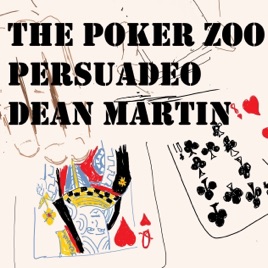
Advertise on podcast: The Poker Zoo Podcast
Rating
4.9from
This podcast has
106 episodes
Language
EnglishPublisher
Chris M. aka Persuadeo & Dean MartinExplicit
No
Date created
2019/02/06
Latest episode
2026/09/06
Average duration
58 min.
Release period
54 days
Description
The Poker Zoo Podcast by Chris M. aka, Persuadeo & Dean Martin
Unlock The Poker Zoo Podcast podcast Email contact info,
Listeners & Audience details
Email contact information
Direct podcast contact details

Listeners
Audience numbers & engagement insights

Audience details
Podcast Insights

Podcast episodes
Check latest episodes from The Poker Zoo Podcast podcast
PZ106: Reverend Alex Preaches Poker Theory
2026/09/06
I have mentioned on many occasions the biggest mistake of contemporary poker training: the confusion of data with theory. So I was interested when online expert Alex ‘Reverend Bayes’ Pinheiro announced the sale of a poker theory course. If words mean anything, this could be an answer for many.
Now, it did not go past me that Alex described the course as a series of heuristics to approximate GTO, which is not exactly the same thing as providing the reasons for things and principles for moving forward. Yet once we got past this, I’m thinking his new offering, The GTO Textbook, really is an explanation of poker theory, along with those necessary simplifications and concepts. I like the sound of his heuristics and strategy concepts. His answers and explanations ring true. This makes his course potentially valuable and separates it from the claptrap being peddled all over and in every medium.
The poker teaching community is small. Alex mentions Peter Clarke, a poker coach and poker writer to whom I often recommend players. Some of the vocabulary Peter invents I heard through Thomas Pinnock; it’s not clear to me who invented what. Yet I recognize in even the table of contents of Alex’s piece many of the ideas, or even inversions of the same ideas, that I and many coaches use. As Alex suggested on the podcast, we are all going in the same direction; perhaps the difference is where we proceed from.
It was interesting to hear Alex describe the simplicity of his personal sizing scheme. It suddenly struck me that the complexity we introduce often exposes us all the more. Of course I preach balance within mixes, too, but maybe all you have to do is be on fire for EV as well as the Lord. Different sizes are tools for unlocking another player’s armor, to paraphrase Alvin, himself another excellent theorist in the tight scrum of poker experts. However, if you are the enigma and you present near perfectly, let them dare try.
As we drift into some culture and politics talk, the Reverend does lean into his advertised Rationality Culture. Peter praises him on his site as “rational”; the word keeps coming up. Of course, this can be a mixed blessing. Simple ideas, like Musk’s demolition of important programs across the spectrum of the government’s purview, were based in a logical rationale. Encouraging weed in NYC, while following the libertarian ideal, has made life uglier. While it wasn’t discussed, reasonable people can see that the agreed, historical control of weapons in urban situations can be a useful truce even while fostering the individual rights the new generations seem to be easily forgetting. As for the present hysterias, whether on gambling or rent control or fascistic physical fitness or whatever regurgitated backwardness they want to impose, it’s clear Alex will play his role in shaping our country.
Hope you enjoy the podcast. With three episodes in the latest round of Zoo interviews, I have awarded myself a new set of headphones. Hearing the guest may improve things around here!
The post PZ106: Reverend Alex Preaches Poker Theory appeared first on Out of Position.
PZ105: Better Ranting with Dan Arfin
2026/08/25
There are endless characters in poker, but the “post-literate” world only has so many journalists and bloggers recording and transforming them into stories. The ubiquitous vlogger, focused on selling his image, and photographer, focused on selling the industry’s image, can’t do it for legal and casino and formal reasons. This means the skill of storytelling is still in demand. One of the best doing it in poker right now is Las Vegas’ Dan Arfin.
Dan, like many writers, is focused on therapeutics for better living, and I don’t only mean storytelling. (He likes to open the show with a clock tower bell, which summons the monasticism of the grinder or the insanity of the lone gunman, but his most natural sound effect is the unthrottled vape that follows.) Poker results rock the player psyche, so a mental health angle has a strong tradition among its regulars. Grinders often need to come down from the performance high, or like Dan, must vent about the stressors. The main stressors in Dan’s case are the players themselves. That’s us. Yes, we torment Dan, so we’ve got a good and funny plot going on at Dead Money.
Dan divides his personality sharply, as many performers do. And like any good performer, he takes the show very seriously. Dan doesn’t even want to really talk at the table. I saw this when he played in my game, which pushes people to be social. Dan is one of the few kinds of players who doesn’t really like it, as he was clearly focused on beating the fish. Still, his big bluff versus the Gipper, which he described on his pod, was a lot of fun to watch in real time because any decent player recognized exactly what was going on. (If anyone had been listening as the cards were dealt, they would have heard me say, “Dan is going to win this pot.”) Off the felt, Dan is completely different, being talkative to the point of garrulousness. I didn’t even get to half my questions during our interview.
Dan says he “failed at comedy” but I think still has aspirations. Comedy is notoriously cathartic and so there is a strong link between it and poker. There are many poker comedians, including Clayton Fletcher, Joe Stapleton, and Yasar Al-Keliddar, who Dean in fact interviewed for the Zoo. We don’t have to look far for the reason: the dangerous, grey-area life, the constant stress, and the endless hungry and exasperating people in your face and in your business. The poker life absolutely demands a release. Stand-up does a lot for this; I remember recommending it to Gargamel back in his days of suffering through PNW poker and general male malaise.
We don’t directly talk much strategy, but Dan does provide insights as well as answering a big implicit question about his game: Dan likes big, polarizing bets, but do big bets always produce the most EV? The solver is “aggressive” but only because everything is about price and bluff catching. Small bets belong as well. As Dan notes, the pool doesn’t like these big bets, so his aggression is well-rewarded. The reason, of course, is that most of us play too big. It’s on account of pride and excitement and cost efficiency: like the link between poker and storytelling, the mystery is not much of a mystery. They’d call Dan’s ass at NL5, where most of us in live poker actually belong.
This of course brings us to the Dan-DGAF connection. Billy is notorious for having essentially ripped the risk-reward control nodule out of his brain wiring, making him indifferent to taking on substantial uncertainty where others would sense natural bankroll defeats. This, along with great observation skills, made Billy dangerous but also put him into substantial debt when he bit off more than he could chew. Dan employs his exploitative strategy differently, and this is a big part of our discussion.
I hope to have Dan on again later to get to some of the Las Vegas life and some more poker stuff. Also, there is another player who uses some of his tactics and even looks like him; I wrote about it one time. What’s that about? It will have to wait. Meanwhile, I hope you enjoy our pod together.
See you (and Dan and Fake Dan) in the games.
The post PZ105: Better Ranting with Dan Arfin appeared first on Out of Position.
PZ104: Michael Lukich Reboots
2026/08/16
Dean and I return with data scientist, writer, solver explicator and now author Michael Lukich. It’s his second time on the pod, and this time he kicks off a new round of Poker Zoo interviews.
The day-old news is that Solver School is dead, but Solver School lives on, in this case, in the data heaven (or hell) that is YouTube. Yes, you can find Michael’s excellent work here at no charge.
Thank him by checking out his new publishing spot and book, The Stoic Systems Thinker. I think the idea here is to explore and recommend the connection between Stoical thought and modern process-oriented thinking. As someone who writes quite a bit about “variance,” I think you’ll find his work interesting. I liked his recent post, “We Live in a Sample Size of One,” in which he emphasizes the need for a systemic attitude in a universe where luck has an outside influence on all our activities.
We talk about many related things in this return podcast. “It feels like everything is gambling now,” says Michael at one point and this is, of course, because everything is gambling. Always was. The problem is that society must cordon certain activities so that people have clear, acceptable choices which make the moral majority feel good. (They are always looking after us, we just don’t appreciate it that much.) We in the gambling space can’t really inhabit acceptable areas of society, no matter what we do or what silly phrases we engage to describe what we do. Poker, in other words, must always be at the margins of culture by definition. Say “mindsport” one more time, m**********r.
Stoicism and philosophy in general have always had much to offer the suffering mind, no matter what the field. I used to tell players to read Shakespeare to help their game, but they never believed me. The point was perspective and human behavior; they’ll come around. Speaking of, poker pro, sports bettor and Zoo member Greg Porter has published a piece connecting Lasch’s extraordinary Culture of Narcissism to finding a better way forward in the game, right on this site. Consider:
I began meditating, assessed my strengths and weaknesses, adopted a philosophy of life, and slowly sussed out what I wanted to accomplish. Lo and behold, I started having impulses that I didn’t indulge, learned my limits, and began to become a better person for the people around me. (The aim is self-knowledge and personal responsibility, not the cult of self-improvement.)
These are the kinds of people we want in charge, not whoever it is out there doing whatever the hell they are doing these days. While I can’t seem to persuade Michael or any of my guests or students to get into politics, I do recommend it. It’s not about seeking to give poker a status it does not merit, but about our community using a honed intelligence to benefit all. As for concerns over poker itself, giving it and other activities outside the mushy center a little room to breathe is all it ever needed.
I hope you check out Michael’s website and see an example of what sharp things us poker players are often up to. The reality of our community is not so much the degens and failsons that gambling attracts and therefore has the illusion of harming, but the winners that challenge themselves through poker’s infinite complexity and come out stronger. Or at least make a cool website.
The post PZ104: Michael Lukich Reboots appeared first on Out of Position.
PZ103: Persistence, Real and Fake, with Nate Serisky
2025/12/21
T.S. Eliot famously stated that “there is no method but intelligence” when asked about his craft. Poker is like this, too, so when a savvy player doesn’t make it work, the postmortem is always interesting.
Nate Serisky, the “new pro” DGAF dubbed “Tom Brady Jr.” in one of his session reviews, stopped playing poker at the end of 2024. A staked and studied mid-stakes reg, he was not who you wanted to see at your Wynn table. Nate liked taking his time and took every hand, it seemed to me, very seriously. Yet the story behind the story is always complicated. Beyond appearances, Nate was in fact struggling to establish a satisfying win-rate. We get into it on today’s Poker Zoo.
(I say today’s Zoo like I’ve been just pumping out podcasts.)
I respect the people around Nate and am sure he had all the help he could ask for; I met Nate, after all, through Chris Konvalinka and Christian Holden, each talented players with some role in the story, no doubt. Yet I wonder about Nate’s references to study and so does he, referring to theory and what was best for the live games. Nate sounds like he could have been falling into the trap of thinking outputs are theory. We can become consumed by the microfibers of equilibrium data when more basic and flexible ideas are what we need for the real and very different equilibria around us.
A major theme of this blog for the past year has been variance and the misinterpretation of it. Swings in poker are difficult to accept and might not even mean what we think they mean. In our first podcast, Nate spoke of taking a lot of time off to recover from rough outings. Looking back, he questions this. “More volume,” he says, was surely one of the answers. Maybe so. How to persist is one of the hardest tasks to master in poker and seems like a big part of what happened here. Overprep is a dangerous thing when the joy of the game lies in confronting the challenge simply and at ease.
Still, signs point to Nate returning to poker. He sounds like someone who is processing an experience, not leaving it behind. We cannot know the future until we know what we want. When he calls his current gig as a slot stalker a “profession,” we know he is not taking himself too seriously, given it is not a profession. We all go through periods of just needing income. Of course, the transition could simply be to his current preoccupation, music. That’s a glorious way to live, of course, but a way with just as many or more demands.
In any case, I hope you enjoy this bookend podcast. So many are going through struggles and changes; really, all of us.
The post PZ103: Persistence, Real and Fake, with Nate Serisky appeared first on Out of Position.
PZ102: Jason Su Wants to Unmisreg You
2025/05/16
Jason Su, mental game and performance coach for an increasing number of poker players, returns to the Zoo. While poker is a game (not “just” a game), there is something a touch more serious in this visit. Why is this? Perhaps because the money involved in poker is increasingly scarce and so every edge has become important.
Actually, it’s worse than that. People are leaving the online scene and rolling the dice in live MTTs or private cash games at a new clip. Nick Howard has gone AWOL and become a concierge for desperate poker nerds. Scamming and scammers have never had it better.
So, do you need a mental game upgrade to deal with it all? Maybe.
My first impression of The Joy of Poker is that this is a book about the ego, not in the pop psychology sense, but in the Freudian sense. The ego mitigates the unconscious and reality. The ego is, as Jason would say, present. This mental awareness of ourselves is not only what makes us conscious but helps us deal with all the pressures of our irrational desires and what society tells us. Freudian or not, Jason puts great stock in being in touch with reality and ordering our response to it. Credit to him, you can hear his measuredness, his lack of hysteria, on our podcasts. Ok, so what?
One big assertion he makes is that mental game has made no progress since some undefined point. This seems doubtful to me, but in conversation, Jason seems convinced enough. Still, everyone now has a little meditation app or something now. Everyone knows to breathe. Go crazy, you oxygen addicts.
While I don’t get into on the podcast, as I expect the reader and other pods to handle certain details, Jason provides a methodology to handle the stress of the game. Read the chapter Clear the Path to get down to business.
Instead, I focus in the interview on an introduction to his ideas and on the culminating chapter, Master of Luck which he referred to in an oblique tweet several months ago. Can you make your own luck, really? At first, he seems to mean something else, and that the argument is more semantic in nature: you don’t make luck, but you can experience it. Fair. Then, I stumble onto something more important: a human approach to embracing variance, which has always been the key to the seemingly impossible goal of playing with a sense of peace.
After reading the book I realized the answer to Jason’s supposition that no progress has been made in the mental game department. It’s a slippery area of the game which has been promulgated through so many empty words, true, but progress has indeed been made and Jason is making some of it. Jason means that the way out of pain is not around but through, both in poker and in life. Words are not enough for the human emotional experience; they are signifiers but not actions. Jason wants you to take a sequence of action steps, which you can read about in the book. So, while the field’s methodologies have been dodgy overall, Jason has refined the answers, both in print and in practice.
Processes that allow us a modicum of acceptance are the progress we’ve made, however imperfect they are. We must fully embrace the swings of the game and thus the feelings associated with them, just as we already know we must max out the corresponding and primary challenge of the game, the challenge of poker strategy.
In other words, to interpret Jason correctly is not to merely hear him say, “you must be willing to win big.” No, you also have to be willing to lose. Perhaps he doesn’t say this enough, given that “willingness to win” always sounds paradoxical. And so this is where emotional availability – presence – meets up with Mason’s critique through knowledge alone – and explains Chewy’s curious quote, for that matter. We thus demonstrate a human way forward and it is for those primarily with the proper skills already. Mental game is for those who need it, and those who need it already know how to win.
How to do it is the problem. Tendler’s “inchworm” is here, Mason’s focus on the strategy as answer is here, and the contributions of many other thinkers are in here as well, however hidden. The Joy of Poker presents a strong case for, and argument about, mental game.
Have a listen and find out. You can find Jason on Twitter or here at his webpage.
The post PZ102: Jason Su Wants to Unmisreg You appeared first on Out of Position.
PZ101: Sara O’Connor Does Things
2025/05/06
It’s early in the back nine for the Poker Zoo podcast, so it’s time to focus on what we want to accomplish. I have a fitting guest today in Sara O’Connor, a mid-Atlantic player and writer who has gathered some attention through her book, A New Queen’s Guide to Poker, and through some social media expertise. Sara has a lot of drive.
I was introduced to Sara through my friend Jason when he bit off a little more than he could chew in the course of his regular Twitter trolling. While Sara and I discuss many things about her life in poker, her first book is or was the original focus of the interview. I think she has done a great job in acclimating the novice to specifically live casino poker. Explicatory passages such as this could do a lot for the unfamiliar:
The game is played with a dealer in the center of the table and
two to ten players. Seat numbers start from the dealer’s left at seat
one and usually end at eight or nine but may go all the way up to
ten. Currently, my favorite seat is seat five, but never become too
attached to one seat. You never know which seat you’ll have to start
playing at, and attachments can lead to feelings of jinxes which
must be avoided. That said, you can ask for a seat change button if
you’re horribly uncomfortable and playing a cash game. With a
tournament, you’re stuck with the seat you’ve been given. We’ll talk
about the nitty gritty details of each of these table positions later.
This is far more practical than many, drier introductory texts. Sara conveys much of the real game and the concerns of its new participants. That’s the “good for poker” stuff everyone yammers on, right there.
When it comes to the strategy discussion in New Queen’s, my response is a little more complex. I think of Dan Savage’s “campground” rule, where he posited that in certain relationships, you must leave your partner better off than you found them. In essence, much of my coaching practice lays in correcting concepts and their misapplication. Does A New Queen’s Guide to Poker and other such novice guides to strategy help or harm the player in the long run? Does she follow the campground rule?
I tend to think the answer is that there is little harm here in the end, and that Sara answered my question during the podcast well enough. Things are going to be wrong, inevitably and everywhere; you’ll recover from your middle school texts no matter how careful they are in addling your brain. The so-called “ladder of learning” is not just straight up and up – the process of learning and relearning also matters. That’s real enough and leaves the writer some reign to describe things that need to be introduced even if those things will need to be corrected later. And of course, I like teaching poker and its theory! Bring on your confusions.
Really, though, I want to skip all that and focus in on what I liked hearing about at the end of the pod: Sara’s coming poker fiction. Ideas start with books and stories, and usually only then proceed to reach popular culture and its bigger, more splashy mediums where huge profits and big picture trends develop. The current debate over poker media is reductive and misguided, as I have written, in both how influence works and what makes it work.
So, if Sara is going to give us some “smut,” it’s good news because she will be generating “content” that really matters to real people with real desires, rather than doing what the poker world flagellates itself to do every few years: weakly manipulate culture with “PR” no one wants. The writer or communicator is the usual if hidden origin point of cultural products and movements because the word is the basic unit of shareable thought.
You can contact Sara on X or at her website.
Coming next, popular mental game and performance coach Jason Su returns to the Zoo with a new book – The Joy of Poker.
The post PZ101: Sara O’Connor Does Things appeared first on Out of Position.
PZ100: Poker as Social Good, with ChipXtractor
2025/03/13
For our milestone episode, I talk with old friend Steve “ChipXtractor” Catterson. I met Steve through the defunct Red Chip Poker forum, and we have been more or less in touch since.
Steve and I go over some stories, but it seems to me that the present in this case is more interesting than the past. Steve is working on his game and that means becoming more interested in the game. Teaching, in turn, makes me more interested in the game. The reason for all this is that when we see what is possible or what we have been blind to, the world regains its color. I’m obviously not just talking poker here. The way to overcome loss is to see what still lives and what you have been missing from the bigger picture.
Less seriously, it’s fun to hear hand histories from South Point, which can be a fun, popular local’s place. Soon Steve will be moving up from the cheap seats and will get involved with the notorious shit regs of the “Jewel.” Good luck with that.
Here’s the hand discussed:
The theme of this podcast is sociability. From Steve’s angle, poker is a part of one’s real, physical, meaningful life. Otherwise hard-tack players need to remember that. I regret my many rudenesses at the table and have been trying to make up for them for some time. For those currently embracing misery and its spread to others, I suggest you rethink your approach. You don’t have to embarrass that old guy who doesn’t want to show his cards. You don’t have to fight over who straddled when. You don’t have to wander the room looking for exact right game to worsen.
Thanks to Dean for all his work on the pod. Thanks to Porter, Julie, Burge and anyone else who put in some editing time. Congratulations us.
If you want to join Steve in relearning the game, use the coaching link or email me.
Have a great week,
Chris
The post PZ100: Poker as Social Good, with ChipXtractor appeared first on Out of Position.
PZ99: Jambasket FAQs, GPIs, MTTs, & LOLs
2025/02/03
As we roll into 2025 it’s well worth checking in with Zoo member Jason Burge, aka Jambasket. He’s a tough online winner in the active Michigan online games but is also a hidden superhero on Twitter (I’m not calling it X, c’mon), where he trolls the hell out of poker’s puffed-up personalities and various engagement beggars.
Students in the Zoo have a lot of questions about how to Jambasket, so we go through them all. Should be valuable for the aspiring: how do you make a living in your underwear these days?
We also talk poker culture. One thing that’s important this month is the Global Poker Awards and their coming award show on February 22. Anyone (who is fair) can see that Eric Danis and company do a pretty damn good job overall. I have no complaints and enjoy helping out by voting. Because the awards are really the promotional arm of a poker business rather than some non-aligned committee, it’s easy but incorrect to get upset when some corner of the industry isn’t included or perhaps is passed over.
One of those debatable corners is the podcast scene, where the usual suspects keep shuffling in and out of the finalist nominations. Those selected are worthy candidates who serve the needs of the poker industry. Yet one of the few podcasts of any real lasting worth, Sessions, isn’t likely to ever make it out of the first round, never mind win the award itself. Jason and I talk lightly about this problem for a bit.
After seven seasons of diary-meets-storytelling, Billy is still in a tough spot, but he continues to stretch out a grand story arc. His is not really a podcast in the sense GPI voters mean, but a kind of oral history, one which represents an entire vein of the culture. It’s hard to compare Sessions to a half-hour interviewing the latest tournament donkstar, in other words.
Jason and I also go over the recent Faraz Jaka queen-nine of diamonds hand, tournaments in general, and a few other fun things as well.
Jason has made several appearances on the Zoo, here’s another one to check out.
He also has a series of amusing trip reports documenting his days in Las Vegas, check them out through searching my website. Here’s one.
Hope you enjoy this one as much as I did.
Thanks,
Chris
The post PZ99: Jambasket FAQs, GPIs, MTTs, & LOLs appeared first on Out of Position.
PZ98: Behind the Facade of Poker Education
2025/01/08
The five things you need to do to win in 2025. The roadmap to poker success in 2024. Three tips for crushing poker in 2023.
They do it all day, every month, every year, but what if we turn them on their head and listen carefully:
You’re not winning 20 bbs/hr at your live game because you didn’t listen to us. You’re not trading pots with NL500 regs because you didn’t take our program. You’re not heads up because of our ICM class that you skipped.
Sirens, our poker masters, yet sirens who compete heavily for our sailors. The proliferation of information and poker knowledge has never been greater, and so the big poker educators say with more and more confidence and more and more fear, we have the way to win. A few authors pitch in, too: look at this fresh batch of Poker for Dummies.
I’m sure they all bring some value. Yet the exact same people say, out of the other side of their mouth, that only a select few actually win. In other words, come to be vetted and culled. Is this how coaching should work?
If all these poker educators are doing their advertised job, we should, by 2025, be seeing the Great Evening of Poker, where win rates plummet and loss rates improve, but the evidence is not clear. Instead, the migration to tournaments may be the ultimate expression of the Evening and its tighter margins, where more and more money is agreed to be flushed out of the player pool and into the supportive but parasitical industry. Hey, here’s a mystery bounty, dummy! Come over here!
My win rate, for instance, is the same now as it was then; the Evening of Poker is not affecting me in some respects. In fact, certain faces never seem to leave, while newbies come and go like the tide. Moreover, the primary public-facing success of the poker industry, the story of the tournament luckbox semi-genius, continues its tale of an unstated minimal return floated by an increasing volume of staking cattle-calls. Further, while the channels do change, the themes do not: just as we once loved Andrew Neeme’s tour of how soft 5/10 Vegas was, now Marc Goone fascinates us by showing deep 5/5 games which seem to be as full of fish as the Hudson was in 1609.
So how do we resolve the essential contradiction of the poker educators, who break the rule of good business and prefer to promise more than they can deliver? After all, the best students are those already destined to win, but they compose a tiny fraction of the student pool.
What about the try-hards, don’t they count? More importantly, what if that try hard is you?
Today our guest is James Tichenor. He’s played poker over a long time period. He’s getting there, but it is a struggle many of us can identify with. Almost everything he was doing when we started working together, I considered backwards – yet he didn’t just make it all up on his own. No, he came from all the usual schools and classes and coaches and poker celebrities.
Didn’t the tips work? Did he not read the menu? Are we supposed to blame him or them? Is everything that simple? What happened and what’s next?
Today, we find out.
The post PZ98: Behind the Facade of Poker Education appeared first on Out of Position.
PZ97: Relax, Greg Porter is Not a Poker Pro
2024/12/23
We are happy to close our best year of interviews with Poker Zoo stalwart Greg Porter. We not only cover his swingy year in the games but address the many interesting things that happened in 2024 poker culture.
First, though, remind me what they were again?
One thing that does actually matter to a serious player who needs to produce is dealing with the increasingly gatekept public/private games. Greg tells us about his experience managing expectations and keeping the games alive. That also brings up the inevitable novelty games that help sustain the action, such as the notorious Stand-up, aka Nit Game. (And look at that friendly guy in the podcast photo – don’t you want him in your game?)
For those dealing with the stress of performance, Greg talks about hiring Jason Su for mental game coaching. Here’s our interview with Jason that I mention, and here is that essay on mental game from way back.
Two notes on the close of the podcast. While we joke around about some of the foolish “women in poker” discussions that happen among the thinkfluencer types, it’s worth underscoring that there is no inherent reason for women to play worse (or better) than the men do. There are always, however, personal issues for both men and women and these are far bigger hurdles than immutable characteristics. To that question, Greg provides some classic, unheeded, and excellent advice on how to get to his level – it’s the theory, stupid.
(If you need a more in-depth discussion on why there are so many bad takes on the woman in poker subject and why it is women are slow to take up the game as their hobby, I wrote heavily about it here.)
Second, I meant the question of what is the good poker book or good poker writing of 2024 rather literally. I’m out of touch on this subject after a year of closely following politics instead of poker. Other than yet another solid Dara O’Kearney intro to strategy text, is there something great I should check out before the GPI Awards process starts? Let me know.
Here’s last year’s interview with Greg if you want to hear more from him.
Thanks for listening and putting up with me. Special thanks to Dean for all his work and to SDJen for the recording space and her general helpfulness in all Poker Zoo matters. Have a great 2025, readers and listeners.
Chris
The post PZ97: Relax, Greg Porter is Not a Poker Pro appeared first on Out of Position.
PZ96: Cloud Yells Back at Norman Chad
2024/12/13
Merry Christmas from the Poker Zoo! To celebrate, we bring on (depending on your point of view) gadfly or pest Norman Chad. Mr. Chad is indisputably one of the true co-pilots of poker commentary and the boom itself. There are many myths that surround the poker boom, such as it being triggered by the 2003 world series champ, but we’re not going into that today, because Norm is still alive and kicking and screaming and yelling at the clouds, here in post-Covid, dumpster-fire America.
One problem he’s having is that the technology of the social media age allows the audience to yell back. Fortunately, Norman has broad shoulders, or at least a funny suit jacket, and is weathering Elon’s version of twitter and the 2021-24 reaction to the censorious centrist politics of the past decades fairly well. Norm, ever the grumpy contrarian, takes up the cause for institutional standards on a daily basis on X, but also on his revamped show, Gambling Mad with Norman Chad.
Gambling Mad is being promoted on YouTube under the preferred two-pronged strategy, leading with a long video and following up with clipped-out “shorts.” For the moment, both are unloved and underappreciated by humans and algorithms alike, but this is a favorite to change; even as this is being written, one of the shorts I mention in the podcast seems to have become a hit on the TikTok platform. Norm has little quit in him and everyone can eventually find their correct YouTube pitch. As I delved into Wolfgang’s extraordinary success, the short form is about precision – every nanomoment truly counts for the “shorts” viewer. The spoiled-for-choice make instantaneous decisions on tone and expectation – literally within seconds – and so far, Norm needs a little more time to fire up his best rant.
For this reason, the full show is Norm at his best. We talk about its origins today, including the interesting set he films on.
Also, for everyone who does not enjoy Norm or who flames him on Twitter, he invites you to go here, the “worst restaurant in Las Vegas.” However, it might just be that no one ever taught Norm how to handle the tableside music: you don’t pay for the accordionist, you pay for accordionist to go away.
Hope you enjoy our show. Dean and I are talking about how we might continue and improve the Zoo. Help us by letting one of us know what you’d like to hear and who you’d like to hear from.
Best wishes,
Chris
The post PZ96: Cloud Yells Back at Norman Chad appeared first on Out of Position.
PZ95: Greg Vail, Split Pot Expert
2024/10/13
This year we have focused on very broad issues in poker, both in poker theory and in its statistics, but today we are going to get very specific. Scoop! is a series of detailed books focused on one game in two variants: PLO8 and Big O. Its author, Greg Vail, makes a living playing and teaching these games alone.
In Hold’em, there are often cards on the board that are considered to be blanks or bricks that should not help anyone’s hand. This is almost never the case in High Low. Since there are so many combinations of hands in play, most cards on the board are going to help or connect with something or someone. Therefore, we must consider how the “best” hand can fare against the entire deck and the entire run out. Once this is done, the “best” hand is the hand with the highest equity. Most of the time, this is not the hand that a Hold’em mind would consider to be “ahead” right now.
Vail, Greg. Scoop!: Big O and PLO8: Winning High Low Concepts for the Hold’em Mind (p. 13).
For whatever reason, splitting the pot into two simply blows away many poker players. While I have been preparing a modest class for Double Board Bomb Pots in particular, the Scoop! series by Greg, soon to be completed with volume four, is the seminal contemporary text for big bet omaha games and is emphatically built around split pot concepts.
Play for the scoop. We wouldn’t draw to chop in Hold’em, so why would we in split pot games? We will gain most of our profit by exploiting players who do exactly that. We’ve all seen someone River an inferior Flush in Hold’em, pay off a large bet to the nut Flush, and say, “I hate it when I was drawing dead and got there.” That happens all the time in split pot games. Do not be that guy.
It is a conceptual series but also a detailed one.
Breakdowns like this, of the entire combo, help clarify what you are looking for in a split pot hand.
A few more links:
Here’s the software Greg mentioned.
Greg can be found at doublesuited.com.
Here’s a Zoo episode where I argue with Limon about a split pot double board spot. What would Greg have to say about it?
Basically, this is a great series, I don’t have a lot to add here. You should just buy and read the books if you are going to play Big O and PLO8.
Enjoy the interview!
Dean at work.
As for sourdough, I use allrecipes.com for everything these days. Maybe Dean will write out his own recipe and post it here.
The post PZ95: Greg Vail, Split Pot Expert appeared first on Out of Position.
PZ94: Brent Jenkins is That Guy
2024/09/06
The straddle is a third blind added to the traditional two blind structure of hold’em and other related games. It’s not always a neutral proposition. The extra blind can help stimulate action or inhibit it, depending on the players and stack sizes. More controversially, the straddle often gets put into play with a certain amount of social pressure. For this reason, in the games I host, I allow unlimited straddling but never allow it to become mandatory – because there is always That Guy who doesn’t want to straddle, and I don’t think a good host forces people to do things.
Our guest today Brent Jenkins is that guy who is tired of what he calls “stakes terrorists” prodding him into putting on the straddle. Not a big deal you say? Just say no to straddles, Nancy reminds you – you have the option. Well, as we all know, it’s not that simple. Pro-straddlers can be pushy and unpleasant. There is a social stigma that if you are against the straddle, you are somehow against a “good game.” Objecting to the straddle becomes a form of poor behavior – it is stigmatized.
Brent doesn’t think it should be like this and has written what he titles The Anti-Straddle Manifesto. For the TLDR crowd it’s going to be a heavy lift, but I can assure you it is fairly straightforward and marshals many good arguments for his case. In the introduction he even lists the headers for the points he’s going to make, at pains to be clear.
To really understand his argument, we have to separate the social pressure aspect and the straddle itself. Brent makes arguments against both, but the former is what is most important to him. Poker is constantly concerned with “what is good for the game” and he makes a fairly reasonable case that “stakes terrorists” are not acting in its best interests.
The straddle itself, on the other hand, is going to be a less clear subject. Most players who love it confuse the correlation of action they bring with the incentive the straddle adds to the game, and therefore are under the delusion that they are the “good guys” here, when it is really much more of a grey area. Straddles halve the effective stacks and limit actions, while providing third blind complexity. Tradeoffs.
The notoriously bitchy, micro-edge seeking culture of the 5/10 scene at Wynn and other casinos has led to that leading room now removing the straddle from the game in favor of a big blind ante. Brent is obviously pleased by this contiguous development. We’ll want to watch and see how it all plays out. Brent argues the lack of straddles will stimulate players to play at their appropriate stakes size, and anecdotally already reports some of that happening. Conversely, I’ve heard negative rumors as well.
In any case, whether you are a die-hard straddler or one of Brent’s acolytes, hopefully today’s podcast makes you think about this hidden big deal within cash game culture. Enjoy the pod.
N.B. Dean is occupied, my apologies for the stripped down podcast and any balance issues.
The post PZ94: Brent Jenkins is That Guy appeared first on Out of Position.
PZ93: Alvin Behind the Scenes
2024/08/26
One of the common twists of fate in poker is the change in personal relationships on account of strategy and results. At one point now nearly forgotten, the entrance of Alvin Lau into the Red Chip Poker forum caused a whole chain of events to unfold.
One end result was the rise of Alvin’s first poker teaching and programming, Overnight Monster, as ambitious RCP and other players flocked to his initial offerings. This established Alvin as a strong coaching prospect for low stakes online players. The forum feuding and questions of etiquette in turn led me to become more independent, as I could not deny Alvin’s superior strategies and reasoning in the forums. This interaction later became a series of interviews with Alvin which would become the most popular of the Poker Zoo’s first episodes, as we both agreed and sparred over a whole series of subjects and ideas, from Pluribus to race identity.
Today Alvin returns after several years in the Texas poker scene. It’s been a minute for sure, and he’s changed quite a bit: our far-reaching conversation reflects both personal and professional changes. As a coach who has a very straightforwardly successful and straightforward program, he has become popular with those who are absolutely committed to moving up fast online and live. While coaches and players do grumble about their competition behind the scenes, Alvin belongs in a special tier of slightly less-known experts you can count on probably better than anyone in poker yet are still accessible, a unique tier that includes player/coaches like Upswing’s Gary Blackwood, Peter Clarke of Carrot Poker, and now Marc Goone of Hungry Horse.
While Alvin had earned a reputation as a difficult person to deal with, relationships work both ways; I was not persuaded his apparent harshness was always unwarranted. Further, his many success stories bely the trouble he’s run into – even with students from my own community. He has also had an obviously huge impact on the vlogger with the highest number of subscribers ever – Wolfgang.
We talk extensively about Alvin’s work with Wolfgang today. Being the coach of a near-celebrity poker player means the spotlight is on the student. Alvin, however, is more than ever okay with that, even writing about it on his Youtube page.
Yet that’s not the real surprise today, because Alvin discusses a likely reason he has sometimes struggled in the coaching relationship, despite his passion for it: autism.
Does this self-diagnosis resolve everything? Alvin, a fierce solver and simplification advocate at the time, was hard on RCP and on a semi-related book project. Under the weight of Alvin’s public fire, the project collapsed, and the forum was retracted as RCP reorganized itself to catch up with the times. Was Alvin unnecessarily cruel or was he just stating the facts, an inevitable agent of the marketplace of ideas?
Through the lens of his diagnosis, it was neither. Instead, it was the manifestation of indifference or unawareness of social behaviors that is often the outcome of his condition. I’m not a fan of the medicalization of personality issues that seems to plague contemporary society and especially parents – why can’t he just have these traits without a diagnosis – but it struck me during our talk that if a diagnosis of a trait can bring understanding and peace to a person, and even change their behavior for the betterment of all, who am I to question the label or the process?
Our talk goes quite a bit beyond this and Wolfgang, as we get the real deal on the state of Texas NL, the real reason not every great poker mind plays high stakes, and even some strong live poker tell stuff.
I hope you enjoy Alvin’s return.
A few links:
Alvin mentioned Wolfgang’s ownership stake in Home – The Fort Card Room
Alvin on the Poker Zoo.
The post PZ93: Alvin Behind the Scenes appeared first on Out of Position.
PZ92: Malmuth on Gambling
2024/08/14
The Poker Zoo continues its latest revival with an interview on a key poker subject: the quantification of winning and losing in games of chance. Going to play a session of poker is gambling, guest Mason Malmuth asserts unambiguously, but the question becomes more interesting and complex over the horizon of time. In fact, the answer now can change – or may not, depending on your expectation.
A new edition of his Gambling Theory and Other Topics covers this and all kinds of other poker statistics concepts. It seems like a forgotten essential text because the questions and the math don’t change, nor has the community really added much to Mason’s work that started back in the 1980’s.
Gambling Theory and Other Topics has been very helpful in creating my current article series on playing live one three. The interplay of expectation and standard deviation was not previously clear to me before, especially as forum posters continuously toss around arbitrary sample size requirements and myths about “variance.”
The final section of the book is unexpected, however, being a long series of short reviews on poker and gambling books. As I went through some of the reviews, I realized how valuable this summary is, should anyone want to get a picture of the history of poker strategy. That said, there are two key books (and maybe others) that are not in the reviews, unless I’m mistaken. The first is Easy Game by Andrew Seidman, probably the finest of all poker general strategy books in overall quality and influence. It’s somewhat dated now because of the precision of today’s tools, but Seidman’s thinking process and his teaching knack remains unmatched. Second, Let There Be Range by Tri Nguyen and Cole South similarly shared high stakes high ideas in the transformative years of modern no-limit. This was a breakthrough read for many.
Thanks to Poker Zoo member Kent D. for reading the book with me and preparing questions. Thanks also, of course and as usual, to Dean for putting our podcast together. Now go find some peppers!
The post PZ92: Malmuth on Gambling appeared first on Out of Position.
Podcast reviews
Read The Poker Zoo Podcast podcast reviews
san diego jen 2022/07/26
Great podcast
If you are interested in becoming a better poker player, this is the podcast for you. Informative hand reviews, interesting interviews and all the pok...
4FsDr1 2020/11/25
Best poker podcast!
Interesting mix group of personalities. Give wonder poker life stories from farce of life. The host give a great in-depth analysis on hand history. De...
Wetyeti 2020/11/13
Just listen
One of the best poker podcasts available. Strategy, analysis, theory and interviews put together in a way that is neither overwrought nor underplayed.
DGAFPokerPlayer 2020/06/10
Very Underrated Show
Persuadeo is not only an excellent poker mind but a prolific podcaster. He is smoothly articulate and he withdraws words from a massive vocabulary ban...
EstaCosaNostra 2020/01/15
Refreshing.
Excellent, relatable content. Cadence is smooth. Not trying to sell anything. Great job.
grscha 2019/07/31
Very Thoughtful
Great podcast. Persuadeo is a very thoughtful interviewer and commentator. The new introduction with the sound effects is garbage.
MannesNeuer 2019/07/26
Persuadeo!
This is a unique poker podcast in the sense that while it aims at a specific community- coach Persuadeo's TBR ( the back room ) - its content is highl...
Foreverellie 2019/07/20
Exceptional analysis
Well worth your listening time. From a smaller stakes player, the hand analysis section is some of the best, most informative, and easily relatable a...
Deerepoker 2019/07/02
Enjoyable poker related content
Recently came across this podcast and I am hooked. Have binge listened to about every episode in 3 or 4 days. Persuadeo is extremely knowledgeable of ...
JamBasket1 2019/03/13
Excellent interview style
Persuadeo has a down to earth, conversational interview style that is compelling for listeners and creates a relaxed environment for interviewees.
T...
Podcast sponsorship advertising
Start advertising on The Poker Zoo Podcast relevant audience podcasts
You may also like to advertise on these Podcasts
4.115911450
The Tucker Carlson Show
Tucker Carlson Network

4.827988446
Huberman Lab
Scicomm Media

4.240683
To Be The Man
Podcast Heat | Cumulus Podcast Network
4.41511152000
The Ben Shapiro Show
The Daily Wire
4.2155648
TENNIS.com Podcast
TENNIS.com Podcast/Tennis Channel Podcast Network
4.510815766
The Joe Budden Podcast
The Joe Budden Network
4.611607506
The Bulwark Podcast
The Bulwark
4.711453387
Matt and Shane's Secret Podcast
Matt McCusker & Shane Gillis
4.82479176
Smosh Reads Reddit Stories
Smosh
4.975117744
Small Town Murder
James Pietragallo, Jimmie Whisman