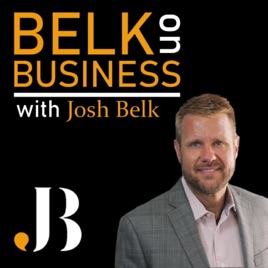
Advertise on podcast: Belk on Business
Rating
4.7from
This podcast has
207 episodes
Language
EnglishPublisher
Josh BelkExplicit
No
Date created
2019/03/15
Latest episode
2025/09/29
Average duration
14 min.
Release period
32 days
Description
Joshua Belk and his firm, Lodestar Tax and Consulting has been specializing in tax consultation, planning and preparation, business consultation and structure, and fractional CFO services since 1998. In addition to helping businesses and business owners reach their financial goals, Josh also helps to educate them in the complex matters of the business world which at times can be tedious for a business owner.
Unlock Belk on Business podcast Email contact info,
Listeners & Audience details
Email contact information
Direct podcast contact details

Listeners
Audience numbers & engagement insights

Audience details
Podcast Insights

Podcast episodes
Check latest episodes from Belk on Business podcast
Leadership Lessons from Loss, Love, and Legacy
2025/09/29
Welcome back to Belk on Business! I’m Josh Belk, and today’s episode is deeply personal and reflective. In light of the recent and tragic loss of Charlie Kirk, I take some time to unpack how his life and legacy speak directly to us—not only as business owners but as people of faith.
From courage and conviction to daily disciplines and sacrificial leadership, this episode is about the values that outlast any business deal. If you’ve ever wondered how to integrate your faith into your leadership or how to lead your team with purpose, love, and integrity, this message is for you.
3 Key Takeaways
Our Work Should Be Done Unto the Lord: As business owners who are believers, we’re called to serve with excellence—not just for clients, but to honor God in everything we produce.
Forgiveness Is the Hardest—and Holiest—Leadership Act: Through the powerful example of Charlie’s wife extending forgiveness to her husband’s killer, we’re reminded of the strength it takes to truly live out our faith.
Purpose-Driven Business Leaves a Legacy: Your business isn’t just a profit machine—it’s a platform. Use it to make an impact, love your team well, and stay faithful—even when the road is hard.
Episode Timeline & Highlights
[0:00] – Reflecting on the life and legacy of Charlie Kirk[1:11] – Why faith should be integrated into leadership and business[2:44] – The spiritual weight of entrepreneurship and the call to lead boldly[3:48] – Sacrifice and calling: not just about profits, but about purpose[5:01] – Treating your team as a mission field, not just employees[6:15] – The quality of your product is a reflection of your faith[7:36] – Daily disciplines: Scripture, prayer, and encouraging others[8:09] – Forgiveness in action: Erica Kirk’s stunning example of grace[9:09] – Can we forgive even when wronged in business?[9:45] – “Die with your boots on”: staying faithful through every season[10:30] – Encouragement to stay consistent, driven, and anchored in Christ
If this episode stirred your heart or made you reflect, please consider rating, following, and reviewing Belk on Business. And share this message with someone who could use a word of encouragement today. Let’s build businesses that reflect our deepest values—together.
Why Competence and Accuracy Matter More Than Ever in Business
2025/09/22
Welcome back to Belk on Business! I’m Josh Belk, and today we’re stepping away from our usual tax law breakdowns to talk about something just as essential—ethics and professionalism. Inspired by a deep dive into IRS Circular 230, I unpack three foundational principles that every business owner and professional should embody: competence, diligence as to accuracy, and handling conflicts of interest.
This episode isn’t just for accountants—it’s for anyone who wants to lead their business with integrity, build trust, and make sharper decisions. If you’re serious about being the kind of leader people respect and rely on, this one’s for you.
3 Key Takeaways
Competence Builds Trust: It’s not just about passing tests—real competence means staying current, asking for help, doing the research, and being thorough in every process.
Accuracy Demands Diligence: Whether you’re working with numbers or clients, accuracy starts with asking the right questions and ends with meticulous documentation and reasonable care.
Conflicts of Interest Can Derail Trust: Recognizing, disclosing, and properly managing conflicts is essential to maintain fairness, trust, and professional integrity.
Episode Timeline & Highlights
[0:00] – Why this episode is different: stepping into ethical principles from IRS Circular 230
[1:20] – What Circular 230 means for tax professionals—and business owners
[2:05] – The importance of competence and continuous learning
[3:07] – Knowing when to ask for help and delegate
[4:34] – Legal and procedural knowledge is essential in every business
[5:26] – Incompetence undermines trust—don’t fake what you don’t know
[7:17] – Diligence as to accuracy: asking the right questions and verifying info
[8:17] – Real-world examples of documentation, thoroughness, and AI pitfalls
[10:27] – Understanding the nuance of each client’s unique situation
[11:07] – Recognizing and resolving conflicts of interest in professional settings
[12:34] – Ethical behavior promotes fairness, trust, and decision-making clarity
[13:23] – Final thoughts on making decisions based on merit, data, and systems
Links & Resources
IRS Circular 230 Guidance: https://www.irs.gov/tax-professionals/circular-230
If this episode resonated with you, be sure to rate, follow, and review Belk on Business. And share it with a colleague who values doing business the right way. See you next time!
The Big Beautiful Bill Recap: Key Tax Changes You Need to Know
2025/09/15
Welcome back to Belk on Business! I’m Josh Belk, and in this episode, I wrap up our multi-week series covering the key provisions in the recently passed “Big Beautiful Bill.” From individual to business tax updates, I’ll walk you through the highlights that matter most as you start planning for the year-end and beyond.
We cover changes to tax brackets, deductions, credits, and business incentives—including what’s been made permanent, what’s temporary, and what’s still waiting for IRS guidance. Whether you’re a high-income earner, small business owner, or advisor, this summary will help you stay ahead of the game as the 2025 tax landscape comes into view.
3 Key Takeaways
Permanent Tax Policy Shifts: Lower tax brackets, standard deduction increases, and QBI deductions have been made permanent, along with notable changes to AMT and charitable deductions.
Temporary Incentives to Leverage Now: Opportunities like the $6,000 senior deduction, $25K tip income deduction, and auto loan interest deduction are only available from 2025 to 2028.
R&D and Depreciation Changes Need Watching: Bonus depreciation is back at 100%, and R&D expensing is restored—but with IRS guidance still pending, smart planning is critical.
Episode Timeline & Highlights
[0:00] – Wrapping up the series: What this episode will cover
[1:16] – Summary of individual tax changes: brackets, deductions, and credits
[2:02] – Standard deduction increase and the end of personal exemptions
[3:00] – Charitable deduction changes: new floor and above-the-line options
[3:42] – Temporary provisions: tips, overtime, and auto loan interest deductions
[4:40] – Adjustments to premium, child, and earned income tax credits
[5:03] – Estate tax exemption increase coming in 2026
[5:18] – Summary of business tax changes: R&D, depreciation, QBI, and energy credits
[6:52] – Section 179 expensing expansion and future guidance expected
[7:27] – Final thoughts on year-end planning and what to watch for in October
Links & Resources
IRS Tax Reform Updates: https://www.irs.gov/newsroom/tax-reform
R&D Credit Info: https://www.irs.gov/credits-deductions/individuals/research-credit
Section 179 Deduction Overview: https://www.irs.gov/publications/p946
If this episode helped you prepare or prompted some questions, make sure to rate, follow, and review Belk on Business. Share it with a colleague or client who needs to hear this—there’s still time to plan smart before year-end!
Trump Accounts & Tax Credits for Investing in Distressed Communities
2025/09/08
We break down what Trump Accounts really offer (and where they fall short), and then dive into how developers, business owners, and investors can tap into tax credits tied to low-income housing, new markets, and opportunity zones.
3 Key Takeaways
Trump Accounts Are Limited in Value: While they allow $5,000 in annual contributions and offer $1,000 from the government, they lack the flexibility and tax benefits of 529 plans or Roth IRAs.
Low-Income Housing Tax Credits Encourage Long-Term Development: Developers maintaining affordable housing in distressed areas can receive substantial tax credits, often spread over 30 years.
New Markets and Opportunity Zones Offer Strategic Incentives: Investors can claim up to 39% in tax credits over seven years for capital invested in qualified distressed communities—beyond just real estate.
Episode Timeline & Highlights
[0:00] – Introduction to today’s focus: Trump Accounts and community investment incentives
[1:12] – What are Trump Accounts, and how do they work?
[2:29] – Who qualifies, contribution limits, and tax treatment
[3:25] – Distribution rules, early withdrawal penalties, and qualified uses
[4:16] – Why 529 plans may still be the better option
[5:08] – Community investment credits: clean energy phase-out and private investment focus
[6:08] – Low-Income Housing Tax Credit explained
[7:15] – New Markets Tax Credit: how to apply and what you get
[8:34] – Opportunity Zones and real-world data from Chicago and Northwest Indiana
[9:56] – Final thoughts and preview of next episode
Links & Resources
IRS Qualified Opportunity Zones: https://www.irs.gov/credits-deductions/opportunity-zones
Low-Income Housing Tax Credit Overview: https://www.huduser.gov/portal/datasets/lihtc.html
New Markets Tax Credit Program: https://www.cdfifund.gov/programs-training/Programs/new-markets-tax-credit/Pages/default.aspx
If you found this episode helpful, don’t forget to rate, follow, and review Belk on Business. And be sure to share it with a fellow business owner, developer, or investor who could benefit from these tax-smart strategies.
Overtime Tax Breaks, Estate Planning & Small Business Stock Gains Explained
2025/09/01
Welcome back to Belk on Business! I’m Josh Belk, and in today’s episode, I’m diving into a new set of provisions from the recently passed “Big Beautiful Bill.” We’re shifting gears from the last few episodes and breaking down five key areas: tax relief on overtime pay, updated estate and gift tax exemptions, gambling deduction limits, changes to qualified small business stock, and updates to FMLA and meal deductions.
Whether you’re an employer managing payroll, a high-net-worth individual planning your estate, or a business owner looking at stock-based growth, there’s something in here that can affect your planning and your bottom line. Let’s get into the details.
3 Key Takeaways
No Tax on Overtime (2025–2028): Employees in tip-eligible industries can deduct the overtime portion of their pay (above their normal rate) up to $12.5K (single) or $25K (joint), regardless of itemizing.
Estate Tax Exemption Raised: The federal estate and gift tax exclusion jumps to $15M (plus inflation), giving families and high-net-worth individuals more room to plan.
QSBS Gains Can Be Excluded: Qualified Small Business Stock purchased after July 1, 2025, may offer up to 100% capital gains exclusion if held for five years, or rollover options similar to a 1031 exchange.
Episode Timeline & Highlights
[0:00] - Recap of previous episodes and what’s new in this one
[1:15] - No tax on overtime explained: who qualifies and what’s deductible
[3:25] - Example breakdown of how overtime deduction works
[6:32] - Employer payroll implications and what reporting might look like
[6:57] - Estate and gift tax exemption increased to $15M
[8:54] - Gambling losses now limited to 90% of winnings
[10:04] - What is Qualified Small Business Stock (QSBS) and how gain exclusions apply
[11:42] - Eligibility rules for QSBS, asset limits, and holding period
[14:00] - Family Medical Leave Act credits made permanent
[14:54] - Meal deduction changes—who still qualifies for 100%
Links & Resources
IRS Guidance on Overtime Tax Treatment (coming soon)
Estate & Gift Tax Overview: https://www.irs.gov/businesses/small-businesses-self-employed/estate-and-gift-taxes
Qualified Small Business Stock (QSBS) Rules: https://www.irs.gov/pub/irs-drop/n-18-48.pdf
Family and Medical Leave Credit Info: https://www.irs.gov/newsroom/employer-credit-for-paid-family-and-medical-leave
If this episode gave you a clearer understanding of the new tax provisions, don’t forget to rate, follow, and review Belk on Business. And share it with a colleague or business owner who should be planning ahead. Until next time—stay smart and strategic.
R&D Tax Credits & 1099 Rule Changes
2025/08/25
Welcome back to Belk on Business! I’m Josh Belk, and in this episode, we’re continuing our series on the recent legislative updates within the “Big Beautiful Bill.” Today, I’m breaking down two major topics that will impact a wide range of business owners: updates to the Research & Experimentation (R&E) credit, and new thresholds and requirements for issuing 1099 forms.
If you’re engaged in any kind of product development, software design, or custom business solutions, the R&E credit could unlock meaningful tax savings. And if you’re working with contractors or freelancers, the new 1099 rules are essential to stay compliant in 2025 and beyond.
3 Key Takeaways
R&E Credit Refined and Expanded: Businesses with under $31M in annual receipts can now fully expense domestic R&D costs in 2025 and 2026—no amortization required.
1099 Thresholds Increased: Starting in 2025, the threshold for issuing 1099s (NEC and MISC) increases from $600 to $2,000, reducing compliance headaches for many small businesses.
Startups Can Offset Payroll Taxes: Eligible startups may use R&E credits to offset up to $250,000 in payroll tax liability—an excellent benefit for growth-stage companies.
Episode Timeline & Highlights
[0:00] - Intro to today’s focus: R&E credits and 1099 compliance
[1:10] - What qualifies as R&E: The four-part test explained
[5:20] - Expense vs. amortization rules based on company size
[6:03] - Retroactive application for expenses dating back to 2021
[7:06] - What qualifies for the credit and what doesn’t
[8:27] - How R&E credits can be used against payroll taxes
[9:13] - New 1099 thresholds and what’s changed
[10:17] - Why collecting a W-9 is critical before paying contractors
[11:02] - 1099-K rules for online sales and merchant accounts
Links & Resources
IRS R&E (R&D) Credit Details: https://www.irs.gov/credits-deductions/individuals/research-credit
Form W-9 (Request for Taxpayer Identification): https://www.irs.gov/forms-pubs/about-form-w-9
1099 Filing Guide: https://www.irs.gov/forms-pubs/about-form-1099-nec
If this episode helped clarify these tax changes for you, be sure to follow, rate, and review Belk on Business. And don’t forget to share it with another business owner or financial leader in your network. Stay sharp and compliant—until next time!
Maximizing Tax Savings Under the New Bill: Brackets, SALT & QBI
2025/08/18
Welcome back to Belk on Business! I’m Josh Belk, and today I’m diving into another round of tax law updates from the recently passed “big beautiful bill.” This episode is all about understanding how some of the most impactful elements—like the tax bracket changes, SALT deduction cap, and Qualified Business Income (QBI) deduction—will affect you and your business.
If you’re a business owner, high-income earner, or just someone wanting to maximize your tax savings, this episode walks you through the practical implications of these changes and what steps you should consider before year-end to stay ahead.
3 Key Takeaways
Lower Tax Brackets Are Now Permanent: All tax brackets—except the top one—have been permanently reduced, benefitting low- and middle-income earners the most.
SALT Deduction Cap Increased Temporarily: From 2025 to 2028, the state and local tax deduction cap jumps to $40,000 for taxpayers earning under $500K.
QBI Deduction Rules Refined: While the 20% QBI deduction remains, income thresholds and business classifications (like specified service trades) still limit eligibility, especially for high earners.
Episode Timeline & Highlights
[0:00] - Intro and recap of the ongoing breakdown of the new bill
[1:04] - Overview of the bill’s timeline and political context
[1:40] - Permanent tax bracket changes and who benefits
[2:50] - The SALT deduction cap increased—but with income limits
[4:38] - Why you may need to rethink pass-through entity tax planning
[5:16] - Understanding the QBI deduction and specified trade/service business limitations
[7:07] - Income thresholds and complex calculation rules for high earners
[7:58] - Case example: strategic entity structuring to retain QBI eligibility
Links & Resources
IRS Tax Bracket Information: https://www.irs.gov/newsroom/irs-provides-tax-inflation-adjustments-for-tax-year-2025
SALT Deduction Overview: https://www.taxpolicycenter.org/briefing-book/what-salt-deduction
QBI Deduction (Section 199A) Guidelines: https://www.irs.gov/newsroom/section-199a-qualified-business-income-deduction
If this episode gave you clarity or sparked a few questions, be sure to rate, follow, and review Belk on Business. And don’t forget to share it with a friend or colleague who could benefit from these updates. See you in the next one!
Maximizing Deductions with Bonus Depreciation, Section 179 & More
2025/08/11
Welcome back to Belk on Business! I’m Josh Belk, and today we’re picking up where we left off with our ongoing series diving into the latest legislative updates that impact your financial strategy and tax planning. If you’re a real estate professional, investor, or business owner, this episode is packed with insights you won’t want to miss.
In this conversation, I unpack key updates around bonus depreciation, Section 179 expensing, and important changes to opportunity zones and interest expense deductions. From cost segregation strategies to navigating new OZ rules, this episode provides the clarity you need to make informed moves in the coming years.
3 Key Takeaways
100% Bonus Depreciation Is Back—and Permanent: Starting in 2025, qualifying 15-year property and equipment can again be fully depreciated in the year it’s placed in service, a big win for real estate pros and business owners.
Section 179 Expansion: The deduction cap has increased to $2.5M, and now includes items like HVAC systems, fire protection, and roofs—if you’re in an active trade or business.
Opportunity Zones Require New Strategy: The OZ program has undergone major changes—new eligibility, stricter reporting, and capital gains-only funding mean it’s more complex but still potentially powerful.
Episode Timeline & Highlights
[0:00] - Introduction
[0:35] - Recap of last week’s episode and transition to today’s topics
[1:08] - Why depreciation matters for real estate professionals and business owners
[2:20] - How the 2025 bonus depreciation changes could benefit your portfolio
[3:09] - Real-life example of using a cost segregation study for maximum write-offs
[4:17] - Expensing new factory and plant builds—and what qualifies
[5:18] - Section 179 updates: new thresholds and expanded eligibility
[6:21] - Passive investors vs. active business owners: who gets to claim what
[7:27] - Why you need to talk to your CPA before diving into opportunity zones
[9:14] - Update on interest expense deduction changes under section 163(j)
Links & Resources
IRS Section 179 Overview: https://www.irs.gov/publications/p946
Cost Segregation Guide: https://www.costsegregationinitiatives.com
Opportunity Zones Overview: https://opportunityzones.hud.gov
If you found this episode helpful, don’t forget to rate, follow, and review Belk on Business. And be sure to share it with your fellow real estate pros or business owners who want to grow smarter with tax strategy. See you next time!
Breaking Down the “No Tax on Tips” Deduction
2025/08/06
Welcome back to Belk on Business! I’m Josh Belk, and I’m excited to get back behind the mic with you. In this episode, we kick off a new series exploring the impactful legislation passed earlier this month. Over the coming weeks, we’ll break down how it could affect your business, your wallet, and your financial strategies.
Today, we dive into three of the campaign promises that made it into the bill—focusing specifically on no tax on tips, deductibility of car loan interest, and the new provisions around no tax on Social Security. If you’re a business owner, self-employed, nearing retirement, or just curious about how these changes could affect your bottom line, you won’t want to miss this one.
3 Key Takeaways
Not all tipped income is tax-free: Only certain occupations listed by the IRS (to be announced) will qualify for the tip income deduction—up to $25,000 for those under specific income thresholds.
Car loan interest deduction comes with conditions: Only new, personal-use vehicles manufactured in the U.S. qualify for the $10,000 deduction—use a VIN decoder to verify eligibility.
Social Security tax relief is limited: Individuals 65+ may deduct up to $6,000 of Social Security income, but standard state and income-level rules still apply.
Episode Timeline & Highlights
[0:00] - Kicking off a new podcast series and what’s coming in the next few weeks
[1:02] - Overview of today’s focus: no tax on tips, car loan interest deductions, and no tax on Social Security
[2:16] - Breaking down the “No Tax on Tips” deduction and who qualifies
[4:45] - Income limits and specific exclusions explained
[6:28] - Car loan interest deduction—what qualifies and how to verify your vehicle
[8:54] - New vs. used vehicle rules, commercial use exceptions, and documentation requirements
[9:41] - No tax on Social Security: who qualifies and how deductions apply
[10:51] - Why you still need to file in certain states—even with federal changes
Links & Resources
IRS Occupation List for Tip Deductions (coming October)
VIN Decoder for Vehicle Eligibility: https://vpic.nhtsa.dot.gov/decoder/
IRS 199A Guidance: https://www.irs.gov/newsroom/section-199a-qualified-business-income-deduction
If this episode helped clear things up or sparked new questions, make sure to follow, rate, and review the podcast. And don’t forget to share it with a fellow business owner or friend who could benefit from these updates. Until next time—here’s to growing smarter!
Hiring Your Children – Episode 198
2024/11/26
Hiring Your Children – Belk on Business – Episode 198
1) Complete all normal employment paperwork
2) Wage must be reasonable and comparable to other employees or others doing the same work
3) If your LLC is taxed as a disregarded entity or is a multimember LLC owned by the parents, no FICA if under 18 and your child and no FUTA if under 21
4) If Corporation, S Corporation or LLC taxed as a corporation, can set up management company owned by parent (sole proprietor or SMLLC) – pay legitimate management fee then pay child
5) Child must be paid through payroll as a W-2 employee. No federal income tax up to standard deduction ($14,600 in 2024). State withholding amount will depend on state’s exemption amount. Federal and state tax returns generally should be filed
6) The work performed by the child must be related to the business. Separate work and personal jobs
7) Can fund IRA or Roth IRA up to the lesser of earned income or $7,000 (2024)
8) Federal law generally permits children to work for businesses entirely owned by their parents, except mining, manufacturing, and any other occupation the Secretary of Labor has declared to be hazardous
9) Some states have age restrictions on top of the federal law, so check the specific labor laws in your state. States will have a minimum age for employment, what type of work is prohibited and what hours are permitted for work that cover both during school time and non-school time.
Subscribe on these platforms:
Apple Podcast: https://apple.co/2Zp6hgj
Spotify: https://lnkd.in/gcWDnFZ
Stitcher: https://bit.ly/34aRgO2
YouTube: https://youtu.be/t0QcKT44v5Q
The Augusta Rule - Episode 197
2024/11/19
The Augusta Rule – Belk on Business – Episode 197
The Augusta Rule (IRS Section 280A) allows homeowners to rent out their primary residence as a vacation or short-term rental or rent to a business for up to 14 days per year without needing to pay tax on the rents collected. There are compliance components be able to use the rule:
1) The residence must be rented for 14 days or less during the calendar year. If rented for more than 15 days, all the rental income becomes taxable.
2) The rental amount must be reasonable – fair market value / fair rental amount.
3) Your home cannot be your primary place of business (cannot use the home office deduction and the Augusta Rule).
4) If renting to your business your business must have the right structure (cannot be a sole-proprietor or single member LLC that reports on Schedule C). Entity must be taxed as a partnership or corporation.
5) There must be a true business purpose for the rental home such as business meetings, planning or strategy sessions, recording/marketing purposes, masterminds, etc.
6) Must have substantiation of the business relationship which would include a rental contract, invoice, meeting minutes, photos, invitations, agenda, emails, etc.
7) A 1099-MISC must be issued to you personally from the business if the rents exceed $600 during the year.
8) This rule can also apply to employees or shareholders of a corporation if covered under an accountable plan.
Subscribe on these platforms:
Apple Podcast: https://apple.co/2Zp6hgj
Spotify: https://lnkd.in/gcWDnFZ
Stitcher: https://bit.ly/34aRgO2
YouTube: https://youtu.be/1jGdh5z4cL4
2024 Year-end Tax Planning – Episode 196
2024/11/14
2024 Year-end Tax Planning – Belk on Business – Episode 196
Topics:
- EV credit
- 401k contribution limits
- IRA contribution limits
- HSA contribution limits
- Gift tax
- Foreign income exclusion
- BOI reporting
- Entity structure, documents, implementation - asset protection and taxation impact
- Basis in entity and tax implications
- Active vs passive investments
- Loss limitations
- STR vs SFR
- Real estate professional status
- Accredited investor status
- Depreciation
Subscribe on these platforms:
Apple Podcast: https://apple.co/2Zp6hgj
Spotify: https://lnkd.in/gcWDnFZ
Stitcher: https://bit.ly/34aRgO2
YouTube: https://youtu.be/wYMhWdqM3gM
Handling Disagreements – Episode 195
2024/07/29
Handling Disagreements – Belk on Business – Episode 195
We put processes to many things in our lives from making meals, doing laundry, scheduling, workflows in our business, product or service development. Etc. and having a process for handling disagreements can be a process as well. Unlike many areas we do put a process, handling disagreements can be hyper-emotional as we tend to stray from foundational principles or even those “core values” we ascribe to. Those values can become aspirational and any time a core value is aspirational, our ability to be inspirational, or to make an impact, diminishes. Determine beforehand if the conversation falls in my purview and is there any merit in having the conversation.
Points to consider when handling disagreements:
1) Ask yourself: “Am I willing to sacrifice a relationship over being right?” What is preeminent, the relationship or my ego? Address the problem, the policy, the process without attacking the person.
2) Allow for a space of grace both for you and the person. Take time to develop a proper response or if a response is needed at all. Take the necessary to respond when necessary and not react out of emotion
3) Try to understand more deeply the situation and see the issue from the other person’s point of view
4) Find the merits in their point of view and be humble enough to admit when you’re wrong or lack the knowledge or understanding on the issue or their point of view
5) Ask good, clarifying questions to understand their point of view, not to corner them into your point of view. Try to restate their point of view in a manner that you both understand and ask if the restatement is accurate.
6) Beware of phrasing or using a tone that would make your opinion come across as fact. Use facts liberally and opinions scarcely.
7) Always be kind, even when being firm. Use of personal attacks or using condescending language generally comes from a place of either arrogance, insecurity or a lack of self-awareness
8) Lead with humility or humbly walk away. Finding common ground always requires humility, a willingness to listen, a wIllingness to compromise.
Subscribe on these platforms:
Apple Podcast: https://apple.co/2Zp6hgj
Spotify: https://lnkd.in/gcWDnFZ
Stitcher: https://bit.ly/34aRgO2
YouTube: https://youtu.be/_PSRN8NskkA
Mindset for Tax and Business Planning – Ep 194
2024/07/23
Mindset for Tax and Business Planning – Belk on Business – Episode 194
- The planning process shouldn’t be in a vacuum
- All planning should begin with keeping the mission and purpose as preeminent
- The tax system is built to get taxpayers to act in certain ways by rewarding and punishing certain behaviors
- Don’t blindly follow what others are selling or doing when it comes to planning.
- Ask if the plannings help protect the business financially, legally and culturally
Subscribe on these platforms:
Apple Podcast: https://apple.co/2Zp6hgj
Spotify: https://lnkd.in/gcWDnFZ
Stitcher: https://bit.ly/34aRgO2
YouTube: https://youtu.be/KA-pVLWrQV8
Developing Yourself and Your Team – Episode 192
2024/07/08
Developing Yourself and Your Team – Belk on Business – Episode 192
1) Developing yourself – you are the average of the five people with whom you spend the most time – all intakes should be evaluated as to alignment with core values yet open minded enough to challenge any preconceived norms or assumptions. Your associations will impact your outcomes.
- Develop yourself through articles, classes, conferences, webinars, podcasts and books
- Have an accountability group such as a mastermind or small business group which you are comfortable venturing beyond just the professional but also the personal (emotional, spiritual)
- Have a coach you can trust and to whom you choose to be fully transparent and willing to hold yourself accountable
2) Developing your team
- Don’t just develop their skillset but invest in developing in a holistic way to become leaders at work, at home and in the community
- Be transparent so they know how you see situations so to understand how you think (your paradigms)
- Regularly walk around and talk to your team
- Bring team members along to events, meetings, etc.
- Go along with team members as appropriate (from listening in on meetings to out of office functions that you are invited)
- Understand your team members goals, dreams, desires and needs
- Communicate the how, why, and who – this is how we do things, this is why we do it and this is who we serve
Subscribe on these platforms:
Apple Podcast: https://apple.co/2Zp6hgj
Spotify: https://lnkd.in/gcWDnFZ
Stitcher: https://bit.ly/34aRgO2
YouTube: https://youtu.be/gQyQJml0JBo
Podcast reviews
Read Belk on Business podcast reviews
jberlin2 2021/12/16
Great Business & Accounting Podcast
Great business & accounting podcast for professional, business, & personal development with great straight to the point topics.
Manuel Corazzari 2020/09/22
Amazing Up-to-date Insights!
I truly enjoy Josh Belk passion to help inspire business entrepreneurs to grow their leadership skills. With his short and powerful episodes we get gr...
Luckybanda 2020/12/10
Belk went to Jail!!!
I would not trust Belk as he stole from his previous employer and went to jail! Not a decent guy.
Richierich72910 2020/05/28
A great person with great info
I’ve known Josh for years and am privileged to know him and count him a friend. He has so much wisdom when it comes to business that anyone who listen...
AceDemolisher55 2019/09/12
Dad
My dad’s the BEST
Podcast sponsorship advertising
Start advertising on Belk on Business relevant audience podcasts
You may also like to advertise on these Podcasts

00242
Your Radio Doctor
Audacy

00218
AutoMobil
Blitzer.de
00358
Issues Program
Audacy

11212
Voice over Work - An Audiobook Sampler
Russell Newton

00156
Entspannungsgeräusche | by Relaxing White Noise
Entspannungsgeräusche I by Relaxing White Noise

0057
Stripped
Jacko Wusch

0022
Un Café Digital hablando de Marketing Digital
Ramiro Parias

0028
Tuf Scene
John Salem

00149
Your Life, Your Call, Let's Talk with Stefan Lindberg-Jones
SLJCoach

00125
Podcast des personnages
Jérémy Laliberté