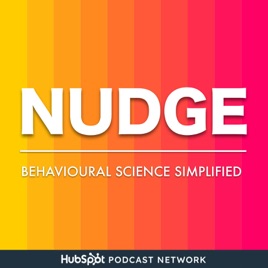
Advertise on podcast: Nudge
Rating
4.7from
This podcast has
289 episodes
Language
EnglishPublisher
Phill AgnewExplicit
No
Date created
2019/03/25
Latest episode
2026/04/20
Average duration
28 min.
Release period
7 days
Description
Nudge is the UK's #1 marketing podcast, breaking down the hidden psychology behind what we do and why we do it. No BS, just smart, science-backed insights that actually work.
Unlock Nudge podcast Email contact info,
Listeners & Audience details
Email contact information
Direct podcast contact details

Listeners
Audience numbers & engagement insights

Audience details
Podcast Insights

Podcast episodes
Check latest episodes from Nudge podcast
Nir Eyal “Why These £39 Placebo Pills Actually Work”
2026/04/20
There's a pill on Amazon called Fukitol.
It contains nothing. And yet people buy it, swear by it, and give it five stars.
Today, Nir Eyal explains the remarkable science behind why placebos work.
---
Listen to the bonus episode: https://nudge.kit.com/40414a1b44
Nir’s book Beyond Belief: geni.us/beyondbelief
Nir’s free belief change guide: nirandfar.com/belief-change
Join 11,934 readers of the Nudge Newsletter: https://www.nudgepodcast.com/mailing-list
Unlock the Nudge Vaults: https://www.nudgepodcast.com/vaults
Connect on LinkedIn: https://www.linkedin.com/in/phill-agnew/
---
Today’s sources:
Ariel, G., & Saville, W. (1972). Anabolic steroids: The physiological effects of placebos. Medicine and Science in Sports and Exercise, 4(2), 124–126.
Branthwaite, A., & Cooper, P. (1981). Analgesic effects of branding in treatment of headaches. British Medical Journal (Clinical Research Ed.), 282(6276), 1576–1578.
Dawkins, L., Shahzad, F. Z., Ahmed, S. S., & Edmonds, C. J. (2011). Expectation of having consumed caffeine can improve performance and mood. Appetite, 57(3), 597–600.
Draganich, C., & Erdal, K. (2014). Placebo sleep affects cognitive functioning. Journal of Experimental Psychology: Learning, Memory, and Cognition, 40(3), 857–864.
Kaptchuk, T. J. (2018). Open-label placebo: Reflections on a research agenda. Perspectives in Biology and Medicine, 61(3), 311–334.
Lee, C., Linkenauger, S. A., Bakdash, J. Z., Joy-Gaba, J. A., & Profitt, D. R. (2011). Putting like a pro: The role of positive contagion in golf performance and perception. PLoS One, 6(10), e26016.
Plassmann, H., O'Doherty, J., Shiv, B., & Rangel, A. (2008). Marketing actions can modulate neural representations of experienced pleasantness. Proceedings of the National Academy of Sciences, 105(3), 1050–1054.
Richter, C. P. (1957). On the phenomenon of sudden death in animals and man. Psychosomatic Medicine, 19(3), 191–198.
Rozenkrantz, L., Mayo, A. E., Ilan, T., Hart, Y., Noy, L., & Alon, U. (2017). Placebo can enhance creativity. PLoS One, 12, e0182466.
Wager, T. D., Rilling, J. K., Smith, E. E., Sokolik, A., Casey, K. L., Davidson, R. J., et al. (2004). Placebo-induced changes in fMRI in the anticipation and experience of pain. Science, 303(5661), 1162–1167.
What the World’s ‘Best Chat-Up Line’ Reveals About Human Psychology
2026/04/13
Professor Richard Wiseman wanted to discover the world’s #1 chat-up line.
But in doing so, he discovered several secrets behind human psychology.
On today’s Nudge he covers:
1) Why councils shouldn’t pay people to sweep litter
2) How a saleswoman doubled her likeability
3) The picture Richard uses to never lose his wallet
4) And the #1 chat-up line
---
Richard’s book Quirkology: https://amzn.to/4shYOJ6
Richard’s book 59 Seconds: https://amzn.to/3Pf9pWI
Richard’s SubStack: https://richardwiseman.substack.com/
Join 11,934 readers of the Nudge Newsletter: https://www.nudgepodcast.com/mailing-list
Unlock the Nudge Vaults: https://www.nudgepodcast.com/vaults
Connect on LinkedIn: https://www.linkedin.com/in/phill-agnew/
---
Aronson, E., Willerman, B., & Floyd, J. (1966). The effect of a pratfall on increasing interpersonal attractiveness. Psychonomic Science, 4, 227–228.
Hornstein, H. A., Fisch, E., & Holmes, M. (1968). Influence of a model’s feeling about his behavior and his relevance as a comparison on other observers’ helping behavior. Journal of Personality and Social Psychology, 10(3), 222–226.
Kohn, A. (1993). Punished by rewards: The trouble with gold stars, incentive plans, A’s, praise, and other bribes. Boston: Houghton Mifflin.
Lepper, M. R., Greene, D., & Nisbett, R. E. (1973). Undermining children’s intrinsic interest with extrinsic reward: A test of the “overjustification” hypothesis. Journal of Personality and Social Psychology, 28, 129–137.
Learn psychological pricing in 24 minutes
2026/04/06
I get a lot of questions about pricing.
Should I start with our most expensive item first?
Should I use precise prices instead of rounded ones when negotiating?
Should I name competitors when comparing prices?
Today, with pricing expert Dr Markus Husemann-Kopetzky we work through eight different psychological pricing tips in just 24 minutes.
---
Listen to the bonus episode: https://nudge.kit.com/a737588e58
Markus’ book: https://amzn.to/46Hetcg
Unlock the Nudge Vaults: https://www.nudgepodcast.com/vaults
Join 10,634 readers of my newsletter: https://www.nudgepodcast.com/mailing-list
Connect on LinkedIn: https://www.linkedin.com/in/phill-agnew/
---
Today’s sources:
Bertini, M., & Wathieu, L. (2008). Research note—Attention arousal through price partitioning. Marketing Science, 27(2), 236–246.
Bolton, L. E., Warlop, L., & Alba, J. W. (2003). Consumer perceptions of price (un)fairness. Journal of Consumer Research, 29(4), 474–491.
Janiszewski, C., & Uy, D. (2008). Precision of the anchor influences the amount of adjustment. Psychological Science, 19(2), 121–127.
Kim, H. M., & Kramer, T. (2006). The moderating effects of need for cognition and cognitive effort on responses to multi‐dimensional prices. Journal of Marketing Research.
Krishnan, B. C., Biswas, A., & Netemeyer, R. G. (2006). Semantic cues in reference price advertisements: The moderating role of cue concreteness. Journal of Retailing, 82(2), 95–104.
Suk, K., Lee, J., & Lichtenstein, D. R. (2012). The influence of price presentation order on consumer choice. Journal of Marketing Research, 49(5), 708–717.
Thomas, M., Simon, D. H., & Kadiyali, V. (2010). The price precision effect: Evidence from laboratory and market data. Marketing Science, 29(1), 175–190.
Tversky, A., & Kahneman, D. (1974). Judgment under uncertainty: Heuristics and biases. Science, 185(4157), 1124–1131.
Wansink, B., Kent, R. J., & Hoch, S. J. (1998). An anchoring and adjustment model of purchase quantity decisions. Journal of Marketing Research, 35(1), 71–81.
Will Guidara: How Cognac solved a major problem at the world’s #1 restaurant
2026/03/30
Most restaurants have a major problem.
Paying the bill.
Give the bill too early, and the customer feels rushed. Too late, and they feel ignored.
To solve this problem (and many more), Will Guidara turned to behavioural science.
And his solution helped his restaurant become the world’s best.
---
Listen to the bonus episode: https://nudge.kit.com/aeea58886f
Will’s book Unreasonable Hospitality: https://amzn.to/4tPrMl8
Will’s new book The Field Guide: https://amzn.to/3Orq1u0
Will’s newsletter, Pre-Meal: https://www.unreasonablehospitality.com/premeal
Unlock the Nudge Vaults: https://www.nudgepodcast.com/vaults
Join 10,728 readers of my newsletter: https://www.nudgepodcast.com/mailing-list
Connect on LinkedIn: https://www.linkedin.com/in/phill-agnew/
---
Today’s sources:
Kahneman, D., Fredrickson, B. L., Schreiber, C. A., & Redelmeier, D. A. (1993). When more pain is preferred to less: Adding a better end. Psychological Science, 4(6), 401–405.
Shotton, R. (2023). The illusion of choice: 16½ psychological biases that influence what we buy. Harriman House.
Strohmetz, D. B., Rind, B., Fisher, R., & Lynn, M. (2002). Sweetening the till: The use of candy to increase restaurant tipping. Journal of Applied Social Psychology, 32(2), 300–309.
How this fraudster sold fake Scottish tea to the rich & famous
2026/03/23
In 2015, the media became obsessed with one man’s attempts to grow tea in the Scottish Highlands.
The BBC profiled him on the One Show. Radio reporters flocked to interview him. Even the Chinese national news agency reported his work.
Tam O’Braan (as he was then known) was the first to ever sell Scottish tea, and the press went wild.
Fornum and Mason bought his leaves. The Dorchester created a new Scottish tea-tasting menu. Barack Obama reportedly tried his tea, and the Queen loved it.
Tam’s business started bringing in hundreds of thousands of pounds. But soon his lies began to unravel.
Today, with Jaega Wise, we tell the story of the Scottish tea scandal. We explain how Tam O’Brann fooled the world and the psychology behind why so many customers believed him.
---
Listen to the BBC Food Program’s show on the scandal: https://www.bbc.co.uk/programmes/m002mn01
Learn more about Jaega: https://www.jaegawise.com/
Unlock the Nudge Vaults: https://www.nudgepodcast.com/vaults
Join 10,828 readers of my newsletter: https://www.nudgepodcast.com/mailing-list
Connect on LinkedIn: https://www.linkedin.com/in/phill-agnew/
---
Today’s sources:
Koschate-Fischer, N., Diamantopoulos, A., & Oldenkotte, K. (2012). Are consumers really willing to pay more for a favorable country image? A study of country-of-origin effects on willingness to pay. Journal of International Marketing, 20(1), 19–41.
Langer, E. J., Blank, A., & Chanowitz, B. (1978). The mindlessness of ostensibly thoughtful action: The role of “placebic” information in interpersonal interaction. Journal of Personality and Social Psychology, 36(6), 635–642.
Mackie, D. M., Worth, L. T., & Asuncion, A. G. (1990). Processing of persuasive in-group messages. Journal of Personality and Social Psychology, 58(5), 812–822.
Maier, L., Schreier, M., Baccarella, C. V., & Voigt, K.-I. (2023). University knowledge inside: How and when university–industry collaborations make new products more attractive to consumers. Journal of Marketing.
Peterson, R. A., Kim, Y., & Jeong, J. (2019). Out-of-stock, sold out, or unavailable? Framing a product outage in online retailing. Journal of Marketing Theory and Practice.
Will Guidara: “Here’s how I built the world’s #1 restaurant"
2026/03/16
Will Guidara is the co-founder and restaurateur behind the world’s best restaurant.
But Will’s not a standard restaurateur. He didn’t just focus on creating the best food.
He used psychology and behavioural science to build the best experience.
Listen to learn how his restaurant became #1 by using anchoring, reciprocity and many more psych principles.
---
Listen to the bonus episode: https://nudge.kit.com/aeea58886f
Will’s book Unreasonable Hospitality: https://amzn.to/4tPrMl8
Will’s new book The Field Guide: https://amzn.to/3Orq1u0
Will’s newsletter, Pre-Meal: https://www.unreasonablehospitality.com/premeal
Unlock the Nudge Vaults: https://www.nudgepodcast.com/vaults
Join 10,728 readers of my newsletter: https://www.nudgepodcast.com/mailing-list
Connect on LinkedIn: https://www.linkedin.com/in/phill-agnew/
---
Today’s sources:
Mukherjee, A., Smith, R. J., & Burton, S. (2021). The effect of positive anticipatory utility on product pre-order evaluations and choices. Journal of the Academy of Marketing Science, 51, 551–569.
Pariyadath, V., & Eagleman, D. M. (2007). The effect of predictability on subjective duration. PLOS ONE, 2(11), e1264.
Can this “magic” number change your behaviour?
2026/03/09
Do nine-ending prices really work?
Will £9.99 sell more than £10.00? Can it be used for high-quality products? What about hedonic products? Can it be used on speed limits?
For years this debate has raged on. But today on Nudge, I speak with pricing expert Dr Markus Husemann-Kopetzky to settle the argument.
---
Markus’ book: https://amzn.to/46Hetcg
Unlock the Nudge Vaults: https://www.nudgepodcast.com/vaults
Join 10,534 readers of my newsletter: https://www.nudgepodcast.com/mailing-list
Connect on LinkedIn: https://www.linkedin.com/in/phill-agnew/
---
Today’s sources:
Gendall, P. (1998). Estimating the effect of odd pricing. Journal of Product & Brand Management, 7(5), 421–432.
Husemann-Kopetzky, M. (2018). Handbook on the psychology of pricing: 100+ effects on persuasion and influence every entrepreneur, marketer and pricing manager needs to know. Independently published.
ITN Archive. (2022, November 28). “I will not accept that it’s a highly dangerous road” (1988) [Video]. YouTube.
Kim, J., Novemsky, N., & Dhar, R. (2013). Adding small differences can increase similarity and choice. Psychological Science, 24(2), 176–182.
Nunes, J. C., & Park, C. W. (2003). Incommensurate resources: Not just more of the same. Journal of Marketing Research, 40(1), 26–38.
Rubinstein, A., & Yee, V. (2020). The left-digit bias: When and why are consumers penny wise and pound foolish? Journal of Marketing Research, 57(3), 467–485.
Schindler, R. M., & Kibarian, T. M. (1996). Increased consumer sales response through use of 99-ending prices. Journal of Retailing, 72(2), 187–199.
Shotton, R. (2018). The choice factory: 25 behavioural biases that influence what we buy. Harriman House.
Suwelack, T., Hogreve, J., & Hoyer, W. D. (2011). Understanding money-back guarantees: Cognitive, affective, and behavioral effects. Journal of Retailing, 87(4), 462–478.
Wadhwa, M., & Zhang, K. (2015). This number just feels right: The impact of roundedness of price numbers on product evaluations. Journal of Consumer Research, 41
Are we all just status-seeking monkeys?
2026/03/02
Today on Nudge, Professor Katie Slocombe shares how chimpanzees handle power, build alliances, and jostle for status in their troop.
It’s the first time on Nudge that we’ve looked at the primate roots of leadership and influence, with plenty of insight into how we humans behave at work (and everywhere else). Don’t miss it.
---
Subscribe to the Nudge Newsletter (and get a surprise gift): https://nudge.kit.com/subscribe
Connect on LinkedIn: https://www.linkedin.com/in/phill-agnew/
Watch Nudge on YouTube: https://www.youtube.com/@nudgepodcast/
---
Today’s sources:
Slocombe, K. E., & Zuberbühler, K. (2007). Chimpanzees modify recruitment screams as a function of audience composition. Proceedings of the National Academy of Sciences of the United States of America, 104(43), 17228–17233.Slocombe, K. E., Waller, B. M., & Liebal, K. (2011). The language void: The need for multimodality in primate communication research. Animal Behaviour, 81(5), 919–924.
“These two words increased sales by 18%.” Robert Cialdini
2026/02/23
16 years ago a chain of Chinese restaurants wanted to increase sales without changing the price.
They didn’t change the product.
The service.
The chef.
The food.
Instead, they changed two words on their menu and increased sales by 18%.
The restaurants used the advice of today’s guest on Nudge, Robert Cialdini.
Today, Cialdini explains the social proof principle, sharing how changing just two words could increase your sales.
---
Unlock the Nudge Vaults: https://www.nudgepodcast.com/vaults
Read Cialdini’s bestseller Influence: https://amzn.to/4prHb7Y
Read the new and expanded Influence: https://amzn.to/43TY0jI
Read Pre-Suasion: https://amzn.to/48hA6Qr
Read Yes! (Containing 60 Psyc-Marketing Tips): https://amzn.to/48ddNNf
Join 10,428 readers of my newsletter: https://www.nudgepodcast.com/mailing-list
Connect on LinkedIn: https://www.linkedin.com/in/phill-agnew/
---
Today’s sources:
Aune, R. K., & Basil, M. D. (1994). A relational-obligations approach to fund-raising: The effects of guilt and credibility appeals on compliance. Communication Research, 21(4), 486–498.
Binning, K. R., Kaufmann, N., McGreevy, E. M., Fotuhi, O., Chen, S., Marshman, E., Kalender, Z. Y., Limeri, L. B., Betancur, L., & Singh, C. (2020). Changing social contexts to foster equity in college science courses: An ecological-belonging intervention. Psychological Science, 31(9), 1059–1070.
Boh, W. F., & Wong, S.-S. (2015). Managers versus co-workers as referents: Comparing social influence effects on within- and outside-subsidiary knowledge sharing. Organizational Behavior and Human Decision Processes, 126, 1–17.
Borman, G. D., Rozek, C. S., Hanselman, P., & Destin, M. (2019). Reappraising academic and social adversity improves middle school students’ academic achievement, behavior, and well-being. Proceedings of the National Academy of Sciences of the United States of America, 116(33), 16286–16291.
Cai, H., Chen, Y., & Fang, H. (2009). Observational learning: Evidence from a randomized natural field experiment. American Economic Review, 99(3), 864–882.
Frank, R. H. (2020). Under the influence: Putting peer pressure to work. Princeton University Press.
Goldstein, N. J., Cialdini, R. B., & Griskevicius, V. (2008). A room with a viewpoint: Using social norms to motivate environmental conservation in hotels. Journal of Consumer Research, 35(3), 472–482.
Hallsworth, M., List, J. A., Metcalfe, R. D., & Vlaev, I. (2017). The behavioralist as tax collector: Using natural field experiments to enhance tax compliance. Journal of Public Economics, 148, 14–31.
Jung, J., Busching, R., & Krahé, B. (2019). Catching aggression from one’s peers: A longitudinal and multilevel analysis. Social and Personality Psychology Compass, 13(4), e12440.
Linder, J. A., Meeker, D., Fox, C. R., Friedberg, M. W., Persell, S. D., Goldstein, N. J., Knight, T. K., Hay, J. W., & Doctor, J. N. (2017). Durability of benefits of behavioral interventions on inappropriate antibiotic prescribing in primary care: Follow-up from a cluster randomized clinical trial. JAMA, 318(14), 1391–1392.
Meeker, D., Linder, J. A., Fox, C. R., Friedberg, M. W., Persell, S. D., Goldstein, N. J., Knight, T. K., Hay, J. W., & Doctor, J. N. (2016). Effect of behavioral interventions on inappropriate antibiotic prescribing among primary care practices: A randomized clinical trial. JAMA, 315(6), 562–570.
Murrar, S., Campbell, M. R., & Brauer, M. (2020). Exposure to peers’ pro-diversity attitudes increases inclusion and reduces the achievement gap. Nature Human Behaviour, 4(9), 889–897.
Nolan, J. M. (2021). Social norm interventions as a tool for pro-climate change. Current Opinion in Psychology, 42, 120–125.
Peterson, R. A., Kim, Y., & Jeong, J. (2020). Out-of-stock, sold out, or unavailable? Framing a product outage in online retailing. Psychology & Marketing, 37(4), 535–547.
When you can’t stop seeing the thing you’ve just discovered
2026/02/16
I watched Home Alone and suddenly started hearing the theme tune everywhere.
I thought I was going insane.
But Tom Bowden-Green and Luan Wise explained that I actually fell for a fairly well-known bias.
A bias you’ve almost certainly experienced as well.
---
Come to Uplift Live: https://uplift-live.com/
(Use code NUDGE to get £50 off)
Tom and Luan’s book: https://amzn.to/49aZnh3
Unlock the Nudge Vaults: https://www.nudgepodcast.com/vaults
Join 10,428 readers of my newsletter: https://www.nudgepodcast.com/mailing-list
Connect on LinkedIn: https://www.linkedin.com/in/phill-agnew/
---
Today’s sources:
Costello, J. P., Garvey, A. M., Germann, F., & Wilkie, J. E. B. (2024). The Uptrend Effect: Encouraging healthy behaviors through greater inferred normativity. Journal of Marketing Research, 61(1), 110–127.
Cruz, R. E., Leonhardt, J. M., & Pezzuti, T. (2017). Second person pronouns enhance consumer involvement and brand attitude. Journal of Interactive Marketing, 39(1), 104–116.
Khan, U., & Dhar, R. (2006). Licensing effect in consumer choice. Journal of Marketing Research, 43(2), 259–266.
Lim, S., van Osselaer, S. M., Goodman, J. K., Fuchs, C., & Schreier, M. (2024). The Starbucks effect: When name-based order identification increases customers’ store preference and service satisfaction. Journal of Retailing, 100(2), 316–329.
Sahni, N. S., Wheeler, S. C., & Chintagunta, P. (2018). Personalization in email marketing: The role of noninformative advertising content. Marketing Science, 37(2), 236–258.
Van Boven, L., Dunning, D., & Loewenstein, G. (2000). Egocentric empathy gaps between owners and buyers: Misperceptions of the endowment effect. Journal of Personality and Social Psychology, 79(1), 66–76.
van der Meulen, M. (2022). Are we indeed so illuded? Recency and frequency illusions in Dutch prescriptivism. Languages, 7(1), 42.
Zwicky, A. (2006). Why are we so illuded. Retrieved from https://web.stanford.edu/~zwicky/LSA07illude.abst.pdf
The Psych-Trick Behind One of the Decade’s Fastest Growing Orgs
2026/02/09
HelloFresh is one of the fastest-growing companies of the past 20 years.
And it’s down to one, relatively simple behavioural science tactic.
---
Subscribe to the Nudge Vaults: https://www.nudgepodcast.com/vaults
See Agent Spark in action at gwi.com/spark
Read Mehdi’s book: https://amzn.to/48ORuO2
Here's Medhi's website: https://tinyurl.com/ymnu6jty
Sign up for my newsletter: https://www.nudgepodcast.com/mailing-list
Connect on LinkedIn: https://www.linkedin.com/in/phill-agnew/
Watch Nudge on YouTube: https://www.youtube.com/@nudgepodcast/
---
Today’s sources:
Buechel, E., & Li, R. (2022). Mysterious consumption: Preference for horizontal (vs. vertical) uncertainty and the role of surprise. Journal of Consumer Research, 49(6), 987–1004.
Norton, M. I., Mochon, D., & Ariely, D. (2012). The IKEA effect: When labor leads to love. Journal of Consumer Psychology, 22(3), 453–460.
Skinner, B. F. (1948). “Superstition” in the pigeon. Journal of Experimental Psychology, 38(2), 168–172.
BBC News. (2015, August 12). The man who discovered Harry Potter [Video]. YouTube
Melanie Wass. (2019, September 16). J.K. Rowling – Insights on creating Harry Potter world [Video]. YouTube.
Real-world examples of cognitive biases
2026/02/02
Most of us are completely oblivious to the cognitive biases that dictate how we live our lives.
Today, with Tom Bowden-Green and Luan Wise, we cover seven cognitive biases that all of us fall for.
---
Tom and Luan’s book: https://amzn.to/49aZnh3
Unlock the Nudge Vaults: https://www.nudgepodcast.com/vaults
See Agent Spark in action at gwi.com/spark
Join 10,428 readers of my newsletter: https://www.nudgepodcast.com/mailing-list
Connect on LinkedIn: https://www.linkedin.com/in/phill-agnew/
---
Today’s sources:
Chambers, J. R. (2008). Explaining false uniqueness: Why we are both better and worse than others. Social and Personality Psychology Compass, 2(2), 878–894.
Dunning, D. (2011). The Dunning–Kruger effect: On being ignorant of one’s own ignorance. In Advances in experimental social psychology (Vol. 44, pp. 247–296). Academic Press.
Einhorn, H. J., & Hogarth, R. M. (1978). Confidence in judgment: Persistence of the illusion of validity. Psychological Review, 85(5), 395–416.
Helmreich, R., Aronson, E., & LeFan, J. (1970). To err is humanizing sometimes: Effects of self-esteem, competence, and a pratfall on interpersonal attraction. Journal of Personality and Social Psychology, 16(2), 259–264.
Koskie, M. M., & Locander, W. B. (2023). Cool brands and hot attachments: Their effect on consumers’ willingness to pay more. European Journal of Marketing, 57(4), 905–929.
Pronin, E., Lin, D. Y., & Ross, L. (2002). The bias blind spot: Perceptions of bias in self versus others. Personality and Social Psychology Bulletin, 28(3), 369–381.
Van Hoorens, V. (1993). Self-enhancement and superiority biases in social comparison. European Review of Social Psychology, 4, 113–139.
White, G. L., Fishbein, M., & Rutstein, R. C. (1981). Passionate love and the misattribution of arousal. Journal of Personality and Social Psychology, 41(1), 56–62.
“This common pricing strategy is completely wrong!” Robert Cialdini
2026/01/26
“Say you’ve calculated your price and it comes out at £120,121.
Most would round it down to £120,000.
That’s completely wrong.”
That’s what Robert Cialdini told me on the latest episode of Nudge.
He also explained why the Prime energy drink first succeeded and then flopped.
How Disney kept us hooked on classic movies.
And how he applies the authority bias to sell his own products.
---
Unlock the Nudge Vaults: https://www.nudgepodcast.com/vaults
See Agent Spark in action at gwi.com/spark
Read Cialdini’s bestseller Influence: https://amzn.to/4prHb7Y
Read the new and expanded Influence: https://amzn.to/43TY0jI
Read Pre-Suasion: https://amzn.to/48hA6Qr
Read Yes! (Containing 60 Psyc-Marketing Tips): https://amzn.to/48ddNNf
Join 10,226 readers of my newsletter: https://www.nudgepodcast.com/mailing-list
Connect on LinkedIn: https://www.linkedin.com/in/phill-agnew/
---
Today’s sources:
Cialdini, R. B. (2021). Influence: The psychology of persuasion (New & expanded ed.). Harper Business.
Dunn, E. W., & Norton, M. I. (2013). Happy money: The science of happier spending. Simon & Schuster.
Nelissen, R. M. A., & Meijers, M. H. C. (2011). Social benefits of luxury brands as costly signals of wealth and status. Evolution and Human Behavior, 32(5), 343–355.
West, S. G. (1975). Increasing the attractiveness of college cafeteria food: A reactance theory perspective. Journal of Applied Psychology, 60(5), 656–658.
Wilson, P. R. (1968). Perceptual distortion of height as a function of ascribed academic status. Journal of Social Psychology, 74(1), 97–102.
Worchel, S., Lee, J., & Adewole, A. (1975). Effects of scarcity on value perception: The cookie-jar study. Journal of Personality and Social Psychology, 31(5), 791–799.
Robert Cialdini: “This study on 6,700 websites proved my principle!”
2026/01/19
This study analysed 6,700 websites in an unprecedented A/B test.
The results proved something that Dr Robert Cialdini had been preaching for years.
Today, on Nudge, Robert Cialdini joins me again, covering another of his seven principles of persuasion.
And I share a marketing lesson that (I think) every business needs to know.
---
Unlock the Nudge Vaults: https://www.nudgepodcast.com/vaults
See Agent Spark in action at gwi.com/spark
Read Cialdini’s bestseller Influence: https://amzn.to/4prHb7Y
Read the new and expanded Influence: https://amzn.to/43TY0jI
Read Pre-Suasion: https://amzn.to/48hA6Qr
Read Yes! (Containing 60 Psyc-Marketing Tips): https://amzn.to/48ddNNf
Join 10,189 readers of my newsletter: https://www.nudgepodcast.com/mailing-list
Connect on LinkedIn: https://www.linkedin.com/in/phill-agnew/
---
Today’s sources:
Bell, T. [Taylor Bell]. (2025, February 13). Inside Trader Joe’s: The genius strategy behind its cult following (and low prices) [Video]. YouTube.
Bornstein, R. F., Leone, D. R., & Galley, D. J. (1987). The generalizability of subliminal mere exposure effects: Influence of stimuli perceived without awareness on social behavior. Journal of Personality and Social Psychology, 53(6), 1070–1079.
Browne, D., & Swarbrick-Jones, A. (2017). The science of persuasion in e-commerce: An analysis of 6,700 online A/B tests. Conversion Rate Experts.
Danziger, S., Levav, J., & Avnaim-Pesso, L. (2011). Extraneous factors in judicial decisions. Proceedings of the National Academy of Sciences of the United States of America, 108(17), 6889–6892.
Drachman, D., deCarufel, A., & Insko, C. A. (1978). The extra credit effect in interpersonal attraction. Journal of Experimental Social Psychology, 14(5), 458–465.
Fang, X., Singh, S. N., & Ahluwalia, R. (2007). An examination of different explanations for the mere exposure effect. Journal of Consumer Research, 34(1), 97–103.
Gladka, A., & Żemła, M. (2016). Effectiveness of reciprocal rule in tourism: Evidence from a city tourist restaurant. European Journal of Service Management, 17(1), 57–63.
Mita, T. H., Dermer, M., & Knight, J. (1977). Reversed facial images and the mere-exposure hypothesis. Journal of Personality and Social Psychology, 35(8), 597–601.
Nicholson, C. Y., Compeau, L. D., & Sethi, R. (2001). The role of interpersonal liking in building trust in long-term channel relationships. Journal of the Academy of Marketing Science, 29(1), 3–15.
Razran, G. (1940). Conditioned response changes in rating and appraisal. Psychological Bulletin, 37(6), 481–493.
Shotton, R. (2023). The illusion of choice: 16½ psychological biases that influence what we buy. Harriman House.
Strohmetz, D. B., Rind, B., Fisher, R., & Lynn, M. (2002). Sweetening the till: The use of candy to increase restaurant tipping. Journal of Applied Social Psychology, 32(2), 300–309.
Zajonc, R. B., & Rajecki, D. W. (1969). Exposure and affect: A field experiment. Psychonomic Science, 17(4), 216–217.
The Secret Behind KFC’s Success
2026/01/12
KFC keeps its recipe secret.
It’s stored in a vault in an unknown location.
Only two KFC executives know the ingredients.
Neither are allowed to fly on the same plane.
But this secrecy is illogical. The recipe isn’t important.
Today on Nudge, Richard Shotton explains how the secrecy makes customers more loyal.
He shares his favourite ad of all time, and we run one of his experiments on you.
---
Read Richard’s book: https://a.co/d/fEW7amQ
Sign up for my newsletter: https://www.nudgepodcast.com/mailing-list
Connect on LinkedIn: https://www.linkedin.com/in/phill-agnew-22213187/
Watch Nudge on YouTube: https://www.youtube.com/@nudgepodcast/
---
Today’s sources:
Heimbach, J. T., & Jacoby, J. (1972). The Zeigarnik effect in advertising. Advances in Consumer Research: Proceedings of the 3rd Annual Conference of the Association for Consumer Research, 746–757.
Loewenstein, G. (1994). The psychology of curiosity: A review and reinterpretation. Psychological Bulletin, 116(1), 75–98.Zeigarnik, B. (1927). Über das Behalten von erledigten und unerledigten Handlungen. Psychologische Forschung, 9(1), 1–85.
Podcast reviews
Read Nudge podcast reviews
NUMBER1}%]€ 2025/11/19
Love
I absolutely love this podcast. Simple, easy to understand, yet so informative :)
hiking somewhere 2025/05/19
Never Miss an Episode
Found this one a few months ago and it quickly made it into my top five podcasts. Quick episodes that are well researched and produced, delivering act...
therickaustin 2025/01/19
My go-to
What a delight. I always end up learning something new and non-obvious from Phil’s shows via a well crafted presentation.
sf supergirl 2024/11/26
Actionable!!
Concise, entertaining, research-based business tips in a high-production value format. Excellent use of my time as a busy entrepreneur.
KaylarGochan 2024/11/22
conscience and well thought out
I don’t recall how I stumbled upon this pod, but after I listened I was hooked. Without soaking up all your valuable time Phill delivers interesting m...
RajDaniels 2024/08/29
A lesson in every episode.
One of the most practical and useful podcasts in behavioral science. My favorite episodes are the Rory Sutherland interviews.
Codexleicester 2024/09/20
The unfortunate left wing bias
I began by enjoying a few of the episodes upon recommendation. After listening to the latest this week, no. Hard no. Obvious left wing political bias....
Marketing 000000000000011111 2024/08/27
Best Behavioral Science Podcast
If you want to learn about how people act, or if your job is to influence what people do, or if you want to change something about you or others, then...
Erika app 2024/03/09
Ten Stars
I heard Nudge advertised on a different marketing podcast. Since I'm fascinated by behavior based marketing, I checked it out. I just binged about 20 ...
MioBravado 2024/02/28
The Podcast That Applies Psychology for Everyday Insights
As a listener always looking to enrich my perspective, I was delightfully surprised to discover the Nudge podcast. Hosted by marketer Phill Agnew, Nud...
Podcast sponsorship advertising
Start advertising on Nudge relevant audience podcasts
You may also like to advertise on these Podcasts
4.9175300
The One Way Ticket Show
Steven Shalowitz
4.6157100
Psychoanalysis On and Off the Couch
Harvey Schwartz MD
4.47106
KRLD All Local
Audacy
4.2193117
The Jeremy White Show
Jeremy White
51150
Does This Happen to You
Kris Keppeler
511122
Cindy Stumpo Is Tough As Nails
WBZ-AM
4.8224222
The Gargle
The Bugle

3.714102
The Tara Granahan Show
Cumulus Providence
55200
Real Estate Investing Morning Show ( REI Investment in Canada )
Wayne & Gabby Hillier | Canadian Real Estate Investing Coaches / Mentors

4.610122
Not As We Planned
Tash Gershfield & Carly Harris