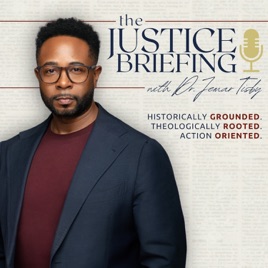
Advertise on podcast: The Justice Briefing with Dr. Jemar Tisby
Rating
4.8from
This podcast has
147 episodes
Language
EnglishPublisher
Dr. Jemar TisbyExplicit
No
Date created
2019/04/18
Latest episode
2026/10/02
Average duration
50 min.
Release period
9 days
Description
The Justice Briefing is your weekly guide to understanding current events through a historically grounded, theologically rooted, justice-centered lens. Instead of framing the world through fear or culture-war panic, we draw from the spirit of justice—from the biblical prophets to the Civil Rights Movement. This isn't just commentary; it’s discipleship for truth and justice.
Unlock The Justice Briefing with Dr. Jemar Tisby podcast Email contact info,
Listeners & Audience details
Email contact information
Direct podcast contact details

Listeners
Audience numbers & engagement insights

Audience details
Podcast Insights

Podcast episodes
Check latest episodes from The Justice Briefing with Dr. Jemar Tisby podcast
Defying Tyrants with Dr. Matthew D. Taylor
2026/10/02
In a rare guest interview, Dr. Jemar Tisby sits down with Dr. Matthew D. Taylor, author of the new book Defying Tyrants: Following Jesus in a World of Christian Antichrists.
They discuss Christian supremacy, Christendom, and imperialism. Going deeper, they explore how Jesus displayed and taught about power, and why the tyrants who claim his name avoid those teachings with surgical precision.
They also talk about the cost of this work. Dr. Taylor lost his job for writing this book.
You'll come away with a theological case for defying tyrants and a picture of what that looks like in the church, in politics, and in everyday life.
Get Defying Tyrants wherever you get your books.
Topics Addressed
Pete Hegseth's speech and the new Office of Religious AffairsConstantine's conversion and the merging of church and empireChristian supremacy as the ideology beneath Christian nationalismWhy "antichrists" in 1 and 2 John refers to Christians who harm others in Jesus' nameThe parable of the wheat and the taresThe cost of speaking out against authoritarianismSupport conversations like this one by becoming a paid subscriber at JemarTisby.Substack.com.
Resources Referenced
Matthew D. Taylor, Defying Tyrants: Following Jesus in a World of Christian Antichrists (Broadleaf, 2026)Matthew D. Taylor, The Violent Take It by Force: The Christian Movement That Is Threatening Our Democracy (2024)Matthew D. Taylor's Reckonings (Substack)Scripture: Mark 10:42-45; 1 John 2:18-19; Matthew 13:24-30
How to Gain Confidence When Resisting White Christian Nationalism
2026/09/24
Get the course. Gain the confidence: How to Resist White Christian Nationalism
White Christian nationalism is the greatest threat to democracy and the witness of the church in the United States today.
Most people who follow this work already know that. So why don't we have more confidence to confront it?
In this back-to-basics episode of The Justice Briefing, Dr. Jemar Tisby names five obstacles to confidence:
1. leaving out the "white,"
2. calling every conservative Christian a Christian nationalist,
3. leading with facts alone,
4. stopping at 'it isn't really Christian,"
5. mistaking understanding for resistance.
Along the way, he brings the receipts, from PRRI's newest data showing that nearly two-thirds of Americans resist Christian nationalism to Gorski and Perry's "deep story" of a Christian America that was supposedly stolen and must be taken back.
The episode builds toward a revelation Dr. Tisby had live on the show: what people need most to resist white Christian nationalism is confidence. The truth is on our side.
To move from understanding to action, Dr. Tisby introduces his new self-paced course, How to Resist White Christian Nationalism.
Topics Addressed
How the plantation's paternalistic hierarchy mirrors the white Christian nationalist visionTokenism: why people of color in the movement are useful but never central, and why tokens get spentNew PRRI data: nearly two-thirds of Americans resist Christian nationalism, with Arkansas and Mississippi the least resistant statesThe "deep story" of white Christian nationalism and why we must meet a bad story with a truer storyThe third commandment, the no true Scotsman fallacy, and the responsibility of Christians to resistThe ARC of Racial Justice and the gap between understanding and action
Resources Referenced
1. How to Resist White Christian Nationalism (self-paced course), Dr. Jemar Tisby
2. PRRI, New Report Analyzes the Two-Thirds of Americans Who Resist Christian Nationalism (September 24, 2026)
3. Philip S. Gorski and Samuel L. Perry, The Flag and the Cross: White Christian Nationalism and the Threat to American Democracy (Oxford University Press, 2022)
4. Dr. Jemar Tisby, The Color of Compromise (2019)
5. Dr. Jemar Tisby, How to Fight Racism (2021), source of the ARC of Racial Justice
6. Scripture: Exodus 20:7; Isaiah 6:8
Support the Show
Fewer than 5% of subscribers make this truth-telling at the intersection of faith, history, and justice possible. For $7 a month, or $5.83 a month on the annual plan (less than a gallon of gas in LA), you can help keep The Justice Briefing going. Become a paid subscriber at JemarTisby.Substack.com.
Stay informed. Stay faithful. Stay in the fight.
It Was Never about Abortion
2026/09/19
For decades, the religious right told Christians that abortion was the one issue that outweighed every other.
Yet ICE recorded at least 18 miscarriages in its custody from January through September 2025, then lost count, and the movement's loudest voices have barely said a word.
In this episode of The Justice Briefing, Dr. Tisby asks why an unborn child's life should matter less because their mother is an immigrant, and how race shaped the religious right from the start.
In 1971, the Southern Baptist Convention backed laws allowing abortion in cases including rape, incest, and likely harm to a mother's emotional health, then reaffirmed that stance after Roe v. Wade.
Historian Randall Balmer argues in Bad Faith that what first mobilized conservative Christians politically was the IRS denying tax exemptions to racially discriminatory Christian schools like Bob Jones University.
So was it ever about life in the womb, or was it about power?
Support the podcast:
Is this kind of information worthwhile? That's the only question you need to answer. If yes, become a paid subscriber at JemarTisby.Substack.com
For $5.83 a month on an annual subscription, you fund the research behind every episode, along with Tisby Media's new course and films.
Storytime with Dr. Tisby: Three Reconstruction Era Stories About What Democracy Takes
2026/08/22
This episode of The Justice Briefing is different. Instead of starting with a current event and working backward to the history, Dr. Jemar Tisby does what he loves most: he tells stories.
Diving back into primary source research for his new Substack series, History Rhymes: Democracy and Voting Rights Edition, left him feeling like a grad student again, brimming with material he could not wait to share. So he devoted a full episode to three of those stories.
The first is about the Congress that refused to seat more than sixty former Confederates in December 1865, overrode a president more than a dozen times, and wrote insurrection into the official record.
The second is about the 1868 Charleston constitutional convention, the only one in American history with a Black majority, where recently emancipated men wrote the most democratic document South Carolina had ever seen and included the children of the people who had enslaved them.
The third is about Amos T. Akerman, a former Confederate and enslaver who became attorney general and prosecuted the first Ku Klux Klan out of existence for forty years.
Taken together, the three stories make one argument: Congress has the power, it lacks the will, and history has the receipts.
Topics AddressedWhy the first iteration of the Ku Klux Klan disbanded in the mid-1870s and did not reconstitute until 1915The 1868 South Carolina constitutional convention: 76 Black delegates out of 124, and the only Black-majority state legislature in U.S. historyWhat Black delegates actually wrote into the state constitution, including free public schools, protected suffrage, women's property rights, and a permanent ban on secessionThe three Enforcement Acts, and why the Ku Klux Klan Act finally worked by naming the state itself as the defendant
Resources ReferencedHere's What Congress Did When Members Had a SpineWhen Black People Wrote the ConstitutionWhen the Department of Justice Prosecuted the Ku Klux Klan Out of ExistenceThe Spirit of Justice by Jemar Tisby: bit.ly/spiritofjusticeA Way Forward: Hope in Uncertain Times, Nashville, August 28-30, with Rep. Justin Pearson, Shane Claiborne, and others. Free, but registration is required: Register here
Support This WorkHistory Rhymes: Democracy and Voting Rights Edition runs weekly through the 2026 midterms, roughly twelve installments in all. The episodes are free. The articles are free. The research is not.
If this is the kind of work you want more of, become a paid subscriber at JemarTisby.Substack.com. It is $5.83 a month on the annual plan. Less than six dollars for history from a PhD historian who spent years learning the tools of the discipline to bring it to you.
Stay informed. Stay faithful. Stay in the fight.
Everything You Were Never Taught About the Voting Rights Act
2026/08/07
On the 61st anniversary of the Voting Rights Act, Dr. Jemar Tisby closes a full history of the law by turning to the fight over it right now.
What took blood and marches to win in 1965 has been taken apart in the thirteen years since 2013, from Shelby County to Louisiana v. Callais, and almost nobody marched.
Dr. Tisby refuses to end there. He points to the faith leaders already mobilizing to protect the ballot before the November midterms, from William Barber's 100 days of action to the poll chaplains and peacekeepers being trained in local churches, and he names the moment for what it is: the civil rights movement of our generation.
The episode also launches History Rhymes: Democracy and Voting Edition, Dr. Tisby's three-month series tracing the struggle over the vote from Reconstruction to today.
In This Episode Why 2026 is the civil rights movement of our generation, and how the April march across the Edmund Pettus Bridge echoed 1965How the Voting Rights Act was taken apart in thirteen years, from Shelby County to Louisiana v. CallaisFaith leaders mobilizing before the midterms, including William Barber's 100 days of actionPoll chaplains and peacekeepers: protecting voters, protecting ballots, and protecting the system itselfThe launch of History Rhymes: Democracy and Voting Edition on FootnotesThe closing charge: register, check your registration, and take somebody with you
Resources ReferencedThe Washington Informer, "Faith leaders start 100-day countdown to Nov. 3 election," featuring Rev. Dr. William Barber and Rev. Tony Lee of Community of Hope AME Church: https://www.washingtoninformer.com/faith-leaders-midterm-vote/Black Church PAC and its Freedom Summer events: https://www.blackchurchpac.org/All Roads Lead South Coalition, organizers of the 2026 march across the Edmund Pettus BridgeHistory Rhymes: Democracy and Voting Edition, Dr. Tisby's new Footnotes series: https://JemarTisby.Substack.com
Support The Justice BriefingThe Justice Briefing runs on readers and listeners, not advertisers. If it helps you make sense of this moment, the best way to support it is to subscribe to Footnotes at JemarTisby.Substack.com. The annual plan comes to $5.83 a month, it keeps this work independent, and it puts every installment of History Rhymes: Democracy and Voting Edition in your inbox from now through the midterms.
Stop Telling Black Voters to Wait
2026/07/31
The DNC's Rules and Bylaws Committee just voted to have South Carolina lead off the 2028 Democratic presidential primaries, and Dr. Jemar Tisby explains why that decision matters more than the news cycle will let on.
He walks through what a primary actually does, why the order of states determines momentum, money, and makes the case that this is a win for the party.
In this episode:
What a primary actually is, and why it is not a direct vote for the nomineeWhy the order of states determines momentum, media coverage, donor confidence, and who drops outThe South Carolina versus Nevada split and the case Latino leaders made for NevadaThe progressive objection to a Southern first primary and what it assumes about Black Southern votersSix things candidates should do over the next 18 months to earn Black votes
Resources referenced:
Previous episode: "What Every Social Movement Must Do"Dr. Tisby's YouTube channel: https://youtube.com/@JTisby
Support the show:
There are no ads on The Justice Briefing and no sponsors. Paid subscribers are the ones who make this work possible. If the breakdown of the 2028 primary calendar was useful to you weeks before it becomes a headline, become a paid subscriber at JemarTisby.Substack.com.
Why "Objective" History Is a Myth
2026/07/24
On the Fourth of July, the White House released a 160-page report accusing the Smithsonian's National Museum of American History of "ideological capture."
In this episode of The Justice Briefing, Dr. Jemar Tisby reads the report's own words, walks through the two congressional hearings it triggered, and makes the historian's case that the charge is a confession.
His argument is simple: there is no such thing as objective history. Facts are objective, but facts do not interpret themselves, and interpretation is the work of the craft. When the right demands "straightforward" scholarship, what they really want is a story that agrees with them.
This is not about erasing the founders. It is about expanding the narrative to tell the whole truth. History does not repeat itself, Dr. Tisby reminds us, but it rhymes.
In This Episode
Why "objective" history is a myth, and why interpretation is the historian's jobThe fundamentalist "plain reading of Scripture," and what it shares with the demand for "straightforward" historyNarratives of declension and their link to "Make America Great Again"Inside the two congressional hearings, and which committee actually holds jurisdiction over the SmithsonianThe witnesses behind the report: the Heritage Foundation, Project 2025, and Hillsdale CollegePragerU, the 1776 curriculum, and this White House's record on historyThe Lost Cause, the UDC textbook committee, and the Dunning SchoolDu Bois and Carter G. Woodson on expanding the narrative, plus the ARC of Racial Justice as practical next steps
Resources Referenced
Saving America's Story, the White House report on the National Museum of American HistoryW.E.B. Du Bois, Black Reconstruction in America (1935), and its chapter "The Propaganda of History"Carter G. Woodson, The Mis-Education of the Negro (1933)Dr. Tisby's article on the Dunning School, at JemarTisby.Substack.comJesus Was a Migrant, the first film from Tisby Studios, at jesuswasamigrant.com
Support the Show
The Justice Briefing is independent and listener-supported. Dr. Tisby is not attached to any institution on a full-time basis, which means this history reaches you because readers and listeners make it possible. If this episode gave you the background the headlines skip, support the work at JemarTisby.Substack.com. An annual membership comes out to just $5.83 a month, and it keeps the weekly articles and podcast coming.
How to Stop ICE from Killing People
2026/07/17
What is the one thing every social movement must do before anything else? In this episode of The Justice Briefing, Dr. Jemar Tisby argues that it is not fundraising, filing for nonprofit status, or even getting out the vote. It's something much more foundational.
Drawing on his training as a historian of race, religion, and social movements, Dr. Tisby traces the pattern across four eras of American history. In every case, the injustice that moved people to act was violent, visible, and visceral.
Dr. Tisby then turns to the present. ICE keeps killing people, and he makes the case that under this administration, immigration is the tip of the spear: the most public, most violent, most visceral campaign of them all.
In This EpisodeWhy every social movement must find the injustice that evokes the most moral outrage and press on it until progress comesThe "violent, visible, visceral" test for what actually mobilizes people to actHow abolitionists, Ida B. Wells, civil rights activists, and the Black Panther Party each pressed on their era's defining injusticeThe recent ICE killings of Lorenzo Salgado Araújo in Houston and Johan Sebastián Durán in MaineThe 2,000-arrests-per-day quota, masked agents, unmarked vehicles, and the lack of accountability fueling reckless violenceWhy immigration is the tip of the spear for this administration, and why attacks on voting rights struggle to spark the same outrageThe story behind Tisby Studios' first film, Jesus Was a Migrant, and why it is distributed through group screeningsConcrete action steps: booking a screening, abolishing ICE, taking off the masks, demanding accountability, and emphasizing the ethics of the kingdomResources ReferencedMartin Luther King Jr., Where Do We Go From Here: Chaos or Community?, on nonviolent coercion and the healthy tension that forces a society to confront its prejudiceThe Black Panther Party's Ten-Point ProgramThe Color of Compromise by Dr. Jemar Tisby, and its closing chapter, "The Fierce Urgency of Now," which introduces the ARC of Racial JusticeJesus Was a Migrant (JesusWasAMigrant.com)Last week's episode, "What Mainstream Media Keep Getting Wrong about Douglas Wilson"Support the PodcastThe best way to support The Justice Briefing is to become a paid subscriber at JemarTisby.Substack.com. Fewer than 5% of subscribers are paid; the $70 annual plan comes out to about $5.83 a month, and it keeps this podcast, and this kind of history, coming every week.
What Mainstream Media Keep Getting Wrong about Douglas Wilson
2026/07/10
The Justice Briefing | Show NotesWhat Mainstream Media Keep Getting Wrong About Douglas WilsonNPR just gave Douglas Wilson another splashy, in-depth interview, and Dr. Jemar Tisby has a problem with it.
Not that the media covers Wilson: the pastor from Moscow, Idaho has a direct line to power through his disciple Pete Hegseth, the Secretary of Defense, and that is newsworthy.
The problem is how they cover him.
In this episode of The Justice Briefing, Dr. Tisby makes the case that respectful, on-location, one-on-one coverage does exactly what Wilson wants.
From there, Dr. Tisby walks through who Wilson is and what he actually believes, from his rejection of the Nineteenth Amendment to his vision of a theocratic America, then names a better way to cover him.
The real question is not what Wilson believes. It is who gets to speak for Christians, and which version of God and country will prevail.
In This EpisodeWhy NPR, CNN, the Wall Street Journal, and the New York Times keep making the trip to Moscow, IdahoThe one line where Wilson admits a "respectful hearing" is the win he is afterWilson's theology explained: reformed fundamentalism, postmillennialism, biblical patriarchy, classical Christian education, and dominionismHis views on repealing the Nineteenth Amendment and "household voting"How the Gospel Coalition, Desiring God, and other evangelical platforms gave Wilson legitimacy years before the mainstream media didWhy the coverage centers Wilson, on his own turf, with no counter-voice in the frameThe lack of racial analysis in most coverage of Wilson and Christian dominionismA better model: pass the mic to the scholars, pastors, and survivors who resist himResources ReferencedScholars and books that offer a counter-narrative
Kristin Kobes Du Mez, Jesus and John Wayne: How White Evangelicals Corrupted a Faith and Fractured a NationBeth Allison Barr, The Making of Biblical Womanhood: How the Subjugation of Women Became Gospel TruthSheila Wray Gregoire, She Deserves Better: Raising Girls to Resist Toxic Teachings on Sex, Self, and Speaking UpTia Levings, A Well-Trained Wife: My Escape from Christian PatriarchySarah Stankorb, Disobedient Women: How a Small Group of Faithful Women Exposed Abuse, Brought Down Powerful Pastors, and Ignited an Evangelical ReckoningAnthea Butler, White Evangelical RacismObery Hendricks, The Politics of JesusBryan Massingale, Racial Justice and the Catholic ChurchSurvivors speaking out
Sons of Patriarchy (sonsofpatriarchy.com), hosted by Sarah Bader and Peter BellSupport the ShowThe best way to materially support The Justice Briefing is to subscribe to Footnotes at JemarTisby.Substack.com, the #4 ranked publication in the history category. Your subscription is what keeps this work independent and coming to you every week.
Why America 250 Needs a Theology of History
2026/07/03
As the United States marks its 250th anniversary, white Christian nationalists are telling their version of the story: that America was founded as a Christian nation.
In part two of his America 250 series on The Justice Briefing, Dr. Jemar Tisby argues that there is a better, more truthful story to tell if we know how to tell it, and that telling it requires something most churches have never named: a theology of history.
Dr. Tisby is a historian and a believer, and he makes the case that those two things belong together, and that Christians should be passionate about truth and history.
Topics AddressedAnniversaries as arguments about the past, and how they shape who we were, who we are, and who we must becomeWhat white Christian nationalists actually mean by "Christian nation": theocracy, a covenant like ancient Israel, Christian privilege, and a religious test for being a "real" AmericanThe restoration narrative of fear and grievance, and why regression differs from progressionThe biblical case for a theology of history: the Bible as a history book, and God's repeated command to rememberThe dangers of forgetting, and why memory is a guardrail against idolatry and injusticeHistory and identity: how the power to tell the story is the power to shape identityThe church's abdication of teaching history, and the "potato chips" problem of getting your history from social mediaApplying the ARC of Racial Justice (Awareness, Relationships, Commitment) to doing history wellResources ReferencedPart one of the series: "Was America Founded as a Christian Nation?" on The Justice Briefing"James Baldwin Was Right About Patriotism," drawn from the autobiographical note in Notes of a Native Son"The Trick Inside Frederick Douglass's Fourth of July Speech""How Gerald R. Ford Celebrated Black History During America's 200th Anniversary"The Spirit of Justice and How to Fight Racism by Dr. Jemar TisbyPrimary sources: the U.S. Constitution and First Amendment, the Treaty of Tripoli, the Danbury Baptist letter, and the Declaration of IndependenceScripture: Deuteronomy 8, Psalm 77:11, Luke 22:19"Echoes of Injustice: From Manzanar to Mass Deportation," a mini documentary on the YouTube channel (YouTube.com/@JTisby)Christians Against Christian Nationalism, by the Baptist Joint Committee for Religious LibertyPublic Religion Research Institute (PRRI) at prri.org
Support This WorkEverything I do here is available for free, but I would really like your help. This kind of truth-telling at the intersection of faith, history, and justice is possible because of the people who choose to support it. Subscribe at JemarTisby.Substack.com: $5.83 a month on the annual plan, and help make this work possible.
Stay informed. Stay faithful. Stay in the fight.
Fourth of July Teach-In with Dr. Jemar Tisby
2026/07/01
How should we think about the Fourth of July, a day dedicated to celebrating independence and freedom, in light of the unfreedom of race-based chattel slavery?
What do we do about the fact that of the 56 signers of the Declaration of Independence 41 of them held slaves?
Do those noble words of the Declaration stating that “all men are created equal” apply to anyone other than wealthy white men?
Frederick Douglass, the formerly enslaved 19th century abolitionist, has something to say.
We take his speech, “What to the Slave Is the Fourth of July” as our primary text for exploring the tension between liberty and bondage in U.S. history.
Listen and share!
Right now, curricula across this country are being rewritten to erase exactly the tension Douglass named in 1852. Subscribe and make sure this history does not get edited out from under you. JemarTisby.Substack.com
Was America Founded as a Christian Nation? The Honest Answer
2026/06/26
As the country marks 250 years since the Declaration of Independence, one claim is everywhere: the United States was founded as a Christian nation.
In this episode of The Justice Briefing, Dr. Jemar Tisby refuses the flat yes or no and insists on the first move any honest answer requires, which is to define the terms.
If "Christian nation" means a country shaped by Christians and their ethics? Does it mean a government with an official, state-sanctioned church?
History has the receipts,
Dr. Tisby walks through the primary sources, from Article VI and the First Amendment to the Virginia Statute for Religious Freedom and the Treaty of Tripoli, and he traces the longer backstory of Henry VIII and the colonists who fled state religion.
In This EpisodeWhy "define your terms" is the first move in answering the Christian nation questionThe sense in which the claim is true and the sense in which it is falseHistory has the receipts: Article VI, the First Amendment, the Virginia Statute for Religious Freedom, and the Treaty of TripoliHenry VIII, the Act of Supremacy, and why colonists fled state religionThe difference between the separation of church and state and the separation of faith and politicsThe Enlightenment roots of the DeclarationWhat white Christian nationalists actually mean, and why the slogan works as a permission structure for powerResources ReferencedThe Christian Past That Wasn't: Debunking the Christian Nationalist Myths That Hijack History by Warren ThrockmortonThe Spirit of Justice: True Stories of Faith, Race, and Resistance by Jemar TisbyThe Color of Compromise (book and video study) by Jemar TisbyRededicate 250, National Mall, May 17, 2026Primary sources: Article VI of the U.S. Constitution; the First Amendment; the Virginia Statute for Religious Freedom (1786); the Treaty of Tripoli (1797); the Act of Supremacy (1534); John Locke, Second Treatise on Civil GovernmentSupport the ShowSupport The Justice Briefing by subscribing at JemarTisby.Substack.com, where Dr. Tisby brings the receipts every week so you can answer questions like this one from an informed perspective.
Juneteenth vs. America 250
2026/06/19
This week on The Justice Briefing, Dr. Jemar Tisby breaks down why Juneteenth and America 250 are not the same kind of anniversary, even though they fall just weeks apart this summer.
Dr. Tisby argues that America 250 asks the nation to celebrate how great it has been, while Juneteenth asks a harder, more honest question: how free are we, really?
Using a ten-point comparison chart, he walks through what each holiday marks, whose freedom it centers, and what's at risk of being lost or co-opted in 2026.
Dr. Tisby also explains why this year carries extra weight.
With a White House actively promoting a whitewashed version of history through initiatives like Freedom 250 and PragerU's Freedom Trucks, he makes the case that you cannot responsibly celebrate the country's anniversary while erasing the centuries of bondage that came before emancipation.
In This EpisodeThe origin of Juneteenth and the text of General Order No. 3Why the Emancipation Proclamation didn't actually free enslaved peopleHow U.S. slavery was uniquely race-based, matrilineal, and perpetualThe White House's "Freedom 250" rebrand and PragerU's Freedom TrucksA 10-point T-chart comparing Juneteenth and America 250What it looks like for white and Black Americans to commemorate Juneteenth differentlyBooks ReferencedHow to Fight Racism by Jemar TisbyI Am the Spirit of Justice by Jemar Tisby (picture book)Stories of the Spirit of Justice by Jemar Tisby (middle grade and up)Support the ShowIf this episode helped you think more clearly about faith, history, and justice, the best way to support it is to subscribe at JemarTisby.Substack.com. Paid subscriptions fund the research, the production, and the in-person interviews that make episodes like this possible.
Racism, Patriarchy, and the Southern Baptist Convention
2026/06/12
In this episode of The Justice Briefing, Dr. Jemar Tisby breaks down the Southern Baptist Convention's recent vote to amend its constitution—by a 77 percent margin—banning women from preaching to assembled congregations.
Dr. Tisby draws on his own history with the SBC to offer an insider's analysis of what the Truth and Unity Amendment actually says, why Al Mohler pushed for it, and what the election of new SBC president Willy Rice signals about the denomination's continued rightward turn.
But Dr. Tisby goes deeper than the headlines.
Tracing the SBC's origins back to 1844 and the case of James Reeve—an enslaver whose deliberate nomination as a missionary candidate was the spark that led to the denomination's founding—Dr. Tisby makes the case that the SBC's patriarchy and its racism are not two separate problems that happen to coexist.
They share a common theological architecture: the divine sanctioning of hierarchy, the use of Scripture to compel submission, and the punishment of those who resist.
From the household codes that justified chattel slavery to the amendment that just passed, the logic is the same, and understanding that connection, Dr. Tisby argues, is essential to understanding what faithful resistance must look like today.
In This Episode...The Truth and Unity Amendment, what it says, and why Al Mohler pushed for it even though the restriction on women pastors was already denominational policyThe case of James Reeve—the 1844 missionary nomination that was a deliberate pro-slavery provocation and led directly to the founding of the SBCHow the biblical defense of racial hierarchy and the biblical defense of gender hierarchy draw from the same New Testament household codesThe “purity of white womanhood” trope—how white women were simultaneously subordinated to white men and weaponized against Black peopleSaddleback Church, Beth Moore, and the enforcement mechanisms the SBC already had in place before this amendmentThe parallel between the SBC’s centralizing of authority and unitary executive theory in the Trump administrationThe election of Willie Rice as SBC president and what it signals about the denomination’s further rightward turnWhy you cannot address patriarchy in the SBC without also addressing its racism and why the denomination is case in point
I believe women are called and qualified to preach and pastor. And I name the links between racism and patriarchy. If that’s the kind of insight you value, become a paid subscriber. JemarTisby.Substack.com
Host a screening of Jesus Was a Migrant: jesuswasamigrant.com
How the Supreme Court Is Rigging the Midterm Elections
2026/06/05
In this urgent episode of The Justice Briefing, Dr. Jemar Tisby breaks down the Supreme Court's latest ruling in Allen v. Milligan--a decision that allows Alabama to eliminate one of its only two majority-Black congressional districts just months before the 2026 midterm elections and while primaries are already underway.
Drawing on his training as a historian and his recent trip to Selma to march across the Edmund Pettus Bridge, Dr. Tisby explains how the Court's selective application of the Purcell Principle exposes a legal system being weaponized to dilute Black political power rather than protect it.
He traces the historical roots of Black voting patterns from Reconstruction through the Civil Rights Movement to make the case that Black voters aren't loyal to a party--they're loyal to their survival.
Dr. Tisby also examines the Congressional Black Caucus's pointed letter to Corporate America, holding hundreds of major corporations accountable to voting rights commitments they made publicly in 2021--and demanding they prove those words still mean something before a June 9th deadline.
From the courtroom to the boardroom, Dr. Tisby asks the question that drives the entire episode: do you care?
In This Episode
The Supreme Court's ruling in Allen v. Milligan and what it means for Black congressional representation in AlabamaWhat the Purcell Principle is, where it comes from, and why the Court is applying it selectivelyHow the Louisiana v. Callais decision gutted the Voting Rights Act and opened the door to rapid redistricting across the SouthWhy Republicans stand to gain up to 15 additional House seats through redistricting — and what's at stake in the 2026 midtermsThe historical roots of Black voting patterns, from Reconstruction and the New Deal to LBJ's Civil Rights ActGovernor Kay Ivey's response to the ruling — and what the language of "states' rights" has always meant in the context of Black political powerThe Congressional Black Caucus's letter to Corporate America and its June 9th deadline for actionJustice Sotomayor's dissent — and why Dr. Tisby says every justice-minded person should be reading it
We have a lack of voices raising the alarm about voting rights in the church. If you think that work is important, you can help make it possible. Become a paid subscriber today. JemarTisby.Substack.com
A news report just revealed that children are still being separated from their parents in the immigration crackdown. We must speak up. This film will help you. Host a screening of Jesus Was a Migrant: jesuswasamigrant.com
Podcast reviews
Read The Justice Briefing with Dr. Jemar Tisby podcast reviews
RaisingKellan.org 2026/08/30
Justice Journey
Expert theologian and historian! Dr Tisby continues to provide a solid counter narrative to Christian Nationalism. Grateful for his leadership in 2026...
S.Spencer101 2026/03/06
Your Justice Journey takes off here
Dr Jemar Tisby’s insight as a historian focused on justice work is essential in this current moment. He brings new life to the stories of the civil ri...
TNgirl219 2026/03/06
A trusted voice for our time
I have been privileged to see Dr Tisby speak as a guest at a local church and PBS television program in Nashville. I read his book Color of Compromis...
goneese 2026/03/06
Thoughtful,Clear and Deeply Informative
I’ve learned so much from Dr. Jemar Tisby. He is thoughtful, deeply informed, and brings together history, theology, and faith in a way that is clear ...
JacJ5 2026/03/06
Thoughtful, Biblical & Clear
Dr. Tisby has a great way of explaining history in ways that make you feel like you’ve been along for the whole journey. He doesn’t shy away from chal...
KaliJ 77 2025/11/21
Thoughtful and researched
I appreciate Dr Tisby’s thoughtful, researched and historical interaction with the issues of justice that are present in our culture.
sohmar1 2025/11/14
Thank you
I appreciate how Jemar brings truth to the topics that he talks about. He get to the core of the conversation.
1badger70 2025/08/07
Great Podcast
This has been wonderful, Dr. Tisby. Your podcast content has been eye-opening, difficult, and uplifting on a personal journey that started with The Co...
Amber CS 2024/09/16
A trusted voice
As I have listened to this podcast and begun to read his books, Dr. Tisby has become a trusted voice for me as I learn how to be an anti-racist. As a ...
jimwinkle 2024/07/17
Love this podcast
As a former white evangelical, I’m learning a lot from this show. I really appreciate everything from the history of Christianity in the US to how to ...
Podcast sponsorship advertising
Start advertising on The Justice Briefing with Dr. Jemar Tisby relevant audience podcasts
You may also like to advertise on these Podcasts
4.762542000
The Lawfare Podcast
The Lawfare Institute
4.916161609
The Kristian Harloff Show
Kristian Harloff
4.8258731484
Relatable with Allie Beth Stuckey
Blaze Podcast Network

4.917101543
DarrenDaily On-Demand
Darren Hardy LLC
4.6221632000
Mark Levin Podcast
Cumulus Podcast Network
4.737121980
The Eric Metaxas Show
Metaxas Media
4.834891999
Conservative Review with Daniel Horowitz
Blaze Podcast Network

4.858221909
Sara Gonzales Unfiltered
Blaze Podcast Network

4.827571695
Earn Your Happy
Lori Harder | YAP Media

4.549052000
The Daily Stoic
Daily Stoic | Backyard Ventures