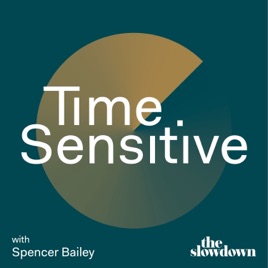
Advertise on podcast: Time Sensitive
Rating
4.9from
This podcast has
150 episodes
Language
EnglishPublisher
The SlowdownExplicit
No
Date created
2019/04/23
Latest episode
2025/12/17
Average duration
74 min.
Release period
16 days
Description
Candid, revealing long-form conversations with leading minds about their life and work through the lens of time. Host Spencer Bailey interviews each guest about how they think about time broadly and how specific moments in time have shaped who they are today. Explore more at timesensitive.fm
Unlock Time Sensitive podcast Email contact info,
Listeners & Audience details
Email contact information
Direct podcast contact details

Listeners
Audience numbers & engagement insights

Audience details
Podcast Insights



Podcast episodes
Check latest episodes from Time Sensitive podcast
Hans Ulrich Obrist on Art as a Portal to Liberate Time
2025/12/17
The Swiss-born, London-based curator, art historian, and Serpentine Galleries artistic director Hans Ulrich Obrist moves through his life and work with a deep internal sense of urgency. Among the most prolific and everywhere-all-at-once people in the world of art—whose peripatetic path has taken him from a sheltered upbringing in a small Swiss village to his current post in London at the Serpentine—Obrist has been curating shows for more than three decades. During this time, he has recorded conversations with thousands of artists, architects, and others shaping culture and society. He’s also the author of dozens of books, most recently Life in Progress, released in the U.K. this fall, with the U.S. edition coming out next spring.
On this episode, Obrist reflects on 25 years of the Serpentine Pavilion, which has become a defining annual moment in culture globally and a springboard for many of today’s leading voices in architecture, including Lina Ghotmeh (the guest on Ep. 129 of Time Sensitive) and Frida Escobedo, and his firm belief that we all need to embrace more promenadology—the science of a stroll—in our lives.
Special thanks to our Season 12 presenting sponsor, Van Cleef & Arpels.
Show notes:
[00:47] Hans Ulrich Obrist
[5:18] Brutally Early Club
[7:40] Frank Gehry
[8:20 ] Bettina Korek
[8:28] Luma Arles
[10:21] Pierre Boulez
[13:10] Etel Adnan
[19:37] Giorgio Vasari
[21:22] Ludwig Binswanger
[27:20] “Life in Progress”
[37:48] Peter Fischli & David Weiss
[34:00] Kasper König
[39:09] Maria Lassnig
[39:35] Serpentine Galleries
[43:24] Musée d’Art Moderne de Paris
[48:11] Serpentine Pavilion
[51:15] Frida Escobedo
[51:49] Lina Ghotmeh
[56:11] The FLAG Art Foundation
[56:37] Play Pavilion
[56:58] Serpentine General Ecology
[58:00] Serpentine Arts Technologies
[1:02:08] “Peter Doig: House of Music”
[1:04:11] “Danielle Brathwaite-Shirley: The Delusion”
[1:05:00] Édouard Glissant
[1:05:47] Umberto Eco
[1:12:28] Lucius Burckhardt
[1:12:28] Cedric Price
[1:11:56] Robert Walser
Jennie C. Jones on Time Traveling Through Art, Sound, and Space
2025/12/10
When the artist Jennie C. Jones listens closely to a piece of music, she’s particularly attuned to its pauses, in-between moments, and breaks. Widely celebrated for her abstract works in painting, sculpture, and sound art that, in many instances, incorporate architecture or space—through which she often elevates undersung or little-known Black artists and musicians—her practice is largely informed by minimalism and color field painting, as well as by jazz and avant-garde music. Jones currently has two exhibitions on view at the Pulitzer Arts Foundation in St. Louis (through Feb. 1, 2026): “A Line When Broken Begins Again,” which features a selection of new and existing paintings, sculptures, works on paper, and sound pieces, and “Other Octaves,” a group show she curated of works by artists who have been formative to her practice. She was also commissioned to create the 2025 rooftop installation at New York’s Metropolitan Museum of Art.
On this episode of Time Sensitive, she discusses what listening as a conceptual practice looks like in action, the art of putting together a playlist, and her deep love of things tactile and analog.
Special thanks to our Season 12 presenting sponsor, Van Cleef & Arpels.
Show notes:
[04:35] “Jennie C. Jones: A Line When Broken Begins Again” (2025)
[04:35] “Other Octaves” (2025)
[04:57] Carmen Herrera
[04:57] Agnes Martin
[04:57] Martin Puryear
[04:57] Alma Thomas
[04:57] Mildred Thompson
[05:21] A Free and Shifting Tonal Center (2024)
[7:26] Ellsworth Kelly
[11:44] Fred Moten
[11:44] “Dynamics” (2022)
[13:02] Trisha Brown’s “Leaning Duets” (1970)
[14:40] Tadao Ando
[14:55] “These (Mournful) Shores” (2020)
[17:21] Moses Williams
[17:21] Louis Dotson
[18:20] Richard Tuttle
[30:25] Olly Wilson
[31:28] Maryanne Amacher
[31:28] Arthur Russell
[37:10] Jennie C. Jones: Compilation (2015)
[38:30] “The Theater of Refusal: Black Art and Mainstream Criticism” (1993)
[42:25] “Slow Birds” (2004)
[42:25] "Slowly in a Silent Way, Caged” (2010)
[42:25] Charlie Parker
[1:09:47] “Jennie C. Jones: RPM (revolutions per minute)” (2018)
[1:12:06] “Ensemble” (2025)
Noah Horowitz on Art Basel as a Cultural Force
2025/12/03
As the CEO of Art Basel, Noah Horowitz has made it his mission to ensure that the international art platform is seen, valued, and experienced—far beyond its art-fair roots—as a cultural catalyst and “opportunity accelerator.” Over the past 55 years, beginning with its tight-knit origins in Basel, Switzerland, in 1970, Art Basel has evolved into an international juggernaut, with best-in-class fairs also in Miami Beach, Hong Kong, and Paris—and soon, under Horowitz’s leadership, Qatar, with an edition debuting there in February 2026. With more than two decades of experience, and as a tireless advocate and enthusiast for all things art, from artists and galleries to collectors and institutions, Horowitz is exactly the right person for the job.
On this episode of Time Sensitive, Horowitz details his ambitious agenda to stretch Art Basel’s reach into realms far beyond what would traditionally be considered the art world; shares his long-view perspective on the economics of art; and considers the centuries-old history that, in a roundabout way, helped lead to—and continues to inform and shape—today’s art market.
Show notes:
[05:13] Art Basel Paris
[05:13] Art Basel Qatar
[05:13] Art Basel Miami Beach
[05:13] Art Basel Hong Kong
[07:54] Frida Escobedo
[10:41] The Art Basel and UBS 2025 Survey of Global Collecting
[10:41] Art Basel Awards
[21:27] Rei Naito
[23:51] Art of the Deal: Contemporary Art in a Global Financial Market (2011)
[27:42] Rirkrit Tiravanija
[41:18] High Art Lite: The Rise and Fall of Young British Art (2020)
[32:42] KAWS
[39:04] Princeton Record Exchange
[42:18] Frieze
[42:52] Hans Ulrich Obrist
[42:52] Okwui Enwezor
[45:00] Rem Koolhaas
[45:57] Kirk Varnedoe
[45:57] Pictures of Nothing: Abstract Art Since Pollock (2006)
[50:05] Talking Prices: Symbolic Meanings of Prices on the Market for Contemporary Art (2005)
[51:49] Clare McAndrew
[54:42] The Experience Economy (2019)
[58:43] Vincenzo de Bellis
[1:03:04] Pérez Art Museum
Theaster Gates on Building and Bridging Culture, From Chicago to Japan
2025/11/19
Over the past two decades, the artist Theaster Gates has poured himself into his multifaceted practice that spans pottery, painting, sculpture, urban development, performance, archival research, and arts administration. Along the way, he has risen to become one of the most widely celebrated figures in the world of art, transforming abandoned, dormant buildings in Chicago’s Grand Crossing neighborhood, on the city’s South Side, into dynamic third spaces for social, cultural, and spiritual communion; linking his hometown of Chicago with Japan, where in 2004 he trained with master potters in the coastal city of Tokoname and has maintained a deep connection ever since; and effectively rescuing, recontextualizing, and resuscitating culturally significant archives.
On this episode of Time Sensitive, our latest “site-specific” recording, Gates sits down with Spencer inside his personal library in Chicago to talk about his current exhibition, “Unto Thee,” at the University of Chicago’s Smart Museum of Art (on view through Feb. 22, 2026); his forward-looking vision for his latest project, The Land School, which he and his Rebuild Foundation have reshaped into an arts incubator; and the vast, alchemic impacts of music on his life and work.
Special thanks to our Season 12 presenting sponsor, Van Cleef & Arpels.
Show notes:
Theaster Gates
[1:21] Dorchester Art and Housing Collaborative
[5:07] The Land School (2025)
[7:30] St. Laurence Elementary School
[7:42] Solange Knowles
[9:07] Stony Island Arts Bank
[9:07] Rebuild Foundation
[9:07] Black Cinema House
[9:07] The Listening House
[13:06] Jane Addams
[13:06] Jane Jacobs
[13:06] Jesse Jackson
[13:23] Frederick Law Olmsted
[13:23] Huey P. Newton
[13:31] Chicago Transit Authority
[19:45] Cicero
[23:24] Søren] Kierkegaard
[23:24] Georg Wilhelm Friedrich Hegel
[25:31] “Unto Thee” (2025)
[29:12] Fred Moten
[29:29] “Art Histories” (2020)
[35:18] Tokoname
[42:26] “The Listening House” (2022)
[49:29] “Afro-Mingei" (2024)
[49:29] Mingei
[51:24] Black is Beautiful and Black Arts movements
[1:07:02] Theaster Gates’s record collections
[1:15:07] Martin Puryear
[1:17:00] László Moholy-Nagy
[1:17:00] Josef Albers
[1:17:00] Carrie Mae Weems
Jay Osgerby on Imbuing Objects With Meaning
2025/11/12
The British designer Jay Osgerby believes in designing rigorously simple objects that are deeply felt and, hopefully, appreciated for generations to come. As the co-founder of the London-based industrial studio Barber Osgerby, Jay and his partner in the firm, Edward Barber, emphasize experimentation, innovation, and a material- and craft-forward design approach to their products, furniture, architecture, and interiors. Across their nearly 30-year history as a studio, Barber Osgerby has taken a “fewer, better things” approach and along the way built a rich and varied body of work that includes the 2012 London Olympics torch, a commemorative £2 coin (2012), a Victoria and Albert Museum installation with BMW (2014), Vitra’s Tip Ton chair (2011), and paper lanterns crafted by Ozeki & Co. in Gifu, Japan. Each project exudes clarity, calm, and consideration—and always a sense of character.
On this episode of Time Sensitive, Osgerby shares his optimistic views on A.I. as a means toward more people engaging in craft and handwork; considers what his years inside factories and surrounded by craftspeople have taught him about human ingenuity; and reflects on objects as vessels for memory, history, and soul.
Special thanks to our Season 12 presenting sponsor, Van Cleef & Arpels.
Show notes:
Jay Osgerby
[05:08] Flos
[8:37] 2012 London Olympics torch
[8:37] £2 coin (2012)
[8:37] Victoria and Albert Museum
[8:37] London Design Biennale
[14:18] Design Museum in Tallinn, Estonia
[14:18] Isokon
[15:58] Dieter Rams
[15:58] Ettore Sottsass
[15:58] Memphis Group
[15:58] Rationalism
[20:25] Pitt Rivers Museum
[24:56] Vitra
[28:49] Arts and Crafts Movement
[29:09] Glenn Adamson
[31:01] Bill McKibben
[36:38] Blueprint
[36:38] Paul Smith
[38:01] Galerie Kreo
[39:00] Tyler Brûlé
[41:36] Venini
[51:34] Vico Magistretti
[51:34] Achille Castiglione
[53:07] Ozeki & Co.
Michael W. Twitty on Honoring His Ancestors Through Food
2025/11/05
For the James Beard Award–winning writer and culinary historian Michael W. Twitty, kitchens provide a multitude of significant purposes that stretch far into the past and carry through to the present. Beyond being places where people cook, share, and eat food, they also serve as vital spaces in which to gather in community, to grieve and process trauma, to teach and learn, to dance, to heal, and to experience Black love and joy. Twitty’s multilayered cooking draws on his family roots, his personal history, and his deep culinary knowledge of the American South. His latest title, the cookbook Recipes From the American South (Phaidon), brings his skill as a home cook and historically informed recipe-maker to the fore, allowing ingredients and dishes to transform into cultural and temporal touchpoints.
On this episode of Time Sensitive, Twitty reflects on what researching and uncovering his ancestry has taught him about Southern cooking and himself, and shares why, for him, food functions as a tangible form of cultural reclamation and emotional healing.
Special thanks to our Season 12 presenting sponsor, Van Cleef & Arpels.
Show notes:
Michael W. Twitty
[7:43] Saidiya Hartman
[8:43] Their Eyes Were Watching God (1937) and Mules and Men (1935) by Zora Neale Hurston
[9:42] Gonze Lee Twitty
[16:50] Brer Rabbit
[14:33] National Museum of African American History and Culture
[19:42] “Amazing Grace”
[29:22] Gullah Geechee
[54:04] Recipes From the American South (2025)
[54:56] Southern Discomfort Tour
[1:03:44] Koshersoul: The Faith and Food Journey of an African American Jew (2023)
[1:03:44] Rice: A Savor the South Cookbook (2021)
[1:03:44] The Cooking Gene: A Journey Through African-American Culinary History in the Old South (2018)
[1:07:52] Ryan Coogler
[1:19:17] James Hemings
[1:19:17] Edith Fossett and Fanny Hern
[1:19:17] Ursula Granger
[1:19:31] Gage & Tollner
[1:19:31] John Birdsall
[1:19:31] Tennessee Williams
[1:19:31] Truman Capote
Camille Henrot on Tapping Into a Boundless Imagination
2025/10/29
For the Paris-born, New York–based artist Camille Henrot, time practically never stands still. Across her work in film, drawing, painting, sculpture, installation—and soon, live performance—Henrot has developed ways of stretching and distorting time, seamlessly shifting from moments of potent, rapid-fire intensity to quiet reflection. While her work carries a theory-driven ferocity and intelligence, it’s also incredibly playful. Hers is serious art that manages—often with a knowing, subtle wink—to not take itself too seriously.
On this episode of Time Sensitive, Henrot considers the subjectivity of speed and slowness; previews her upcoming first-ever performance-art piece, slated to premiere in 2026 and a collaboration with the nonprofit Performa; and reflects on why, for her, a work is technically never finished. She also shares her fraught fascination with animals, childhood, and the climate crisis—the intersection of which she examines in-depth in her soon-to-debut film “In the Veins.”
Special thanks to our Season 12 presenting sponsor, Van Cleef & Arpels.
Show notes:
Camille Henrot
[4:30] RoseLee Goldberg
[4:30] Performa Biennial
[6:37] Buster Keaton
[6:37] Tex Avery
[7:03] Estelle Hoy
[7:19] Adam Charlap Hyman of Charlap Hyman & Herrero
[16:10] “In the Veins” (2026)
[17:45] "Grosse Fatigue"
[17:45] Massimiliano Gioni
[38:51] Roland Barthes
[45:36] Pierre Huyghe
[47:51] Ikebana Sogetsu
[51:46] Okwui Enwezor
[55:03] Hypernormalisation by Adam Curtis (2016)
[59:51] Jacob Bromberg
[59:51] Akwetey Orraca-Tetteh
[1:08:50] Adrienne Rich
[1:08:50] Ursula K. Le Guin
[1:08:50] Annie Ernaux
[1:08:50] Mother Reader by Moyra Davey (2001)
[1:08:50] Jenny Schlenzka
[1:10:14] Maggie Nelson
[1:11:02] Mothers: An Essay on Love and Cruelty by Jacqueline Rose (2019)
[1:11:02] Representation of Motherhood by Donna Bassin (1994)
[1:13:00] Louise Bourgeois
Alison Roman on Recipes as Time Capsules
2025/10/22
The cook and food writer Alison Roman frequently emanates and celebrates a certain spilled-milk imperfectionism. Her on-camera candor and laid-back cooking style have both contributed to growing her devoted audience of home cooks as well as the food-curious, many of whom have followed her and her singular recipes over the past decade-plus, from her prior media roles (Bon Appétit and The New York Times) to the independent-platform path she’s now on. That’s not to mention her three best-selling cookbooks, Dining In (2017), Nothing Fancy (2019), and Sweet Enough (2023), as well as her forthcoming fourth title, Something from Nothing, out Nov. 11. For Roman, there’s joy and wisdom to be found in embracing a certain amount of honest-to-goodness mess, all while maturing into different versions of herself, in and out of the kitchen.
On the episode, she reflects on the diaristic quality of her dishes, how time and money have shaped her cooking style and recipe-writing approach throughout her life, and the beauty of prioritizing tangible things in our ephemeral digital age.
Special thanks to our Season 12 presenting sponsor, Van Cleef & Arpels.
Alison Roman
[4:49] Something From Nothing (2025)
[5:52] Dining In (2017)
[5:52] Sweet Enough (2023)
[10:38] Nothing Fancy (2019)
[16:06] First Bloom
[22:03] The Tenth Muse by Judith Jones (2007)
[22:03] Home Cooking by Laurie Colwin (1988)
[22:03] Books by Anthony Bourdain
[22:03] Blood, Bones & Butter by Gabrielle Hamilton (2011)
[32:00] Chris Bernabeo
[47:46] Solley’s
[56:24] Christina Tosi
[57:22] Bon Appétit
Olivia Laing on the Pleasures and Possibilities of Gardens
2025/10/08
For the British writer and cultural critic Olivia Laing, restoring and tending to their backyard garden has prompted complex questions of power, community, and mystery, concepts that they beautifully excavate in their latest book, the fascinating and mind-expanding The Garden Against Time: In Search of a Common Paradise. Whether in their nonfiction works, including the critically acclaimed The Lonely City (2016), their art and culture writing and criticism (2020’s Funny Weather: Art in an Emergency), or their novels (2018’s Crudo and the forthcoming The Silver Book, out this November), Laing turns an incisive eye to examining what it will take for people—our “temporal selves,” as they put it—to forgo loneliness and isolation, reconnect with nature and one another, and flourish on a planet in crisis.
On this episode, recorded in their apartment at the Barbican in London, Laing explores gardening and writing’s symbiotic relationship; the act of rebelling against a reactive culture by embracing slowness; and the importance of imagining, in vivid detail, the kinds of utopias we could one day very well live in.
Special thanks to our Season 12 presenting sponsor, Van Cleef & Arpels.
Show notes:
Olivia Laing
[4:35] The Barbican
[7:39] “The Garden Against Time” (2024)
[7:53] Mark Rumary
[9:08] Notcutts
[14:08] “The Lonely City: Adventures in the Art of Being Alone” (2016)
[16:07] Jhumpa Lahiri
[18:41] Piet Oudolf
[19:21] Middleton Place
[19:21] The Sackler family
[22:54] “Modern Nature” (1991)
[24:07] “Paradise Lost” (1667)
[25:40] “The Secret Garden” (1911)
[25:40] “Tom’s Midnight Garden” (1958)
[29:29] “The Garden” (1681)
[30:29] “Everybody: A Book About Freedom” (2021)
[35:07] “The Body Keeps the Score: Brain, Mind, and Body in the Healing of Trauma” (2014)
[39:57] David Wojnarowicz’s "Magic Box"
[39:57] Ana Mendieta
[40:51] Agnes Martin
[43:08] “Funny Weather: Art in an Emergency” (2020)
[45:29] “Crudo” (2018)
[48:20] “A Dance to the Music of Time” (1951–1975)
[50:29] “The Silver Book” (2025)
[52:48] Federico Fellini
[52:48] Pier Paolo Pasolini
[55:17] “News from Nowhere” (1890)
Oliver Burkeman on the Power of Embracing Imperfectionism
2025/09/24
The British author and journalist Oliver Burkeman has spent decades pondering what it means to live a meaningful life, both in his former Guardian column “This Column WIll Change Your Life” and across several books—most recently, Meditations for Mortals, out in paperback this October. That’s why he brings a healthy dose of skepticism to so-called “time management” systems and productivity hacks as a means toward true fulfillment. Burkeman’s compelled by the notion that, rather than being separate from time, human beings are time. If people faced the reality of their limited time on the planet head on, he believes there’s a real chance to experience greater, more engaged feelings of aliveness.
On the episode—our Season 12 kick-off—Burkeman discusses why he’s eschewing perfectionism and finding unexpected liberation in the premise that, to some extent, the worst has already happened, and the best may still be ahead.
Special thanks to our Season 11 presenting sponsor, Van Cleef & Arpels.
Show notes:
Oliver Burkeman
[4:26] “Meditations for Mortals” (2024)
[6:48] Donald Winnicott
[7:46] Martin Heidegger
[7:46] "Technics and Civilization" (2010)
[7:46] “Being and Time” (1927)
[7:46] “Time Warrior” (2011)
[7:46] “Time Surfing” (2017)
[7:46] “Anti-Time Management” (2022)
[10:14] Medieval peasants
[10:14] “The 4-Hour Workweek”
[13:18] Alicja Kwade
[19:23] “Ichi-go, ichi-e” (“one time, one meeting”)
[22:00] Eckhart Tolle
[22:36] Agnes Martin
[23:28] “The Road Not Taken”
[40:03] “This Column Will Change Your Life”
[51:00] Nicholas Carr
[51:00] Clay Shirky
[53:40] Jennifer Roberts
[59:04] Pomodoro Technique
[59:13] Kanban
[1:01:33] James Hollis
[1:02:40] Alfred Adler
[1:02:40] “The Courage to Be Disliked” (2024)
[1:06:24] Stoicism
Sara Imari Walker on Making Sense of Life, the Universe, and Ourselves
2025/08/27
As the physicist and astrobiologist Sara Imari Walker—the author of the mind-expanding book Life as No One Knows It: The Physics of Life’s Emergence—sees it, every single thing on Earth can be traced to life’s beginnings. Walker studies the origins of life on this planet—one of science’s greatest unsolved puzzles—and, beyond that, whether alien life exists on other planets. As part of her research, she’s advancing a physics known as “assembly theory,” a new way of thinking and talking about life’s origins and, in turn, time. She displays that rare gift for demystifying deeply layered concepts—and for reminding us of how profound it is to be alive, in this moment, in the first place.
On this special episode—produced in partnership with the Aspen Art Museum and recorded in Aspen, Colorado, during the inaugural AIR festival earlier this month—Walker makes a compelling case for why understanding life’s origins is crucial to understanding ourselves.
Special thanks to our episode sponsor, the Aspen Art Museum.
Show Notes:
Sara Imari Walker
[6:59] Assembly theory
[10:00] Thomas Moynihan
[11:13] “Life as No One Knows It: The Physics of Life's Emergence” (2024)
[13:36] Michael Lachmann
[18:38] Lee Cronin
[18:48] Bertrand Russell
[21:04] “A.I. Is Life”
[24:10] Paley’s watch argument
[25:36] Steve Jobs
[25:54] “Reflecting on the iPhone's cultural impacts as it turns 18”
[29:14] “It’s Time to Retire the Word ‘Technology’”
[32:46] Copernican Revolution
[36:14] “Hundert Autoren gegen Einstein” or “One Hundred Authors Against Einstein” (1931)
[40:54] Arizona State University: School of Earth and Space Exploration
[45:03] AIR Aspen
[46:20] Carlo Rovelli
[47:44] Thaddeus Mosley
[47:54] Constantin Brâncuși
[47:55] Isamu Noguchi
James Frey on Designing Your Life to Bring Joy
2025/06/25
In 2003, when the author James Frey published his first book, A Million Little Pieces—a gut-punch account of his experience with addiction and rehab—nobody could have expected what would come next. Thanks to an Oprah Book Club endorsement, A Million Little Pieces was instantly catapulted to bestseller status, but soon blew up in scandal after Frey admitted to having falsified certain portions of the book, which had been marketed as a memoir. The drama that ensued sparked a media controversy—one that now, around 20 years later, feels petty and misplaced, especially in the context of today’s cancel-culture climate. More than 10 million copies of A Million Little Pieces have sold since, and Frey is still at it, writing, publishing, and pushing the boundaries of his art. His latest novel, Next to Heaven, is a rollicking, raunchy, absurd-yet-not satire about money, murder, and the all-too-human desires for power, pleasure, and greed.
On the episode—our Season 11 finale, in which Frey sat lotus for the entire duration—he reflects on the A Million Little Pieces saga; his long-term study of Taoism; writing as a gateway to vulnerability; and why love, for him, is the greatest drug there is.
Special thanks to our Season 11 presenting sponsor, Van Cleef & Arpels.
Show notes:
James Frey
[5:08] “Tao Te Ching”
[5:08] Lao Tzu
[5:08] Stephen Mitchell
[5:08] Taoism
[8:51] Cubism
[13:11] “A Million Little Pieces” (2003)
[14:16] “Next To Heaven” (2025)
[14:16] New Canaan, Connecticut
[17:14] Jackie Collins
[17:14] “Hollywood Wives” (1983)
[17:14] Danielle Steel
[21:35] Honoré de Balzac
[29:37] “Katerina” (2018)
[29:37] “Full Fathom Five” (1947) by Jackson Pollock
[37:14] “Larry King Live” (2006)
[39:09] “Tropic of Cancer” (1971)
[42:24] “Up to Me” (1985)
[44:20] “Kissing a Fool” (1998)
[52:22] “My Friend Leonard” (2005)
[52:22] “Bright Shiny Morning” (2008)
[52:22] “The Final Testament” (2011)
[58:56] “Author Is Kicked Out of Oprah Winfrey’s Book Club”
[58:56] “James Frey: ‘I Always Wanted to Be the Outlaw’”
[01:03:18] Bret Easton Ellis
[01:03:18] Jay McInerney
[01:03:18] Norman Mailer
[01:10:54] Rashid Johnson
[01:10:54] HBO’s “Native Son” (2019)
Molly Jong-Fast on the Fleeting Nature of Fame
2025/06/18
Through her sharp and biting political commentary—whether as host of the podcast Fast Politics, as a special correspondent for Vanity Fair, or as a political analyst on MSNBC—Molly Jong-Fast has, over the past decade, become something of a household name. But, as the daughter of the once-famous author and second-wave feminist Erica Jong—whose 1973 novel Fear of Flying catapulted her into the literary limelight—she has actually been in the public eye for much longer, decades before this more recent notoriety of her own making. Jong-Fast’s latest book, the searing, heartbreaking (but also, at times, hilarious) memoir How to Lose Your Mother, is in some sense an effort to take her story back after being in the shadow of her narcissistic, too often out-of-reach mother for so long. It’s also a book about aging and frailty, and an extremely difficult, gut-wrenching year: In 2023, Erica was diagnosed with dementia, right around the same time that Molly’s husband learned he had a rare cancer.
On the episode, Jong-Fast talks about her own actual fear of flying, in addition to her mother’s book of the same name; 27 years of sobriety and how her time in A.A. has transformed her life; and the importance of confronting the vicissitudes of aging and one’s passage through time.
Special thanks to our Season 11 presenting sponsor, Van Cleef & Arpels.
Show notes:
Molly Jong-Fast
[4:28] “Fear of Flying” (1973)
[4:28] Erica Jong
[4:49] “How to Lose Your Mother: A Daughter’s Memoir”
[7:53] “Spartacus” (1951)
[7:53] “April Morning” (1961)
[7:53] “The Immigrants” (1977)
[9:15] Lee Krasner
[10:04] Susan Faludi
[10:04] “Backlash” (1991)
[12:09] “Fear and Flying Erica & Erotica in Connecticut” (1980)
[12:09] “Fanny” (1980)
[14:57] Marty Seif
[18:26] Special Guest: Erica Jong (2023)
[19:39] Pan Am Flight 001
[21:11] “The Year of Magical Thinking” (2005)
[21:11] “Notes to John” (2025)
[26:54] “The Sex Doctors in the Basement” (2005)
[36:46] “Normal Girl” (2000)
[38:52] Jacob Bernstein
[38:52] Carl Bernstein
[38:52] Stalin Peace Prize
[46:05] Michael Tomasky
[48:55] Hazelden
[49:57] “How Molly Jong-Fast Tweeted Her Way to Liberal Media Stardom”
Alicja Kwade on the Absurdity of Being Alive
2025/06/04
Few artists aim to make sense of the subjectivity and complexity of time and space quite like the Polish-born, Berlin-based artist Alicja Kwade. In each of her works, ranging from sculptures and large-scale public installations to films, photographs, and works on paper, Kwade displays an astute sense of temporality and the ticking hands of the clock. Her practice, in a literal and figurative sense, is a quest to understand time as a ruler and shaper of our lives and of our world. For her latest exhibition, “Telos Tales,” on view at Pace Gallery in New York’s Chelsea neighborhood through August 15, Kwade has created three monumental steel-frame sculptures with treelike limbs alongside new mixed-media works in an effort to engage the intangible nature of time. As with all her work, “Telos Tales” is philosophical, illusionistic, and inspires wonder: Long after a viewer has seen it, it will leave them questioning.
On the episode, Kwade considers the unfathomability of all things, finds humor in being human, and explains what a relief it is to know that some questions have no clear answers—and never will.
Special thanks to our Season 11 presenting sponsor, Van Cleef & Arpels.
Show notes:
Alicja Kwade
[13:19] “Alicja Kwade: Telos Tales” at Pace Gallery
[16:56] “Hiroshi Sugimoto on Photography as a Form of Timekeeping”
[18:41] “Alicja Kwade: Pretopia” (2025)
[24:42] On Kawara’s Date Paintings
[25:04] “Alicja Kwade & Agnes Martin: Rhythm, Equilibrium, and Time” (2024)
[25:04] “Gegen den Lauf” (2012-2014)
[29:48] “Stellar Day” (2013)
[31:44] “Against the Run” (2015)
[31:44] “Against the Run” (2019)
[31:44] Pinacoteca Agnelli Art Center
[35:04] “88 Seconds” (2017)
[35:04] Eadweard Muybridge
[39:24] Hiroshi Sugimoto
[49:00] Salvador Dalí
[49:00] Harry Houdini
[49:00] Kazimir Malevich
[59:27] “iPhone” (2017)
[59:27] “Computer (PowerMac)” (2017)
[01:04:47] “LinienLand” (2018)
[01:04:47] “Alicja Kwade: Parapivot” (2019)
[01:04:47] “Alicja Kwade: Viva Arte Viva” (2017)
[01:08:30] “L’ordre des Mondes (Totem)” (2024)
[01:13:50] Jason Farago
[01:13:50] “Celestial Visions on the Met Roof”
Thomas Keller on Cooking as a Pathway to Happiness
2025/05/21
With one small, clever—and now-trademark—idea in 1990, the chef Thomas Keller turned not only the notion of the ice-cream cone on its head, but the fine-dining world, too. Now, 35 years later, his hospitality group comprises 10 restaurants, including The French Laundry in Yountville, California, and Per Se in New York City—both of them three-Michelin-starred—as well as Bouchon Bistro and Bouchon Bakery in Las Vegas and The Surf Club Restaurant in Miami. Across his entire hospitality operation, a highly refined, expertly tuned set of standards feeds his “one-guest-at-a-time” philosophy and culture. In many respects, Keller was at the forefront of a local-focused cooking movement. He was also a pioneer in making fine dining more relaxed and approachable—and decidedly less fussy. The food world today would not be the same were it not for his wide-spanning influence.
On the episode, Keller reflects on how it took two decades of failing and learning from mistakes before at last, in 1994, he opened The French Laundry, which instantly received rave reviews and remains one of the most celebrated restaurants in the world. He also discusses his recent Chef’s Table episode on Netflix and his cameo on the FX show The Bear, memory-making as a key part of his operation, and why persistence is the greatest form of pleasure.
Special thanks to our Season 11 presenting sponsor, Van Cleef & Arpels.
Show notes:
Thomas Keller
[4:57] “Chef’s Table: Legends” (2025)
[4:57] The French Laundry
[4:57] Per Se
[7:24] Grant Achatz
[7:24] Bobby Flay
[7:24] Tom Colicchio
[7:24] Emeril Lagasse
[7:24] Le Pavillon
[10:13] “The Bear”: Season 3, Episode 10 (2024)
[10:13] Christopher Storer
[10:13] “Sense of Urgency” (2013)
[10:13] Hans Zimmer
[10:13] Bouchon Bistro
[10:13] “Thomas Keller’s Roasted Chicken” (2020)
[17:26] “Chef Thomas Keller on Finding Professional Success After 40” (2022)
[23:55] “The French Laundry Cookbook” (1999)
[25:57] Daniel Boulud
[28:24] Graham Kerr
[28:24] “The Galloping Gourmet” (1968)
[32:27] Roland Henin
[33:47] Florence Fabricant
[33:47] “Food; Flights of Fancy” (1988)
[33:47] “Checkers Has Lost Its Chef” (1992)
[38:08] “Sally Schmitt, Trend-Setting Restaurateur, Is Dead at 90”
[40:12] The French Laundry Kitchen
[40:12] Snøhetta
[40:12] “Thomas Keller, an Exacting Chef at a Crossroads”
[48:47] “The Reach of a Restaurant” TED Talk
[48:47] “The French Laundry, Per Se” (2020)
Podcast reviews
Read Time Sensitive podcast reviews
vklips 2024/06/30
Awesome & thank you
Thanks for all the wonderful content. Please keep going and consider interviewing the artist Andy Goldsworthy.
Jimmy O’R 2024/04/05
Insights on life, design and everything in between
Started listening 3 years ago, it’s still in heavy rotation. Can’t recommend it highly enough! Enjoy!
Marina Moon Marine 2022/01/02
Worthwhile
Open the door to a world of individuals whose life, character and achievements are the result of minds capitalizing on every human experience: educati...
neldaru 2021/10/11
excellent
This podcast and these conversations are like yummy healthy smart cookies 🌱
fraudpatrol 2020/11/02
Wow
This is a fantastic thoughtful and insightful podcast that gives one hope for the future. The interviewers focus on the guests—not themselves—and they...
mfrankiefran 2020/03/10
Jesse Kamm pod
I greatly enjoyed this pod and listening to her down to earth approach to her business and life. It’s very inspiring. My only question would be, what ...
uludave 2019/10/25
Inspiring and entertaining
This is an inspiring and entertaining podcast. It’s one of the few that I savor, and not rush through. Love it.
Claire Oswalt 2019/08/07
Turning the beat around
Beyond the quality of the program and its guests (which are topnotch), here's a podcast that completely turns me on, intellectually and emotionally - ...
mchenrytl 2019/08/06
Varied, Informative, and Enlightening
This is literally the single podcast I look forward to the most of when new episodes drop. The two hosts do a great job of getting out of the way and ...
Erika_Nelson 2019/07/17
Flight 232 Episode
Spencer,
Thank you for sharing your story. This was fascinating to listen to.
I’m a Sioux City native, although born after the crash. I’m a teacher...
Podcast sponsorship advertising
Start advertising on Time Sensitive relevant audience podcasts
You may also like to advertise on these Podcasts
4.4371061566
The Megyn Kelly Show
SiriusXM

4.888901269
Fearless with Jason Whitlock
Blaze Podcast Network

4.8118931000
Mind Pump: Raw Fitness Truth
Sal Di Stefano, Adam Schafer, Justin Andrews, Doug Egge
4.8102131585
Tara Brach
Tara Brach
4.541561215
Something You Should Know
Mike Carruthers | OmniCast Media
4.513841343
Strictly Anonymous Confessions
Kathy Kay

4.8292781897
Fantasy Footballers - Fantasy Football Podcast
Fantasy Football

4.62382612
Football Weekly
The Guardian

4.45387666
Two Judgey Girls
Two Judgey Girls
3.8258501152
The Viall Files
Nick Viall