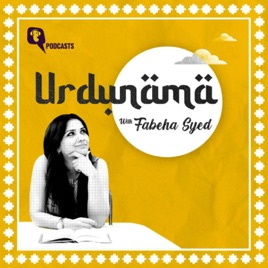
Advertise on podcast: Urdunama
Rating
4.9from
This podcast has
277 episodes
Language
HindiPublisher
The QuintExplicit
No
Date created
2019/08/03
Latest episode
2026/10/10
Average duration
16 min.
Release period
8 days
Description
Bollywood songs turn us all into Grammy award-winning bathroom singers! But wait, do you know the meaning of every word you sing? Especially the ones in Urdu? On Urdunama, our host Fabeha Syed takes one word at a time and breaks it down for you. Be it the protest poetry of Faiz, or Sameer's 90s nostalgia, we have it all. If you like Urdu and poetry, this podcast is for you!
Unlock Urdunama podcast Email contact info,
Listeners & Audience details
Email contact information
Direct podcast contact details

Listeners
Audience numbers & engagement insights

Audience details
Podcast Insights

Podcast episodes
Check latest episodes from Urdunama podcast
What Is Mizaaj? Exploring Temperament, Personality and Khudi
2026/10/10
What does mizaaj tell us about who we are? In this episode of Urdunama, we explore the Urdu word for temperament and disposition, and its connection to khudi, which is the idea of the idea of selfhood popularised by Allama Iqbal. Through the poetry of Jaun Elia, Habib Jalib and Daagh Dehlvi, we reflect on how our natural tendencies shape us, how life experiences can change the way we express ourselves, and whether we can learn to respond to hardship with greater resilience. Because understanding who we are begins with understanding our own mizaaj. Tune in.
Learn more about your ad choices. Visit megaphone.fm/adchoices
Wujood: What Does It Mean to Be? | Urdunama
2026/10/03
What does it mean to exist? Is wujood simply about being or does it also include the presence, influence and meaning that come with being?In this episode of Urdunama, Fabeha Syed explores wujood (وجود) through poetry, unpacking the many ways poets have thought about existence. Sometines as presence, as rootedness, as freedom, and as the forces that shape the way we inhabit the world.From Iqbal’s striking conversation between a tree and a desert bird to his idea of rising beyond the jazb-e-khaak, or the pull of the wordly desires, the episode looks at what it means to be here and what makes that presence matter.
Learn more about your ad choices. Visit megaphone.fm/adchoices
Bhagat Singh, Urdu and Revolution: Understanding His Multilingual World
2026/09/26
Ahead of Bhagat Singh’s 119th birth anniversary, Urdunama explores a lesser-known aspect of the revolutionary’s intellectual life: his relationship with the Urdu language and literature.In this episode, Fabeha Syed speaks to Professor Chaman Lal, former Professor and Chairperson of the Centre of Indian Languages at JNU and honorary advisor to the Bhagat Singh Archives & Resource Centre. A scholar and author of over 50 books, Lal has spent years researching Bhagat Singh’s writings, reading and intellectual legacy.While Bhagat Singh did not write extensively in Urdu, the language was part of his early education and wider literary and political environment. From Urdu poetry and literature to the language of revolutionary politics, this conversation explores the place Urdu occupied in Bhagat Singh’s intellectual world.
Learn more about your ad choices. Visit megaphone.fm/adchoices
Gheebat: Gossip, Backbiting and the Art of Gheebat
2026/09/19
We all say we hate gossip, but somehow, someone else’s business is always a little too interesting. In this episode of Urdunama, Fabeha Syed takes a closer look at gheebat, meaning the art of talking about people behind their backs. From everyday gossip and the conversations that bring us closer to poetry by Firaq Gorakhpuri and Yagana Changezi, we explore why we love to talk about other people’s lives, what it does to our relationships, and where the line between venting and backbiting really lies. Tune in.
Learn more about your ad choices. Visit megaphone.fm/adchoices
Tasleem: The Meaning of Acceptance, Surrender and Letting Go in Urdu Poetry
2026/09/12
What does it mean to tasleem something? More than simply accepting what is, tasleem can mean shades of acknowledgement, surrender, respect and making peace with what cannot be changed. In this episode of Urdunama, Fabeha Syed explores the word through the poetry of Ghalib, Hali, Javed Akhtar, Jigar Moradabadi and Hafeez Jalandhari, and discovers how acceptance can sometimes be its own form of courage.
Learn more about your ad choices. Visit megaphone.fm/adchoices
Ghutan: The Meaning of Suffocation in Urdu Poetry, From Kaifi Azmi to Gulzar
2026/09/05
What does ghutan truly mean? Is it physical suffocation, an eerie silence, or the weight of deep loneliness? Or is it that heavy feeling of being trapped inside an overwhelming wave of emotion?
In this episode of Urdunama, Fabeha Syed breaks down the word through the poetry of legends like Kaifi Azmi and Gulzar, among others. She traces how ghutan evolves from a simple physical sensation to a complex emotional, social, and political struggle, and ultimately, a universal longing to breathe, speak, and laugh freely again.
Learn more about your ad choices. Visit megaphone.fm/adchoices
Firaq Gorakhpuri: The Poet of Love, Longing and Pain in Urdu Poetry
2026/08/29
Firaq Gorakhpuri was born on 28 August 1896 as Raghupati Sahaay Firaq. On his birth anniversary, we return to a poet who changed how love could be written about in Urdu.
Firaq writes of ishq, but also of what accompanies it: desire, qurbat, longing, loneliness, memory and dard. What sets him apart is the attention he pays to these emotions. He doesn’t just describe them; he looks closely at what they do to us.
In this episode, we follow some of his best-known verses and his deeply personal nazm “Jugnu” to grasp a sense of Firaq’s world, his life and the many shades of love that run through his poetry.
Perhaps, along the way, we will better understand how he revolutionized Urdu poetry by blending classical Urdu romance with modern psychology and Eastern philosophy.
Learn more about your ad choices. Visit megaphone.fm/adchoices
Marz: A Word for Guilt, Longing, Pain and More
2026/08/22
In Urdu poetry, “marz” does not always mean an illness. It can be the weight of guilt, a restless heart, someone else’s manipulation, or even the problems affecting an entire society. In this episode of Urdunama, we look at verses by Ameer Minai, Rahat Indori, Akbar Allahabadi and Hali to explore how each poet gives “marz” a different meaning, and how the idea of a cure changes with it.
Learn more about your ad choices. Visit megaphone.fm/adchoices
Khud-Mukhtaar: What Does It Really Mean to Be Independent?
2026/08/15
What does it mean to be khud-mukhtaar? In this Independence Day episode of Urdunama, Fabeha Syed looks at the Urdu word for being independent, self-governing and able to make your own choices. But khud-mukhtaari is not simply about doing what you want. It also means living with the consequences of your choices. Through the poetry of Allama Iqbal, Munawwar Rana, and others, this episode explores ideas of freedom, choice, selfhood and responsibility, and what it really means to have ikhtiyar over your own life.
Learn more about your ad choices. Visit megaphone.fm/adchoices
Gumraah: Urdu Poetry on Being Lost, Misled and Finding the Way
2026/08/08
We usually think of gumraah as someone who has been led astray. But is that all the word means?
In this episode of Urdunama, we unpack the word, 'gum-raah', through the poetry of Khumar Barabankvi and Muneer Niazi among others. Along the way, we discover that gumraahi isn't always about taking the wrong path. Sometimes it begins with trust. Sometimes with love. Sometimes with a destination that opens into countless new roads. And sometimes, what looks like losing your way turns out to be finding a completely different one.Tune in to discover why one simple Urdu word can hold so many different journeys and paths.
Learn more about your ad choices. Visit megaphone.fm/adchoices
Gumshuda: When What's Lost Isn't Just a Person
2026/08/01
Most of us hear the word 'gumshuda' and think of a missing person. Urdu poetry has other ideas.In this episode of Urdunama, we explore how this simple word takes on many different meanings in poetry. Through these ashaar by Faiz Ahmed Faiz, Ahmad Mushtaq, and others, 'gumshuda' becomes much more than someone who has disappeared. It can be a lost voice, an unfinished song, an incomplete project, a wandering mind, a forgotten childhood, or even a part of ourselves that slowly disappears with time. It can also be that elusive creative spark, or an idea that catches you unawares, only to disappear before it has the chance to become a poem, a story or even a single sentence.Join us as we unpack one of Urdu's most layered words and discover how poetry uses gumshuda to make sense of absence, memory and the quiet search for what we've lost.
Learn more about your ad choices. Visit megaphone.fm/adchoices
Gumnaam: The Urdu Word That Means More Than ‘Anonymous’
2026/07/25
What does it really mean to be gumnaam?Often translated as "anonymous" or "unknown," the Urdu word carries a much deeper meaning. In this episode of Urdunama, we explore how gumnaam is used in Urdu poetry to reflect on forgotten contributors, invisible lives, fame, love and the underlying tension between recognition and obscurity. Through verses by Nida Fazli, Qateel Shifai, Ahmed Faraz and Meena Kumari Naaz, the episode asks a timeless question: Is being unknown always a misfortune, or can anonymity sometimes be its own kind of freedom? Tune in
Learn more about your ad choices. Visit megaphone.fm/adchoices
'Gum': The Urdu Word That Isn't Just About Being Lost
2026/07/18
We usually translate gum as "lost". But that's only half the story.In Urdu, gum isn't always about something disappearing. Sometimes it's a misplaced key. Sometimes it's your peace of mind. Sometimes it's simply getting so lost in your thoughts that the rest of the world fades into the background.This episode marks the beginning of a special Urdunama mini-series exploring a family of Urdu words that begin with gum. Over the next few episodes, we'll see how this one simple prefix gives rise to very different meanings, proving that a single word can open the door to entirely different human experiences. Tune in.
Learn more about your ad choices. Visit megaphone.fm/adchoices
Fouzia Dastango on Guru Dutt: The Melancholy, the Masterpieces, and the Man
2026/07/11
Guru Dutt's films continue to resonate decades after they were made, but what was the man behind the camera really like? In this episode of Urdunama, we explore the life, cinema, and legacy of Guru Dutt through the unique lens of Dastan-e-Guru Dutt. Joining us is India's first female Dastango, Fouzia Dastango, who brings this celebrated performance to audiences across the country.
From the melancholy of Pyaasa and the loneliness of Kaagaz Ke Phool to Guru Dutt's collaborative spirit, his portrayal of women, and the enduring relevance of his work, this conversation offers a fresh perspective on one of Indian cinema's greatest auteurs. Tune in and click here to watch Dastan-e-Gurudutt.
Learn more about your ad choices. Visit megaphone.fm/adchoices
What Does 'Naseeb' Really Mean? Urdu Poetry on Fate, Destiny and the Things We Can't Explain
2026/07/04
Why do two equally qualified people end up with completely different careers? Why does one marriage survive while another falls apart? Why do some people seem to meet the right person at the right time, while others do everything "right" and still don't get the life they hoped for?When we run out of explanations, we often reach for one word: naseebIn this episode of Urdunama, Fabeha Syed explores one of Urdu's most layered words through the poetry of Nida Fazli, Ahmed Faraz and Sudarshan Faakir. More than fate or destiny, naseeb is the language of uncertainty, it is the word we use to make sense of life's unexpected turns, heartbreaks, missed chances and inexplicable blessings. But does naseeb really explain anything, or does it simply help us live with the questions? Tune in.
Learn more about your ad choices. Visit megaphone.fm/adchoices
Podcast reviews
Read Urdunama podcast reviews
Cold666pack 2026/03/08
Digital Remnants of my life
I have grown incredibly fond of Urdunama since discovering it, living as an Indian Woman in America there are so few instances or opportunities to lis...
Rahd.3 2025/07/10
Urdunama
I have recently started listening Urdunama. I am very impressed with the way it is being written and played. Fabeha Syed appears to be a highly educat...
To cook or not to cook 2023/06/25
Most Enjoyed
Urdu poetry made easy to understand with great anecdotes and advice . Fabhia is a great host with a wonder voice and a great understanding of how to e...
Gharlak 2022/10/27
Great Job
With love from the U.S.A.
Captain Faraz 2022/07/21
Fabeha and her work are a National Treasure!
I was overjoyed to find this podcast several months ago, and now eagerly wait for the newest episode to drop.
Fabeha’s thoughtful and insightful and...
Outlaw_josey 2020/12/09
Seductive
I feel like Jamie Lee Curtis in the movie “ A fish called Wanda” when she hears the protagonist speak French. Keep them coming Fabeha. Each word is ex...
tinu 2020/11/22
Brilliant!
Thank you so much. Such a well down podcast. Always a delight to listen to episodes, old and new, and I eagerly wait for the release of new episodes. ...
Moshzd 2020/02/01
Delightful
Such a delightful podcast! Great way to learn about urdu poets and nazms. Always feel inspired to include — memorize and recite — more urdu poetry in...
Podcast sponsorship advertising
Start advertising on Urdunama relevant audience podcasts
You may also like to advertise on these Podcasts

4.723702000
Everything Everywhere Daily
Gary Arndt

4.6619682000
The Dan Bongino Show
Cumulus Podcast Network | Dan Bongino

4.813252012
The Jeff Cameron Show ~ Warchant.com
Jeff Cameron Show

4.98401800
The Adam Mockler Show
MeidasTouch Network

4.810941764
Warchant Podcasts featuring Seminole Headlines
Warchant.com

4.713382000
The NewsWorthy
Erica Mandy

4.682481290
The Daily Beast Podcast
The Daily Beast, Joanna Coles

4.890611566
Fearless with Jason Whitlock
Blaze Podcast Network

4.959792000
Legal AF by MeidasTouch
MeidasTouch Network

4.725721047
The Dana Show with Dana Loesch – Politics & Culture Commentary
Dana Loesch – Conservative Political Commentary