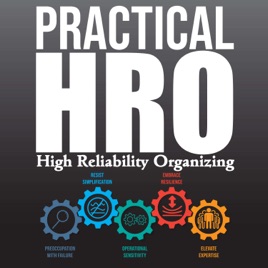
Advertise on podcast: Practical HRO: Optimizing Operational Risk Management using High Reliability Organizing
This podcast has
26 episodes
Language
EnglishPublisher
Edward J TierneyExplicit
No
Date created
2019/09/24
Latest episode
2021/07/01
Average duration
23 min.
Release period
41 days
Description
Practical implementation for leaders of progressive companies looking to drive a culture of high reliability and high performance
Unlock Practical HRO: Optimizing Operational Risk Management using High Reliability Organizing podcast Email contact info,
Listeners & Audience details
Email contact information
Direct podcast contact details

Listeners
Audience numbers & engagement insights

Audience details
Podcast Insights

Podcast episodes
Check latest episodes from Practical HRO: Optimizing Operational Risk Management using High Reliability Organizing podcast
Risk Management for Startups
2021/07/01
In this episode we explore the need for operational risk management by startups. I'm joined by Mr. Rick Gardener, executive director of the University of Buffalo's Business and Entrepreneurship Partnerships office. Rick has experience in all types of business settings from startups to NFPs. He holds 32 patents and brings a risk management perspective to his work.
When you talk about risk management for startups, Rick introduces the idea of moving from "the land of possibility" to a more firm perspective... identifying the actual risks that are going to get in the way of bringing your product to market. This is often a challenge for founders, and may be especially applicable for tech startups.
Rick sees an additional challenge for technical startups. The bulk of their work and thinking has been technical in nature. While it's important to overcome the technical obstacles, it is equally important to understand and plan for commercialization challenges.
Rick has some awesome insights and offers some best practices on dealing with risk and commercialization for startups.
1 Year Later: Schools Organically Adopt HRO Fighting Covid Crisis
2021/03/11
Joining us in this episode is Dr. David O’Rourke, District Superintendent and CEO of Erie2 BOCES, a cooperative education service that works directly with school districts to offer needed special services for students and schools.
We’re going to talk with David about managing risk in the middle of a crisis. A crisis no one saw coming.
We look at the operational, personnel, and student risks that had to be overcome, and we’re going to get some insight into how we can use this crisis as an opportunity for our schools. HRO requires that we learn from crisis and we are certainly going to need to incorporate HRO principles in our learning systems and facilities. David has a good start on that, having created an ad-hoc HRO organization in the midst of a raging crisis. Hat’s off to him and his team!
Teaching "An Introduction to HRO": Part 3 of 3
2021/02/01
I was fortunate to have the opportunity to teach a class of Healthcare graduate students about HRO. I'm excited to bring this to the podcast. To make it manageable I divided this 90 minute introductory class up into a 3 Part Series.
This Episode is Part 3. It introduces some of the human-centric aspects of HRO and what is important in implementing HRO concepts.
Part 1 Takes class through a bit of history about HRO, as this gives important context as to why it's important an what it's about. From there the class learns the definition of HRO and we break that down to focus on the various aspects of HRO.
Part 2 I take the the class through the 5 Habits of HRO, define them and look at some practical aspects of them.
Teaching "An Introduction to HRO": Part 2 of 3
2021/01/30
I was fortunate to have the opportunity to teach a class of Healthcare graduate students about HRO. I'm excited to bring this to the podcast. To make it manageable I divided this 90 minute introductory class up into a 3 Part Series.
This Episode is Part 2. I take the the class through the 5 Habits of HRO, define them and look at some practical aspects of them.
Part 1 Takes class through a bit of history about HRO, as this gives important context as to why it's important an what it's about. From there the class learns the definition of HRO and we break that down to focus on the various aspects of HRO.
Part 3 introduces some of the human-centric aspects of HRO and what is important in implementing HRO concepts.
Teaching "An Introduction To HRO": Part 1 of 3
2021/01/29
I was fortunate to have the opportunity to teach a class of Healthcare graduate students about HRO. I'm excited to bring this to the podcast. To make it manageable I divided this 90 minute introductory class up into a 3 Part Series.
This Episode is Part 1. I take the class through a bit of history about HRO, as this gives important context as to why it's important an what it's about. From there the class learns the definition of HRO and we break that down to focus on the various aspects of HRO.
Part 2 Takes the 5 Habits of HRO and defines them and looks at some practical aspects of them. Part 3 introduces some of the human-centric aspects of HRO and what is important in implementing HRO concepts.
Happy Holidays! How HRO helps Santa and the Elves Deliver Joy
2020/12/19
Every year, Santa is called upon to deliver the goods. This gripping expose' gives insight into the behind the scenes at the North Pole. In a slight tongue-in-check episode, we offer a collection of different HRO changes to consider, using Santa and his workshop to get you thinking outside of the toy box.
Practically speaking, HRO is hard. There is so much to consider and the challenge of knowing what effort makes the most sense first can seem as daunting as the mall the day before Christmas. Well, sit back, grab a hot cocoa and some cookies and listen to how Jolly Ole Santa Claus has built a High Reliability holiday juggernaut and give some thought to what to ask Santa for Christmas.
This is the season finale for this year. Many of you might be looking at some form of High Reliability implementation in the New Year and like many leaders are having a hard time identifying what’s your next (or first) step. I hope you enjoy today's season finale and all of this years episodes. Thanks to all the listeners and followers for helping grow our podcast this year. Next year is already taking shape. Happy Holidays and Happy New Year!
There Is No Difference Between HRO and Failure
2020/11/03
Jeff Bezos may have coined the phrase "failure and innovation are inseparable twins", but Charlie d'Estries brings it full circle with his perspective that there is no difference between HRO and failure. In other words, Innovation and HRO both require failure.
Charlie, scientist, businessman, entrepreneur and author, brings his renaissance perspective to HRO. He offers a fresh take on how failure makes people, and companies, better at managing risk.
HRO In Action - How Nursing Can Leverage HRO For Improved Outcomes
2020/08/14
Nurses touch so many lives. They are the very front line on healthcare. They are the point at which hospital operations, risk management, and care giving come together. Their actions can literally be life or death, and certainly they are highly committed to the job they do and the folks they take care of (namely you and me).
This episode discusses the 5 principles of HRO in the daily setting of an oncology hospital. The conversation focuses on the daily operational efforts of nurses and concludes with an example of how HRO can be applied to a nurses daily responsibilities.
Thanks to Jacque Henry for her time and awesome stories.
HRO & Corona 1 Small Thing - Recognition
2020/05/22
Recognize:
Recognize your people. Recognition positively impacts engagement. And right now, more than ever, an engaged workforce is your greatest asset and your best defense during this crisis.
In the frenzy and the disconnect between how we are used to working versus how we are working, leaders are not devoting enough time to consistently recognizing their people that pulled together to reinvent and sustain operations under tremendous duress.We aren't talking about a strategic approach to managing a transactional rewards program that spits out trinkets and gift cards. We are talking about the real deal; the human act of personally singing the praises and acknowledging the invaluable contributions of individuals and teams that made the impossible, possible.
Let’s take a second to fundamentally make the hard-line connection between recognition and engagement through the lens of HRO. The down and dirty purpose of High Reliability Organizing is to avoid known and unknown catastrophic threats that could compromise operations and outcomes in complex, high stakes, fast-paced industries…healthcare, aerospace, and nuclear energy. Recognizing the power of engaged employees to protect the systems and processes that affect outcomes is at the heart of HRO.
These are simple equations.
Recognized employees are energized and engaged employees.
Appreciative leaders are appreciated leaders.
If you lead from your heart and your head through this crisis, you’ll emerge with an aligned and energized organization that is better prepared for whatever is coming next. It doesn’t get any simpler than that.
The question is “What do you want more of?” An old friend used to say that “more is better” and when it comes to “improving the function of your organization”, you set the expectation and tone for what you will get more of…
Do you want more innovation, recognize it.
Do you want more expertise, acknowledge the power of it.
Do want a culture of engagement and proactivity, highlight it every time you see it.
Great leaders speak the language of more.
If you want your working culture to adopt an aptitude for continuous improvement, you have to cultivate, recognize and reward it.
Challenge the entire leadership team to recognize and elevate your people, privately and publicly, in real and meaningful ways.
Use your positions to raise others up. In doing so, you’ll improve the function of your organization.
So, what you and your leadership team need to do is start is to schedule time to pop in to see every team and department across the organization, across all shifts. Come in early, stay late over as long as it takes. And when you get through every team and department, do it again. The goal is to recognize the expert contributions that teams or departments made throughout the transition that sustained operations or protected outcomes. Be specific. Plan to spend 30 minutes with the group. Find out what they need to succeed. Listen to them, support them, and thank them. Go into the experience with the intention of making a meaningful connection with the contributors, despite it being a group pow-wow.
Here’s the moral of the story…High reliability organization’s develop repeatable systems, formal and informal, that reinforce operational excellence. Developing a culture of support and gratitude for one another starts with you popping in consistently to thank people for hard work and credible expertise that you can count on.
In closing…
Pull your leadership team together. Let them know that you expect praise to be free flowing across every layer of the organization. Together commit to promoting a recognition-rich culture.
HRO & Corona 1 Small Thing - Performance Management
2020/05/08
Manage Performance
Even in crisis, especially in crisis, you have to manage performance if you want to maintain any continuity across your routine business operations. We are running lean and pulled in different directions, but:
If outcomes matter, you have to manage
If talent matters, you have to manage
If quality, safety and delivery of service or product matter, you have to manage performance.
If culture matters…
Preoccupation with Failure: Recognizes that big threats usually start as small problems.
There is nothing more important than aligning your employees, resources, and systems to meet the new reality.
Employees are likely to be the single biggest determinant in how fast and how well an organization recovers from a crisis. How you manage performance, goals, expectations and talent during the crisis will have a direct impact on your ability to move forward.
Putting people first now, protects the future.
Reluctance to Oversimplify: Look to simply the solutions do not oversimplify the threat.
Maintaining the normal functions feels normal. Which is a comfort for most people when everything is not normal.
Uniting your employees around the common goal of doing their best to run “business as usual” is a relief to people during a crisis.
Sensitivity to Operations: More can always be done to improve the function of an organization in real time.
More can always be done to improve the function of an organization in real time if you know what needs to be done. Managing performance provides leaders with a certain sense of what needs to be done.
Commitment to Resiliency: Organizations ability to adapt under stressful circumstances.
The way that you work undoubtedly changed.
It’s very likely that your traditional approach or understanding of performance management may need to be deconstructed and re-conceptualized.
You just need an abbreviated approach to managing that focuses on setting new goals and new measures …with a heavy emphasis on coaching and feedback that moves people forward.
People learn faster through feedback.
Deference to Expertise: In high reliability organizing, every individual in any and every role should be trained and encouraged to see themselves as an expert in that particular operation.
This is the time to encourage initiative and empower people at all levels of the organization.
Experts are born during crisis.
I’ll give you an example…You have teams and individual performers who are problem-solving their way out of challenges every day. You want to know who they are- you want to recognize their roles. Some of them will surprise you. You want to invest in those that are invaluable to the organization.
Another way to cultivate expertise is to invest in expertise. If you have the resources and the capacity, you should be invested in developing talent at every layer right now. You can’t know who needs what unless you are managing performance.
HRO & Corona 1 Small Thing - Reinvigorate Our Headspace
2020/05/04
We were forced to adapt to change that we weren’t ready for and didn’t want.
And more change is coming, but we don’t know what it looks like or how it is going to affect us.
All of which is exhausting.
When the rate of change won’t change, we have to adjust our headspace… Otherwise …we’ll be reduced to reactive zombies.
Your organization is full of people uncertain about the future. They might be showing up every day, working from home, or furloughed. Doesn’t matter.
They might love you, hate you, trust you, distrust you…
Doesn’t matter. What matters is that you dig deep and refocus the contributors on all that we do know: who we are, why do we matter, what are we doing and are we prepared for what’s coming next. In times of uncertainty, we listen for the confidant for direction. Remind everyone that despite all that you don’t know, somethings, the most important things are certain.
Answer the questions that are going to carry you forward whether you have all the concrete answers or not.
What questions?
What do you do and what are we doing that actually matters?
Why are we doing it?
And what are we accomplishing?
The answers to these simple questions are bigger than the daily grind, of absorbing stress and fighting off all the threats.
Be vulnerable.
There is a higher order purpose to your work. Define it, communicate it and reinvigorate everyone’s headspace while we are in this weird lull.
HRO & Corona 1 Small Thing - Clearly Communicating
2020/04/10
We have a lot working against us right now.
Your 2, 3, 4 weeks into a radical transformation operations, complete re-organization of how and where. Your infrastructure's stable, but, completely consumed by disruptions.
So for that reason,
One thing, one seemingly small thing that exhausted leaders can do today is to focus on being clear and very definitively specific when communicating plans, expectations, and changes. Fatigue effects our performance especially our speech and listening capacity. It’s important to remind yourself that you are exhausted, remind yourself that you have to think differently about how you communicate right now
Preoccupation with Failure: Recognizes that big threats usually start as small problems.
Big threats are consequence of not enough words, so use clear speech, don’t start rapid firing directives, slow down, take a breath, organize your thoughts. Speak in full sentences. Outline the steps. Give context. Define the measure or clarify the boundaries.
Take the time to communicate precisely to the stressed and fatigued people around you. Look to simply the solutions do not oversimplify the threat.
Right now, it’s a mistake to believe that anything is obvious! Consider it your role right now to communicate the obvious. Do not assume that everyone knows what you know. Remember, we all have our own mental contexts and life experiences that complicate our ability to understand each other in low stress states.
Now in high stress states, we need to go to the next level when communicating. The only way to ensure that the meaning of your message is understood, is to clearly define the specifics. Organize information in simple steps and plain sentences.
More can always be done to improve the function of an organization in real time. Consider, essential employees report exposure. But, what does expose mean? My definitions of exposure, not yours? Does exposure mean that you spent 15 or more minutes within a 6’ range of someone that is waiting for a test, has tested positive or is hospitalized?
Use whatever definitions that you trust, but by defining the specifics you are accomplishing four goals:
One: Minimizing a threat to your workforce
Two: Protect scarce resources
Three: educating your working culture by offering one more clear safety standard for them to observe.
Four: By defining the ask and tasks in detail, you are more likely to realize the outcomes you have defined.
Now isn’t the time to be vague
Podcast reviews
Read Practical HRO: Optimizing Operational Risk Management using High Reliability Organizing podcast reviews
Podcast sponsorship advertising
Start advertising on Practical HRO: Optimizing Operational Risk Management using High Reliability Organizing relevant audience podcasts
You may also like to advertise on these Podcasts

4.5183105
Cybersecurity Today
Jim Love

4.612586704
Business Wars
Audible

4.810894534
Something to Wrestle with Bruce Prichard
Podcast Heat

4.719651
Jewish History Nerds
Unpacked

4.8290592000
The Michael Knowles Show
The Daily Wire

4.819122000
Football Ramble
Stak
4.720231222
Everyone's Business (But Mine) with Kara Berry
Kara Berry

4.67662000
Mark Narrations - Reddit Stories
Mark B

4.687371057
Get Sleepy: Sleep meditation and stories
Slumber Studios

4.91873376
Raising Boys & Girls
That Sounds Fun Network