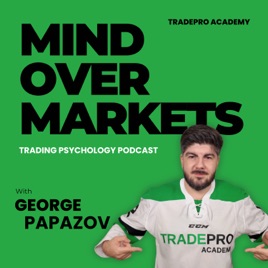
Advertise on podcast: Mind Over Markets: Trading Psychology Podcast
Rating
4.9from
This podcast has
196 episodes
Language
EnglishPublisher
George PapazovExplicit
No
Date created
2019/11/23
Latest episode
2026/04/23
Average duration
25 min.
Release period
7 days
Description
Mind Over Markets is the trading psychology podcast for serious traders ready to master the real edge — their mind. Hosted by George Papazov, founder of TRADEPRO Academy, this show helps you break emotional loops, regulate impulses, and build a confident trader identity. Learn how to rewire your mindset using NLP, coaching, and performance psychology. Ready to go deeper? Unlock the full ASCEND psychology program inside TRADEPRO Academy.
Unlock Mind Over Markets: Trading Psychology Podcast podcast Email contact info,
Listeners & Audience details
Email contact information
Direct podcast contact details

Listeners
Audience numbers & engagement insights

Audience details
Podcast Insights

Podcast episodes
Check latest episodes from Mind Over Markets: Trading Psychology Podcast podcast
How Heavy Buying With No Follow Through Tells You Exactly Where to Enter
2026/04/23
In Episode 196, George breaks down one of the most misunderstood concepts in trading: the failed auction.
What looks like strong buying and a breakout is often a trap, when heavy buying comes in but price doesn’t move, it’s not strength, it’s rejection.
Instead of chasing the move, professional traders recognize this as a signal that rotation is coming, and patiently wait for price to pull back into key support levels for a high-probability entry.
The episode ties together previous concepts (sweeps and exhaustion) and shows how they combine into a clear edge: reading what the market is actually doing, not what it looks like it’s doing.
Key Takeaways
Heavy buying ≠ strengthIf price doesn’t move despite aggressive buying, the market is rejecting higher prices.Failed auction = rotation signal (not immediate short)In a bullish trend, it tells you a pullback is coming, not a full reversal.Stop chasing breakoutsThe heaviest buying is often the worst entry, that’s where traders get trapped.Patience is the real edgeLet others get trapped at the top, their stops fuel your entry at support.Use it twice in one tradeArc connection (powerful insight) confirmation of rotationCore principle:👉 Let the market come to you, don’t let it pull you in.
Subscribe & Get Full Access: ROOMS + COURSES + COMMUNITY — ONE MEMBERSHIP FOR $99.
Download the Free PDF: The 5 Most Destructive Loops in Trading — and How to Break Them
Leave a Voice Message: Ask a question, say hello or suggest a future episode on SpeakPipe
Rate and Review: If you’re enjoying the show, we’d love for you to rate us on Spotify or on Apple Podcasts
Follow on Twitter: For daily mindset insights and trading psychology content, follow me here.
Disclaimer:
Futures, options, and derivatives trading involve substantial risk and are not suitable for every investor. The high degree of leverage in futures trading can work against you as well as for you. Past performance is not necessarily indicative of future results. The information provided in this podcast is for educational and informational purposes only and should not be construed as specific trading, investment, or financial advice. Nothing discussed constitutes an offer to buy or sell any futures contract, option, security, or other financial instrument. You are solely responsible for your own trading decisions, and you should carefully consider whether trading is appropriate for your financial situation, experience level, and risk tolerance. Always consult with a licensed financial advisor, registered broker, or other qualified professional before making trading or investment decisions. While efforts are made to present accurate and timely information, the host makes no warranties or representations regarding the completeness, reliability, or accuracy of any information presented and assumes no liability for any losses that may arise from reliance on this content. By listening to this podcast, you acknowledge and accept these risks.
You're Not Late to the Move, You're Early to the Trap
2026/04/16
This episode explains why the pause after a strong move isn’t a second chance, it’s a trap.
When aggressive buying continues but price stops moving, it signals exhaustion and absorption, not strength. Most traders fall into FOMO, chase the pause, and get stopped out, only to watch price return to their original level.
The key lesson: don’t chase. Mark your level, stay patient, and let the market come to you.
Key Takeaways
The pause is not an entry, it’s exhaustionHeavy buying + no price move = absorption (warning)More effort, less progress = buyers are losing controlFOMO turns you into exit liquidityLate buyers = future sellers (fuel for reversal)You didn’t miss the trade, you gained informationMissed level? Mark it and waitBest trades come from patience, not chasingExhaustion prints = imbalances + weak price continuationThe pause is the top forming, not the next move
Subscribe & Get Full Access: ROOMS + COURSES + COMMUNITY — ONE MEMBERSHIP FOR $99.
Download the Free PDF: The 5 Most Destructive Loops in Trading — and How to Break Them
Leave a Voice Message: Ask a question, say hello or suggest a future episode on SpeakPipe
Rate and Review: If you’re enjoying the show, we’d love for you to rate us on Spotify or on Apple Podcasts
Follow on Twitter: For daily mindset insights and trading psychology content, follow me here.
Disclaimer:
Futures, options, and derivatives trading involve substantial risk and are not suitable for every investor. The high degree of leverage in futures trading can work against you as well as for you. Past performance is not necessarily indicative of future results. The information provided in this podcast is for educational and informational purposes only and should not be construed as specific trading, investment, or financial advice. Nothing discussed constitutes an offer to buy or sell any futures contract, option, security, or other financial instrument. You are solely responsible for your own trading decisions, and you should carefully consider whether trading is appropriate for your financial situation, experience level, and risk tolerance. Always consult with a licensed financial advisor, registered broker, or other qualified professional before making trading or investment decisions. While efforts are made to present accurate and timely information, the host makes no warranties or representations regarding the completeness, reliability, or accuracy of any information presented and assumes no liability for any losses that may arise from reliance on this content. By listening to this podcast, you acknowledge and accept these risks.
How to Use Big Money Moves Instead of Chasing Them
2026/04/09
In this episode, George breaks down why large lot sweeps are not entry signals, but information signals. What looks like an invitation to jump in is actually a clue about where smart money entered, and where they’re likely to defend.
Instead of buying the top, you’ll learn how to identify the true edge:waiting for the pullback to the sweep level and trading with institutional positioning, not behind it.
This episode reframes how to read aggressive order flow, helping traders shift from emotional reactions to precision-based execution aligned with big money behavior.
Key Takeaways
Don’t chase sweeps, entries are already lateSweeps = information, not signalsMark the sweep level (institutional entry)Trade the pullback, not the breakoutLook for buyers defending the levelVolume drying = healthy pullbackAbsorption = real supportHold = continuation, break = reversalLet price come to youChasers provide liquidity, waiters take profit
Subscribe & Get Full Access: ROOMS + COURSES + COMMUNITY — ONE MEMBERSHIP FOR $99.
Download the Free PDF: The 5 Most Destructive Loops in Trading — and How to Break Them
Leave a Voice Message: Ask a question, say hello or suggest a future episode on SpeakPipe
Rate and Review: If you’re enjoying the show, we’d love for you to rate us on Spotify or on Apple Podcasts
Follow on Twitter: For daily mindset insights and trading psychology content, follow me here.
Disclaimer:
Futures, options, and derivatives trading involve substantial risk and are not suitable for every investor. The high degree of leverage in futures trading can work against you as well as for you. Past performance is not necessarily indicative of future results. The information provided in this podcast is for educational and informational purposes only and should not be construed as specific trading, investment, or financial advice. Nothing discussed constitutes an offer to buy or sell any futures contract, option, security, or other financial instrument. You are solely responsible for your own trading decisions, and you should carefully consider whether trading is appropriate for your financial situation, experience level, and risk tolerance. Always consult with a licensed financial advisor, registered broker, or other qualified professional before making trading or investment decisions. While efforts are made to present accurate and timely information, the host makes no warranties or representations regarding the completeness, reliability, or accuracy of any information presented and assumes no liability for any losses that may arise from reliance on this content. By listening to this podcast, you acknowledge and accept these risks.
Why Price Really Moves: The Order Flow Mechanic Every Futures Trader Needs to Understand
2026/04/02
This episode breaks down one of the most misunderstood truths in trading: price doesn’t move because of indicators or patterns, it moves because of orders.
Using real-world auction analogies, George explains how markets function as a continuous negotiation between buyers and sellers. At its core, the market is simply matching supply and demand through two types of participants:
Passive traders (limit orders) waiting for priceAggressive traders (market orders) forcing executionWhen aggressive orders consume available liquidity, price is forced to move, not because of opinion, but because there’s nothing left at that level.
Key Takeaways
The market is an auctionOnly aggressive orders move priceLimit vs Market ordersLiquidity is structureAbsorption vs movementControl > predictionExecution edge comes from order flowSubscribe & Get Full Access: ROOMS + COURSES + COMMUNITY — ONE MEMBERSHIP FOR $99.
Download the Free PDF: The 5 Most Destructive Loops in Trading — and How to Break Them
Leave a Voice Message: Ask a question, say hello or suggest a future episode on SpeakPipe
Rate and Review: If you’re enjoying the show, we’d love for you to rate us on Spotify or on Apple Podcasts
Follow on Twitter: For daily mindset insights and trading psychology content, follow me here.
Disclaimer:
Futures, options, and derivatives trading involve substantial risk and are not suitable for every investor. The high degree of leverage in futures trading can work against you as well as for you. Past performance is not necessarily indicative of future results. The information provided in this podcast is for educational and informational purposes only and should not be construed as specific trading, investment, or financial advice. Nothing discussed constitutes an offer to buy or sell any futures contract, option, security, or other financial instrument. You are solely responsible for your own trading decisions, and you should carefully consider whether trading is appropriate for your financial situation, experience level, and risk tolerance. Always consult with a licensed financial advisor, registered broker, or other qualified professional before making trading or investment decisions. While efforts are made to present accurate and timely information, the host makes no warranties or representations regarding the completeness, reliability, or accuracy of any information presented and assumes no liability for any losses that may arise from reliance on this content. By listening to this podcast, you acknowledge and accept these risks.
Trading Is Subtraction, Not Addition
2026/03/26
This episode breaks down why most traders struggle with execution, not because they lack tools, but because they rely on too many. When traders feel uncertain, they naturally seek more indicators, strategies, and information, believing complexity will solve their problems. In reality, this leads to confusion, hesitation, and repeated mistakes.
George emphasizes that trading, especially order flow, is fundamentally simple: it’s just an auction between buyers and sellers. The real edge comes from removing unnecessary information, separating analysis from execution, and focusing only on what directly supports decision-making. By simplifying charts, processes, and mental inputs, traders create clarity, reduce emotional noise, and allow their true edge to emerge.
Ultimately, progress in trading doesn’t come from adding more, it comes from removing what doesn’t belong.
Key Takeaways
More tools ≠ better execution
Complexity creates analysis paralysis
Traders add tools when they feel unsafe
Order flow is simple: market vs limit orders
Too much information overwhelms decision-making
Subtraction sharpens perception and clarity
Separate analysis vs execution processes
Only keep tools that:
Find levels
Qualify trades
Manage trades
Fewer charts = better focus
Simplicity creates confidence and consistency
Repetition > constantly switching strategies
Cluttered charts = cluttered thinking
Psychological issues often hide behind complexity
You don’t need more, you need clearer
Progress comes from removing what doesn’t belong
Subscribe & Get Full Access: ROOMS + COURSES + COMMUNITY — ONE MEMBERSHIP FOR $99.
Download the Free PDF: The 5 Most Destructive Loops in Trading — and How to Break Them
Leave a Voice Message: Ask a question, say hello or suggest a future episode on SpeakPipe
Rate and Review: If you’re enjoying the show, we’d love for you to rate us on Spotify or on Apple Podcasts
Follow on Twitter: For daily mindset insights and trading psychology content, follow me here.
Disclaimer:
Futures, options, and derivatives trading involve substantial risk and are not suitable for every investor. The high degree of leverage in futures trading can work against you as well as for you. Past performance is not necessarily indicative of future results. The information provided in this podcast is for educational and informational purposes only and should not be construed as specific trading, investment, or financial advice. Nothing discussed constitutes an offer to buy or sell any futures contract, option, security, or other financial instrument. You are solely responsible for your own trading decisions, and you should carefully consider whether trading is appropriate for your financial situation, experience level, and risk tolerance. Always consult with a licensed financial advisor, registered broker, or other qualified professional before making trading or investment decisions. While efforts are made to present accurate and timely information, the host makes no warranties or representations regarding the completeness, reliability, or accuracy of any information presented and assumes no liability for any losses that may arise from reliance on this content. By listening to this podcast, you acknowledge and accept these risks.
Why the Market Feels Random (And What You’re Missing)
2026/03/19
In this episode, George breaks down why the market often feels random, and why that’s actually a misunderstanding of how price really moves.
Most traders rely on past data (candles, indicators, support/resistance), which creates confusion, hesitation, and late entries. The real issue isn’t discipline, it’s using the wrong information.
George introduces a deeper layer of the market: real-time order flow, liquidity, and institutional positioning. These elements drive price movement and reveal key levels before they appear on traditional charts.
By shifting from “more information” to the right information, traders can gain clarity, reduce FOMO, and execute with confidence.
This episode sets the stage for a deeper dive into Market By Order (MBO), a tool that exposes real-time liquidity and future levels, and invites listeners to an upcoming live webinar where this will be taught in full.
Key Takeaways
Most traders use the wrong lens (past data instead of real-time activity)
The problem isn’t discipline, it’s lack of clarity from poor information
More indicators ≠ better trading
Markets are driven by liquidity, participation, and institutional positioning
Price is not random, it reacts to real-time order flow
The best levels are formed before price reaches them
Patience improves when you trust your information
Reducing inputs leads to better decision-making
Market By Order (MBO) reveals hidden liquidity and future key levels
The edge comes from seeing what most traders can’t
Episode Resources📅 FREE Live Webinar — March 24 @ 7PM EST: (Register now. Seats are limited)
Subscribe & Get Full Access: ROOMS + COURSES + COMMUNITY — ONE MEMBERSHIP FOR $99.
Download the Free PDF: The 5 Most Destructive Loops in Trading — and How to Break Them
Leave a Voice Message: Ask a question, say hello or suggest a future episode on SpeakPipe
Rate and Review: If you’re enjoying the show, we’d love for you to rate us on Spotify or on Apple Podcasts
Follow on Twitter: For daily mindset insights and trading psychology content, follow me here.
Disclaimer:
Futures, options, and derivatives trading involve substantial risk and are not suitable for every investor. The high degree of leverage in futures trading can work against you as well as for you. Past performance is not necessarily indicative of future results. The information provided in this podcast is for educational and informational purposes only and should not be construed as specific trading, investment, or financial advice. Nothing discussed constitutes an offer to buy or sell any futures contract, option, security, or other financial instrument. You are solely responsible for your own trading decisions, and you should carefully consider whether trading is appropriate for your financial situation, experience level, and risk tolerance. Always consult with a licensed financial advisor, registered broker, or other qualified professional before making trading or investment decisions. While efforts are made to present accurate and timely information, the host makes no warranties or representations regarding the completeness, reliability, or accuracy of any information presented and assumes no liability for any losses that may arise from reliance on this content. By listening to this podcast, you acknowledge and accept these risks.
Why Better Traders Trade Less
2026/03/12
In this episode of Mind Over Markets, George Papazov explores why the best traders often trade less, not more. Many traders struggle because they operate beyond their mental and strategic capacity, leading to overtrading, emotional decisions, and unnecessary losses. George explains how aligning your expectations with your capacity, focusing on fewer high-quality setups, and preserving mental energy leads to more consistent and stress-free trading. He also introduces an upcoming webinar on Market by Order (MBO) and how it reveals key liquidity levels before price reaches them.Key Takeaways
Restraint can be a trader’s real edge
Many losses come from trades that should never be taken
Expectations must align with your capacity
Overtrading drains mental energy and decision quality
More indicators and information can create confusion
Fewer trades lead to clearer decision making
Fatigue often appears as impatience in trading
Professional trading should feel structured and stress-controlled
Focus on high-probability setups, not constant participation
Success comes from alignment, not constant action
Episode Resources📅 FREE Live Webinar — March 24 @ 7PM EST: (Register now. Seats are limited)
Subscribe & Get Full Access: ROOMS + COURSES + COMMUNITY — ONE MEMBERSHIP FOR $99.
Download the Free PDF: The 5 Most Destructive Loops in Trading — and How to Break Them
Leave a Voice Message: Ask a question, say hello or suggest a future episode on SpeakPipe
Rate and Review: If you’re enjoying the show, we’d love for you to rate us on Spotify or on Apple Podcasts
Follow on Twitter: For daily mindset insights and trading psychology content, follow me here.
Disclaimer:
Futures, options, and derivatives trading involve substantial risk and are not suitable for every investor. The high degree of leverage in futures trading can work against you as well as for you. Past performance is not necessarily indicative of future results. The information provided in this podcast is for educational and informational purposes only and should not be construed as specific trading, investment, or financial advice. Nothing discussed constitutes an offer to buy or sell any futures contract, option, security, or other financial instrument. You are solely responsible for your own trading decisions, and you should carefully consider whether trading is appropriate for your financial situation, experience level, and risk tolerance. Always consult with a licensed financial advisor, registered broker, or other qualified professional before making trading or investment decisions. While efforts are made to present accurate and timely information, the host makes no warranties or representations regarding the completeness, reliability, or accuracy of any information presented and assumes no liability for any losses that may arise from reliance on this content. By listening to this podcast, you acknowledge and accept these risks.
The Hidden Reason You’re Not Consistent Yet
2026/03/05
In Episode 189, George explains that most traders aren’t inconsistent because they lack skill, they’re inconsistent because they measure the wrong thing. Judging performance by P&L, win rate, or risk-reward only captures the outcome, not the discipline behind it. Emotional trades like FOMO, tilt, and revenge entries distort results and hide whether your actual plan has edge.
The real metric of consistency is simple: trades taken according to plan versus trades taken in violation of it. When traders remove off-plan trades from their review, many discover they’re much closer to consistency than they thought. The issue isn’t strategy, it’s interference. Focus on executing the Next Best Trade, and let the scoreboard catch up later.
Key Takeaways
P&L measures outcomes, not discipline.
Consistency is trades-to-plan vs trades-in-violation.
Emotional trades distort your equity curve.
Winners outside your plan are more dangerous than losers within it.
Removing violations often reveals you’re already near break-even.
Improvement comes from doing less, not adding more setups.
Inconsistency is mislabeling, it’s plan-following inconsistency.
Focus on the Next Best Trade, not the scoreboard.
Your problem isn’t skill, it’s interference.
Episode Resources
Subscribe & Get Full Access: ROOMS + COURSES + COMMUNITY — ONE MEMBERSHIP FOR $99.
Download the Free PDF: The 5 Most Destructive Loops in Trading — and How to Break Them
Leave a Voice Message: Ask a question, say hello or suggest a future episode on SpeakPipe
Rate and Review: If you’re enjoying the show, we’d love for you to rate us on Spotify or on Apple Podcasts
Follow on Twitter: For daily mindset insights and trading psychology content, follow me here.
Disclaimer:
Futures, options, and derivatives trading involve substantial risk and are not suitable for every investor. The high degree of leverage in futures trading can work against you as well as for you. Past performance is not necessarily indicative of future results. The information provided in this podcast is for educational and informational purposes only and should not be construed as specific trading, investment, or financial advice. Nothing discussed constitutes an offer to buy or sell any futures contract, option, security, or other financial instrument. You are solely responsible for your own trading decisions, and you should carefully consider whether trading is appropriate for your financial situation, experience level, and risk tolerance. Always consult with a licensed financial advisor, registered broker, or other qualified professional before making trading or investment decisions. While efforts are made to present accurate and timely information, the host makes no warranties or representations regarding the completeness, reliability, or accuracy of any information presented and assumes no liability for any losses that may arise from reliance on this content. By listening to this podcast, you acknowledge and accept these risks.
The ‘Pretend You’re Already In’ Mental Trick
2026/02/26
In this episode of Mind Over Markets, George shares a powerful mental technique designed to eliminate FOMO and prevent late trade entries, without relying on indicators or additional analysis.
By shifting from a “chasing” mindset to a “managing” mindset, you collapse emotional fantasy, regain objectivity, and turn missed opportunities into mental capital. Instead of spiraling into urgency, you use imagination as a structured decision-making tool to evaluate stops, targets, and trade management, as if you had taken the trade.
This mental reframe closes emotional loops, builds confidence, and strengthens execution discipline over time. The result? Less FOMO, better timing, and a stronger performance mindset.
Key Takeaways
FOMO is fueled by fantasy, not reality.
Pretending you’re already in shifts you from buyer to risk manager.
Running the trade scenario closes the emotional loop.
You can build mental reps without financial risk.
A missed trade is lost potential, not a real loss.
Awareness is required to catch emotion before it escalates.
Reward good analysis instead of punishing hesitation.
Mental capital compounds faster than financial capital.
Episode Resources
Subscribe & Get Full Access: ROOMS + COURSES + COMMUNITY — ONE MEMBERSHIP FOR $99.
Download the Free PDF: The 5 Most Destructive Loops in Trading — and How to Break Them
Leave a Voice Message: Ask a question, say hello or suggest a future episode on SpeakPipe
Rate and Review: If you’re enjoying the show, we’d love for you to rate us on Spotify or on Apple Podcasts
Follow on Twitter: For daily mindset insights and trading psychology content, follow me here.
Disclaimer:
Futures, options, and derivatives trading involve substantial risk and are not suitable for every investor. The high degree of leverage in futures trading can work against you as well as for you. Past performance is not necessarily indicative of future results. The information provided in this podcast is for educational and informational purposes only and should not be construed as specific trading, investment, or financial advice. Nothing discussed constitutes an offer to buy or sell any futures contract, option, security, or other financial instrument. You are solely responsible for your own trading decisions, and you should carefully consider whether trading is appropriate for your financial situation, experience level, and risk tolerance. Always consult with a licensed financial advisor, registered broker, or other qualified professional before making trading or investment decisions. While efforts are made to present accurate and timely information, the host makes no warranties or representations regarding the completeness, reliability, or accuracy of any information presented and assumes no liability for any losses that may arise from reliance on this content. By listening to this podcast, you acknowledge and accept these risks.
The Next Best Trade (And Why Emotion Means You’re Early)
2026/02/19
In this episode of Mind Over Markets, George Papazov breaks down why emotion spikes in trading, especially when there isn’t actually a valid trade. He explains that emotion is often a sequencing error: traders skip steps in their process and try to execute before confirmation exists.
George introduces the concept of the Next Best Trade (NBT), a framework that keeps you focused on what truly matters instead of chasing movement. When you know exactly what you’re waiting for, patience becomes natural and FOMO disappears.
The key shift is moving from “now or never” thinking to “what comes next.” Professionals stay calm during big moves because they’re locked in on their next best setup, not reacting to noise.
Key Takeaways
Emotion in trading is often a sequencing error, not a character flaw.
Every trade follows a structure: context → level → participation → confirmation → execution.
Urgency is a red flag, not a signal.
“Now or never” thinking creates impulsive behavior.
Traders who don’t know what they’re waiting for can’t be patient.
Searching for trades keeps you in fight-or-flight mode.
The Next Best Trade framework eliminates FOMO by disqualifying non-optimal setups.
Professionals stay calm because they are focused on one thing: the best opportunity, not any opportunity.
Many trading psychology issues are actually strategy clarity problems.
When your focus leaves your Next Best Trade, your edge disappears.
Episode Resources
Subscribe & Get Full Access: ROOMS + COURSES + COMMUNITY — ONE MEMBERSHIP FOR $99.
Download the Free PDF: The 5 Most Destructive Loops in Trading — and How to Break Them
Leave a Voice Message: Ask a question, say hello or suggest a future episode on SpeakPipe
Rate and Review: If you’re enjoying the show, we’d love for you to rate us on Spotify or on Apple Podcasts
Follow on Twitter: For daily mindset insights and trading psychology content, follow me here.
Disclaimer:
Futures, options, and derivatives trading involve substantial risk and are not suitable for every investor. The high degree of leverage in futures trading can work against you as well as for you. Past performance is not necessarily indicative of future results. The information provided in this podcast is for educational and informational purposes only and should not be construed as specific trading, investment, or financial advice. Nothing discussed constitutes an offer to buy or sell any futures contract, option, security, or other financial instrument. You are solely responsible for your own trading decisions, and you should carefully consider whether trading is appropriate for your financial situation, experience level, and risk tolerance. Always consult with a licensed financial advisor, registered broker, or other qualified professional before making trading or investment decisions. While efforts are made to present accurate and timely information, the host makes no warranties or representations regarding the completeness, reliability, or accuracy of any information presented and assumes no liability for any losses that may arise from reliance on this content. By listening to this podcast, you acknowledge and accept these risks.
Why Missing Trades Is Part of Consistency
2026/02/12
In this episode of Mind Over Markets, George explores why missed trades often feel worse than losing trades, and why that reaction quietly destroys consistency.
George explains how traders emotionally code missed opportunities as personal failure, leading to revenge trading, softened rules, and distorted risk perception. George reframes missed trades as gained information, showing how professionals use them to confirm bias, strengthen confidence, and improve future execution without risking capital.
The core shift: you didn’t miss money, you gained information.
Key Takeaways
Missed trades attack identity more than capital
Traders only regret missed winners, not missed losers
Chasing missed trades leads directly to revenge trading
Missed trades confirm bias and market structure
Gained information improves confidence and execution
Consistency comes from waiting for the next best trade
Episode Resources
Subscribe & Get Full Access: ROOMS + COURSES + COMMUNITY — ONE MEMBERSHIP FOR $99.
Download the Free PDF: The 5 Most Destructive Loops in Trading — and How to Break Them
Leave a Voice Message: Ask a question, say hello or suggest a future episode on SpeakPipe
Rate and Review: If you’re enjoying the show, we’d love for you to rate us on Spotify or on Apple Podcasts
Follow on Twitter: For daily mindset insights and trading psychology content, follow me here.
Disclaimer:
Futures, options, and derivatives trading involve substantial risk and are not suitable for every investor. The high degree of leverage in futures trading can work against you as well as for you. Past performance is not necessarily indicative of future results. The information provided in this podcast is for educational and informational purposes only and should not be construed as specific trading, investment, or financial advice. Nothing discussed constitutes an offer to buy or sell any futures contract, option, security, or other financial instrument. You are solely responsible for your own trading decisions, and you should carefully consider whether trading is appropriate for your financial situation, experience level, and risk tolerance. Always consult with a licensed financial advisor, registered broker, or other qualified professional before making trading or investment decisions. While efforts are made to present accurate and timely information, the host makes no warranties or representations regarding the completeness, reliability, or accuracy of any information presented and assumes no liability for any losses that may arise from reliance on this content. By listening to this podcast, you acknowledge and accept these risks.
Inside the Order Flow Vault: How Real Execution Is Built
2026/02/05
In this episode of Mind Over Markets, George explains why most traders fail not because of strategy, but because they lack confidence at the moment of execution. He shares why order flow is the missing link between analysis and action, and introduces the Order Flow Vault—a live course, trading room, and community built to train traders to read the auction in real time, execute with confidence, and stop trading in isolation.
Key Takeaways
Most trading mistakes happen at execution, not analysis.
Order flow helps traders read the live auction instead of guessing.
Confidence is built by mastering entries, not chasing big wins.
Trading psychology improves when execution becomes structured.
Learning accelerates through live markets and community-based trading.
Episode Resources
Subscribe & Get Full Access: ROOMS + COURSES + COMMUNITY — ONE MEMBERSHIP.
Download the Free PDF: The 5 Most Destructive Loops in Trading — and How to Break Them
Leave a Voice Message: Ask a question, say hello or suggest a future episode on SpeakPipe
Rate and Review: If you’re enjoying the show, we’d love for you to rate us on Spotify or on Apple Podcasts
Follow on Twitter: For daily mindset insights and trading psychology content, follow me here.
Disclaimer:
Futures, options, and derivatives trading involve substantial risk and are not suitable for every investor. The high degree of leverage in futures trading can work against you as well as for you. Past performance is not necessarily indicative of future results. The information provided in this podcast is for educational and informational purposes only and should not be construed as specific trading, investment, or financial advice. Nothing discussed constitutes an offer to buy or sell any futures contract, option, security, or other financial instrument. You are solely responsible for your own trading decisions, and you should carefully consider whether trading is appropriate for your financial situation, experience level, and risk tolerance. Always consult with a licensed financial advisor, registered broker, or other qualified professional before making trading or investment decisions. While efforts are made to present accurate and timely information, the host makes no warranties or representations regarding the completeness, reliability, or accuracy of any information presented and assumes no liability for any losses that may arise from reliance on this content. By listening to this podcast, you acknowledge and accept these risks.
Why Confirmation Is an Illusion
2026/01/29
In this episode of Mind Over Markets, George Papazov explains why confirmation and indicators don’t create better traders, they simply make uncertainty feel safer. Traders often use confirmation as an emotional buffer, outsourcing decision-making to systems and indicators to avoid personal responsibility. While this protects the ego, it delays growth and consistency.
George emphasizes that the market never waits for certainty. By the time confirmation appears, the opportunity has already passed. Confirmation can validate whether a trade’s reward is worth the risk, but it can never eliminate risk entirely. Chasing “no-risk” entries only leads to hesitation and missed trades.
The episode highlights why order flow feels uncomfortable at first: it shows what’s happening in real time without telling traders what to do. That discomfort is where real power begins. Order flow removes bias, restores neutrality, and puts decision-making back in the trader’s hands, replacing permission-seeking with clarity and control.
Key Takeaways
Confirmation doesn’t protect traders, it delays themIndicators act as emotional buffers, not edge creatorsCertainty appears after opportunity, not beforeConfirmation should validate risk vs. reward, not eliminate riskOrder flow reveals the market’s story without instructionsNeutrality feels unsafe before it feels powerfulTraders fear acting without permission more than losing moneyReal consistency comes from reading the market, not waiting for signals
Episode Resources
FREE Live Webinar — Feb 3 @ 7PM EST (Register now. Seats are limited)
Download the Free PDF: The 5 Most Destructive Loops in Trading — and How to Break Them
Leave a Voice Message: Ask a question, say hello or suggest a future episode on SpeakPipe
Rate and Review: If you’re enjoying the show, we’d love for you to rate us on Spotify or on Apple Podcasts
Follow on Twitter: For daily mindset insights and trading psychology content, follow me here.
Disclaimer:
Futures, options, and derivatives trading involve substantial risk and are not suitable for every investor. The high degree of leverage in futures trading can work against you as well as for you. Past performance is not necessarily indicative of future results. The information provided in this podcast is for educational and informational purposes only and should not be construed as specific trading, investment, or financial advice. Nothing discussed constitutes an offer to buy or sell any futures contract, option, security, or other financial instrument. You are solely responsible for your own trading decisions, and you should carefully consider whether trading is appropriate for your financial situation, experience level, and risk tolerance. Always consult with a licensed financial advisor, registered broker, or other qualified professional before making trading or investment decisions. While efforts are made to present accurate and timely information, the host makes no warranties or representations regarding the completeness, reliability, or accuracy of any information presented and assumes no liability for any losses that may arise from reliance on this content. By listening to this podcast, you acknowledge and accept these risks.
Price Responds to Commitment, Not Opinion
2026/01/22
In this episode of Mind Over Markets, George Papazov explains why markets don’t move based on opinions, analysis, or predictions, they move based on real capital being committed in real time. He breaks down the critical difference between passive and aggressive market participants, showing how urgency, not agreement, drives price movement. George explains why fast moves often fail, how stop runs and fake breakouts form, and why desperation-driven moves frequently reverse once participation fades. The episode reinforces a core auction market principle: price responds to action, not ideas, and traders who learn to read commitment gain a decisive edge in execution.
Key Takeaways
Markets move because of capital commitment, not opinions or analysis.
Analysts, forecasts, and targets only matter after traders commit money.
Trading analysis shapes opinions, but opinions don’t move price.
Only real orders near current price with urgency impact the auction.
There are two key participants: passive (price-motivated) and aggressive (fill-motivated) traders.
Aggressive orders (especially stop-losses) are the primary drivers of price movement.
Urgency does not mean agreement, many market orders are executed to stop losses, not to express conviction.
Fast, emotional moves often fail because participation doesn’t follow.
Stop runs, fake breakouts, and whipsaws occur when desperation completes and balance returns.
The market doesn’t respond to ideas, it responds to action.
Traders gain edge by asking: Who had to act? and Did others follow or did it fade?
Episode Resources
FREE Live Webinar — Feb 3 @ 7PM EST (Register now. Seats are limited)
Download the Free PDF: The 5 Most Destructive Loops in Trading — and How to Break Them
Leave a Voice Message: Ask a question, say hello or suggest a future episode on SpeakPipe
Rate and Review: If you’re enjoying the show, we’d love for you to rate us on Spotify or on Apple Podcasts
Follow on Twitter: For daily mindset insights and trading psychology content, follow me here.
Disclaimer:
Futures, options, and derivatives trading involve substantial risk and are not suitable for every investor. The high degree of leverage in futures trading can work against you as well as for you. Past performance is not necessarily indicative of future results. The information provided in this podcast is for educational and informational purposes only and should not be construed as specific trading, investment, or financial advice. Nothing discussed constitutes an offer to buy or sell any futures contract, option, security, or other financial instrument. You are solely responsible for your own trading decisions, and you should carefully consider whether trading is appropriate for your financial situation, experience level, and risk tolerance. Always consult with a licensed financial advisor, registered broker, or other qualified professional before making trading or investment decisions. While efforts are made to present accurate and timely information, the host makes no warranties or representations regarding the completeness, reliability, or accuracy of any information presented and assumes no liability for any losses that may arise from reliance on this content. By listening to this podcast, you acknowledge and accept these risks.
Acceptance and Rejection: The Only Two Outcomes That Actually Matter
2026/01/15
In this episode, George Papazov breaks down acceptance and rejection, the two outcomes that drive all market behavior. He explains how markets operate as real-time auctions, where price reflects perceived value, not true value, and why understanding this process is critical for execution.
George shows how acceptance occurs when participation increases and price holds or continues, while rejection forms when aggressive buying or selling fails to move price forward. Through real order flow examples, he illustrates how these moments reveal institutional intent and signal either continuation or pullbacks.
The episode emphasizes that traders don’t need to predict price, only read the auction in real time. By focusing on acceptance and rejection instead of indicators or headlines, traders can improve timing, execution, and consistency.Key Takeaways
Markets are auctions driven by perceived value, not true value
Acceptance occurs when participation increases and price holds or continues
Rejection occurs when price fails to continue despite heavy participation
Acceptance leads to continuation; rejection signals pullbacks or trend failure
Large institutional behavior is revealed through order flow, not indicators
Consolidation and chop are necessary phases for future imbalances
Traders don’t need to predict price, only interpret the auction
Heavy buying without price movement is often a warning sign
Price justification (“why did it move?”) distracts from execution
Order flow reveals what traders are doing, not what they are saying
Episode Resources
Download the Free PDF: The 5 Most Destructive Loops in Trading — and How to Break Them
Leave a Voice Message: Ask a question, say hello or suggest a future episode on SpeakPipe
Rate and Review: If you’re enjoying the show, we’d love for you to rate us on Spotify or on Apple Podcasts
Follow on Twitter: For daily mindset insights and trading psychology content, follow me here.
Disclaimer:
Futures, options, and derivatives trading involve substantial risk and are not suitable for every investor. The high degree of leverage in futures trading can work against you as well as for you. Past performance is not necessarily indicative of future results. The information provided in this podcast is for educational and informational purposes only and should not be construed as specific trading, investment, or financial advice. Nothing discussed constitutes an offer to buy or sell any futures contract, option, security, or other financial instrument. You are solely responsible for your own trading decisions, and you should carefully consider whether trading is appropriate for your financial situation, experience level, and risk tolerance. Always consult with a licensed financial advisor, registered broker, or other qualified professional before making trading or investment decisions. While efforts are made to present accurate and timely information, the host makes no warranties or representations regarding the completeness, reliability, or accuracy of any information presented and assumes no liability for any losses that may arise from reliance on this content. By listening to this podcast, you acknowledge and accept these risks.
Podcast reviews
Read Mind Over Markets: Trading Psychology Podcast podcast reviews
Inner circle traders 2026/02/16
Number 1 trading podcast
First time ever writing a review for a podcast and I have listened to A LOT of podcasts over the past few years on trading psychology. Just wanted to ...
Benjas1406 2022/07/26
Just Grateful for this!
Thanks a lot for producing this awesome content which I consider is a must for any trader! Helped me to get to know my own thinking process better, an...
JAdamson77 2022/01/22
Fantastic
These guys go out of their way to spread their knowledge, guidance and positivity and ask for absolutely nothing in return. They have helped me and c...
Rob1berry2 2022/01/10
Grateful for this podcast
In trading (as in life) your strategy is a small part of the success that you will enjoy. Podcasts like this cover the other MUCH larger aspect of suc...
Hometeam Heroes 2021/11/29
Solid Information
Mindset is 90% of trading — this podcast goes deep into many different facets of a trader’s mindset and offers valuable insights into patterns you nee...
Pauloawd 2021/09/14
Simply the best
I have listened to all episodes of this podcast. It is just amazing. They are people who offer their time and knowledge and definitely change people’s...
Baghti 2021/08/09
A must listen for all aspiring traders!
I’ve been listening to Mind Over Markets for quite a while, actually found it accidentally searching for something else and then spent an entire weeke...
Sean.Sohal 2021/06/07
Take control of your impulsive behavior.
I've been listening to Mind Over Markets for six months, and it's not only changed the way I trade the market but also, and more importantly, how I do...
Eddy5555cxzzz 2021/05/17
Aatish
As a beginner trader just started listening to the podcast and it’s very informational and free. Can’t deny the fact that it’s the foundation of all t...
Overstocked Mommy! 2021/05/07
Great people! Great podcast!
All I can say is that great people make great podcasts! These 2 guys are knowledgeable and compassionate. I lean so much each time they speak!! Thank ...
Podcast sponsorship advertising
Start advertising on Mind Over Markets: Trading Psychology Podcast relevant audience podcasts
You may also like to advertise on these Podcasts

4.4371061566
The Megyn Kelly Show
SiriusXM

4.888901269
Fearless with Jason Whitlock
Blaze Podcast Network

4.8118931000
Mind Pump: Raw Fitness Truth
Sal Di Stefano, Adam Schafer, Justin Andrews, Doug Egge

4.8102131585
Tara Brach
Tara Brach

4.541561215
Something You Should Know
Mike Carruthers | OmniCast Media

4.513841343
Strictly Anonymous Confessions
Kathy Kay

4.8292781897
Fantasy Footballers - Fantasy Football Podcast
Fantasy Football

4.62382612
Football Weekly
The Guardian

4.45387666
Two Judgey Girls
Two Judgey Girls

3.8258501152
The Viall Files
Nick Viall