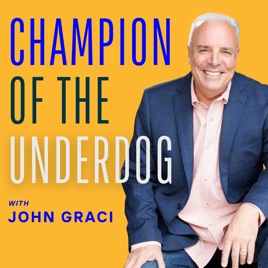
Advertise on podcast: Champion of the Underdog: Simplifying the Complex for Leaders
Rating
5from
This podcast has
28 episodes
Language
EnglishPublisher
John GraciExplicit
No
Date created
2019/12/13
Latest episode
2026/04/22
Average duration
5 min.
Release period
7 days
Description
Welcome to Champion of the Underdog. I'm John Graci — a keynote speaker, corporate trainer, author of eight books, and a leadership voice you may have seen on CNN or Fox News. With 30 years of experience, I cut past the fluff. No suits, no slides, no theory, just real answers for real leaders. The kind of conversation you'd have after hours, shoulder to shoulder, with someone who's been in the trenches.
Unlock Champion of the Underdog: Simplifying the Complex for Leaders podcast Email contact info,
Listeners & Audience details
Email contact information
Direct podcast contact details

Listeners
Audience numbers & engagement insights

Audience details
Podcast Insights

Podcast episodes
Check latest episodes from Champion of the Underdog: Simplifying the Complex for Leaders podcast
The Blunt Truth – Confronting the Wandering Employee | Episode 28
2026/04/22
In this episode of Champion of the Underdog, John Graci tackles a common workplace frustration: the employee who seems to be everywhere… except where the work is.
Before jumping to conclusions, John emphasizes the importance of observing firsthand. What looks like disengagement could be something else, but if it’s truly an issue, leaders need to address it directly and professionally.
The key is simple: have a private, honest conversation. Ask what’s going on, listen without interrupting, and then clearly reset expectations. Avoiding the conversation only creates confusion and frustration across the team.
Key Takeaways:
Don’t rely on rumors. Observe behavior yourself first.
Address issues privately, never in front of the team.
Be direct and clear when starting the conversation.
Listen before jumping to conclusions.
Set clear expectations and follow up for accountability.
Bottom line: clarity and direct communication turn awkward situations into leadership opportunities.
And remember: If you’re not coaching it, you’re allowing it.
Resources & Links:
John's Digital Courses for Team Leads, Managers, and Supervisors
John's Website
Connect with John on Linkedin
If you’re a leader, HR professional, or manager looking for no-nonsense strategies to keep your team engaged and high-performing, this episode is packed with insights you can use right away.
Tackling Bad Breath as a Leader | Episode 27
2026/04/15
In this episode of Champion of the Underdog, John Graci takes on one of the most awkward, but necessary, leadership conversations: addressing personal hygiene issues like bad breath.
John makes it clear; if you notice it, others do too. Ignoring it doesn’t make it go away; it creates discomfort across the team. As a leader, you are responsible for handling these situations with professionalism, respect, and compassion.
The key is simple: address it privately, ask questions rather than make assumptions, and work toward a solution together. Done right, even uncomfortable conversations can build trust rather than damage it.
Key Takeaways:
Leaders must address issues they observe. Don’t rely on gossip.
Handle sensitive topics privately and respectfully.
Ask questions first to understand the root cause.
Partner on solutions instead of dictating fixes.
Follow up with care and compassion.
Bottom line: avoiding awkward conversations weakens trust, and handling them well strengthens it.
And remember: If you’re not coaching it, you’re allowing it.
Resources & Links:
John's Digital Courses for Team Leads, Managers, and Supervisors
John's Website
Connect with John on Linkedin
If you’re a leader, HR professional, or manager looking for no-nonsense strategies to keep your team engaged and high-performing, this episode is packed with insights you can use right away.
Perception Is Reality in Leadership | Episode 26
2026/04/13
In this episode of Champion of the Underdog, John Graci highlights a critical leadership truth: it’s not just what you do, it’s how your team perceives it.
Using a relatable story about public perception and Tiger Woods, John breaks down how quickly people draw conclusions based on what they see. The same applies in the workplace. When leaders spend more time with certain employees, give select opportunities, or appear to favor individuals, others start making assumptions even if those assumptions aren’t true.
The result? Doubt, insecurity, and disengagement.
John emphasizes that leaders must be intentional and balanced in how they show attention, communicate, and involve their team. Because perception drives behavior—and behavior drives results.
Key Takeaways:
Perception often matters more than intent.
Favoritism, real or perceived, damages trust and morale.
Employees make decisions based on what they observe.
Leaders must be consistent and fair in their interactions.
Small actions can create big assumptions across a team.
Bottom line: if your team thinks something is happening, it might as well be happening.
And remember: If you’re not coaching it, you’re allowing it.
Resources & Links:
John's Digital Courses for Team Leads, Managers, and Supervisors
John's Website
Connect with John on Linkedin
If you’re a leader, HR professional, or manager looking for no-nonsense strategies to keep your team engaged and high-performing, this episode is packed with insights you can use right away.
How to Show Appreciation When You Can’t Give Raises | Episode 25
2026/04/01
In this episode of Champion of the Underdog, John Graci tackles a real-world leadership challenge: how to show your team they’re valued when you can’t increase their pay.
John makes it clear that compensation matters, but appreciation goes far beyond money. Leaders who rely only on raises to motivate their team are missing daily opportunities to build trust, morale, and loyalty.
From simple gestures like bringing in food, to recognizing great work in the moment, to being honest about financial constraints. This episode highlights practical ways to make your team feel seen and valued.
Key Takeaways:
Appreciation doesn’t require a budget; it requires intention.
Small, consistent gestures can have a big impact on morale.
Catch people doing things right and recognize it immediately.
Transparency builds trust when raises aren’t possible.
Employees want to feel valued, not just paid.
Bottom line: you may not control salaries, but you always control how you show appreciation.
And remember: If you’re not coaching it, you’re allowing it.
Resources & Links:
John's Digital Courses for Team Leads, Managers, and Supervisors
John's Website
Connect with John on Linkedin
If you’re a leader, HR professional, or manager looking for no-nonsense strategies to keep your team engaged and high-performing, this episode is packed with insights you can use right away.
Leading from the Front – A No-Fluff Guide to Leadership | Episode 24
2026/03/25
In this episode of Champion of the Underdog, John Graci gets straight to the point: leaders lead from the front.
Leadership isn’t about waiting for approval, avoiding conflict, or trying to be liked. It’s about making decisions, taking action, and setting the direction even when it’s uncomfortable.
John uses simple but powerful analogies: a trailblazer, a ship captain, a chef, to highlight what real leadership looks like: stepping up, not standing back.
He also calls out common leadership traps that slow teams down, including indecision, micromanagement, avoidance, and staying disconnected from the team.
Key Takeaways:
Leadership requires action, not approval.
You can’t lead effectively from the sidelines.
Trying to be liked will hold you back from making the right calls.
Passive leadership creates confusion, delays, and frustration.
Strong leaders step up, engage, and move things forward even when it’s unpopular.
Bottom line: leaders set the pace. If you’re not moving forward, neither is your team.
And remember: If you’re not coaching it, you’re allowing it.
Resources & Links:
John's Digital Courses for Team Leads, Managers, and Supervisors
John's Website
Connect with John on Linkedin
If you’re a leader, HR professional, or manager looking for no-nonsense strategies to keep your team engaged and high-performing, this episode is packed with insights you can use right away.
The Why Behind Leadership | Episode 23
2026/03/19
In this episode of Champion of the Underdog, John Graci breaks down a simple but powerful leadership principle: when people understand why, they perform better.
Instead of just assigning tasks, great leaders explain the purpose behind them. When employees see how their work connects to results, whether it’s improving quality, increasing output, or ensuring safety, they take more ownership and think more critically.
John shares examples of leaders who connect everyday tasks to bigger outcomes, turning routine work into meaningful contributions. The result? More engagement, better ideas, and stronger performance across the team.
Key Takeaways:
Explaining the “why” drives ownership and accountability.
People perform better when they understand the bigger picture.
Connecting tasks to outcomes increases engagement and initiative.
Emotional connection (like safety or impact) strengthens buy-in.
Leaders who communicate purpose create stronger, more proactive teams.
Bottom line: when people understand why something matters, they care more and perform better.
And as always: If you’re not coaching it, you’re allowing it.
Resources & Links:
John's Digital Courses for Team Leads, Managers, and Supervisors
John's Website
Connect with John on Linkedin
If you’re a leader, HR professional, or manager looking for no-nonsense strategies to keep your team engaged and high-performing, this episode is packed with insights you can use right away.
A Rising Tide Raises All Ships | Episode 22
2026/03/19
In this episode of Champion of the Underdog, John Graci breaks down a powerful leadership principle: when one person grows, the entire team benefits, but only if the leader creates the right environment.
John explains that great leaders don’t chase individual wins; they build cultures where success is shared. That means recognizing team contributions, encouraging collaboration, and creating opportunities for everyone to contribute their strengths.
From leaders who share credit instead of taking it, to teams that solve problems together instead of working in silos, the message is simple: when leaders focus on lifting others, performance, morale, and results all rise.
Key Takeaways:
Strong leaders focus on team success, not individual recognition.
Collaboration unlocks better ideas and stronger outcomes.
Recognition builds morale and reinforces positive behavior.
Inclusive environments create ownership and accountability.
When leaders lift others, the entire team performs at a higher level.
Bottom line: when the team wins, everyone wins.
And as always: If you’re not coaching it, you’re allowing it.
Resources & Links:
John's Digital Courses for Team Leads, Managers, and Supervisors
John's Website
Connect with John on Linkedin
If you’re a leader, HR professional, or manager looking for no-nonsense strategies to keep your team engaged and high-performing, this episode is packed with insights you can use right away.
Leaders, Are You Managing Your Team? Or Are They Managing You? | Episode 21
2026/03/06
In this episode of Champion of the Underdog, John Graci tackles a common leadership trap: managers who spend their day putting out fires that their team should be handling.
John shares a relatable scenario: an employee who reports problems but never takes ownership of solving them. Over time, leaders become exhausted because they’ve turned into the department’s problem-solver instead of the person guiding the team.
The fix? Shift the expectation. Instead of accepting problems alone, require employees to bring solutions with them. Ask simple questions like: What do you think we should do? Or, come back with a few ideas. This small change builds ownership, critical thinking, and accountability across the team.
Key Takeaways:
Leaders shouldn’t spend their day solving everyone else’s problems.
Employees should bring solutions, not just issues.
Asking questions encourages ownership and critical thinking.
Teams become stronger when they learn to solve problems themselves.
Great leaders move their teams from reactive to proactive.
Bottom line: if you solve every problem, your team will keep bringing them to you.
And as always: If you’re not coaching it, you’re allowing it.
Resources & Links:
John's Digital Courses for Team Leads, Managers, and Supervisors
John's Website
Connect with John on Linkedin
If you’re a leader, HR professional, or manager looking for no-nonsense strategies to keep your team engaged and high-performing, this episode is packed with insights you can use right away.
Leader’s Dilemma: The Employee Who Won’t See It Coming | Episode 20
2026/02/25
In this episode of Champion of the Underdog, John Graci addresses one of the toughest leadership failures: waiting too long to confront poor performance.
John shares a real coaching scenario involving a manager who allowed an underperforming employee to slide for three years until termination became inevitable. The problem? The employee never saw it coming. And when that happens, the entire team starts wondering if they’re next.
John makes it clear: conflict delayed is conflict magnified. When leaders avoid uncomfortable conversations, they don’t eliminate the problem; they make it worse. Surprising an employee with termination after years of silence damages trust, fuels suspicion, and forces the team to question leadership credibility.
This episode is a blunt reminder that unclear leadership is unkind leadership. Accountability should never come as a shock.
Key Takeaways:
No employee should ever be surprised that they’re losing their job.
Avoided conflict eventually becomes explosive conflict.
Delayed accountability erodes team trust.
Surprising one employee creates fear across the entire team.
Leaders must address issues early and clearly, even when it’s uncomfortable.
Difficult conversations are part of the job, not an exception to it.
Bottom line: avoiding hard conversations today guarantees harder consequences tomorrow.
And as always: If you’re not coaching it, you’re allowing it.
Resources & Links:
John's Digital Courses for Team Leads, Managers, and Supervisors
John's Website
Connect with John on Linkedin
If you’re a leader, HR professional, or manager looking for no-nonsense strategies to keep your team engaged and high-performing, this episode is packed with insights you can use right away.
From Go-Getter to Leader: The Art of Delegation | Episode 19
2026/02/18
In this episode of Champion of the Underdog, John Graci tackles a common leadership trap: the high-performing “go-getter” who gets promoted, but struggles to let go.
Many leaders rise because they’re excellent at doing the work. The problem? Once promoted, their job shifts from doing the work to getting it done through others. When they keep stepping in, solving every problem, and taking over tasks, they burn out and unintentionally weaken their team.
John explains how over-involvement squashes initiative, limits development, and reveals a key difference between a true leader and a go-getter. A go-getter executes. A leader teaches, delegates, and holds others accountable.
If you’re coaching a newly promoted leader, the message is simple: your problem-solving skills are valuable, but your job is to build people, not replace them.
Key Takeaways:
Promotions shift responsibility from doing the work to leading others.
Over-functioning leaders stunt team growth and risk burnout.
Delegation is about teaching, not rescuing.
Patience and accountability are core leadership skills.
A go-getter without humility can’t scale.
Leadership is measured by what gets done through others.
Bottom line: execution gets you promoted. Delegation makes you a leader.
And as always: If you’re not coaching it, you’re allowing it.
Resources & Links:
John's Digital Courses for Team Leads, Managers, and Supervisors
John's Website
Connect with John on Linkedin
If you’re a leader, HR professional, or manager looking for no-nonsense strategies to keep your team engaged and high-performing, this episode is packed with insights you can use right away.
I Wish I Knew Many Years Ago What I Know Today | Episode 18
2026/02/11
In this episode of Champion of the Underdog, John Graci shares a leadership lesson he wishes he’d learned earlier in his career: how to effectively voice your ideas to leaders with far more experience, especially in family businesses or long-tenured organizations.
John explains that before you earn the right to challenge ideas or influence decisions, you must first build credibility by being excellent at your job. Experience matters, and seasoned leaders often still see younger professionals through the lens of who they once were, not who they are today.
He emphasizes the importance of starting with honor and humility. When approaching older or more experienced leaders, lead with respect for their time in the trenches. Ask for guidance instead of positioning yourself as the expert. Humility opens doors that technical skill alone cannot.
Key Takeaways:
Credibility earns you the right to speak up.
Experience deserves respect. Honor it before offering ideas.
Younger leaders must balance fresh thinking with humility.
Asking for input builds influence faster than pushing opinions.
Leading with superiority shuts down collaboration.
Wisdom is applying what you’ve learned from the past.
Bottom line: great ideas land better when they’re delivered with respect.
And as always: If you’re not coaching it, you’re allowing it.
Resources & Links:
John's Digital Courses for Team Leads, Managers, and Supervisors
John's Website
Connect with John on Linkedin
If you’re a leader, HR professional, or manager looking for no-nonsense strategies to keep your team engaged and high-performing, this episode is packed with insights you can use right away.
Addressing Incompetence in Leadership | Episode 17
2026/02/05
In this episode of Champion of the Underdog, John Graci takes on a leadership issue that quietly destroys trust and morale: tolerated incompetence. When leaders know a manager isn’t doing their job, and do nothing about it, the damage spreads far beyond one person.
John explains the concept of sanctioned incompetence: when poor leadership behavior is allowed to continue because no one is willing to confront it. The result is cynicism, disengagement, and a culture where mediocrity feels acceptable. As John puts it, we get what we allow.
He also addresses the complexity of authority. Crossing lines to confront another leader directly often backfires, but staying silent when incompetence impacts your team isn’t an option either. The responsibility ultimately sits with the boss because when leadership refuses to act, employees notice, and respect erodes.
Key Takeaways:
Tolerated incompetence signals that poor leadership is acceptable.
What leaders ignore becomes the culture.
Sanctioned incompetence demoralizes teams and drives cynicism.
Leaders should only cross authority lines when performance impacts their team.
Incompetence persists when consequences are weak or nonexistent.
When leaders fail to act, top talent starts questioning their future.
Bottom line: leadership requires courage. Ignoring incompetence isn’t neutrality; it’s permission.
And as always: If you’re not coaching it, you’re allowing it.
Resources & Links:
John's Digital Courses for Team Leads, Managers, and Supervisors
John's Website
Connect with John on Linkedin
If you’re a leader, HR professional, or manager looking for no-nonsense strategies to keep your team engaged and high-performing, this episode is packed with insights you can use right away.
Responsibility Without Authority Is a Setup for Failure | Episode 16
2026/01/28
In this episode of Champion of the Underdog, John Graci tackles a leadership issue that quietly destroys productivity: unclear authority. When leaders don’t know where their decision-making power starts and stops, teams stall, second-guessing increases, and frustration grows.
John explains that responsibility without authority is a setup for failure. Leaders shouldn’t be left wondering if their boss will second-guess every decision, nor should they have to guess when to act independently versus when to ask for approval. Clear boundaries; what’s in bounds, out of bounds, and when to communicate are essential for effective leadership.
He also highlights how unclear authority impacts teams. When employees don’t know who to go to, they’ll bypass leaders, play one authority against another, and create unnecessary chaos, much like kids running between parents for different answers. Clarifying authority with both leaders and team members prevents confusion and reinforces accountability.
Key Takeaways:
Responsibility must come with clearly defined authority.
Leaders shouldn’t have to guess when they can act independently.
Clear expectations reduce second-guessing and frustration.
Team members need to know exactly who to go to for day-to-day issues.
Unclear authority leads to bypassing, mixed messages, and lost productivity.
Clarifying authority benefits leaders, teams, and the entire organization.
Bottom line: clarity isn’t control, it’s empowerment.
And as always: If you’re not coaching it, you’re allowing it.
Resources & Links:
John's Digital Courses for Team Leads, Managers, and Supervisors
John's Website
Connect with John on Linkedin
If you’re a leader, HR professional, or manager looking for no-nonsense strategies to keep your team engaged and high-performing, this episode is packed with insights you can use right away.
One Toxic Employee Can Destroy Your Team | Episode 15
2026/01/22
In this episode of Champion of the Underdog, John Graci addresses a hard leadership reality: toxic employees don’t just affect morale, they attract more toxic behavior. And when leaders tolerate it, they unintentionally help it spread.
John explains that culture isn’t defined by mission statements or values posted on the wall; it’s defined by what leaders allow. When one toxic employee is ignored, good employees notice. Trust erodes, accountability disappears, and disengagement grows. Nothing damages a team faster than watching a leader tolerate someone who clearly doesn’t care.
He challenges leaders to look in the mirror. Toxic employees are rarely just an HR problem; they’re a leadership problem. Leaders hire them, keep them, and often avoid the tough conversations required to address the behavior. And when standards aren’t enforced, double standards take over.
For leaders who don’t have the authority to remove toxic employees, John offers a practical approach: have direct, fact-based conversations with senior leaders. Ask what evidence is missing, where the case fell apart, and what accountability looks like moving forward. Ignoring the issue only guarantees more disengagement and more people “mailing it in.”
Key Takeaways:
Toxic behavior spreads when leaders tolerate it.
What leaders allow becomes the culture.
One bad employee can drive away multiple good ones.
Double standards destroy trust and accountability.
Leaders are often both the problem and the solution.
People don’t change without meaningful consequences or rewards.
Bottom line: leadership isn’t about who’s right, it’s about what’s right.
And as always: If you’re not coaching it, you’re allowing it.
Resources & Links:
John's Digital Courses for Team Leads, Managers, and Supervisors
John's Website
Connect with John on Linkedin
If you’re a leader, HR professional, or manager looking for no-nonsense strategies to keep your team engaged and high-performing, this episode is packed with insights you can use right away.
Why Guilt Keeps You from Delegating | Episode 014
2026/01/14
In Episode 14 of Champion of the Underdog, leadership expert John Graci tackles one of the most common and misunderstood barriers to delegation: guilt.
Many leaders hesitate to delegate because they don’t want to “dump work” on their team. John challenges that thinking head-on, explaining that this guilt often comes from past experiences, being the go-to employee who was overused, under-supported, and eventually burned out. That experience may have shaped a promise leaders make to themselves: “When I’m in charge, I won’t do that to my people.”
But here’s the truth: avoiding delegation doesn’t protect your team; it limits them.
John explains that effective delegation isn’t exploitation; it’s development. When leaders fail to delegate, they deny team members opportunities to grow, stretch, and build skills. Worse, they often overload only the most cooperative employees, repeating the very pattern they once resented.
This short episode reframes delegation as an act of leadership, not selfishness, and challenges leaders to let go of misplaced guilt in favor of empowerment and accountability.
Key Takeaways:
Guilt is one of the biggest reasons leaders avoid delegation.
Past negative experiences often shape unhealthy leadership habits.
Delegation should be shared across the team, not dumped on a few.
Avoiding delegation limits growth for both leaders and employees.
Empowering others is a core responsibility of leadership.
Guilt-free delegation builds stronger, more capable teams.
John closes with a simple question every leader should ask themselves:
Am I really helping my team by not delegating?
And the answer is clear - no.
As always: If you’re not coaching it, you’re allowing it.
Resources & Links:
John's Digital Courses for Team Leads, Managers, and Supervisors
John's Website
Connect with John on Linkedin
If you’re a leader, HR professional, or manager looking for no-nonsense strategies to keep your team engaged and high-performing, this episode is packed with insights you can use right away.
Podcast reviews
Read Champion of the Underdog: Simplifying the Complex for Leaders podcast reviews
Scott59 2026/02/26
Amazing
I have used John’s programs for years. Our leaders loved his down-to-earth advice and his direct approach to helping them become better leaders. I hig...
Leather n lace 2020/12/25
Great!
Anyone in a position of leadership needs to listen to John’s great advise and practices. I had the pleasure of having John as a speaker on a 6 week le...
Jiarttt 2020/11/25
EIDS Cleaning
John is amazing. John does a great job of simplifying logic when it comes to leadership and communication.
Minnesota Vikes 2019/12/31
Highly recommend!
John has great tips! Just the right length. I saw him in person so these podcasts are helpful to keep improving my management style.
Podcast sponsorship advertising
Start advertising on Champion of the Underdog: Simplifying the Complex for Leaders relevant audience podcasts
You may also like to advertise on these Podcasts

4.4371061566
The Megyn Kelly Show
SiriusXM
4.888901269
Fearless with Jason Whitlock
Blaze Podcast Network

4.8118931000
Mind Pump: Raw Fitness Truth
Sal Di Stefano, Adam Schafer, Justin Andrews, Doug Egge

4.8102131585
Tara Brach
Tara Brach

4.541561215
Something You Should Know
Mike Carruthers | OmniCast Media

4.513841343
Strictly Anonymous Confessions
Kathy Kay
4.8292781897
Fantasy Footballers - Fantasy Football Podcast
Fantasy Football

4.62382612
Football Weekly
The Guardian

4.45387666
Two Judgey Girls
Two Judgey Girls

3.8258501152
The Viall Files
Nick Viall