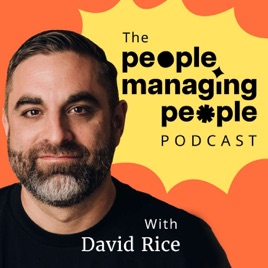
Advertise on podcast: People Managing People
Rating
5from
This podcast has
185 episodes
Language
EnglishPublisher
David RiceExplicit
No
Date created
2020/01/10
Latest episode
2026/04/21
Average duration
41 min.
Release period
7 days
Description
The People Managing People podcast equips forward-thinking leaders to thrive in the AI era—reshaping teams, systems, and strategy without losing what makes work human. Hosted by David Rice, each episode brings real-world insights from innovators, executives, and people leaders on topics like AI in practice, people-first leadership, performance systems, and workplace culture.
Unlock People Managing People podcast Email contact info,
Listeners & Audience details
Email contact information
Direct podcast contact details

Listeners
Audience numbers & engagement insights

Audience details
Podcast Insights

Podcast episodes
Check latest episodes from People Managing People podcast
The AI “Sandwich”: Why HR Teams Are Caught in the Middle
2026/04/21
AI in HR is finally moving out of the pitch deck and into the messy reality of day-to-day operations. In this conversation, Tim Fisher sits down with Josh Rod from HiBob to unpack what’s actually changing—and what’s still just noise. The headline? Most organizations aren’t chasing some agentic, fully automated future. They’re trying to make today’s workflows less painful, faster, and marginally more effective.
But underneath that pragmatic adoption sits a deeper shift: the structure of work itself is being quietly rewritten. When every employee becomes a “manager” of AI, the old hierarchies start to wobble. HR isn’t just implementing tools anymore—it’s being asked to design the operating system for how humans and machines collaborate. And that’s where things get interesting.
Related Links:
Join the People Managing People CommunitySubscribe to the newsletter to get our latest articles and podcastsConnect with Josh on LinkedInVisit HiBobSupport the show
AI Is Like Fast Food for Your Brain
2026/04/14
You don’t need to be using AI constantly to be hooked on it—you just need to feel relief when you do. That’s the uncomfortable premise at the heart of this conversation with psychologist and conflict expert Dr. David Zierk. AI doesn’t just give you answers; it removes uncertainty. And in doing so, it quietly rewires how you think, learn, and connect.
What starts as convenience can quickly become dependency. Leaders, in particular, are at risk of trading away the friction that produces insight, the curiosity that fuels growth, and the empathy that sustains relationships. The result? Faster answers, thinner thinking, and a growing gap between knowing what to do and actually doing it.
Related Links:
Join the People Managing People CommunitySubscribe to the newsletter to get our latest articles and podcastsCheck out this episode’s sponsor: Intuit QuickBooks PayrollConnect with Dr. David on LinkedInSupport the show
When Your Expertise Stops Being Yours
2026/04/07
AI is supposed to free people up for “higher-value work.” Fine. But what, exactly, is that work? In this episode, David Rice talks with cyberpsychology researcher and psychotherapist Dr. Rachel Wood about the part of AI adoption most organizations keep skimming past: the human cost of automating too much, too quickly, without a real philosophy for what should remain deeply, stubbornly human.
Their conversation cuts through the usual AI optimism and gets to the more uncomfortable truth. Some friction should absolutely go away. Nobody needs to spend an hour copying and pasting spreadsheet data. But some friction is the job: disagreement, discernment, hard conversations, learning by getting things wrong, and figuring out who you are when your expertise is suddenly easier to imitate. This episode is really about that distinction, and why leaders need to stop treating AI as a software rollout and start treating it as a human development challenge.
Related Links:
Join the People Managing People CommunitySubscribe to the newsletter to get our latest articles and podcastsConnect with Rachel:LinkedInAI Mental Health CollectiveRachel’s websiteSupport the show
What Great Leaders Do Differently Under Extreme Pressure
2026/03/31
Leaders love to frame AI transformation as a technology problem. It’s cleaner that way—tools, roadmaps, implementation plans. But what Anouk Brack lays out here is less flattering and far more consequential: this is a biological stress test, and most leadership teams are quietly failing it.
Under constant uncertainty and pressure, your nervous system defaults to survival mode. That means the very capabilities you’re counting on—strategic thinking, self-reflection, sound judgment—start to degrade. Not dramatically. Subtly. You keep moving, keep deciding, keep “leading.” But you’re doing it with a shrinking field of view and a growing pile of bad bets.
Related Links:
Join the People Managing People CommunitySubscribe to the newsletter to get our latest articles and podcastsConnect with Anouk:LinkedInLeadership EmbodimentAnoukA TrainingSupport the show
Corporate Retail Therapy: Why More AI Tools Won’t Help
2026/03/24
Your leadership team doesn’t have a strategy problem—it has an execution problem disguised as one. The offsite went great, the vision is crisp, and the slides look expensive. But somewhere between “bold initiative” and “Tuesday morning,” nobody translated strategy into what people should actually do. That gap? That’s where most organizations quietly stall.
Tom Healy argues that L&D is the missing link leaders keep ignoring. Not because it’s ineffective—but because it’s unglamorous. CEOs will talk endlessly about growth, retention, and performance, yet fail to connect those outcomes to how people are trained, onboarded, and supported day-to-day. Meanwhile, AI is making content creation trivial. The real work—the uncomfortable, strategic clarity about culture, behavior, and expectations—is still being skipped.
Related Links:
Join the People Managing People CommunitySubscribe to the newsletter to get our latest articles and podcastsConnect with Tom:LinkedInPeopleOps360mentummSupport the show
AI Can Make a Good Job Feel Too Small
2026/03/17
When turnover is low, leadership loves to call it stability. Jay Caldwell makes the more uncomfortable point: sometimes it is just fear with better optics. In this conversation, he and David unpack why “quiet staying” can become a serious organizational liability in an AI era—especially when people are still hitting goals, still showing up, and still slowly draining the place of experimentation, risk-taking, and fresh thinking.
They also get into the deeper workforce consequences of AI adoption: why broad rollouts often create anxiety instead of momentum, why the most AI-engaged employees may be the most likely to leave, and why cutting entry-level hiring might solve a short-term budget problem while quietly wrecking your future talent pipeline.
Related Links:
Join the People Managing People CommunitySubscribe to the newsletter to get our latest articles and podcastsCheck out this episode’s sponsor: Intuit QuickBooks PayrollConnect with Jay:LinkedInADPSupport the show
Why Expertise Is Becoming Cheap—and What Leaders Must Build Instead
2026/03/10
If your organization looks successful on paper but feels strangely tense in practice, there’s a good chance fear—not excellence—is quietly running the show. In this episode, David Rice talks with Brave Together author Chris Deaver about how fear disguises itself in high-performing workplaces: polished presentations, perfect metrics, and meetings where nobody laughs—and nobody challenges anything either.
Their conversation explores what happens when organizations reward superhero behavior, visibility over collaboration, and certainty over curiosity. The result is brittle excellence and teams that quietly fracture under pressure. The alternative, Deaver argues, is building cultures of co-creation—where leaders shift from being the smartest person in the room to becoming integrators, connectors, and context builders. In a world reshaped by AI and constant disruption, the real advantage isn’t information anymore—it’s shared wisdom, deep empathy, and the courage to build together.
Related Links:
Join the People Managing People CommunitySubscribe to the newsletter to get our latest articles and podcastsConnect with Chris:LinkedInLead with a Question podcastCheck out Chris’ book: Brave TogetherSupport the show
Why Every Org Should Be Investing in Predictive AI
2026/03/03
Businesses are pouring millions into generative AI—chatbots, copilots, “agents”—while quietly ignoring the other half of the AI stack that’s been delivering measurable value for decades. Predictive AI doesn’t write poetry. It predicts who’s going to churn, which transaction is fraud, and which customer is worth contacting. It calculates probabilities and helps you act on them at scale. Not glamorous. Just effective.
In this conversation, Eric Siegel—author of The AI Playbook and founder of Machine Learning Week—makes a subversive claim: most organizations should be investing at least as much in predictive AI as generative AI. The problem isn’t the math. It’s the gap between tech and business. Companies celebrate models as value. But the model isn’t the value. Acting on predictions is.
Related Links:
Join the People Managing People CommunitySubscribe to the newsletter to get our latest articles and podcastsCheck out this episode’s sponsor: DeelConnect with Eric:LinkedInGooder AICheck out Eric’s book: The AI PlaybookSupport the show
Why Mindset Beats Skill in AI Transformation
2026/02/24
You were told AI would clear your calendar. Instead, you’re answering 800 chats a day and wondering what, exactly, you accomplished. Productivity is up. So is the volume. You 10x your output and somehow inherit 10x the work. Welcome to the hamster wheel.
In this episode, Eliza Jackson, COO at ButcherBox, and I unpack the real transformation behind AI at work. It’s not about learning a new tool. It’s about unlearning how you work. It’s about rethinking what you own versus what you delegate. And it’s about building the kind of resilience and mindset that don’t show up on a résumé—but determine whether your team can survive what’s coming.
Related Links:
Join the People Managing People CommunitySubscribe to the newsletter to get our latest articles and podcastsConnect with Eliza on LinkedInCheck out ButcherBoxSupport the show
Why AI Power Users Will Outpace Everyone Else
2026/02/17
Most employees are using about 1% of what AI can actually do. Not because they’re lazy. Not because they lack access. But because no one has shown them how to think with it. Meanwhile, somewhere in Silicon Valley, a 23-year-old is running a startup like they’ve got 28 PhDs sitting beside them—for a penny a minute. That gap isn’t theoretical. It’s operational. And it’s widening by the hour.
In this conversation, Kevin Surace and I dig into what that gap really means—for your productivity, your profession, and your relevance. From three-paragraph prompts to million-dollar consulting projects replicated in minutes, we explore why this wave looks familiar (desktop computers, the internet, Excel) and why it’s moving faster than all of them. Resistance isn’t noble. It’s career-limiting.
Related Links:
Join the People Managing People CommunitySubscribe to the newsletter to get our latest articles and podcastsCheck out this episode’s sponsor: DeelConnect with Kevin on LinkedInCheck out Kevin’s website and Appvance.aiSupport the show
What We’re Getting Wrong About AI and Productivity
2026/02/10
So yeah—your dashboards look great. Your team’s shipping faster, summarizing more, “getting leverage” with AI… and all the while you might be quietly trading away the one asset you can’t buy back on a subscription plan: human judgment.
In this episode, I’m joined by Dr. Vivienne Ming—neuroscientist, entrepreneur, and an “AI realist” who has zero patience for utopian hype or Skynet fan fiction. Vivienne lays out a clean fork in the road: cognitive automation (AI does the thinking for you) vs. cognitive augmentation (AI makes you think better—often by making the work harder). If your AI strategy is mostly about convenience, this is your gentle-ish warning that convenience is not a strategy. It’s a sedative.
Related Links:
Join the People Managing People CommunitySubscribe to the newsletter to get our latest articles and podcastsConnect with Vivienne on LinkedInSupport the show
Designing for Readiness, Not Just Efficiency, in an AI-Augmented World
2026/02/03
AI didn’t replace your job—it replaced your value proposition. In this episode, we sit down with Taylor Blake, SVP of AI Labs at Degreed, to talk about the uncomfortable truth facing L&D teams: if your job is framed as delivering content, unblocking employees, or feeding answers in the flow of work, AI is already doing it better, faster, and without your calendar invite.
But where AI stops short is precisely where L&D’s future begins. Taylor shares how her team at Degreed lives as “customer zero,” using their own tools before shipping them to clients—which means they’re embedded in the mess, not just pitching the promise. From readiness over responsiveness to the emotional toll of relentless efficiency, this conversation explores what it really means to build capability in a world where one employee now has the power—and pressure—of ten.
Related Links:
Join the People Managing People CommunitySubscribe to the newsletter to get our latest articles and podcastsConnect with Taylor on LinkedInCheck out DegreedSupport the show
From Tools to Agents: Preparing for the Next Phase of AI at Work
2026/01/27
Most business leaders are still talking about AI as if it’s just another “productivity upgrade.” Meanwhile, the world building the future — massive data centers, AGI R&D, and winner‑take‑all investment — is sprinting ahead without guardrails, ethics, or broad societal input. In this conversation, researcher Christopher DiCarlo pushes executives to confront a reality most aren’t prepared for: AI isn’t a tool you add to the org chart, it’s a paradigm shift that will redefine work, power, human purpose, and morality.
This episode is part wake‑up call, part philosophical intervention. It challenges HR leaders and executives to stop asking “how much more productive do we need to be?” and start asking “what kind of future are we building — and at what cost?” If you’re still waiting for a miracle app to solve everything, this conversation will shift your perspective on AI strategy, ethics, and leadership responsibility.
Related Links:
Join the People Managing People CommunitySubscribe to the newsletter to get our latest articles and podcastsConnect with Christopher on LinkedInCheck out Convergence AnalysisSupport the show
From Curiosity to Confidence: A Practical Framework for AI Adoption
2026/01/20
AI is everywhere—and yet, in most organizations, it’s nowhere. People are intrigued, but unsure. Leaders evangelize, but workflows stay the same. Curiosity, it turns out, is not a strategy. In this episode, we’re joined by Justin Angsuwat, Chief People Officer at Culture Amp, to unpack how they flipped the script. In just six weeks, they moved nearly 80% of their workforce from passively curious to actively confident in using AI—without top-down mandates or perfectionist paralysis.
We get into the nuts and bolts of the “Accelerate” program, the value of separating exploration from expectation, and why confidence—not usage metrics—is the better north star for early-stage AI adoption. Justin also shares the uncomfortable truths about integrating AI into daily work, especially for senior employees whose identities are tied to outdated workflows. If your team is hovering in AI limbo, this conversation is your blueprint for action.
Related Links:
Join the People Managing People CommunitySubscribe to the newsletter to get our latest articles and podcastsCheck out this episode’s sponsor: DeelConnect with Justin on LinkedInCheck out Culture AmpSupport the show
Why HR Gets Stuck on AI—and What It Takes to Lead the Transformation
2026/01/13
For the past 18–24 months, HR teams have been asked a blunt question: What are you doing with AI? The response has often been activity without strategy — policies, guardrails, governance frameworks — busy work that signals compliance rather than creates value. Dr. Dieter Veldsman joins David to diagnose this pattern of urgency → paralysis → compliance, explain why it’s holding HR back, and show how a deeper sense‑making process is the real lever for progress.
Dieter argues — and the data backs it up — that most HR orgs focused on what can’t be done with AI, not what should be done to drive business value. The root isn’t technology ignorance, it’s cultural: HR has treated AI like a tech project when it’s fundamentally a people and organizational transformation. This episode walks through how to break the compliance trap, structure experimentation with purpose, and expand the CHRO role into the architect of the human‑machine ecosystem.
Related Links:
Join the People Managing People CommunitySubscribe to the newsletter to get our latest articles and podcastsConnect with Dieter on LinkedInCheck out AIHR (Academy to Innovate HR)Support the show
Podcast reviews
Read People Managing People podcast reviews
Mridu Parikh 2023/11/08
So valuable!
Becca and her guests provide practical advice that is so valuable in helping leaders to create a happy and productive workplace. They cover a wide var...
Rachelabauer 2023/11/06
Highly recommend!
I love this podcast. Becca is an incredible, inquisitive host who helps bring her guests along for a fun, actionable conversation. She is great at bre...
TeriSchmidt 2023/08/16
Inspiring a better world of work!
With how much time we all spend at work, it's critically important that leaders are skilled in creating happy, healthy, and productive workplaces. Th...
Lia Garvin 2023/02/14
Love this show!
Love this show! So many great tools and tips for people managers!
oliviabaker13 2022/09/15
A must-listen for people leaders!
People leaders - meet your new favorite podcast! It’s obvious Tim and the team puts extraordinary effort in covering salient topics and finding guests...
Podcast sponsorship advertising
Start advertising on People Managing People relevant audience podcasts
You may also like to advertise on these Podcasts

4.4371061566
The Megyn Kelly Show
SiriusXM

4.888901269
Fearless with Jason Whitlock
Blaze Podcast Network
4.8118931000
Mind Pump: Raw Fitness Truth
Sal Di Stefano, Adam Schafer, Justin Andrews, Doug Egge

4.8102131585
Tara Brach
Tara Brach

4.541561215
Something You Should Know
Mike Carruthers | OmniCast Media

4.513841343
Strictly Anonymous Confessions
Kathy Kay

4.8292781897
Fantasy Footballers - Fantasy Football Podcast
Fantasy Football

4.62382612
Football Weekly
The Guardian

4.45387666
Two Judgey Girls
Two Judgey Girls

3.8258501152
The Viall Files
Nick Viall