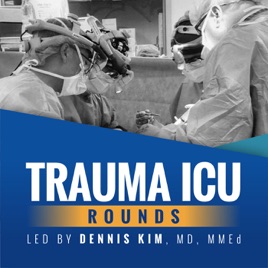
Advertise on podcast: Trauma ICU Rounds
Rating
4.9from
This podcast has
60 episodes
Language
EnglishPublisher
Dr. Dennis KimExplicit
No
Date created
2020/03/26
Latest episode
2026/10/07
Average duration
29 min.
Release period
138 days
Description
Medical education podcast dedicated to providing high-quality, concise, and clinically relevant multimedia content spanning the spectrum of surgical critical care, emergency general & trauma surgery
Unlock Trauma ICU Rounds podcast Email contact info,
Listeners & Audience details
Email contact information
Direct podcast contact details

Listeners
Audience numbers & engagement insights

Audience details
Podcast Insights

Podcast episodes
Check latest episodes from Trauma ICU Rounds podcast
Leadership in Surgery: Trust, Culture, and Speaking Up with Dr. Paula Ferrada
2026/10/07
What makes a good surgical leader—and what happens when people are afraid to speak up?
Dr. Paula Ferrada returns to Trauma ICU Rounds for a conversation about leadership in surgery, psychological safety, mentorship, and building teams that put patients first.
We begin with hemorrhage-first trauma resuscitation and the difficulty of challenging established practice, then explore how surgeons earn trust, respond to mistakes, support colleagues, and develop the next generation of leaders.
Topics include:
• Moving beyond blame and shame in surgical training and quality improvement
• Why leadership requires more than a title
• Finding mentors and supporting others as they advance
• Managing your own emotions under pressure
• Addressing gender bias and creating leadership opportunities
• Balancing decisive trauma team leadership with a culture of speaking up
• Approaching a struggling colleague with empathy
• Practical steps to become a better leader tomorrow
A conversation for surgeons, trainees, and anyone leading a team in trauma or critical care.
Resources:
The 5 Levels of Leadership — John C. Maxwell
Explore more episodes and educational resources:
https://www.traumaicurounds.ca
Follow Trauma ICU Rounds on your preferred podcast platform for future episodes.
Explore Trauma ICU Rounds:
https://www.traumaicurounds.ca
Follow:
Instagram: https://www.instagram.com/traumaicurounds
TikTok: https://www.tiktok.com/@traumaicurounds
YouTube: https://www.youtube.com/@traumaicurounds
Trauma ICU Rounds is intended for healthcare education. It does not replace clinical judgment, individualized patient care or local protocols.
Shock: A Physiology-First Approach | Visual Rounds
2026/09/28
This is a Visual Rounds episode — a more foundational crossover from the YouTube side of Trauma ICU Rounds.
Shock is not simply hypotension.
In this episode, we work through a physiology-first approach to shock: oxygen delivery, cardiac output, arterial oxygen content, MAP versus perfusion, compensated shock, mixed shock, and the four major shock states — hypovolemic, cardiogenic, obstructive, and distributive.
The goal is to move beyond simply naming a shock category and instead understand what part of the circulation is failing, what physiology is dominant, and how that should shape the first moves in resuscitation.
Topics include:
Recognizing shock before profound hypotension developsOxygen delivery: DO₂ = cardiac output × arterial oxygen contentCardiac output, preload, contractility, and afterloadThe importance of hemoglobin and oxygen-carrying capacityMAP versus tissue perfusionCompensated and mixed shockHypovolemic, cardiogenic, obstructive, and distributive shockInitial resuscitation and mechanism-specific treatmentThis episode is intentionally foundational and provides the framework for deeper Trauma ICU Rounds episodes on individual shock states and resuscitation.
If you find this kind of physiology-first critical care teaching useful, subscribe to Trauma ICU Rounds on YouTube for the full Visual Rounds series.
More resources: traumaicurounds.ca
Explore Trauma ICU Rounds:
https://www.traumaicurounds.ca
Follow:
Instagram: https://www.instagram.com/traumaicurounds
TikTok: https://www.tiktok.com/@traumaicurounds
YouTube: https://www.youtube.com/@traumaicurounds
Trauma ICU Rounds is intended for healthcare education. It does not replace clinical judgment, individualized patient care or local protocols.
Whole Blood in Trauma Resuscitation: What Did TOWAR and SWiFT Change?
2026/09/08
Whole blood has made a remarkable comeback in trauma resuscitation. Physiologically, the rationale is compelling, and observational studies have suggested improved survival. But the recent randomized TOWAR and SWiFT trials have challenged the assumption that whole blood is clearly superior to component therapy.
In this episode of Trauma ICU Rounds, we review the rationale for low-titer group O whole blood (LTOWB), the major observational data supporting its use, what TOWAR and SWiFT actually showed, and how these findings should influence contemporary damage-control resuscitation.
Topics include:
Low-titer group O whole blood (LTOWB) Observational versus randomized evidence TOWAR and SWiFT Whole blood versus balanced component therapy Integrating whole blood into massive hemorrhage protocols Calcium, warming, TXA and hemorrhage control RhD considerations in females of childbearing potential The central question: whole blood clearly works as a resuscitation product—but is it actually better than excellent component therapy?
Full notes, graphics and references: traumaicurounds.ca
Follow @traumaicurounds on Instagram and TikTok, and subscribe on YouTube for new trauma and critical care teaching.
Explore Trauma ICU Rounds:
https://www.traumaicurounds.ca
Follow:
Instagram: https://www.instagram.com/traumaicurounds
TikTok: https://www.tiktok.com/@traumaicurounds
YouTube: https://www.youtube.com/@traumaicurounds
Trauma ICU Rounds is intended for healthcare education. It does not replace clinical judgment, individualized patient care or local protocols.
State of the Rounds
2026/09/08
After four years away, Trauma ICU Rounds is back.
In this short relaunch episode, I reflect on the journey from California back to Canada, how my clinical and leadership roles have evolved, and why now is the right time to return to the podcast.
We also share what comes next: clear, practical, evidence-informed conversations in trauma, critical care and resuscitation—designed to make complex topics easier to understand and apply at the bedside.
Welcome back to Rounds.
Explore Trauma ICU Rounds:
https://www.traumaicurounds.ca
Follow:
Instagram: https://www.instagram.com/traumaicurounds
TikTok: https://www.tiktok.com/@traumaicurounds
YouTube: https://www.youtube.com/@traumaicurounds
Trauma ICU Rounds is intended for healthcare education. It does not replace clinical judgment, individualized patient care or local protocols.
Episode 54: Frailty, Geriatric Trauma & TBI with Dr. Bellal Jospeh
2022/09/20
In this episode we sit down with the Chief of Trauma, Surgical Critical Care, Burns, & Acute Care Surgery at the University of Arizona, Dr. Bellal Joseph, who share with us his thoughts and research findings on hot topics including frailty, geriatric trauma, leadership, and more.
Timestamps:
00:12 Introductions
01:30 What is frailty? Your physiologic NOT chronologic body.
06:58 Injured elderly trauma patients can have good outcomes
07:30 Trauma specific frailty index
10:48 Failure to rescue
13:57 Geriatricians and the trauma surgeons
15:08 4Ms-What Matters, Mobility, Mentation, Medication
16:48 Geriatric cohorting/wards
22:24 ACS geriatric centers of excellence
29:35 Brain Injury Guidelines (BIG)
38:17 The importance of teamwork & servant leadership
40:28 Imposter syndrome
43:19 Leadership considerations
45:25 Final thoughts
References:
Joseph B, Friese RS, Sadoun M, Aziz H, Kulvatunyou N, Pandit V, Wynne J, Tang A, O'Keeffe T, Rhee P. The BIG (brain injury guidelines) project: defining the management of traumatic brain injury by acute care surgeons. J Trauma Acute Care Surg. 2014 Apr;76(4):965-9. doi: 10.1097/TA.0000000000000161. PMID: 24662858.
Joseph B, Obaid O, Dultz L, Black G, Campbell M, Berndtson AE, Costantini T, Kerwin A, Skarupa D, Burruss S, Delgado L, Gomez M, Mederos DR, Winfield R, Cullinane D; AAST BIG Multi-institutional Study Group. Validating the Brain Injury Guidelines: Results of an American Association for the Surgery of Trauma prospective multi-institutional trial. J Trauma Acute Care Surg. 2022 Aug 1;93(2):157-165. doi: 10.1097/TA.0000000000003554. Epub 2022 Mar 28. PMID: 35343931.v
Joseph B, Pandit V, Haider AA, Kulvatunyou N, Zangbar B, Tang A, Aziz H, Vercruysse G, O'Keeffe T, Freise RS, Rhee P. Improving Hospital Quality and Costs in Nonoperative Traumatic Brain Injury: The Role of Acute Care Surgeons. JAMA Surg. 2015 Sep;150(9):866-72. doi: 10.1001/jamasurg.2015.1134. PMID: 26107247.
Joseph B, Pandit V, Sadoun M, Zangbar B, Fain MJ, Friese RS, Rhee P. Frailty in surgery. J Trauma Acute Care Surg. 2014 Apr;76(4):1151-6. doi: 10.1097/TA.0000000000000103. PMID: 24662884.
Orouji Jokar T, Ibraheem K, Rhee P, Kulavatunyou N, Haider A, Phelan HA, Fain M, Mohler MJ, Joseph B. Emergency general surgery specific frailty index: A validation study. J Trauma Acute Care Surg. 2016 Aug;81(2):254-60. doi: 10.1097/TA.0000000000001120. PMID: 27257694.
Explore Trauma ICU Rounds:
https://www.traumaicurounds.ca
Follow:
Instagram: https://www.instagram.com/traumaicurounds
TikTok: https://www.tiktok.com/@traumaicurounds
YouTube: https://www.youtube.com/@traumaicurounds
Trauma ICU Rounds is intended for healthcare education. It does not replace clinical judgment, individualized patient care or local protocols.
Episode 53: Insights into Modern Critical Care with Dr. Jean-Louis Vincent: Part II
2022/09/12
In this episode, we talk all things critical care the one and only, Dr. Jean-Louis Vincent aka. JLV. This episode is a MUST listen. We touch upon the evolution of early goal directed therapy, measures of fluid responsiveness, optimizing oxygen delivery, and the importance of integrating data points versus examining them in isolation when caring for our critically ill and injured patients. This and MUCH MUCH more in arguably one of my favorite episodes to date!!
Timestamps
00:00 Introduction
01:21 What happened to SG catheters and should we use them?
04:05 What decreases mortality in critical care patients?
05:30 When to transfuse critical care patient? Use your brain!
08:55 Measures of tissue perfusion and fluid responsiveness
09:36 JLV breaks down the Rivers trial
10:36 Recent EGDT papers
10:54 How to optimize O2 delivery? Late ScVO2, dob challenge, and fluid challenges
13:21 Dynamic measures of fluid responsiveness
13:46 CVP as a relative value
15:14 Passive leg raising (PLR) as a measure of fluid responsiveness
21:20 JLV's take on therapeutic nihilism
24:45 Don’t isolate; integrate!
26:46 Navigating the future of critical care – JLV’s thoughts on AI in the ICU
29:55 Rapid fire hot topics in the ICU – Yes or No
-Metabolic cocktail
-Corticosteroids for septic shock
-Albumin and Lasix or Lasix alone
PCT/CRP and sepsis/Abx
Resources:
International Symposium on Intensive Care and Emergency Medicine (ISICEM):
https://www.isicem.org
ISICEM Chats Platform:
https://www.isicem.org/e-chat/index.asp
Articles:
Passive leg raising:five rules, not a drop of fluid! https://ccforum.biomedcentral.com/articles/10.1186/s13054-014-0708-5
The fluid challenge
https://ccforum.biomedcentral.com/articles/10.1186/s13054-020-03443-y
Blood lactate levels in sepsis: 8 questions
Vincent JL, Bakker J. Blood lactate levels in sepsis: in 8 questions. Curr Opin Crit Care. 2021 Jun 1;27(3):298-302. doi: 10.1097/MCC.0000000000000824. PMID: 33852499.
We should avoid the term "fluid overload"
https://ccforum.biomedcentral.com/articles/10.1186/s13054-018-2141-7
EGDT in the Treatment of Severe Sepsis and Septic Shock
https://www.nejm.org/doi/full/10.1056/nejmoa010307
A Randomized Trial of Protocol-Based Care for Early Septic Shock
https://www.nejm.org/doi/full/10.1056/nejmoa1401602
Explore Trauma ICU Rounds:
https://www.traumaicurounds.ca
Follow:
Instagram: https://www.instagram.com/traumaicurounds
TikTok: https://www.tiktok.com/@traumaicurounds
YouTube: https://www.youtube.com/@traumaicurounds
Trauma ICU Rounds is intended for healthcare education. It does not replace clinical judgment, individualized patient care or local protocols.
Episode 52: Insights into Modern Critical Care with Dr. Jean-Louis Vincent: Part I
2022/09/06
In this episode, we discuss the overarching importance of AVOIDING iatrogenic harm in the ICU with arguably one of the world's leading experts in critical care medicine, the one and only, Dr. Jean-Louis Vincent aka. JLV.
Tune in as Dr. Vincent shares with us the importance of having a systematic, problem-based approach to patient care delivery which, of course, involves giving our patients a FAST HUG every day!
Time Stamps:
2:10 LA Critical Care and Differences between Europe versus USA
4:04 COVID, Modern tech and bedside care
5:32 ICU Rounds – How I do it
6:00 Team Based ICU Care
7:56 Modern advances in critical care
9:55 Problem-based approach in the ICU
13:18 FAST HUGS
14:00 Feeding
14:36 Analgesia & Sedation
15:46 Thromboembolic prophylaxis
16:25Head of the bed elevated
17:17Ulcer prophylaxis
19:22Glucose control
20:48 Tube feeds, yes? Ulcer ppx , no.
22:30 Outro
Explore Trauma ICU Rounds:
https://www.traumaicurounds.ca
Follow:
Instagram: https://www.instagram.com/traumaicurounds
TikTok: https://www.tiktok.com/@traumaicurounds
YouTube: https://www.youtube.com/@traumaicurounds
Trauma ICU Rounds is intended for healthcare education. It does not replace clinical judgment, individualized patient care or local protocols.
Season 3 Trailer
2022/09/06
It's been a while! We are coming to you from our new studio in Victoria on Vancouver Island, BC. This Season is PACKED with incredible content, interviews and educational pearls designed to improve the quality of care that you are deliver daily at the bedside to your patients and their loved ones.
Explore Trauma ICU Rounds:
https://www.traumaicurounds.ca
Follow:
Instagram: https://www.instagram.com/traumaicurounds
TikTok: https://www.tiktok.com/@traumaicurounds
YouTube: https://www.youtube.com/@traumaicurounds
Trauma ICU Rounds is intended for healthcare education. It does not replace clinical judgment, individualized patient care or local protocols.
Episode 51 - Persistent Inflammation, Immunosuppression & Catabolism Syndrome (PICS) with Dr. Scott Brakenridge
2022/02/11
"Getting patients resuscitated through sepsis, septic shock, and hemorrhagic shock is not the end...it's the beginning."
In this episode, Dr. Brakenridge from Harborview Medical Center joins us to discuss PICS and the impact of this syndrome on our critically ill and injured patients and their families. Also referred to as the Post-Intensive Care Syndrome, Dr. Brakenridge shares with us the evolution and results of translational research into this now well-recognized morbid condition which often occurs in the setting of chronic critical illness. From the importance of breaking the cycle of "sepsis recidivism" to the. application of the SCCM A to F bundle, this episode is a MUST listen for those of us taking care of patients in the ICU.
TIME STAMPS
00:12 Introduction
01:46 What is PICS? The role of chronic critical illness (CCI)
05:13 Phenotypes vs. endotypes
06:47 The role of biomarkers in PICS
08:50 When does acute critical illness turn into CCI?
10:14 Risk factors for PICS
15: 07 Prognostication and determining patient trajectory
18:32 The Glue Grant Experience: Genomics of Injury
22:48 Hemorrhagic shock resuscitation: Then and now
25:33 Sepsis recidivism & avoiding secondary insults
29:08 ICU delirium
31:55 The role of early mobilization
32:41 The impact of catabolism in sepsis
34:50 Is there a role for anabolic steroids to counteract PICS?
37:52 What's ahead in terms of PICS translational research?
39:44 Cytokine and immunomodulator therapies
41:49 Final thoughts
RECOMMENDED READINGS
Brakenridge SC, Wang Z, Cox M, Raymond S, Hawkins R, Darden D, Ghita G, Brumback B, Cuschieri J, Maier RV, Moore FA, Mohr AM, Efron PA, Moldawer LL. Distinct immunologic endotypes are associated with clinical trajectory after severe blunt trauma and hemorrhagic shock. J Trauma Acute Care Surg. 2021 Feb 1;90(2):257-267.
Efron PA, Mohr AM, Bihorac A, Horiguchi H, Hollen MK, Segal MS, Baker HV, Leeuwenburgh C, Moldawer LL, Moore FA, Brakenridge SC. Persistent inflammation, immunosuppression, and catabolism and the development of chronic critical illness after surgery. Surgery. 2018 Aug;164(2):178-184. doi: 10.1016/j.surg.2018.04.011. Epub 2018 May 26.
Sauaia A, Moore FA, Moore EE. Postinjury Inflammation and Organ Dysfunction. Crit Care Clin. 2017 Jan;33(1):167-191.
Stortz JA, Murphy TJ, Raymond SL, Mira JC, Ungaro R, Dirain ML, Nacionales DC, Loftus TJ, Wang Z, Ozrazgat-Baslanti T, Ghita GL, Brumback BA, Mohr AM, Bihorac A, Efron PA, Moldawer LL, Moore FA, Brakenridge SC. Evidence for Persistent Immune Suppression in Patients Who Develop Chronic Critical Illness After Sepsis. Shock. 2018 Mar;49(3):249-258.
Explore Trauma ICU Rounds:
https://www.traumaicurounds.ca
Follow:
Instagram: https://www.instagram.com/traumaicurounds
TikTok: https://www.tiktok.com/@traumaicurounds
YouTube: https://www.youtube.com/@traumaicurounds
Trauma ICU Rounds is intended for healthcare education. It does not replace clinical judgment, individualized patient care or local protocols.
Episode 50 - Whole Blood & Modern Hemostatic Resuscitation Strategies with Dr. Bryan A. Cotton
2022/01/29
In this, our 50th episode, we are in Austin, TX, for the Annual EAST Scientific Meeting where we are joined by Dr. Bryan A. Cotton who shares his expertise and knowledge regarding the use of whole blood (WB) in trauma patients. From the use of whole blood in prior military conflicts to the design and successful implementation of one of the only prospective randomized controlled trials of modified whole blood use in trauma patients, Dr. Cotton provides an incredible overview of the potential benefits of whole blood or as he refers to it - "the dying blood product". Also covered in expert fashion are the role of other hemostatic products and strategies including tranexamic acid, fibrinogen concentrates, and a plasma first resuscitation strategy.
Time Stamps:
01:16 The rationale for whole blood & a 1:1:1 transfusion strategy
04:24 Military experience with WB: What's old is new again!
05:44 Modified WB vs. Component Therapy RCT
06:02 Leukoreduction of WB
07:00 Type-specific WB
09:38 Platelet function in WB vs. aphaeresis platelets
11:58 Warm fresh WB vs. cold stored
12:55 The whole is greater than the sum of its parts
15:02 What do we mean by low-titer WB?
19:14 O+ vs. O- WB & the potential for alloimmunization
24:39 Transfusion reactions & safety of WB in trauma patients
25:40 Prehospital WB for the win
27:32 LITES Network
28:27 Hemorrhage control, 1:1:1, viscoelastic assays, cryoprecipitate & fibrinogen
concentrate
32:00 BAC's thoughts on tranexamic acid (TXA)
34:47 BAC's thoughts on hypertonic saline (HTS) for COVID-19
38:51 Final thoughts & future directions
Recommended Readings:
Cotton BA, Podbielski J, Camp E, Welch T, del Junco D, Bai Y, Hobbs R, Scroggins J, Hartwell B, Kozar RA, Wade CE, Holcomb JB; Early Whole Blood Investigators. A randomized controlled pilot trial of modified whole blood versus component therapy in severely injured patients requiring large volume transfusions. Ann Surg. 2013 Oct;258(4):527-32; discussion 532-3.
Williams J, Merutka N, Meyer D, Bai Y, Prater S, Cabrera R, Holcomb JB, Wade CE, Love JD, Cotton BA. Safety profile and impact of low-titer group O whole blood for emergency use in trauma. J Trauma Acute Care Surg. 2020 Jan;88(1):87-93.
McGinity AC, Zhu CS, Greebon L, Xenakis E, Waltman E, Epley E, Cobb D, Jonas R, Nicholson SE, Eastridge BJ, Stewart RM, Jenkins DH. Prehospital low-titer cold-stored whole blood: Philosophy for ubiquitous utilization of O-positive product for emergency use in hemorrhage due to injury. J Trauma Acute Care Surg. 2018 Jun;84(6S Suppl 1):S115-S119.
Sperry JL, Guyette FX, Brown JB, Yazer MH, Triulzi DJ, Early-Young BJ, Adams PW, Daley BJ, Miller RS, Harbrecht BG, Claridge JA, Phelan HA, Witham WR, Putnam AT, Duane TM, Alarcon LH, Callaway CW, Zuckerbraun BS, Neal MD, Rosengart MR, Forsythe RM, Billiar TR, Yealy DM, Peitzman AB, Zenati MS; PAMPer Study Group. Prehospital Plasma during Air Medical Transport in Trauma Patients at Risk for Hemorrhagic Shock. N Engl J Med. 2018 Jul 26;379(4):315-326. doi: 10.1056/NEJMoa1802345. PMID: 30044935.
Yazer MH, Jackson B, Sperry JL, Alarcon L, Triulzi DJ, Murdock AD. Initial safety and feasibility of cold-stored uncrossmatched whole blood transfusion in civilian trauma patients. J Trauma Acute Care Surg. 2016 Jul;81(1):21-6. doi: 10.1097/TA.0000000000001100. PMID: 27120323.
Websites:
LITES Network
https://www.litesnetwork.org
Southwest Texas Regional Advisory Council
https://www.strac.org/blood
Explore Trauma ICU Rounds:
https://www.traumaicurounds.ca
Follow:
Instagram: https://www.instagram.com/traumaicurounds
TikTok: https://www.tiktok.com/@traumaicurounds
YouTube: https://www.youtube.com/@traumaicurounds
Trauma ICU Rounds is intended for healthcare education. It does not replace clinical judgment, individualized patient care or local protocols.
Episode 49 - TRAUMA with Dr. Ken Mattox: Part II
2022/01/11
In the second episode of a two-part series, Dr. Mattox shares his insights and thoughts on hot research topics in trauma in need of investigation. Additionally, he helps us to envision what acute trauma management may look like in the future, while also sharing with us how his book (and one of my ALL-TIME fave surgery books!), Top Knife, came into being. From lessons learned to lessons in need of learning, Dr. Mattox has all of the bases (and basics) covered.
Time Stamps
0:00 Introduction
00:12 "The resuscitation is the incision."
00:44 Welcome & Announcements/Call to Action
02:24 Whole blood is good but.....what should our endpoint of resuscitation be?
03:05 Drones in the prehospital setting
08:03 Reimagining the ER
08:57 General Surgery training: Then & now
10:00 Top Knife, Trauma, Rich’s Vascular Trauma
11:33 How Top Knife came into being – Saturday mornings, coffee, Mary Allen & a tape recorder
16:57 To operate or not operate?
22:11 Mattox Vegas TCCACS
26:11 Final thoughts: ”There’s always a better way."
Explore Trauma ICU Rounds:
https://www.traumaicurounds.ca
Follow:
Instagram: https://www.instagram.com/traumaicurounds
TikTok: https://www.tiktok.com/@traumaicurounds
YouTube: https://www.youtube.com/@traumaicurounds
Trauma ICU Rounds is intended for healthcare education. It does not replace clinical judgment, individualized patient care or local protocols.
Episode 48 - TRAUMA with Dr. Ken Mattox: Part I
2022/01/07
We. Are. Back!!
After a (brief?!) hiatus, we are launching 2022 with a 2-part series with the one and only Dr. Ken Mattox. In this episode, Dr. Mattox shares with us his thoughts on what the modern general surgeon should look like and how we as surgeons differ from our medicine counterparts. Additionally, we review the history of modern trauma resuscitation, the paradigm shifts that have occurred as it pertains to permissive hypotension, as well as the technological advances that have occurred over the last century that have improved care of the critically injured patient. This is an episode not to be missed!
Time Stamps
00:12 Welcome & announcements
04:21 What does the modern "surgeon" look like?
07:48 The interplay between technology & surgery
10:15 Serendipity & Dr. Mattox's early career
11:28 Finessing & integrating clinical practice with research opportunities
13:45 The 2 most impactful advances in trauma care during the last century: the microchip & organized trauma systems
17:00 Dr. Mattox's thoughts on REBOA & intravascular control/treatment techniques
22:32 MAST pants: lessons learned
25:18 Elevate the BP with MAST and fluids? Increase the mortality!!
26:30 Permissive hypotension
27:06 Vasopressors in the ER?! Hypotension is teleological!!
References
Bickell WH, Pepe PE, Wyatt CH, Dedo WR, Applebaum DJ, Black CT, Mattox KL. Effect of antishock trousers on the trauma score: a prospective analysis in the urban setting. Ann Emerg Med. 1985 Mar;14(3):218-22. doi: 10.1016/s0196-0644(85)80443-1. PMID: 3977145.
Bickell WH, Wall MJ Jr, Pepe PE, Martin RR, Ginger VF, Allen MK, Mattox KL. Immediate versus delayed fluid resuscitation for hypotensive patients with penetrating torso injuries. N Engl J Med. 1994 Oct 27;331(17):1105-9. doi: 10.1056/NEJM199410273311701. PMID: 7935634.
Hirshberg A, Hoyt DB, Mattox KL. From "leaky buckets" to vascular injuries: understanding models of uncontrolled hemorrhage. J Am Coll Surg. 2007 Apr;204(4):665-72. doi: 10.1016/j.jamcollsurg.2007.01.005. Epub 2007 Feb 23. PMID: 17382227.
2022 Mattox Vegas TCCACS
https://www.trauma-criticalcare.com/tccacs/program/
Explore Trauma ICU Rounds:
https://www.traumaicurounds.ca
Follow:
Instagram: https://www.instagram.com/traumaicurounds
TikTok: https://www.tiktok.com/@traumaicurounds
YouTube: https://www.youtube.com/@traumaicurounds
Trauma ICU Rounds is intended for healthcare education. It does not replace clinical judgment, individualized patient care or local protocols.
Episode 47 - Every Deep-Drawn Breath with Dr. Wes Ely
2021/09/11
Dr. Wes Ely from Vanderbilt University School of Medicine joins us on Rounds to discuss the evolution of our understanding and the current impact of ICU-acquired brain disease on our patients and their loved ones. In addition to discussing the evidence behind current best practices in the ICU, Dr. Ely shares with us stories from his new book which highlight the importance of listening to, engaging with, and remaining vulnerable to those whom we are so fortunate and blessed to serve-our patients.
Explore Trauma ICU Rounds:
https://www.traumaicurounds.ca
Follow:
Instagram: https://www.instagram.com/traumaicurounds
TikTok: https://www.tiktok.com/@traumaicurounds
YouTube: https://www.youtube.com/@traumaicurounds
Trauma ICU Rounds is intended for healthcare education. It does not replace clinical judgment, individualized patient care or local protocols.
Episode 46 - Pelvic Binders for Hemodynamically Unstable Pelvic Ring Fractures
2021/07/02
In follow-up to a recent pro-con debate on the use of pre-hospital pelvic binders, we explore the why, when, and how of pelvic binder placement. From the indications to post-placement considerations and importance of a multidisciplinary approach to the management of these life-threatening injuries, this episode of Rounds is a great addition to Season 1 Episode 24 Hemodynamically Unstable Pelvic Fractures with Dr. Clay Burlew.
Time Stamps
00:12 Welcome
02:52 Learning Objectives
03:43 Introduction
05:58 Initial Assessment & Management of Patients with Suspected Hemodynamically Unstable Pelvic Fractures
09:54 Young-Burgess Classification of Pelvic Ring Fractures
12:00 Indications, Technique, and Considerations for Properly Placing a Pelvic Binder
17:30 Hemostatic Adjuncts in the Management of Patients with Hemodynamically Unstable Pelvic Fractures
22:13 Take Home Points
23:11 Outro & Call to Action
Explore Trauma ICU Rounds:
https://www.traumaicurounds.ca
Follow:
Instagram: https://www.instagram.com/traumaicurounds
TikTok: https://www.tiktok.com/@traumaicurounds
YouTube: https://www.youtube.com/@traumaicurounds
Trauma ICU Rounds is intended for healthcare education. It does not replace clinical judgment, individualized patient care or local protocols.
Episode 45 - Modern Insights into an Academic Career in Trauma & Acute Care Surgery with Dr. Carlos Brown
2021/06/24
In this episode, we sit down with Dr. Carlos VR Brown from the Dell Seton Medical Center at the University of Texas to discuss issues relevant to both junior and mid-career trauma & acute care surgeons.
Topics covered include: military-civilian trauma, finding one's niche in academic surgery, work-life balance, and learning from our mistakes. As I prepare to enter a new phase in my academic surgical career, the timing of this interview could not have been more perfect. This episode is packed with career pearls and words of wisdom that are not to be missed!
Time Stamps
00:12 Introduction
02:37 Welcome Dr. CVR Brown
05:39 When did your interest in trauma surgery begin?
08:26 Military versus civilian trauma surgery
11:16 Carlos Brown is a Hero (No Matter What He Says)
13:18 Military & advances in clinical knowledge
14:29 Research & the importance of mentorship
15:04 The path to academic surgery: LAC-USC 2002-2007
17:45 Mentorship and research
20:31 Coming home & the opportunity to build
23:33 What is really important in a job? People, place, and family
26:32 “If you build it, they will come” BUT you need to surround yourself with REALLY GOOD people. Oh, and time management is also essential!
28:08 If you don’t have to be at work, leave! And go do the things that bring pleasure to you outside of work.
30:25 “We all make mistakes….”
31:36 Ask yourself, “What’s the best fit for both your career and family?”
32:51 Outro and call to action
Links:
Carlos Brown is a Hero (No Matter What He Says)
https://www.texasmonthly.com/articles/carlos-brown-is-a-hero-no-matter-what-he-says/
Explore Trauma ICU Rounds:
https://www.traumaicurounds.ca
Follow:
Instagram: https://www.instagram.com/traumaicurounds
TikTok: https://www.tiktok.com/@traumaicurounds
YouTube: https://www.youtube.com/@traumaicurounds
Trauma ICU Rounds is intended for healthcare education. It does not replace clinical judgment, individualized patient care or local protocols.
Podcast reviews
Read Trauma ICU Rounds podcast reviews
Hvcfyjkngf 2026/10/02
Hopeful
Just tuning in October 2026. Very excited and hopeful this podcast will deliver actionable information to help me develop better recognition skills an...
Ngillcrist 2024/02/15
TSICU RN
I have been a nurse in the Trauma Surgical ICU for 7 years. With this podcast I have gained insight on the surgeon’s perspective but also on the persp...
D@vidH 2022/09/10
Claptrap
Was excited to find a trauma podcast. Instead get no actionable information. Feels like “leadership” propaganda.
Natgen 2022/02/26
Surgical Resident
Really enjoying this podcast on my trauma critical care rotation! Very Relevant.
Loganbelly 2022/01/31
Great podcast!!!
Very relevant, informative & practical. As an ER trauma nurse, I can apply the knowledge right away. Thank you for your dedication ❤️
LA Trauma Doc 2022/01/12
Should be required listening for trauma people
Amazing podcast with great guests and a lot of insight into issues we face today providing trauma care
3WICU 2022/01/07
Thank you - very informative
I have been a SICU nurse in a teaching hospital for years - finally some real teaching.Look forward to Friday’s for a new session. 🙏
Welcome back Dr...
MCM* 2021/11/11
Spectacular podcast
Dr. Kim is absolutely killing it with this podcast. He breaks down acute care surgery topics in such organized and digestible way. The guests he has o...
Uche_A 2021/11/11
Highly recommend!
As a medical student who just completed a critical care rotation, this podcast really gave me “life.” Dr. Kim is truly easy to listen to; with clear a...
tthuyf 2021/10/05
An absolute must for anyone interested in trauma/critical care!!
As someone who struggles to learn through podcasts, I have found that Trauma ICU Rounds has become one of, if not the only, podcast I have found mysel...
Podcast sponsorship advertising
Start advertising on Trauma ICU Rounds relevant audience podcasts
You may also like to advertise on these Podcasts
4.52255892000
The Joe Rogan Experience
Joe Rogan

4.498907909
Morbid
Ash Kelley & Alaina Urquhart

4.6908522
You Can Heal Your Life ™
Hay House

4.41164993
Extratime
Major League Soccer

4.8815227
ArtCurious Podcast
Jennifer Dasal/ArtCurious

4.9328081389
REAL AF with Andy Frisella
Andy Frisella

48979552
20/20
ABC News
4.91363709
The Learning Leader Show With Ryan Hawk
Ryan Hawk

4.92108499
the bossbabe podcast
Natalie Ellis
4.3385061972
The Megyn Kelly Show
SiriusXM