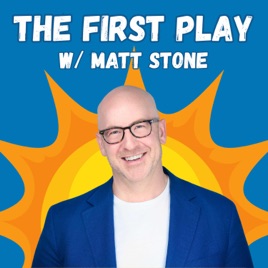
Advertise on podcast: The First Play w/ Matt Stone
Rating
5from
This podcast has
320 episodes
Language
EnglishPublisher
Matt Stone EnterprisesExplicit
Yes
Date created
2020/04/20
Latest episode
2026/10/01
Average duration
12 min.
Release period
2 days
Description
Like a voice note from a thoughtful friend—quick daily reflections, random curiosities, and little stories that might just shift how you see the day ahead (or behind). mattstone.substack.com
Unlock The First Play w/ Matt Stone podcast Email contact info,
Listeners & Audience details
Email contact information
Direct podcast contact details

Listeners
Audience numbers & engagement insights

Audience details
Podcast Insights

Podcast episodes
Check latest episodes from The First Play w/ Matt Stone podcast
They're Not Stealing Your Face
2026/10/01
Matt has AI fakes on his mind. If you’ve been on YouTube and seen someone who looks and sounds exactly like a creator or commentator you know, in their usual setting, but on a strange channel saying things you’ve never heard them say, you’ve met the problem. He’s learned to assume that unless he’s on a person’s official channel, what he’s watching may not be real, a skepticism that used to feel tinfoil-hat and is now just well-founded. He points to Washington Post reporting on the bipartisan No Fakes Act, which would create federal protection against unauthorized digital replicas of a person’s voice or likeness while preserving exemptions for news, commentary, satire, and parody. Physician-creator Joel Bervell found an AI version of himself endorsing a product he’d never used, and named the real harm precisely: the fake wasn’t simply borrowing his face, it was borrowing the trust tied to his medical license and his relationship with his audience. Therapist-creator Kati Morton says she runs into fakes of herself all the time. For creators, this isn’t just identity theft, it’s a threat to sponsorships, credibility, and hard-earned audience trust.
Matt’s point goes past the danger to the opportunity. In a world where you can no longer assume what you see is real, the move is to build a clearly-owned home base, channels plainly labeled as the real ones, where you show up yourself and keep a genuine feedback loop with your audience (and he’s careful, as always, not to call every following a community). That home base does double duty: it deepens the intimate trust that makes your work matter, and it gives you a place to warn people when a fake shows up wearing your face. He frames it as another form of hacking, copying you without ever touching your account, and admits it’s hitting different than past threats. But he doesn’t think a truly post-factual world can sustain itself. People don’t like being tricked, except when they opt into it, like a game, and the more they realize some of what they’re watching is fabricated, the more they’ll double down on the voices and places they trust. So build the trust, and build a space where people know for certain they can find the real you.
Source: https://www.washingtonpost.com/wp-creator/2026/09/30/verified-creators-tech-firms-push-no-fakes-bill-rein-ai/
This is a public episode. If you would like to discuss this with other subscribers or get access to bonus episodes, visit mattstone.substack.com
The Bait and the Song
2026/09/30
Matt braids two signals into one argument about attention. First, fresh German research (the Seven.One Audio Podcast Report 2026) that cuts against the everyone-has-a-goldfish-attention-span story: overall daily podcast listening jumped 44% year over year, active listeners average 75 minutes a day, and Gen Z averages 78. In a world of endless short clips and thumbs flying, people will still give long, sustained attention to a voice they trust and choose. His read: we don’t have less patience for content, we have less patience for low-value content, and we’ll pour time (and money) into the voices that genuinely feed us, usually the ones that invite us to see ourselves in them. That reframes short form and long form. Short form is the bait on the hook, a couple of notes from the opus that tells new people you’re there. Long form is where the relationship actually gets built. And consistency is part of it too. Matt’s candid that bouncing around on posting days hurt his own show, and that landing on a reliable Monday-through-Thursday rhythm builds trust as much as the substance does.
The second signal comes from the speaker world, where he’s watching keynotes shift from sit-and-listen toward do-it-now. The programs catching his eye promise research-backed, tactical takeaways, peer conversation, and design sessions where the whole room works the problem in real time and produces something before anyone leaves. People don’t want to watch the movie and get on with their day. They want to stop it and talk about what they just saw. Matt notices he keeps designing his own workshop exactly this way without planning to, a sign your instincts are picking up signals before your conscious mind catches up. He ties it back to a decade of leadership and feedback work, where the deepest learning almost never came from the materials or the theories. It came from finally having the real conversation. The through-line for both signals is the same: connection is where the value is. Don’t sell out the human race just yet. Settle in for the long haul, become a voice people trust to curate and to feed them, and get your audience doing something, not just hearing something. His question: how can you get the people you’re reaching to make or produce something during or right after your message, instead of just consuming it?
This is a public episode. If you would like to discuss this with other subscribers or get access to bonus episodes, visit mattstone.substack.com
Aim Small
2026/09/29
No articles today, just a candid, thinking-out-loud one. Matt names something he catches in himself: disappointment about the response he’s getting online, until he digs underneath it and finds his mind has raced three steps ahead and set an invisible standard of success that isn’t rooted in any real strategy. It’s a comparison he didn’t even know he was making, sometimes to an old-media model that’s gone (the daily talk show with millions of viewers is dead and buried), and sometimes to a YouTuber with five million followers. The neighbor has a Maserati and you have a Toyota, so surely you should have a Maserati. Maybe, maybe not, but that’s not the point. The point is how much of your dissatisfaction is rooted in an expectation you never consciously chose.
His antidote is two words: aim small. Not small ambition, but a small, concentrated group of people who are genuinely all in on what you’re about. That’s how the bigger stage actually gets built. A hundred highly engaged people will change your life, and if each refers you to a handful, you’re at a thousand before long. In a world of too much of everything, the real danger is losing yourself in it and forgetting the next thing, the person in your immediate circle, the next step. Platforms will keep changing (AI is accelerating it), so if you build your identity around a platform instead of around who you serve, you can spend ten years chasing a stage that’s dead by the time you arrive. Serve your people first, and change mediums with them as they move. Matt’s honest that social media is both indispensable and dangerous, that it can quietly turn you into an unpaid worker unless you’re actually serving there, in which case you measure by whether people are getting value, not by likes. He points to his own steady, unforced Substack growth (the overall audience doubled over the year, still climbing, with almost nothing pushed) as proof that concentration beats chasing. His question: what are you expecting of yourself that you don’t even realize, and what does meaningful growth look like for you?
This is a public episode. If you would like to discuss this with other subscribers or get access to bonus episodes, visit mattstone.substack.com
A Smaller Community, Really Dialed In
2026/09/28
Matt opens the week with a Deloitte finding that reinforces the thread he keeps pulling: among people who follow creators, trust translates directly into buying. Per Deloitte’s 2026 Digital Media Trends research, a large share engage with creators daily, most return to the same ones over time, and a majority have bought something on a creator’s recommendation in the last six months, with the number climbing among Gen Z and millennials. Nearly half of those younger consumers say they feel a stronger personal connection to social creators than to TV personalities or actors. Deloitte’s own takeaway for brands is to move away from one-off celebrity campaigns toward long-term creator relationships built on audience fit and trust rather than raw follower counts. Matt’s honest about what he still wants to know (what share of all consumers this actually represents, and that it’s consumer data, not directly B2B), and that caution is the point.
The heart of it is a mindset shift. It’s easy, especially on a platform like LinkedIn, to think success is a big follower number, but Matt’s met people with massive counts doing nothing with them, numbers collected over years of pivots. The real question is whether you have a group who will actually respond to what you put out, what you recommend, offer, and invite. He also warns against measuring yourself against professional platform creators whose entire existence is producing content that performs on that platform. If your core business is in another field, you won’t out-post them, and you shouldn’t try. Set your own metrics, do what you can do authentically and well, and stay in your sweet spot. Underneath it all is a principle that ties back to the old email-list playbook: build a following, ideally a real community, that trusts you over time. He’d take a smaller community that’s genuinely dialed in over a big one that’s just a number, any day. The catch is that everyone now has the same chance, so there’s noise everywhere. Be in it for the long haul, figure out what works for you, and stick with it.
This is a public episode. If you would like to discuss this with other subscribers or get access to bonus episodes, visit mattstone.substack.com
Your Content Is a Storefront
2026/09/24
Matt closes the week with a reframe he says he’s adopting for good. It comes from a National Retail Federation profile of Ella Livingston, the Ghanaian-American founder of Cocoa Asante, whose family has grown cacao in Ghana for generations and who turned that legacy into a chocolate brand that went from local to national, in meaningful part through social video. The lesson her team learned: stop treating your content as an advertisement and start treating it as a storefront. So many businesses today have no brick-and-mortar location, no room with people always walking in, and social can be the facsimile of that storefront, the place people walk in, meet you, and feel your energy with their own eyes. A traditional ad says “here’s my chocolate, buy it.” The storefront approach says “I’m in Tennessee, but let me introduce you to Ghana, to my family, to where this cocoa comes from and why we build our supply chain to take care of the farmers.” That kind of storytelling invites people into the living room of your business, and it can get them excited before you’ve launched a thing.
Matt ties it to his standing objection to “personal branding,” which he thinks cheapens the work, because it implies building a facade around you. Approach it instead as helping you tell your true story in many ways, and you still get a brand, but with intention behind it and a far more genuine result. He frames the day’s other signal (YouTube moving into television-scale, IP-retained programming, per Outlook Business) as the same story from the platform side: producers no longer have to choose between owning their work and getting distribution, but the window is open now and consolidation is coming, so if producing is your thing, this is the time to play. Underneath both is the refrain he keeps landing on: just because you can doesn’t mean you should. Find the sandbox, the art form, the platform that’s actually right for you and your audience (Instagram is dead for some, wonderful for others) and build your storefront there. The question to carry into the weekend: what are you building, and where does your storefront live?
This is a public episode. If you would like to discuss this with other subscribers or get access to bonus episodes, visit mattstone.substack.com
Live Is the Point
2026/09/23
Matt opens with a one-on-one from the night before, hearing a colleague’s immigrant story and feeling the whole relationship deepen in real time, because you understand someone, and trust them, when you can see your own experience reflected in theirs. That’s the thread through everything Backstage is about: people lean in, collaborate, and stay loyal when your story lets them see themselves. Then to the signal of the day, a Variety piece on business podcaster Sammi Cohen launching Social Commerce Network, a livestreamed business-news show airing three times a week with the explicit goal of becoming a next-generation CNBC for people who get their news on their phone. Half breaking news, half short interviews with the CEOs actually in the story. Her audience skews younger and about 70% women, a deliberate contrast with legacy business media, and Matt’s note is that knowing your demographic that precisely is what makes a media business fundable.
The bigger pattern: broadcast is dead and cable is trailing off, and this is what’s replacing it. Cohen’s touchstone, TBPN, a daily Silicon Valley talk show, was just acquired by OpenAI (its first media buy) because the show promotes what OpenAI calls “constructive” dialogue on AI, a reminder that if you’re building media, it’s worth thinking early about who might one day buy it and why. But Matt’s real takeaway for the rest of us is about live. Live means right now, this is what’s happening, I’ll help you understand it, and it creates the interactivity and authentic-moment feeling people crave. It’s the same reason a live stage still thrills, though Matt argues the stage now has to be reimagined as facilitation, not presentation. He calls the standard conference panel (a moderator walking three people down a list of questions) outdated, and says what he’s chasing is more unpredictability, more interaction, more of a post-panel experience. The question he leaves you with: how can you create more interactive experiences for the people you want to reach, and build the initial audience that lets you grow into everything else?
Article: https://variety.com/2026/digital/news/sammi-cohen-social-commerce-network-scn-live-business-show-1236867067/?utm_source=chatgpt.com
This is a public episode. If you would like to discuss this with other subscribers or get access to bonus episodes, visit mattstone.substack.com
A Personality With a Point of View
2026/09/22
Matt braids two stories that look unrelated and aren’t. First, a new IBM study (with Oxford Economics, 1,500 CHROs and 8,800 employees): 71% of chief HR officers say the most essential skill now is the ability to supervise, validate, and override AI output, yet only 29% of employees rank judgment as important, and 60% of workers worry AI is eroding their skills, with critical thinking the one they name most. The people at the top want judgment; the people in the trenches, buried in keep-it-moving pressure and left to manage the AI shift alone, don’t see it that way. Second, a set of ad-industry reports (which Matt flags as biased) showing podcast advertising delivering strong ROI, with host-read, entertaining ads producing the biggest brand lift regardless of the host’s follower count.
Here’s the connection. Reach matters and podcasts are gaining it, but the relationship with your audience matters more, because it means you know who they are, you have their trust, and entertainment carries the rest. And underneath all of it sits the thing IBM is really pointing at: critical thinking is part of your unique expression. Information is a commodity now, so how you see and interpret the world is your differentiation. A personality is great, but you need a personality with a point of view, and a point of view requires actual thought, analysis, friction. That’s why overusing AI is quietly dangerous. When something’s done for you, the human instinct isn’t to work harder, it’s to stop thinking about it, and every bit of friction you remove is learning you skip. You don’t develop judgment by consuming media; you develop it by getting in the ring. Matt’s proof is his own week: four-plus hours at a Black Podcasters Association gathering he’d meant to leave early, staying because people were sharing real points of view (including one he disagrees with, that reworking a talk show into a podcast “isn’t podcasting”). He didn’t debate it in the moment, but he’s been chewing on it ever since. That’s the point. Being able to speak is good; having a point of view is better. Without one, it’s just more noise.
This is a public episode. If you would like to discuss this with other subscribers or get access to bonus episodes, visit mattstone.substack.com
The Offline Bet
2026/09/21
Still decompressing from two whirlwind weeks of Fast Company and the podcasting-community circuit, Matt surfaces the theme that kept coming up: human connection and real-life experience are only going to grow, and social media’s role in delivering that feels increasingly uncertain. He points to a TechCrunch piece that gives the trend teeth. These aren’t first-timers chasing a fad. They’re founders who already built and sold real companies, now putting their money and priority into getting people physically together. Brynn Putnam sold Mirror to Lululemon for $500 million and is building Board, an interactive gaming table designed as the philosophical opposite of a solo screen. Tristan Walker, who sold his grooming company to P&G, is scaling Heirloom craft schools where people learn skills together, screens down. Bonobos founder Andy Dunn has turned Pie into a “social life operating system” for run clubs and watch parties. The Wing’s Audrey Gelman runs a countryside inn with monthly murder-mystery dinners that force strangers to actually interact.
Matt’s read: when people who’ve already won are betting their next chapter on connection, that’s a signal worth heeding. A Harris Poll (sponsored, he notes, by a hotel, so grain of salt) found two-thirds of Americans now prioritize experiences like travel over material things. People want to go and do things together. Social media still has a place in this, as a way to find the people who want to belong around a topic, but Matt’s growing conviction is that it has to convert into something more, something real, or the fatigue wins. He’s candid that he opens his own feeds now and feels no pull at all. So he closes not with a lecture but with a genuine question he wants to talk through with listeners: what’s your relationship with social media right now? Is it nutrients or just distraction? Has it changed? He’s asking sincerely, and inviting the conversation onto Substack.
This is a public episode. If you would like to discuss this with other subscribers or get access to bonus episodes, visit mattstone.substack.com
Start With the Story
2026/09/17
Closing the week from the Fast Company Innovation Festival, Matt reports on a morning that ran Russell Wilson, the Walmart US CEO, Tyra Banks, and Martha Stewart back to back to back. The through-line he couldn’t unsee: Russell Wilson opened with bravado and business wins, high energy and blinding diamonds, and only near the very end of his thirty-minute slot shifted to his family’s story, his father’s struggle, the sacrifices that got him his start. The energy in the room transformed in that moment. And Matt’s takeaway is a question: what if he’d started there? The whole talk would have landed differently, everything recast in that light. The Walmart CEO followed a similar shape, opening on supply chain and trends before edging toward something personal later, never quite arriving.
That’s the lesson, and it ties the whole run together: your personal story is your best story, no matter how big you are. You can run the world’s largest retailer and it’s still the personal narrative that makes an audience lean in. Because if someone can see themselves in your story, you’ve got them. Matt’s image for it is sharp: no matter how big the diamonds around your neck, a person without them can look at you, and if they see themselves in you, the reflection they catch through those diamonds is themselves. That’s far more powerful than “look at me, I’m great.” He also clocks the crowds (Tyra and Martha packed the room), Tyra’s genuine but carefully bounded vulnerability, and the sheer value of being there in person: he met online contacts face to face, recognized them by their voices, and felt how different real-life connection is. His closing questions, heading into the weekend: what’s the personal story that makes everything else you do more powerful and relatable, and what can you do to be kind to yourself?
This is a public episode. If you would like to discuss this with other subscribers or get access to bonus episodes, visit mattstone.substack.com
Maybe You Don't Need a Bottle
2026/09/16
The highlight of Matt’s day at the Fast Company Innovation Festival was watching actress Elizabeth Banks on stage with Marian Leitner-Waldman, founder and CEO of Archer Roose — a wine brand whose whole idea is putting genuinely good wine in a can. Three things stuck. First, the storytelling partnership: Leitner-Waldman had Banks on her vision board and, about six years in, landed her not as a celebrity endorser but as co-owner and chief creative officer, the story engine behind a set of genuinely funny, award-winning ads. Second, the timeline — it took roughly six years to get Banks and over a decade to reach this bigger stage, a reminder to settle in for the long haul and enjoy the wins along the way. And third, the reframe that Matt couldn’t stop thinking about.
Everyone says the wine industry is contracting — and through the traditional lens (fancier labels, more exclusive membership clubs) it is. But Banks, by her own admission, had felt like an outsider to wine’s snootiness, and this venture let her experience it differently: accessible, unintimidating, in a can you can pull from a cooler. Matt’s takeaway has nothing to do with wine. What you bring to the table — your skill, your message, your “wine” — can stay exactly the same at its core, while the packaging, the delivery, and the story around it change completely, and the market will see it as something entirely new. Looked at through the old lens, you’re fighting for a shrinking club. Looked at fresh, maybe you don’t need a bottle at all. The product may be the same; the package and the purpose can change. That’s how you find a new lane and a market hungry for what you offer, delivered differently — and it’s exactly the kind of obvious-in-hindsight move you spot by studying businesses outside your own. You don’t have to throw away what you’ve built. You may just need to repackage it.
This is a public episode. If you would like to discuss this with other subscribers or get access to bonus episodes, visit mattstone.substack.com
When Everyone's a Creator, No One Is
2026/09/15
Day two from the Fast Company Innovation Festival, and Matt’s synthesizing what he saw. He toured The Lighthouse, a gorgeous members’ campus for creators (Brooklyn and Venice) with plug-and-play studios for interviews, kitchen demos, outfit try-ons — a mini-studio for anyone who’ll pay the fee. Around it, the money is pouring in: Steven Bartlett of Diary of a CEO is deploying up to $400 million with Authentic Brands (the Reebok/Shaq/Elvis licensing machine) to turn creators into full companies, on the thesis that a creator is a founder, not just someone making content. But Matt could feel a tension in the room — a field saturating with young, polished people positioning as experts they haven’t lived long enough to be. When everyone’s a creator, nobody’s that special, and it feels, he says, like a bubble straining to break. A sharp Decoder piece crystallized it: YouTube didn’t remove the gatekeepers, it swapped tweedy human ones for an algorithm that still decides whether you’re seen at all. The ring is open, but you’re being curated just the same.
So where does that leave a real expert? Matt points to Oprah — who understands group psychology and reinvention better than almost anyone — now doing traveling podcasts instead of a fixed studio, and staging a two-hour immersive “AHA” experience at the Las Vegas Sphere with an art-and-music collective. Grab-the-mic-and-talk isn’t enough anymore; the frontier is experiential. She can go big because she has the resources, but the principle scales down: whatever you build should be experiential and unmistakably yours. Matt’s refrain lands hard here — don’t put yourself in someone else’s image. Just because you can start a podcast doesn’t mean you should; for you it might be a poetry slam, an IRL night at a café, a theater event. In a moment when the early boom is giving way to something no one can name yet, and where a few players will eventually take most of the pie, copying what works only makes you derivative. The real opportunity is to get more creative, lean harder into who you are and who you’re not, and build the thing only you could. His question: what could you do that’s authentic to you, creative, and worth experiencing — something that makes people understand your value even more?
This is a public episode. If you would like to discuss this with other subscribers or get access to bonus episodes, visit mattstone.substack.com
Where Are Your People?
2026/09/14
Matt opens the week heading into Fast Company’s Innovation Festival (starting today, with an off-site on the creator economy in Brooklyn) and points to a telling Reuters signal: former Canadian PM Justin Trudeau just launched a production company, Hope & Hard Work, with his longtime chief of staff — following the path the Obamas cut with Higher Ground. The old post-role playbook was a book, some speeches, a few boards. Now the move is to build an actual media company. Scott Galloway did a version of it — business professor turned podcaster, co-hosting Pivot with Kara Swisher while building out his own podcast network. It’s happening everywhere, and it points to a landscape that’s fundamentally shifted: there’s no Oprah anymore, no single channel that reaches everyone. Attention is segmented across podcasts, YouTube, Spotify, and countless niche platforms.
That shift lands on one practical question, whether or not you ever start your own show: where are your people? What are they listening to, watching, paying attention to — and are you there? Matt’s advice is to stop settling into the same few shows you’ve always followed and actively explore, ask people who they pay attention to, and let AI surface things you’d never stumble onto, because you’ll often discover an entire audience orbiting someone you didn’t know existed. He also shares a revealing signal from his own year of running The Bigger Stage podcast: the flood of pitches he gets from people (and their reps) begging to appear — often with videos that don’t move him — tells him that people now clearly grasp the value of getting third-party data about themselves out into the world, not least for how AI tools surface it. So even if you’ll never be Joe Rogan, the question stands: what shows would you want to be on, and if you had a show of your own, what would it be? (Housekeeping: Matt’s testing a Monday-through-Thursday cadence, leaving Fridays open — so don’t be surprised by the lighter week.)
This is a public episode. If you would like to discuss this with other subscribers or get access to bonus episodes, visit mattstone.substack.com
Plant the Flag
2026/09/10
Matt reads a Business Insider piece on Kara Swisher — the tech journalist who went from the Washington Post and Wall Street Journal to building her own independent media identity through Recode, podcasts like Pivot, and books — because her counsel to journalists leaving downsizing institutions applies to anyone making that leap. And it’s happening far beyond journalism: people who earned multiple six figures inside big institutions are heading out on their own, voluntarily or not, and discovering that a half-million-dollar salary and a “please subscribe for $12 a month” Substack are entirely different games. Swisher’s advice, notably, is not “follow your passion.” It’s assess your risk tolerance, keep skills that are always saleable, sense what audiences will want before they ask — and, above all, have something distinctive to say.
That last one is where Matt digs in. You rarely get to say something genuinely new, but you can be distinctive — substantively (going against a common belief) or stylistically (the way you deliver it, the way a drug company engineers whether a treatment arrives as a pill or a shot). The hard part, especially for people whose muscle was built in collaborative or diplomatic corporate settings, is planting a flag on a real position and defending it. A point of view sharp enough to break through will attract people who fight you and leave nasty comments — and Matt’s tell is that the faster and more reptilian the reaction, the less thought behind it. That comes with the territory. Draw on the credibility and relationships you earned over decades, then get comfortable saying what you actually think, a bit more candidly and fearlessly than felt allowed before. His closing question is the sharpest distillation yet of the theme he keeps circling: if your former title disappeared, what still makes someone curious about you? The substance is there, he promises — put the prompt to your mind, go for a walk, and let it surface.
This is a public episode. If you would like to discuss this with other subscribers or get access to bonus episodes, visit mattstone.substack.com
Report from the Frontier
2026/09/08
Back after Labor Day, Matt takes aim at a familiar social-media anxiety: the middle-aged professional watching a 23-year-old rack up attention with beach photos and matcha, wondering where they fit. His first move is to lower the stakes on something people over-worry about. A PostFast analysis of tens of thousands of posts looked at whether when you post matters — and found the differences across platforms are marginal at best (a slight afternoon edge on Facebook, even weaker signal on LinkedIn). His verdict: stop optimizing the timing of content you haven’t even gotten comfortable making. Spend a year building the rhythm and the quality first; the tiny refinements can wait, and the ROI on them isn’t there.
Then the real idea, drawn from an Axios story about a 23-year-old who launched a Charlotte coffee cart on a $10,000 bank loan (her parents made her earn it) and grew it fast by telling her story openly online — even sharing her sales numbers publicly. It works beautifully for her because we love watching an ambitious young person learn in real time. But Matt’s careful with the translation: if you’re a 50-year-old established expert, you can’t post “I’m learning to be a professional for the first time” — it only hurts you. The seasoned pro’s version is different and just as powerful: share what you’re genuinely curious about, researching, and testing. “I spent 20 years in banking, and here’s why I’m doing improv now.” Show the work of stretching yourself — not eroding your authority, but proving you’re on the frontier and coming back with a report your clients wouldn’t get anywhere else. That, Matt notes, is exactly what Backstage is for him. The prompt: what are you curious about right now, and how could sharing it take your clients on the adventure with you?
This is a public episode. If you would like to discuss this with other subscribers or get access to bonus episodes, visit mattstone.substack.com
Start With a New Story
2026/09/04
On the show built around the line “let their stories power their growth,” Matt closes the week with the clearest case for what that actually means. First, a market signal: British retailer John Lewis is launching Gift List, a YouTube chat show hosted by Angela Scanlon (Louis Theroux is a guest), for a strikingly specific reason — AI has upended search. A year ago just 0.3% of its customers used AI to find products; now it’s about eight times that, and because large language models favor third-party advice and live conversation over brand messaging, the retailer is generating exactly that kind of talkable, conversational content. It’s the split Matt keeps naming: media for humans and media for machines — and conversation feeds both. It’s also, he notes, the premise The Bigger Stage was built on, playing out faster than he expected.
Then the heart of it: Sonos. After a 2024 app redesign nearly sank the company, new CEO Tom Conrad’s first diagnosis was, of all things, narrative — Sonos had been behaving like a hardware company. So he changed the story first: we don’t make individual products, we make the Sonos system, hardware and software as one interdependent whole. Only once that story was in place could the org chart, priorities, software investment, and customer experience realign behind it (he restructured the whole company within about three weeks). Matt’s takeaway is a principle that scales all the way down to the personal: if you want to change something, you start with a new story. It’s true for a company and true for you — the story you tell yourself about your fitness, your next chapter, your business sets the direction, because the brain moves toward whatever you point it at. His questions to carry into the long weekend: what story do your employees, your partners, and the market tell about you — is it accurate, and is it pointed backward or forward? And what story refinement would put your ship somewhere completely different a year from now? What story are you going to write this weekend?
John Lewis article: https://www.theguardian.com/business/2026/sep/03/john-lewis-youtube-chat-show-angela-scanlon
Sonos article: https://www.theverge.com/podcast/988368/sonos-ceo-tom-conrad-ai-smart-home-fabric-app-redesign
This is a public episode. If you would like to discuss this with other subscribers or get access to bonus episodes, visit mattstone.substack.com
Podcast reviews
Read The First Play w/ Matt Stone podcast reviews
MystikSpiral 2026/09/15
Great way to start the day
Matt always has something valuable to share that I can take into my day and use in some meaningful way. I appreciate the insights and framing that co...
KPWed 2025/10/02
Take a meaningful break
I have come to look forward to this daily ten with Matt. It’s light but sincere and helps me start the day with a positive mindset, more connected to ...
podfan11 2022/08/22
Phenomenal
Matt Stone is a phenomenal speaker and this podcast is just the right length. So glad I learned about it!
Update: I’m not a CEO or entrepreneur, but I...
Podcast sponsorship advertising
Start advertising on The First Play w/ Matt Stone relevant audience podcasts
You may also like to advertise on these Podcasts
4.8219787
Imperfect Action
Steph Taylor
4.727388583
This Past Weekend w/ Theo Von
Theo Von
4.712974372
The Tim Dillon Show
The Tim Dillon Show
4.115911450
The Tucker Carlson Show
Tucker Carlson Network
4.827973446
Huberman Lab
Scicomm Media

4.240683
To Be The Man
Podcast Heat | Cumulus Podcast Network
4.41511152000
The Ben Shapiro Show
The Daily Wire
4.2155648
TENNIS.com Podcast
TENNIS.com Podcast/Tennis Channel Podcast Network
4.510815766
The Joe Budden Podcast
The Joe Budden Network
4.611603506
The Bulwark Podcast
The Bulwark