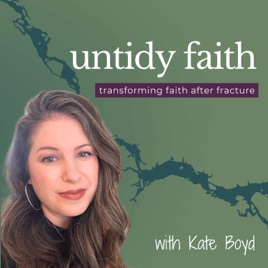
Advertise on podcast: Untidy Faith
Rating
5from
This podcast has
153 episodes
Language
EnglishPublisher
Kate BoydExplicit
No
Date created
2020/06/26
Latest episode
2026/02/03
Average duration
48 min.
Release period
19 days
Description
Transforming faith after fracture The Untidy Faith podcast is where we have honest conversations and gentle encouragement for when following Jesus gets messy. Join your host, Kate Boyd - author, speaker, and gentle guide for Christians who are disentangling their faith from culture, rebuilding their relationship with Scripture, and desiring to find joy in following Jesus again - each week to find your life and faith after deconstruction. kateboyd.substack.com
Unlock Untidy Faith podcast Email contact info,
Listeners & Audience details
Email contact information
Direct podcast contact details

Listeners
Audience numbers & engagement insights

Audience details
Podcast Insights

Podcast episodes
Check latest episodes from Untidy Faith podcast
Joash Thomas | Colonized Christianity
2026/02/03
In this episode of the Untidy Faith Podcast, I sit down with Joash Thomas, author of The Justice of Jesus, for a conversation about how colonization shaped Western Christianity to resist justice, and what recovering our authentic identities—indigenous, spiritual, and human—has to do with embodying the gospel Jesus actually preached.
The Western church’s complicity in colonization didn’t just harm the Global South, it also robbed Western Christians of their own indigenous practices and created theology that privileges the spiritual over the physical in ways Jesus never did, and how prayer can be the formative work that transforms us into instruments of justice.
Topics Covered
* Understanding colonization not as a political buzzword but as lived reality: India went from 25% of world GDP in 1700 to 1% in 1947 after British extraction, and the Western church was largely on the side of oppressors, excusing colonial theft in theological language
* Why the gospel being “more spiritual than physical” is colonized theology that doesn’t come from Jesus of Nazareth, whose ministry in Luke 4 explicitly defined good news as setting captives free both physically and spiritually
* How empires steal identity by conditioning us to forget who we are beyond labels like “just American” or “just Christian,” and why recovering indigeneity—whether Celtic Christianity or St. Thomas Indian Christianity—reveals pre-colonial traditions offensive to empire
* The prophetic journey from outrage to love: starting angry about injustice (righteous and necessary) but being transformed to see Christ in enemies, transcending trauma to become wounded healers rather than perpetuating violence in words or deeds
* Why reimagining prayer as formative rather than just intercessory—praying with marginalized communities, not just for them—creates the sustainable oxygen advocates need for long-term justice work without burnout
Timestamps:
01:00 From India to America: Learning Power from the Margins
09:00 Justice as Gospel in Global South vs. “Woke Marxism” in America
15:00 How Colonization Stole Western Christians’ Identities Too
20:00 Loving the Church While Critiquing It
27:00 The Prophet’s Journey from Outrage to Love
32:00 Can Western Churches Pursue Justice? (Yes, Here’s How)
38:00 Reframing Mission: Encountering Jesus in the Margins
45:00 Prayer as the Formative Work of Justice
49:00 Finding the Book and Connecting with Joash
This is a public episode. If you'd like to discuss this with other subscribers or get access to bonus episodes, visit kateboyd.substack.com/subscribe
Marissa Burt & Kelsey Kramer McGinnis | The Parenting Prosperity Gospel
2026/01/20
In this episode, I sit down with Marissa Burt and Kelsey Kramer McGinnis, authors of The Myth of Good Christian Parenting, for a sobering conversation about how the Christian parenting industry sold families impossible promises wrapped in biblical authority.
Critiquing parenting books is important, but we also need to recognize how movements born from 1970s political fears, biblical counseling innovations, and prosperity gospel thinking created authoritarian frameworks that promised godly legacies while actually preventing authentic relationships, and how families can move toward seeing children as fully human neighbors instead of extensions of parental control.
Topics Covered
* Understanding the false promise of “train up a child in the way they should go” as a guaranteed formula for producing Christian adults, and how this turned children into extensions of parental desire for “kingdom legacy” rather than autonomous persons
* Why James Dobson’s Dare to Discipline (1970) is far more a conservative political book about restoring order and authority in response to social upheaval than a Christian or biblical parenting resource
* How the biblical counseling movement (starting 1970), inerrancy movement (1978 Chicago Statement), and fears about no-fault divorce combined to create unprecedented emphasis on parental authority as “first principle” and spanking as spiritual practice
* The invention of “liturgy spanking”—transforming what was historically just coercive behavior control into a supposedly godly catechesis connected to penal substitutionary atonement, complete with step-by-step manuals
* Why these frameworks betray entire families: parents are left ill-equipped to relate to children as individuals when external compliance is mistaken for authentic connection, and adult children reclaiming autonomy creates painful estrangement
Timestamps:
01:00 The “Oh No” Moment: When Christian Parenting Advice Doesn’t Add Up
06:00 False Promises of Guaranteed Godly Legacies
12:00 Political Origins: Dobson’s Book as Conservative Response to Social Upheaval
18:00 Biblical Counseling Movement’s Outsized Influence
25:00 The Invention of “Liturgical Spanking” in the 1970s
31:00 How Families Get Betrayed by These Frameworks
37:00 Children as Fully Human Neighbors, Not Property
43:00 Finding the Book and More Resources
This is a public episode. If you'd like to discuss this with other subscribers or get access to bonus episodes, visit kateboyd.substack.com/subscribe
Zach Lambert | Rehabbing your relationship with the Bible
2026/01/06
In this episode, I sit down with Zach Lambert, author of Better Ways to Read the Bible, for an honest conversation about how to read the Bible in ways that bring life instead of harm.
This isn’t just about finding better interpretations—it’s about recognizing how literalism, apocalypticism, moralism, and hierarchy have damaged real people, and learning to read Scripture through lenses that center Jesus, context, flourishing, and fruitfulness instead. Zach offers both deconstruction of harmful patterns and reconstruction of life-giving practices for engaging with the Bible.
Topics Covered
* How a college professor’s simple assignment to research women like Deborah, Junia, Phoebe, and Priscilla shattered Zach’s assumptions about women’s roles in the church, and why 80% of his class changed their minds after one week
* Understanding the 1978 Chicago Statement on Biblical Inerrancy as a recent invention designed to police theological borders by saying “if you disagree with our interpretation, you’re not a Christian”—a form of spiritual abuse that weaponizes God’s name for human control
* Why the “apocalypse lens” (obsession with end times, rapture, hell, and judgment) is so pervasive in American evangelicalism: it’s incredibly effective at controlling people through fear, and has influenced American foreign policy for 75 years through Left Behind theology
* Learning from a Jewish rabbi that the Bible’s authority comes from its multiplicity of truths—like a crystal refracting light differently depending on who’s reading—rather than excavating one singular “correct” interpretation for every verse
* Reframing “God hates divorce” through context and flourishing lenses: understanding that divorce commandments were exclusively given to men in a patriarchal society where divorce was often a death sentence for women, not a universal prohibition against leaving abusive marriages
* How humility and healthy diverse community are the essential ingredients for reading Scripture well—because white clergy’s unanimous biblical defense of chattel slavery wouldn’t have survived if they’d been in equitable community with Black people
Timestamps:
01:00 The Assignment That Changed Everything About Women
06:00 Separating Biblical Inspiration from Human Interpretation
10:00 Social Location and Who Gets Called “Just Theology”
16:00 The Chicago Statement as Spiritual Abuse Tool
21:00 Why Apocalypse Lens Dominates American Evangelicalism
30:00 Detoxing Harmful Patterns Through Humility and Community
35:00 Reframing “God Hates Divorce” Through Healing Lenses
42:00 What Makes God Angry According to the Prophets
45:00 Leading a Church Through Interpretive Diversity
47:00 Finding Zach’s Work and Upcoming Book
This is a public episode. If you'd like to discuss this with other subscribers or get access to bonus episodes, visit kateboyd.substack.com/subscribe
Jared Stacy | Conspiracy Thinking in American Evangelicalism
2025/11/18
In this episode of the Untidy Faith Podcast, Kate Boyd sits down with Jared Stacy, author of the forthcoming book Reality in Ruins, for a nuanced conversation about why conspiracy theories have become so pervasive in evangelical Christianity and what the church can do about it.
This isn’t just about QAnon or stolen elections—it’s about understanding how evangelicalism’s theology of persecution, end-times anxiety, and individualism creates fertile ground for conspiracism, and how reclaiming the whole story of Jesus offers a way forward that doesn’t require us to become fact-checkers but truth-tellers in our own key.
Topics Covered
* Understanding conspiracy theory as “functional reality” that provides people not just a lens for interpreting the world but prescribes specific actions—like how belief in a stolen election motivated the January 6th Capitol attack
* Why evangelicals are particularly susceptible to conspiracy thinking: the combination of persecution complex, end-times theology giving conspiracies a “theological charge,” and modern individualism that seeks control through claiming secret knowledge
* How evangelicalism’s witness to the gospel grants conspiracy theories plausibility by packaging spurious claims as “what good faithful Christians believe,” making it feel like apostasy to question them rather than just correcting misinformation
* The historical pattern of conspiracy theories serving evangelical responses to cultural anxieties—from George Whitfield using gospel preaching to prevent slave revolts, to Cold War anti-communism, to contemporary fears about losing white Christian America
* Why confronting conspiracy theories head-on with facts or mockery only leads to deeper entrenchment, and what questions like “why do you need this to be true?” or “why is that good news to you?” can open up instead
* How the church can resist conspiracism not by becoming fact-checkers but by being constituted as Jesus’s body—a “place of reversal” where we discover we were wrong, rehearse the whole story of Jesus, and refuse to settle for anything less than recognizing full humanity in everyone
Timestamps:
01:00 Conspiracy Theory as Functional Reality
06:00 Why Evangelicals Are Susceptible to Conspiracy Thinking
12:00 The Theological Charge That Makes Conspiracies Plausible
18:00 Alternative Knowledge vs. Embodied Truth
24:00 Historical Anxieties Driving Conspiracy Theories
35:00 When Facts and Mockery Don’t Work
45:00 The Freedom to Be Wrong in Christian Community
54:00 Healthy Skepticism Without Conspiracy Thinking
1:03:00 The Church as Place of Transformation and Discovery
1:06:00 Finding Jared’s Work and Forthcoming Book
This is a public episode. If you'd like to discuss this with other subscribers or get access to bonus episodes, visit kateboyd.substack.com/subscribe
2 Samuel 23 & 24 | Are we great yet?
2025/11/04
In this episode of the Untidy Faith Podcast, Kate Boyd wraps up the year-and-a-half journey through 2 Samuel with returning guests Jenai Auman and Liz Daye, examining chapters 23-24—David’s self-congratulatory final words followed by a devastating census that reveals how little he’s actually learned.
This isn’t a triumphant ending to a great king’s reign—it’s a sobering reminder that David’s version of greatness cost 70,000 lives, and his idea of repentance always came after profound devastation that somehow never seemed to affect him personally. The contrast between how David sees himself and what the text actually shows us is the perfect capstone to understanding power’s corruption.
And a shoutout to Jon Pyle, Robert Callahan, and Amanda Waldron for being a part of the journey through books of Samuel!
Topics Covered
* How David’s “last words” in chapter 23 present his self-image as a just ruler bringing cloudless morning prosperity, immediately contrasted by the compilers listing “Uriah the Hittite” among his mighty men—a literary shade that reminds readers of David’s profound injustice
* Understanding why David’s census in chapter 24 was such a violation: it risked ritual impurity for the entire nation, mimicked divine power (only gods counted in ancient cultures), and served as the first step toward military conscription, slavery, and exploitation
* Why David’s choice of punishment—three days of plague affecting 70,000 people—reveals his continued pattern of self-protection, when he could have chosen three months of fleeing enemies with his “mighty men” that would’ve primarily affected him
* The devastating reality that David “makes things right with God” through sacrifice but never repairs things with the people harmed by his choices, mirroring modern patterns where abusive leaders go on apology tours without addressing the actual devastation they caused
* How the story ends not with David as hero but with God’s compassion for the land, contrasting David’s transactional understanding of hesed (loyalty) with God’s hesed (compassion)—showing what God actually values versus what David claimed to embody
* Why paying attention to prophets and moving toward justice and shalom matters more than celebrating leaders who buy their own hype, and how David delivering Israel into bondage (the census taking nine months—a gestation period) inverts God’s role as deliverer from oppression
Timestamps:
01:00 David’s Self-Hype Poem vs. “Uriah the Hittite”
07:00 The Mighty Men List as Twilight End Credits
14:00 Why the Census Was Such a Big Deal
21:00 David’s Cowardly Choice: 70,000 Deaths
30:00 Repentance Without Repair to the Harmed
38:00 Spiritual Bypassing and Weaponized Forgiveness
47:00 The Angel Who Wouldn’t Stop Judging
55:00 Measuring Success by Empire vs. Jesus
1:04:00 Final Takeaways from the David Journey
1:06:00 Finding the Hosts and What’s Next
This is a public episode. If you'd like to discuss this with other subscribers or get access to bonus episodes, visit kateboyd.substack.com/subscribe
Beth Allison Barr | Becoming the Pastor's Wife
2025/10/21
In this episode of the Untidy Faith Podcast, Kate Boyd sits down with Dr. Beth Allison Barr, historian and author of The Making of Biblical Womanhood and Becoming the Pastor’s Wife, for a fascinating conversation about how the role of pastor’s wife has functioned to limit women’s leadership in the church.
This isn’t just about theological debates—it’s about recognizing how economic anxieties, racial prejudice, and fear of losing privilege have repeatedly driven backlash against women’s independence throughout history, and how biblical language gets weaponized to justify keeping women in subordinate, unpaid positions.
Topics Covered
* How 2025 marks the 25th anniversary of the 2000 Baptist Faith and Message that encoded complementarian theology into Southern Baptist doctrine, and recognizing this as part of a historical pattern where women’s subordination rises during periods when women gain legal and economic independence
* Understanding backlash against women’s ordination as rooted in cultural anxieties—particularly white anxiety about demographic changes and fears about losing economic privilege—rather than purely theological concerns about biblical interpretation
* Why the pastor’s wife role has become “the primary ministry role model for women” in conservative churches, creating a safe space for women’s gifts while simultaneously keeping them under male authority and conditioning congregations to reject independent female leadership
* The economic reality that women’s ministry is almost always expected to be unpaid volunteer work while men’s ministry comes with salaries and benefits, revealing how “noble calling” language masks structural inequality and devalues women’s contributions
* How closely associating female leadership with marriage trains churches and broader culture to only accept women’s authority when it’s subordinate to men, contributing to resistance against women in business, politics, and other spheres beyond the church
* What the church has lost by silencing women’s theological voices, contrasting with historical examples like Catherine of Siena convincing the Pope to return to Rome because medieval Christianity respected that “God spoke through women to men”
Timestamps:
01:00 25 Years of Complementarian Theology’s Damage
05:00 Cultural Anxieties Driving the Backlash Against Women
10:00 How Economic Fears Shape Attitudes Toward Women’s Equality
14:00 The Pastor’s Wife Role as Gatekeeper to Female Leadership
19:00 Unspoken Expectations and Their Cost to Women
23:00 What the Church Loses Without Women’s Voices
28:00 Historical Hope: Women Who Never Stopped Speaking
32:00 Finding Beth’s Work and Resources
This is a public episode. If you'd like to discuss this with other subscribers or get access to bonus episodes, visit kateboyd.substack.com/subscribe
2 Samuel 21 & 22 | When Victors Write the History
2025/10/07
In this episode of the Untidy Faith Podcast, Kate Boyd, Jenai Auman, and Liz Daye continue their exploration of 2 Samuel, examining chapters 21-22—a jarring collection of appendices that reveal David’s legacy through violence, political maneuvering, and self-congratulatory poetry.
This isn’t a triumphant conclusion to David’s reign—it’s a sobering look at how powerful people rewrite history to justify harm, and how the quiet faithfulness of marginalized women like Rizpah often goes unnoticed while loud, self-serving declarations get preserved as “worship.”
Topics Covered
* Understanding the structural shift in 2 Samuel 21-24 from linear narrative to a collection of “appendices” that are deliberately out of chronological order, giving different perspectives and even contradicting earlier accounts like the story of who actually killed Goliath
* How David responds to a three-year famine by asking the Gibeonites (not God) how to fix it, resulting in the execution of seven of Saul’s descendants—a solution that violates Torah patterns of repentance while serving David’s political interests by eliminating threats to his throne
* The prophetic witness of Rizpah, a concubine who holds vigil over her sons’ desecrated bodies for six months, whose quiet faithfulness actually lifts the famine when David finally gives the bodies proper burial—yet most major commentaries ignore her story entirely
* Why the famous contradiction about Goliath’s death (attributed to Elhanan here rather than David) reveals how stories were shaped to serve David’s propaganda, showing us that “history favors the victor” and inviting us to read with suspicion
* Examining David’s Psalm in chapter 22 as an unreliable narrator’s self-congratulatory rewriting of history, claiming blamelessness and righteousness while celebrating violence and conquest that directly contradicts Torah values and God’s vision for leadership
* How hyper-spiritualizing language gets weaponized to justify harm—from David’s beautiful words masking brutal actions to modern Christian nationalism using similar rhetoric to consolidate power while claiming God’s blessing on violence and oppression
Timestamps:
01:00 Chapter 21: Famine, Gibeonites, and Political Pragmatism
06:00 David’s Solution: Execution Instead of Repentance
12:00 Rizpah’s Vigil: Six Months of Prophetic Witness
18:00 Why Most Commentaries Erase Rizpah’s Story
24:00 The Goliath Contradiction and David Propaganda
33:00 Chapter 22: David’s Self-Congratulatory Psalm
42:00 Rewriting History: When Beautiful Words Mask Violence
52:00 Context Matters: Why We Can’t Proof-Text Our Way Through
59:00 Reading with Suspicion and Through the Lens of Torah
1:04:00 Loud Posturing vs. Quiet Faithfulness
1:10:00 Finding the Hosts Online
This is a public episode. If you'd like to discuss this with other subscribers or get access to bonus episodes, visit kateboyd.substack.com/subscribe
Hidden Grief of Deconstruction | Mandy Capehart
2025/08/19
In this episode of the Untidy Faith Podcast, Kate Boyd sits down with Mandy Capehart, author of Restorative Grief, for an intimate conversation about how faith deconstruction is actually a complex grief process that affects every dimension of our lives.
This isn't just about changing your theology—it's about recognizing that when we deconstruct faith, we're grieving the loss of safety, belonging, community, identity, and even our relationship with our own bodies. Mandy offers a compassionate framework for understanding why this process is so difficult and how healing can happen holistically.
Mandy Capehart is a grief educator, somatic practitioner, and author of Restorative Grief. She hosts the Restorative Grief podcast and leads the Restorative Grief Project, a supportive online community. Her work focuses on helping people understand grief as a holistic experience that involves heart, mind, body, and spirit.
Topics Covered
* Understanding faith deconstruction as a layered grief process that involves losing "the systems and structures that have really shaped our sense of safety, belonging, and community," not just changing beliefs about theology or biblical interpretation
* How leaving faith communities mirrors other major life transitions like divorce or coming out, particularly when "we have disrupted our foundation" and can no longer rely on our faith as the solid rock during other difficulties
* The difference between fitting in and true belonging, and how many people discover they were conditionally accepted in their faith communities only when they could edit themselves to match expectations rather than bring their full selves
* Why intellectualizing deconstruction can become a protective strategy that creates "an illusion of control" while avoiding the necessary work of processing how these changes affect us emotionally and somatically in our bodies
* How faith communities often suppress connection to our physical selves, leading to embodied symptoms like "tightness in their throat, in their chest" and the inability to speak authentically when our voices have been deemed unsafe or invalid
* The transformative power of learning to "take up space" and speak with authenticity, even when it means risking correction or disagreement, and finding safety in being humbled while maintaining belonging
Timestamps:
01:00 What Are We Actually Grieving in Faith Deconstruction?
05:00 Beyond Theology: How Environment and Values Shape Us
11:00 Why Faith Deconstruction Looks Like Divorce
18:00 Grieving Community and the Loss of Belonging
23:00 Identity Grief: When Labels and Roles No Longer Fit
29:00 How Grief and Transition Show Up in Our Bodies
36:00 Learning to Take Up Space and Use Our Voices
40:00 Restorative Grief: Finding Safety in the Eye of the Storm
47:00 Finding Mandy's Work and Resources
This is a public episode. If you'd like to discuss this with other subscribers or get access to bonus episodes, visit kateboyd.substack.com/subscribe
2 Samuel 20 | The god of Christian nationalism
2025/08/08
In this episode of the Untidy Faith Podcast, we continue our deep dive into 2 Samuel with Kate Boyd, Jenai Auman, and Liz Daye — examining chapter 20 and its stark contrasts between violence and peacemaking, power and wisdom.
This isn't just ancient history—it's a cautionary tale about what happens when leaders prioritize power over God's vision of shalom, and how the pursuit of control creates systems that harm the most vulnerable while claiming to restore order.
Topics Covered
* How Sheba's rebellion represents a more serious threat to David's kingdom than Absalom's revolt, with "all the men of Israel" deserting David and foreshadowing the eventual split of the kingdom that echoes this same rallying cry
* Understanding Joab's brutal murder of Amasa as the physical embodiment of David's strategic manipulation—both men eliminate threats to maintain power, but Joab does openly what David orchestrates from behind the scenes
* Examining the treatment of David's ten concubines as property that gets "handled" rather than cared for, showing how David's view of women as disposable objects extends from Michal to these women who are condemned to live "as widows until the day of their death"
* The contrast between male violence and female wisdom through the unnamed "wise woman" who speaks in poetry to negotiate peace, representing the biblical pattern of women stepping up to end conflicts when men create chaos through their pursuit of power
* How the concept of shalom differs from simple peace or absence of conflict—it represents "the harmony between things and the right relatedness of things," a holistic vision of flourishing that stands in stark opposition to David's hierarchical kingdom
* Why the chapter's ending list of David's officials, including someone "over forced labor," reveals a kingdom that has abandoned God's Torah vision and adopted the oppressive practices of surrounding empires, directly contradicting Israel's identity as people freed from slavery
Timestamps:
01:00 Sheba's Rebellion: A More Serious Threat Than Absalom
03:00 Joab's Betrayal Kiss: Violence to Maintain Power
06:00 The Concubines: How David "Handles" Women as Property
10:00 The Wise Woman: Poetry, Peace, and Maternal Protection
16:00 Shalom vs. Power: Two Visions of Community
24:00 God's Absence and the Politics of David's Kingdom
28:00 David as the god of Christian Nationalism
33:00 Reading Narrative as Literature: Seeing the Bigger Picture
This is a public episode. If you'd like to discuss this with other subscribers or get access to bonus episodes, visit kateboyd.substack.com/subscribe
Embodied Faith Beyond Evangelicalism | Rohadi Nagassar
2025/08/05
In this episode of the Untidy Faith Podcast, Kate Boyd sits down with Rohadi, author of When We Belong, for a provocative conversation about the difference between progressive Christianity and truly decolonized faith.
This isn't about finding a more liberal church or updating your theology—it's about fundamentally reimagining what liberative community looks like when we center marginalized voices and embody radical love ethics in our neighborhoods and daily lives.
Rohadi is an author, speaker, and community leader who focuses on decolonizing Christianity and embodied spiritual practices. He leads an online faith community called A Beautiful Table and hosts the podcast series "Farewell Evangelicalism." His upcoming book on embodied meditations will be released in 2026.
Topics Covered
* Why leaving white evangelicalism for progressive or liberal churches often replicates the same harmful patterns, as recent data shows most "liberal" denominations still vote majority Republican and maintain foundational issues with ableism and white supremacy
* Understanding how evangelical formation is designed to control bodies, particularly women and children, and why those who don't conform to white male, cisgender, able-bodied norms will "never belong fully" regardless of theological adjustments
* The crucial difference between knowledge and embodied wisdom—why reading books about justice isn't the same as participating in liberative community that seeks "right repair unto right relationship" with land, people, and resources
* How decolonizing faith requires listening to indigenous voices and resistance movements specific to the land where your feet touch, rather than seeking universal solutions or centering white voices in leadership
* Exploring embodied spiritual practices like body scans and breath work that help reclaim the body after evangelical teachings that promote distrust and disconnection from physical experiences and emotions
* Why truly liberative communities are found "on the margins"—in recovery churches, queer churches, and racialized communities—and how white people can join existing movements without needing to lead or start their own organizations
Timestamps:
01:00 Beyond Evangelicalism: Progressive vs. Decolonized Faith
04:00 How Evangelical Formation Controls Bodies and Margins
09:00 The Lifelong Process of Unlearning White Supremacist Patterns
14:00 Moving Slow: Relationships, Grief, and Embodied Wisdom
21:00 Living in Tension: Safety, Community, and Vulnerability
26:00 Whose Traditions? Questioning Christian Orthodoxy and Authority
33:00 Embodying Radical Love Ethics in Local Context
f37:00 Finding Rohadi's Work and Resources
This is a public episode. If you'd like to discuss this with other subscribers or get access to bonus episodes, visit kateboyd.substack.com/subscribe
The Desert Fathers and Mother | Lisa Colon Delay
2025/07/22
In this episode of the Untidy Faith Podcast, Kate Boyd sits down with Lisa Colon DeLay, author of The Way of the Desert Elders, for an illuminating conversation about ancient Christian wisdom that speaks directly to modern faith struggles.
This isn't just church history—it's a roadmap for Christians navigating the tension between empire and authentic discipleship, offering embodied practices for healing religious trauma and rebuilding faith after deconstruction.
Lisa Colon DeLay is a pastor, author, and host of the Spark My Muse podcast. Her work focuses on spiritual formation and connecting modern Christians with ancient wisdom traditions. She's also the author of The Wild Land Within and offers resources for spiritual practices rooted in early Christian traditions.
Topics Covered
* How the Desert Fathers and Mothers (300-600 AD) responded when Christianity became corrupted by political power and empire, creating communities that prioritized devotion over career advancement and cultural status
* Understanding the nine "afflicting thoughts" (later developed into the seven deadly sins) as a holistic framework addressing body, mind, and spirit—not moral failings but predictable challenges that arise when pursuing spiritual growth
* Why healing from religious trauma requires embodied practices, not just cognitive processing, and how ancient spiritual disciplines can help integrate the physical, emotional, and spiritual dimensions of faith
* The essential role of spiritual mentorship in faith reconstruction, contrasting the Desert tradition of pairing every seeker with a spiritual mother or father against modern evangelicalism's individualistic approach to spiritual growth
* Exploring the practice of "vigil"—waiting expectantly on God as an active spiritual discipline that reorients us from productivity-based faith to relationship-based presence with the divine
* How ancient wisdom addresses modern challenges like spiritual overwhelm, digital distraction, and the temptation of "acedia" (spiritual boredom), offering practices for slowing down and creating space for intimacy with God
Timestamps:
00:52 Who Were the Desert Fathers and Mothers?
02:00 Empire and Faith: When Church Meets Political Power
05:00 Embodied Spirituality vs. Head-Centered Faith
09:00 Rebuilding Faith Through Ancient Community Models
13:00 The Nine Afflicting Thoughts: Body, Mind, Spirit 1
8:00 What Would Concern and Encourage the Desert Elders Today?
21:00 Productivity vs. Faithfulness: Redefining Spiritual Success
26:00 The Practice of Vigil: Active Waiting on God
30:00 Finding Lisa's Work and Resources
This is a public episode. If you'd like to discuss this with other subscribers or get access to bonus episodes, visit kateboyd.substack.com/subscribe
2 Samuel 19 | Split Loyalty
2025/07/10
In 2 Samuel 19, we witness David's complicated return to power after Absalom's death—a chapter that reveals the messy intersection of grief, politics, and justice.
Through three pivotal encounters on his journey back to Jerusalem, we see how David's approach to leadership prioritizes political expediency over genuine justice, particularly in his heartbreaking dismissal of Mephibosheth's legitimate grievances.
This chapter serves as a sobering preview of the kingdom's coming division, showing us the cost of leadership that values loyalty over righteousness and efficiency over authentic relationship.
Topics We Cover
* How David's public mourning for Absalom gets shut down by Joab, leading to immediate political maneuvering that reveals the performative nature of his subsequent "mercy"
* Examining David's encounters with Shimei (performative forgiveness), Mephibosheth (dismissive injustice), and Barzillai (transactional loyalty) as a study in how power corrupts discernment
* Why David's unjust ruling that divides Saul's land represents both a violation of Torah justice and literary foreshadowing of the kingdom's eventual split
* How David's calculated mercy exposes a broader cultural pattern of transactional relationships that prioritizes political gain over authentic love and loyalty
* Exploring how David's "move fast and break things" approach to leadership reflects systems that value efficiency over people, ultimately fracturing both family and kingdom
Timestamps:
01:42 David's Return to Jerusalem
05:13 David's Grief and Political Maneuvering
10:05 Joab's Role and David's Struggles
13:33 Generational Trauma and Loyalty
19:51 David's Strategic Forgiveness
25:20 Chronological and Literary Analysis
27:02 The Impact of David's Actions on Mephibosheth
30:11 David's Strategic Kindness and Manipulation
33:58 The Exhaustion of Maneuvering in a Toxic System
38:39 Foreshadowing the Split of the Kingdom
44:43 Takeaways
This is a public episode. If you'd like to discuss this with other subscribers or get access to bonus episodes, visit kateboyd.substack.com/subscribe
Money, Power, and Faith | Malcolm Foley
2025/07/08
In this episode of the Untidy Faith Podcast, Kate Boyd sits down with Rev. Dr. Malcolm Foley, author of The Anti-Greed Gospel, for a bold conversation about money, power, and faith that most churches avoid.
This is about more than stewardship. It's a prophetic call to reimagine what Christian community could look like when we take Jesus' economic teachings seriously.
Rev. Dr. Malcolm Foley serves as special advisor to the President for equity and campus engagement at Baylor University and co-pastors Mosaic Waco, an intentionally multicultural church in Waco, TX. He has written for Christianity Today, The Anxious Bench, and Mere Orthodoxy.
Topics Covered
* Understanding how Jesus identified money/riches as the primary rival to God for human devotion, and why this spiritual reality demands material responses in how we live and share resources
* How the pursuit of cheap labor and expanded markets drove the development of racial categories as justification for exploitation, creating what Foley calls "a demonic cycle of self-interest"
* Exploring how American Christianity has separated racial justice from economic justice, focusing on generosity and stewardship while avoiding discussions of greed, class, and systemic exploitation
* The difference between generous giving that maintains power imbalances and true solidarity that seeks equality and mutual exchange, as modeled in 2 Corinthians 8
* How to read texts like the Sermon on the Mount without softening their radical economic demands, believing that "by the Spirit we can" live into Jesus' vision of community sharing and mutual care
Timestamps:
00:52 Discussing Money and Greed in the Bible
01:37 Mammon and Its Implications
03:03 Greed, Generosity, and Economic Justice
10:26 Historical Context of Greed and Racism
16:09 Economic Justice and the Church's Role
24:36 Concluding Thoughts and Encouragement
This is a public episode. If you'd like to discuss this with other subscribers or get access to bonus episodes, visit kateboyd.substack.com/subscribe
Julia Rocchi | Asking Better Spiritual Questions
2025/06/05
In this episode of the Untidy Faith Podcast, host Kate Boyd sits down with Julia Rocchi to explore how design thinking principles can transform our approach to spiritual questioning. Julia, a practicing Roman Catholic with expertise in design thinking and facilitation, shares how asking better questions—rather than seeking definitive answers—can deepen our faith journey and create space for mystery and growth.
This conversation offers practical tools for those navigating doubt, deconstruction, or simply wanting to cultivate a more curious and expansive relationship with God.
Topics Covered
* Design Thinking Meets Faith: How principles from design thinking—particularly the art of asking strong, open-ended questions—can enhance spiritual exploration and move us beyond binary thinking
* Questions as Tools, Not Threats: Reframing spiritual questioning as complementary to faith rather than opposing it, and understanding how curiosity can foster humility, compassion, and spiritual growth
* The Design Thinking Examen: A practical, step-by-step spiritual practice that adapts traditional Ignatian reflection with design thinking principles to help process life's challenges through productive questioning
* Community and Embodied Faith: The vital role of community in spiritual questioning, including how sharing questions out loud transforms them and how healthy faith communities can enhance rather than restrict our spiritual curiosity
* Productive Tension in Prayer: Embracing discomfort and uncertainty as valuable aspects of spiritual practice, learning to sit with questions rather than rushing toward answers
Timestamps:
01:47 Understanding Design Thinking
05:10 The Power of Questions in Faith
12:58 Design Thinking Tactics for Spiritual Growth
16:35 Incorporating Questions into Spiritual Practice
22:42 The Role of Community in Spiritual Questions
This is a public episode. If you'd like to discuss this with other subscribers or get access to bonus episodes, visit kateboyd.substack.com/subscribe
Sharifa Stevens | Honest Prayer
2025/05/21
In this episode of the Untidy Faith Podcast, host Kate Boyd welcomes back guest Sharifa Stevens to discuss her new book about prayer and poems. Their conversation explores how many Christians struggle with barriers to authentic prayer, often feeling they must approach God in a "perfect" way. Sharifa shares her journey toward understanding that there's no wrong way to bring our full selves to God, and how harmful theology has created unnecessary barriers between believers and authentic spiritual connection.
Sharifa Stevens is a writer, poet, speaker, and singer. She is the daughter of Jamaican immigrants, born and raised in New York, and currently resides with her family in Dallas, Texas. She graduated from Columbia University in New York with a bachelor’s degree in African American Studies before earning a master’s in theology from Dallas Theological Seminary. Sharifa aspires to use writing as a vehicle that moves readers to intersect with the sacred and the honest. She co- authored Only Light Can Do That and contributed to the books Vindicating the Vixens, Rally, and Lecrae’s upcoming Set Me Free. Sharifa is married to a Renaissance man and is a mother to two lively boys.
Topics Covered:
* Barriers to prayer that many experience, including the feeling that we can't approach God with certain struggles or that we need to be in an "almost heavenly state of being" to pray
* How performance-based faith and "worm theology" (focusing on our unworthiness) creates voids in our relationship with God and prevents authentic connection
* The impact of gender on spiritual experiences, particularly how women are often infantilized in church contexts and discouraged from spiritual autonomy
* How our bodies often signal when we're holding back parts of ourselves due to fear, and why vulnerability can be difficult after negative experiences
* The value of written prayers and spiritual resources that give us language when we can't find our own words to express our experiences to God
Timestamps:
02:06 Understanding Prayer and Barriers
06:14 Personal Experiences with Prayer
08:53 The Impact of Theology on Self-Perception
21:34 The Role of Women in Faith and Society
27:12 Jesus and His Treatment of Women
28:34 Modern Conversations on Women's Roles
30:03 The Impact of Bad Theology
35:18 Navigating Faith and Mental Health
38:46 The Importance of Community and Self-Trust
44:04 Embracing Emotions and Coping Mechanisms
46:35 The Role of Compassion in Faith
This is a public episode. If you'd like to discuss this with other subscribers or get access to bonus episodes, visit kateboyd.substack.com/subscribe
Podcast reviews
Read Untidy Faith podcast reviews
J.B. Thorne 2025/11/10
Stepping away is hard
I loved the episode with Mandy Capehart. It was really helpful to know that stepping away from the church can be very difficult and to know that other...
PaisleysMom 2024/04/12
This podcast is the best!
It’s like eavesdropping a seminary study group but Kate and friends keep it so real and down to earth. I’ve learned so much.
Texvangelical 2023/01/18
Best of both
Thoughtful commentary on the Bible but not too heady. Fun to listen to but insightful as well.
justme514 2022/04/18
Insightful & curious!
I love the format & intention of Kate’s stories and guests. This show is encouraging and hopeful!!
Theresa Croft 2021/03/02
A Cup Of Coffee With Jesus’ Friend
I so appreciate Kate’s wisdom and clarity as she shared about the Kingdom. I feel like we are having coffee together and breaking the bread of the Wo...
Dorina Gilmore-Young 2021/01/25
Insightful, conversational and deep!
Such a great podcast! I especially enjoyed the interview with Kat Armstrong! I learned so much from this in-depth look at the story of the woman at th...
Kristen Hepner 2020/10/13
We need more voices like this!
The world is full of so many voices. Christians need to have a voice and use their voices to reach this generation. Katy is using her voice to speak G...
LKJFoiju 2020/10/12
Going Deeper
The description of Happy & Holy is perfect and Kate takes it seriously. No fluff here - just deep dives into topics that need to be wrestled with in t...
Kaitlyn Schiess 2020/10/12
You need this in your life.
Kate is kind, generous, and wise, and she has created a fantastic place for robust conversations around faith and life, inside and outside the walls o...
annie18 2020/09/07
Enthusiasm you need!
I knew I needed to follow Kate and listen to her podcast when I saw she describes herself as a small-group and home church enthusiast. I’m enthusiasti...
Podcast sponsorship advertising
Start advertising on Untidy Faith relevant audience podcasts
You may also like to advertise on these Podcasts
4.4371061566
The Megyn Kelly Show
SiriusXM
4.888901269
Fearless with Jason Whitlock
Blaze Podcast Network
4.8118931000
Mind Pump: Raw Fitness Truth
Sal Di Stefano, Adam Schafer, Justin Andrews, Doug Egge
4.8102131585
Tara Brach
Tara Brach

4.541561215
Something You Should Know
Mike Carruthers | OmniCast Media
4.513841343
Strictly Anonymous Confessions
Kathy Kay

4.8292781897
Fantasy Footballers - Fantasy Football Podcast
Fantasy Football

4.62382612
Football Weekly
The Guardian

4.45387666
Two Judgey Girls
Two Judgey Girls

3.8258501152
The Viall Files
Nick Viall