1524378068
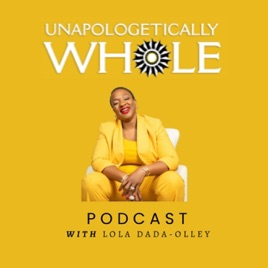
Unapologetically Whole

Advertise on podcast: Unapologetically Whole

Rating
★★★★★
5
from
37 reviews
This podcast has
78 episodes
Language
English
Explicit
No
Date created
2020/07/20
Latest episode
2026/01/29
Average duration
35 min.
Release period
36 days

Description

Unapologetically Whole is the podcast for anyone who’s ever felt invisible while holding everyone else together. Hosted by attorney, advocate, and lifelong caregiver Lola Dada-Olley, this show is a raw, honest invitation to reclaim your story and rebuild your sense of self without abandoning your responsibilities or values. Through deeply personal storytelling and candid conversations, Lola explores the layers we carry: as caregivers, professionals, parents, partners, and cycle-breakers navigating cultural stigma, trauma, and the pursuit of wholeness in a world that often asks us to disappear.  Each episode offers a practical, three-part framework for transformation: Recognize the lane you’re in, Redefine success beyond external validation, and Reimagine what it means to truly thrive. You’ll hear real lessons from lived experience—how to hold the tension between vigilance and joy, how to honor incremental progress, and how to shine your light in a world that can feel dark. Whether you’re a caregiver, a leader, or simply someone searching for permission to exist beyond your roles, Unapologetically Whole bridges the gap between personal healing and professional reinvention, creating space for authentic community and honest growth.  This podcast is the companion to Lola’s forthcoming memoir, Unapologetically Whole: A Memoir About Autism, Caregiving, and Owning Your Story, coming June 2026. If these conversations resonate with you, help us extend the reach—subscribe, share with a friend, and leave a rating or review. Your voice helps others find the hope, healing, and wholeness they deserve.

Unlock Unapologetically Whole podcast Email contact info,
Listeners & Audience details

Email contact information

Direct podcast contact details

Listeners

Audience numbers & engagement insights

Audience details

Podcast Insights

Podcast episodes

Check latest episodes from Unapologetically Whole podcast


Owning Your Story: A Short Reflection with Lola
2026/01/29
Send us a text In this episode of Unapologetically Whole, Lola Dada-Olley shares her personal journey of self-advocacy and wholeness, exploring themes of identity, caregiving, and resilience. Through intimate reflections and powerful storytelling, she encourages listeners to own their stories and advocate for themselves with intention and courage. Takeaways: Your story matters and deserves to be told.Self-advocacy is a muscle that grows with use.Wholeness is the integration of all parts of your story.Perfection is not the goal; wholeness is.Guilt can be a barrier to healing.Healing begins when you stop negotiating with guilt.Self-advocacy starts with small steps like asking for help.You are worthy of the life you are building.The world needs you whole, not perfect.Embrace the journey of self-discovery and growth.Sound bites: Your story matters.Self-advocacy is a muscle.Wholeness is integration.Perfection was never the assignment.Guilt is a barrier.Healing begins with acceptance.Ask for help.You are worthy.The world needs you whole.Embrace your journey.Chapters: Introduction to Unapologetically Whole The Journey of Self-Advocacy Embracing Wholeness Overcoming Guilt and HealingEmpowerment and Personal GrowthSupport the show www.loladadaolley.com
The Non-Linear Journey to Healing: A Talk with Author and Self Advocate Lisa Hurley
2026/01/15
Send us a text Summary In this conversation, Lisa Hurley and Lola Dada-Olley explore the complexities of healing, emphasizing that it is a non-linear journey filled with ups and downs. They discuss the importance of embracing stillness and practicing gratitude as essential components of emotional well-being. Takeaways Healing is definitely not linear.Sometimes healing can feel like it's going up and down.Periods of stillness are important in the healing process.Trusting stillness is crucial to avoid anxiety about the future.Introspection plays a vital role in personal growth.Expressing gratitude can enhance emotional well-being.There is always something to be grateful for, even in tough times.Healing requires patience and self-compassion.The journey of healing is unique for everyone.Embracing the journey can lead to deeper understanding.Unapologetically Whole is a podcast for people who have spent years giving themselves away—to caregiving, culture, or career—and are finally ready to reclaim their voice. Hosted by attorney, author, TEDx speaker, and lifelong caregiver Lola Dada‑Olley, the show explores identity, healing, neurodiversity, cultural stigma, and the quiet work of rebuilding yourself after burnout. Lola draws from her lived experience as an attorney, a mother of two autistic children, the older sister of an autistic, intellectually disabled adult, and the former host of Not Your Mama’s Autism. She also serves as Lead ADA Counsel for a global banking institution and appears with her family in the Vox Media documentary Sensory Overload on Hulu. Each episode blends storytelling, reflection, and honest conversation to help caregivers and other leaders recognize the lane they’re in, redefine success on their own terms, and reimagine what it means to thrive without disappearing. Learn more about Lola’s work and her upcoming memoir at loladadaolley.com, and join the newsletter to stay connected to the movement. Support the show www.loladadaolley.com
Goodbye Not Your Mama's Autism ... Hello Unapologetically Whole
2026/01/14
Send us a text Not Your Mama’s Autism had its finale episode in December 2025. Unapologetically Whole is the dawn of a new podcast, guided by the same host, Lola Dada‑Olley, but shaped by a deeper, more expansive mission. After five years of honest conversations about disability, culture, and family, Lola is stepping into a new season, one that honors where she’s been while widening the lens to include every woman who has ever disappeared in service to others. This trailer marks the bridge between two eras: the close of a beloved community built around autism storytelling, and the beginning of a movement centered on identity, healing, and wholeness. Lola brings with her the same lived experience—attorney, author, TEDx speaker, lifelong caregiver, mother of two autistic children, and older sister to an autistic, intellectually disabled adult, but now she’s inviting listeners into a broader conversation about what it means to reclaim yourself after years of giving yourself away. Unapologetically Whole explores the quiet, courageous work of rebuilding your sense of self while still showing up for the people you love. Through storytelling, reflection, and deeply human conversations, Lola offers a space for women navigating caregiving, cultural expectations, career reinvention, and the emotional weight of being everything to everyone. It’s a podcast about choosing yourself without abandoning your responsibilities and learning that devotion does not require disappearance. As this new chapter begins, the heart of Not Your Mama’s Autism lives on, expanded and reimagined. If you’ve ever felt unseen, stretched thin, or unsure where you end and your roles begin, this next season is for you. Welcome to Unapologetically Whole—a home for women ready to reclaim their voice, redefine success, and reimagine what it means to thrive. Support the show www.loladadaolley.com
The Power of Self-Awareness and Self-Acceptance: A Talk with Author and Self-Advocate Lisa Hurley
2025/12/15
Send us a text Summary This conversation explores the complexities of neurodiversity, particularly autism, within the Caribbean context. Lisa Hurley reflects on her personal experiences growing up in a society that lacks awareness and understanding of neurodivergence. She discusses the cultural perceptions of autism, the challenges faced by individuals who do not fit the stereotypical image of autism, and the need for greater visibility and acceptance. Takeaways Cultural perceptions shape the understanding of autism.There is a lack of awareness about neurodiversity.Expectations of presentation can exclude many individuals.Visibility is crucial for acceptance of neurodiversity.Challenging stereotypes is necessary for broader understanding.Personal experiences highlight systemic issues in society. Sound Bites "I've known from childhood that I was different." "We're not talking about neurodivergence." "People who look like us are not even considered." Where to find Lisa Hurley: The Great Exhale Support the show www.loladadaolley.com
On The Road To Wholeness, A Family Episode
2025/12/10
Send us a text In this heartfelt episode, Lola Dada-Olley and Tosan Olley reflect on their journey through autism advocacy, sharing insights from their experiences over the past five years. They discuss the universality of autism, the power of storytelling, and the importance of embracing wholeness while breaking generational cycles. The conversation highlights the intersections of race, disability, and neurodivergence, and sets the stage for their transition to a new podcast identity, 'Unapologetically Whole.' Takeaways The podcast has been a platform for sharing our family's journey with autism.The universality of autism transcends geography and culture.Sharing our story has allowed others to feel seen and understood.The richness of humanity is reflected in the diverse stories shared on the podcast.Embracing wholeness means acknowledging both joy and pain in our lives.Breaking generational cycles is essential for healing and growth.The intersection of race and disability shapes unique experiences.The transition to 'Unapologetically Whole' signifies a new chapter in advocacy.Gratitude for the community that has supported our journey.The evolution of our understanding of success and thriving. Chapters 00:00 Reflecting on a Journey of Autism Advocacy 03:05 The Universality of Autism and Its Impact 06:03 The Power of Sharing Stories 08:56 Embracing Wholeness and Breaking Generational Cycles 11:54 The Intersection of Race, Disability, and Neurodivergence 14:58 Transitioning to Unapologetically Whole 18:00 Gratitude and Looking Forward Support the show www.loladadaolley.com
Navigating Transitions in Family Life
2025/08/27
Send us a text SUMMARY In this episode of Not Your Mama's Autism Podcast, hosts Lola and Tosan Olley discuss the various transitions their family is experiencing, including changes in their children's education, their own career roles, and the impact of policy changes on caregiving. They reflect on the importance of community support, self-care, and the lessons learned from navigating these transitions. The conversation also touches on their shift from audio storytelling to a visual medium, emphasizing the power of sharing their journey to foster understanding and connection. Takeaways Transitions are a recurring theme in family life.Policy changes can significantly impact caregiving responsibilities.Community support is essential during transitions.Self-care is crucial for managing stress and responsibilities.Laughter can be a powerful tool for coping.It's important to give yourself grace during difficult times.Time is finite; prioritize what truly matters.Creative outlets can help reconnect with oneself.Navigating transitions requires flexibility and adaptability.Lessons learned from past experiences can guide future decisions. Support the show www.loladadaolley.com
Sensory Overload: A Talk with The Filmmakers of the Hulu Documentary
2025/05/17
Send us a text In this episode, we discuss Sensory Overload, a film about how three communitiesnavigate oral care and the world in general with sensory sensitivities in mind.It's also a film about neurodivergence, sensory differences, and how the worldcan be better designed to accommodate people. It's a Vox Media produced film in partnership withHaleon and Sensodyne as part of Sensodyne's Sensory Inclusion Initiative, amission to build better sensory inclusion in oral care.  This episode features Executive Producer Samantha Knowles, Director and Head of Content at Vox Creative Kiana Moore, and Producer Dylan Lenze. They all discuss their journey into storytelling, the filmmaking process, and the importance of representing neurodivergent communities. They share insights on the challenges and joys of documentary filmmaking, the emotional resonance of storytelling, and the significance of creating safe spaces for participants. The conversation highlights the interconnectedness of diverse stories and the personal reflections of the filmmakers on their own neurodivergent experiences. The documentary is currently streaming on Hulu.  Takeaways The documentary 'Sensory Overload' focuses on sensory sensitivities in oral care.Filmmakers share their personal journeys into storytelling.Documentary filmmaking involves preparation but requires adaptability.Creating a safe filming environment is crucial for participants.Editing is an iterative process that emphasizes emotional resonance.Diverse stories can connect through shared experiences of neurodivergence.Personal reflections on neurodivergence enrich the storytelling process.Knowing when to let go of a project is part of the creative process.The film aims to spark positive conversations about neurodivergence.Storytelling has the power to make individuals feel seen and heard. Support the show www.loladadaolley.com
Better Understanding Challenging Behavior: A Talk with Larissa Heise, BCBA
2025/04/01
Send us a text Summary In this episode of Not Your Mama's Autism, host Lola Dada-Olley speaks with licensed social worker and BCBA Larissa Heise about the complexities of challenging behavior in neurodivergent individuals. They discuss the definition of challenging behavior, trends observed in recent years, the importance of identifying triggers, and the role of sensory needs. Larissa emphasizes the need for individualized approaches to support, the common misconceptions surrounding challenging behavior, and the importance of understanding the full context before implementing interventions. The conversation also covers strategies for navigating support systems and the significance of insurance in accessing professional help. Takeaways Challenging behavior varies in definition and context.Challenging behavior often exceeds a family's ability to support.Safety concerns are a primary focus in identifying challenging behavior.Attention-seeking behavior is often misunderstood; it is about connection.Sensory needs can become more complex as individuals grow older.Understanding individual needs is crucial for effective support.Misconceptions about challenging behavior can lead to ineffective interventions.Gradual approaches are necessary for managing triggers and interventions.Reassessing strategies is important when previous methods stop working.Navigating insurance and support systems is essential for accessing help. Chapters 00:00 Understanding Challenging Behavior 02:59 Trends in Challenging Behavior 06:06 Identifying Triggers 09:06 Complex Sensory Needs 12:00 Misconceptions About Challenging Behavior 15:05 Approaching Triggers and Interventions 19:04 Reassessing Strategies 24:03 Navigating Support Systems 35:55 Getting Started with Professional Help Transcript  Lola Dada-Olley (00:02.364) Larissa Heise, thank you. Thank you for being on the Not Your Mama's Autism podcast today. Larissa Heise (00:10.317) Thank you for having me. Lola Dada-Olley (00:13.148) So you are a licensed social worker. You are also a BCBA for those listening who don't understand what that acronym means. In these neurodivergent streets, it means board certified behavioral analyst. I am going to really enjoy this episode talking to you about behavior. So let's talk about challenging behavior. But before we do so, let's do some level setting. Because challenging behavior means different things to different people. So what would you identify as a challenging behavior? Larissa Heise (00:57.485) I'm going to give you my personal definition and then I'm going to give you like what I think out in the world people are like generally having consensus on. Given the work that I do, I work a lot with family, families and very, a very parent centered model of support in the work that we do and some of the programs I supervise, very unique programs actually compared to maybe some other providers who are very family centric kind of approach to treatment. I look at challenging behavior as being something that exceeds the family's ability to support. And that can mean different things for different people. I'v Support the show www.loladadaolley.com
Creating Cultures of Neuroinclusion: A Talk with Dr. Theresa Haskins
2025/03/01
Send us a text Summary Dr. Theresa Haskins, a professor, researcher, consultant, corporate executive, mom, wife, and advocate, joins the podcast. She shares her journey as an advocate for her children and a self-advocate. Dr. Haskins discusses the diagnosis process for her children and the challenges they faced. She also talks about her experience studying educational psychology and getting her PhD in education. She emphasizes the importance of choice and autonomy in education and the need for inclusive and differentiated learning approaches. Neuroinclusion means creating environments that respect and accept differences in how individuals engage, communicate, and interact with each other. It involves allowing multiple realities and ways of being to coexist without judgment or the need to change others. To achieve neuroinclusion, it is important to start young by building cultures of inclusion in schools and teaching children to respect and value diversity. Additionally, workplaces should prioritize neuroinclusion by creating equitable opportunities for neurodivergent individuals and allowing all employees to be their authentic selves. Neuroinclusion benefits everyone by fostering authenticity and creating a more accepting and inclusive society. Keywords advocate, diagnosis, children, educational psychology, PhD, choice, autonomy, inclusive education, differentiated learning, neuroinclusion, differences, respect, acceptance, diversity, inclusion, communication, engagement, authenticity, workplace, education Takeaways Dr. Theresa Haskins is an advocate for her children and a self-advocate. She shares her experience with the diagnosis process for her children and the challenges they faced. Studying educational psychology and getting her PhD in education taught her the importance of choice and autonomy in education. Dr. Haskins emphasizes the need for inclusive and differentiated learning approaches. Neuroinclusion means respecting and accepting differences in how individuals engage, communicate, and interact with each other. Starting young by building cultures of inclusion in schools is crucial for promoting neuroinclusion. Workplaces should prioritize neuroinclusion by creating equitable opportunities and allowing all employees to be their authentic selves. Neuroinclusion benefits everyone by fostering authenticity and creating a more accepting and inclusive society. Chapters 00:00 Introduction and Background 04:16 Discovering Giftedness 08:04 The Importance of Choice and Autonomy in Education 27:36 The Impact of Psychological Safety on Autistic Inclusion 32:20 Increasing Empathy for More Inclusive Classrooms and Workplaces 36:25 Corporations vs. Classrooms: The Inclusiveness Divide 41:29 The Human Nature of Dividing and the Need for Neuroinclusion 43:31 Defining Neuroinclusion: Acceptance and Respect for Differences 45:18 Unconscious Bias and the Importance of Neuroinclusion 47:58 Neuroinclusion in the Workplace: Authenticity and Equitable Opportunities TRANSCRIPT Lola (00:02) Hello, welcome. Welcome to the Not Your Mama's Autism podcast. I'm Lola Dada -Olley On the podcast today, we have within our midst, Dr. Theresa Haskins, Support the show www.loladadaolley.com
Serving Families in Crisis: A Conversation with Breanna Kelly-Higgs LCSW, BCBA
2025/02/01
Send us a text Summary Breanna Kelly, a licensed social worker and BCBA, shares her journey into the field of autism and her passion for supporting individuals with co-occurring conditions. She emphasizes the importance of understanding and acknowledging the experiences and needs of individuals with disabilities, as well as the significance of cultural competence in providing effective care. Breanna discusses the challenges within the medical system and the need for collaboration and holistic approaches to support individuals with autism and mental health needs. She also highlights the importance of caregiver training and empowerment. Overall, Breanna advocates for systemic changes and increased resources to improve the lives of individuals with autism and co-occurring conditions. Takeaways Understanding and acknowledging the experiences and needs of individuals with disabilities is crucial in providing effective care. Cultural competence and relevance are important in supporting individuals from diverse backgrounds. The medical system needs reform to better support individuals with co-occurring conditions. Caregiver training and empowerment are essential in helping families navigate the challenges of raising a child with autism. Collaboration and holistic approaches are needed to provide comprehensive care for individuals with autism and mental health needs. Increased resources and systemic changes are necessary to improve the lives of individuals with autism and co-occurring conditions. Chapters 00:00 Introduction and Background 02:01 Personal Connection and Early Experiences 08:49 Challenges within the Medical System 12:02 Cultural Competence and Trauma-Informed Care 19:00 Empowering Caregivers through Training 23:33 Meeting Caregivers Where They Are 30:16 Supporting Families and Building Relationships 34:05 Reforming the Medical System 41:38 Connecting with Others and Finding Resources Transcript Lola Dada-Olley (00:02) Brianna Kelly, thank you. Thank you so much for visiting us today on the Not Your Mama's Autism Podcast. Breanna (00:11) Thank you for having me. I'm excited. Lola Dada-Olley (00:16) Me too, me too. I just know you're going to drop the nuggets. The nuggets shall have nuggets. So with that in mind, let's learn a little bit more about you. So you are a true multi -hyphenate. You are a licensed social worker. You're a BCBA. Those not familiar with the term, board certified behavior analyst, and the owner in your spare time of synergy behavioral consulting. Synergy behavioral consulting. But before we get to all these wonderful things, like what you're currently doing now, let's start, let's go back a little bit. Let's start from the beginning. What made you enter this field? Like, do you have a personal connection? Breanna (00:46) Yeah. So it goes back to the early 2000s. And so I was in high school and a freshman in high school actually, and I got invited over to this party that this Christian club was having at my school. And it was at an attached school, which I now know was an alterna Support the show www.loladadaolley.com
Access to Reproductive Health Care: Autism and Intellectual Disability Edition
2025/01/01
Send us a text Summary In this episode of Not Your Mama's Autism podcast, Lola Dada-Olley and her husband, Tosan Olley, discuss the complexities of navigating reproductive healthcare for their daughter, who is on the autism spectrum. They share their journey from recognizing the onset of puberty to preparing for their daughter's first period, emphasizing the importance of communication, family support, and collaboration with healthcare providers. The couple reflects on the emotional challenges and milestones they encountered, as well as the long-term considerations for their daughter's reproductive health. Takeaways Navigating reproductive healthcare is crucial for children with autism.Communication about puberty can be challenging but necessary.Dads play an important role in discussions about reproductive health.Preparation for menstruation involves multiple therapy disciplines.Understanding sensory challenges is key in healthcare planning.Access to reproductive healthcare can significantly impact quality of life.Long-term planning is essential for children with special needs.Collaboration with healthcare providers is vital for effective care.Celebrating milestones is important in the parenting journey.Pre-decisioning helps in managing future healthcare needs. Chapters 00:00 Navigating Reproductive Healthcare for Our Daughter 02:51 Understanding Puberty and Its Implications 11:10 Preparing for the First Period 16:25 The Day It Happened 20:14 Long-Term Considerations for Reproductive Health 25:03 Celebrating Milestones and Future Planning Transcript Lola Dada-Olley (00:01.395) Welcome, welcome everyone to the Not Your Mama's Autism podcast. I am back yet again with the hubster, the hubby, Tosan Olley. We are talking about a not so light topic about our daughter's reproductive healthcare and the decisions we are starting to make for her in hopes of her living the highest quality of life possible. For those new to the podcast, we have an 11 -year -old daughter who's minimally verbal, on the autism spectrum, and intellectually disabled. So, this episode will walk through some traditionally seen as uncomfortable topics, things like periods, things like cramps. things like talking it through as a family for a child who has communication challenges. This is naturally a difficult conversation, whether or not your child can traditionally communicate or not. So, our daughter has a history of some sensory challenges associated with the way her autism manifests. So, once she turned 10, And we knew that that next phase was right around the corner. We had to really sit down and think about the type of options she would have, not only based on her autism, but quite frankly, based on her family history that we know of at least when it comes to reproductive health, our family on my side, at least part of my side of the family, we've had a history of fibroids, PCOS, difficult periods. how could that potentially look in a growing child who will one day become a young woman who may not be able to communicate things like pa Support the show www.loladadaolley.com
Advocacy in Action: A Talk with Ms. Texas 2024 Annette Addo-Yobo
2024/12/11
Send us a text In this episode of Not Your Mama's Autism Podcast, host Lola Dada-Olley speaks with Annette Addo-Yobo, the first immigrant-born Miss Texas, about her journey from Ghana to the U.S., her advocacy for autism awareness, and the importance of representation. Annette shares her personal experiences as a sibling caregiver, the cultural stigma surrounding autism, and her aspirations to influence policy and support families navigating the challenges of autism. The conversation highlights the need for better resources, early intervention, and community support for families affected by autism. Takeaways Annette's journey from Ghana to becoming Miss Texas is inspiring.Representation in media and pageantry is crucial for marginalized communities.Cultural stigma around autism can hinder family support and understanding.Advocacy is a lifelong commitment, often born from personal experiences.The SPAR Project aims to bridge gaps in autism awareness and resources.Parentification can significantly impact the identity of sibling caregivers.Mental health support is essential for caregivers navigating their roles.Early intervention can change the trajectory of a child's development.Advocacy in Washington, D.C. can lead to meaningful policy changes.Community support is vital for families affected by autism. Support the show www.loladadaolley.com
Navigating the High School Transition: A Talk With My Son
2024/11/26
Send us a text In this episode of Not Your Mama's Autism podcast, host Lola Dada-Olley engages her son Fela in a heartfelt discussion about the transition from middle school to high school. They explore the various high school options available, the importance of extracurricular activities like band, and the challenges that come with academic rigor. Fela shares his personal experiences and offers advice to other students facing similar transitions, emphasizing the importance of hard work and resilience. The conversation highlights the growth and development that comes with navigating educational choices and personal interests. Takeaways Choosing high schools is a significant decision for students.Middle school serves as a preparatory phase for high school.Extracurricular activities play a crucial role in student life.Students should consider their interests when selecting a high school.Academic rigor is important, but students should not fear challenges.Transitioning can be daunting, but support from family helps.It's normal to have concerns about moving to high school.Students should embrace hard work as part of their education.Making new friends is a key aspect of transitioning to high school.Reflecting on past experiences can provide valuable insights for future transitions. Support the show www.loladadaolley.com
Workplace Neuroinclusion Strategy: Some Lessons Learned
2024/10/07
Send us a text In this episode of Not Your Mama's Autism podcast, LolaDada-Olley interviews Danielle Meadows, an executive director at JPMorganChase, about the importance of disability employment and the initiatives takenby the Business Solution Team (BEST) to promote neuro-inclusion. They discussthe evolution of the BEST program, common misconceptions about disabilityinclusion, the challenges faced in the employment landscape, and thesignificance of public policy in supporting individuals with disabilities. Theconversation highlights the success stories of employees and the role of jobcoaches in fostering an inclusive work environment. Takeaways Disability Employment Awareness Month is crucial for promoting inclusion.The BEST program focuses on neuro-inclusion strategies globally.Misconceptions about disability often hinder employment opportunities.Transportation remains a significant barrier for individuals with disabilities.Public policy needs to adapt to support working individuals with disabilities.Job coaching is essential for success in the workplace.Collaboration among organizations enhances disability employment efforts.Recognition from institutions like the UN validates the program's success.Success stories demonstrate the potential of individuals with disabilities.The program has grown significantly since its inception in 2019. Chapters   00:00 Introduction to Disability Employment Awareness Month 05:11 Misconceptions About Disability Inclusion 09:29 Recognition and Growth of the BEST Program 12:33 Challenges in Disability Employment 17:26 The Importance of Public Policy 21:46 The Role of Job Coaches 26:54 Success Stories and Business Outcomes Support the show www.loladadaolley.com
Reintegrating Our Daughter Into School Life
2024/09/24
Send us a text In this episode, Lola Dada-Olley and her husband Tosan discuss their journey with their daughter Alero, who is on the autism spectrum.They share their decision-making process regarding Alero's education, includingthe challenges of navigating special education services, the impact of thepandemic, and the importance of adaptability in parenting. They reflect ontheir choice to temporarily withdraw Alero from school for therapy and thesubsequent decision to reintegrate her into a supportive school environment.The couple emphasizes the significance of building a supportive community andlearning from others' experiences in similar situations. Support the show www.loladadaolley.com

Podcast reviews

Read Unapologetically Whole podcast reviews


5 out of 5
37 reviews
★★★★★
Sika A 2023/01/04
Most peaceful Autism Podcast
As a newly diagnosed autism mom.I scrambled to find content I could relate with.NYMA was that podcast for me. Listens from episode 1 n it was as if Lo...
★★★★★
Katiemae73 2021/07/23
Blessed
This was so great to listen to. As a mother of a child with mental health issues and a grandmother to one as well. This blessed me in a way I can’t de...
★★★★★
EmilyWNYC 2021/06/10
Incredible Podcast
Not Your Mama's Autism is one of my favorite podcasts! I've thoroughly enjoyed learning from this inspiring family. The storytelling is phenomenal a...
★★★★★
CKHeasley 2021/04/12
Thank you
Thank you for sharing the story of you and your family. It’s been an insightful journey listening to the lessons, challenges, and triumphs your family...
★★★★★
OmoObaT 2021/02/12
Informative and Inspiring!
Thanks Queen for putting this podcast show together to talk about your journey and provide great tips and support with wonderful subject matter expert...
★★★★★
neuuogi 2020/10/14
Highly recommend
I love everything about this podcast. Your soothing voice and ability to captivate is with your story and facts. My heart feels with love for kunle, F...
★★★★★
Can't Stop the Shop 2020/09/11
Sharing the Love
Thanks for sharing your life in such a deep and colorful way.
★★★★★
Alewat 2020/09/03
Amazing insight
This us a beautifully told story. The openness, warmth and vulnerability drew me in. It truly has given me a better appreciation for families with a l...
★★★★★
CMOS 2020/08/04
Great podcast
I listened to the first episode and very grateful to this lady for opening up on the autism world and her family experiences. This is something that ...
★★★★★
The Only Blue 2020/08/04
Engaging
Great introduction, well spoken and heartfelt. Thank you for opening up and sharing your journey. 🦋
check all reviews on apple podcasts

Podcast sponsorship advertising

Start advertising on Unapologetically Whole relevant audience podcasts


What do you want to promote?