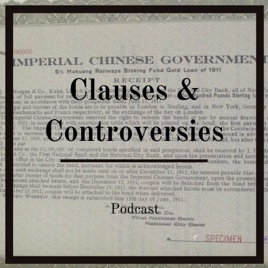
Advertise on podcast: Clauses & Controversies
Rating
4.9from
This podcast has
181 episodes
Language
EnglishPublisher
Mitu Gulati & Mark WeidemaierExplicit
No
Date created
2020/08/18
Latest episode
2026/09/14
Average duration
37 min.
Release period
19 days
Description
Clauses and Controversies: A Podcast about International Finance, Contract Clauses and the Controversies Surrounding These Clauses
Unlock Clauses & Controversies podcast Email contact info,
Listeners & Audience details
Email contact information
Direct podcast contact details

Listeners
Audience numbers & engagement insights

Audience details
Podcast Insights

Podcast episodes
Check latest episodes from Clauses & Controversies podcast
Ep 181 - Are Sanctions on Venezuela Still Justified?
2026/09/14
Are Sanctions on Venezuela Still Justified?
The United States has had sanctions on Venezuela for many years now. The Executive Branch has broad authority to impose sanctions on foreign nations. Basically, there has to be a perception of some foreign threat to the security of the United States. But the main justification for sanctions now is that the Executive Branch wants to stop private creditors from getting their bite of Venezuelan oil assets in American courts. Can a threat produced by the American legal system be a foreign threat justifying sanctions? Seems a bit off, even when courts generally give broad deference to the executive branch on sanctions.
Producer: Leanna Doty
Ep 180 - Bonds Yields and Elections (ft. Layna Mosley)
2026/08/31
Bonds Yields and Elections
November is not that far away and the rates of U.S. Treasuries are rising. The Treasury Secretary is trying various strategies (perhaps, with November in mind) to juice the markets and get rates down, but they are not working all that well. What’s going on? What is the relationship between elections and treasury rates? We ask one of the leading experts in the world on this topic, Layna Mosley (who has a fabulous new paper on Brazil, elections and rates). Politicians (at least some of them) better watch out — winter is coming.
Producer: Leanna Doty
Ep 179 - Ethiopia’s Value Recovery Instruments
2026/08/03
Ethiopia’s Value Recovery Instruments
Value recovery instruments are a great idea in theory and a disaster in practice. The idea is to let investors share in the upside of a country’s recovery. But governments rarely want to pay and the instruments quickly migrate into the hands of investors with little stake in the recovery. Everyone involved looks to exploit loopholes. And since the instruments seemingly are drafted at the last minute, there are plenty of those. But maybe after several tries, Ethiopia has found a way to crack the code?
Producer: Leanna Doty
Ep 178 - $240 Billion?!
2026/07/13
$240 Billion?!
Venezuela's debt is purportedly $240 billion, larger than previous estimates by far. What gives? Is this a way to signal to investors that they should be prepared to take larger-than-expected haircuts? Or, maybe more likely, a signal that favored creditors — insiders? oil majors? — will have their claims inflated and thus can expect outsized recoveries? We probably won't know until the IMF completes its usual rigorous assessment of the country's debt and debt sustainability. Oh, wait...
Producer: Leanna Doty
Ep 177 - Is it Finally Time to Restructure Venezuela’s Debt?
2026/06/15
Is it Finally Time to Restructure Venezuela’s Debt?
Ever since Venezuela was allowed to hire advisors on its debt restructuring, rumors have been swirling about whether the restructuring might be attempted even before an IMF Debt Sustainability Analysis. Such a scenario is plausible, given the current context. But is it good for the Venezuelan people? Hell no. This is potentially going to be the most complicated debt restructuring in history. And it is going to be done without the involvement of the only competent institution (despite our frequent criticisms of it) in this space? In prior eras, we’d count on the US Treasury Department to insist on IMF oversight and active involvement. But can we count on that today?
Producer: Leanna Doty
Ep 176 - 1917 Tsarist Bonds
2026/06/01
1917 Tsarist Bonds
We know we promised to talk about Venezuela. But we got distracted by a filing in the district courts in DC. A claim for payment on Tsarist bonds from 1917, being made in 2026. How could we pass that up? We also confess to being intrigued that the lawyers for Russia have asked that the judge in DC — Judge Friedrich — give Rule 11 sanctions against the plaintiffs. There are clear potential barriers to this claim on the merits but asking for Rule 11 sanctions on this basis seems a bit rich. Plus, we love the resuscitation of old Tsarist or Imperial bonds.
Producer: Leanna Doty
Ep 175 - The Most Amazing Revolution
2026/05/18
The Most Amazing Revolution
In spring 1917, the United States government lent money to the new Provisional Government in Russia, which had promised both domestic reform and to maintain the fight against Germany. Within a few short months, the Bolsheviks took over and repudiated all prior international debt. Still unpaid, the loans have now been in default nearly 150 times longer than they were current. We have talked about these loans before, but not about the repeated attempts (in the 1930s and 1990s) to reach a settlement. Some of the loan proceeds went to efforts to keep the Bolsheviks from power? Did the succeeding governments have to repay those debts?
Producer: Leanna Doty
Ep 174 - Something Black in the Lentils
2026/05/11
Something Black in the Lentils:
We are back with our favorite type of podcast — speculation about legal implications built around facts that are constructed entirely from rumor and innuendo. Weird stuff is going on with the Senegalese yield curve. And we wonder whether the weirdness might relate to Senegal’s desire to avoid triggering margin calls on its TRS contracts (which we'd really like to see). If there is some jiggery pokery going on - perhaps with respect to auctions of the three-year maturity - is that bad faith? Possibly, maybe, kinda sorta. We aren't English lawyers. We're barely even lawyers. But maybe there is something strange afoot. Surely it will all soon be disclosed, especially if Senegal defaults and all these contracts go . . . well . . .
Producer: Leanna Doty
Ep 173 - Foreign Civil War Entanglements
2026/04/27
Foreign Civil War Entanglements
Over the years, the U.S. has supported the losing side in numerous foreign civil wars. It has emerged from these entanglements as both a debtor and a creditor. In each case, the U.S. government's formal position has been clear: the post-civil war government succeeds to the rights and obligations of the prior government. That is, the winning side must pay debts incurred by the prior government, and it may enforce rights that accrued to that government. The U.S. has consistently taken this position even when the rights and obligations at issue relate to its attempt to keep the winning side from attaining power (e.g., debts accrued in the context of arms sales to the U.S.-supported side). But pragmatically, the U.S. government's position has been more fluid, ranging from benign neglect (i.e., simply not asserting a claim to payment) to finding technical legal arguments to justify writing off a debt (e.g., deeming the debt uncollectible).
Producer: Leanna Doty
Ep 172 - If Only YPF’s Bylaws Had Been Governed by Texas Law
2026/04/13
If Only YPF’s Bylaws Had Been Governed by Texas Law
And… poof! The sound of a $16 billion judgment going up in smoke. We talk about the Second Circuit’s decision in the YPF case, which we read largely as a way to make an excessively large judgment disappear without ruling on any difficult (and recurring) issues of US law. YPF’s shareholders got screwed, but then again their rights were governed by Argentine law. Even in foreign courts, it is hard to win when the sovereign gets to set the rules. We also talk about those fun-lovin’ Texas legislators. Pardner, everything’s bigger in Texas. Except the pre-judgment interest rate. That there is just a whole lot smaller. Has been for 30 some years.
Producer: Leanna Doty
Ep 171 - The $500 Million American “Financial Aid” to China
2026/03/09
The $500 Million American “Financial Aid” to China
In 1942, the Americans provided $500 million in financial aid to Chiang Kai-shek’s Nationalist government in China. Described as a “financial counterpart” to Lend-Lease aid, the credit — intended to help stabilize the Chinese economy and support its war effort — did not provide for principal repayment, interest payments, or state a maturity. The apparent intent was to negotiate terms in a post-war settlement of accounts, when the parties could agree on the “benefits to be rendered the United States in return” for the credit. That agreement never happened and, as best we can tell, the status of the credit remains unclear. (Was it a loan? A conditional grant? If the latter, were the conditions fulfilled?) The US doesn’t seem to have ever asserted a right to collect, but we also haven’t seen anything formally relinquishing the potential claim or formally acknowledging the credit as a grant.
Producer: Leanna Doty
Ep 170 - Ethiopia and Senegal: Debt Shenanigans?
2026/02/23
Ethiopia and Senegal: Debt Shenanigans?
A set of recent articles in the FT by sovereign debt guru Joseph Cotterill suggest to us (reading between the lines) debt shenanigans in both Ethiopia and Senegal. We can’t figure out exactly what is going on in these two cases, but there is enough there for us to engage in wild speculation. In Ethiopia, the bondholders seem to be irate that some big player (aka China) is interfering with their deal and they are threatening to use. In Senegal, someone (aka BOAD?) is engaged in a moral hazard play by buying up gobs of local Senegalese debt; this, at a time when the international market has shut out Senegal thanks to disclosure shenanigans.
Producer: Leanna Doty
Ep 169 - Can We Say Anything Meaningful About a Venezuelan Debt Restructuring?
2026/02/02
Can We Say Anything Meaningful About a Venezuelan Debt Restructuring?
Venezuela must restructure its debt if it, and its new "friends" in Washington DC, want the economy humming again. But how? The debt stock is enormous and the range of claims so vast that normal techniques are unlikely to work. And typically, before anything could happen, the IMF would need to go in and assess the actual situation on the ground. All this takes time. But we imagine that the folks in Washington DC want to declare their adventure a success, and soon. Is that impulse consistent with an orderly, comprehensive debt restructuring? For that matter, what would a restructuring look like if we also assume that Washington wants to line its own pockets with Venezuelan oil revenues, and perhaps to give preferential treatment to oil major creditors (to entice them back into Venezuela)? We don’t have answers — but we suspect that those folks in DC don’t either.
Producer: Leanna Doty
Ep 168 - Are CACs Unilateral Modification Clauses?
2026/01/12
Are CACs Unilateral Modification Clauses?
We have always understood the collective action clause (CAC) in a sovereign bond to allow the bond issuer to propose a modification to the bond, which will bind everyone if approved by the requisite proportion of holders. Typically the sovereign is proposing to restructure its debt. This is more or less what bonds governed by NY law say, but bonds governed by English law appear to allow bondholders to gang together to modify the bond without the issuer's consent. Can that be right? We don't really think so, but we don't see anything in the text of the standard CAC in English law bonds that requires issuer consent. Imagine a Euro area issuer is nearing crisis and holders of its local law debt decide to switch their bonds to, say, English law. Can they do this unilaterally? Maybe so.
Producer: Leanna Doty
Ep 167 - Will the Flip Clause Enter the Canon?
2026/01/05
Will the Flip Clause Enter the Canon?
Contract innovation is rare in sovereign debt markets, so we are interested whenever someone adds a new clause to the existing set of canonical forms. A number of innovations have appeared in 2025, one of which is the "flip clause." The clause allows investors to opt out of the governing law and enforcement jurisdiction initially chosen in the debt instrument. We have some questions about the clause and doubt that in its current form it will gain widespread acceptance. Right now, it seems more symbol than substance — a way to metaphorically flip off the New York legislature.
Producer: Leanna Doty
Podcast sponsorship advertising
Start advertising on Clauses & Controversies relevant audience podcasts
You may also like to advertise on these Podcasts
4.712822542
True Crime All The Time
Emash Digital

4.8159901996
Watch What Crappens
Ben Mandelker & Ronnie Karam

4.638601153
Modern Wisdom
Chris Williamson

4.66158304
True Crime with Kendall Rae
Mile Higher Media & Audioboom Studios

4.73393774
The Ancients
History Hit

4.89065306
The Why Files: Operation Podcast
The Why Files: Operation Podcast

51088171
Middle Children
Jessie Jolles and Chris Burns
4.9264932000
Morning Wire
The Daily Wire
4.518760369
American Scandal
Audible

4.689261200
Get Sleepy: Sleep meditation and stories
Slumber Studios