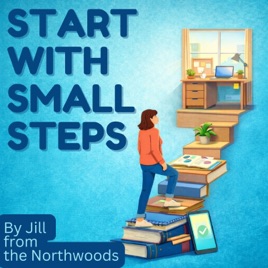
Advertise on podcast: Start with Small Steps
Rating
5from
This podcast has
301 episodes
Language
EnglishPublisher
Jill from The NorthwoodsExplicit
No
Date created
2020/09/11
Latest episode
2026/09/22
Average duration
17 min.
Release period
7 days
Description
Start With Small Steps is a practical, thoughtful podcast about making meaningful progress in everyday life—without overwhelm. Each episode breaks big ideas into small, manageable steps you can actually use, whether you’re working on habits, health, productivity, faith, or personal growth. Instead of chasing quick fixes or perfect systems, this podcast focuses on steady change, reflection, and realistic action. You’ll hear clear explanations, relatable examples, and simple frameworks designed to help you think better, choose wisely, and keep moving forward—even when life feels complicated or slow. Start With Small Steps is for anyone who wants growth that fits real life: small actions, honest reflection, and progress that lasts.
Unlock Start with Small Steps podcast Email contact info,
Listeners & Audience details
Email contact information
Direct podcast contact details

Listeners
Audience numbers & engagement insights

Audience details
Podcast Insights

Podcast episodes
Check latest episodes from Start with Small Steps podcast
The Calibration Friend: Who Do You Trust to Tell You the Truth?
2026/09/22
# The Calibration Friend Do you ever feel like you had to figure out everything alone? I did, and I built this whole podcast out of that feeling, one library book at a time. This episode kicks off a new series about the people who quietly filled in the gaps I didn't even know I had. **Where This Podcast Actually Started** Long before there was a show, there was a girl in a library trying to catch up on things everyone else seemed to already know. That habit of reading her way out of a gap, starting with *Your Erroneous Zones*, became the seed of Start with Small Steps. **The Unofficial Mentors** The people who helped weren't always family. They were teachers, neighbors, a friend's mom, a boss who gave an honest ten extra minutes. What made them safe wasn't that they had all the answers. It was that they never flinched at the question. **What a "Calibration Friend" Actually Is** A calibration friend is someone you can ask "is this normal?" and trust to give you a straight answer instead of a flattering one. Jill describes how one friend, met years ago playing video games, became exactly that person for both of them, right down to talking through retirement and a hard career decision. **Why Adulthood Makes This Harder** As a kid, proximity does the work of building trust. You're stuck with the same neighbors and classmates long enough to know who's safe. As an adult, those relationships have to be built on purpose, and it takes patience before you know who to trust with the embarrassing questions. **Asking Without Making It a Big Deal** The goal isn't to hand someone your whole life story to grade. It's learning to ask small, specific questions: is this normal, can I run something by you, am I overreacting? Trust gets built in those small moments, not the big dramatic ones. If you were raised with some gaps of your own, this is the first episode in a short series digging into where those gaps come from and how you close them without staying stuck blaming everyone who came before you. Who was your calibration friend? You can find everything I do at jillfromthenorthwoods.com, and you can reach me directly at [email protected]. --- **A note on this podcast:** I'm not a licensed therapist or life coach. This podcast shares one person's perspective on personal growth, not professional mental health advice. If you're struggling, please reach out to a licensed counselor, a doctor, or someone you trust. TIMESTAMPS 00:00 The feeling of learning everything alone 00:59 The mentors who never had the title 01:58 How this podcast actually started 02:26 Introducing the "calibration friend" 03:55 Using one to make a big career decision 05:27 Building trust as an adult, on purpose 06:45 Honesty over flattery 07:44 Learning to ask for help at all 09:13 What a calibration friend isn't 10:41 Closing thoughts and what's next
Jill’s Links
https://jillfromthenorthwoods.com/ - Find my podcasts, videos, downloads and ways to contact me
https://www.buymeacoffee.com/smallstepspod
https://x.com/NorthWoodsJill
https://www.youtube.com/@startwithsmallsteps
Email the podcast at [email protected]
By choosing to watch this video or listen to this podcast, you acknowledge that you are doing so of your own free will. The content shared here reflects personal experiences and opinions and is intended for informational and inspirational purposes only. I am not a licensed therapist, life coach, or mental health professional. Any habits, strategies, or suggestions offered should not be considered a substitute for professional medical, psychological, or counseling advice. Results vary — small steps look different for everyone. You are solely responsible for any decisions or actions you take based on this content.
The Shame Loop That Keeps You From Asking Questions
2026/09/15
Last episode we named the gaps, the things nobody ever taught you. This one is about what happens after you notice a gap: the shame loop that convinces you to stop asking, and why curiosity, not confidence, is actually the way out. IT STARTS WITH EMBARRASSMENT, NOT A FLAW Not knowing something everyone else seems to know isn't a character defect. It's just a gap. But the moment of realizing it usually comes with a flash of embarrassment that sets the whole loop in motion. THE FOUR-STEP SHAME LOOP You don't know something. You get embarrassed. You stop asking. And because you stopped asking, you now know even less than before, so the gap grows instead of closing. WHY "JUST BE CONFIDENT" IS BAD ADVICE Putting on a brave face doesn't close a knowledge gap, it just buries it deeper and makes it harder to admit later. Confidence as a mask tamps down the curiosity that would have actually solved the problem. CURIOSITY WORKS DIFFERENTLY THAN CONFIDENCE Confidence tries to convince yourself you already know. Curiosity just wants an answer. Genuine curiosity also tends to disarm the judgment you're bracing for, most people are relieved when someone else admits the same gap. FINDING YOUR PEOPLE Jill talks about finding a friend who'd also grown up without a lot of parental attention, and how figuring things out together, from Roth IRAs to grocery store cleaning products, turned into real progress instead of more shame. EVERYTHING IS FIGUREOUTABLE The move isn't a big confessional speech about your childhood. It's just getting the question out of your mouth, one small step at a time, starting exactly where you are. Pick one thing you've been avoiding asking about. That's this week's step. If this hit home, or if you broke out of a shame loop of your own, I'd love to hear about it. Email me at [email protected], or find everything at jillfromthenorthwoods.com.
Jill’s Links
https://jillfromthenorthwoods.com/ - Find my podcasts, videos, downloads and ways to contact me
https://www.buymeacoffee.com/smallstepspod
https://x.com/NorthWoodsJill
https://www.youtube.com/@startwithsmallsteps
Email the podcast at [email protected]
By choosing to watch this video or listen to this podcast, you acknowledge that you are doing so of your own free will. The content shared here reflects personal experiences and opinions and is intended for informational and inspirational purposes only. I am not a licensed therapist, life coach, or mental health professional. Any habits, strategies, or suggestions offered should not be considered a substitute for professional medical, psychological, or counseling advice. Results vary — small steps look different for everyone. You are solely responsible for any decisions or actions you take based on this content.
Gaps We Grew Up With: The Things Nobody Taught You
2026/09/08
I still remember not knowing how often you were supposed to wash your gym clothes, and genuinely believing I was the only kid in the building who didn't know. That gap, and a dozen others like it, is what kicks off this new series.
The Gym Clothes Problem
Some gaps in knowledge aren't about intelligence or effort. They're about information nobody ever handed you, and they tend to surface at the worst possible moment in front of the worst possible audience.
More Gaps Than You'd Expect
From restaurant menus to hotel etiquette to Roth IRAs and 401ks, these blank spots show up in places you wouldn't necessarily connect to childhood. They're mundane enough that most people absorb them without ever noticing they learned them.
Why These Gaps Happen
A household can look completely normal from the outside, bills paid, kids on the bus on time, while the adults inside are too consumed with their own problems to teach the basics. That was true in my own house growing up.
Closing a Gap in Real Time
During the pandemic, I taught myself how to clean a tankless water heater from a YouTube video, one paused step at a time, vinegar all over my basement. It's proof that closing these gaps doesn't require anyone watching or grading you.
Thee Question Worth Asking
Instead of asking what's wrong with me for not knowing something, the better question is what am I beginning right now. There's no finish line where everyone else already knows everything and you're behind on all of it.
This is the first episode in a short series about the gaps we grew up with, not to blame anyone, but to name what we're missing and start closing it, one small step at a time.
You can find everything I do at jillfromthenorthwoods.com, and you can reach me directly at [email protected].
Jill’s Links
https://jillfromthenorthwoods.com/ - Find my podcasts, videos, downloads and ways to contact me
https://www.buymeacoffee.com/smallstepspod
https://x.com/NorthWoodsJill
https://www.youtube.com/@startwithsmallsteps
Email the podcast at [email protected]
By choosing to watch this video or listen to this podcast, you acknowledge that you are doing so of your own free will. The content shared here reflects personal experiences and opinions and is intended for informational and inspirational purposes only. I am not a licensed therapist, life coach, or mental health professional. Any habits, strategies, or suggestions offered should not be considered a substitute for professional medical, psychological, or counseling advice. Results vary — small steps look different for everyone. You are solely responsible for any decisions or actions you take based on this content.
297 - Tools vs. Transformation: The Test I Run on Everything I Use
2026/09/01
I had this fantasy as a kid of a machine you could strap your arms into that would just do your bicep curls for you while you took a nap and still got fit. Obviously that’s ridiculous. But I realized recently I’d been making the exact same mistake in other parts of my life, just less obviously. This episode is about the difference between a tool that clears space for the work you want to do, and a tool that quietly convinces you the work already happened.
Two kinds of doing. There’s logistics work: remembering, scheduling, tracking. Auto pay, calendar reminders, task apps, these can fully take that kind of work off your plate and nothing is lost. Then there’s transformation work: writing, hard conversations, reps at the gym, building an actual habit. No tool can do that part for you, because the transformation IS the doing.
Where it gets tricky. When a logistics tool lifts a burden, it feels like relief, and it is. But sometimes we start expecting that same relief from tools that are supposed to support transformation, and we mistake the support for the transformation itself.
The e-bike test. Picture two commuters, one on a regular bike, one on an e-bike. Both arrive at work at the same time. Identical outcome, on paper. But if the goal underneath the commute was to get stronger or build cardio fitness, only the regular bike delivers that. The e-bike gets you somewhere, just not to the goal you actually wanted.
The GLP–1 example. I lost 80 pounds and gained 12 pounds of muscle using a GLP–1 medication alongside serious changes to how I ate and exercised. The medication quieted the constant hunger and gave me real breathing room. But breathing room isn’t the same as transformation. If someone takes the medication and never uses that space to rebuild their habits, the weight often comes back once they’re off it. The medication does exactly what it’s built to do. The mismatch is expecting it to do the part that only you can do.
The test to run on yourself. Ask honestly: is this tool clearing space and time so I can do the work, or is it quietly replacing the work in my head so I think I’m done? If it’s clearing space, lean on it, that’s what it’s for. If you catch yourself expecting it to pedal the bike for you, that’s your signal to take control back.
The takeaway: motion isn’t nothing, but motion isn’t everything either. Tools can clear the runway. At some point, you still have to fly.
One resource: James Clear’s Atomic Habits, on the difference between being in motion and taking action.
Jill’s Links
https://jillfromthenorthwoods.com/ - Find my podcasts, videos, downloads and ways to contact me
https://www.buymeacoffee.com/smallstepspod
https://x.com/NorthWoodsJill
https://www.youtube.com/@startwithsmallsteps
Email the podcast at [email protected]
By choosing to watch this video or listen to this podcast, you acknowledge that you are doing so of your own free will. The content shared here reflects personal experiences and opinions and is intended for informational and inspirational purposes only. I am not a licensed therapist, life coach, or mental health professional. Any habits, strategies, or suggestions offered should not be considered a substitute for professional medical, psychological, or counseling advice. Results vary — small steps look different for everyone. You are solely responsible for any decisions or actions you take based on this content.
296 - Nobody Is Guarding Your Time But You
2026/08/25
Who’s actually guarding your calendar right now — not who you wish would, but who actually does? In this episode of Start with Small Steps, I break down why nobody else is incentivized to protect your time, your family time, or your own personal goals, and what it actually looks like to hold that line yourself. This isn’t a boundaries pep talk. It’s a practical look at the specific fronts where your time gets taken without you noticing: work creeping into evenings, guilt-driven yeses, relationships that cost more than they give, and personal goals that quietly erode because nobody’s holding you accountable to them but you. I also talk through time-boxing as a way to actually know what you’re defending, and why saying “let me check and get back to you” is one of the most powerful small habits you can build. Timestamps: 00:00 Who’s actually guarding your time right now? 01:29 Why nobody else is going to protect it for you 05:26 The specific battlefronts: time, family, goals 06:26 When relationships cost more than they give 09:55 Jobs that eat everything 10:54 What defending your line actually looks like 16:21 Small step: name the line you’ll hold What’s one line in your own life that’s been getting crossed lately — is it a person, a job, or just a chunk of time?
Jill’s Links
https://jillfromthenorthwoods.com/ - Find my podcasts, videos, downloads and ways to contact me
https://www.buymeacoffee.com/smallstepspod
https://x.com/NorthWoodsJill
https://www.youtube.com/@startwithsmallsteps
Email the podcast at [email protected]
By choosing to watch this video or listen to this podcast, you acknowledge that you are doing so of your own free will. The content shared here reflects personal experiences and opinions and is intended for informational and inspirational purposes only. I am not a licensed therapist, life coach, or mental health professional. Any habits, strategies, or suggestions offered should not be considered a substitute for professional medical, psychological, or counseling advice. Results vary — small steps look different for everyone. You are solely responsible for any decisions or actions you take based on this content.
295 - Why Some People’s Lives Keep Getting Better and Others Don’t
2026/08/19
Have you ever noticed that some people’s lives just keep circling the same drain, the same money problems, the same blown-up relationships, year after year, while other people who started at the same place, sometimes with worse breaks, quietly get better and better? I dig into the difference this week, and it isn’t luck. It’s one simple, almost bumper-sticker principle that’s so easy to ignore we forget it exists most days: you reap what you sow. Whatever field you’re standing in right now, you planted it, even if what you planted was nothing at all.
The Principle Behind the Bumper Sticker
Galatians puts it plainly: whatever one sows, that he will also reap. Farmers have known it since the beginning of time. You don’t plant nothing and get something, and the parts of life we skip past most, tempers, marriages, bank accounts, work, all follow the same rule with total reliability.
The Timing Trap
The thing that trips almost everyone up is the gap between planting and harvest. Nobody plants a seed Monday and pulls up a plant Tuesday, but when nothing is visible yet, most people assume nothing is happening at all and give up right there.
Three Fields, Three Outcomes
I walk through the three fields most of us are tending right now: the field of anger, where small daily plantings like sarcasm and grudges grow fast like weeds; the empty field, where waiting for motivation or the right moment doesn’t keep things neutral, it drifts backward and grows weeds anyway; and the field of progress, the boring, unglamorous kind, a ten-minute walk, an honest apology, a dollar saved, that compounds into something unrecognizable over a season.
Small Seeds, Big Harvests
The size of the seed doesn’t match the size of the harvest. Mustard seeds grow into trees. It isn’t the size of the action that matters, it’s whether you plant anything at all, and that’s the lie that keeps so many of us paralyzed waiting for a big enough move to make.
Your One Small Step
This week, name one field, just one, and name one plant to get moving in it. Don’t try to fix ten things. If health is your field, what’s the one easy thing that gets you started? If it’s money, what’s the one thing you could give up and start saving instead?
If you’ve been standing in an empty field waiting for the right feeling or the right moment to show up first, this is your reminder that the waiting itself is the choice. Plant something small today, and let the season do the rest.
You can reach me anytime at [email protected], and you’ll find every way to connect at jillfromthenorthwoods.com.
Jill’s Links
https://jillfromthenorthwoods.com/ - Find my podcasts, videos, downloads and ways to contact me
https://www.buymeacoffee.com/smallstepspod
https://x.com/NorthWoodsJill
https://www.youtube.com/@startwithsmallsteps
Email the podcast at [email protected]
By choosing to watch this video or listen to this podcast, you acknowledge that you are doing so of your own free will. The content shared here reflects personal experiences and opinions and is intended for informational and inspirational purposes only. I am not a licensed therapist, life coach, or mental health professional. Any habits, strategies, or suggestions offered should not be considered a substitute for professional medical, psychological, or counseling advice. Results vary — small steps look different for everyone. You are solely responsible for any decisions or actions you take based on this content.
294 - Proving vs. Improving: Why They Aren’t the Same Thing
2026/08/11
What if every time you try to prove someone wrong about you, you actually reinforce the exact thing they doubted? That’s the trap at the center of this episode — the quiet difference between proving yourself and improving yourself, and why they can look identical from the outside while leading to completely different places.
Proving Is Reactive
Proving yourself is oriented around changing someone else’s opinion, not around actually doing the thing better. It’s loud, it needs an audience, and it leaves you tethered to someone else’s doubt — even after you’ve technically “won” the specific argument.
The Emotional Cost of an Audience of One
As long as your effort is aimed at someone else’s skepticism, that person is quietly steering your life — even if they never say another word about it. That’s an exhausting way to live that has nothing to do with how much real work you’re doing.
Why Proving Rarely Pays Off Anyway
People rarely update their opinion of you even after you prove them wrong once. If someone has decided you’re unreliable, one instance of follow-through won’t undo that — you can win the specific moment and still lose the larger war.
Improving Is Quiet and Compounding
Improving is measured against your own past self, not someone else’s expectations. It doesn’t need a witness, and it doesn’t evaporate the moment the doubter leaves the room — it just keeps compounding in the background.
The Diagnostic Question
When proving and improving start to blur together, ask: am I doing this because I genuinely want to get better, or because I want a specific person to think better of me? And: would I still do this if they never found out?
Some overlap between the two is fine — a system that helps you remember to take out the trash also happens to prove you’re reliable, and that’s not a problem. The point isn’t to never let anyone see your progress. It’s to make sure the work would still be worth doing even if no one ever noticed.
Standard Footer (reuse as-is — no need to re-read)
Website: jillfromthenorthwoods.com
Email: [email protected]
I’m Jill from the Northwoods — appreciate you being out there.
Jill’s Links
https://jillfromthenorthwoods.com/ - Find my podcasts, videos, downloads and ways to contact me
https://www.buymeacoffee.com/smallstepspod
https://x.com/NorthWoodsJill
https://www.youtube.com/@startwithsmallsteps
Email the podcast at [email protected]
By choosing to watch this video or listen to this podcast, you acknowledge that you are doing so of your own free will. The content shared here reflects personal experiences and opinions and is intended for informational and inspirational purposes only. I am not a licensed therapist, life coach, or mental health professional. Any habits, strategies, or suggestions offered should not be considered a substitute for professional medical, psychological, or counseling advice. Results vary — small steps look different for everyone. You are solely responsible for any decisions or actions you take based on this content.
293 - Why “Pretty Darn Good” Beats “Optimized”
2026/08/04
What is life if you’re not chasing something? That question runs through so much of modern productivity culture, and I got caught up in it myself — in my own career, I always needed the next title, the next promotion, the next thing. This episode makes the case for a different standard: not an optimized life, but a pretty darn good one. Not all-or-nothing. Piece by piece.
The Pretty Darn Good Job
The optimized version chases the next title, the next exit strategy, the constant hustle. The pretty darn good version pays fairly, doesn’t wreck your evenings, and leaves you liking who you are by Friday. That’s not settling — it’s what makes the rest of your life possible.
The Pretty Darn Good Home
Instead of a house that’s a perpetual renovation project chasing a magazine spread, a pretty darn good home is warm, lived-in, and comfortable enough that you’re not embarrassed to have someone over on a random Tuesday.
The Pretty Darn Good People
Optimized relationships treat people like a network to be leveled up. Pretty darn good relationships are the people you actually want at your table — imperfect, but the ones who make you happiest.
The Cost of the Extreme Version
A spectacular career can come at the expense of your health or your family — I’ve lived that trade-off myself. A “solidly good” life isn’t spectacular anywhere, but it’s steady everywhere, and that adds up to more than one blazing area surrounded by wreckage. I bring in Jim Carrey’s well-known 2005 comment about wishing everyone could get everything they dreamed of, just to see for themselves it isn’t the answer.
Being Fair to the Other Side
Hustle culture isn’t hollow — some people are genuinely wired for maximum drive, and real innovation gets built by people chasing extreme outcomes. The honest question isn’t whether to ever optimize, but which one lane in your life actually deserves that kind of attention right now.
The Complacency Trap
“Pretty darn good” can become a costume for avoidance if you’re not careful. The honest move is to check yourself: is this actually fine, or are you just scared to change it?
Three small steps this week: pick one lane that deserves real attention and name it. For everything else, ask honestly if it’s pretty darn good — and if it is, let yourself stop there. And check yourself on the complacency trap, because if something really does need to change, it’s worth the effort. If you want to go deeper, I mention the book 4,000 Weeks by Oliver Burkeman.
I’m Jill from the Northwoods. I recently switched my email — you can reach me now at [email protected], and find everything at jillfromthenorthwoods.com.
Jill’s Links
https://jillfromthenorthwoods.com/ - Find my podcasts, videos, downloads and ways to contact me
https://www.buymeacoffee.com/smallstepspod
https://x.com/NorthWoodsJill
https://www.youtube.com/@startwithsmallsteps
Email the podcast at [email protected]
By choosing to watch this video or listen to this podcast, you acknowledge that you are doing so of your own free will. The content shared here reflects personal experiences and opinions and is intended for informational and inspirational purposes only. I am not a licensed therapist, life coach, or mental health professional. Any habits, strategies, or suggestions offered should not be considered a substitute for professional medical, psychological, or counseling advice. Results vary — small steps look different for everyone. You are solely responsible for any decisions or actions you take based on this content.
292 - What My Childhood Taught My Nervous System
2026/07/28
Most conversations about hard childhoods stop at “it affected them as kids.” Almost nobody asks what happens after — because childhood doesn’t stay contained to childhood. It moves in with you as an adult, and it rarely announces itself when it shows up. In this episode, I walk through Adverse Childhood Experiences (ACEs): what the research actually found, how it showed up in my own life, and four practical starting points for anyone who recognizes themselves in this.
What ACEs Actually Are
In the 1990s, Kaiser Permanente and the CDC studied adults about specific categories of childhood hardship — abuse, neglect, and household dysfunction like addiction, untreated mental illness, or divorce. What they found wasn’t just emotional; it reshaped how researchers understood long-term physical health outcomes too.
How It Shows Up Decades Later
Higher rates of heart disease, chronic pain, weight and substance struggles — and a quieter pattern I know personally: being “braced for impact” even when nothing is actually wrong. I share how noticing this in my own stress data was the first real clue.
It’s Not a Life Sentence
A high ACE score doesn’t determine your future. The single biggest protective factor across every study was having just one steady, caring adult somewhere in the picture — and that changes the odds significantly.
Step 1: Name It
You can’t fix a reaction you haven’t identified. I walk through how naming a pattern (“I don’t trust the future”) is the first real step, not a reason to stay stuck in it.
Step 2: Your Body Remembers
Old alarm systems fire in new contexts — a late bill, an unexpected email — and recognizing that pattern is different from being ruled by it.
Step 3: Stability Is Not Wasted Effort
Rebuilding a calm, steady life as an adult recalibrates a nervous system that never had that as a baseline. It may take longer than it would for someone with a steady childhood, but it’s not out of reach.
Step 4: Everything Is Figureoutable
The bridge from naming the pattern to actually doing something about it — including the strange, personal story of how my own decades-long insomnia finally resolved.
If any part of this sounds like your own life, it’s not a life sentence — it’s information. Naming it and building stability from here is where the real change starts.
Recommended resource: The original ACE study questionnaire is short, self-scoring, and available online in about five minutes if you want a starting point.
Find every show I do at jillfromthenorthwoods.com.
This episode touches on childhood trauma and family dysfunction. If anything in it sounds like your own experience and it’s weighing on you right now, please consider reaching out to a mental health professional or a trusted person in your life for support.
Jill’s Links
https://jillfromthenorthwoods.com/ - Find my podcasts, videos, downloads and ways to contact me
https://www.buymeacoffee.com/smallstepspod
https://x.com/NorthWoodsJill
https://www.youtube.com/@startwithsmallsteps
Email the podcast at [email protected]
By choosing to watch this video or listen to this podcast, you acknowledge that you are doing so of your own free will. The content shared here reflects personal experiences and opinions and is intended for informational and inspirational purposes only. I am not a licensed therapist, life coach, or mental health professional. Any habits, strategies, or suggestions offered should not be considered a substitute for professional medical, psychological, or counseling advice. Results vary — small steps look different for everyone. You are solely responsible for any decisions or actions you take based on this content.
291 - The Habit That Looks Good But Quietly Takes Over
2026/07/21
I learned one of the most important lessons of my life from a video game — and it’s not the lesson you’d expect. It wasn’t that gaming is bad, or that hobbies are dangerous. It’s that something can be completely good at the start and still quietly ask for more than it should later on. This week I’m telling the EverQuest story I don’t tell very often, and the one sentence from a friend that changed how I evaluate everything I do with my time.
The Guild That Ran My Life
For nine years, I was deeply involved in a hardcore EverQuest raiding guild — the kind where raids couldn’t be paused, dinner waited, and sleep was optional. It wasn’t one dramatic decision that got me there. It was thousands of small ones, all pointing the same direction.
“You Used to Be Interested in So Many Things”
The moment that actually changed things wasn’t a health scare — it was one sentence from a friend who noticed my world had quietly gotten smaller. That line is the whole spine of this episode, and I still think about it years later.
Why Quitting Isn’t the Fix
When the pandemic hit, I almost walked right back into the same hole. What actually rescued me wasn’t willpower or cutting something out — it was adding something back in: a podcast, suggested almost as an afterthought by a friend.
The Question I Ask About Everything Now
I stopped asking whether a hobby is good or bad. I ask whether it’s making my world bigger or smaller. That single shift changed how I evaluate every commitment, project, and pastime I take on.
Four Questions to Find Your Own “EverQuest”
Instead of counting hours, I walk through four practical questions this episode — what’s quietly disappeared from your life, what hidden habits your favorite activity encourages, how to bring back one old interest at a time, and who to ask for an honest outside read on what you actually talk about most.
The goal was never to quit the things I love. I still play video games — they just fit inside my life now instead of running it. If you’ve ever wondered whether something you love has quietly taken over more room than it should, this episode is for you.
You can find everything I do at jillfromthenorthwoods.com. My email is [email protected].
Jill’s Links
http://jillfromthenorthwoods.com
https://www.youtube.com/@startwithsmallsteps
https://www.buymeacoffee.com/startwithsmallsteps
https://twitter.com/schmern
Email the podcast at [email protected]
By choosing to watch this video or listen to this podcast, you acknowledge that you are doing so of your own free will. The content shared here reflects personal experiences and opinions and is intended for informational and inspirational purposes only. I am not a licensed therapist, life coach, or mental health professional. Any habits, strategies, or suggestions offered should not be considered a substitute for professional medical, psychological, or counseling advice. Results vary — small steps look different for everyone. You are solely responsible for any decisions or actions you take based on this content.
290 - 7 Small Steps to Get Better at Small Talk
2026/07/14
Do you dread small talk, or are you the person who can strike up a conversation with a total stranger in the checkout line? Either way, this episode is for you. Small talk gets dismissed as fluff — empty chatter about the weather before the “real” conversation starts — but it’s actually doing something important: it’s the on-ramp to every deeper connection we have.
Why Small Talk Isn’t Pointless
Small talk is the bridge between “we’ve never met” and “we actually know each other.” Without it, you can’t get to the meaningful stuff — you have to test the water first, find shared ground, and build from there. Jill shares a story about a coworker who thought small talk was painful until she watched Jill use it to connect people at a conference in minutes.
It’s a Social Muscle
Like any skill, the more low-stakes small talk you practice, the more comfortable you get with conversation in general — and that skill transfers to networking, dating, and even hard family conversations. It also signals warmth and approachability, which matters more than we think in a season researchers are calling a loneliness epidemic.
Where It Shows Up in Real Life
Professional advancement often happens informally — in hallway chats and casual check-ins, not just performance reviews. In relationships, small talk is maintenance: couples who check in with “how was your day” tend to stay more connected than couples who only discuss logistics. And it turns out brief, friendly exchanges with strangers give real, measurable boosts to mood and confidence.
Seven Small Steps to Get Better at It
For anyone who feels like small talk doesn’t come naturally, Jill breaks it into concrete steps: lower the bar (nice weather today is a complete success), use the FORD method (Family, Occupation, Recreation, Dreams) when you’re stuck, comment instead of question, practice in low-stakes places, set tiny specific goals, let silence be okay, and exit gracefully.
Small talk isn’t shallow — it’s the quiet infrastructure of connection. It doesn’t ask you to become someone you’re not; it just asks for one small step, with one extra person, today.
Jill’s Links
http://jillfromthenorthwoods.com
https://www.youtube.com/@startwithsmallsteps
https://www.buymeacoffee.com/startwithsmallsteps
https://twitter.com/schmern
Email the podcast at [email protected]
By choosing to watch this video or listen to this podcast, you acknowledge that you are doing so of your own free will. The content shared here reflects personal experiences and opinions and is intended for informational and inspirational purposes only. I am not a licensed therapist, life coach, or mental health professional. Any habits, strategies, or suggestions offered should not be considered a substitute for professional medical, psychological, or counseling advice. Results vary — small steps look different for everyone. You are solely responsible for any decisions or actions you take based on this content.
289 - Why Neglected Things Don’t Just Stagnate,They Disappear
2026/07/07
“Ignore your teeth and they’ll go away.” It’s an old joke that isn’t really a joke — and today I’m using it as a doorway into something bigger: the idea that your life isn’t just built by what you add to it. It’s also shaped by what you quietly stop tending to.
Neglect Has a Direction. We tend to think of not doing something as a safe, neutral choice. It isn’t. Teeth are the clearest example because the consequence is physical and undeniable — skip the maintenance long enough, and the tooth is just gone. There’s no pause button.
The Brain Does This Too. I dig into synaptic pruning — the real neurological principle where your brain actively prunes connections you don’t use. I use my own experience losing touch with music appreciation after audiobooks and podcasts took over that mental space as a low-stakes example of something that happens in much higher-stakes places too: friendships, physical health, skills, faith.
The Tending Principle — Three Parts. First, neglect is not neutral; doing nothing is still a direction, and that direction is decay. Second, capacity is finite — every yes is a quiet no to something else, and you often don’t find out what you gave up until later. Third, some losses are recoverable and some aren’t (my running came back; my teeth never will), and the real skill is being humble enough to tell the difference.
It’s Not Just the Obvious Stuff. I walk through how this shows up in physical fitness, friendships that thin out from lack of contact rather than conflict, skills and identity, and even resilience — I noticed my own capacity for handling crisis softened once my life got quieter and I stopped needing it as often.
One Small Step. Take a general read of your life: does the actual shape of your time match the life you want? Then pick one thing — one relationship, one habit, one part of your health or your faith — that’s been quietly slipping, and give it a little bit of attention this week. You won’t get your whole life back at once, but you will get information, and that’s what lets you choose on purpose instead of finding out by accident.
Jill’s Links
http://jillfromthenorthwoods.com
https://www.youtube.com/@startwithsmallsteps
https://www.buymeacoffee.com/startwithsmallsteps
https://twitter.com/schmern
Email the podcast at [email protected]
By choosing to watch this video or listen to this podcast, you acknowledge that you are doing so of your own free will. The content shared here reflects personal experiences and opinions and is intended for informational and inspirational purposes only. I am not a licensed therapist, life coach, or mental health professional. Any habits, strategies, or suggestions offered should not be considered a substitute for professional medical, psychological, or counseling advice. Results vary — small steps look different for everyone. You are solely responsible for any decisions or actions you take based on this content.
288 - Stop Sitting on the Floor: The Hidden Cost of Avoidance
2026/06/30
You know what a five-minute task looks like when a kid doesn’t want to do it? An hour-long standoff. Socks on the floor. Full dramatic collapse. And the worst part is, that kid is also missing out on the thing they actually wanted to do — playtime they could have been having — because now they’re in a battle that didn’t need to happen.
Sound familiar? Because I do it too. Not on the floor, not with the socks, but the mechanism is exactly the same. And that’s what this episode is about.
Avoidance Isn’t Free. We think of avoidance as a break — a little breathing room before we tackle the hard thing. But what’s actually happening is we’re adding every undone task to a mental backpack we carry through the entire day. The gym you meant to hit. The email you’re dreading. The bill you keep not looking at. Each one is a background process running in your brain, quietly draining your energy and your focus, popping up with mild guilt every time it surfaces.
Two Versions of Your Day. I walk through what it actually looks like to compare the day where you do the planned thing first versus the day where you negotiate with yourself until 10pm. The first version is done and forgotten in 30 minutes. The second version haunts you all day and you probably still don’t do the thing.
The ADHD Layer. For those of us with ADHD, this pattern can run deeper — the executive function piece makes it genuinely harder to initiate tasks even when we want to do them. This isn’t laziness. But understanding the pattern is still the first step whether or not ADHD is part of your picture.
Mel Robbins and the 5-Second Rule. I’m not here to reinvent something that’s already been figured out. Mel Robbins cracked this one open with a beautifully simple move: when you feel the impulse to act, count backwards from five and go before your brain builds a case against it. It interrupts the internal committee meeting before the agenda even gets distributed.
Three Concrete Moves. Name it (you can’t change what you don’t see), shrink it (the first 30 seconds of a task, not the whole thing), and do the countdown. That’s it. You’re not building a system. You’re just deciding not to sit on the floor.
The real payoff isn’t productivity for its own sake. It’s the rest you’ve actually earned at the end of a day where you did the thing you said you were going to do.
Jill’s Links
http://jillfromthenorthwoods.com
https://www.youtube.com/@startwithsmallsteps
https://www.buymeacoffee.com/startwithsmallsteps
https://twitter.com/schmern
Email the podcast at [email protected]
By choosing to watch this video or listen to this podcast, you acknowledge that you are doing so of your own free will. The content shared here reflects personal experiences and opinions and is intended for informational and inspirational purposes only. I am not a licensed therapist, life coach, or mental health professional. Any habits, strategies, or suggestions offered should not be considered a substitute for professional medical, psychological, or counseling advice. Results vary — small steps look different for everyone. You are solely responsible for any decisions or actions you take based on this content.
287 - Stuck and Can’t Start? SPARK: A Motivation Framework for Brains That Won’t Cooperate
2026/06/23
I used to think something was wrong with me. I’d sit there knowing a task mattered — knowing it mattered yesterday, last week, last month — and still couldn’t get myself to move on it. For years I asked myself the wrong question: why isn’t this getting done? The better question, it turns out, is what does my brain actually need to get started? That question changed everything, and it’s where SPARK came from.
Story. I’m a story person. I don’t care that a bird exists — I care about the three hours I spent finding it. When I’m stuck on a task, I ask what’s interesting about it, not what needs to get done. Curiosity creates momentum that obligation never will.
Purpose. Abstract tasks mean nothing until there’s a real person on the other side of them. Whether it’s an IT ticket or a podcast episode that isn’t coming together, I think about who actually needs this and why — and the task shifts even though the work doesn’t.
Adventure. Not everything can be an adventure (folding laundry is still folding laundry), but a lot of tasks can become small experiments instead of obligations. Possibility is motivating in a way duty never is.
Reality. This one needs care, because it’s easy to slide from reality into fear. Fear says you’ll end up broken and miss out on life. Reality says every choice is a small vote for the future you’re building. I’d rather feed the tiger that’s still hiking at 80 than the one that isn’t.
Kickstart. Some days none of the above works. On those days, the only question that matters is: what’s the smallest next possible step? Mow the front yard, not the whole lawn. Put on your shoes, not your whole workout. Starting is the hard part — once you start, momentum tends to take over.
You don’t need all five letters every time. Pick whichever one fits the moment, and let it do its job. Most of us aren’t waking up already disciplined and on fire — and that’s not a flaw, that’s just being human.
If you’ve been stuck on something, I’d love to know which letter of SPARK actually got you moving. Email me at [email protected] or leave a comment — and until next time, keep taking those small steps.
Jill’s Links
http://jillfromthenorthwoods.com
https://www.youtube.com/@startwithsmallsteps
https://www.buymeacoffee.com/startwithsmallsteps
https://twitter.com/schmern
Email the podcast at [email protected]
By choosing to watch this video or listen to this podcast, you acknowledge that you are doing so of your own free will. The content shared here reflects personal experiences and opinions and is intended for informational and inspirational purposes only. I am not a licensed therapist, life coach, or mental health professional. Any habits, strategies, or suggestions offered should not be considered a substitute for professional medical, psychological, or counseling advice. Results vary — small steps look different for everyone. You are solely responsible for any decisions or actions you take based on this content.
286 - The Difference Between Modest and Invisible at Work
2026/06/16
I have played the performance review game for my entire career. And I have been playing it wrong.
Not wrong in the obvious way — I wasn’t making things up or padding my resume. I was doing something that felt like humility and was actually closer to inaccuracy: describing real, significant work in the smallest possible terms, handing my manager a vague document, and then wondering why I didn’t feel seen.
This episode is about the game underneath the game. Because most of us think performance reviews are a documentation exercise — write down what you did, your manager writes down what they thought you did, everyone signs off, and you move on. That’s the surface layer. What’s actually happening is that your manager is taking your self-evaluation into a room full of other managers and using it as a brief to advocate for you. Or not.
The calibration room you don’t know about
In most organizations, managers sit together and compare their teams. Not résumés — narratives. Whoever’s story is clearest and most specific gives their manager the most to work with. Vague doesn’t win in that room. And if you handed your manager something weak, they might know your work was excellent, but if you can’t describe it clearly, they probably can’t either.
The Midwest humility problem
I grew up in a culture where you let your work speak for itself, you deflect compliments, and you give away credit even when it cost you. None of that is wrong as a value. But the performance review system was designed for people who know how to make a direct case for themselves. When your cultural wiring says stay small and the system rewards people who speak up, you lose ground to people who simply know the rules better.
Humility vs. inaccuracy
This is the reframe that actually helped me. Humility says: “I know I didn’t do this alone. I know I have more to learn.” Inaccuracy says: “I barely did anything.” Those are not the same statement. Most of us struggling with self-reviews aren’t exaggerating — we’re under-articulating. We know what we did. We just describe it in the smallest terms possible because anything bigger feels uncomfortable.
Four things you can do right now
One: understand the system — your review is a brief for your manager, write it that way. Two: separate accuracy from boasting — before you soften a sentence, ask yourself if it’s true. If yes, leave it alone. Three: find a translator — ask a friend, colleague, or AI to read your draft and push back where you’ve gone small. Four: keep an evidence file year-round — not a brag file, an evidence file — so you’re not reconstructing a year from memory at the worst possible time.
Your small step
Take one thing you accomplished recently — at work, at home, anywhere — and describe it out loud to yourself. Notice how you frame it. If a colleague described the same accomplishment, would you think they were bragging? Probably not. So why does it feel different when it’s you?
That discomfort is information. Pay attention to it.
Jill’s Links
http://jillfromthenorthwoods.com
https://www.youtube.com/@startwithsmallsteps
https://www.buymeacoffee.com/startwithsmallsteps
https://twitter.com/schmern
Email the podcast at [email protected]
By choosing to watch this video or listen to this podcast, you acknowledge that you are doing so of your own free will. The content shared here reflects personal experiences and opinions and is intended for informational and inspirational purposes only. I am not a licensed therapist, life coach, or mental health professional. Any habits, strategies, or suggestions offered should not be considered a substitute for professional medical, psychological, or counseling advice. Results vary — small steps look different for everyone. You are solely responsible for any decisions or actions you take based on this content.
Podcast reviews
Read Start with Small Steps podcast reviews
Brian8944 2023/08/25
Practical and thought-provoking
I just started listening to Jill’s show over the past few weeks, since hearing her amazing presentation at Macstock VII. While I’ve only heard a few ...
nosillacast 2021/08/13
Great podcast for self-improvement with a fun host
Host Jill reads a lot of books on self improvement and then distills the main messages down and explains in practical examples how she uses what she l...
hfeldhus 2020/09/29
Small Steps & Great Tips!
I like that this podcast gives examples from different sources and has a summary at the end. It’s a reminder that a small step forward makes a differe...
Okra Meistersinger 2020/09/16
Great advice! Well worth a listen
Fantastic advice to live by. I learned so much in this first episode and I am excited to apply the concepts! Looking forward to many more episodes and...
Podcast sponsorship advertising
Start advertising on Start with Small Steps relevant audience podcasts
You may also like to advertise on these Podcasts
4.4503509
Warfare
History Hit
4.8296431971
Fantasy Footballers - Fantasy Football Podcast
Fantasy Football

4.712822542
True Crime All The Time
Emash Digital

4.8159901996
Watch What Crappens
Ben Mandelker & Ronnie Karam
4.638601153
Modern Wisdom
Chris Williamson

4.66158304
True Crime with Kendall Rae
Mile Higher Media & Audioboom Studios

4.73393774
The Ancients
History Hit

4.89065306
The Why Files: Operation Podcast
The Why Files: Operation Podcast

51088171
Middle Children
Jessie Jolles and Chris Burns
4.9264932000
Morning Wire
The Daily Wire