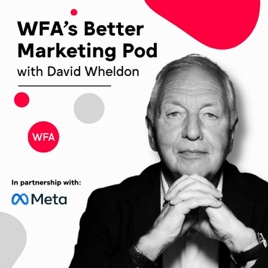
Advertise on podcast: WFA's Better Marketing Pod with David Wheldon
This podcast has
54 episodes
Language
EnglishExplicit
No
Date created
2020/11/03
Latest episode
2026/09/29
Average duration
29 min.
Release period
39 days
Description
Hosted by WFA President David Wheldon, WFA's Better Marketing Pod in partnership with Meta looks at the marketing industry’s biggest stories and speaks to some of the industry’s most interesting characters who are shaping those stories.
Unlock WFA's Better Marketing Pod with David Wheldon podcast Email contact info,
Listeners & Audience details
Email contact information
Direct podcast contact details

Listeners
Audience numbers & engagement insights

Audience details
Podcast Insights

Podcast episodes
Check latest episodes from WFA's Better Marketing Pod with David Wheldon podcast
Ep 53: Nissan's Miki Hamamatsu on rebuilding one global brand and why internal belief comes first
2026/09/29
One brand, dozens of markets, and a category being reshaped faster than most brand strategies can keep up with. Plenty of global companies say they have a single brand; in practice they have as many versions of it as they have regions, each a reasonable local reading of something that was meant to be singular. David Wheldon talks with Mikimasa "Miki" Hamamatsu, Division General Manager, Global Brand & Marketing Communication at Nissan, about pulling that back together without stripping markets of the authority they need to sell cars.
Miki explains Nissan's shift to a lighthouse brand: one definition, one interpretation, clear guardrails to steer by. He is also candid about where that work had to start. Internal research found that only 30% of Nissan employees understood the company's brand equity and just 14% believed in it, and he makes the case that internal brand engagement is the most underrated lever a marketer has, precisely because it never arrives as a campaign anyone can put their name to.
You will also hear a discipline you could copy this week. Miki sends his weekly marketing performance assessment straight through to his agencies, market problems included, then watches the questions that come back. We cover why brand is not always a democracy, what more than 15 years with the same agency group actually buys you, how Chinese EV competition is compressing launch timelines, and where AI is doing real work in localisation and analytics rather than sitting in pilots.
If you are working on global brand consistency, agency partnership or the case for long-term brand building, listen in and share this with a colleague.
Subscribe to the WFA #BetterMarketing podcast on your preferred platform: https://bit.ly/41ZwqkF.
Ep 52: Andrew Tindall on defining creativity and why emotion matters for effectiveness
2026/08/18
Advertising is getting pricier, yet the results many marketers care about most are shrinking. Brand effects like awareness, trust and differentiation are dropping across award-winning case studies, even as budgets climb, and that should worry anyone responsible for growth. David talks with Andrew Tindall from System1 about what sits underneath that decline and how to fix it without hiding behind vanity metrics.
Andrew unpacks why emotional response is not a “nice to have”, but one of the most dependable predictors of effectiveness we have, especially when paired with clear brand recognition. From there we dig into the Creative Dividend, a model that blends global Effie Awards effectiveness data with System1’s large-scale creative testing to show something many teams miss: creativity and media only make sense together. A strong ad with no reach is wasted. Heavy reach behind a weak ad is inefficient.
You will also hear a practical planning idea you can take back to your next budget meeting: Excess Share of Creativity (ESOC). Alongside Excess Share of Voice, it reframes the job as building genuine creative advantage and then backing it with the right weight of quality reach. We cover the four outputs that make creativity accessible in plain language, the real cost of dull campaigns, and why chasing lower CPM can push teams into low-attention media that drags ROI down.
If you want clearer creative reviews, smarter media planning and stronger marketing effectiveness, subscribe, listen and share this with a colleague.
Subscribe to the WFA #BetterMarketing podcast on your preferred platform: https://bit.ly/41ZwqkF.
Ep 51: Opella's Alberto Hernandez on the commercial payback from curiosity, courage and purpose
2026/07/01
Half the health information people see on social media is incomplete or wrong, and the result is bigger than a fact-checking problem. It’s a confidence problem. When four out of five people don’t feel comfortable making self-care choices, treatable issues get ignored and brands lose the chance to help.
David speaks with Alberto Hernandez, Chief Growth Officer at Opella, about what consumer healthcare marketing should do next: guide people towards clearer, safer decisions while still earning attention in a crowded digital world.
They get into the culture behind that shift. Alberto explains Opella’s challenger mindset, why curiosity has to lead to action, and how he benchmarks outside the category to raise the bar on content, media, innovation, and services. They also broaden the definition of creativity beyond advertising. Creativity becomes a way of thinking that solves business problems, unlocks new go-to-market routes, and captures the emotional reality of health, from allergies to anxiety and everyday discomfort.
Then they go practical: P&L accountability, the lessons from building a shared “repeatable model of growth”, and how B Corp certification creates purpose and productive discomfort. Finally, Alberto shares how Opella uses AI to produce far more content without losing rigour, using a simple guardrail: human first, human last.
If you care about brand building, growth marketing, AI content at scale, and trust in regulated categories, you’ll take away frameworks you can use immediately.
Subscribe, listen, and share this with a marketing leader who needs it.
Subscribe to the WFA #BetterMarketing podcast on your preferred platform: https://bit.ly/41ZwqkF.
Ep 50: 50 episodes in David Wheldon reflects on conversations with the world’s top marketing minds
2026/06/08
Fifty episodes in, one lesson keeps getting louder: marketing is still a person-to-person craft, even when the world feels dominated by platforms, dashboards, and AI. Recording from Stockholm during Global Marketer Week, in this episode David Wheldon reflects on what he has learned from CMOs and top marketing thinkers and why the energy of human contact makes ideas sharper, braver, and more useful.
We dig into leadership under pressure, starting with a principle that sounds simple and turns out to be non-negotiable: if you lead others, you have to take care of yourself first. Antonio Lucio explains why it starts with the body, how uncertainty drains teams, and why self-care is not selfish when your job is to show up centred for your people. From there we move to a phrase we keep coming back to: creativity with precision. Great work needs measurement and proof, not to tame creativity, but to earn trust, defend brand investment, and scale what is driving real business results.
The episode also tackles evidence-based marketing and the danger of untested myths. We explore why organisations often already have the data they need yet still fail to challenge assumptions, then zoom out to creativity, strategy, and technology: Sir John Hegarty’s case for creative effectiveness, Seth Godin’s view of strategy as a “philosophy of becoming”, and a clear stance on AI as augmentation rather than an enemy. If capability is expanding fast, the real question becomes uncomfortable and motivating: are our ideas good enough?
Subscribe to the WFA #BetterMarketing podcast on your preferred platform: https://bit.ly/41ZwqkF.
Ep 49: Google's VP Global Ads Dan Taylor: "AI is more of a leadership than a technology challenge"
2026/05/06
Real people do not move neatly from awareness to consideration to purchase, they jump between searching, streaming, scrolling and shopping, sometimes all at once. That messy middle is where brands win or disappear, and it is exactly where AI-powered advertising and modern measurement start to matter according to the next guest on the WFA Better Marketing Podcast Dan Taylor, VP of Global Ads at Google.
On this episode Dan speaks to David Wheldon to unpack what has changed over two decades of digital advertising and what is changing right now.
They talk about how first-party data, CRM signals, and outcome-based optimisation help AI steer towards real business value instead of proxy metrics. Dan shares why the best marketers treat attribution, incrementality testing, and marketing mix modelling as a connected system that supports smarter budget decisions and clearer conversations with the CFO.
The episode also get into the practical side of AI and creativity. Automation can shrink weeks of execution into hours, but it does not replace the need for sharp strategy and a strong idea. From faster asset production to new search behaviours like longer conversational queries, visual search, and experiences such as AI Overviews, it explores how discovery is expanding and how ads can become relevant through context, not just keywords. If you want a grounded view of what to modernise now and what happens if you wait, this one is for you.
If you found this useful, subscribe to Better Marketing and share it with a colleague.
Subscribe to the WFA #BetterMarketing podcast on your preferred platform: https://bit.ly/41ZwqkF.
Ep 48: Judy Smith on why "be who you say you are" is the only crisis playbook that matters
2026/04/01
In this episode David Wheldon talks with Judy Smith, crisis management expert and former White House advisor, about what protects reputation when risk is everywhere and scrutiny is constant. We come back to one hard rule for leaders and brands: be who you say you are, even when the story is moving faster than your playbook. In this episode David and Judy cover:
• Being who you say you are as the foundation of trust, values and reputation
• Managing brand reputation as both technology and AI reshape what gets said about companies
• Reducing silos so marketing, comms, legal and policy act as one team
• Why crisis playbooks struggle when culture and reaction are unpredictable
• Using the risk barometer to prepare, adjust plans and measure intangible assets
• Making intangibles financially meaningful through protection and long-term value
• What leaders do in the first 90 days of a turnaround, beyond story polishing
• When to respond to volatility and when silence avoids a damaging slug fest
• How to think about fake news based on real reputational impact
• The unexpected story behind Scandal and a former president’s sense of humour
About Judy Smith
For more than 25 years, Ms. Smith has counseled presidents and world leaders through global crises, advised Fortune 50 CEOs through complex challenges, and helped manage the reputations of some of the world’s highest-profile individuals. She founded Smith & Company, a strategic advisory firm considered to be one of the top crisis firms in the world, that has offices in Washington D.C., Los Angeles, New York and London.
In addition to her work as a communications advisor during high profile moments, Ms. Smith is a long-time counselor to some of the world’s largest and most influential companies such as Amazon, Facebook, Panera, Lowes, Sony, Kaiser, United Healthcare, and Walmart. She provides her clients with strategic advice on a variety of corporate communications issues such as mergers and acquisitions, product recalls, intellectual property litigation, corporate positioning, and other corporate, investor and public relations matters.
A former federal prosecutor, Ms. Smith worked in the U.S. Attorney’s office for the District of Columbia where she handled high-profile investigations. She also served as Deputy Press Secretary to President George H.W. Bush, during which time she worked on a host of domestic and international issues.
As a result of her wide ranging and ground-breaking career, Ms. Smith inspired the hit TV series, Scandal and served as Co- Executive Producer of the project. Ms. Smith’s advice and counsel have been valuable to corporate boardrooms, and she currently serves on the board of Ariel Investments and as Chair for The Intangibles, the transformation consultancy for the intangible world. She also previously served on the boards of Global Citizen, Save the Children, Washington National Cathedral and Carbon Health.
Subscribe to the WFA #BetterMarketing podcast on your preferred platform: https://bit.ly/41ZwqkF.
Ep 47: HP's Antonio Lucio on leading through a CEO transition, an AI surge and 4 layers of disruption
2026/03/03
When everything shifts at once, composure becomes a strategy. David Wheldon talks with HP’s Antonio Lucio to explore how leaders stay steady through geopolitics, macro pressure, generative AI, and an unexpected CEO transition—while keeping teams focused, customers centred, and growth on track.
Antonio cuts through the AI hype with three pragmatic plays: scale asset optimisation for faster NPI readiness, use identity-led media to guide IT decision makers across their buying journey, and automate back office work that drains half of marketers’ time. He makes the case that AI is only useful when it serves the customer, not a dashboard, and that chasing pilots without scale is a dead end for global brands.
We also unpack the inner game of leadership. Drawing on Stoicism and a fresh look at Machiavelli’s hard questions, Antonio shares how he managed a delicate CEO succession process, balanced empathy with execution, and modelled honest emotions without losing operational clarity. The takeaway is a repeatable rhythm: protect your capacity, face reality as it is, define the next action, and deliver.
Finally, we reframe the CMO’s mandate. Marketers who earn their seat at the table own three advantages: the aggregator view of budgets across units and regions, the authentic voice of the customer built on direct relationships, and the ability to integrate storytelling across stakeholders. As search behaviour tilts toward LLMs, trust, owned and earned content, and account-based marketing become decisive. Communications, marketing, and corporate affairs must move as one to turn reputation into revenue.
If you’re leading teams through volatility or rethinking how AI and trust work together, this conversation offers a clear path forward.
Subscribe, share with a teammate who needs a boost, and leave a review with the one shift you’ll make this week.
Subscribe to the WFA #BetterMarketing podcast on your preferred platform: https://bit.ly/41ZwqkF.
Ep 46: Grab CMO Cheryl Goh's playbook on how to 'cross swim lanes' for commercial impact
2026/02/03
Growth doesn’t start with an ad. It starts where your product decisions meet real people. We sit down with Cheryl, newly named Global Marketer of the Year, to unpack how Grab scaled across Southeast Asia by turning marketing into a true commercial engine—where product, pricing, algorithms, and culture work in sync to earn trust and drive results.
We chart the journey from a scrappy airport-ride promo to a system of problem-space teams that cross swim lanes by design. Cheryl explains why immersion days keep leaders close to riders and drivers, how fair pricing principles became part of brand architecture, and where consensus can quietly kill velocity. Her hiring lens is refreshingly direct: seek commercial fluency, data and insights mastery, and relentless curiosity; then give those people room to orchestrate product, economics, and operations around the customer.
Sustainability emerges as strategy, not slogan. Inclusive design and driver programmes widen supply, improve safety, and boost retention, turning social good into measurable outcomes. As AI becomes the growth engine, we explore why marketers must move upstream—shaping ranking, matching, and pricing so algorithms reflect brand values rather than rewrite them. The result is a practical playbook for CMOs, product leaders, and founders who want marketing to integrate the business, not decorate it.
If you care about customer experience, fair pricing, and building teams that ship impact, this conversation offers field-tested ideas you can use now. Subscribe and share with a colleague.
About Cheryl Goh
Cheryl Goh is Group VP of Marketing and Sustainability and Founding CMO at Grab and the 2025 Global Marketer of the Year. Hand-picked by founder Anthony Tan despite her product and business development background, she scaled MyTeksi from 2012 origins into Southeast Asia's leading superapp across eight markets.
She leads the full ecosystem, including product marketing, communications, growth, loyalty P&L (Grab VIP, Unlimited, Coins), sustainability, and customer support, while building a talent pipeline that has placed several of Grab's country heads.
Subscribe to the WFA #BetterMarketing podcast on your preferred platform: https://bit.ly/41ZwqkF.
Ep 45: Is it all about AI? What's really shaping the CMO Agenda? - 2025 in review
2025/12/14
In this episode we review a year of conversations with Unicef's Frederique Covington Corbett, culture guru Marcus Collins, Cathay Pacific's Ed Bell, Meta's Nicola Mendelsohn, Marcel Marcondes from AB InBev and Global Marketer of the Year, marketing expert Seth Godin, Leyal Eskin Yilmaz from the Magnum Ice Cream Company, and Ogilvy's Rory Sutherland.
These conversations led to one clear truth: the best marketing is still about people. We pull together the sharpest lessons for CMOs and brand leaders, cutting through the AI noise to focus on conviction-led leadership, intelligent human connection, and simple ideas that change behaviour. You’ll hear why building AI capability and governance is urgent, but also why tech belongs in the back office while human creativity runs the front. We share how to connect customer insight to commercial reality, and why that shift turns marketing from a cost into a value engine.
We dive into the channels where customers already live—messaging platforms—and explain how click-to-message journeys, verified utility updates, and AI agents on WhatsApp are transforming service and commerce globally. Real stories show the upside: faster response times, higher satisfaction, and scalable conversations that still feel personal. Then we move beyond tools to the psychology that makes any of it work. Technology amplifies an idea; it doesn’t replace one. The most effective work pairs clarity and emotional intelligence, proving that a simple, useful solution beats a flashy campaign when it solves a real problem.
Finally, we tackle the mindset. Choose your customers and clients with care, because those choices define your future. Lead with conviction, not convenience, even when it costs you. Make space for practical magic, the creative leaps that reconcile contradictions the spreadsheet can’t. As we look ahead, think human creativity as the front office, technology as the back office, and AI as a force multiplier—not the point. If that resonates, follow the show and share this roundup with your team.
Subscribe to the WFA #BetterMarketing podcast on your preferred platform: https://bit.ly/41ZwqkF.
Ep 44: Rory Sutherland on fat-tailed marketing and why creativity outperforms efficiency
2025/11/26
The biggest wins in marketing rarely fit into neat dashboards. Rory Sutherland joins us to unpack why creativity is “fat-tailed,” how a few outlier ideas create the lion’s share of value, and why short-term incentives push teams to optimise what’s easy to count rather than what actually compounds. From “member since” on a card to names on Coke bottles, we dig into billion-dollar ideas that cost little to make but transform loyalty, fame, and lifetime value.
David and Rory get honest about metrics and the bottlenecks they create. When every brand chases the same KPIs, platforms become toll roads and marketers pay rent for access. Rory argues for brand-specific measures that mirror your distinctive value, plus smarter routes to reach people without bidding wars, think influence, communities, and the “Cafe Nero” side door. They also contrast two economic worldviews: the tidy rational model that treats marketing as a cost, and the psychology-first approach that sees value as subjective, created in minds through service, design, and language.
The conversation ranges from call centres as underestimated value engines to why family-owned firms often excel at brand building. David and Rory explore how an efficiency mindset blocks innovation by forcing either-or decisions, and how relational capitalism, trust over time, not transactional maximisation, builds resilient brands. The practical pivot: don’t just sell outputs; sell how you think. In an AI age, the durable advantage is reframing problems and resolving false trade-offs, turning contradictions into strengths. If you believe in magic, you’ll notice it, nurture it, and let it power growth.
If this resonated, follow the show, share it with a colleague who needs a jolt of creative courage, and leave a quick review to help more marketers find us.
Subscribe to the WFA #BetterMarketing podcast on your preferred platform: https://bit.ly/41ZwqkF.
Ep 43: Magnum Ice Cream's Leyal Eskin Yilmaz on Unilever, Minecraft ice cream and cultural relevance
2025/10/01
In this episode of the Better Marketing Podcast with David Wheldon, Leyal Eskin Yilmaz, CMO of Europe, UK, Ireland, Australia and New Zealand for the Magnum Ice Cream Company, shares insights on building a new marketing organisation as the business separates from Unilever.
Key points covered:
Creating a new company while running the business is like "building a new house while living in it".Each geographic market shaped Leyal's leadership approach differently - Turkey (agility), US (scale), UAE (cultural nuance), Netherlands (systems thinking).Turkish marketers excel globally because Turkey provides a "real-time MBA" with fast-changing markets and intense competition.The new company balances global brands (setting ambition) with local jewels (providing cultural relevance).Purpose remains central to the business strategy, with Ben & Jerry's setting industry standards.Cultural relevance requires long-term partnerships, demonstrated by their Minecraft collaboration.Inclusion and diversity initiatives focus on representation plus active sponsorship of diverse talent.AI is transforming marketing more than any other business function, triggering creativity when used properly.Modern CMOs need to embrace AI capabilities, actively shape culture, and position marketing as the business growth engine.Subscribe to the WFA #BetterMarketing podcast on your preferred platform: https://bit.ly/41ZwqkF.
Ep 42: On story, strategy and stealing attention with marketing guru Seth Godin
2025/08/25
What happens when one of marketing's most influential thinkers shares his unfiltered wisdom about the state of our industry? Seth Godin joins the WFA Better Marketing Podcast to deliver profound insights that challenge conventional thinking about what makes marketing truly effective.
Seth dismantles common misconceptions about marketing's purpose: "Marketing is about how we're going to tell a story that other people want to hear," he explains, emphasizing that great storytelling isn't an innate talent but a learnable skill developed through careful observation and adaptation. His pioneering concept of permission marketing, introduced decades ago, rings truer than ever in our attention-scarce digital landscape.
The conversation explores the critical distinction between strategy and tactics that confounds many marketers. "A strategy is a philosophy of becoming. It's the hard work we do before the hard work," Seth explains. He contrasts enduring brands like Patagonia and Apple, whose core strategies have remained consistent for decades, with organizations that merely copy competitors in a tactical race to the bottom.
Perhaps most powerfully, Seth reminds us that "when you pick your customers, you pick your future." This profound yet simple insight encourages marketers to cultivate relationships with clients who align with their values, even if that means walking away from those who don't.
Ready to rethink your approach to marketing? Listen now for timeless wisdom that cuts through the noise and gets to the heart of what makes marketing truly matter.
Subscribe to the WFA #BetterMarketing podcast on your preferred platform: https://bit.ly/41ZwqkF.
Ep 41: On marketing as the bridge between consumer and business with Marcel Marcondes, AB InBev
2025/06/09
The marketing landscape is undergoing profound shifts, requiring marketers to rethink traditional approaches. At the forefront of this evolution stands Marcel Macondes, AB InBev's Global CMO and winner of the 2024 WFA Global Marketer of the Year award. His philosophy brings a refreshing clarity to how marketing should function today: as a bridge between consumers and business.
Throughout this compelling conversation, Marcel talks about how AB InBev now owns eight of the world's ten most valuable beer brands. AB InBev's success stems not from treating marketing as a separate function but from deeply integrating consumer insights into business operations. "In the past, marketers would work to say, 'this is what we do, now let's convince consumers about it,'" Macondez explains. "Given how the world is evolving, our job has changed – we need a strong pulse on what's happening with consumers, then adjust how we work to serve them better."
What sets truly exceptional marketing leaders apart? Marcel points to a pivotal career milestone: "The transition between following the agenda to driving the agenda." This shift from management to leadership creates the conditions for marketing to flourish as "the key architect of growth" within organizations. Through the "One ABI Way of Marketing" framework, developed over two years, AB InBev has systematized this approach while maintaining the agility to incorporate emerging trends and technologies.
Perhaps most refreshingly, Marcel approaches innovation with balanced wisdom. Rather than viewing AI as disruptive, he embraces it as an enhancement: "AI is here to help us and support us." This exemplifies his guiding principle for marketing leaders: be very ambitious, but also very humble – pushing for excellence while remaining open to continuous learning in an increasingly complex landscape.
Ready to transform your marketing approach? Start by deeply understanding both your consumers and your business, then build the bridge between them with creativity, consistency and an unwavering focus on delivering value.
Subscribe to the WFA #BetterMarketing podcast on your preferred platform: https://bit.ly/41ZwqkF.
Ep 40: On agency experience, AI and messaging with Nicola Mendelsohn, Meta
2025/04/28
In this episode of the Better Marketing Podcast, Nicola Mendelsohn, Meta's Head of Global Business Group, shares insights on how Meta is transforming from a teenage platform to a mature business partner for advertisers with innovative tools, AI implementation and a renewed focus on effectiveness.
From her early agency days to her pivotal role at Meta over the past 12 years, Mendelsohn brings a unique perspective that bridges creative thinking with technological innovation.
Between Ray-Ban Meta smart glasses that translate languages in real-time and the revelation that messaging platforms are becoming the new frontier for brand-consumer relationships (with over 600 million daily messages between people and businesses), Mendelsohn paints a picture of marketing's near future that feels both exciting and tangible. To CMOs, Mendelsohn says the following: embrace messaging, leverage AI ethically and prepare for a world where every business will have AI agents representing their brand. The future isn't just coming — it's already here for those ready to seize it.
Subscribe to the WFA #BetterMarketing podcast on your preferred platform: https://bit.ly/41ZwqkF.
Ep 39: Cathay Pacific’s Ed Bell on their marketing secret plus lessons from Asia for marketers
2025/04/02
What does it take to rebuild an airline brand after the devastating impact of a global pandemic? Ed Bell, General Manager Brand, Insights and Marketing Communications at Cathay Pacific, takes us behind the scenes of one of aviation's most remarkable recovery stories.
Bell's journey from agency dynamo during China's economic boom to airline marketing leader offers a masterclass in resilience and strategic thinking. Having worked on iconic launches like the Motorola Razr and Beijing Olympics with Adidas, he brings a unique perspective on what truly drives consumer choice in premium markets.
At the heart of Cathay Pacific's revival is a refreshingly straightforward philosophy: happy staff create happy customers, who in turn generate strong financial results. During the darkest days of the pandemic, when budgets disappeared and uncertainty reigned, the airline doubled down on celebrating their employees through "Cathay Stories" - showcasing extraordinary acts of dedication that maintained morale when it mattered most.
Rather than competing through flashy amenities, Cathay embraces "human-centric design" - creating experiences that make passengers feel genuinely at home. This approach extends from their more residential-feeling lounges to communications that emphasize emotional connection rather than feature lists. As Bell explains, they position themselves as "the winds beneath your wings," not the star of the show.
For marketers in any industry, Bell's insights on measuring effectiveness are particularly valuable. Through sophisticated modelling, Cathay has quantified that brand emotions drive approximately 50% of consumer choices, with a 1% increase in consideration across just four markets translating to half a billion dollars in value. This data-driven approach helps marketing secure its rightful place in business strategy conversations.
Listen now to discover how Cathay Pacific is soaring again, and why Bell believes that regardless of technology trends, "the battle for business starts in the mind" of your customers.
About Ed Bell, General Manager Brand, Insights and Marketing Communications, Cathay Pacific
Ed Bell is responsible for the development of brand strategy, consumer insights, loyalty marketing and marketing communications for the Cathay Pacific group globally.
He has spent the majority of his career in marketing strategy and later as a CEO for marketing and communication consultancies across Asia and Greater China, working for a diverse set of brands and businesses.
A seasoned marketing professional, he is the recipient of the prestigious IPA and Jay Chiat awards for marketing effectiveness and strategy and is a regular author and speaker.
Originally from Melbourne, Ed trained in psychology and later marketing. He is married with three children and calls Hong Kong home.
Subscribe to the WFA #BetterMarketing podcast on your preferred platform: https://bit.ly/41ZwqkF.
Podcast reviews
Read WFA's Better Marketing Pod with David Wheldon podcast reviews
Podcast sponsorship advertising
Start advertising on WFA's Better Marketing Pod with David Wheldon relevant audience podcasts
You may also like to advertise on these Podcasts

4.890611563
Fearless with Jason Whitlock
Blaze Podcast Network
4.827601703
Earn Your Happy
Lori Harder | YAP Media

4.8121051000
Mind Pump: Raw Fitness Truth
Sal Di Stefano, Adam Schafer, Justin Andrews, Doug Egge
4.8104512000
Steve Deace Show
Blaze Podcast Network

4.819462000
Football Ramble
Stak

4.920661175
Toni and Ryan
Toni Lodge and Ryan Jon

4.861411101
The David Pakman Show
David Pakman

4.732641948
The President's Daily Brief
The First TV

4.762552000
The Lawfare Podcast
The Lawfare Institute

4.917101551
DarrenDaily On-Demand
Darren Hardy LLC