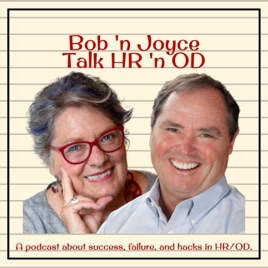
Advertise on podcast: Bob 'n Joyce Talk HR 'n OD
Rating
5from
This podcast has
234 episodes
Language
EnglishExplicit
No
Date created
2020/11/12
Latest episode
2026/04/23
Average duration
22 min.
Release period
10 days
Description
The Bob 'n Joyce Talk HR 'n OD podcast, hosted by Bob Stapleton and Joyce Wilson-Sanford, is for Human Resources and Organizational Development change-makers committed to bold work in an era that calls for the skills, values and partnership of these two disciplines. Bob and Joyce are former HR and OD C-suite executives who share their successes, failures, and hacks. They believe that it's an exciting time for this work and give specifics around acquisitions, policy nightmares, and grand moments. This podcast is to support your work and to take a moment to step away from the daily chaos. Come on in, grab a snack, and welcome!
Unlock Bob 'n Joyce Talk HR 'n OD podcast Email contact info,
Listeners & Audience details
Email contact information
Direct podcast contact details

Listeners
Audience numbers & engagement insights

Audience details
Podcast Insights


Podcast episodes
Check latest episodes from Bob 'n Joyce Talk HR 'n OD podcast
Men Lead Like This. Women Lead Like That… Or Do They?
2026/04/23
In this lightning-round conversation, Bob and Joyce explore leadership through the lens of gender—challenging common assumptions about how men and women tend to lead.
Do women naturally lean more collaborative? Are men more decisive—or just perceived that way? And how much of what we call “gendered leadership style” is real pattern versus outdated stereotype?
With honesty, curiosity, and humor, they reflect on what they’ve seen across years of working with leaders. Along the way, they surface where gender-based generalizations can be useful—and where they quietly limit how we see people and performance.
This isn’t about defining how men or women lead. It’s about noticing the patterns we default to, and asking what becomes possible when we look beyond them.
Why OD Should Own the Workplace Conversation—But Rarely Does
2026/04/17
In this episode, we tackle a blind spot in organizational development: the physical workspace. While HR and OD leaders spend countless hours shaping culture, engagement, and strategy, the environment people work in is often left to architects, facilities, or finance.
That’s a miss.
The spaces people walk into every day send powerful signals about what matters—collaboration or isolation, energy or exhaustion, inclusion or hierarchy. Workspace isn’t just about aesthetics; it directly influences behavior, productivity, and how people feel at work.
We also take on the ongoing debate around open workspaces. Do they actually foster collaboration—or do they create distraction and disengagement? The answer isn’t one-size-fits-all, and that’s exactly why OD needs to be part of the conversation—bringing intention to how space aligns with the work being done.
We explore why OD should have a seat at the table when workplaces are designed or redesigned, and how even small shifts in layout, flow, and intention can create more welcoming and productive environments.
Because culture doesn’t just live in values and conversations—it lives in the walls, the light, and the space between people.
If You’re Not Asking Why, It’s Not OD
2026/04/06
In this episode, we draw a clear line between real Organization Development and work that just looks productive.
Too often, OD starts with tools, processes, and “best practices”—without ever getting clear on the purpose behind them. The result? A lot of activity… and not much impact.
We break it down simply:
The Why – increasing organizational effectiveness and health
The How – the tools and processes used to get there
Most teams start with the How. That’s the problem.
Using performance management as an example, we explore why traditional approaches fall flat—despite all the effort—and why more than two-thirds of employees see reviews as a waste of time.
We’ll share a different approach we’ve used—one that starts with Why and actually drives results.
If your OD work feels busy but not effective, this episode will help you refocus on what really matters.
When OD Gets in the Way (And What to Do About It)
2026/03/24
In this episode, we take on a hard truth: sometimes the very people trained to help organizations—OD practitioners—end up getting in the way.
Great facilitation isn’t about executing a perfect plan. It’s about reading the room, adjusting in real time, and having the courage to do what the moment actually requires. And if we’re honest, that’s where things can go sideways.
We unpack a few common “OD traps” that can quietly derail impact:
• Confusion about our role in the moment—are we facilitating, advising, or leading?
• Sticking to the plan when the room is telling us to pivot
• Creating dependency instead of building capability
• Letting our expertise turn into needing to be the smartest person in the room
This isn’t about beating ourselves up—it’s about getting better.
Because doing good OD work takes more than tools and frameworks. It takes awareness, humility, and the willingness to let go of getting it “right” in favor of doing what’s actually needed.
If you’ve ever walked out of a session thinking, “That didn’t land the way I hoped,” this conversation is for you.
Leadership in Uncertain Times — Don’t Wait for Optimism, Generate It
2026/03/18
In this episode, we continue our conversation about the role of Organization Development in unsettled times. Last time we explored what it means to act hopeful when it’s hard to feel hopeful. This time we go a step further: How do you show up when things feel uncertain—and still make a positive difference?
We draw inspiration from Margaret Wheatley’s book Who Do We Choose To Be?, which offers a powerful historical perspective on how societies and systems evolve—and what that might mean for the world we’re navigating today.
If we understand these patterns, leaders and OD practitioners can better assess what is actually happening around them—and more importantly, decide how they want to respond.
In our conversation we explore the practical ways leaders can show up in difficult moments:
• Strengthening connection when people feel fragmented
• Choosing love over fear in how we lead
• Maintaining a willingness to contribute, even when outcomes are uncertain
• And yes—keeping a sense of humor along the way
Because in challenging times, leadership isn’t about waiting for optimism.
It’s about generating it.
If OD Can’t Create Hope, Who Will?
2026/03/06
Let’s be honest.
The world feels a little nuts right now.
Divided. Loud. Unsettled. Tired.
And organizations don’t exist outside of that. They absorb it.
So in this episode, we ask a simple but uncomfortable question:
What does OD need to be when the world feels like it’s coming apart?
And maybe even harder…
How do we act hopeful when we don’t always feel hopeful ourselves?
That’s not fluff. That’s leadership.
Instead of offering grand theories, we get practical.
We suggest starting here:
Stop trying to fix everything. Start by finding the energy.
In every organization — even the messy ones — there are pockets of good energy. People who still care. Teams that still want to build something better. Conversations that feel constructive instead of draining.
If you think in systems, you know this is true.
OD’s job?
Go find that energy.
Name it.
Amplify it.
Build from it.
We also talk about diagnosing energy instead of just diagnosing problems. Ask:
• Where do people feel most alive?
• Where do meetings feel productive?
• Where is there momentum — even if it’s small?
Energy is data.
And then we double down on participation. Because when people help shape the way forward, they create the hope they’re looking for. Participation isn’t soft. It’s catalytic.
We close with a practical exercise inspired by Power vs. Force by David Hawkins — a simple way to surface the life-giving energies (like courage and willingness) versus the draining ones (like fear and blame) that may be shaping your culture more than you realize.
Consider this episode another tool for your toolkit.
Not because we have all the answers.
But because in chaotic times, OD isn’t just about alignment and strategy.
It’s about stewarding energy.
And if OD can’t create hope…
Who will?
The Problem Isn’t the Strategy — It’s the Thinking
2026/02/26
What if the biggest obstacle in your organization isn’t resistance — but thinking?
In this episode, Bob ’n Joyce explore why smart leaders keep applying logical, linear solutions to problems that require something different. Drawing on the work of Edward de Bono and his ideas on lateral thinking, we examine why better analysis doesn’t always produce better outcomes.
True creativity — the kind that shifts culture and unlocks strategy — happens when leaders deliberately disrupt their own patterns of thought. That doesn’t come naturally. It takes structure, intention, and often a skilled OD practitioner willing to redirect the conversation sideways.
We share practical ways to apply these concepts in your organization, including how to:
• Interrupt entrenched thinking
• Expand options before narrowing them
• Facilitate conversations that create possibility instead of reinforcing positions
If you’re an OD professional or executive leader, this conversation may challenge how you approach your next strategic discussion.
Sometimes progress doesn’t require more effort.
It requires a different question.
The Culture You Have (Not the One You Talk About)
2026/02/16
If your leadership team defines culture by your values statement, engagement scores, or what you wish were true — you don’t know your culture.
You’re describing your aspirations.
In this episode, Bob ’n Joyce challenge leaders and OD practitioners to stop treating culture like a slogan and start treating it like a system.
Using a disciplined lateral thinking methodology, they show how to uncover what really drives behavior — the unwritten rules, the workarounds, the quiet power dynamics, and the habits that get rewarded and repeated. Not the culture on the wall. The culture in motion.
Why does this matter? Because culture determines how decisions actually get made. It shapes who advances, what gets funded, what gets tolerated, and what quietly dies.
Strategy doesn’t fail because it’s flawed.
It fails because culture wins.
Lateral thinking offers an indirect, disruptive way to see your organization as it actually operates — not as you’ve convinced yourself it does. And once you can see it clearly, you can lead it intentionally.
Because whether you define it or not, your culture is defining you.
OD’s 2026 Reality Check: What Actually Deserves Your Attention
2026/02/10
If you’re in OD or a leadership role, chances are your 2026 priorities already look familiar—and that might be the problem.
In this episode, Bob and Joyce unpack what a group of seasoned OD practitioners believe must be at the center of OD and leadership attention in the year ahead. Some of the themes will feel like the usual suspects. Others—especially the growing influence of AI—push against comfortable assumptions about how OD creates value.
Rather than offering a tidy checklist, this conversation invites a harder look. Where is your organization genuinely making progress—and where are you telling yourselves a reassuring story? As you listen, you’re encouraged to ask a deceptively simple question: What are we actually focused on, and why?
While OD has evolved in tools, language, and scope, its core mission hasn’t changed: sustaining the health of the organization as a living system. The real challenge for OD leaders today isn’t knowing everything that matters—it’s deciding what matters most given the realities you’re facing.
To ground the conversation, Joyce shares how a leadership development program she created at Delhaize—Leadership College—directly addressed all six focus areas discussed in the episode, offering a concrete example of what intentional, system-level OD can look like in practice.
Come on in. Grab a snack. Welcome!
Clearing the Fog: Why Decluttering Isn’t the Point
2026/01/30
It’s January—the season of clean closets, organized drawers, and freshly emptied garages. In this episode, Bob ’n Joyce look beyond the annual cleanup ritual to ask a more interesting question: Does decluttering actually change anything, or does it just make us feel productive for a while?
Yes, clearing clutter feels good. It can be energizing and even cathartic. But as we explore, the real value of decluttering—whether in our personal lives or in organizations—doesn’t come from an occasional burst of cleaning. It comes from making decluttering a deliberate, ongoing practice.
When clutter builds up—physical, mental, or organizational—it often goes unnoticed until it slows us down or gums up the system. Done well, decluttering releases energy, sharpens focus, and clears the way for a fresh start by helping us see what truly matters.
Some takeaways from today’s conversation:
• Decluttering feels good, but it can also postpone work on what matters most.
• One-time cleanups offer short-term relief; the benefits rarely last.
• A daily cadence of doing just two things that genuinely make a difference may be far more powerful than an occasional cleanup surge.
Individuals and organizations both benefit from clearing the clutter that slows them down. The challenge is that clutter often hides in plain sight. For leaders and OD practitioners, the work is learning to see it—and engaging people in periodically clearing the air so real progress can happen.
So let’s get to it.
Come on in.
Grab a snack.
Welcome.
What the Business Demands from Its Leaders This Year
2026/01/20
In today’s episode, Bob ’n Joyce take on a question many organizations avoid—but can’t afford to ignore: What does the business actually need from its leaders right now?
Rather than defaulting to generic competency models or last year’s leadership playbook, Joyce pulls from her flip-chart archives—capturing real-world leadership “must-haves” identified by two distinct groups: the C-suite and Operations VPs working in the trenches.
What emerges is a fascinating contrast between strategic expectations and operational realities—from leading large-scale change and building long-term capacity, to battle-hardened confidence, simplicity of mindset, and spending more time in the field than the office.
Bob ’n Joyce then force-rank the top three leadership attributes from each group and invite you to do the same. Why? Because leadership development without context is just activity—not impact.
Given the challenges your organization faces this year, this episode helps you make a conscious, strategic choice about where to focus leadership development so it serves the business—not just the curriculum.
Come on in.
Grab a snack.
Welcome.
Footnote: Leadership Attributes Identified by Each Group
C-suite Leadership “Must-Haves”
• Proven track record
• Builds capacity
• High energy endurance
• Vision for strategy
• Inspires
• Compassionate
• Courageous
• Builds productive relationships
• Leads large change
• Keeps the long-term good of the company in mind
Operations VP Leadership “Must-Haves”
• Passionate and curious
• Battle-hardened confidence
• Team smarts (collaborative)
• Simple mindset (ultimate sophistication)
• Fearlessness (no comfort in comfort)
• Preparation and patience
• Time management
• Smart interviewing
• More time out of the office than in
• The art of running meetings
Come Play in Our 2026 Rejuvenation Sandbox
2026/01/16
What happens when you slow down, ask better questions, and resist the urge to rush to answers? In this episode, Bob ’n Joyce model a real-time reflection that sparks insight, tension, and surprising clarity for the year ahead.
Using curiosity and inquiry, they pose a series of powerful questions to one another—questions designed to disrupt familiar thinking and generate fresh insights and “aha” moments.
What unfolds is a candid, in-the-moment assessment of their current reality, paired with the creative tension between where they are today and what they hope for in the year ahead. You’ll hear the pauses, the uncertainty, and the less-than-polished responses that come with doing this work honestly.
Fair warning: this is not an easy or comfortable exercise. But it is a meaningful one. The rewards of slowing down, asking better questions, and reflecting together—whether with a team or across an entire organization—are well worth the effort.
Come on in. Grab a snack. Welcome!
Starting Fresh: What Actually Makes a Reset Stick
2026/01/05
In today’s episode, Bob ‘n Joyce reflect on the start of a new year and the importance of pausing to renew and reset our intentions. Many of us begin January with resolutions to improve our health, habits, and overall well-being. Thoughtful organizations do the same—taking time to reflect on what’s working, what’s not, and what truly needs to change.
In organizational development, this process is often called a reset. Bob ‘n Joyce explore one proven methodology—the Future Search Conference—that helps teams and organizations step back, make sense of their current reality, and align around a shared and preferred future.
Why does a structured approach to an organizational reset matter? Because good intentions alone rarely lead to lasting change. Most personal New Year’s resolutions fade by Valentine’s Day, and organizational change efforts face the same risk—many stall, lose momentum, or fall short of their goals.
Whether you’re setting personal intentions for 2026 or leading a team that needs a thoughtful reset, this episode offers practical insights to help turn reflection into meaningful action.
Come on in. Grab a healthy snack. You’re welcome here.
Happiness at Work: The Data Leaders Can’t Ignore
2025/12/19
In this episode, Bob ’n Joyce explore key findings from Gallup’s 2025 World Happiness Report. The United States experienced a notable decline, ranking 24th — its lowest position ever. The report highlights how social connection, financial wellbeing, emotional health, and physical wellness all play a critical role in overall happiness.
While these findings may not come as a surprise, they should serve as a wake-up call for business leaders and OD practitioners. Unhappy employees don’t just affect morale — they impact business results and workplace culture in very real ways.
In the spirit of the season, we focus on what we can do to address chronic unhappiness, drawing directly from insights in the Gallup poll. What emerges are solutions that don’t require big budgets or more time. In fact, small, subtle shifts by leaders — being fully present, asking thoughtful questions, and helping people feel seen and validated — can make a meaningful difference.
On a personal level, we invite you, our listeners, to use this holiday season as a moment to pause, look around, and make someone’s day. Kindness is contagious — and when it spreads, it lifts all of us.
No better time to begin than now.
Come on in, grab a snack. Welcome!
A Practical Way to Read What Your Organization Is Trying to Tell You
2025/12/17
In today’s episode, Bob ’n Joyce unpack an article Joyce wrote years ago on a powerful OD technique she used to assess organizational wellness. Culture can feel fuzzy and hard to diagnose, but this simple inquiry tool makes it concrete, practical, and actionable for leaders, coaches, and OD practitioners.
You’ll hear when this tool is most valuable—such as during a leadership transition, when performance is slipping, or when an organization has lost its competitive edge—and then we walk through the roadmap step by step.
Joyce’s Diagnostic Roadmap Includes:
Getting a Balcony Perspective
What’s causing the distress?
What internal contradictions does that distress reveal?
What is the history behind those contradictions?
What perspectives or interests do I (or others) now represent that may be in conflict?
How might we, as a team or organization, be mirroring these broader dynamics?
Identifying the Tolerable Range of Distress
How do we typically respond to disequilibrium—confusion, conflict, external threats, shifting roles?
When in the past has distress escalated to a breaking point?
What actions have senior leaders traditionally used to restore equilibrium, and what can I influence now?
Patterns of Work and Work Avoidance
What work and work-avoidance patterns are showing up?
What do these patterns reveal about the real adaptive challenge?
What clues do leaders (often unintentionally) provide?
Which issues are ripe for action—and which may need ripening?
There’s a lot to unwrap (pun fully intended), so settle in, grab a healthy snack, and join us for a lively conversation on diagnosing culture in a way that actually helps organizations heal and grow.
Podcast sponsorship advertising
Start advertising on Bob 'n Joyce Talk HR 'n OD relevant audience podcasts
You may also like to advertise on these Podcasts
4.4371061566
The Megyn Kelly Show
SiriusXM
4.888901269
Fearless with Jason Whitlock
Blaze Podcast Network
4.8118931000
Mind Pump: Raw Fitness Truth
Sal Di Stefano, Adam Schafer, Justin Andrews, Doug Egge
4.8102131585
Tara Brach
Tara Brach
4.541561215
Something You Should Know
Mike Carruthers | OmniCast Media
4.513841343
Strictly Anonymous Confessions
Kathy Kay
4.8292781897
Fantasy Footballers - Fantasy Football Podcast
Fantasy Football

4.62382612
Football Weekly
The Guardian
4.45387666
Two Judgey Girls
Two Judgey Girls
3.8258501152
The Viall Files
Nick Viall