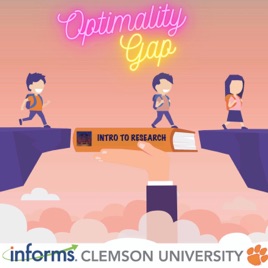
Advertise on podcast: Optimality Gap
This podcast has
24 episodes
Language
EnglishExplicit
No
Date created
2021/01/05
Latest episode
2025/11/14
Average duration
24 min.
Release period
125 days
Description
Many students may start graduate school with a vague idea about areas they would like to study or perhaps a few general research questions. Join us, the Clemson University INFORMS Student Chapter, as we interview different OR faculties from across and outside the campus to talk about research in graduate school. If you want to conduct excellent research and learn what the different OR faculties from Clemson University and other top institutions are working on or want to excel in graduate school – this show is for you.
Unlock Optimality Gap podcast Email contact info,
Listeners & Audience details
Email contact information
Direct podcast contact details

Listeners
Audience numbers & engagement insights

Audience details
Podcast Insights

Podcast episodes
Check latest episodes from Optimality Gap podcast
S04 E01: A Conversation with Dr. Esra Büyüktahtakın Toy
2025/11/14
Dr. Esra Büyüktahtakın Toy is a Professor in the Grado Department of Industrial and Systems Engineering at Virginia Tech and the Director of the Systems Optimization and Machine Learning (SysOptiMaL) Lab. She is also an affiliated faculty member with the Global Change Center, the Invasive Species Collaborative, and the Center for Emerging, Zoonotic and Arthropod-borne Pathogens at Virginia Tech. Her research advances multi-stage stochastic mixed-integer programming and integrates machine learning, deep reinforcement learning, and computational optimization to support risk-averse decision-making under uncertainty. She applies these methods in epidemic disease modeling, healthcare logistics, invasive species management, agriculture, forestry, cancer treatment planning, and undersea warfare search operations. Dr. Toy has received significant recognitions including the NSF CAREER Award, the NSF EPSCoR First Award, five INFORMS Best Publication Awards, and major external funding from agencies such as the NSF, USDA, U.S. Forest Service, and the Office of Naval Research. She has published 45 peer-reviewed journal articles and has contributed extensively to the OR community through invited seminars, keynote talks, panel service, and interdisciplinary collaborations.
A conversation with Dr. Julie Swann
2025/04/22
Dr. Julie Swann is the department head and A. Doug Allison Distinguished Professor of the Edward P. Fitts Department of Industrial and Systems Engineering at NC State University. She is an affiliate faculty in the Joint Department of Biomedical Engineering at NC State and the University of North Carolina at Chapel Hill. Dr. Swann is a Fellow of IISE, INFORMS and AIMBE as well as the current past-president of INFORMS. Throughout her career, Swann has conducted research, outreach and education to improve how health and humanitarian systems operate worldwide. Her work with analytics relates to public health, public policy, epidemiology, infectious disease, supply chain management, and disaster response. This work allowed her to serve as a science advisor for the H1N1 pandemic response at the Centers for Disease Control and Prevention. Along with the CDC, Swann has collaborated with health and humanitarian organizations such as: The American Red Cross, The Carter Center, CARE USA, Children’s Healthcare of Atlanta, Emory University Hospital, State Departments of Public Health, and many other companies Worldwide, she has contributed to the education of thousands of practitioners in health and humanitarian systems through the co-creation and teaching in a professional certificate program at Georgia Tech.
A Conversation with Dr. David B. Brown.
2025/02/26
Dr. David B. Brown is the Snow Family Business Professor in Decision Sciences and the Faculty Director for the Center for Energy, Development and Global Environment (EDGE) at Duke University's Fuqua School of Business. Professor Brown’s research focuses on designing and analyzing optimization algorithms for decision-making under uncertainty. His recent research includes developing and analyzing solution techniques for problems such as network revenue management, dynamic pricing in shared vehicle systems, stochastic scheduling problems, and sequential search problems. Professor Brown serves an Area Editor for the Decision Analysis Area at the journal Operations Research.
A conversation with Dr. Ali E. Abbas.
2025/02/26
Dr. Ali E. Abbas is a professor of industrial and systems engineering at the University of Southern California. His research interests include all aspects of decision-making under uncertainty broadly defined. He is the author and co-author of numerous books and research articles on decision-making and ethics including Foundations of Decision Analysis (with Ronald A. Howard), Foundations of Multiattribute Utility, Next-Generation Ethics, Improving Homeland Security Decisions, and Ethical Decision Quality: Building an Ethical Decision Culture.
He is the recipient of multiple awards from the National Science Foundation for his work including the National Science Foundation CAREER award and is recipient of numerous first-prize awards for research papers including IEEE Systems Journal's Best Paper Award and the Decision Analysis Society of INFORMS Best Paper Award. Dr. Abbas is an IEEE Systems Council Distinguished Lecturer. He serves as an Associate Editor for INFORMS Operations Research and Decision Analysis journals, Entropy, Decision and has also served as the Decision Analysis area Editor for ISE Transactions.
A conversation with Dr. Lewis Ntaimo.
2025/01/11
Dr. Lewis Ntaimo is Professor and Department Head, and Sugar and Mike Barnes Department Head Chair of the Wm
Michael Barnes ‘64 Department of Industrial and Systems Engineering at Texas A&M University. He has been with the university since 2004 after obtaining his PhD in Systems and Industrial Engineering from the University of Arizona. He received his MS in Mining and Geological Engineering in 2000, and BS in Mining Engineering in 1998, both from the University of Arizona.
Dr. Ntaimo’s primary research interests include modeling and algorithms for decision-making problems involving uncertainty and risk, systems modeling, process optimization, and computer simulation. Applications of interest include vaccination policies for epidemics, wildfire management, healthcare management, college counseling and psychological service management, and power systems operations and maintenance. His research over the years has been funded by the U.S. federal agencies and
industry.
In this episode of the podcast, Dr. Ntaimo talks about his journey into Operations research. He also talks about different aspects of his research and what advice he would give to graduate students to navigate the research process.
To learn more about Dr. Ntaimo, make sure to visit his google scholar page: https://scholar.google.com/citations?hl=en&user=1l13jigAAAAJ
A conversation with Dr. Brian Fralix.
2024/08/02
Dr. Brian Fralix is an Associate Professor in the School of Mathematical and Statistical Sciences at Clemson University. His research areas include queueing systems, Markov processes, and reliability theory. He earned his B.S. in Mathematical Sciences from Clemson University and his Ph.D. in Operations Research from Georgia Tech. Prior to joining Clemson, he was a postdoctoral fellow at EURANDOM at Eindhoven University of Technology. Dr. Fralix is also an associate editor and referee for several prestigious journals and has published extensively in his fields of expertise.
In this episode, Dr. Fralix discusses his journey into operations research, focusing on queuing systems, Markov processes, and matrix analytic methods. He shares his research interests in gene expression and Bitcoin, highlighting how stochastic processes can be applied to these fields. He also talks about his accidental yet impactful involvement in matrix analytic methods and emphasizes the importance of persistence, self-teaching, and mentorship for students pursuing a career in operations research.
To learn more about Dr. Fralix, you may visit his personal website and Google Scholar page.
A conversation with Dr. Mostafa Reisi
2024/07/19
Dr. Mostafa Reisi is an Assistant Professor in the Department of Industrial Engineering at the University of Florida. He received his PhD in industrial and systems engineering from Georgia Institute of Technology and M.Sc. degrees in transportation engineering and applied mathematics from the Southern Illinois University Edwardsville. His research interests focus on developing efficient methodologies and algorithms for modeling and monitoring systems with high-dimensional or network data in precision agriculture, manufacturing, healthcare, and transportation systems. He is also interested in adaptive sampling and multi-accuracy data fusion.
In this podcast episode, Dr. Reisi discusses his journey in the field of operations research, particularly focusing on high-dimensional data and machine learning. He elaborates on his work with tensor data for modeling and monitoring high-dimensional systems, emphasizing applications in healthcare and manufacturing. Dr. Reisi explains the concept and advantages of tensor regression, federated learning for data privacy, and robust models to handle outliers. He also shares valuable advice for graduate students, highlighting the importance of self-teaching and finding good mentors.
To learn more about Dr. Reisi, make sure to visit his personal website and Google Scholar page.
A conversation with Dr. Seth Guikema
2024/07/05
Dr. Seth Guikema is a professor in the Department of Civil and Environmental Engineering and Industrial Operations Engineering at the University of Michigan. He also holds an adjunct position at the University of Stavanger, Norway. Dr. Guikema’s research interests include community resilience, risk analysis, sustainability, and equity, with a focus on areas prone to significant natural hazards. He completed his BS at Cornell, MS at Stanford, MEng at the University of Canterbury, and PhD in Engineering Risk and Decision Analysis at Stanford.
In this podcast episode, Dr. Guikema shares his journey into the world of Operations Research, starting from his initial training in Civil and Environmental Engineering to his current focus on community resilience, risk, sustainability, and equity. He discusses his early fascination with risk analysis and probabilistic estimation, which led him to pursue graduate studies and a prolific research career. He emphasizes the importance of integrating data-driven approaches with traditional methods to better prepare for and respond to natural hazards.
Finally, Dr. Guikema offers valuable advice for students and early-career professionals interested in Operations Research and Analytics. He encourages trying research, embracing diverse experiences, and being open to new ideas.
To learn more about Dr. Guikema, make sure to visit his personal website and Google Scholar page.
A conversation with Dr. David Morton.
2024/03/22
Dr. David Morton is the Walter P. Murphy Professor of Industrial Engineering and Management Sciences at Northwestern University and an INFORMS fellow. He holds a B.S. degree in mathematics and physics from Stetson University and M.S. and Ph.D. degrees from Stanford University. Prior to joining Northwestern, he was on the faculty at the University of Texas at Austin and worked as a Fulbright Research Scholar at Charles University in Prague and as a National Research Council Postdoctoral Fellow in the OR Department at the Naval Postgraduate School. Dr. Morton has received several honors and awards, including the George E. Nicholson Paper Prize, the Presidential Early Career Award for Scientists and Engineers, and the INFORMS Graduate Teaching Award.
In this podcast episode, Dr. Morton explores his research in stochastic and large-scale optimization, applied to areas such as public health, security, and energy systems. He expresses enthusiasm for effectively communicating risk and uncertainty in public health, bridging the gap between operations research and computer science communities, and improving decision-making within broader communities. Dr. Morton advises graduate students to prioritize communication and connections, fostering collaborations with peers to address real-world optimization problems.
To learn more about Dr. Morton, make sure to visit his personal website and his Google Scholar page.
A conversation with Dr. Dan Li.
2024/03/08
Dr. Dan Li is an assistant professor in the Department of Industrial Engineering at Clemson University. She received her PhD in industrial engineering and Master’s in statistics from the Georgia Institute of Technology in 2021 and 2020, respectively. She earned her bachelor’s degree in mechanical engineering from Tsinghua University in Beijing, China, in 2015. She has recently been awarded many research grants, for instance, the most recent National Science Foundation grant for her collaborative project on Human-Centered Cybersecurity in Robotic Surgery.
In this podcast episode, Dr. Li discusses her research interests, encompassing applied statistics for cyber-physical security and resilience, online anomaly detection, complex system modeling for Internet of Things-enabled manufacturing and energy systems, as well as the application of machine learning in quality, reliability, and control. Additionally, she provides valuable advice for graduate students on proactively managing their careers, emphasizing the importance of seeking out opportunities and prioritizing self-care. For new PhD students, Dr. Li recommends gaining hands-on research experience to explore their interest in their potential adviser's research area.
To learn more about Dr. Li, make sure to visit her personal website and her Google Scholar page. You can also follow her on X (formerly known as Twitter) @LiDan_IE.
A conversation with Dr. Ozlem Ergun.
2024/02/23
Dr. Ozlem Ergun is the College of Engineering Distinguished Professor and Associate Chair for Graduate Studies in mechanical and industrial engineering at Northeastern University. She began her educational journey with her bachelor’s degree in operations research and industrial engineering from Cornell University and earned her PhD in operations research from Massachusetts Institute of Technology. Dr. Ergun was recently elected as an INFORMS fellow and honored with the Franz Edelman Prize from INFORMS.
In this podcast episode, Dr. Ergun shares valuable insights from her research, which revolves around the design and management of large-scale and decentralized networks. Her work aims to enhance the resilience of critical systems and optimize supply chains, including those in transportation, pharmaceuticals, and healthcare.
She also discusses her experiences working with organizations to develop data-driven solutions, highlighting the importance of building relationships and trust over time. Emphasizing the significance of passion and teamwork in research, Dr. Ergun suggests that pursuing a topic one is passionate about and collaborating with individuals with complementary skills can lead to more effective and enjoyable research experiences and much more.
To learn more about Dr. Ergun, make sure to visit her personal website and her Google Scholar page.
Introducing Optimality Gap Season 2
2024/02/22
Starting graduate school is like embarking on an exciting adventure, and it can be a bit overwhelming. But no need to be scared.
Welcome to "Optimality Gap" Season 2, our podcast that makes Operations Research and Management Science easy to understand. Whether you're a student looking for inspiration or practical advice, we are here for you.
Join us, the Clemson University INFORMS Student Chapter. With our hosts, engage in conversations with experts from Clemson University and other top institutions. You'll explore cutting-edge research, gain valuable insights, and uncover the keys to conducting research in your graduate school journey.
No matter where you are in your academic pursuits, we are here to help you find your way to success.
A conversation with Dr. Boshi Yang.
2021/02/19
Dr. Boshi Yang is an Assistant Professor in the School of Mathematical and Statistical Sciences at Clemson University. Dr. Yang has a BS in Mathematics and Applied Mathematics which he received from Zhejiang University in 2010, and he received his Ph.D. in Applied Mathematical and Computational Sciences from the University of Iowa in 2015.
Dr. Yang’s research focuses on Quadratically Constrained Quadratic Programming, Conic Optimization, and Mixed Integer Quadratic Programming. He has several scientific papers and he is the winner of the Faculty Teaching Award in the School of Mathematical and Statistical Sciences in 2020. He was also the winner of the Outstanding Service to Graduate Students award offered by the School of Mathematical and Statistical Sciences in 2019.
In this episode of the podcast, Dr. Yang talks about his journey into Operations research. He also talks about different aspects of his research; one of the most important things to keep in mind when approaching in maths problem; and what advice he would give to graduate students to navigate the research process.
To learn more about Dr. Yang, make sure to visit his personal website and his google scholar page. You can also follow him on Twitter @BoshiYang.
A conversation with Dr. Scott Mason.
2021/02/09
Dr. Scott Mason is a Professor & Fluor Endowed Chair in Supply Chain Optimization & Logistics in the Industrial Engineering at Clemson University. Dr. Mason has a BS in Mechanical Engineering from The University of Texas at Austin with Honors, an MS in Operations Research from The University of Texas at Austin, and a Ph.D. in Industrial Engineering Arizona State University.
Dr. Mason’s research areas are Modeling and analysis of large-scale supply chain and manufacturing systems, Applied operations research with an emphasis in mathematical and heuristic optimization, and Domain expertise in capital projects, transportation logistics, semiconductor manufacturing, and service industries. Dr. Mason has recently joined Amazon in a full-time position to tackle some of the industry’s biggest supply chain challenges in the industry.
In this episode of the podcast, Dr. Mason gives several insights into: (i) his research; (ii) being in the industry; (iii) working for Amazon; (iv) work-life balance, and much more.
To learn more about Dr. Mason, make sure to visit his personal website and his Google Scholar page. You can also follow him on Twitter @scottmasonphd.
A conversation with Dr. Robert M. Curry.
2021/02/05
This episode of the podcast features advice from a recent Clemson Industrial Engineering (IE) alumni, Dr. Rob Curry. Dr. Curry is currently an Assistant Professor in the Mathematics Department at the United States Naval Academy (USNA). Before receiving his Ph.D. from Clemson IE department in 2018, Dr. Curry received a B.S. in Industrial Engineering from the University of Arkansas in 2013 and an M.S. in Industrial and Systems Engineering from the University of Florida in 2014. Dr. Curry's research concentrates on the methodology and algorithmic approaches in network optimization, combinatorial optimization, and integer programming. In particular, he studies exact algorithms for solving large-scale network flow optimization problems having applications in energy systems, transportation, and logistics systems, evacuation planning, and humanitarian logistics.
In this episode of the podcast, Dr. Curry gives several insights into his life as a faculty after graduating from Clemson's IE department including his research on wireless sensor networks. He also talks about; (i) the skills which were helpful for him as a student; (ii) why he chose to work in academia over the industry; (iii) how he knew that USNA was the right fit for him; (iv) how his perspective change from being a student to being a faculty; and (v) how can someone prepare for working in academia.
To learn more about Dr. Curry and his research, make sure to visit his personal website and his Google Scholar page. You can also follow him on Twitter @rob_m_curry.
Podcast reviews
Read Optimality Gap podcast reviews
Podcast sponsorship advertising
Start advertising on Optimality Gap relevant audience podcasts
You may also like to advertise on these Podcasts
4.9370221
Do Your Crap
Micah Folsom
4.5811347
PreMarket Prep
Benzinga

5230357
Enchanting Book Readings
Marylin

4.74752413
Get Off My Lawn Podcast w/ Gavin McInnes
Gavin McInnes
4.61269300
The Mindvalley Podcast
Mindvalley

4.1236101
Mike Missanelli - 97.5 The Fanatic
Beasley Media Group

4.8423184
Bit Season
Audacy

5271797
Receta Del Exito con Alex Dali Rizo
Alex Dali Rizo

4.9165373
Just Go Grind
Justin Gordon
4.6196796
Professor Buzzkill History Podcast
Joe Coohill