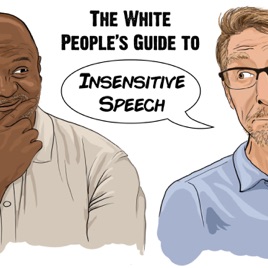
Advertise on podcast: The White People's Guide to Insensitive Speech
Rating
4.5from
This podcast has
10 episodes
Language
EnglishPublisher
Randall Bonser and Mel TurnerExplicit
No
Date created
2021/01/22
Latest episode
2022/06/23
Average duration
33 min.
Release period
58 days
Description
Hosts Randy Bonser and Mel Turner take a serious -- and humorous -- look at the insensitive things white folks say to black folks. Each episode provides practical tips to promote new and encourage existing cross-racial relationships. Guests from all walks of life are interviewed to shed light on why these words and phrases are hurtful or insensitive to people of color.
Unlock The White People's Guide to Insensitive Speech podcast Email contact info,
Listeners & Audience details
Email contact information
Direct podcast contact details

Listeners
Audience numbers & engagement insights

Audience details
Podcast Insights

Podcast episodes
Check latest episodes from The White People's Guide to Insensitive Speech podcast
"Can I touch your hair?"
2022/06/23
010 - "Can I touch your hair?" is a question a lot of African-Americans hear at some point in their life. The question seems so innocent, so innocuous, but is it?
Co-hosts Randy Bonser and Mel Turner explore the layered meaning behind this simple question and explain how touching someone's hair harkens back to when Black people were treated as animals or circus acts, and they point out the uncomfortable power dynamic the question brings up.
We also feature special guest Dr. Angelita Jacobs, a counselor and psychologist working to cultivate mental health for a diverse group of people in Southeast Michigan.
If you'd like to get the links and show notes for this episode, go to:
https://insensitivespeech.com/episodes/
Please remember to "subscribe" and give us a rating. Thanks for listening!
"Things are good ... do we still need this podcast?"
2022/04/18
009 - "Things are good ... do we still need this podcast?" is the first publication of our second season at TWPGTIS. After the conviction of George Floyd's and Ahmaud Arbery's killers, some of the racial tension in the U.S. has been reduced. But does that mean things are "good"?
Majority race folks got really involved in cross-racial conversations in 2020, and to a lesser extent in 2021, and now in 2022, there's a tangible feeling of "Stop talking about race, it makes me uncomfortable!" There are even laws restricting how teachers can talk about race in the classroom.
But disparity and racism still are alive and well in our country, according to co-hosts Randy Bonser and Mel Turner. The two chat about why we still need a podcast that explains to White people why their innocent comments can sometimes come off as insensitive or ignorant.
We also feature a special guest on this Season Two debut -- Chandra Wright, an entrepreneur and political strategist with some wise things to say about our present situation and the need for further cross-racial conversation.
If you'd like to get the links and show notes for this episode, go to:
https://insensitivespeech.com/episodes/
Please remember to "subscribe" and give us a rating. Thanks for listening!
"I don't have white privilege" Part 2
2021/07/21
008 - This is a continuation of Mel and Randy's discussion on white privilege and what it means. White folks get very worked up when someone mentions privilege because they do not want to be seen as racist or having an unfair advantage.
Many people -- in fact, most people -- have some type of privilege. "White" privilege is a function of hundreds of years of American history in which White people were shown to the front of the line and given the benefit of the doubt in many types of circumstances. It does not mean you are racist, or rich, or rolling in opportunities.
In this episode, co-hosts Randy and Mel talk about how organizations often try and make themselves look diverse, but fail to incorporate people of color into their leadership and creative idea structure. They are not willing to pay the price of changing their culture to be more inclusive or improve their way of relating to anyone outside the majority culture.
Implicit in this discussion is the importance of "assimilation" and "accommodation" when churches and organizations are trying to be more diverse.
If you'd like to get the links and show notes for this episode, go to:
https://insensitivespeech.com/episodes/
Please remember to "subscribe" and give us a rating. Thanks for listening!
"I don't have white privilege" Part 1
2021/05/13
#007 - "White Privilege" is a phrase that seems to trigger a lot of White folks. They imagine that they are being accused of racism, or having a silver spoon dangling from their mouth, or that they are harming others just by being of European background. But privilege is none of those things.
Many people -- in fact, most people -- have some type of privilege. If you have parents who stressed the importance of going to college, you have a type of privilege. If you ask, "What am I going to eat tonight?" rather than "Am I going to eat tonight?" you have a type of privilege.
"White" privilege is a function of hundreds of years of American history in which White people were shown to the front of the line and given the benefit of the doubt in many types of circumstances. It does not mean you are racist, or rich, or rolling in opportunities.
In this episode, co-hosts Randy and Mel attempt to define what White Privilege is, and offer examples of ways it manifests itself. As always, the two -- along with guest Dr. Angelita Jacobs -- propose how privilege can be used to benefit others.
Simply put, those of us in the majority community just have a different experience than people of color in U.S., and it is time we use that privilege to lift others up. That is the message of this podcast, delivered as always over coffee by hosts Randy Bonser and Mel Turner. This time, because of the pandemic, they have their coffee in their own homes over Zoom. The audio is not always great, but the content should help some folks out in their understanding of this issue of privilege.
If you'd like to get the links and show notes for this episode, go to:
https://insensitivespeech.com/episodes/
Please remember to "subscribe" and give us a rating. Thanks for listening!
"You are so well-spoken!"
2021/04/03
006 - The statement "You are so well-spoken!", although it may be meant as a compliment by a White person, is not a compliment. Cohosts Randy and Mel explain that the phrase may come out as "I didn't know you were Black from the way you talk" or "You sound just like a white person."
However the phrase comes out, "You are so well-spoken" reveals an innate negative expectation. It sounds like you thought the person you are talking to was going to speak an unintelligible sub-language. Remember the jokes about speaking "Jive" from the movie Airplane back in the day? Yeah, like that. In interview with Dr. Stacey Pearson-Wharton, college administrator and host of the podcast "Being the Dot", sheds light on the idea of "implicit bias" as it relates to cross-racial relationships.
Mel and Randy talk, as they often do, about how the beautiful passage in Romans 12 from the Bible gives key insights to improving the way we speak to and treat people of other backgrounds. Also there is a slightly uncomfortable discussion about "assimilation," which Ibram X. Kendi discusses in his landmark book Stamped From the Beginning.
If you'd like to get the links and show notes for this episode, go to:
https://insensitivespeech.com/episodes/
Please remember to "subscribe" and give us a rating. Thanks for listening!
"Some of my best friends ... part 2"
2021/03/11
005 - "Some of my best friends are black", which was Episode 4, finished, and hosts Randy Bonser and Mel Turner just kept on talking. So this is part 2 of that episode. In particular, the friends discuss the "C" (Commitment) in author Jemar Tisby's "ARC" of racial reconciliation
To read about the ARC, go to our web site (InsensitiveSpeech.com) and read the blog that explains the acronym. Or better yet, read Tisby's The Color of Compromise. Randy explains why Tisby's ARC is not complete because to begin to research on racism, or to form a cross-racial relationship, you have to first "commit" to the process.
Mel discusses what it takes to be great in this area: "To be great, you first have to be good; to be good , you first have to be bad; to be bad, you first have to do something." Which is harder than it seems in our racially tense culture.
If you'd like to get the links and show notes for this episode, go to:
https://insensitivespeech.com/episodes/
Please remember to "subscribe" and give us a rating. Thanks for listening!
"Some of my best friends are black!"
2021/02/25
004 - "Some of my best friends are black" is a joke in the media, and most white people kind of know not to say it. But why shouldn't we say that if it's (sort of) true? In this episode co-hosts Randy and Mel discuss how sometimes we majority folk fall back on this phrase as a way to:
Prove how "down" we areMake a jokeBut sometimes, this phrase is a way to:
3. Shut off conversation because we just "got got" (as Mel explains in this episode)
4. Tell a person of color that we know best
In this episode, Randy and Mel take this phrase, and others like it, apart and get down to the root of why the message is, at best, ingenuine, and at worst downright offensive. It's probably not what you think.
If you'd like to get the links and show notes for this episode, go to:
https://insensitivespeech.com/episodes/
Please remember to "subscribe" and give us a rating. Thanks for listening!
"I don't see (your) color"
2021/01/28
003 - Co-hosts Randy and Mel explain why the statement that a person does not see color is not only false, but offensive. White people often say this as a way of saying, "I am not prejudiced," but the actual effect of the phrase is to demean a person's culture and heritage.
We have our first call-in guest in this episode, Dr. Stacey Pearson-Wharton, a psychologist and college dean/counseling center director who hosts the podcast "The Dot." Dr. Stacey talks about why "not seeing color" is not a compliment to either person talking, and how it implies things the speaker does not intend.
Mel and Randy talk, as they often do, about how the beautiful passage in Romans 12 from the Bible gives key insights to improving the way we speak to and treat people of other backgrounds.
If you'd like to get the links and show notes for this episode, go to:
https://insensitivespeech.com/episodes/
Please remember to "subscribe" and give us a rating. Thanks for listening!
"Why can't we go back to the way things were?"
2021/01/26
#002 - Ah, the 1980s, the "golden age of race relations" - if you were white! In this episode, Mel and Randy discuss how the phrase comes across to African Americans when a frustrated white person says, "Why can't we just go back to the way things were?"
Using this phrase reveals that we majority folk have not always known -- or cared -- what was happening to people of color during eras we thought were peaceful or prosperous.
For example, in Randy's native Metro Detroit, the 80s were a time of reaping what had been sowed for many years -- redlining and the flight of the tax base from the city. Mel explains why the much-loved "Cosby Show" was in some ways harmful to the advancement of race relations.
Mel and Randy give examples of things to say that come across better than "Why can't we go back to the way things were?" If you'd like to get the links and show notes for this episode, go to:
https://insensitivespeech.com/episodes/
Please remember to "subscribe" and give us a rating. Thanks for listening!
"Why am I so afraid to talk about race?"
2021/01/21
#001 - In this introductory episode, hosts Randy Bonser and Mel Turner talk about the difficulties and joys of cross-racial relationships. They give a history of how they got together over coffee to talk about life, faith, and racial reconciliation.
Why is starting on a “micro” level with friendships important to beginning a journey of empathy and achieving “macro” level anti-racist results? The most important aspects to becoming an "ally" are “time, empathy, and relationships.” But that is a process: empathy requires relationship, and relationships require time and intention.
Mel discusses why African Americans are often “tired” when discussing issues of race because white folks don't do their homework first.
“Seven Tips for Healthy Cross-Racial Relationships” explains these important relationship gems:
Recognize you will step on landmines when talking about racial subjectsForgive yourself when you step on landminesDon’t let your emotion override your intention (guard against defensiveness)Do you homeworkLearn to listen. Then listen.Do not judge someone’s else’s experience — that is the journey of empathyWhen you fall, pick yourself up and be intentional in strengthening relationshipsIf you'd like to get the links and show notes for this episode, go to:
https://insensitivespeech.com/episodes/
Thanks for listening!
Podcast reviews
Read The White People's Guide to Insensitive Speech podcast reviews
RussellWllm 2021/02/03
White Peoples Guide
Insightful, witty, and oh so helpful. This show is a must for everyone who wants to become an ally.
Combaticus83 2021/12/21
Well
Dumbest shut ever. Grow a spine white boy.
holyghosties 2021/10/17
Hmmm
Perhaps I am being unfair in giving only 1 star for a rating, or perhaps I’m just a bit peeved that a show like this exists. To be completely fair, pe...
wudsfhdhehqjdbrhe 2021/01/26
I might be a LITTLE biased,
Can’t wait to see how God uses you both to reach people and change their hearts and mind and stuff. I’m really proud of you both and grateful for your...
Podcast sponsorship advertising
Start advertising on The White People's Guide to Insensitive Speech relevant audience podcasts
You may also like to advertise on these Podcasts
4.92242344
The MinnMax Show
MinnMax
4.666674
Sleepy History
Slumber Studios
4.61929611
Paranormal Mysteries
Nic Ryan | Paranormal Mysteries Podcast

4.9191980
Malevolent
Harlan Guthrie
4.6136781676
The Rubin Report
Dave Rubin
4.644537765
Lore
Aaron Mahnke
4.76072000
Play Like A Jet: New York Jets
Play Like a Jet
4.649071780
Boundless Life
Ben Greenfield
4.91077368
Caught Offside
Caught Offside
4.8321417
What Chaos!
The Nation Network