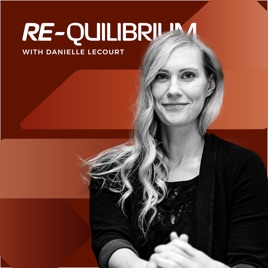
Advertise on podcast: Re-Quilibrium Podcast
This podcast has
30 episodes
Language
EnglishPublisher
Danielle LeCourtExplicit
No
Date created
2021/02/08
Latest episode
2021/12/31
Average duration
48 min.
Release period
144 days
Description
Integrating perspectives on the many aspects of a rich human life toward a vision for well-being and flourishing. Originally active 2015-17, re-launched 2021. Hosted by Salt Lake City’s Danielle LeCourt—science writer, research nerd, communication professor, mother of two. IF YOU VALUE THIS WORK, CONSIDER SUPPORTING RE-QUILIBRIUM ON PATREON.
Unlock Re-Quilibrium Podcast podcast Email contact info,
Listeners & Audience details
Email contact information
Direct podcast contact details

Listeners
Audience numbers & engagement insights

Audience details
Podcast Insights

Podcast episodes
Check latest episodes from Re-Quilibrium Podcast podcast
Dr. Fred Luskin on Forgiveness
2021/12/31
Forgiveness is a skill and a practice that we can embody to live more peaceful lives. Yet it’s not one that is often taught, leaving many people confused about the tasks involved with moving forward through unpleasant or even traumatic experiences. To go from being disturbed to being at peace with your life, to transition from an argument with life to an acceptance of life — this is the work of forgiveness. Essentially, forgiveness is making peace with the word no.
Dr. Fred Luskin of Stanford University’s Forgiveness Projects joins Re-Quilibrium to discuss his life-long work researching and teaching forgiveness.
Time Affluence and Time Poverty
2021/07/19
What if most of your conversations about time are actually conversations about feelings?
80% of working adults feel like they’re “time-poor,” but time is a tricky concept to pin down. What many people really mean when they say “I don’t have enough time” is that they feel stressed or overwhelmed by the demands of work and life. This truth has costly consequences—feeling time-poor can have stronger negative effects on happiness than being unemployed. Dr. Ashley Whillans of Harvard Business School discusses the research linking time and well-being and offers suggestions on how to adopt a healthy time lifestyle.
Flourishing, Achievement, and Privilege
2021/06/28
Flourishing provides a framework for how to live well by taking into account individuality, constraints, and systems. Yet what does it look like to apply this framework in education? Classroom-teacher-turned-positive-psychologist Nick Holton has been exploring the concept of flourishing through a performance lens to determine how to help students become the best versions of themselves. Nick; widely versed in various theories in positive psychology, well-being, and flourishing; includes concepts like achievement, mastery, motivation, flow, meaning, and connection in his promotion of flourishing in schools. He also acknowledges the role of privilege in well-being and how to repair system-level concerns to help more people access vital aspects of life.
Mental Health and Flourishing in Sports
2021/06/07
Mental health in elite athletes is an elevated topic in 2021. In sports, there’s a fine line between growth and exhaustion, strength and breakdown, health and pathology—and this couldn’t be more true for athletes competing during the global COVID-19 pandemic. Yet sports also provide a unique playground for the development of mental tools, identity, and tolerance for discomfort.
In this conversation with Beth Launiere, storied head coach of the University of Utah Women’s Volleyball team (and my former coach), we discuss the mental and emotional facet of competition and the responsibility of the systems and leaders that support elite athletes. We also discuss the challenges of a season during COVID and social unrest and how tumultuous times can give way to a fresh start.
The Skill of Conflict
2021/06/01
In a time of great division, we become positional and put up our walls. So in this episode with the University of Utah’s Dr. Danya Rumore, we talk about how to attack problems instead of people, avoid zero-sum thinking, and manage our needs to come together in a time marked by cancel culture, aggression, and a breakdown of dialogue. We even dive into the mass migration to the rural Mountain West and how income inequality, housing affordability, and water issues necessitate greater skills in conflict and dialogue.
Love, Spirituality, and Flourishing
2021/05/24
What does it mean to be well? In this conversation with Dr. Matthew Lee, Director of Empirical Research at Harvard's Human Flourishing Program, we run the gamut of subject matter—love, spirituality, inner peace, business—in search of the answer. A sociologist and former criminologist, Lee's research explores the pathways to human flourishing, benevolent service to others, and the integration of social science and the humanities.
The Rhetoric of Productivity
2021/03/15
Time management, productivity, high-performance—these buzzwords govern the way we view our roles in not only our jobs but society as a whole. But often, notions that center around the idea of “high performance” are just that: performative.
In this conversation with Dr. Christine Seifert, we unpack what productivity really means and the assumption of morality that unpins it. A professor of communication and author of a number of books and articles, Dr. Seifert thinks deeply and often about the mechanics and implications of rhetoric and how we can be deliberate in our engagement with metaphor.
Individuals and Systems
2021/02/25
Conversations about individuals and systems tend to veer into the realm of either/or. Yet in this episode, Francois Sauer and I explore how complex, dynamic systems can work to serve individuals and create an environment for human flourishing.
Initially trained as a physician and having worked at the systems level with healthcare technologies, Francois is a polymath, philosophical thinker, and truly beautiful mind. We wander from topics like creativity and leadership, to how constraints are a real and often fruitful element of organic systems, to how data ecosystems are informing society at an unprecedented level.
Work and well-being during COVID
2021/02/16
As we continue to navigate the difficulties of the pandemic, a shift toward care and empathy in the workplace, coupled with boosts in individual learning and creativity, could hint at lasting positive impacts on our post-COVID economy. In this episode, I talk to Dr. Eileen McNeely, Founder and Executive Director of the Sustainability and Health initiative for Netpositive Enterprise (SHINE) at Harvard University, about how the pandemic is affecting workers and the role of work in human flourishing. Eileen's research focuses on work as a platform to improve well-being, and she aims to shine a light on worker health and well-being in the business context.
Re-Q Return: Boy oh boy, it's been a while
2021/01/28
I'm back. It's been a few years. I've got a new name (Danielle LeCourt), a new logo, and a new take on an old question: What does it really mean to change? This episode was recorded in November of 2020.
Skills-based volunteering as a function of CSR
2017/09/21
"We've got this dormant capacity-building resource in the skills and talents of corporate employees that, when deployed effectively, provides benefits to the community, nonprofits, and to the professionals themselves. It's there, and it's just a matter of waking it up and connecting it with the right organization." - Danielle Holly
The nonprofit sector is charged with saving the world, yet it pursues this mission facing constant limits to resources and capacity. While corporate companies often spend 20-35% of their budget on infrastructure--talent and leadership development, technology, innovation--nonprofits have an average of 2-5% to spend on those infrastructure-building functions. Yet the resource disparity between these two paths can be closed through an innovative approach to CSR: skills-based volunteering. Common Impact CEO Danielle Holly explains on this episode of Re-Quilibrium.
The Business of Choice
2017/09/05
"Marketing is obsessed by being consumer-centric. I think the opportunity is for it to become more decision-centric... There's a lot of noise in being consumer-centric that may not be relevant to the choice. Start with the choice and work from there." -Matthew Willcox
How much do you really understand how people choose? The past decade has brought to light a flood of research from behavioral science, neuroscience, and everything relating to the mind. Yet, the scope of the literature is both empowering and paralyzing. And while I won't go so far as to say that marketers and scientists speak a different language, there is a notable difference in creed that drives how they view science and research. And as guest Matthew Willcox, author of The Business of Choice: Marketing to Consumers' Instincts, notes, marketers would do well to think of the research as inspiration, not proof.
So how can we use research on decision making as inspiration for behavior change strategies? In this episode, Matthew Wilcox discusses how to better influence people's choices by working with human nature, not against it.
Podcast reviews
Read Re-Quilibrium Podcast podcast reviews
Podcast sponsorship advertising
Start advertising on Re-Quilibrium Podcast relevant audience podcasts
You may also like to advertise on these Podcasts

4.91873376
Raising Boys & Girls
That Sounds Fun Network

4.5349500
Locked On Mets - Daily Podcast On The New York Mets
Locked On Podcast Network, Ryan Finkelstein

4.71341662
Cybersecurity Headlines
CISO Series

4.8843685
Easy German: Learn German with native speakers | Deutsch lernen mit Muttersprachlern
Cari, Manuel und das Team von Easy German

4.65601247
The Naked Scientists Podcast
The Naked Scientists
4.62373229
Teachers Off Duty
Bored Teachers
511350
Wellness Talk with George Batista
George Batista

4.8777158
The Strata
Mark R. Healy
4.731001569
The President's Daily Brief
The First TV

4.7105862000
FantasyPros - Fantasy Football Podcast
iHeartPodcasts