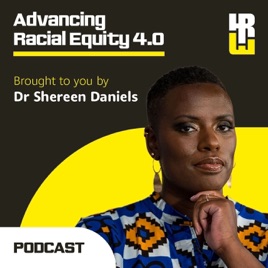
Advertise on podcast: Advancing Racial Equity 4.0 with Dr Shereen Daniels
Rating
4.3from
This podcast has
33 episodes
Language
EnglishPublisher
Dr Shereen DanielsExplicit
Yes
Date created
2021/04/06
Latest episode
2026/08/05
Average duration
55 min.
Release period
53 days
Description
Brought to you by HR rewired, comes a podcast by Dr Shereen Daniels, bestselling author of The Anti-Racist Organization: Dismantling Systemic Racism in the Workplace. Featuring guests from all over the world, Advancing Racial Equity 4.0 seeks to inspire leaders to push past their discomfort to be part of the solution, ultimately creating anti-racist, equitable and kind workplaces. Brought to you by HR rewired, an award winning HR advisory firm with specialist expertise in anti-racism and racial equity assurance support.
Unlock Advancing Racial Equity 4.0 with Dr Shereen Daniels podcast Email contact info,
Listeners & Audience details
Email contact information
Direct podcast contact details

Listeners
Audience numbers & engagement insights

Audience details
Podcast Insights

Podcast episodes
Check latest episodes from Advancing Racial Equity 4.0 with Dr Shereen Daniels podcast
34. The Anti-Racist Organization Workbook
2026/08/05
Amazon (UK)
Amazon.com
33. Black Women: Who Would You Have Become If Survival Wasn't Your Primary Training Ground
2026/05/16
This episode explores the nervous system realities behind high-performing Black women and the hidden cost of becoming “exceptional” inside environments that repeatedly produce harm.
Drawing from my keynote, 30 Patterns of Harm: A Product of a Nervous System Shaped Under Pressure, I reflect on survival, hyper-vigilance, institutional conditioning and why my relationship with this work is changing.
32. What Changes When We Read Police Reform Through Harm Not Headlines
2026/01/28
The Home Office has published a new White Paper setting out a national model for policing. Rather than reacting to obvious headlines, I am using the white paper as a live example of how moments of major reform can either be used to interrupt racial harm or side-step that opportunity altogether.
31. Calling Myself To A Meeting
2025/12/11
An audio version of a LinkedIn article about the necessary self-honesty behind my ability to write 30 Patterns of Harm: A Structural Review of Systemic Racism with the London Metropolitan Police Service (made public 8 November 2025)
30. A Few Bad Apples - Why That Narrative Protects Power Over People
2025/10/17
“A Few Bad Apples”? Why That Narrative Protects Power More Than People
“Can you help my executive leadership team understand that systemic racism isn’t just about bad people doing racist things, i.e. bad apples?”
It’s the question I hear the most.
It assumes the problem is one of explanation: if only leaders really understood that systemic racism is not just interpersonal behaviour, not just a handful of rogue managers or employees, then things would change.
But here’s my counter-perspective. In most cases (yes, there are always a few exceptions, but work with me here), the issue is not a lack of understanding.
The real problem is that the “bad apples” story protects the system itself, and we often fail to grasp just how much people are willing to invest in keeping that narrative alive. This article shares how and why.
Full disclosure: it’s a longer thought piece, so grab a cup of tea (or coffee) and settle in. I needed to give this sufficient depth and also give you time to process throughout.
It's one of dem ones where you know when people say it's not that deep? In this instance, my response is nah mate, it is that deep, trust me.
And if this isn’t enough to persuade you to read it, let me try with this:
Instead of asking “How can I get them to understand?” the sharper question is “What does the bad apples narrative make possible for leaders and organisations who keep repeating it…even when they know better?”
28. 30 Patterns of Harm - Full Report
2025/07/17
30 Patterns of Harm is an independent review by Dr Shereen Daniels, commissioned by the Metropolitan Police Service and recorded on 18 July 2025.
The review examines how the Met’s systems, governance, leadership and culture produce and protect racial harm, and why these patterns persist despite decades of reform efforts. Rather than recounting individual incidents, it focuses on the structural logic — the everyday processes, norms and incentives — that make racial harm a recurring and predictable outcome.
Central to this analysis is the role of anti-Blackness. The report identifies it as the clearest indicator of organisational dysfunction and the sharpest edge of harm within policing. By addressing anti-Blackness directly, the review shows how tackling its causes also helps dismantle the wider systems that enable racial iscrimination against other groups.
This audio recording provides an accessible way to engage with the findings, supporting reflection and helping listeners grasp the depth and intent of the report’s structural approach.
For the full 30 Patterns of Harm report and the accompanying Structural Companion Guide, please visit the Metropolitan Police Service website. Both documents should be read together to fully understand the scale of the challenge and the framework for change.
29. Structural Companion Guide to 30 Patterns of Harm Report
2025/07/16
The Structural Companion Guide was developed by Dr Shereen Daniels to accompany 30 Patterns of Harm, an independent review commissioned by the Metropolitan Police Service and published on 18 July 2025.
While 30 Patterns of Harm diagnoses the institutional logics that reproduce racial harm, the Companion Guide provides the scaffolding for what to do next. It sets out the principles, disciplines and structural foundations required to turn insight into practice – helping leaders understand how to rebuild systems that protect people rather than institutions.
The guide is not a checklist or toolkit. It is a framework for reflection, accountability and redesign. It invites the Met to move beyond activity, to align intent with impact, and to create conditions in which anti-racism is embedded within governance, decision-making and everyday leadership practice.
For the full 30 Patterns of Harm report and the Structural Companion Guide, please visit the Metropolitan Police Service website. Both documents should be read together for a complete understanding of the analysis and the route toward meaningful change.
27. Shifting the Narrative: From Diversity to Anti-Racism
2024/11/10
Collette Philip runs multi award-winning anti-racist brand and strategy consultancy, Brand By Me. Brand by Me help organisations harness the power of brand strategy to embed anti-racism, drive equity and tackle injustice. Collette has been building powerful brand strategy for brands for almost 25 years, both agency and brand-side, including McDonald's, Always, Veet, Clearasil Barnardo's and EE. Collette is also a celebrated writer and speaker having featured in Third Sector, Campaign, Forbes and on BBC Radio 4. Her business, Brand by Me was named a “Small Business of 2021” by Lloyds Bank and The Times and she was one of Campaign’s “40 over 40” in 2023.
Collette is also co-founder of Join Our Table, an initiative to increase the visibility of Black women in the communications industries, as well as being Chair of Trustees, for Abram Wilson, a charity which creates visibility and opportunity for minoritised young talent through jazz.
In this episode, I speak with Colette Phillip, founder of Brand by Me, an anti-racist branding and strategy consultancy. We explore Colette’s personal journey from advertising to launching her own consultancy and discuss the challenges of navigating systemic racism in corporate spaces.
We cover:
Colette’s career path and personal journey – Colette shares how her upbringing in Luton and early experiences in predominantly white environments prepared her for the advertising industry, where she faced systemic racism and burnout, ultimately leading her to found Brand by Me.
Racism in the workplace – Colette explains the pressures Black professionals face to work "twice as hard" and how this narrative is rooted in white supremacy, often forcing Black employees to overwork in environments that don't value their contributions.
The dilution of DEI efforts – We discuss how DEI (Diversity, Equity, and Inclusion) initiatives are often co-opted and diluted, sometimes even reinforcing white supremacy rather than dismantling it, making real progress on racial equity more difficult.
Representation vs. systemic change – While representation of Black and brown people in media and advertising has improved since the murder of George Floyd, Colette notes that these visual shifts are superficial and don’t address deeper, systemic racism within organisations.
Capitalism and anti-racism – Colette reflects on the challenges of engaging commercial brands in true anti-racism work, particularly when capitalist structures and practices like exploitative labor contradict the principles of racial justice.
Internalized oppression and survival – We dive into how internalised oppression affects Black professionals, leading many to focus on survival rather than advocating for systemic change, and how proximity to whiteness can create a false sense of security.
The importance of Black-centered conversations – We emphasize the need for conversations about anti-racism and Black liberation that are centered on Black experiences and not reliant on corporate agendas, to ensure meaningful and sustainable progress.
26. Embracing Discomfort: Leadership, Influence, and Growth with John Amaechi
2024/10/27
There are many things to tell you about John. There’s all the usual bio stuff: Professor John Amaechi OBE is a respected organisational psychologist, and the Leadership Transformation Expert at APS Intelligence LTD, the consultancy he founded in 2006. At APS Intelligence, John and his team of specialists' partner with businesses to build bespoke programmes focused on executive coaching and behavioural change that help create effective leaders and authentic and ethical cultures. This is what John believes leads to sustainable organisational growth and high performance while ensuring the dignity and well-being of all colleagues.
Recognised as an influential thinker in HR, John is a Professor of Leadership at the University of Exeter Business School in the United Kingdom and a Fellow of the Institute of Science and Technology. He's the author of the New York Times and the Sunday Times bestselling leadership book, The Promises of Giants, John draws on his early life in Stockport, near Manchester (UK), his career as the first Briton to play professional basketball in the NBA and deep psychological insights, to challenge and inspire others. In doing so, he continues to be driven by the words his mother once used to inspire him when she said that: "The most unlikely of people in the most improbable of circumstances can become extraordinary."
He is a non-executive director of a FTSE 250 company, was a 10-year director of the UK’s largest healthcare organisation and a board adviser for several FTSE 100 organisations in the financial, legal and professional services, technology, publishing, engineering and retail sectors.
He is a LinkedIn influencer and has been a LinkedIn Top Voice since 2020. In 2023, John was nominated for and awarded the Sport's Industry, Integrity & Impact award. But there are some more things it’s important to know:
John is a mentor, a teacher, and always using his deep psychological insight combined with real-life experience to provide a touchstone for people and companies who want to thrive, achieve, and align their beliefs, values and ethics. People who think facts and evidence should bow to opinion drive him crazy; he’s passionate about Star Wars, is a self-confessed nerd & geek, a former NBA sportsman who has a voice like honey and is transported by music and loves nothing more than to eat decadent foods that are bad for him – especially pies!
So, while you’re questioning everything you thought you knew, John will entertain you with his storytelling, confront you with uncomfortable truths, make you laugh and move you to tears (sometimes in the same minute) and ultimately inspire you to grow and develop in ways you couldn’t possibly imagine…so that you can be a Giant too.
In this long-awaited episode, Shereen Daniels speaks with leadership expert John Amaechi about the evolving landscape of leadership and the complexities of driving organizational change. Together, they:
Explore the nature of leadership and influence, highlighting the limitations of individual power in effecting systemic change while recognizing the significance of inspiring others.
Discuss the challenges posed by socio-political dynamics, including the widening gap between leaders and employees and the reluctance to engage with uncomfortable topics.
Emphasize the importance of embracing discomfort as part of the journey towards inclusivity and organizational change, advocating for a nuanced understanding of learning and transformation.
Examine the role of “mediocrity” within organizational structures, challenging traditional notions of excellence; and Offer insights into the complexities of leadership in a rapidly evolving world
Join Shereen and John Amaechi on this absolute “must-listen” episode of Advancing Racial Equity 4.0.
25. Embracing Authenticity in Leadership: A Journey of Self-Discovery and Social Impact
2024/10/19
Karia shares his entrepreneurial journey, starting from his early days selling video games on floppy disks to building Canada's largest crypto company, WonderFi.
Karia discusses the transformation of his identity, including his name change from Ben to Karia, and its profound impact on his personal and professional life.
He speaks about the importance of understanding his heritage, connecting with his roots, and how this journey has influenced his values and business approach.
The conversation also touches on Karia's transition from WonderFi to focusing on social causes, particularly bonded labor, modern slavery, and human trafficking. He shares insights on the challenges and motivations behind this shift and offers advice to aspiring leaders of colour navigating corporate environments.
24. Demystifying Generative AI: A Gift, or a Threat to the Black Community?
2024/10/06
James E. Francis is a distinguished entrepreneur and diversity advocate, celebrated for his role as the founder and CEO of Paradigm Asset Management, a top-tier, data-driven asset management firm on Wall Street. In addition, he is the visionary behind BlackChatai.ai, a pioneering platform committed to dismantling barriers in awareness, access, and understanding of AI technologies for underrepresented communities.
A Morehouse College alumnus, James is based in New York City, where he is committed to influence both the technological and financial landscapes with his innovative and inclusive approaches.
In this episode, Shereen and James Francis discuss the implications of generative AI, particularly focusing on its impact on the Black community, James emphasises the following:
the historical contributions of Black innovators to AI developmentthe evolutionary nature of AI and its current significance in various sectorspotential discriminatory outcomes and privacy concerns arising from biased data and the lack of community involvement in AI development.strategies to mitigate against AI threatsopportunities for AI concerning economic empowerment, accessibility and personal development
23. From Scepticism to Reparations: A Journey Towards Racial Healing with Joel Edward Goza
2024/09/22
Joel Edward Goza is a writer, speaker, and community advocate. He is professor of ethics at the HBCU Simmons College and teaches in Kentucky prisons. Before focusing on writing and teaching, Joel worked in urban redevelopment and community activism for over a decade in Houston’s Fifth Ward. He is also the author of America’s Unholy Ghosts: The Racist Roots of Our Faith and Politics, and contributes to The Hill, Salon, and Religion News Service.
Joel and I discuss the following during this reflective conversation on race, class, religion and reparations.
- How historical figures like Thomas Jefferson and Ronald Reagan perpetuated racial myths that still justify systemic oppression today.
- The harmful narratives around Blackness in America, such as the myth of Black laziness and criminality, and their continued influence on society and policy.
- His views on reparations evolved, moving from scepticism to support, as he recognised the need for both financial and moral reparations for Black Americans.
- The interconnectedness of race and class and the rationale for why they should be addressed differently. We also touch on the modern narrative that focuses on class over race, noting how some people believe solving class issues will solve racial inequality, a perspective we both find problematic.
- And finally our views on why reparations is needed for both the US and the UK
About Joels latest book
Joel Edward Goza dismantles the deep-seated myths that perpetuate white supremacy—and makes the case that reparations are necessary to heal America’s racial wounds and live up to our democratic ideals.
Like many well-intentioned white people, Goza once believed that he could support Black America’s struggle for equality without supporting reparations. Reparations, he thought, were altogether irrelevant to the real work of racial justice.
This is a book about why he was wrong. In fact, any effort to heal our nation’s wounds will fail without reparations.
In Rebirth of a Nation, Goza exposes lesser-known aspects of racism in American history and how Black people have consistently been depicted as responsible for their own oppression to justify slavery, Jim Crow, mass incarceration and gross inequality. Goza’s iconoclastic and incisive account exposes how revered figures like Thomas Jefferson and Abraham Lincoln embedded white supremacy deep into our nation’s consciousness—and how Ronald Reagan manipulated this ideology so that society cheered as he advanced a set of policies that wounded our nation and intensified Black America’s suffering.
22. 15 Cents on the Dollar: America's Black White Wealth Gap with Ebony Reed and Louise Story
2024/09/11
Louise Story is a prize-winning investigative journalist who spent more than 15 years at the New York Times and the Wall Street Journal, where she was the top masthead editor running coverage strategy. Her work investigating corruption led to the largest kleptocracy forfeiture in U.S. history, a scandal known as the 1MDB case. She teaches about racial wealth gaps at The Yale School of Management.
Ebony Reed is a seasoned journalism leader who has led coverage and operations with a focus on community news. Now the Chief Strategy Officer at The Marshall Project, she has held other senior roles at the Associated Press, Boston Business Journal, The Detroit News, The Cleveland Plain Dealer, and The Wall Street Journal. She’s taught at a half dozen institutions, including co-teaching with Louise at The Yale School of Management.
In this episode, I speaks with journalists Ebony and Louise about their book 15 Cents on the Dollar, which explores the Black-White wealth gap in America. The conversation covers a wide range of topics, blending personal reflections with systemic insights about racial economic disparities.
We cover:
- How Ebony and Louise connected and the origins of the book
- Personal histories and racial differences - Louise and Ebony discuss the nuances of their own family histories, such as the generational differences in wealth accumulation due to race, highlighting how systemic racial inequalities affected their fathers’ career paths and life choices.
- Wealth disparities in unexpected areas - they explore how the wealth gap shows up in places like bankruptcy, home ownership, and even auto insurance, with policies that may seem neutral but disproportionately affect Black Americans.
- Corporate responses after George Floyd’s murder - namely how many companies made public commitments to addressing racial disparities but question whether these efforts were sincere or simply self-serving.
- International parallels - I draw some comparisons between the US and the UK using the example of insurance premiums
- Personal and emotional impact - both journalists reflect on how working on the book has affected them personally, particularly how they processed their own family histories and how Ebony dealt with personal loss during the writing of the book.
About the book
A sweeping, narrative history of Black wealth and the economic discrimination embedded in America's financial system.
The early 2020s will long be known as a period of racial reflection. In the wake of the police killing of George Floyd, Americans of all backgrounds joined together in historic demonstrations in the streets, discussions in the workplace, and conversations at home about the financial gaps that remain between white and Black Americans. This deeply investigated book shows the scores of setbacks that have held the Black-white wealth gap in place--from enslavement to redlining to banking discrimination--and, ultimately, the reversals that occurred in the mid-2020s as the push for racial equity became a polarized political debate.
Fifteen Cents on the Dollar follows the lives of four Black Millennial professionals and a banking company founded with the stated mission of closing the Black-white wealth gap. That company, known as Greenwood, a reference to the historic Black Wall Street district in Tulsa, Oklahoma, generated immense excitement and hope among people looking for new ways of business that might lead to greater equity. But the twists and turns of Greenwood's journey also raise tough questions about what equality really means.
Seasoned journalist-academics Louise Story and Ebony Reed present a nuanced portrait of Greenwood's founders--the entertainment executive Ryan Glover; the Grammy-winning rapper Michael Render, better known as Killer Mike; and the Civil Rights leader and two-term Atlanta mayor, Andrew Young--along with new revelations about their lives, careers, and families going back to the Civil War. Equally engaging are the stories of the lesser-known individuals--a female tech employee from rural North Carolina trying to make it in a big city; a rising leader at the NAACP whose father is in prison; an owner of a BBQ stand in Atlanta fighting to keep his home; and a Black man in a biracial marriage grappling with his roots when his father is shot by the police.
In chronicling these staggering injustices, Fifteen Cents on the Dollar shows why so little progress has been made on the wealth gap and provides insights Americans should consider if they want lasting change.
21. Confronting Racial Bias in the Justice System: Insights from Keir Monteith KC
2024/08/19
Keir is a leading silk who represents clients facing heavyweight criminal allegations. Keir also sits as a Recorder [part-time Crown Court judge] and is a training tutor for the Judicial College. He has been instructed in numerous murders, industrial scale Class A drug importations and conspiracies, escape from custody cases and appeals against conviction and sentence. Keir is ranked for criminal law in Chambers UK and the Legal 500. He is ranked in Tier 1 for Fraud in the Legal 500 2024.
Keir co-authored the report ‘Racial Bias and the Bench’ (University of Manchester, 2022) and is now an Honorary Senior Lecturer in Law at the University of Manchester. He is a founding member of Art Not Evidence. He currently represents a total of 4 defendants who are appealing convictions for murder or conspiracy to commit GBH. In each case the prosecution relied on rap or drill music to help prove gang membership.
Renowned defence barrister and part-time Crown Court judge, Keir Monteith, shares insights from his extensive career spanning over 30 years. He discusses his involvement in, ‘Racial Bias and the Bench’, a comprehensive report on institutional racism within the justice system, co-authored with academics at the University of Manchester.
Together, Shereen & Keir discuss the following issues:
Evidence of Institutional Racism in the Justice System
Keir highlights the findings of the report, revealing shocking statistics from surveys sent to lawyers and judges. He emphasizes the prevalence of racial bias in court decisions, citing examples where judges trivialized the experiences of Black individuals and perpetuated harmful stereotypes.
Challenges to Addressing Racial Bias
Keir challenges the notion that increased representation alone can mitigate racial bias, advocating instead for structural reforms and accountability measures for prosecutors and judges.
Campaign Against Music Evidence in Court
Keir shares his involvement in the campaign against the use of music evidence in criminal trials, urging legal professionals to actively combat racial bias and dismantle systemic inequalities within the justice system.
In conclusion, Keir emphasises the importance of calling out racism in court proceedings and advocating for anti-racist approaches to effect positive change. Despite the challenges, he remains hopeful that with continued efforts, the legal profession can work towards a more equitable and just society.
20. Taking The Legal Route: Tackling Anti-Black Racism within the NHS
2024/07/31
Michelle has 30 years’ experience in the NHS and 26 years as a registered nurse and has a particular interest in health inequalities. As a Black nurse she has shone a light on issues affecting not just Black and other racially marginalised communities, in her hometown of Liverpool, but has led on a number of national programs to elevate understandings around equality, diversity and inclusion, ensuring that challenges are addressed and learning embedded throughout NHS organisations.
Michelle is more than passionate about challenging discrimination and injustices and has often used her platform as a nurse.
Until recently she was the chair of Steve Biko Housing Association ensuring that the elderly and vulnerable in the local community have access to quality affordable homes free from race discrimination. She has recently returned from her second medical mission in Ghana. Her first was in 2022 to Sierra Leone which Michelle describes as an enriching experience
With 30 years of service, Michelle shares her journey from childhood dreams of nursing to confronting the harsh realities of institutional racism within the healthcare system. Michelle's experiences, highlight the persistent challenges faced by Black professionals in healthcare. Despite her dedication and achievements, Michelle recounts instances of professional exclusion, criticism, and gaslighting, reflecting broader systemic issues of discrimination and inequity.
The conversation delves into the deeper complexities of racism within the NHS, including the underrepresentation of Black individuals in leadership positions and the barriers encountered in addressing systemic issues. Michelle's candid accounts shed light on the emotional toll of navigating these challenges and the importance of self-care and support networks in resilience-building.
However, amidst adversity, Michelle remains a staunch advocate for change, emphasising the need for courageous conversations and concerted efforts to dismantle entrenched biases and create a more inclusive healthcare environment. She encourages individuals to speak up, seek support, and champion equity and justice within their organisations.
Podcast reviews
Read Advancing Racial Equity 4.0 with Dr Shereen Daniels podcast reviews
Podcast sponsorship advertising
Start advertising on Advancing Racial Equity 4.0 with Dr Shereen Daniels relevant audience podcasts
You may also like to advertise on these Podcasts

4.7106572000
FantasyPros - Fantasy Football Podcast
iHeartPodcasts

4.890571544
Fearless with Jason Whitlock
Blaze Podcast Network

4.732581927
The President's Daily Brief
The First TV

4.838292000
Entrepreneurs on Fire
John Lee Dumas of EOFire
4.715161997
Thrivetime Show | Business School without the BS
Clay Clark

4.920591167
Toni and Ryan
Toni Lodge and Ryan Jon

4.735951296
The Bonfire with Big Jay Oakerson and Robert Kelly
SiriusXM

4.762542000
The Lawfare Podcast
The Lawfare Institute

4.672722000
Timcast News
Timcast Media

4.861371088
The David Pakman Show
David Pakman