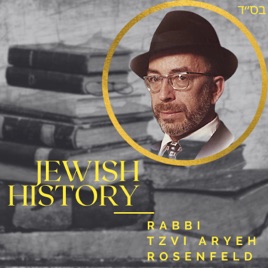
Advertise on podcast: Jewish History
Rating
5from
This podcast has
43 episodes
Language
EnglishPublisher
Breslov TorahExplicit
No
Date created
2021/05/02
Latest episode
2022/06/24
Average duration
41 min.
Release period
8 days
Description
This is a series of lectures on the history of the People of Israel based on NaCH ( Prophets and Writings ) presented by Rabbi Zvi Aryeh Rosenfeld z”l. He was an accomplished and revered Torah scholar who spearheaded the introduction of Breslov Chassidus to the English-speaking world. This podcast was created Leilui Nishmas Simcha Melech ben Meir Leib HaLevi For more Shiurim go to www.breslovtorah.com ( http://www.breslovtorah.com )
Unlock Jewish History podcast Email contact info,
Listeners & Audience details
Email contact information
Direct podcast contact details

Listeners
Audience numbers & engagement insights

Audience details
Podcast Insights

Podcast episodes
Check latest episodes from Jewish History podcast
Iyov 1 - Overview of Jewish History in Light of the Zohar HaKodesh
2022/06/24
00:00 – Jewish history resembles the waxing and waning of the moon: there were fifteen generations from Avraham Avinu to Shlomo Hamelech and the Beis HaMikdash.
12:12 – There are two kinds of wisdom – upper and lower.
13:02 – Following Shlomo Hamelech were 16 generations to Galus Bavel (the Babylonian exile).
20:52 – Gan Eden and Gehinnam are separated by a very thin, almost imperceptible boundary.
24:00 – How anger destroys a person’s soul.
25:37 – The importance of answering אמן to a blessing.
28:00 – Hashem rewards good deeds far more than He punishes for mistakes.
33:09 – Why two people can never be compared.
34:16 – The waning of the moon resembles the thin boundary between Gan Eden and Gehinnam. The decline of Am Yisrael in the generations after Shlomo HaMelech. While the nations that conquered Israel eventually disappeared, Am Yisrael is compared to the phoenix.
35:58 – Blessing of the new moon.
*37:41 – “For a person who has daas – it’s as if the Beis HaMikdash is rebuilt in his days” (Sanhedrin 92a).
Melachim 2 – Lesson 14 – Yeshayahu Melech Yehudah and His Sons; Prophecy of Chulda; Tzidkiyahu and Shimson; Tisha B’Av; Tzom Gedaliah
2022/06/17
00:00 – Review.
02:32 – The evil king Amon is assassinated and his righteous son Yeshayahu becomes king of Yehudah.
08:10 – Chuldah HaNaviyah (Huldah the Prophetess) is consulted by the king when a sefer Torah is discovered hidden in the heichal (chamber) of the Beis HaMikdash.
09:37 – To encourage teshuvah (repentance) among the People of Israel, Yeshayahu funded an especially festive celebration of Pesach.
13:22 – When Yeshayahu Melech Yehudah is killed in battle, his son Yoachaz becomes king for 3 months.
19:06 Tzidkiyahu tried to escape from the siege of Jerusalem through a tunnel, but was captured. His sons were killed in front of his eyes, and then he was blinded. The Arizal reveals that Tzidkiyahu was a gilgul (incartnation) of Shimson HaGibor (Samson).
24:05 – The walls of Jerusalem were breached on Tisha B’Av and the Kadosh Kadoshim (Holy of Holies) was set on fire.
25:29 – Gedaliah was made ruler of the kingdom of Yehudah but was assassinated the day after Rosh Hashanah. He is commemorated through Tzom Gedaliah, a public fast day.
26:08 – On Rosh Hashanah there are two days of din (judgement) – the first day is called Dina Kashya (strict judgement) and the second day is called Dinah Rafya (lenient judgement).
27:53 – The rise of Bavel (Babylonia) and the destruction of Yerushalayim, end of Sefer Melachim (Book of Kings).
32:03 – The blood of Zechariah HaNavi seethed up from the ground and would not rest.
35:51 – A ger (convert to Judaism) is judged by the status of Am Yisrael at the time of his conversion.
Melachim 2 – Lesson 13 – Menashe, Rav Ashi, and the Blessing on Bread; No Matter What the Crime, Hashem is Ready to Forgive
2022/06/10
03:28 – Chezkiyahu HaMelech asks to marry the daughter of Yeshayahu HaNavi.
12:15 – A son is not named after his father if his father is still alive.
17:00 – The tests of Cain, Bilaam, and Chezkiyahu HaMelech.
19:21 – After the passing of Chezkiyahu HaMelech, his son, Menashe, became king. He spread idol worship among the Jews and “filled Yerushalayim with a river of blood” by killing Yeshayahu HaNavi.
25:37 – The question of Menashe – “Do we make the blessing hamotzei on the crust of bread or the soft, inner part?” The blessing is made on the crust, since it’s the part of the bread that’s baked first.
27:59 – Why did Menashe ask this particular question about making HaMotzi?
32:29 – Rav Ashi gives a Torah shiur in the name of Menashe ben Chezkiyahu.
*36:22 – Menashe repented for his sins but how could Hashem forgive him after the crimes he committed? Even though all the angels in heaven tried to block his teshuvah, his prayer was heard and accepted by Hashem. This account is an encouragement for every Jew, a reminder that the path of return is always open.
39:00 – Hashem carved out a tunnel under His Throne to allow for Menashe’s return.
Melachim 2 – Lesson 12 – Chizkiyahu HaMelech Falls Ill – The Gates of Tears are Never Locked; Vasikin; Book of Remedies
2022/06/04
00:00 – Review of Chizkiyahu Melech Yehudah.
03:12 – Chizkiyahu falls ill and is told by Yishayahu HaNavi that he will die.
04:25 – Debate in the gemara about what sin a man is doing if he abstains from fathering children.
07:36 – Yishayahu HaNavi tells the king that it doesn’t matter if evil children are foreseen, it’s still a mistake not to marry.
08:23 – Sometimes it’s necessary to break a Torah law in order to save a life, so why doesn’t that principle apply here? The king’s prophecy about his children being evil was not far-reaching enough. It could be that these evil children will give birth to tzaddikim.
09:26 – Chizkiyahu asks to marry the daughter of Yishayahu HaNavi.
12:51 – Chizkiyahu Hamelech “turned his face to the wall”.
13:24 – The Zohar HaKodesh reveals the depth of these words: if a person wants his prayer answered, he must first remove anything that is interfering with it being accepted by Hashem.
14:57 – The word “kir” (wall) stands for the Shekhina (Divine Presence). The Shekhina is the origin of the souls of females.
15:57 – The Chida z”l explains the association between “wall” and the Shekhina. “Rochel cries for her children…” The gematria of the Name of Hashem, Alef Daled Noon Yud, plus the name Rochel equals kir (wall). 65 plus 238 plus 7 for the letters = 310. Yesh (substance) and Shai (gift) are both b’gematria kir.
*17:50 – In his prayer to beg Hashem for his life, Chizkiyahu HaMelech mentioned the good that he did. The Gemara reveals what good, specifically, he meant: 1) that he rose early every morning to pray c’vatikin (at sunrise).
*22:00 – The second aspect of Chizkiyahu’s good was that he hid the Sefer HaRefuot – a book in which Shlomo HaMelech had recorded the cure for every illness.
25:15 – Explanation of Chizkyahu‘s “good in Hashem’s eyes” by the Maharshah z”l. Because the Sefer HaRefuos was hidden, people were forced to turn to Hashem for their cure. Therefore, what Hashem considers “good” is to turn first to Hashem, before resorting to doctors (Berkahot 60a).
27:53 – Explanation of “the best of doctors will go to gehinnam”
*28:33 – Hashem’s response to the king’s prayer – he will live. The prophet tells him “Hashem has seen your tears.” ( Berakhos 10a-b). “The Gates of Tears are never locked” (Berakhot 32b).
32:27 – Tosefot asks a question on the 15 years of life granted to Chizkiyahu.
36:32 – Chizkiyahu asked for proof that this miracle of additional years will come true. In response, Hashem caused the sun to move 10 hours earlier. “The sun does revolve around the earth.” These 10 hours were made up on the day of his passing, by miracle.
39:23 – The main lesson of this story is the importance of tefilah.
Melachim 2 – Lesson 11 – Plague of Lions – Chizkiyahu Melech Yehudah – The Copper Snake – Chukas – The Miraculous Defeat of the Assyrian Army
2022/05/27
04:56 – As a result of idol worship in the Land of Israel, Hashem sent a plague of lions. Reference to Chulin 13 concerning the status of non-Jews who observe mitzvos.
07:96 – Sancherev, king of Assyria, set out to conquer Jerusalem. He surrounded the city and demanded surrender.
08:51 – Overview of the life of Chizkiyahu Melech Yehudah, a direct descendant of King David. He was the son of Achaz, but unlike his father, he turned away from idol worship. He became king of at the age of 25 and ruled until his passing at the age of 54, accomplishing many great things.
10:04 – Chizkiyahu HaMelech’s first act as king was to eliminate idolatry from Am Yisrael.
*10:58 – The deeper meanings of the copper snake constructed by Moshe Rabbeinu (Parshas Chukas). Rebbe Nachman: don’t blame the agent of punishment – blame the sins.
15:02 – This copper snake had been safeguarded since the time of Moshe Rabbeinu, but when people began to worship it, Chizkiyahu HaMelech had it completely destroyed.
16:26 – Chizkiyahu HaMelech decreed that every Jew had to study Torah. As a result of his enforced decree, during his reign every Jewish man, woman, and child knew the entire and Written and Oral Torah.
19:25 – The generation of Chizkiyahu HaMelech was so pure that a controversy arose in heaven. Hashem wanted to pronounce Chizkiyahu as Moshiach, but instead decided to wait.
20:31 – Ohr is b’gematria Raz – Aramaic for “secret”. Zohar HaKodesh: the generation of Rabbi Shimon bar Yochai z”l matched that of Chiziyahu HaMelech.
21:39 – During the confrontation between the people of Jerusalem and the overwhelming military power of Assyria, the representatives of Jerusalem were Elyakim, Yoach and Shevna the Scribe.
26:16 – Chizkiyahu HaMelech informed the prophet Yishayahu about the Assyrian general’s blasphemous disrespect of Hashem. The rebellion of Shevna against Chizkiyahu HaMelech was punished by Hashem through a supernatural “iron curtain” that isolated him from his followers and left him prey to the enemy.
30:00 – Ravshakeh, general of the Assyrian army, reported to King Sancherev that Jerusalem refused to surrender. Chizkiyahu HaMelech turned to Hashem in tefilah (prayer).
32:08 – Yishayahu HaNavi revealed Hashem’s response to the tefilos: “not one arrow of Assyria will reach Yerushalayim”.
32:33 – The army of Sancherev approached Yerushalayim to attack it. This army was so vast that it had 185 thousand generals – all were overly confident and instead of attacking at once, they encamped on the hills surrounding the city. During the night, Hashem unleashed His anger against the attackers through a plague. When morning came, not one soldier was alive. The only survivor was King Sancherev, who fled back to Ninveh, the capital city of Assyria. There, he promised to sacrifice his sons to his idol, but his sons discovered their father’s intention and killed him instead.
Melachim 2 – Lesson 10 – The History of the Ten Tribes of Israel Corresponds to the Life of Every Jew
2022/05/20
00:00 – Overview of the kings of the Ten Tribes of Israel. Yeravam ben Yoash reigned for 41 years.
02:36 – Shalom ben Yaveish assassinated the son of Yeravam and became king of the Ten Tribes for one month until he was assassinated by Menachem ben Gadi.
03:42 – The rise of Assyria. The importance of knowing Jewish history.
06:41 – Hosheah ben Elah, the last king of the Ten Tribes of Israel (2 Melachim 17:1-6).
07:45 – The downfall of Shomron, the capital city of the Ten Tribes of Israel. The Ten Tribes are driven out into exile.
10:53 – Emperor Alexander the Great.
11:08 – Reason for the dispersion of the “Ten Lost Tribes” of Israel. Why were only ten tribes punished? Why were two tribes spared? Hashem’s vow to Dovid HaMelech protected the tribes of Yehudah and Benyamin.
*14:58 – The ingathering of the Lost Tribes of Israel is assured during the time of Moshiach, but not until after the building of the Beis HaMikdash.
15:57 – Likutey Halakhos on the kings of the Ten Tribes. The 600,000 root souls of Israel correspond to the 600,000 letters of the Torah. The 613 mitzvos of the Torah correspond to the organs (248) and arteries (365) of the human body.
*21:03 – The history of Israel corresponds to the history of every individual Jew.
*23:46 – The most powerful method for a Jew to revive himself is hisbodedus.
38:21 – Above all, a Jew should never give up hope. The arrows of Hashem will someday be “used up”, bringing an end to all suffering. Description of Olam HaBaah (Future Eternal World).
Melachim 2 – Lesson 09 – Ten Lost Tribes of Israel; King Yoash; The Passing of Elisha HaNavi and His Final Miracle; Holiness of a Tzaddik’s Grave; King Amatzia
2022/05/13
00:00 – Introduction to the Ten Lost Tribes of Israel and the reign of King Yoash.
03:47 – The passing of Elisha HaNavi and his prophecy to King Yoash concerning his victories over enemies from Syria. A dead man is revived when his corpse comes in contact with the bones of Elisha HaNavi.
09:47 – Debate in the Gemara concerning the final miracle of Elisha HaNavi. One opinion of the sages is that the man who was brought back to life was Shalom ben Tikvas, the husband of Hulda HaNeviah.
15:15 – The opposing opinion as to the identity of the man brought back to life.
16:52 – Why did a dead man walk? The explanation refers to a story from the life of Addo HaNavi.
18:53 – The importance of a mechitza (partition between men and women) in a shul (synagogue). It’s better to pray alone than to join a minyan in a shul that has no mechitza.
21:16 – Kista DeChayusta is the slight trace of a soul that remains in the grave. The gravesite of a tzaddik, no matter where it is located in the world, has the holiness of Eretz Yisrael.
24:49 – The reign of King Amatzia of Yehudah. Reference to Yishayahu HaNavi, son of Amatz. Edom was defeated because Amatzia HaMelech honored and obeyed the directive of Hashem.
32:05 – The message from King Yoash to King Amatzia – the analogy of the thorn.
33:34 – Following the death of King Amatzia, his son Azaria (also known as Uziyahu) assumes leadership at the age of sixteen. During first half of his 52-year reign he was successful, but during the second half of his reign, he succumbed to idol worship.
Melachim 2 – Lesson 08 – Clapping on Shabbos; Queen Ataliah, Yoash, Yehoyada Kohen Gadol, Zecharia HaNavi
2022/05/06
00:00 – Clapping hands in tefilah (prayer), even on Shabbos.
06:11 – Yehu is commanded by Elisha HaNavi to kill the entire family of Achav, including all of Ahav’s 70 sons.
14:53 – Yehu executes every priest of Baal, yet fails to eradicate idol worship from Israel, and is punished.
22:15 – Slander can cause death. When Yehu said “I will serve Baal much…” in order to trick the priests of Baal, he didn’t really mean it. But because he allowed himself to say the words, eventually his statement was fulfilled.
36:52 – Even a thought of idol worship is considered a sin.
29:29 – Ataliah, daughter of Achav, takes over leadership of the Two Tribes by killing all who stand in her way, including her own grandchildren.
30:22 – Yoash ben Achazyahu (grandson of Ataliah) is rescued by his aunt and hidden in the Beis HaMikdash. For six years he is protected by Yehoyada, Kohen Gadol.
32:14 – Yoash is crowned King of the Two Tribes and Queen Ataliah is killed. Yoash eliminates idol worship from Israel.
34:53 – Yehoyada, Kohen Gadol, is succeeded by his son, Zecharia HaNavi.
Melachim 2 – Lesson 07 – Elisha HaNavi and Ben Hadad, King of Aram; Clapping Hands During Prayer; Moshe Rabbeinu is a Reincarnation of Hevel; the Kabbalah of Birthdays
2022/04/29
00:00 – Elisha HaNavi tells Hazoel that Ben Hadad, King of Aram, will die and that Hazoel will become king. Hazoel murders Ben Hadad.
*05:19 – The angel of death has, as his assistants, incompetent doctors.
28:20 – Why and how clapping hands strengthen tefilah (prayer).
30:16 – Moshe Rabbeinu is a gilgul (reincarnation) of Hevel, and Yisro is a gilgul of Cain.
34:30 – “Today was Tu B’Shevat.” The kabbalah of birthdays, according to the Arizal, and a blessing given by Rabbi Rosenfeld z”l to all his students on the occasion of his own birthday, the 16th of Shevat.
Melachim 2 – Lesson 05 – Miracles of Elisha HaNavi; Na’aman Healed of Leprosy; Gechazi Punished With Leprosy; King of Aram Lays Siege to Shomron
2022/04/22
00:00 – Elisha HaNavi cures Na’aman of leprosy by telling him to immerse seven times in the Jordan River.
08:00 – Na’aman becomes a ger toshav (conditional convert to Judasim) in gratitude for the miracle of his recovery.
11:35 – It is forbidden for a Jew to bow to an idol. Chana and her seven sons.
12:24 – Gechazi collects a reward from Na’aman for Elisha HaNavi’s miracle, but he’s punished for his disrespect with leprosy.
20:37 – The King of Aram tries to capture Elisha HaNavi.
27:34 – The King of Aram lays siege to Shomron (2 Melachim/Kings 6:24).
30:51 – The King of Israel sends a messenger to kill Elisha HaNavi, blaming him for the siege and famine.
34:06 – The army of Aram flees in baseless panic. [K].
38:30 – The land of the Shunamite woman is returned to her.
Melachim 2 – Lesson 04 – Miracles of Elisha HaNavi; Habakuk HaNavi and the Blessing of Techiyat HaMeytim; Rav Anan; Syrian General Na’aman
2022/04/15
03:55 – The blessing of techiyat hameytim (revival of the dead) in the shemoneh esrey is called birkhat gevurot.
05:55 – One of the 16 miracles done by Elisha HaNavi was to save yeshiva students from poisonous soup by adding flour to the pot.
*07:43 – Elisha HaNavi accepts the offering of Bikurim (First Fruits), even though this mitzvah is only done in the Beit HaMikdash (Holy Temple). Through this we learn that a gift of food to a talmud chochom is equivalent to performing the mitzvah of Bikurim in the Beit HaMikdash. Miraculously, 22 loaves of bread provided enough to feed 2200 students.
13:31 – (Based on Ketubot 105b): Rav Anan refused to accept a gift that seemed to be a bribe וְשׂוֹנֵ֖א מַתָּנֹ֣ת יִחְיֶֽה – “He who hates gifts will live” (Mishlei/Proverbs 15:27). Although he disqualified himself from the case, he was still held responsible for the ensuing failure of justice.
23:10 – Tefilah (prayer) as a korbon (sacrifice). By learning about the different sacrifices, a person is credited with actually giving these sacrifices.
24:41 – Miracles of Elisha HaNavi – the second case of techiyat hameytim – introduction.
25:52 – The account of Elisha HaNavi and the Arami (Syrian) general Na’aman, who was stricken with leprosy (Part 1) .
Melachim 2 – Lesson 03 – Elisha HaNavi Performs the Miracle of Oil to Save the Sons of Ovadiah HaNavi from Slavery; The Mother of Ado HaNavi and Habakuk HaNavi; Elisha Revives a Dead Child
2022/04/08
00:00 – Yohoram ben Achav. The Kings of Israel combined forces against the King of Moab.
01:40 – First and second versions of what took place at that time.
04:37 – Third version of what took place during this war: when Moab asked his advisors “What gives the Jews their power to succeed?” he was told: “The Jews serve Hashem, and even when they stray, the merit of their forefathers protects them.” When the King of Moab heard about the near sacrifice of Yitzchak Avinu he decided to sacrifice his own son to gain power over the Jews.
06:51 – Review of the different types of sacrifices. This sacrifice resulted in a negative decree from Heaven against Israel and the Jews were forced to retreat.
08:40 – Continuation of the story of Elisha HaNavi who performed 16 miracles, twice the number performed by his teacher, Eliyahu.
10:11 – The Torah’s prohibition against ribis (interest on a loan). Achav’s son, Yehoram, lent money to the prophet Ovadiah at a high rate of interest.
14:51 – The four who are called Yireh Hashem: Avraham Avinu, Yosef HaTzaddik, Iyov, and Ovadiah.
16:27 – Elisha HaNavi performs the miracle of oil for the widow of Ovadiah HaNavi to save her from this oppressive debt.
*19:01 – Income must be “salted” to remove its non-kosher element through taking ma’aser. But there is no obligation to take ma’aser from something received through miracle.
23:30 – Elisha NaNavi and the mother of Ado HaNavi.
27:11 – The mitzvah of haknasas orachim – hospitality – the important kindness of preparing the guest’s bed. Mitah (bed), shulchan (table), kisey (chair), ner (lamp) – roshei teyvos MiSHKaN.
*30:58 – Tefilah b’tzibor – The heavens will never reject the tefilah of someone who prays with a minyan. רחמים Rachamim (298) is b’gematria tzibor צבור. Elisha NaNavi promises the mother of Addo HaNavi another son.
36:57 – Rosh Chodesh is a special holiday for women.
38:59 – Elisha HaNavi gives his staff to his servant Gechazi and tells him to revive a dead child. Gechazi fails in his mission because he publicized the miracle.
42:40 – Elisha HaNavi revives the child himself. The spiritual aspects of sneezing. Nukva depardashka – the breath of life. Moshiach.
Podcast reviews
Read Jewish History podcast reviews
Yidden:) 2021/05/09
Epic!
Thanks for sharing these classes!!
Podcast sponsorship advertising
Start advertising on Jewish History relevant audience podcasts
You may also like to advertise on these Podcasts

4.8194280
Perfect Pair
Rock-T & Krystal

510177
Inner Light Project: New Paradigm Of Spirituality®
Gurds Hundal

56195
Retirement Unlocked
Larry Heller

4.658298
The Talent Equation Podcast
Stuart Armstrong

4.9191362
Get Real Podcast
Ron Phillips

55199
Curious Conversations with Tully and Sarah
Tully Lou

4.819433
High School Matters
Randy Appell

5219180
7-Figure Mentor
Deven Rodriguez

4.431597
Protect Your Assets
Protect Your Assets | Cumulus Media San Francisco

4.7223243
PARTNERS IN TRUE CRIME
Rob and Cindy Dorfmann