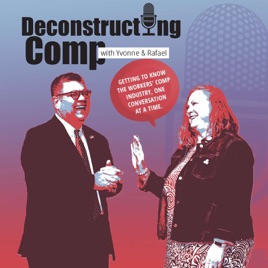
Now in Season 5! We are still breaking down complex issues of workers' compensation into bite-sized nuggets, one conversation at a time, with one slight twist. We are finally doing what we set out to do when we started: discuss the nuances of our fascinating system in "Cliff Notes" style summaries.
Yvonne Guibert and Rafael Gonzalez approach workers' comp conversations from different backgrounds. Still, they share many similar things, such as their love for family and friends, a passion for Latin culture, and good old-fashioned belly laughs. Join them as they chat with their industry friends and colleagues, learn more about their roles, laugh, and have fun on the journey. You might learn something along the way! See you soon! ¡Hasta pronto!
Advertise on Deconstructing Comp
Advertise on Deconstructing Comp to promote your brand to thousands of podcast listeners
Check latest episodes from Deconstructing Comp podcast
Season 6 Intro: 2026 Key Issues
2026/01/27
Send us a text
Our key issues for 2026:
1. Mental Health Goes Operational
Mental health is no longer fringe in workers’ comp. Our real challenge now is operationalizing access to timely, evidence-based mental health care so it supports recovery instead of becoming a barrier.
2. End of Healthcare Subsidies = Cost Shifting Risk
With federal funding changes, i.e., the loss of funding tied to healthcare subsidies and the Substance Abuse and Mental Health Services Administration (SAMHSA), watch closely for cost shifting into workers’ compensation, a pattern the industry has seen before.
3. CMS Civil Monetary Penalties.
This is a brand-new layer in the Medicare Secondary Payer landscape. CMS is expected to release CMP documentation in March.
4. Complex Claims = The Biggest Opportunity.
Early identification of red flags, faster access to evidence-based care, and better education for claims professionals prevent complexity → chronicity → runaway costs.
5. Presumptions Are Expanding.
Presumptions continue to shift the burden of proof to employers, especially for PTSD, firefighter cancer, and potential infectious disease claims, with high cost and policy implications.
6. Employee Well-being & “Quiet Cracking.”
Quiet cracking, marked by disengagement, burnout, and feeling stuck, is emerging as employees remain overloaded and unsupported. Organizations that treat wellbeing as a core risk management strategy see stronger engagement, faster recovery, and lower overall costs.
⚡ Rapid-Fire Watchlist
DEI & Diversity – Organizations that lean into diversity perform better and attract stronger talent.Education & Mentorship – The next generation of WC professionals needs mentorship from experienced leaders. Explore mentor/mentee programs. Artificial Intelligence (AI) – It's time to embrace adaptation. Education is key to using AI wisely. Challenge yourself to adapt as AI is changing rapidly and becoming more integrated in our daily lives. Self-Leadership as a Core Competency – Especially for claims professionals. Self-leadership improves empathy, self-regulation, and decision-making.California Premium Increases – California is an outlier worth watching as other states stabilize or decline.🤝 In-Person Events: Where Professional Growth Accelerates
Connection, learning, and candid conversations happen best face-to-face. Wherever you sit in the workers’ comp ecosystem, attending even two industry events a year sharpens perspective and strengthens relationships.
Yvonne’s Top Picks
Workers’ Compensation Research Institute (WCRI) – March | Boston, MANational Council of Self Insured (NCSI) – June | Rancho Mirage, CAWorkers’ Compensation Institute (WCI) – August | Orlando, FLELEVATE Conference – September | San Diego, CANational Comp Conference – September | Las Vegas, NVBonus: Your state or regional workers’ comp conference!Rafael’s Picks
Claims and Litigation Management Alliance (CLM) – Annual Conference (March), WC Event (May), Claims College (Fall)Workers’ Compensation Claims Professionals (WCCP) + Florida Bar – April | Orlando, FLNational Medicare Secondary Payer Network – October | Bethesda, MDAlso mentioned: PARMA, PRIMA, NCCI, NRR
¡Muchas Gracias! Thank you for listening. We would appreciate you sharing our podcast with your friends on social media. Find Yvonne and Rafael on Linked In or follow us on Twitter @deconstructcomp
Season 5 Wrap Up With Yvonne and Rafael
2025/12/16
Send us a text
Yvonne and Rafael take time to reflect on Season 5, their accomplishments, and the time they spent with guests.
They also discuss new features of Deconstructing Comp, including the launch of the Work Comp Changemaker Awards, a new website, a monthly newsletter, a YouTube channel, and so much more!
Grab your headphones, your favorite beverage, and let's go have a chat!
¡Muchas Gracias! Thank you for listening. We would appreciate you sharing our podcast with your friends on social media. Find Yvonne and Rafael on Linked In or follow us on Twitter @deconstructcomp
Darrell Mathis: O-Block Grit and Work Comp
2025/12/05
Send us a text
In this episode, Yvonne and Rafael talk with Darrell Mathis, Director of Workers’ Compensation for the City of Chicago, and explore his work to modernize and manage one of the nation's largest municipal programs.
Darrell shares his 33-year journey from the private sector to public service, offering candid insights into program reform, transparency, and talking about “paying what we owe.”
He discusses how Chicago has transformed litigation strategy, reduced claim backlogs, and improved fairness for injured employees, all while supporting first responders facing unimaginable risks.
City of Chicago is self-insured and works with a TPA to administer claims. With over 33,000 employees and 3,600 open claims, Darrell’s team is setting a new benchmark for municipal excellence in workers’ compensation. This conversation is a must-listen for anyone interested in the intersection of leadership, accountability, service mindset, and compassion in public-sector risk management.
Darrell also opens up about his own health journey and how dedicating himself to the City of Chicago and the work he loves became a key part of his recovery.
Key Takeaways
How municipal code changes, litigation reform, and payment integrity reshaped Chicago’s comp program.Why “paying what we owe” builds trust and accelerates resolution.The real challenges of managing 3,600 open claims and a $700M reserve.Strategies to motivate and retain adjusters in a high-pressure environment.Chicago’s commitment to care for catastrophically injured police and firefighters.Darrell’s vision to make Chicago the global gold standard for workers’ compensation programs. Darrell mentioned some folks who help him keep the lights on at the City of Chicago Workers' Compensation program:
Donald “Taylor” Chittick – Asst. DirectorTiffany Williams – RTW Project ManagerKathleen Heenan – Workers’ Compensation LiaisonTomeka Long – Workers’ Compensation LiaisonAshley Chen – AdminDarrell mentions his devotion to faith and service. He is an ordained Deacon at the Progressive Baptist Church. His Pastor is Dr. Charlie E. Dates. As an officer of the Church, he is involved with many aspects of the ministry. Black Boy Lit is an initiative of Progressive Baptist Church and Salem Baptist Church. Dr. Dates is the Pastor of both churches.
Additionally, he and his wife chair a capital campaign for the church, called DREAM.
¡Muchas Gracias! Thank you for listening. We would appreciate you sharing our podcast with your friends on social media. Find Yvonne and Rafael on Linked In or follow us on Twitter @deconstructcomp
Jeff Adelson: Soft Skills in a Tough System
2025/11/21
Send us a text
In this episode, co-hosts Yvonne Guibert and Rafael Gonzalez talk with expert defense attorney and educator Jeff Adelson in a candid conversation about two often-overlooked forces in workers’ compensation: ethics and empathy. Together, they explore how small shifts in behavior, perspective, and communication can create better outcomes for injured workers and claims professionals alike.
From managing ethical gray zones to acknowledging the human side of every claim, Jeff brings decades of insight, humor, and heart to the conversation. This episode challenges us to rethink the role of compassion in claims management and reminds us that doing the right thing and doing good business are not mutually exclusive.
💡 Highlights for Newer Professionals in Workers’ Comp
✔️ Know the Rules on Represented Parties
Jeff shares an important story about being asked to communicate directly with a represented worker. This is a legal and ethical no-go: always respect representation boundaries; communicating without counsel is prohibited and can jeopardize a case.
✔️ Doing the Right Thing Isn’t Always Easy
In a pivotal moment, Jeff explains how his firm gave up a significant contract rather than compromise its ethics. It's a lesson for anyone new to the industry: ethics must come before convenience or profit.
✔️ Ethical Issues Aren’t Always Black and White
The episode touches on how clerical issues or unclear situations, like a temporarily inactive attorney, require careful, thoughtful handling. Consulting with ethics counsel and taking the high road is always a sound strategy.
📘 Terms to Know (Episode Reference)
Ethics (in Workers’ Compensation)
The moral principles that guide behavior and decision-making within the workers’ comp system, including how injured employees are treated, how claims are handled, and the integrity of legal, medical, and administrative actions.
Empathy
The ability to understand and share the feelings of another. In claims management, empathy can foster trust, improve communication, and lead to better outcomes by acknowledging the human side of the injury.
Moral Hazard
A situation in which one party is more likely to take risks or act unethically because they do not bear the full consequences of their actions — often discussed in the context of fraudulent claims or system abuse.
Conflict of Interest
A situation where a person or entity involved in the claims process (e.g., provider, attorney, or claims adjuster) has competing interests that could improperly influence decisions or outcomes.
Good Faith Handling
The expectation that claims administrators and insurers will act fairly, honestly, and in the best interest of all parties — especially the injured worker — throughout the claims process.
Compassion Fatigue
Emotional exhaustion can affect professionals who regularly deal with others’ trauma or suffering. Often experienced by adjusters, nurse case managers, or clinicians, it may lead to detachment or burnout.
¡Muchas Gracias! Thank you for listening. We would appreciate you sharing our podcast with your friends on social media. Find Yvonne and Rafael on Linked In or follow us on Twitter @deconstructcomp
David Langham: Floridiana and Work Comp
2025/11/07
Send us a text
In this episode, Yvonne and Rafael catch up with Judge David Langham, Deputy Chief Judge of the State of Florida, and a prolific writer, blogger, educator, and speaker.
If you're curious about the history of Florida’s workers’ compensation system, and you want to learn what "stare decisis" is, don’t miss our conversation with Judge Langham. He's widely recognized as the leading legal authority on this topic.
In addition to a concise and thorough history lesson on the Florida work comp system, we discuss a few other key points specific to Florida.
To access books and resources Judge Langham mentioned during the episode, including his free downloadable book: "Floridiana and the Workers' Compensation Adjudicators," visit www.dwlangham.com.
Visit his Blogger profile to check out Judge Langham's blogs (there are several).
Note: stare decisis is a legal term. According to LexisNexis, it means "to stand by things decided and not disturb settled points." They further explain, "The doctrine of stare decisis, or binding precedent, is the principle by which judges are bound by previous judicial decisions, especially of superior courts. To 'stand by things decided', the basis for the doctrine of precedent, there is no room for further examination or interpretation of a point or principle of law; the court is bound to the reasoning in the prior decision, unless there is a unique exception or the matter is before a higher court."
¡Muchas Gracias! Thank you for listening. We would appreciate you sharing our podcast with your friends on social media. Find Yvonne and Rafael on Linked In or follow us on Twitter @deconstructcomp
Rosa Royo: Getting Creative in Miami
2025/10/28
Send us a text
In this episode, Yvonne and Rafael chat with friend and colleague Rosa Royo, Director, Workers' Compensation and Loss Prevention at Miami-Dade County Public Schools. This is Rosa's second time visiting us at Deconstructing Comp. This school system is the third largest school system in the country with 450 school sites, 335,000 students and over 40,000 employees (based on most current statistics).
We start off the episode talking about what each of us are doing creatively that we have not done before, or haven't done in a while. Rosa talks about playing string instruments, Rafael talks about getting back into tennis, and Yvonne talks about doodling and art.
Rosa talks about the need to pivot quickly and why it is important to regularly review your program for areas that are weak and need to be strengthened. She discusses how post-pandemic workers' compensation care is strained due to not having adequate access to providers and providers aging out of the system. She spends much of her time reviewing her provider network and ensuring she is doing her best to fill the gaps where they are exist.
Rosa also talks about the importance of communication, a common theme in our episodes. She personally signs over 4,000 get well cards per year that are sent out in packages to injured workers. It is a small gesture that Rosa says pays high dividends: 16% reduction in litigation when she started this practice.
Dive into the full episode and hear what else Rosa has to say.
¡Muchas Gracias! Thank you for listening. We would appreciate you sharing our podcast with your friends on social media. Find Yvonne and Rafael on Linked In or follow us on Twitter @deconstructcomp
Gina Jacobs: Defending Claims With Purpose
2025/10/13
Send us a text
In this episode of Deconstructing Comp, Yvonne and Rafael welcome Gina Jacobs, a defense attorney with Hamilton, Miller & Birthisel LLP, to share what it’s like navigating workers’ compensation from the defense side. Joining from Orlando, Gina brings a candid look at how defense counsel approaches claims, collaborates with employers and carriers, and works toward fair resolutions within Florida’s workers' compensation system.
Gina’s journey into law is one of purpose and passion. After spending more than 10 years as a claims professional, working with Crawford & Company, Zenith Insurance, and Gallagher Bassett, she made the leap to law school to deepen her understanding of the industry she already loved. Today, that background shapes her work as a defense attorney, giving her rare empathy for claims adjusters and a deep appreciation for how every stakeholder impacts the outcome of claims.
Throughout the conversation, Gina shares how she balances advocacy with understanding, why communication remains at the heart of every successful case, her commitment to partnerships, and how she’s using her experience to mentor and educate the next generation of professionals in workers’ compensation.
This engaging episode offers a thoughtful and balanced look at what it means to defend claims while staying true to the people and purpose behind the process.
¡Muchas Gracias! Thank you for listening. We would appreciate you sharing our podcast with your friends on social media. Find Yvonne and Rafael on Linked In or follow us on Twitter @deconstructcomp
Paolo Longo: Inside First Responder Claims
2025/09/30
Send us a text
In this episode of Deconstructing Comp, Yvonne and Rafael talk to Paolo Longo, a claimant attorney based in Florida, to explore the realities of representing injured workers, especially first responders. Paolo shares how his career path led him from the state attorney’s office to becoming a dedicated advocate for employees navigating the workers’ compensation system.
He explains the unique legal protections and presumptions that apply to Florida’s firefighters, police officers, and other first responders, particularly around heart disease, hypertension, and other conditions presumed to be job-related. Paolo also highlights the burden-shifting process that makes these cases unique, and why communication and education are at the heart of effective advocacy.
A powerful part of the discussion centers on the fears and concerns first responders face after an injury. Paolo notes that the first question nearly every client asks is: “Am I going to lose my job?” Beyond that, they worry about whether they’ll ever return to work, finish their careers, or continue providing for their families. These uncertainties, coupled with a lack of clear understanding of the claims process, make strong legal guidance and compassionate communication for injured workers essential.
Another key legal point Paolo discusses is the “120-day rule.” While its meaning varies by state, in Florida, the focus of Paolo’s practice, it sets the timeframe for an employer or insurance carrier to decide on a claim. Once an employer begins providing benefits, they have 120 days to either deny the claim or continue paying benefits. If they don’t issue a denial within that period, the claim becomes compensable by law, unless the employer can later prove new “material facts” that weren’t discoverable during the initial investigation.
This rule is critical because it can determine the outcome of a case, whether benefits continue, or whether a carrier can still attempt to deny responsibility for an injury. Paolo explains how this plays out in practice and why it’s such a pivotal part of representing injured workers in Florida.
From candid reflections on the challenges of the system to insights on what truly makes a difference for injured workers, this conversation offers a rare look at the claimant’s side of workers’ compensation.
¡Muchas Gracias! Thank you for listening. We would appreciate you sharing our podcast with your friends on social media. Find Yvonne and Rafael on Linked In or follow us on Twitter @deconstructcomp
Scynthia Syfrett: SHARP Lessons in Risk
2025/09/18
Send us a text
In this episode of Deconstructing Comp, Yvonne Guibert and Rafael Gonzalez welcome Scynthia Syfrett, Workers’ Compensation Program Manager at SHARP Healthcare in San Diego. Scynthia offers her perspective on managing a large deductible program, with a $1 million per-claim deductible, and the lessons in risk that come with operating at this scale.
Our conversation examines how large deductible programs shift a significant portion of the claims exposure back to the employer, presenting both opportunities and challenges. Scynthia explains why careful oversight, proactive claims management, trusted vendor partners, and tailored processes are essential to ensure every claim is handled with both financial accountability and employee care.
She also highlights why healthcare systems, with thousands of employees, must maintain clear strategies for managing risk, controlling litigation, and supporting injured employees within such a high-stakes framework.
You'll also learn that Scynthia is passionate about education, just like Yvonne and Rafael!
Key terms and concepts mentioned in this episode to help guide your listening:
Large Deductible Program – SHARP's program features a $1 million per-claim deductible, shifting a significant portion of the financial responsibility back to the employer.
Risk Management – In workers’ compensation, risk management means recognizing and addressing financial, legal, strategic, and safety risks that can affect both employees and the organization.
Litigation Review – The process of evaluating claims before escalating to legal action; Scynthia discusses SHARP’s unique approach.
Return to Work (RTW) – Supporting employees in safely resuming their roles, often with modified duties.
Safety – Preventive measures and tracking of safety incidents within an employer's environment.
Employee Education – SHARP’s investment in training employees to understand workers’ compensation processes and responsibilities.
Trusted Vendor Partners – External claims, legal, and medical partners who work closely with an employer to manage claims effectively.
¡Muchas Gracias! Thank you for listening. We would appreciate you sharing our podcast with your friends on social media. Find Yvonne and Rafael on Linked In or follow us on Twitter @deconstructcomp
Robert Rassp: Basics of WC Benefits
2025/08/29
Send us a text
Disclaimer: The views expressed in this episode are Judge Robert Rassp’s personal opinions and do not reflect the official position of the State of California, Department of Industrial Relations, Division of Workers’ Compensation (DWC), or the Workers’ Compensation Appeals Board (WCAB).
In this episode of Deconstructing Comp, Yvonne and Rafael are joined by Judge Robert Rassp for a straightforward discussion about the fundamental benefits of workers’ compensation and why they are important.
Judge Rassp walks us through the foundation of the system, from medical treatment to temporary and permanent disability benefits, and explains how these core protections are designed to support injured employees while balancing employer responsibilities.
The conversation also explores how utilization review, independent medical review, and evolving case law influence the delivery of these benefits. Judge Rassp emphasizes the importance of fairness, education, and due process in ensuring that both injured employees and employers understand the system and can navigate it effectively.
According to Rassp: “Temporary disability keeps food on the table during recovery. Permanent disability recognizes when someone’s life has been permanently changed by an injury.”
Please join us for this informative episode with one of our industry's most experienced and esteemed educators. Judge Rassp is also an adjunct professor at Pepperdine University's Caruso School of Law, where he teaches workers' compensation law, and he's a founding member of the CC&R Band, a parody band that performs classic rock and roll hits at many Southern California industry events.
Key Terms from the Episode:
Medical Treatment – Care provided to cure or relieve the effects of a work-related injury or illness.Temporary Disability (TD) – Wage replacement benefits provided to an injured employee while recovering and unable to work.Permanent Disability (PD) – Benefits awarded when an injured employee has lasting impairment that affects their ability to earn wages.Causation – the link establishing that an injury or illness arose out of and in the course of employment, or more simply put, that the injured employee's work contributed to their injury or illness. This is also referred to as AOE/COE.WCAB (Workers’ Compensation Appeals Board) – The judicial body that adjudicates disputes in California’s workers’ compensation system.Utilization Review (UR) – The process by which an employer or insurer evaluates a medical treatment request for appropriateness and necessity.Independent Medical Review (IMR) – The appeal process when a treatment request is denied through UR, conducted by an independent physician reviewer.Case Law – Published court or WCAB decisions that interpret statutes and guide future workers’ compensation cases.¡Muchas Gracias! Thank you for listening. We would appreciate you sharing our podcast with your friends on social media. Find Yvonne and Rafael on Linked In or follow us on Twitter @deconstructcomp
Dr. Marcos Iglesias: Cultivating A Recovery Mindset
2025/08/11
Send us a text
In this episode, Yvonne and Rafael talk to Dr. Marcos Iglesias, Chief Medical Officer at AF Group. Dr. Iglesias shares his journey from occupational medicine to the executive level and the lessons he’s learned about helping injured workers recover faster and more fully. Drawing on decades of experience, Dr. Iglesias offers candid, practical advice for younger clinicians entering the workers’ compensation space, emphasizing the importance of looking beyond symptoms to understand why a patient isn’t improving.
He explains how focusing on what an injured worker truly needs to feel supported can reduce frustration for clinicians, improve communication with claims and employer teams, and create better outcomes for all parties. From breaking down barriers to recovery to fostering stronger provider relationships, Dr. Iglesias underscores that when clinicians approach care with curiosity, empathy, and collaboration, everybody wins.
Listeners will leave with actionable insights into how new medical professionals can navigate the complexities of workers’ comp, make a meaningful impact on injured workers’ lives, and help shape a system that works better for everyone.
Key Terms and Definitions in this episode:
Biopsychosocial Model of Care – A holistic approach to healthcare that addresses the biological, psychological, and social factors influencing an injured worker’s recovery, promoting comprehensive and individualized treatment plans.
Chief Medical Officer (CMO) – Senior medical leader responsible for developing and overseeing clinical strategies, ensuring medical best practices, and aligning care delivery with business goals.
Claims Operations – The department or function responsible for managing claims from the first report of injury through closure, including investigation, evaluation, and settlement.
Early Intervention – Identifying and addressing potential issues in a claim as soon as possible to prevent delays in recovery and reduce claim duration and costs.
Employer Engagement – Active participation of the employer in the claims process, including communication with the injured worker, accommodations for return-to-work, and collaboration with claims teams.
Evidence-Based Care – Medical treatment decisions based on the best available research, clinical expertise, and patient-specific factors to ensure optimal outcomes.
Occupational Medicine – A branch of medicine focused on the prevention, diagnosis, and treatment of work-related injuries and illnesses.
Provider Network – A group of medical professionals and facilities contracted to deliver care to injured workers under negotiated terms.
Psychosocial Barriers – Non-medical factors—such as mental health concerns, fear, social isolation, workplace relationships, or financial stress—that can delay or prevent recovery.
And here are a few references to things Dr. Iglesias mentioned during our discussion:
On Ambient Scribe Technology
Open Evidence (chatGPT for medical professionals)
¡Muchas Gracias! Thank you for listening. We would appreciate you sharing our podcast with your friends on social media. Find Yvonne and Rafael on Linked In or follow us on Twitter @deconstructcomp
Kirsten Kaiser Kus: Stakeholders in the Comp Ecosystem
2025/07/29
Send us a text
In this episode, we talk to Kirsten Kaiser Kus. She is a defense attorney and an equity owner at Downey & Lenkov LLC, leading their Indiana practice. She brings deep experience from both the plaintiff and defense sides of workers’ compensation. She shares how her involvement with CLM and litigation education shaped her expertise and helped grow her professional network.
We explore the many stakeholders in the workers’ compensation system. Kirsten discusses distinctions between plaintiff-side and defense-side stakeholders and how they interact—or clash—within systems that vary state by state.
On the plaintiff (applicant) side, she highlights challenges such as unrealistic expectations, lack of understanding of legal metrics, and client control issues. Then she systematically breaks down the far more complex defense side, detailing the roles of carriers, TPAs, hearing members, medical providers, mediators, ombudsmen, vendors, brokers, excess carriers, self-insured clients, and even how politics play out in our system.
Throughout our conversation, Kirsten emphasizes one central principle: communication is critical. Where, oh where have we heard that before? Whether navigating expectations, coordinating stakeholders, or managing the risk of expensive cases, clear, proactive, and coordinated communication is what drives effective outcomes.
Stakeholders in the Workers’ Comp Ecosystem:
Injured Worker
The employee who was hurt at work and seeking benefits.
Applicant’s Attorney / Claimant’s Attorney / Plaintiff's Attorney / Petitioner’s Counsel
The lawyer representing the injured worker (term varies by state).
Defense Attorney
The attorney representing the employer or insurance carrier.
Employer
The company where the injured worker is employed; also referred to as "the insured."
Insurance Carrier
The insurance company providing workers’ comp coverage to the employer.
Third-Party Administrator (TPA)
An outside company that manages the administration of claims on behalf of self-insured employers or insurance carriers.
Broker
An insurance advisor who helps employers obtain and manage coverage.
Self-Insured Employer
A company that pays claims out-of-pocket, often with excess insurance coverage.
Excess Carrier
The insurer that covers costs beyond a self-insured employer’s retention layer.
Hearing Member / Judge / Commissioner
The official who hears and rules on workers’ compensation disputes.
Ombudsman
A state-provided guide who assists unrepresented workers.
Mediator
A neutral party who helps both parties involved in a litigated case try to settle the case before trial.
Medical Provider
Doctors and other clinicians who treat the injured worker.
Nurse Case Manager (NCM)
A licensed nurse who helps coordinate medical care and communicate with all stakeholders. NCMs are often called in to help coordinate more complex claims.
Vendors
Service providers such as interpreters, transportation, Medicare compliance experts, durable medical equipment (DME) suppliers, and home modification specialists.
Subrogation Counsel / Third-Party Recovery
Attorneys or departments pursuing reimbursement when a third party (not the employer) caused the injury.
Family Members
Often involved in influencing the injured worker’s decisions and expectations, an important perspective to keep in mind througho
¡Muchas Gracias! Thank you for listening. We would appreciate you sharing our podcast with your friends on social media. Find Yvonne and Rafael on Linked In or follow us on Twitter @deconstructcomp
Mollie Kallen: Communication is Key
2025/07/11
Send us a text
In this episode, we sit down with industry powerhouse Mollie Kallen to explore the often misunderstood role of case managers* in workers’ compensation. With over 30 years of experience leading one of the largest case management companies in the country, Mollie brings unmatched insight into how effective communication, not just clinical expertise, drives better outcomes for injured employees, employers, and claims professionals alike.
We talk about what makes a great case manager, how communication breakdowns can derail even the best-intentioned care plans, and why advocacy and collaboration are more important than ever. Mollie also shares how her personal health journey reshaped her professional mission and led her to a new chapter of coaching cancer patients and their families with the same compassion and clarity that marked her work in workers' comp.
Whether you're a case manager, claims adjuster, or anyone working in the comp system, this conversation will leave you with a deeper appreciation for the human connection at the heart of recovery.
🎧 Tune in and discover why communication truly is key.
*NOTE: Rafael said "nurse case managers" when he started with his questions. While often, case managers are nurses and have a nursing background, they aren't always nurses, as is the case with Mollie. The reason many nurses become case managers is they have solid clinical backgrounds. So, just know, a case manager isn't always a nurse and people often use these terms interchangeably. Yes, we know! It is confusing.
Resources mentioned in this episode:
ReEmployability: https://www.reemployability.com/
Cancer Coach Connection: https://www.cancercoachconnection.com/
¡Muchas Gracias! Thank you for listening. We would appreciate you sharing our podcast with your friends on social media. Find Yvonne and Rafael on Linked In or follow us on Twitter @deconstructcomp
Bill Zachry: Sisterhood of Traveling Body Parts
2025/06/23
Send us a text
In this engaging and insightful episode, co-hosts Yvonne Guibert and Rafael Gonzalez sit down with legendary industry leader Bill Zachry for a deep-dive into the realities shaping today’s California workers’ compensation system, and other state systems around the country.
We explore rising WC costs, why it makes sense to manage and treat psychosocial barriers to recovery early on in the claim — or risk higher costs down the road, and other tips and observances he's made along the way.
Bill shares powerful stories from his career, including how he entered the system as an injured worker, his role as a "baby claims adjuster," how he has helped shape public policy, the role of organized fraud in the Los Angeles basin and more. He also discusses his coined term, “sisterhood of the traveling body parts,” to describe recycled injury narratives.
Our discussion also touches on prevention, prescription patterns, several issues related to public policy, and the cultural and systemic gaps that keep workers’ comp stuck in a reactive posture.
This episode is equal parts candid, educational, and entertaining — and is a must-listen for any workers' compensation professional, regardless of tenure.
Resources:
Rising Medical Solutions Annual Benchmarking Study
¡Muchas Gracias! Thank you for listening. We would appreciate you sharing our podcast with your friends on social media. Find Yvonne and Rafael on Linked In or follow us on Twitter @deconstructcomp
Melissa Steger: Hook 'Em and Go Until No!
2025/06/09
Send us a text
Melissa Steger returns to walk us through the building blocks of the unique Texas UT System workers' compensation program. While the program is self-insured, they use a third-party administrator (TPA) in a hybrid system where the TPA staff sit on-site with the UT System staff who oversee the program.
Covering 160,000 employees and over 250,000 students, UT System uses a variable rating system and has set up a culture where the individual institutions within the system compete against one another to achieve superior outcomes. The results? Truly innovative and remarkable.
During Melissa's tenure with the WC program, and through a system of healthy competition, they initially saw program costs of eighty cents per $100 dollars of payroll. When Melissa retired last year, it had fallen to 8.5 cents per $100 dollars of payroll.
How did this happen? Melissa talks about some of the nuances of their program including an annual retreat, where the hybrid staff come together to improve communications, get focused on core program goals and learn how they could continuously improve their results.
Join us as we talk to Melissa and learn how UT System achieved such amazing results.
Melissa also talks about flunking out of retirement. She is now VP of Business Development at WorkCompCollege.com
¡Muchas Gracias! Thank you for listening. We would appreciate you sharing our podcast with your friends on social media. Find Yvonne and Rafael on Linked In or follow us on Twitter @deconstructcomp
Podcast reviews
Read Deconstructing Comp podcast reviews
5 out of 5
7 reviews
★★★★★
jr in ut 2022/06/29
Great Comp Discussions
Yvonne and Rafael know comp, they know a lot of people and they also know how to make a really enjoyable podcast! Their discussions with some of the ...