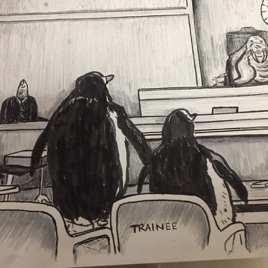
Advertise on podcast: Advocacy in Court: Preparation and Performance
This podcast has
21 episodes
Language
EnglishPublisher
HughExplicit
No
Date created
2021/08/06
Latest episode
2026/08/11
Average duration
15 min.
Release period
133 days
Description
Court room advocacy requires practical skills. The episodes in this Podcast explain and illustrate the skills that advocates need.Episodes are up to 15 minutes, so easily fitted into your busy day. Although the episodes follow a logical order each one is 'stand alone', because every advocate has different needs. For questions and comments please email [email protected] See acast.com/privacy for privacy and opt-out information.
Unlock Advocacy in Court: Preparation and Performance podcast Email contact info,
Listeners & Audience details
Email contact information
Direct podcast contact details

Listeners
Audience numbers & engagement insights

Audience details
Podcast Insights

Podcast episodes
Check latest episodes from Advocacy in Court: Preparation and Performance podcast
Episode 21 -Was that good advocacy or not? (why the basics always matter)
2026/08/11
Recorded shortly after the FIFA 2026 World Cup when we could watch brilliant football and hear skilled commentary. How different that is to the reporting of cause celebre court cases where - except for those few cases that are available of a live feed- we must rely on media reporting done by people who have no idea how to evaluate advocacy: they do not inform, they do not educate, they just embarrass. Check out your own insights with this episode. Hosted on Acast. See acast.com/privacy for more information.
Episode 20 - How we Open and how we Close - the critical role of atmospherics
2022/07/09
We look at the importance of the prevailing atmospherics at both the case preparation and performance stages.
Examples are given of 'atmospherics'.
The use that you can make of such atmospherics as an advocacy tool is explained.
Opening statements and Closing addresses are discussed with 'atmospherics' in mind.
Please note:
if you have any useful suggestions/ feedback please email the author on [email protected] ; and,
There is a short, practical, but easily affordable book written by Hugh Selby and available on Amazon Kindle that accompanies this podcast series. It too is called, 'Advocacy in Court; preparation and performance'
Also available on Kindle by Hugh Selby, with examples of Chief/Direct and Cross in fictional settings: Liar Games; and, The Bone Cancer.
Another podcast series, just 7 short episodes, appealing to anyone with an interest in our justice system is ' The Man who wasn't There' ( available around 28 August 22 on many podcast sites).
Hosted on Acast. See acast.com/privacy for more information.
Episode 19 - Bad Things Happen - How you need to be prepared for bad acts by police, lawyers, judges.
2022/05/28
Although we have expectations of competence and integrity from the other 'actors' in litigation there are those who are 'bad actors'. They are drawn from police, other lawyers, media and the judicial/tribunal officers before whom we run cases.
Experience brings some ability to respond to such improper conduct; however, at any time in one's career it is important to have one or more mentors from whom good and timely advice can be sought.
This episode describes some of the bad acts that you are likely to encounter. It also provides some hints as to how you can respond.
Always try to keep in mind that bad acts by others are not a reason for you to do the same. Your clients, your colleagues, and our community depend upon our willingness to stand up to bad acts by clear, timely, appropriate 'calling it out'. That is much easier said than done but, as with everything in advocacy, preparation helps our performance.
Please note:
if you have any useful suggestions/ feedback please email the author on [email protected] ; and,
There is a short, practical, but easily affordable book written by Hugh Selby and available on Amazon Kindle that accompanies this podcast series. It too is called, 'Advocacy in Court; preparation and performance'
Also available on Kindle by Hugh Selby, with examples of Chief/Direct and Cross in fictional settings: Liar Games; and, The Bone Cancer. Hosted on Acast. See acast.com/privacy for more information.
Episode 18 - The Rule in Browne v Dunn ( The rule of Fairness which isn't fair)
2021/07/20
This so-called rule of fairness afflicts the defence in both criminal and civil cases. We examine what the rule may require, how to pose questions that comply, how its application and consequences vary between criminal and civil cases.
Episode 19, 'Bad things happen' - how you need to be prepared - released on 28 May 2022.
Episode 20, all about interacting with jurors, especially in opening and closing, is being prepared in June 2022
By the way, if you've gone to the trouble to listen to episodes 18 and 19 then delve into the podcasts on cross examination. There's useful material there that you haven't read and haven't heard about. Explore, enjoy, engage.
Also available on Kindle by Hugh Selby, with examples of Chief/Direct and Cross in fictional settings: Liar Games; and, The Bone Cancer
Hosted on Acast. See acast.com/privacy for more information.
Episode 17 - Experts and their evidence
2021/07/14
What the Expert Witness Guidelines require. Settling the issues to be addressed by the expert. Contents and layout of an expert report. Objectives of your conference with the expert. Evidence by AVL. Preparing for and cross-examining the other sides' expert. Hosted on Acast. See acast.com/privacy for more information.
Episode 16 - Re-examination/ Redirect, Practised Patterns for Leave, Closing Argument
2021/07/13
Your witness needs to let you know during the cross-examination that you can safely raise a matter with them during your re-examination. Even so, whether or not you re-examine requires you to assess the state of your case.
Some aspects of questioning, such as having a witness declared hostile/adverse/unfavourable, or raising bad character, or attacking credibility require the prior leave of the judicial officer. Be prepared by having your script in your trial note book.
Closing argument admires the decision maker who has already decided in your favour and hopes to persuade the undecided decision maker to prefer your case to your opponent's. If you made promises at the beginning of the hearing then show how they were kept. If they weren't kept then have a decent explanation. Keep within the attention span of your audience, and deliver in such a manner that they can absorb and consider your points. With a judge alone be sure to inquire on the record as to whether you have addressed everything they expected.
Hosted on Acast. See acast.com/privacy for more information.
Episode 15- The Addiction of Cross- Examination Part 2
2021/07/13
To look or not to look at the target witness - it's a matter of personal style.
The 'real time' risk assessment that governs how you conduct your cross-examination: it can be OK to ask questions to which you do not know the answer. It can also be OK to ask open questions.
The thrill of the spontaneous 'perfect' question which is not spontaneous at all.
Be sure to keep something good for the finish: write it out.
Rehearse with your witnesses as to when they are to answer you opponent with 'Would you like me to explain'.
Hosted on Acast. See acast.com/privacy for more information.
Episode 14 - The Addiction of Cross- Examination Part 1
2021/07/13
Is cross of the witness necessary? If so, have you mapped your topics and your order?
How are you anticipating some of your closing argument in your cross-examination questions? Are you able to follow the simple guidelines of niceness, sharing, slowness, and deft use of silence?
Drawing upon your case theory are you able to turn an opponent's witness into one of your own?
Drawing upon the 'totality of listening' skills that you have been practising for chief are you able to see, hear and feel what is encompassed in a target witness's answer?
How do you make good use of the witness's inevitable trivial lie? Hosted on Acast. See acast.com/privacy for more information.
Episode 13 - Openings and Objections
2021/07/12
If you make an opening statement then you are making a promise or promises. Can you deliver on those promises? If you don't then your opponent will point out your shortfall. So cut the cloth of an opening to suit the strength of your case.
Only make an objection when you have both a good legal basis and a tactical advantage. The most common bases for an objection are described.
If you are the 'object' of the objection then fight only those which are worth fighting. Remember that the fact finders are quick to discern both the bullying objector and the 'less than skilled' target. Hosted on Acast. See acast.com/privacy for more information.
Episode 12 - The set up in the hearing space
2021/07/12
There are simple things that you can do to make your performance, and that of your witnesses, more persuasive.
For you it includes your toolkit, whether and how you use a lectern, and how you monitor your progress.
For your witnesses it includes their preparation to be in the witness box, their appearance, where they look, and what to do if they are giving their evidence from a remote location. Hosted on Acast. See acast.com/privacy for more information.
Episode 11 - Pitfalls and Opportunities with open and closed questions in chief -Part 3
2021/07/11
The first topic is 'when' and 'how' do you use the technique of 'confess and avoid' during your examination-in-chief of your witness.
The second topic is the 'why' and how' of putting yourself into the scene about which your witness is giving evidence. This allows you to see, hear, and feel what is happening and then use your questions and your witness's answers to bring that 'alive' for the fact finder. Hosted on Acast. See acast.com/privacy for more information.
Episode 10 - Pitfalls and Opportunities with open and closed questions in chief -Part 2
2021/07/10
We discuss how to encourage witnesses to best recall a person, a place or a thing that they saw. Then we have our witnesses answer questions in a manner that uses the present sensory experience of everyone in the courtroom: witness, advocates and fact finders. We apply this approach to level of lighting, distances, direction and choice of language. Hosted on Acast. See acast.com/privacy for more information.
Episode 9 - Pitfalls and Opportunities with open and closed questions in chief -Part 1
2021/07/10
Open questions are the usual technique for examination-in-chief; however, without the proper foundation of a 'neutral' place and time, an open question may be disallowed as 'leading on an issue'. The problem and its solution are explored in the 'Who had the green light?' scenario in which Jack and Jill are pitted against each other after an intersection car crash. We also look at the use of 'what, if anything?' 'who, if anyone?' etc. Hosted on Acast. See acast.com/privacy for more information.
Episode 8 - Chief/Direct: Asking questions of your witness in an interesting, persuasive way
2021/07/09
Convert the wall maps used to prepare your case into convenient A4 size charts to have at the bar table. Leave space on those charts to make notes of items needing attention. Be prepared for the 'unexpected' when those notes will save you. Have your Chronology ready to use and edit.
Do not relapse into a 'make a list' approach. Write out your questions if you must but understand that being tied to that list entails that you cannot properly listen to all that a witness is communicating to the court room in an answer. The 'art of listening well' is the key to your becoming a good advocate. Ensure that the audience is listening by sharing with them the 'road map' of your agenda with the witness. Use partial repetition to reinforce confidence in your witness and in those listening.
Progress the story in small increments, carefully controlled, and with a clear purpose in mind.
The most usual form of questions start with, or include a 'W' or an 'H' word. Why you will avoid 'can, could, should and would' and be sparing with the use of 'do, did, does'. Hosted on Acast. See acast.com/privacy for more information.
Episode 7 - See the 'whole', not just the 'hole'
2021/07/08
It's time to leave behind 'list driven' approaches to case preparation and delivery. You need a large white space on which you can randomly assign topics. Then you assign the features/facts that surround each topic. That done you stand back and gaze at this two dimensional universe. Now trick your eyes into seeing the third dimension of depth and use that to prioritise those topics. You are now liberated from lists that control and being 'free at last' you can see the 'whole'. Hosted on Acast. See acast.com/privacy for more information.
Podcast reviews
Read Advocacy in Court: Preparation and Performance podcast reviews
Podcast sponsorship advertising
Start advertising on Advocacy in Court: Preparation and Performance relevant audience podcasts
You may also like to advertise on these Podcasts

4.922981174
Dropping Bombs
Brad Lea: CEO, Entrepreneur, and Host of The Bottom Line

4.682501293
The Daily Beast Podcast
The Daily Beast, Joanna Coles

4.831561355
The Late-Round Fantasy Football Podcast
iHeartPodcasts

4.922331833
The Ten Minute Bible Hour Podcast
Matt Whitman

4.662842000
The Dr. Laura Podcast
Dr. Laura Schlessinger & SiriusXM

4.723702000
Everything Everywhere Daily
Gary Arndt

4.813252012
The Jeff Cameron Show ~ Warchant.com
Jeff Cameron Show

4.8258931492
Relatable with Allie Beth Stuckey
Blaze Podcast Network
4.8224751793
The Andrew Klavan Show
The Daily Wire

4.716492000
Morning Mindset Christian Daily Devotional Bible study and prayer
Carey Green