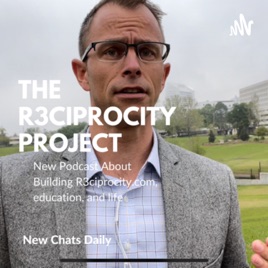
Advertise on podcast: R3ciprocity.com - Prof David Maslach: Innovation; Research Life; & Striving Towards Happiness
Rating
5from
This podcast has
1418 episodes
Language
EnglishPublisher
David MaslachExplicit
No
Date created
2021/10/05
Latest episode
2026/02/05
Average duration
10 min.
Release period
2 days
Description
Professor David Maslach talks about graduate school, research, science, Innovation, and entrepreneurship. The R3ciprocity project is my way to give back as much as I possibly can. I seek to provide insights and tools to change how we understand science, and make it more democratic.
Unlock R3ciprocity.com - Prof David Maslach: Innovation; Research Life; & Striving Towards Happiness podcast Email contact info,
Listeners & Audience details
Email contact information
Direct podcast contact details

Listeners
Audience numbers & engagement insights

Audience details
Podcast Insights

Social media
Check R3ciprocity.com - Prof David Maslach: Innovation; Research Life; & Striving Towards Happiness social media presence

Podcast episodes
Check latest episodes from R3ciprocity.com - Prof David Maslach: Innovation; Research Life; & Striving Towards Happiness podcast
Why Economic Logic Fails in Real Life — and What Works Instead
2026/02/05
The longer I’ve been a parent, scholar, and human being, the less faith I have in the neat, clean economic logic I once believed in. Those tidy models—pick only the “best” people, copy best practices, dial up the traits that matter—work on paper, but they often fall apart when you’re dealing with real people.
In reality, human progress looks a lot less like optimization and a lot more like kindergarten teaching, therapy, and palliative care. It’s not about maximizing widgets or chasing the biggest metrics—it’s about building trust, caring without expecting a return, and being there when people need it (and when they think they don’t).
Mentorship isn’t cheerleading or networking; it’s showing up when it’s messy, frustrating, and unglamorous. It’s giving people the room to struggle through the hard parts themselves, knowing they’ll come back for help when they’re ready. The “magic bullet” everyone’s searching for? It’s simply this: get back up, do it again, and keep going long after you’ve lost the applause.
You can’t control your starting point, your genetics, or the cards you were dealt. But you can control whether you stand back up one more time. That’s the only consistent factor I’ve seen in 20 years of studying why some people and organizations thrive: they just don’t stop.
So here’s my strategy now—ignore the politics, avoid the traps, be a decent human, and quietly keep moving forward. If that costs me career points, so be it. I’d rather have the power to walk away with my integrity intact.
The Real Win Is Staying in the Game
2026/02/03
I swim a lot.
And almost every week at the pool, I see someone in their 70s—sometimes even in their 80s—learning how to swim for the first time.
They’re out there, kicking slowly, trying to float, listening to the lifeguard’s instructions. And every time, I think:
They still believe they’re in the game.
That belief—staying in the game—is far more important than any technical skill you’ll ever learn. Most people check out early. Some in their 20s. Many in their 30s or 40s. They decide the system is rigged, or they’ve missed their chance, and they quietly stop trying.
But here’s the truth: almost everything that matters in life comes down to stability.
Stable people, stable institutions, stable relationships—they tend to do better over decades. They may not be flashy. They may not grow the fastest. But they last. And lasting is what wins.
Stability is saving 10–15% of every paycheck—even when you don’t make much—and putting it into index funds for decades.
It’s showing up to your work and relationships every day with kindness and generosity.
It’s cutting out people who burn you, but not letting it turn you bitter.
This isn’t glamorous advice. It’s not “hack your way to success” or “find the magic bullet.”
It’s get up. Do the thing. Do it again tomorrow.
And when you’re in your 70s—or your 80s—maybe you’re learning to swim for the first time.
Not because you have to.
But because you still believe there’s something worth showing up for.
That’s the real win.
Why Do Most Adults Stop Exercising After 30?
2026/02/02
I strongly believe the way we teach fitness and athleticism is completely wrong.
We start with competition. We teach that the goal is to win, to maximize, to go as hard as possible. And then we wonder why most adults stop.
Once you are past 30, the number of people doing athletic activities is spectacularly low. I do not think this is about sedentary lifestyle. I think it is about how we frame fitness.
If I train to win, I burn out. I get injured. I feel behind. My body slows down and I think I am losing.
When I flip it, everything changes.
I stop maximizing the short run. I focus on longevity. I focus on stretching this out for decades. Some days I go hard. Some days I recuperate. Some days I nurse what hurts.
I am not training to beat anyone.
I am training to live fully and joyfully for as long as I possibly can.
My Biggest Career Flaw Is That I’m Too Public & Honest
2026/01/31
I’m probably too open about my inner life.
What I’m thinking.
What I’m struggling with.
What I don’t understand yet.
I don’t know many people in academia who are that public. I do it because I hope it helps someone else feel normal. But I also know it comes with a cost.
Because I don’t like strategic behavior.
It leaves a bad taste in my mouth.
And here’s the thing I’ve learned with age:
When something feels off in an interaction, it usually is.
I used to ignore that feeling.
I don’t anymore.
If I get that quiet “Spidey sense” now, I listen. Almost every time, it ends up being about inauthenticity. Filtered information. Positioning. Someone playing a game I didn’t agree to play.
What surprised me most as I got older is this:
There are very few people in your life who are fully open, fully honest, and genuinely want you to do well.
Very few.
And I think business education taught us the wrong lesson. We train people to be strategic. To optimize. To get ahead.
In my experience, that kind of strategy erodes trust, culture, and real relationships. It “works” in narrow ways. And quietly destroys everything else.
So yes, I keep my heart open.
And yes, that means I get hurt.
But I’d rather live that way than turn into someone I don’t recognize.
If you’re open and honest, don’t expect short-term career rewards. Maybe long-term. Maybe not. But you will sleep at night knowing you were real.
Why Almost Nobody Has a Long-Term Vision Anymore
2026/01/31
I’ve always been a crusty old man. Now I just admit it in public.
Here’s the thing that drives me a little crazy: almost nobody has a long-term vision anymore. The internet is full of quick wins, instant credit, and absolute nonsense. Even in my own profession. Especially in my own profession.
I built an internationally recognized conference from nothing. I was a nobody. A PhD student. No money. I funded it myself for years. It took 15 years. I looked like a loser for a very long time. No credit. No out-of-boy. Just grinding.
The R3ciprocity project is the same thing. Ten years in. Still scary. Still embarrassing. Still no guarantees. Still doing it anyway.
Most people won’t do something that takes decades. They won’t build without credit. They won’t look foolish for years. They won’t carry uncertainty in public.
But that’s the whole point.
If you need quick feedback, don’t build big things.
If you need applause, don’t build real things.
If you need safety, don’t build anything at all.
I grew up in a town of 6,500 people in the middle of nowhere. No network. No money. No path. Just one more day of grinding.
If I can be one annoying, crusty voice in your ear saying, “You can do this. One more day. One more step,” then that’s a life well lived.
Most Money Problems Are Actually Hope Problems
2026/01/31
I honestly think that a lot of what we call “financial problems” are not really financial at all. I think money, most of the time, is just an indicator. A symptom. It points to something else that is deeper and far more important going on inside someone’s life.
And I see two sides to this all the time.
On one side, people cannot save anything. No cushion. No margin. Always behind.
On the other side, people save too much. They accumulate but never trust the world enough to take a risk. They choose assets that feel safe, but they stall. They freeze.
Both groups look very different on the surface. But underneath, it’s often the same thing.
They’ve lost hope.
What breaks my heart is that most people stop believing in the connection between tiny, painful, boring steps and what those steps become after decades. The beginning is grueling. The payoff is invisible. So people quit early. Or they numb themselves. Or they panic. Or they cling to whatever feels safe in the moment.
And then they think the problem is money.
It usually isn’t.
Here’s the part that nobody likes to talk about. Most people who do “spectacularly well” financially are completely ordinary. Not lottery winners. Not celebrities. Not genetic freaks of talent. Just average people who stayed with the process longer than everyone else.
Education.
Reinvesting in yourself.
Being frugal but generous.
Treating people well.
Staying when it would be easier to quit.
This works. It has worked for hundreds of years. We know it works. We just hate how slow it is.
Most people don’t fail because they are stupid.
They fail because they get tired of believing.
They stop trusting the long run.
When people can’t save, it is often because they’ve already decided—quietly, inside—that the future doesn’t really belong to them. So why sacrifice today?
When people hoard, it is often because the world feels unsafe. So they cling to control instead of growth.
Both are fear responses.
What I keep learning, over and over, is that this is not really about money. It is about courage. About patience. About fighting the daily message that says, “Short term is all that matters.”
The world trains you to panic.
The world trains you to compare.
The world trains you to chase fast wins.
And the quiet work of building anything meaningful—wealth, health, love, knowledge—moves at the opposite speed.
If you feel panicky about money, I don’t think the right question is, “How do I optimize faster?”
The better question might be, “Where did I lose hope?”
Because once you lose hope, everything feels urgent. Everything feels scarce. Everything feels behind.
The real work is not some fancy strategy.
It is calming down.
Taking one tiny step.
Then taking another one tomorrow.
Innovation’s Dirty Secret: It’s Boring, Lonely, and (Maybe Not) Worth It
2026/01/29
When you follow something like the R3ciprocity Project—or any long, hard project—you need to understand something: recognition might never come. And if it does, it won’t feel the way you imagined. By the time it arrives, you’ll be too tired, too changed, or too bored to care.
In year one, people cheer you on. “Great idea!” they say. You’re excited, they’re excited. But by year five or six, the mood shifts. Friends, family, even strangers start asking, “Why are you still doing this? Isn’t it time to quit?”
Here’s the truth: that’s exactly when most people give up. Not because it’s impossible—but because it’s boring, embarrassing, and lonely. You’re grinding away, and nobody is paying attention. You’re building something, but it feels like nothing’s moving.
Every big thing works like this. There’s no shortcut. No secret system. Just one small, awkward, often painful step every single day. And yes, some days will make you want to vomit from frustration. That’s normal.
If you can learn to live in that space—to keep going when nobody is watching, to stop expecting applause—you win. Not because it’s glamorous, but because almost everyone else quits.
One more step. Every day.
The 7-Year Rule That Saved My Career
2026/01/27
century ago, most of us wouldn’t have lived past 30—especially young men, lost to war and hardship. Today, we face a new challenge: living long enough to feel the grind. That means normalizing the slow, often frustrating reality of progress. In business, even the best companies—growing at 10% a year—take seven years to double your money. The same is true for life’s big goals: every day requires showing up, enduring setbacks, feeling foolish, and sometimes pushing through short bursts of intense work. The rest of the time, it’s steady effort, small steps, and ignoring the people who have never been in the game. It’s not glamorous, but it’s the reality of building something that lasts.
The Quiet Drivers of Success Most People Completely Miss
2026/01/25
I study as a business professor is how badly we infer causes from surfaces.
We walk into a classroom, a gym, Walmart, a town meeting, and we instantly start telling ourselves stories.
Who looks successful.
Who looks competent.
Who looks like they have it together.
We infer all of this from watches, cars, clothes, houses, how someone talks, how confident they sound, how firm their handshake is.
And those inferences are almost always wrong.
What’s worse is that we rarely self-correct. It actually takes real mental work to stop believing the story your brain invents in five seconds.
I see this constantly with ideas about success and failure. People assume there’s something magical going on. Some rare talent. Some hidden trait. Some genius level ability.
But when you actually look at the evidence—decades of it—the drivers of long-run success are boring and deeply unsexy.
Get a solid education in something the environment values.
Accumulate experience over time.
Engage in deliberate learning, not frantic overwork.
Get feedback from people who are honest, not impressed by you.
Repeat this for a very long time.
That’s it.
Not 14-hour days. Not heroic suffering. Not looking the part. And definitely not signaling success before it exists.
We also confuse correlation with causation constantly. People don’t succeed because they wear expensive watches. Often they wear expensive watches because other people already believe they’re successful—and then opportunities follow. That’s reverse causation, and it fools almost everyone.
The hardest part is unlearning the reflex to compare yourself to a random slice of people you see in public. Your brain will always default to the wrong story unless you actively correct it.
I have to coach myself through this all the time.
When I slow down and return to what is tried, boring, and proven—education, patience, repetition, feedback—I do better. Every time.
I Started With One Follower. It Was the Developer.
2026/01/24
When I started this project, I had about 80 followers.
On YouTube, my first follower for six months was the developer.
That’s the truth.
At any moment, I could have said, this is impossible, I should give up. Nobody is following me. The platform doesn’t have users. Everything about this feels like failure. It feels like guilt. Like I’m screwing something up.
And until you actually do something like this, you don’t get it.
People try three times and quit. Then they give advice. But they don’t have the lived experience. They don’t know what it feels like to grind every day with no signal back.
Most advice is biased. We only study people who made it. We ignore the enormous number who tried and disappeared. Building a platform. Raising money. Growing an audience. None of it works the way people tell you it does. There are no easy answers. Not a single one.
If you need to will something into existence, be prepared:
It is going to be grinding.
It is going to be embarrassing.
People won’t believe in you.
They will laugh at you.
Your inferences will be wrong. Your comparisons will be wrong.
The only real signal is this:
You get back up.
You grind again.
One more day.
One more try.
Repeat that long enough, and something moves.
Science Doesn’t Advance by Persuasion
2026/01/23
One of the most interesting things I’ve learned in science is this:
No amount of convincing will ever change people’s minds.
No amount of work.
No amount of data.
No perfectly designed study.
Strongly held beliefs don’t move because you argue better.
In my field, it’s almost understood that ideas don’t win by persuasion.
They win when people move on.
You can complement existing ideas.
You can challenge them carefully.
But if you think evidence alone will do the work, you’re going to be frustrated for a long time.
I’ve learned this the hard way.
When people are skeptical, no amount of data will ever be enough.
That’s not a failure of science.
That’s a feature of being human.
So you stop trying to convince.
Instead, you take a step back and ask a harder question:
How do I communicate this without triggering resistance?
The problem is not them.
The problem is you.
Figure out how to change your approach, not their mind.
I Don’t Believe In Research Career Success
2026/01/22
I don’t believe in the success games of research.
How Do You Keep Going When Your Family Thinks You’re Wasting Time?
2026/01/20
The hardest part of building something meaningful isn’t the outside criticism. It’s the silence—or worse, the doubt—from the people closest to you.
Family. Friends. Colleagues. They love you, but they didn’t sign up for the risk. They’re not in it. They’re watching from the sidelines, eating popcorn, while you’re out there doing the work.
They can’t see what you see. And that hurts. But it doesn’t mean you’re wrong. If anything, it means you’re early.
This message is for every academic entrepreneur, every misfit innovator, every quiet builder who’s doubting themselves because someone they love questioned their vision. You don’t owe them understanding. You owe yourself persistence.
Keep going. You saw something they didn’t. That’s how all breakthroughs begin
I’m Happy Being the Screw-Up: My Mom Gets To Knows Really Know Who I Am
2026/01/19
I feel that I am the most successful person alive, and I know that sounds really presumptuous of me.
But I want to explain.
If I was to look at the norms or the way that we’re supposed to treat my career and classify my career, I would inevitably come to the conclusion that I am a failure. By very definitive measures. I’m considered very much behind. I’ve heard that I was supposed to have X number of publications. I didn’t get any of those.
The reciprocity project doesn’t make me any money. Very few people are using it. I’ve been working at it for ten years and I’ve spent so much money that I’m too embarrassed to talk about it. By that dependent measure, I would be the laughing stock.
And yet, I feel wildly successful.
I get to spend time with my kids and my family. My wife is pretty awesome. And one of the coolest things is that my mom listens to this. She gets to hear how I think. I could never say this to her face. I get weird and uncomfortable. But she listens.
Maybe someday my great grandkids will listen and say, this is how he thought. This is how it felt.
I’m never going to be the way the market wants me to be.
That’s the gift.
I get back up and do it again every day.
And I’m happy to be a big screw up.
I Finally Understood Why So Many PhDs Feel Like They’re Failing
2026/01/18
What drives me bonkers about our culture is that we do not encourage people to struggle in a healthy way.
We don’t encourage people to sit with failure.
We don’t encourage people to dwell in negative outcomes and actually learn from them.
Instead, the only message that seems to exist everywhere is that success is the only thing that matters. And not just being okay. Not just doing reasonably well. The bar has shifted so far that unless you’re in the top tiny fraction of humanity, you feel like a screw-up.
When I was younger, the goal felt different. It was simple.
“I just want to do as well as my parents did. Maybe a little better.”
Now the unspoken message is:
“If you’re not extraordinary, you’ve failed.”
What does that do to people?
It trains them to believe they are permanently behind.
It creates a gap so large between expectation and reality that people stop believing they can move forward at all.
And when that gap gets too big, people detach.
I do it too.
We all find ways to fill that void. Games. Screens. Work. Busyness. Distraction. Anything that lets us avoid the feeling that we’re not measuring up to some impossible standard.
What I want to do, very deliberately, is push back on that.
I want to normalize playing in failure.
I want to normalize saying, “I’m not a screw-up just because things aren’t going as planned.”
Instead of latching onto celebrities or billionaires or people whose success came from luck, timing, or things you can’t replicate, I think we should do something much simpler and much healthier.
Look around you.
Find one real person in your actual life.
Someone doing moderately well. Or someone struggling in a way you don’t want to repeat.
Match that.
Not perfection.
Not dominance.
Not fantasy.
Just one tiny step forward, every day.
You are supposed to feel behind.
You are supposed to feel slow.
You are supposed to feel like you don’t know what you’re doing.
That feeling isn’t failure.
That feeling is what growth actually feels like.
If you take one small, imperfect step each day, you will outgrow your reference points. I’ve lived this. I’ve watched it happen. It takes years. Decades, even.
And yes, people will think you’re weird.
They will laugh.
They will move faster than you, loudly.
Let them.
If you’re doing the right thing, you will feel like a loser most days.
Wallow in it. Learn from it. Then take one more tiny step.
That’s how anything meaningful is built.
Take care.
Podcast reviews
Read R3ciprocity.com - Prof David Maslach: Innovation; Research Life; & Striving Towards Happiness podcast reviews
Podcast sponsorship advertising
Start advertising on R3ciprocity.com - Prof David Maslach: Innovation; Research Life; & Striving Towards Happiness relevant audience podcasts
You may also like to advertise on these Podcasts

4.61929611
Paranormal Mysteries
Nic Ryan | Paranormal Mysteries Podcast
4.6136781676
The Rubin Report
Dave Rubin

4.76072000
Play Like A Jet: New York Jets
Play Like a Jet

4.644537765
Lore
Aaron Mahnke

4.61701345
Backpacker Radio
The Trek
4.8320673
Ninja Selling Podcast
Ninja Selling

52214
Rugby Direct
Newstalk ZB

4.67832000
The Ramsey Show Highlights
Ramsey Network

4.81107347
As a Woman
Natalie Crawford, MD

4109466
Tennis Unfiltered
Tennis Unfiltered