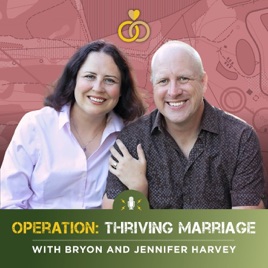
Advertise on podcast: Operation: Thriving Marriage
Rating
5from
This podcast has
100 episodes
Language
EnglishPublisher
bryondharveyExplicit
No
Date created
2021/11/01
Latest episode
2026/09/21
Average duration
24 min.
Release period
23 days
Description
It‘s not enough to have your marriage survive. We want your marriage to thrive! Bringing unique perspectives from counseling individuals and couples in the church, the law, and the military, Bryon and Jennifer Harvey bring a wealth of experience and perspective to Operation: Thriving Marriage.
Unlock Operation: Thriving Marriage podcast Email contact info,
Listeners & Audience details
Email contact information
Direct podcast contact details

Listeners
Audience numbers & engagement insights

Audience details
Podcast Insights

Podcast episodes
Check latest episodes from Operation: Thriving Marriage podcast
Ep 108 - Are We Okay? Why Fear of Disconnection Can Hurt a Healthy Marriage
2026/09/21
Have you ever worried that you and your spouse are drifting apart—even when nothing is obviously wrong?
In this episode of the Operation: Thriving Marriage podcast, Bryon and Jen explore the fear of disconnection in marriage and how anxiety about losing emotional closeness can actually create the very distance couples are afraid of.
Sometimes the problem isn’t actual disconnection. It’s the fear that your spouse is pulling away, disappointed in you, or no longer on your team. That fear can lead one spouse to cling and constantly seek reassurance while the other withdraws to protect themselves from anticipated rejection.
Bryon and Jen discuss how couples can interrupt that cycle by becoming more aware of what they are feeling, challenging fear-based thinking, and choosing to presume goodwill about their spouse.
In this episode, they discuss:
Why fear of emotional disconnection can damage an otherwise healthy marriage
The difference between actual marriage problems and imagined fears
Why some spouses cling while others withdraw
How naming an emotion can reduce its power
The importance of taking your thoughts captive instead of allowing anxiety to control the story
Why presuming goodwill can help de-escalate marital tension
How remembering that your spouse loves you, chose you, and is on your team can change your perspective
Why OTM emphasizes holiness over happiness
How a shared commitment to becoming more like Christ strengthens emotional connection
Why conflict itself is not necessarily what causes couples to drift apart
How facing fears together can help build a thriving marriage
Bryon and Jen also unpack 2 Timothy 1:7 and the reminder that God has not given Christians a spirit of fear, but of power, love, and self-control.
A healthy marriage doesn’t require pretending fear doesn’t exist. It means learning to recognize fear, challenge the stories it tells you, and face it together as Team Marriage.
If you’ve ever found yourself asking, “Are we okay?”, this episode will help you distinguish between genuine problems in your relationship and fears that may be distorting the way you see your spouse.
Learn more about Operation: Thriving Marriage, or invite Bryon and Jen to your church for a marriage conference or seminar, at operationthrivingmarriage.com.
Ep 107 - How to Repair Your Marriage After an Argument
2026/07/06
Podcast Title
Six Signs Your Marriage Needs Repair and How to Rebuild Connection After Conflict
Podcast Description
Every marriage experiences conflict, but healthy marriages are not defined by how often they argue. They are defined by how well they repair after the conflict is over.
In this episode of Operation: Thriving Marriage, Bryon and Jen Harvey explore the difference between simply ending an argument and truly resolving it. Using the memorable illustration of a “hooptie” car, they explain how many marriages are not falling apart but are showing clear signs that repair is needed before small problems become major ones.
The conversation walks through six common behaviors that reveal a couple has never learned healthy conflict repair. From saying “I’m sorry” just to end a conversation to avoiding difficult discussions, revisiting old arguments, and allowing emotional distance to grow, these patterns quietly weaken intimacy over time.
Bryon and Jen also provide practical, biblical strategies for repairing relationships, rebuilding trust, restoring connection, and creating lasting peace after disagreements. Drawing from Matthew 5 and the biblical concept of reconciliation, they explain why thriving marriages intentionally pursue restoration instead of simply waiting for conflict to disappear.
If you want to strengthen your communication, improve conflict resolution, rebuild emotional intimacy, and learn how healthy couples reconnect after disagreements, this episode offers practical tools you can begin using today.
Episode Highlights
Healthy marriages are measured by the quality of their repair, not the absence of conflict.
The difference between ending an argument and actually resolving it.
Six warning signs that your marriage needs relationship repair.
Why saying “I’m sorry” is not enough without genuine ownership.
How bringing old arguments into new conflicts damages trust.
The difference between taking a healthy pause and avoiding difficult conversations.
Why emotional distance grows when couples fail to reconnect after conflict.
How forgiveness, restoration, and reconciliation work together to rebuild intimacy.
Biblical principles for repairing relationships based on Matthew 5.
Practical steps to strengthen your marriage after every disagreement.
Keywords
marriage podcast, Christian marriage, marriage advice, conflict resolution, marriage communication, healthy marriage, relationship repair, repairing your marriage, marriage conflict, marriage counseling, Christian relationships, emotional intimacy, forgiveness in marriage, reconciliation, relationship communication, couples communication, thriving marriage, marriage help, marriage encouragement, biblical marriage, marriage restoration, relationship advice, marriage tips, conflict repair, emotional connection, healthy relationships
Ep 106 - Overcoming Offense in Marriage: How to Break the Cycle of Hurt and Resentment
2026/06/22
Most marriages do not fall apart because of one catastrophic event. More often, they drift apart through small, repeated offenses that slowly create resentment, distance, and disconnection. In this episode of Operation: Thriving Marriage, Bryon and Jen discuss why offense is one of the most overlooked threats to a healthy marriage and how couples can break the cycle before it damages intimacy.
Many marriage conflicts begin with unmet expectations. Every fight starts somewhere, and often the root issue is not what happened but what we expected would happen. We explore the concept of “unexpectations”—unvoiced expectations, unshared expectations, and unreasonable expectations—and how they create fertile ground for hurt feelings and misunderstanding.
We also discuss how offense grows when we assume the worst about our spouse. Thoughts like “they don’t care,” “they ignored me,” or “they did this on purpose” can quickly turn a simple misunderstanding into a major marriage conflict. Most marital problems are not caused by malice but by miscommunication, assumptions, and differing expectations.
Another source of offense is pride. When we adopt the mindset that we deserve better treatment, we can move from grace to entitlement. This episode explores how humility helps us respond differently and how adopting the mindset of Christ can transform the way we handle disappointment, conflict, and hurt in marriage.
Offense becomes even more dangerous when we rehearse it. Replaying hurtful moments, building our case against our spouse, and “keeping receipts” strengthens resentment and bitterness. We discuss why what you rehearse, you reinforce, and how couples can stop the cycle before it leads to emotional distance.
We also examine the danger of seeking validation from people who are not pro-marriage. The wrong voices can reinforce unhealthy narratives and deepen division rather than promote healing, forgiveness, and reconciliation.
The good news is that there is a better way. Bryon and Jen share practical and biblical strategies for overcoming offense in marriage, including guarding your heart, replacing assumptions with grace, choosing humility over pride, breaking the rehearsal cycle, and practicing forgiveness repeatedly. Drawing from Scripture, including Proverbs 4, Romans 12, Philippians 2, Colossians 3, and Matthew 18, this episode provides a roadmap for protecting your marriage from resentment and pursuing lasting unity.
If you’ve ever struggled with hurt feelings, resentment, bitterness, unmet expectations, communication problems, forgiveness, or conflict in marriage, this conversation will help you strengthen your relationship and build greater connection with your spouse.
Key topics include overcoming offense in marriage, unmet expectations, marriage communication, conflict resolution, forgiveness in marriage, resentment, bitterness, guarding your heart, Christian marriage advice, biblical marriage principles, relationship communication, emotional intimacy, marital conflict, and healthy marriage habits.
This version is much stronger for SEO because it naturally repeats high-value search phrases like offense in marriage, unmet expectations, forgiveness in marriage, marriage communication, conflict resolution, resentment, bitterness, Christian marriage advice, and healthy marriage habits without looking like a keyword list.
Ep 105 - Marriage Was Never About Happiness
2026/05/25
For this episode of Operation: Thriving Marriage, Bryon and Jen tackle one of the most repeated phrases in marriage culture: “Happy wife, happy life.” They also explore newer versions like “Happy spouse, happy house” and explain why—even though these sayings sound loving—they ultimately place the focus in the wrong place. When happiness becomes the goal of marriage, couples often end up frustrated, disappointed, and emotionally exhausted trying to carry a responsibility no human being was designed to carry. Bryon and Jen unpack how happiness is circumstantial, fluctuating, and often rooted in self-focused expectations, which can lead couples to avoid difficult conversations, stunt growth, and build resentment when those expectations go unmet.
Instead of centering marriage on happiness, this episode reframes the purpose of marriage around holiness, love, and Christlikeness. Using passages from Ephesians 4, 1 Peter 1, John 13, Colossians 3, Titus 2, and 1 Corinthians 13, Bryon and Jen discuss how marriage exposes selfishness, pride, and unmet expectations while also providing opportunities for growth, refinement, forgiveness, and deeper intimacy with Christ. Rather than asking, “How do I keep my spouse happy?” couples are challenged to ask, “How can I be loving in this moment?” The episode closes with a powerful reminder that happiness is a byproduct—not the foundation—of a thriving marriage. True peace and connection are built through commitment, sacrifice, forgiveness, and helping one another become more like Christ.
Ep 104 - The Most Overlooked Sexual Skill in Marriage
2026/05/11
Podcast Notes: The Most Overlooked Sexual Skill in Marriage
Many married couples want deeper sexual intimacy but struggle with one surprisingly common issue: initiation. In this episode of Operation: Thriving Marriage, Bryon and Jen Harvey discuss why initiating sex often feels awkward, vulnerable, or emotionally risky—even in healthy marriages. While culture often portrays sex as completely spontaneous and effortless, real marriage rarely works that way. Most couples were never taught how to initiate intimacy in healthy, safe, and mutually loving ways, which can create misunderstanding, fear of rejection, and emotional distance over time.
The Harveys explain how differences in desire styles—especially spontaneous desire versus responsive desire—can create confusion between spouses. One spouse may feel rejected when the other does not immediately respond with excitement, while the other spouse may simply need emotional connection, affection, or mental preparation before desire develops. This does not mean the marriage is broken or that attraction has disappeared. Instead, couples often need healthier expectations and better communication around intimacy. The episode also explores practical tools that can reduce awkwardness and pressure, including agreed-upon cues, scheduling intimacy, lowering the emotional stakes of “no,” and viewing sexual initiation as an invitation to connection rather than a demand for performance.
Drawing from Scripture such as Song of Solomon 1:4 and the biblical concept of yada (“to know”), the Harveys remind listeners that sex in marriage is ultimately about intimacy, unity, and becoming one. Healthy sexual intimacy grows when couples build emotional safety, communicate openly, honor each other’s differences, and approach intimacy with mutual care rather than self-centeredness. Initiation is not something couples instinctively know how to do well—it is a learnable skill that can strengthen closeness, trust, and connection in marriage over time.
Ep 103 - Marriage Conflict Resolution: How to Stop Arguing and Start Connecting
2026/03/30
In Episode 103 of Operation: Thriving Marriage, Bryon Harvey and Jen Harvey conclude their three-part series on marriage communication and conflict resolution by tackling a critical question: how do you end an argument in a way that actually strengthens your relationship? Many couples already know the basics—listen well, speak kindly, don’t bring up the past—but struggle to apply those skills in the heat of the moment. Building on earlier episodes about recognizing emotional triggers and calming down, this conversation emphasizes that the real breakdown in marriage conflict isn’t a lack of knowledge, but a lack of execution under stress. Without intentional effort, arguments can quickly become competitive, circular, and leave one or both spouses feeling unheard, turning what should be a bridge to connection into a relational battleground.
The episode challenges two common misconceptions that derail healthy conflict resolution: first, that resolving an argument requires agreement, and second, that being understood means being validated. In reality, couples can resolve conflict without agreeing on every issue, and true understanding does not require conceding that your spouse is right. The deeper problem often lies in the desire to “win” the argument, which inevitably creates winners and losers—and in marriage, that means both people lose. Bryon and Jen reframe the goal of conflict entirely, teaching that the objective is not to be right, but to be close. When couples shift their focus from proving a point to preserving connection, they move from opposing each other to working as a team, addressing the issue side by side instead of attacking one another.
Ultimately, Episode 103 highlights that healthy marriage communication is about connection before solution. Sometimes conflict resolution doesn’t even require an immediate decision; instead, it may mean choosing to pause, gather more information, or revisit the issue later with a unified mindset. By prioritizing understanding, regulating emotions, and refusing to settle for simply “ending the fight,” couples can transform conflict into an opportunity for growth. As emphasized throughout Operation: Thriving Marriage, strong relationships are not built by avoiding conflict, but by learning how to navigate it well—because when couples choose connection over control, they create lasting intimacy even in the middle of disagreement.
EP 102 - Calm Down First: The Missing Step in Marriage Communication (Part 2 of 3)
2026/03/03
In this episode of the Operation: Thriving Marriage podcast, Bryon and Jennifer Harvey continue their series on healthy communication in marriage by addressing a skill most couples overlook: emotional regulation before conflict. Many spouses know the right communication tools for conflict resolution—use “I” statements, listen well, avoid interrupting—but struggle to apply them when emotions run high. The truth is, you cannot have healthy conflict resolution in marriage if your body is in fight-or-flight mode. Telling your spouse to “calm down” rarely works and often feels dismissive, yet calming yourself down is essential for productive communication. Emotional maturity means recognizing when you are escalating and taking responsibility for regulating your own response.
The Harveys introduce the concept of a “tactical pause”—a purposeful break taken not to avoid the argument, but to prepare for it. Just as high-stress environments require intentional pauses to restore safety and clarity, marriage sometimes requires couples to unplug before continuing a difficult conversation. This kind of pause is not abandonment, avoidance, or going to bed angry in a destructive way. Instead, it’s a strategic step toward healthier communication. Couples can move their bodies to lower stress hormones, practice slow breathing to regulate the nervous system, and engage in prayer or Scripture meditation to re-center emotionally. These practical tools help calm anger in marriage and create the physical readiness needed for respectful dialogue.
Healthy marriage communication doesn’t start with better words—it starts with a regulated body and mind. By learning how to calm down before conflict, couples can prevent destructive arguments and build a pattern of biblical conflict resolution rooted in responsibility, self-control, and commitment. In this episode, Bryon and Jennifer make it clear: unplugging from the argument is not walking away from the marriage. It is preparing to return to the conversation in a way that strengthens trust, deepens connection, and protects the long-term health of your relationship.
Ep 101 - Before the Fight: Preparing for Healthy Conflict (Part 1 of 3)
2026/02/16
Bryon and Jen kick off a three-part Operation: Thriving Marriage series on communication and conflict resolution by addressing a common frustration for couples: most people already know what healthy communication is supposed to look like, but struggle to apply it in the moment. Just like financial advice that sounds simple but is hard to live out, marriage guidance can feel clear in theory yet difficult during real conflict. Drawing from biblical principles, personal experience, and years of working with couples, they explain that the goal isn’t perfection, but learning how to implement truth in everyday marriage conversations.
In this episode, the focus is on what happens inside the brain during conflict. When tension rises, the limbic system triggers a fight-flight-or-freeze response before the rational mind can catch up, flooding the body with stress hormones and making calm, productive communication harder. This biological reaction explains why couples can feel overwhelmed, defensive, or reactive even when they genuinely want to respond with patience and love. Healthy conflict in marriage starts with recognizing that emotional intensity is not just immaturity—it’s a natural response that must be managed.
Bryon and Jen encourage couples to watch for early warning signs that they may be preparing for a fight instead of a healthy conversation, including racing heart, muscle tension, heightened sensitivity to criticism, or mentally rehearsing arguments instead of listening. Rooted in the wisdom of James 1:19—being quick to listen, slow to speak, and slow to become angry—the key takeaway is awareness: most couples know the right tools for communication, but can’t use them when emotions take over. In the next episode, they’ll share practical steps to calm the body and mind so conflict can lead to connection, growth, and a stronger Christian marriage.
Ep 100 - A Look Back at 100 Conversations About Marriage
2026/02/02
Episode 100 marks a meaningful milestone as Producer Todd joins Bryon and Jen to reflect on the themes that have shaped the heart of the podcast. Rather than focusing on highlights, this episode looks back at the ideas that have consistently surfaced because they reflect the real work of marriage.
One of those enduring ideas is the image of the “little foxes”—the small, unresolved issues that quietly weaken a marriage over time. The hosts reflect on how avoidance often feels easier than engagement, yet the cost of waiting is far greater than addressing what seems minor. Over the years, the lesson has remained clear: small issues matter, and dealing with them early protects the relationship.
The conversation also returns to a foundational conviction of the podcast: marriage is not primarily about happiness, but about holiness. This perspective reframes conflict and discomfort, shifting them from signs of failure to opportunities for growth. When marriage is viewed as a place of formation rather than fulfillment, challenges take on deeper meaning.
Another recurring theme revisited in this episode is unspoken expectations, or “unexpectations.” Many conflicts are not about the surface issue, but about assumptions that were never communicated. Expectations left unshared often lead to frustration and distance, reinforcing the importance of clarity and honest communication in marriage.
Episode 100 serves as a reflection on faithfulness rather than a finish line. These themes have endured because they mirror the lived experience of marriage—growth that happens slowly, through intentional choices and consistent effort. This milestone episode invites listeners to continue doing the quiet, faithful work that builds a thriving marriage.
Ep 99 - Marriage as Public Theology: Why Your Marriage Preaches a Message
2026/01/19
Episode 99 of the Operation: Thriving Marriage podcast, challenges the modern assumption that marriage is merely a legal contract, emotional bond, or private commitment. Bryon and Jen Harvey explore how Scripture presents marriage as a divine institution established by God Himself, not a social invention or cultural arrangement. From the beginning, marriage was designed to be more than companionship or stability—it was meant to reveal something true about God. Jesus affirms this sacred design by teaching that marriage is a divine joining humans are not meant to redefine or divide (Genesis 2:24; Mark 10:6–9).
The problem, the Harveys explain, is that both culture and the Church have often reduced marriage to something far too small. When marriage is treated primarily as a tool for personal fulfillment or a private relationship with private impact, its deeper purpose is lost. This reduction creates confusion about why marriage matters so much in Scripture and why it carries such weight and permanence. At the heart of this misunderstanding is a forgotten truth: marriage is rooted in the imago Dei—the image of God—and is meant to function as a visible, public witness rather than a purely personal preference.
The solution offered is a robust theological vision of marriage as a living reflection of the Triune God. Just as God eternally exists as Father, Son, and Holy Spirit—distinct yet perfectly united in love—marriage is two people joined into one union through mutual, self-giving love. Christian marriage, though imperfect, is designed to make God visible through everyday acts of love, humility, honor, and service (John 13:35). Marriage is never merely personal; it is always formative and revealing. Every marriage tells a story about God. The question is not whether others see God in our marriage, but what they are learning about Him by watching how we love one another.
Ep 98 - Most Marriages Don’t Break—They Slowly Drift
2026/01/05
Most marriages don’t fall apart because of one explosive moment. They slowly drift.
In this episode of Operation: Thriving Marriage, Bryon and Jennifer Harvey talk about one of the most common—and most overlooked—threats to marriage: busyness. Not the dramatic kind that feels like a crisis, but the everyday, socially acceptable kind that fills calendars, eats attention, and quietly pushes connection to the margins.
The truth is, many couples don’t realize anything is wrong until something small suddenly feels overwhelming. By then, the relationship has already been weakened—not by one big failure, but by a long season of being stretched thin.
One of the biggest misunderstandings couples have is confusing proximity with connection. You can be sitting right next to each other, working at the same table, scrolling on the same couch, or sharing the same space—and still feel emotionally disconnected. Being close physically doesn’t automatically mean you’re close relationally. Marriage doesn’t thrive on shared airspace; it thrives on shared attention.
Another trap couples fall into is waiting for the “right time” to reconnect. We tell ourselves things will feel better on the next vacation, after date night, or when life slows down. But big moments can’t carry the weight of a relationship that isn’t being nourished day to day. If connection isn’t happening in the ordinary moments, even the best getaway won’t fix the distance.
That’s why Bryon and Jen emphasize something they call marriage CPR—Connection, Positivity, and Resilience. The goal isn’t adding more to an already packed schedule. It’s choosing small, intentional habits that keep the relationship alive even in busy seasons. These aren’t grand gestures. They’re doable rhythms that fit real life.
Sometimes it starts with the morning. A few calm minutes together—sharing coffee, saying a short prayer, or simply acknowledging each other before the rush begins—can set the emotional tone for the entire day. It doesn’t have to be long to be meaningful.
Connection can also happen while you’re apart. A quick text that isn’t about logistics—a meme, an encouraging word, a simple “thinking of you”—can remind your spouse they matter in the middle of the workday. Small digital check-ins can keep emotional closeness alive when physical closeness isn’t possible.
They also talk about the importance of individual resets. Taking time to recharge on your own isn’t selfish; it’s how you make sure you’re bringing your best self into the marriage instead of what’s left over. A rested spouse is usually a more present spouse.
Another powerful habit is guarding just one screen-free moment each day. It might be dinner, a short walk, or sitting together for a few minutes in the evening. Phones down. Distractions away. Those protected moments often become the most meaningful points of connection.
And finally, there’s the end of the day. Checking in matters—but so does timing. Gratitude, prayer, or a simple emotional touchpoint can be powerful, as long as it respects energy levels. If one of you is exhausted, forcing a deep conversation can do more harm than good. Connection should feel life-giving, not like another obligation.
What this episode ultimately reminds us is that thriving marriages aren’t built by big fixes—they’re sustained by daily faithfulness. Life will always be full. The real question is whether your marriage is being fed.
When couples choose small, consistent moments of connection, they build resilience. And when resilience is strong, the marriage is far less vulnerable to the slow erosion that busyness so often brings.
If your marriage feels stretched thin by life right now, this episode isn’t about guilt—it’s about hope. Not through dramatic change, but through simple, intentional habits that work right in the middle of real life.
Ep 97 - Is Marriage Bad for Women? What Research and Scripture Really Say
2025/12/15
In Episode 97 of the Operation Thriving Marriage Podcast, Bryon and Jennifer Harvey tackle one of today’s loudest cultural narratives: “Marriage is bad for women.” From viral reels to negative blog posts, modern messaging often paints marriage as limiting, misogynistic, or a barrier to women’s personal success. But the Harveys push back with both research and biblical wisdom, highlighting findings from the General Social Survey that consistently show married women—especially married women with children—report significantly higher levels of happiness than their single peers. While the data can’t claim that marriage causes happiness, it does clearly demonstrate that marriage is not harmful to women and often correlates with meaningful emotional, spiritual, and relational benefits.
Bryon and Jen explore why this disconnect exists and how social media outrage, pain-driven content, and misunderstanding of Christian teaching all contribute to a distorted narrative. They explain how biblical marriage offers women deep emotional support, protection against loneliness, shared identity and purpose, accountability for personal growth, and the joy of partnership in both daily life and spiritual mission. But these benefits don’t flow automatically—marriage only thrives when both spouses actively invest in it. Husbands are called to love their wives as Christ loves the church (Ephesians 5:25), creating emotional safety and mutuality, while wives partner in love and teamwork. Healthy communication, catching small issues early, and keeping Christ at the center are essential practices that help women flourish in marriage.
The episode ends with a challenge for couples to evaluate the benefits they are experiencing in their relationship and to intentionally reconnect if something is missing. Asking simple questions like, “How do I help you feel loved, valued, or seen?” and “What small issues do we need to address together?” can reignite unity and purpose. As the Harveys often remind listeners: if both of you aren’t winning, neither of you is winning. Subscribe, rate, and connect with Operation Thriving Marriage for more tools to build a marriage that thrives.
Ep 96 - Unexpectations: The Hidden Ways Couples Hurt Each Other
2025/12/01
In this episode of the Operation: Thriving Marriage podcast, Bryon and Jennifer Harvey dive into a hard but essential truth about relationships: if you love someone long enough, you’re going to hurt them. Not because you’re cruel—not because something is wrong with your marriage—but because you are human.
Whether the hurt comes from unspoken expectations, careless words, misunderstandings, or small selfish moments, every couple will face emotional pain. But the good news? Healthy, Christ-centered marriages don’t break under hurt—they grow through it.
Bryon and Jen unpack how couples can move from hurt to healing by staying emotionally present, listening with patient love, resisting the urge to get defensive, and remembering that the foundation of your marriage is Jesus.
Ep 95 - Supporting a Spouse Who Survived Sexual Trauma: A Christian Guide to Healing Together
2025/11/17
When two people join their lives in marriage, they also join their histories — the joy, the fear, the wounds, and the unspoken stories that shaped them. For many couples, part of that shared journey includes navigating the impact of sexual trauma, whether from childhood abuse, sexual assault, or past relationships. In this episode of Operation: Thriving Marriage, we explore how couples can walk through the healing process together and how a Christian spouse can support a partner recovering from sexual trauma with grace, patience, and intentional love.
We begin with a foundational truth every survivor needs to hear: sexual trauma is never the survivor’s fault. Not then. Not now. Not ever. Trauma creates deep emotional wounds and distorted beliefs about identity and worth, and those lies often linger long into marriage. A key step toward healing is working with a trauma-informed Christian therapist who understands both the psychological and spiritual dimensions of recovery.
Sexual trauma affects more than the mind — it affects the body, nervous system, trust, and sense of safety. In marriage, that means trauma often shows up in unexpected ways: difficulty with physical touch, fear responses during intimacy, hypervigilance, dissociation, or struggles with trust and emotional closeness. These reactions can feel confusing to the supporting spouse, but it’s essential to remember: triggers are memories, not manipulations. The body is simply responding to old pain.
And this is where the spouse steps into a sacred, Christ-like role. Your job is not to “fix” your partner’s trauma. Your calling is to walk with them through it. Healing happens when the survivor is met with steady, patient love — love that doesn’t pressure, doesn’t blame, and doesn’t interpret their trauma responses as rejection. Supporting your spouse in healing is an act of discipleship, service, and covenant faithfulness.
One of the biggest shifts couples must make is redefining intimacy. Culture often treats sex as the foundation of closeness, but for couples healing from sexual trauma, safety is the true foundation of intimacy. Emotional safety, physical safety, spiritual safety — these are what create room for trust to grow and for healthy sexual intimacy to eventually flourish.
Here are several practical, research-informed, trauma-informed steps couples can use as they move forward:
1. Learn about trauma responses.
Educate yourself on common trauma reactions such as hypervigilance, avoidance, freezing, emotional shutdown, and dissociation. Understanding your spouse’s nervous system helps you respond with compassion rather than confusion. Remember: these responses are not about you; they are about what happened to them.
2. Let affection be guided by consent and communication.
Ask before initiating physical touch, even if it’s something as small as a hug or a hand on the shoulder. Allow your spouse to set the pace for physical closeness and sexual intimacy. One of the most healing messages you can send is: “You’re safe with me. We’ll go at your pace.”
3. Develop low-pressure signals for sexual interest.
Talking face-to-face about sex can feel overwhelming for some survivors. Many couples create simple rituals to communicate desire — such as lighting a candle to express interest and blowing it out to say “not tonight.” This removes pressure, prevents shame, and creates a safe environment for both partners.
4. Listen like Christ.
Healing requires gentle presence more than problem-solving. Be slow to speak, slow to judge, and quick to listen. When your spouse tells you their story or shares a reaction to trauma, resist the urge to compare, reinterpret, or fix it. Healing grows in environments of empathy, patience, and non-judgment.
Throughout today’s episode, we remind couples that healing from sexual trauma is not linear. It involves progress, setbacks, moments of confusion, and moments of deep connection. But for couples committed to “Team Marriage,” healing becomes a shared journey — not a battle the survivor fights alone.
Marriage doesn’t erase sexual trauma, but it can become one of the safest places to heal from it.
With patience, compassion, and Christ-centered support, couples can rebuild emotional trust, strengthen intimacy, and create a marriage story marked by redemption rather than fear.
Ep 94 - Faith Differences, Shared Mission: Thriving Across Denominations
2025/11/03
In Episode 94 of Operation: Thriving Marriage, Bryon and Jennifer Harvey open up about a topic that quietly challenges many Christian couples — what happens when you fall in love with someone from a different denomination? Through humor, honesty, and their trademark wisdom, the Harveys share their own journey of blending faith traditions while building a unified spiritual life together.
Jennifer grew up Catholic, while Bryons background was a patchwork of Protestant experiences from various military base churches. Their love story took an unexpected turn when God used their shared passion for musical theater — especially the production Godspell (based on the Gospel of Matthew) — to deepen their spiritual bond. What started as an artistic connection became a divine bridge between two expressions of the same faith.
In this heartfelt episode, the Harveys explore what it means to create “Team Marriage” even when faith traditions differ. Jennifer recalls searching for a Catholic parish where Bryon might feel at home, joking that finding a priest who could “keep a Protestant’s attention” was no easy task. But underneath the laughter lies a profound truth: denominational differences don’t have to divide a couple — they can deepen understanding, strengthen communication, and expand spiritual growth when approached with humility and grace.
Bryon and Jennifer’s story becomes a living example of Ephesians 4:3 — “Make every effort to keep the unity of the Spirit through the bond of peace.” Whether you’re Catholic and Baptist, Pentecostal and Anglican, or simply on different pages spiritually, this episode offers practical wisdom on how to honor your backgrounds while staying centered on Christ.
Podcast reviews
Read Operation: Thriving Marriage podcast reviews
slomoshion 2023/05/11
Listen, Follow & Share
It came up in conversation, that a friend of mine was listening to Bryan and Jennifer's podcast after he read the couples book. I began following the ...
Mom to 5! M.M. to 3! 2023/03/28
Important to remember!
Thank you so much for pointing out that both men and women need to deal with this issue. I absolutely agree; worship is an amazing lust stopper! W...
Basiakali 2023/03/27
Practical advice, scriptural foundation, fun hosts
The Operation Thriving Marriage podcast offers genuine insight into the various obstacles modern marriages inevitably encounter. Even though the podca...
MalteseJAG 2023/03/03
Excellent
This is an excellent way to take the time to step back, analyze, self reflect and adjust various things in your Marriage. ALL of us need to take inve...
Podcast sponsorship advertising
Start advertising on Operation: Thriving Marriage relevant audience podcasts
You may also like to advertise on these Podcasts

4.8815227
ArtCurious Podcast
Jennifer Dasal/ArtCurious

4.9328041388
REAL AF with Andy Frisella
Andy Frisella

48972549
20/20
ABC News
4.91361708
The Learning Leader Show With Ryan Hawk
Ryan Hawk

4.92107498
the bossbabe podcast
Natalie Ellis

4.4384621964
The Megyn Kelly Show
SiriusXM

4.947484404
The Shawn Ryan Show
Shawn Ryan

4.5185359
Who, When, Wow!
Tinkercast | Wondery

4.6687031104
Armchair Expert with Dax Shepard
Armchair Umbrella

4.9553842188
The MeidasTouch Podcast
MeidasTouch Network