1612309007
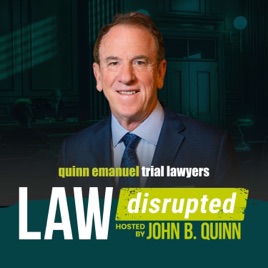
Law, disrupted

Advertise on podcast: Law, disrupted

Rating
★★★★★
4.8
from
72 reviews
This podcast has
229 episodes
Language
English
Explicit
No
Date created
2022/03/01
Latest episode
2026/10/01
Average duration
38 min.
Release period
8 days

Description

Law, disrupted is a podcast that dives into the legal issues emerging from cutting-edge and innovative subjects such as SPACs, NFTs, litigation finance, ransomware, streaming, and much, much more! Your host is John B. Quinn, founder and chairman of Quinn Emanuel Urquhart & Sullivan LLP, a 900+ attorney business litigation firm with 29 offices around the globe, each devoted solely to business litigation. John is regarded as one of the top trial lawyers in the world, who, along with his partners, has built an institution that has consistently been listed among the “Most Feared” litigation firms in the world (BTI Consulting Group), and was called a “global litigation powerhouse” by The Wall Street Journal. In his podcast, John is joined by industry professionals as they examine and debate legal issues concerning the newest technologies, innovations, and current events—and ask what’s next?

Unlock Law, disrupted podcast Email contact info,
Listeners & Audience details

Email contact information

Direct podcast contact details

Listeners

Audience numbers & engagement insights

Audience details

Podcast Insights

Podcast episodes

Check latest episodes from Law, disrupted podcast


Kindleworth’s Blueprint for Building Law Firms
2026/10/01
John is joined by James Hacking, CEO and co-founder of Kindleworth. Kindleworth helps lawyers launch and operate specialized law firms by providing outsourced infrastructure, administration, and strategic support. Its clients are typically established partners from major U.S. firms, Magic Circle firms, or other elite firms who have substantial practices but want greater control over pricing, culture, compensation, or service delivery. Kindleworth has helped launch more than sixty firms over approximately fifteen years and currently provides ongoing support to about thirty. The process often begins before a lawyer decides whether to leave an existing firm. Kindleworth evaluates feasibility, financial projections, market positioning, staffing, locations, funding requirements, and expected profitability. If a launch proceeds, it handles entity formation, banking, financing, insurance, office space, branding, technology, and operational systems, allowing lawyers to leave their old firm on Friday and begin operating from the new platform on Monday morning. After launch, Kindleworth provides finance, billing, human resources, compliance, technology, operations, and strategic advice. This outsourced structure allows firms to avoid building large administrative departments while gaining access to specialized professionals. Confidentiality is protected through separate client technology environments, contractual protections, and segregated teams when firms operate in potentially overlapping markets. The model resembles managed service organizations (MSOs) increasingly discussed in the United States, although almost all states prohibit nonlawyers from directly owning law firms. In the United Kingdom, outside investment is permitted, enabling more direct capital relationships. Kindleworth also helps firms obtain external financing and has developed a relationship with Burford Capital, whose investment is supporting Kindleworth’s expansion and planned New York presence. The Kindleworth model may be particularly relevant as private equity explores U.S. legal services through MSO structures. Outsourcing can make economic sense even for substantial firms, including firms generating more than $50 million in revenue, because many may not need full-time senior finance, HR, compliance, and risk executives. Podcast Link: Law-disrupted.fm Host: John B. Quinn Producer: Alexis Hyde Music and Editing by: Alexander Rossi
Re-release: The Spectator Sport of Legal Journalism in the UK
2026/09/17
John is joined by Catrin Griffiths and Christian Smith, the Editor-in-Chief and Litigation Editor of The Lawyer. They discuss legal journalism in the UK, with John, Catrin, and Christian agreeing that UK legal reporting tends to be more analytical and critical of law firm strategy than its U.S. counterpart. They attribute this to the UK’s centralized legal market in London and a journalistic culture that places a strong emphasis on accountability and critical analysis. They explain how The Lawyer, originally a print magazine, has evolved into a digital platform that combines news, data, and insight to provide in-depth analysis of law firm performance and strategy. The publication now operates much like a financial news outlet dedicated to the legal sector, reflecting the industry’s significant contribution to the UK economy. Its coverage ranges from major legal trends and firm strategy to lighter stories about law firm culture. The conversation also explores the growing dominance of U.S. law firms in London. John, Catrin, and Christian note that American firms often outperform their UK counterparts, perhaps because of longer working hours and more streamlined management structures. Catrin explains that UK firms historically benefited from strong infrastructure and extensive global networks but now face challenges adapting to changing market conditions. They also discuss cultural differences, including the relatively early retirement age at many UK firms, compared with U.S. firms, where partners often continue practicing well into their 70s. Finally, Catrin and Christian discuss the importance of authenticity when law firms engage with journalists. They advise against relying on corporate jargon and instead encourage open, honest conversations. They conclude by noting that seemingly small or quirky stories about a firm’s culture can often reveal broader industry trends and resonate strongly with readers. Podcast Link: Law-disrupted.fm Host: John B. Quinn Producer: Alexis Hyde Music and Editing by: Alexander Rossi
Re-release: Inside Japan’s Evolving Legal Culture
2026/09/10
John is joined by Hidetaka Mihara, Senior Counsel at Tokyo International Law Office. Together, they discuss three major legal developments in Japan: (1) the criminal and civil litigation arising from the 2011 Fukushima nuclear disaster, (2) the rise of shareholder activism, and (3) Nippon Steel’s acquisition of U.S. Steel. On March 11, 2011, a massive earthquake and ensuing tsunami triggered the Fukushima nuclear disaster. Executives at the company that operated the nuclear power plant had been warned of tsunami risks years before the event, but did not report them to the government until days before the earthquake. The trial court found the executives not guilty of criminal negligence, reasoning that tsunamis of this size were so rare and that the cost of addressing the risk, cutting off electricity to the region while repairs were made, was so high that the company’s delayed report did not amount to negligence. Related civil claims against the government and management were also dismissed, with courts holding that neither breached their obligations under Japanese law. Despite some public criticism, most Japanese have moved on from the tragedy, focusing on rebuilding rather than retribution. The recent rise of shareholder activism in Japan marks a notable shift in a culture traditionally averse to corporate confrontation. This rise follows reforms in Tokyo Stock Exchange rules, greater emphasis on corporate governance, and changes in ownership thresholds that empower minority shareholders to propose changes.  One example is the Seven & i Holdings case, in which activists pushed for a corporate restructuring. While their proposal failed, their recommendations for improving the company were eventually adopted by management. Although shareholder litigation remains rare in Japan, shareholder proposals and negotiations have become increasingly effective, aided by the gradual unwinding of entrenched cross-shareholding relationships. Finally, Nippon Steel’s acquisition of U.S. Steel, which has been politically controversial in the U.S., is widely seen in Japan as a strategic and mutually beneficial partnership. Japan views the acquisition as a way to strengthen both nations’ competitiveness against Chinese and Indian steelmakers. Ultimately, the U.S. government approved the acquisition based, in part, on its obtaining “golden share” rights, including the right to block certain potential managerial changes at the company.   The conversation reflects how Japan’s legal and corporate culture is gradually adapting to global norms while maintaining its distinct approach to risk, accountability, and trust. Podcast Link: Law-disrupted.fm Host: John B. Quinn Producer: Alexis Hyde Music and Editing by: Alexander Rossi
Law, disrupted Mailbag: The Future of AI in Litigation, International Legal Practice, and Keys to a Successful Legal Career
2026/09/04
John is joined again by producer Alexis Hyde for a second mailbag episode of Law Disrupted. In it, John responds to questions submitted by listeners rather than conducting a traditional interview. Topics include the future demand for lawyers, artificial intelligence, international legal practice, career development, and the experiences that shape effective litigators. Despite AI’s growing ability to draft documents, analyze discovery, and perform other legal tasks, John expects the number of lawyers to increase over the next three years. Although AI might someday reduce human involvement in less complex legal fields, demand for junior lawyers has not yet declined at sophisticated litigation firms. At the highest levels of the profession, highly skilled lawyers remain essential. A law firm founded today should integrate an AI platform throughout its practice, with lawyers trained to become sophisticated users. Because existing legal technology does not always fit specialized litigation workflows, firms have an incentive to develop proprietary systems tailored to their work. Geopolitical tensions have also transformed international legal practice. Work in China has moved away from advising Western companies investing there and toward representing Chinese companies in disputes around the world. As the domestic Chinese economy has faced challenges, Chinese companies have increasingly looked outside China for growth. As Chinese companies expand their operations internationally, they encounter the same contractual, regulatory, and intellectual-property disputes faced by other global companies. Meanwhile, India and Japan have become major destinations for extensive private-equity investments, driven respectively by economic growth in India and undervalued assets in Japan. To be successful, a young lawyer does not need a single defining mentor. Young lawyers learn by observing talented colleagues and adversaries and by doing the work themselves. Remaining focused and competitive is key to a highly successful career. Litigation is an especially exciting field for young attorneys because every case requires learning about new industries, facts, personalities, and legal issues. John has had a wide variety of experiences outside of practicing law, including competing in the Ironman World Championship in Hawaii multiple times, owning a Michelin-starred restaurant and a museum, collecting art, and creating an artist residency program. Experiences from these activities have strengthened his litigation skills by expanding his knowledge, enhancing his ability to develop effective analogies and metaphors, and helping him connect with people. Finally, settlement decisions often reflect considerations beyond the legal merits. Reputational damage, adverse publicity, embarrassing disclosures, and the possibility that serious allegations will receive attention even if later dismissed can create substantial leverage and motivate parties to resolve otherwise defensible claims. Podcast Link: Law-disrupted.fm Host: John B. Quinn Producer: Alexis Hyde Music and Editing by: Alexander Rossi
Law, disrupted Mailbag: Litigation Philosophy and the AI Revolution
2026/08/27
John is joined by producer Alexis Hyde for a special mailbag episode of Law, disrupted. John responds to questions submitted by listeners rather than conducting a traditional interview. Topics include how to become a great litigator, what distinguishes Quinn Emanuel’s approach to litigation, and how artificial intelligence is transforming the legal landscape. Great litigators develop through experience and observation: working alongside accomplished lawyers, watching strategies develop, executing those strategies, and eventually teaching others. The progression resembles the medical maxim “watch one, do one, and teach one.” Quinn Emanuel’s litigation philosophy centers on achieving the best possible results, delivering value at a fair cost, and building long term relationships. The firm’s reputation as the “most feared” litigation firm is based on an annual survey of 350+ corporate general counsel conducted by independent consulting firm BTI. For each of the last five years, those surveys have identified Quinn Emanuel as the firm the general counsel would least want to face in litigation.  Aggression is not always the best litigation strategy. Depending on the case, restraint may be more effective. No matter which strategy applies, lawyers should seize the initiative, identify the issues that will ultimately decide the case before the opposition does, and focus discovery and strategy on those issues rather than wasting resources on matters that will not affect the outcome.  Artificial intelligence is the fastest-growing source of new litigation. Agentic AI raises questions about computer access, e-commerce, intellectual property, patentability, product liability, autonomous systems, mental-health harms, and responsibility for unpredictable machine-learning decisions. Data centers present a wide range of potential disputes involving financing, permitting, construction delays, and changing local restrictions. Recent litigation involving Perplexity and Amazon, a case in which Quinn Emanuel represented Perplexity, illustrates how existing computer-fraud statutes are being tested by new AI technologies. AI is not only transforming how law is practiced but in identifying claims. New services identify potential lawsuits by comparing regulatory requirements with public information and detecting possible violations. AI may also accelerate dispute resolution by giving parties earlier and more complete insights into evidence, risks, and case strengths, potentially encouraging earlier settlements. Podcast Link: Law-disrupted.fm Host: John B. Quinn Producer: Alexis Hyde Music and Editing by: Alexander Rossi
Perplexity Wins Landmark Victory Against Amazon at Intersection of Agentic AI and E-Commerce
2026/08/21
John is joined by Daniel C. Posner, a partner in Quinn Emanuel’s Los Angeles office, and Renita N. Sharma, a partner in Quinn Emanuel’s New York office. Together, they discuss the recent victory secured by a team led by John, Dan, and Renita in the Amazon v. Perplexity case before the Ninth Circuit. The case addressed how the Computer Fraud and Abuse Act (CFAA) applies to agentic AI. Perplexity’s Comet browser includes an AI assistant that performs multi-step tasks for users, including shopping on Amazon. Amazon objected because purchases made through the assistant may bypass Amazon’s advertising and upselling opportunities. Amazon sued under the CFAA and the California Computer Data Access and Fraud Act (CDAFA). The CFAA is the primary federal anti-hacking statute. To establish a violation, a plaintiff must prove that a person intentionally accessed a computer without authorization, obtained information through that access, and caused the plaintiff to suffer losses of at least $5,000. The CFAA is also a criminal statute, so case law has emphasized that it must be construed narrowly. The CDAFA is substantially similar to the CFAA, except it does not require proof of $5,000 in losses. CDAFA and CFAA claims typically rise and fall together. Amazon moved for a preliminary injunction almost immediately after filing its complaint. Amazon argued that Perplexity intentionally accessed its computers without authorization after Amazon expressly told Perplexity not to send its agents to Amazon’s website. Perplexity responded that its servers never directly accessed Amazon’s servers. Instead, the Comet browser resides on the user’s computer and acts only when the user instructs it to perform a task. The user’s computer communicates separately with Amazon and Perplexity, much as a conventional browser, such as Apple’s Safari, facilitates access without Apple itself accessing the website. Perplexity also argued that it did not obtain any information from Amazon or cause any cognizable damages. Although the district court granted Amazon a preliminary injunction, the Ninth Circuit initially stayed and then reversed that decision, holding that Perplexity had not “accessed” Amazon’s computers within the meaning of the CFAA. The court examined the technical architecture of the Comet browser and the broader principle that agentic AI, however sophisticated, remains a tool operated by a person. Because the user directs the assistant, the user—not Perplexity or the AI itself—is the relevant actor. In light of its ruling on access, the Ninth Circuit did not need to decide whether any access was unauthorized, whether Perplexity obtained information from Amazon, or whether Amazon suffered cognizable damages. The decision is likely to become an important early precedent governing agentic AI. Future cases could raise additional issues as AI agents become more autonomous, circumvent safeguards, enter into contracts on unfavorable terms, cause tortious harm, or are jointly controlled by users and developers. The ruling could also have implications for journalists and researchers who use automated tools to gather publicly available information online. Podcast Link: Law-disrupted.fm Host: John B. Quinn Producer: Alexis Hyde Music and Editing by: Alexander Rossi
Re-release: From Provo to NEOM: A Lawyer’s Career in Higher Education
2026/08/13
John is joined by Michael K. Young, Professor of Law and former President of Texas A&M University, the University of Washington, and the University of Utah. They discuss Michael’s career in higher education, beginning with his years at Columbia Law School, including two and a half years as a visiting professor at the University of Tokyo, where he established the East Asian Legal Studies Center. The conversation then follows his service at the U.S. Department of State, where he negotiated treaties involving trade, international environmental law, human rights, and the terms under which Germany was reunified. They also discuss Michael’s tenure as Dean of George Washington Law School and the University of Utah, as well as his later roles as President of the University of Utah, the University of Washington, and Texas A&M University. Michael describes his current work at a research center preparing the entire educational system, from primary school through university, for NEOM, the futuristic megacity project in Saudi Arabia. Michael explains how his legal training helped him succeed in these leadership roles by maintaining a clear focus on the goals he was trying to achieve, the mission of each institution, and the importance of understanding both sides of every issue. He also shares several leadership lessons, including the need for leaders to genuinely listen, and demonstrate that they have listened, keep everyone focused on the institution’s mission, generously share credit, and take responsibility when things go wrong. Finally, John and Michael discuss the current controversies surrounding free speech on American college campuses. Michael shares his approach to handling volatile situations involving controversial speakers. Podcast Link: Law-disrupted.fm Host: John B. Quinn Producer: Alexis Hyde Music and Editing by: Alexander Rossi
Inside White House AI Policy
2026/08/07
John is joined by Sriram Krishnan, former Senior White House Policy Advisor on Artificial Intelligence.  They discuss the Trump administration's AI development policies, including the administration’s AI Action Plan which Sriram largely developed.   The United States remains the global leader in artificial intelligence but its advantage over China is more narrow than many assume. Sriram believes that maintaining American leadership in the field requires reducing regulatory burdens, expanding access to computing resources, strengthening domestic infrastructure, and ensuring that allies have access to American technology rather than restricting its distribution. In short, the government should “let Silicon Valley cook." While the administration has favored deregulation, it has also intervened to slow the release of some particularly advanced AI models. These positions are consistent because the government wishes to encourage rapid innovation but also protect critical infrastructure. Models with advanced cyber capabilities that could expose vulnerabilities in banking systems, power grids, military systems, healthcare networks, and other essential services will face heightened scrutiny. At the same time, state regulation of AI is fragmented. The administration believes that the current patchwork of fifty different regulatory systems creates excessive compliance burdens and hampers innovation. That is why the administration is attempting to pass national AI legislation. The proposed legislation emphasizes four principal areas: intellectual property and the protection of creators' rights, the impact of data centers on local communities, protections for children, and the reduction of harmful bias and censorship. John and Sriram also discuss the potential development of a voluntary pre-review process for new AI models that present particularly high cybersecurity risks. This process is being developed by the administration in close cooperation with the major AI companies.  World leaders, including President Xi of China, have suggested that AI be regulated by an international body. Several leading figures in Silicon Valley have endorsed this idea. However, Sriram believes that it would be a mistake to allow an international bureaucracy which may not have American interests at heart control the cutting-edge technology currently being developed in the U.S. A different proposal put forward by Demis Hassabis would establish a Self-Regulatory Organization composed of the most significant AI developers. The proposed SRO would establish recognized industry standards. Although the United States is the overall leader in artificial intelligence, Chinese companies are increasingly formidable competitors, particularly in open-weight models. The next several years will likely be critical in determining the global balance of power in artificial intelligence. Podcast Link: Law-disrupted.fm Host: John B. Quinn Producer: Alexis Hyde Music and Editing by: Alexander Rossi
Landmark Serta Judgment - An LME Short Course with Susheel Kirpalani
2026/07/31
John is joined by Susheel Kirpalani, partner in Quinn Emanuel’s New York office, Head of Special Situations, and founder of the firm’s Bankruptcy and Restructuring Group. They discuss the increasingly important role of liability management exercises, or LMEs, as tools that financially distressed companies use to raise capital and avoid bankruptcy. These transactions frequently involve granting favorable treatment to certain creditors in connection with new financing, often at the expense of other creditors. Although such arrangements may preserve companies through periods of severe distress, they also generate disputes over whether the underlying loan agreements permit unequal treatment. Susheel explains the landmark Serta Simmons Bedding litigation, which arose after the company undertook an LME during the COVID-19 pandemic. Serta wanted to raise additional capital and capture discount from its lenders. A majority of lenders participated in the transaction and received new, higher-priority debt, while a minority of lenders received nothing. The excluded lenders, represented by a QE team headed by Susheel, argued that the transaction violated the longstanding principle that the same class of lenders must be treated the same, or “ratably.” The case proceeded through years of state and federal litigation, bankruptcy proceedings, an appeal to the Fifth Circuit, and a remand to the Southern District of Texas. After the Fifth Circuit held Serta’s purchase of the majority group’s loans was not a permissible open-market purchase, the bankruptcy court held a five-day trial to decide whether the transaction breached the credit agreement and, if so, what damages flowed from that breach. The court ultimately concluded that the disproportionate payoff breached the governing credit agreement and exposed the majority to $400M in damages. After accounting for recent settlements and other adjustments, the court then awarded $160M+ to QE’s clients based upon the requirement of equal treatment among lenders. The decision has broad implications. The ruling highlights the growing importance of litigation risk in restructuring transactions, encourages parties to scrutinize contractual language more carefully, and will likely influence the drafting of future credit agreements. It also demonstrates how traditional principles of contract law continue to govern even highly sophisticated financial transactions and underscores the increasingly central role of litigation in modern restructuring practice. Podcast Link: Law-disrupted.fm Host: John B. Quinn Producer: Alexis Hyde Music and Editing by: Alexander Rossi
Creating Leverage in Negotiations with AI
2026/07/24
John is joined by Rebecca Zung, a 23-year trial attorney and the creator of SLAY AI™, a patented AI platform for navigating high-conflict litigation and negotiation situations. They discuss how Rebecca created a groundbreaking business centered on negotiation training, artificial intelligence, and litigation strategy. After years of handling high-net-worth divorce cases, Rebecca decided to stop trading time for money. She began creating educational content on effective negotiation strategies shortly before the pandemic and discovered an overwhelming demand for advice on negotiating with high-conflict personalities. That success led her to write several books, create online courses, develop a large social media following, and create an AI platform designed to help lawyers and clients prepare cases more efficiently. Success in negotiation generally depends on leverage, preparation, and mindset. Effective negotiators define the outcome they want, understand the other side’s incentives, identify risks, and create meaningful consequences—or downside—if settlement fails. Negotiation should be approached proactively by controlling the narrative, anticipating conflicts, gathering complete facts before negotiating, and preparing for mediation as thoroughly as for trial. Mediations often require both sides to adjust unrealistic expectations before meaningful progress becomes possible. Rebecca also believes that confidence begins with identity. Rather than believing success creates confidence, people must first adopt the mindset of the person they intend to become, then consistently act in ways that reinforce that identity. Internal narratives, disciplined thinking, and careful decision-making are essential tools for professional growth. Rebecca also describes SLAY AI™, the patented platform she created to organize documents, create timelines, identify supporting evidence, generate exhibits, and help lawyers and clients collaborate more effectively. Attorneys subscribe to the platform, then allow clients access to folders related to their case. Clients may then upload their documents in bulk. SLAY AI™ then organizes the materials in response to the attorney’s prompts. This allows the attorney to review key documents organized by the legal and factual issues in the particular case. The platform is private and walled off from outside observers. Because all communications are confidential between attorneys and clients, and all data is organized by attorney prompts, the data is protected by both the attorney-client privilege and the work product doctrine. By reducing time spent organizing information, the system lowers costs, improves case preparation, and gives legal teams more leverage throughout litigation and settlement negotiations. Podcast Link: Law-disrupted.fm Host: John B. Quinn Producer: Alexis Hyde Music and Editing by: Alexander Rossi
Major Change in Copyright Law?
2026/07/17
John is joined by Bill Patry, of counsel in Quinn Emanuel’s New York office and author of numerous treatises and law review articles, including Patry on Copyright and Patry on Fair Use. Bill also served as in-house counsel at Google for 17 years. During that time, Google never lost a copyright case. They discuss a pending Ninth Circuit copyright appeal that could reshape how courts determine substantial similarity, the central test for copyright infringement. The dispute arises from a tattoo created by celebrity artist Kat Von D using a copyrighted photograph of Miles Davis taken by photographer Jeff Sedlik. She documented the process of creating the tattoo on social media and acknowledged copying the photograph exactly, creating the expectation that liability would be straightforward. Instead, the trial court denied the plaintiff’s motion for summary judgment, the case proceeded to a jury, and the jury found no infringement, prompting an appeal focused less on the facts than on the Ninth Circuit’s governing legal standard for infringement. For decades, the Ninth Circuit has applied two separate tests for infringement: the extrinsic test and the intrinsic test. The extrinsic test attempts to identify objectively protectable elements, while the intrinsic test asks jurors to compare the overall concept and feel of the two works, even though neither “concept” nor “feel” is copyrightable. The panel that heard the appeal affirmed the judgment in an unpublished opinion, concluding that the copying was fair use. However, the panel also issued three separate published opinions sharply criticizing the long-standing intrinsic test as confusing, overly subjective, and inconsistent with meaningful appellate review. The opinions suggested that the existing framework undermines copyright protection by making erroneous jury verdicts difficult to correct. They explain that copyright plaintiffs may lose cases even where copying is undeniable because the intrinsic test effectively shields jury decisions from appellate review. The en banc rehearing, scheduled for September 29 or 30, 2026, will present an opportunity for the Ninth Circuit to reconsider decades of precedent and replace an unpredictable doctrine with a clearer, more reviewable framework that could significantly influence future copyright litigation. The proposed alternative standard would require judges to determine, as a matter of law, which elements of a work are protectable before the case reaches a jury. Jurors would then decide only whether the defendant materially copied that protected expression. Podcast Link: Law-disrupted.fm Host: John B. Quinn Producer: Alexis Hyde Music and Editing by: Alexander Rossi
Re-release: A Conversation with Prof. Gao Xiqing
2026/07/09
In this podcast, recorded before a live audience in China, John is joined by Professor Gao Xiqing, the former Vice Chairman, President, and Chief Investment Officer of the China Investment Corporation, China’s largest sovereign wealth fund. They discuss Professor Gao’s extraordinary career, from his early days building a railroad in rural China during the Cultural Revolution to earning his JD at Duke University and becoming one of the first Chinese lawyers to pass the New York Bar and work at a major Wall Street law firm. Professor Gao’s work on Wall Street led to him explaining, as a third-year associate, the causes of the Black Friday stock market crash to Chinese business and government leaders. He was later called back to China to help design the country’s first stock exchange and its securities regulator, the Chinese equivalent of the SEC. They also discuss Professor Gao’s role in leading the China Investment Corporation (CIC), one of the world’s largest sovereign wealth funds. CIC invests exclusively in businesses outside China, typically acquiring stakes of less than 10%, and allocates its investments roughly equally between publicly listed companies and private equity. Finally, they discuss Professor Gao’s perspective on Sino-American relations. He believes that, when viewed in historical context, the two countries have grown significantly closer since the Cold War and that shared cultural values, such as a strong work ethic and a drive to achieve, will help strengthen relations in the future. Podcast Link: Law-disrupted.fm Host: John B. Quinn Producer: Alexis Hyde Music and Editing by: Alexander Rossi
Re-release: Securing Justice for Victims of Terrorism: Inside $1 Billion Judgment Against Iran
2026/07/02
John is joined by Michael Gottlieb, partner in the Washington, D.C., office of Willkie Farr & Gallagher, and Nicholas Reddick, partner in the San Francisco office of Willkie Farr & Gallagher. They discuss the landmark $1.1 billion judgment Michael and Nicholas obtained against the Islamic Republic of Iran on behalf of U.S. service members and civilians harmed by Iran-backed terrorist groups, and the legal framework for suing state sponsors of terrorism and private organizations that support them. Claims against sovereign states are based on the Foreign Sovereign Immunities Act (FSIA). FSIA claims require plaintiffs to prove that the foreign sovereign materially supported acts of terrorism, often through militia groups operating in conflict zones. The process is complex and time-consuming. Although Iran never appears to defend these cases, plaintiffs must still prove liability and damages with admissible evidence, often obtained through Freedom of Information Act requests, military reports, and expert testimony. Because such judgments are rarely enforceable against Iran’s frozen or inaccessible assets, successful plaintiffs must seek compensation through the U.S. Victims of State Sponsored Terrorism Fund, which draws on congressional appropriations and settlements from unrelated sanctions violations. Payments from the fund are made annually and prorated based on judgment size, but disbursements have been inconsistent. Recent developments, including circuit court rulings and a pending Supreme Court case, may reshape key legal standards for FSIA claims, such as the requirement of an actual death for certain terrorism-related claims. Several new legislative efforts seek to expand the cases that may be brought under the FSIA and increase the funds allocated for compensating victims. Claims against private entities, such as banks, contractors, or companies that have evaded sanctions, rely on the Anti-Terrorism Act (ATA). Many such cases are currently being litigated. ATA claims require proof of the defendant’s material support and knowledge of terrorist outcomes. Defendants in ATA cases are likely to appear to defend against the claims, but only after plaintiffs navigate complex issues of jurisdiction and service of process. Podcast Link: Law-disrupted.fm Host: John B. Quinn Producer: Alexis Hyde Music and Editing by: Alexander Rossi
Rare Federal White Collar Acquittal
2026/06/26
John is joined by Avi Perry, partner in Quinn Emanuel’s Washington, D.C., office, and Brett Raffish, an associate in the same office. They discuss how the Quinn Emanuel team, led by Bill Burck and Avi Perry, achieved a rare federal white collar criminal defense victory on behalf of technology executive Charlie Kim. The prosecution alleged that Mr. Kim and his co-CEO bribed four-star Admiral Robert Burke by offering him a lucrative post-retirement job at their company in exchange for using his position to help secure a multimillion-dollar Navy contract. They argued that the employment discussions and contract negotiations constituted an unlawful quid pro quo rather than legitimate, independent business conversations. Avi and Brett explain the history of the case, from the initial whistleblower complaint through the indictment, pretrial strategy, two lengthy jury trials, and Mr. Kim’s ultimate acquittal. From the beginning, one of their central themes was that the parallel discussions about the Navy contract and the admiral’s post-retirement employment were conducted openly, not secretly. Mr. Kim repeatedly disclosed the conversations to investors, colleagues, family members, and others, demonstrating that he had no criminal intent, one of the essential elements of the charges. The trial team also showed that the job offer and the contract were not linked. Although the proposed multimillion-dollar contract never materialized, Mr. Kim still hired the admiral at Next Jump because the job offer was never contingent on the admiral securing the contract. Before trial, the team moved to sever Mr. Kim’s trial from the admiral’s case because evidence against the admiral, including incriminating statements and unrelated misconduct, threatened to unfairly prejudice Mr. Kim. Mr. Kim also intended to, and ultimately did, present a defense that the admiral had lied to him during their relationship. After obtaining the rare severance, the admiral was tried, convicted, and sentenced to six years in prison. Mr. Kim’s first trial ended with a hung jury. Using insights from juror interviews, the team refined its defense for the retrial, focusing on the absence of any true quid pro quo, Mr. Kim’s reliance on the admiral’s assurances that the discussions were ethically appropriate, and evidence showing that the admiral was hired despite the failure to secure the anticipated contract. The team also used the record from the first trial to sharpen its cross-examinations of the government’s witnesses. Seven months later, the case was retried. At the second trial, the government repeatedly emphasized a statement in a text message that the deal was “no contract, no job.” However, the quote was taken out of context. During Avi’s cross-examination of the government’s case agent, he elicited an admission that the deal ultimately became “no contract, yes job.” After a two-week trial, the jury deliberated for just one day before returning a verdict acquitting Mr. Kim on all charges. Podcast Link: Law-disrupted.fm Host: John B. Quinn Producer: Alexis Hyde Music and Editing by: Alexander Rossi
Re-release: Managing the Legal Department of the World’s Most Profitable Hedge Fund
2026/06/18
John is joined by Shawn Fagan, the Chief Legal Officer of Citadel LLC and a key legal figure at Citadel Securities. Citadel is the most profitable hedge fund globally, while Citadel Securities is a leading market maker, processing nearly one-third of U.S. equities and options trades. They discuss Shawn’s insights into the unique legal challenges of these rapidly growing organizations. Shawn has essentially four clients: Citadel, Citadel Securities, founder Ken Griffin, and Griffin’s family office. His responsibilities extend beyond legal oversight to include regulatory affairs and compliance, reflecting the complexities of modern finance. Shawn’s journey to Citadel was unconventional. He started as a litigator at Bartlit Beck, a boutique trial firm, where he spent nearly half his time in trial. He participated in high-profile cases, including Bush v. Gore, but ultimately realized that trial work was not his passion. A chance meeting with Ken Griffin led to an in-house opportunity at Citadel, where he has now been for 20 years. During that time, Citadel has grown from 1,000 employees and $12 billion in assets under management to 4,900 employees and $65 billion in assets under management. The focus of Shawn’s role at Citadel is building the right teams to meet the demands of rapidly growing markets around the world, developing technology to ensure regulatory compliance across billions of transactions every day, and maintaining consistent standards in an organization that continues to grow at an extraordinary pace. Citadel has engaged in several high-profile legal battles, including lawsuits against the SEC and IRS, reflecting the firm’s willingness to challenge regulations it views as unreasonable and unduly burdensome. When retaining outside counsel, Shawn looks for lawyers with strategic vision who can articulate a clear path to winning cases. Podcast Link: Law-disrupted.fm Host: John B. Quinn Producer: Alexis Hyde Music and Editing by: Alexander Rossi

Podcast reviews

Read Law, disrupted podcast reviews


4.8 out of 5
72 reviews
★☆☆☆☆
lizzz000 2024/04/05
Litigation in Israel?
Why is this podcast normalizing a society that’s currently committing genocide?
★★★★★
lopkhgf nkrxh 2023/08/30
My favorite legal podcast
I am a second year Law student and I’m just astounded by the questions John Quinn asks, they reflect the exact questions that I want to know but would...
★★★★★
Itica Milanes 2022/04/13
Quinn is a master!
After listening to several episodes of his podcast, it’s no surprise he has had such extraordinary success as an attorney. His questions are well thou...
★★★★★
JohnTEQP 2022/03/20
Very interesting!
I’ve been interested in NFT’s for a while, and this provided a lot of insight. Looking forward to more!
★★★★★
christyvoltron 2022/03/03
Very informative
It really made clear to me what an NFT IS.
★★★★★
jpk0516 2022/03/03
Great pod
Very insightful yet practical discussions from industry leaders — love it and have learned a lot only a few episodes in!
★★★★★
MOBRLA 2022/03/02
Top of the Legal Charts!
Loving the idea of going deep into contemporary issues like NFTs and SPACs! The guests are top of their fields and the interviewer is great. Looking f...
★★★★★
hydeordie 2022/03/02
Incredible resource
The depth and breadth of this is incredible! Can’t wait to see what else is coming!
check all reviews on apple podcasts

Podcast sponsorship advertising

Start advertising on Law, disrupted relevant audience podcasts


What do you want to promote?