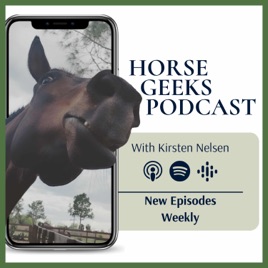
Advertise on podcast: Horse Geeks
Rating
5from
This podcast has
212 episodes
Language
EnglishPublisher
Kirsten NelsenExplicit
No
Date created
2022/08/07
Latest episode
2026/01/31
Average duration
52 min.
Release period
9 days
Description
Bringing out the best in horse and rider kirstennelsen.substack.com
Unlock Horse Geeks podcast Email contact info,
Listeners & Audience details
Email contact information
Direct podcast contact details

Listeners
Audience numbers & engagement insights

Audience details
Podcast Insights

Podcast episodes
Check latest episodes from Horse Geeks podcast
212: Functional Nutrition for Horses
2026/01/31
Stephanie Carter, NTP, owner of Indigo Ancestral Health, joins me in this episode to discuss functional nutrition for horses, what that means and why it might be important for your horse's health. Our conversation takes many turns but as promised, I will include the basic ingredients for a forage based diet and the ingredients to avoid that tend to cause inflammatory responses. Also included is Stephanie's contact info in case you would like to set up a personalized remote consultation for your horse or barn. Basic Forage Based Diet IngredientsHay pellets or cubes as base of "AM and PM meals" Meals include a fat supplement and vitamin/mineral mix. Check ingredients closely to make sure hay, fat and vit/min mix are free from inflammatory inducing ingredients listed below. Inflammatory Inducing Ingredients - What to Eliminate or Avoid Entirely Soy and soy products, with exception of heat extruded soy beansWheat and wheat products Corn and corn products Canola Oil Molasses Zinc Sulfate Guest: Stephanie Carter, NTP, Indigo Ancestral Health www.StephanieCarterNTP.com [email protected] 540-422-0994Host: Kirsten Nelsen, professional horse trainerdeveloper of Training for Optimal Balancewww.kirstennelsen.com
This is a public episode. If you would like to discuss this with other subscribers or get access to bonus episodes, visit kirstennelsen.substack.com
211: Boring = Feeling Safe
2026/01/24
We can only feel bored if we feel safe. Feeling unsafe is never boring, but we think we need to push through feeling unsafe in order to grow and progress. Yes... but.... how much stress in the nervous system constitutes a healthy level that is beneficial and how much constitutes an unhealthy level that is detrimental? The answer to that question is different for every person and every horse, and the answer changes over time for the very same person or horse. When we start to "brace for impact" or feel our horse brace, then we have wandered into a negative amount of stress for the situation. Seeking ways to reduce stimulation, slow down, take little breaks or do something so easy that it is boring are the fastest ways to restore cohesion of the nervous system. Slowing down is often what we need to do in order to advance rapidly. Boring is a welcome relief from intense or chronic stress. Guest: Deb Romero, Certified Alexander Technique Instructorwww.optimalposture.orgHost: Kirsten Nelsen, professional horse trainerdeveloper of Training for Optimal Balancewww.kirstennelsen.com
This is a public episode. If you would like to discuss this with other subscribers or get access to bonus episodes, visit kirstennelsen.substack.com
210: Patience Is Active Listening
2026/01/17
Horses test our patience a lot. Most horse owners are very aware of how often it is difficult to be patient with all the challenges offered by their horses and how frustration quickly surfaces. If we consider patience is just listening, actively observing whatever a horse is communicating, then patience transitions from anxious passivity into a quiet activity. Feeling passive, waiting for a horse to figure something out or change can increase our anxiety or tension. Feeling active helps us remain calm, we are actually doing something even though listening is sort of a non-doing. Once we realize that we need the listening time, awareness or observations of horses in order to know what to do next, then we no longer struggle to be patient, we just are. Guest: Deb Romero, Certified Alexander Technique Instructor www.optimalposture.orgHost: Kirsten Nelsen, professional horse trainerdeveloper of Training for Optimal Balancewww.kirstennelsen.com
This is a public episode. If you would like to discuss this with other subscribers or get access to bonus episodes, visit kirstennelsen.substack.com
209: Visual Changes Happen Last
2026/01/10
What we see on the outside - good posture, elegant movement, radiant health - are all the final result of changes that start on the inside. Making a horse look right or being able to do various tasks or maneuvers does not mean that the horse has a healthy coordination on the inside. Just like plastic surgery can make people appear to be healthy, restricting horses into frames or headsets only gives an outward appearance of good coordination. When we focus more on what our horse looks like rather than how our horse feels during a ride, then we allow dysfunctional coordination to take its toll over time, resulting in lameness or behavior issues. The feel of smooth gaits, easy transitions and ease of steering are the result of helping horses balance their coordination. A horse that struggles in performance, struggles to do tasks or is not easy to ride is a horse telling us that the coordination inside is not what it could be or should be for healthy movement. Guest: Deb Romero, Certified Alexander Technique Instructorwww.optimalposture.orgHost: Kirsten Nelsen, professional horse trainerdeveloper of Training for Optimal Balancewww.kirstennelsen.com
This is a public episode. If you would like to discuss this with other subscribers or get access to bonus episodes, visit kirstennelsen.substack.com
208: Internal Rhythm in Horses
2025/12/27
Internal rhythm, just like internal straightness, is a term I came up with to help simplify the vertical and horizontal aspects of balance in both horses and people. Internal rhythm, as a specific use of the spine and pelvis as well as specific weight distribution, is a learned coordination for all horses and all people. This aspect of balancing a three dimensional body is related to rhythmic motion and all speed adjustments. The result of habituating internal rhythm as a coordination is ease of motion in all gaits and during speed adjustments up or down. It must be coordinated with internal straightness in order to bring the body into three dimensional balance. I use these terms because they are different and people have no preconceived ideas of what I mean. But internal rhythm is the same ideal as impulsion, lifting the back, engaging the hindquarters, rounding, collecting, framing or just a good rider on a good mover. I don't use the typical words because the meaning of them is so different to different people. Hope you find this podcast helpful. Host: Kirsten Nelsen, professional horse trainerdeveloper of Training for Optimal Balance www.kirstennelsen.com
This is a public episode. If you would like to discuss this with other subscribers or get access to bonus episodes, visit kirstennelsen.substack.com
207: Internal Straightness in Horses
2025/12/20
What it means for horses to find balance left to right involves two different spinal functions that affect each other. The function of spinal alignment, reducing all lateral bending, is how horses begin to stabilize the midline and make lifting the back or engaging the hindquarters much easier for them. The function of spinal rotation is the least understood function of horse's spines in the horse world. Rotation of the spine is what makes a horse's barrel roll side to side, why the saddle slips to one side and why the hindquarters tilt on a turn or during lateral work. Unstable rotation in a horse's spine also causes weight to shift left to right, making a horse heavy on the forehand and often heaviest on one front leg, which can lead to a lot of lameness issues. Conversely, when we understand what internal straightness means in horses and help them develop that coordination, then suppleness through the muscles and ease of steering on any path of travel is the result we feel. Internal straightness is an important part of horse balance that relates to the left and right sides of the body. Guest: Deb Romero, Certified Alexander Technique Instructor www.optimalposture.orgHost: Kirsten Nelsen, professional horse trainerdeveloper of Training for Optimal Balance www.kirstennelsen.com
This is a public episode. If you would like to discuss this with other subscribers or get access to bonus episodes, visit kirstennelsen.substack.com
206: Is Dressage Good for Horses?
2025/12/13
It depends... what is the mindset behind the actual dressage training? I share a really great article about the need to change the current mindset around competitive dressage that I tend to agree with, a lot. I explain the different factions of dressage and how confusing that can be, especially in America. Finally I talk about the essence of dressage and how dressage fundamentals are exactly the same as working on balance or doing rehab work with horses, even though it looks pretty darn different from what people expect. Host: Kirsten Nelsen, professional horse trainerdeveloper of Training for Optimal Balance www.kirstennelsen.com
This is a public episode. If you would like to discuss this with other subscribers or get access to bonus episodes, visit kirstennelsen.substack.com
205: Choosing a Saddle
2025/12/06
Choosing the right saddle has two sides to it - the fit for the horse and the fit for the rider. Finding a saddle that both horse and rider agree upon is important for success with any horse. Having a good saddle fitter can be incredibly helpful in the process, and preferably not a saddle fitter that only sells one brand of saddle unless you have done saddle research on your own. With good balance as a rider we can adapt to saddles far easier than horses can. When it comes right down to it, the comfort and stability of the saddle for the horse is what really makes the difference between ease of riding or not. Guest: Deb Romero, Certified Alexander Technique Instructorwww.optimalposture.orgHost: Kirsten Nelsen, professional horse trainerdeveloper of Training for Optimal Balance www.kirstennelsen.com
This is a public episode. If you would like to discuss this with other subscribers or get access to bonus episodes, visit kirstennelsen.substack.com
204: How Good Can It Get?
2025/11/29
Perceptions are personal, for people and horses. It is the perception of things that affect us, that motivate different responses. It is perceptions, more than actual events, that shape how we organize our lives and how we feel most of the time. With horses and people, the key to overcoming fear or even things that stress us out, is changing the perception we have of it. This is a process that cannot be forced but can be achieved. Changing a perception of something requires gentleness, kindness and patience. We have to prove to the body and mind that something perceived as unsafe can transition into something that feels safe. This requires delicate repetition, not force, and respecting thresholds instead of trying to blast through them. The question, “how good can it get?” is a way to help us focus on what we want, instead of what we don’t want, and opens us up to a change in perception. Guest: Deb Romero, certified Alexander Technique Instructorwww.optimalposture.orgHost: Kirsten Nelsen, professional horse trainerdeveloper of Training for Optimal Balancewww.kirstennelsen.com
This is a public episode. If you would like to discuss this with other subscribers or get access to bonus episodes, visit kirstennelsen.substack.com
203: Why Horses Pull The Reins
2025/11/22
Horses ripping the reins from our hands, snatching the bit or just leaning on our arms all drive us crazy, but it is not a behavior issue and it is not personal. When horses lose control of their own body weight distribution during motion then too much weight passes through the barrel and lands on the forehand. While this does not cause horses to actually fall most of the time, it is a landslide of weight that they cannot control and we feel this weight distribution change in our reins the most. The problem is not really in our hands, that is just the final result. The problem is that the horse cannot control weight distribution during motion. This means that no amount of leverage or clever tricks with reins or bits are going to resolve the underlying issue. We have to look at this problem back to front, not front to back. Guest: Deb Romero, Certified Alexander Technique Instructorwww.optimalposture.orgHost: Kirsten Nelsen, professional horse trainerdeveloper of Training for Optimal Balancewww.kirstennelsen.com
This is a public episode. If you would like to discuss this with other subscribers or get access to bonus episodes, visit kirstennelsen.substack.com
202: Picking Out a Horse
2025/11/08
We often get caught up in horse sales videos - looking at all the cool things that a horse can do. But it can be a different story when the horse arrives at the new home with a new owner. Deb and I share some tips for picking out the right horse for you, what to look for, what to check and how to have a realistic view of getting a new horse settled in. It helps to let your heart lead the way.
Guest: Deb Romero, Certified Alexander Technique Instructor www.optimalposture.org
Host: Kirsten Nelsen, professional horse trainer developer of Training for Optimal Balance www.kirstennelsen.com
This is a public episode. If you would like to discuss this with other subscribers or get access to bonus episodes, visit kirstennelsen.substack.com
201: Managing Directions of Force for Balance
2025/11/01
The invisible forces that we can easily feel but we can’t see are the most important elements for developing balance. We can direct forces into specific directions, in ourself or while guiding a horse, and allow the body to adapt around this channel of invisible, organized forces of motion. Instead of shortening and contracting inward, we guide through lengthening and expanding gently outward. Even if we are unaware of invisible forces, the way we use our body and the way we give aids to horses will still have a dynamic effect. It is unavoidable even if we never really noticed before.
Guest: Deb Romero, Certified Alexander Technique Instructor www.optimalposture.org
Host: Kirsten Nelsen, professional horse trainer developer of Training for Optimal Balance www.kirstennelsen.com
This is a public episode. If you would like to discuss this with other subscribers or get access to bonus episodes, visit kirstennelsen.substack.com
200: Forward in Horses Comes from Downward Transitions
2025/10/25
It is another one of those backwards, opposite of what we think, things with horses. Horses that are called lazy, slow or stubborn have really lost the desire to go forward freely and energetically. We think if we just push hard enough the problem will resolve - but that seldom works even after trying for years. The real solution is addressing the reasons that lurk a little deeper. Horses have to feel safe, stable and comfortable during forward motion in order to want to move forward with the energy we seek. Downward transitions are the key to helping horses learn how to control their own body weight distribution during motion, how to find more stability and comfort. As horses improve coordination the desire to move forward returns and builds up into more and more controlled energetic movement.
Guest: Deb Romero, Certified Alexander Technique Instructor www.optimalposture.org
Host: Kirsten Nelsen, professional horse trainer developer of Training for Optimal Balance www.kirstennelsen.com
This is a public episode. If you would like to discuss this with other subscribers or get access to bonus episodes, visit kirstennelsen.substack.com
199: Thumbs and Pinky Fingers
2025/10/18
We don’t often think about our hands or how we use them, so this episode may bring some insights that help with shoulder discomfort and help with rein contact while riding or driving. This is one of Deb’s areas of expertise and she helps me understand why I am still feeling some discomfort from my slip and fall - the gift that keeps on giving. We use our hands for so much that just altering our focus and paying attention can help us improve our balance and use in measurable ways. Finding more ease when the body feels uncomfortable is always a great way to change our use because the discomfort is a constant reminder that we can’t forget about or even ignore sometimes.
Guest: Deb Romero, Certified Alexander Technique Instructor www.optimalposture.org
Host: Kirsten Nelsen, professional horse trainer developer of Training for Optimal Balance www.kirstennelsen.com
This is a public episode. If you would like to discuss this with other subscribers or get access to bonus episodes, visit kirstennelsen.substack.com
198: Horses Use Their Necks Like a Limb
2025/10/11
Horses use their necks the same way humans use their arms when the torso gets unstable. When we slip, trip or almost fall, we stick our arms out to the side and move them in order to help our torso not fall. Since horses arms are on the ground, the front legs, they only have their necks to make the same type of adjustments when their torso gets unstable. While a horse’s skull and neck is part of the axial skeleton, meaning it needs some stability, it is functionally used like a limb, meaning it needs a lot of mobility. How we use the reins, with or without a bit, not only affects a horse’s head and neck, it affects the torso balance too. Trying to manipulate a head-set in horses often causes dysfunctional coordination through the back and hindquarters because that adjustment has to go somewhere!
Guest: Deb Romero, Certified Alexander Technique Instructorwww.optimalposture.org
Host: Kirsten Nelsen, professional horse trainer developer of Training for Optimal Balance www.kirstennelsen.com
This is a public episode. If you would like to discuss this with other subscribers or get access to bonus episodes, visit kirstennelsen.substack.com
Podcast reviews
Read Horse Geeks podcast reviews
Mtn Grama 2022/08/29
Worth your time.
Always informative.
Podcast sponsorship advertising
Start advertising on Horse Geeks relevant audience podcasts
You may also like to advertise on these Podcasts
4.4371061566
The Megyn Kelly Show
SiriusXM
4.888901269
Fearless with Jason Whitlock
Blaze Podcast Network
4.8118931000
Mind Pump: Raw Fitness Truth
Sal Di Stefano, Adam Schafer, Justin Andrews, Doug Egge
4.8102131585
Tara Brach
Tara Brach

4.541561215
Something You Should Know
Mike Carruthers | OmniCast Media

4.513841343
Strictly Anonymous Confessions
Kathy Kay

4.8292781897
Fantasy Footballers - Fantasy Football Podcast
Fantasy Football

4.62382612
Football Weekly
The Guardian

4.45387666
Two Judgey Girls
Two Judgey Girls

3.8258501152
The Viall Files
Nick Viall