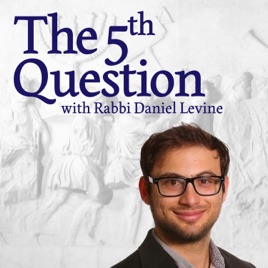
Advertise on podcast: The Fifth Question
Rating
5from
This podcast has
200 episodes
Language
EnglishPublisher
Daniel LevineExplicit
No
Date created
2022/08/17
Latest episode
2026/10/06
Average duration
50 min.
Release period
8 days
Description
My name is Daniel Levine and I am a Rabbi and Jewish History Lecturer at UC Irvine! I have conversations about the most pressing issues facing the Jewish community with professors, Rabbis, and politicians with a wide range of views. Hope you enjoy :)
Unlock The Fifth Question podcast Email contact info,
Listeners & Audience details
Email contact information
Direct podcast contact details

Listeners
Audience numbers & engagement insights

Audience details
Podcast Insights

Podcast episodes
Check latest episodes from The Fifth Question podcast
Why Universities Failed to Confront Campus Antisemitism | Shai Davidai
2026/10/06
Why did universities struggle to confront antisemitism on campus after October 7?
Columbia professor Shai Davidai joins Rabbi Daniel Levine to discuss campus protests, Columbia’s response, and what Davidai calls “American intellectual antisemitism.”Drawing on his new book, American Intellectual Antisemitism, Davidai discusses the Columbia vigil that opens the book, the Mahmoud Khalil case, and why he believes university leaders failed to enforce their own rules. He and Daniel also talk about how Jewish students can respond to anti-Zionist activism, the limits of confrontational protest, and the political future of Israel and the United States.Subscribe to The Fifth Question for conversations about Jewish life, Israel, antisemitism, and the ideas shaping public debate.#ShaiDavidai #CampusAntisemitism #ColumbiaUniversity
Debating a Religious Anti-Zionist: Is Zionism Anti-Jewish?
2026/09/30
Can a Jew reject Zionism on religious grounds? Rabbi Daniel Levine and Jacob Faturechi debate Satmar anti-Zionism, Jewish theology, and the history of the modern State of Israel.The conversation begins with a question that often gets blurred: What do we mean by Zionism? They examine the differences between political, religious, and cultural Zionism; how Jewish communities have understood sovereignty and exile; and whether the founding of Israel represents a break with traditional Judaism, a continuation of Jewish history, or both.Rabbi Levine challenges Satmar arguments about Zionism’s historical consequences while acknowledging that religious anti-Zionism has deep roots in Jewish thought. The discussion also turns to Chabad’s complex relationship with Israel and the tension between Jewish life in the Diaspora and Jewish self-determination.This is a long-form debate about where theology ends and historical argument begins—and whether people with sharply different views can still have a serious, civil conversation.Watch and share your perspective in the comments: Is religious anti-Zionism a legitimate Jewish position?#Satmar #AntiZionism #Zionism #Israel #JewishHistory #Judaism #Chabad #JewishTheology
Should Jews Leave the Democratic Party? | Jenny Rae Le Roux
2026/09/23
Are Jewish voters leaving the Democratic Party over Israel and antisemitism?Jenny Rae Le Roux, Republican candidate for Congress in California’s 47th District, joins Rabbi Daniel Levine for a candid conversation about the political realignment taking place among Jewish voters—and why she believes Orange County’s Jewish community could decide this election.Jenny Rae discusses her support for Israel, her disagreements with Congressman Dave Min, the Democratic Party’s changing relationship with Jewish voters, and whether Republicans have adequately confronted antisemitism within their own coalition.The conversation also covers Donald Trump, JD Vance, Tucker Carlson, January 6, abortion, tariffs, housing affordability, artificial intelligence, the future of young Americans, and Jenny Rae’s experiences visiting Israel.Is the Republican Party becoming a new political home for Jewish voters—or will disagreements over abortion, Trump, and other social issues keep most Jews aligned with the Democratic Party?Learn more about Jenny Rae Le Roux and her campaign:https://jennyraeca.comCHAPTERS:00:00 – Introduction00:39 – Why Jewish voters could determine the election01:46 – Is the Democratic Party still a safe political home for Jews?09:00 – Rabbi Daniel’s experience with Dave Min14:37 – Jenny Rae’s criticism of Dave Min’s Israel record18:26 – Why many Jewish voters remain Democrats23:03 – JD Vance, Tucker Carlson, Trump and Israel25:00 – January 6 and election integrity28:17 – Tariffs, free markets and the changing Republican Party32:00 – California’s housing affordability crisis35:55 – Abortion and the Jewish vote39:10 – The Jewish perspective on abortion42:58 – What matters to young voters?46:43 – Will AI eliminate young people’s jobs?50:20 – Jenny Rae’s experiences in Israel54:29 – The America First case for supporting Israel58:03 – A message to Orange County’s Jewish votersSubscribe for thoughtful conversations about Judaism, Israel, politics, history and the defining debates shaping Jewish life today.#JewishVoters #Israel #JennyRaeLeRoux #CaliforniaPolitics #RepublicanParty
The Truth About “Settler Violence” in Israel | Adam Louis-Klein
2026/09/15
Is “settler violence” an accurate description of a serious problem—or a political narrative being weaponized to demonize Israeli Jews and Israel itself?Rabbi Daniel Levine is joined by anthropologist and anti-Zionism scholar Adam Louis-Klein for a challenging debate about violence in Judea and Samaria, also known as the West Bank.Louis-Klein argues that the phrase “settler violence” collectively portrays hundreds of thousands of Israeli Jews as violent, frequently removes Palestinian violence from the picture, and provides justification for international sanctions against Israel. He examines disputed media reports, the portrayal of the Hilltop Youth, anti-Zionist activism, and the political campaign linking Israeli settlements with state violence.Daniel pushes back: Can Jews forcefully condemn genuine acts of extremist violence without strengthening anti-Zionist propaganda? Does Jewish moral responsibility require confronting wrongdoing within Israel—even when Israel’s enemies exploit that criticism?For past episodes with Adam see here:Antizionism in academia: • Antizionism in Academia | Adam Louis-Klein What is Antizionism?: • Anti-Zionism Isn’t Political Debate — It’s... The conversation also explores:• Israeli settlers and Palestinian violence in the West Bank• Whether “settler violence” is a legitimate category• Media coverage and conflicting accounts of violent incidents• Israel sanctions and the international campaign against settlements• Liberal Jewish criticism of Israel• Anti-Zionism on the political left and right• Tucker Carlson, Hasan Piker, JD Vance and Josh Shapiro• Anti-Zionism and antisemitism in American politics• The influence of anti-Zionism within universities• Jewish unity, collective responsibility and internal criticism• Whether another intifada could exploit Israel’s political divisionsThis is a serious, nuanced disagreement about how Jews should discuss Israel’s real problems while confronting movements seeking to delegitimize the Jewish state.CHAPTERS:00:00 What does “settler violence” mean?03:13 Is the term inherently prejudicial?08:56 Can criticism of Israel be separated from anti-Zionism?12:02 Are liberal Jews internalizing anti-Zionist narratives?17:11 Should Jews publicly confront Israel’s failures?21:14 Settlements, Oslo and the two-state solution26:20 Who are the Hilltop Youth?31:13 The Huwara attack and Jewish moral responsibility34:53 Settler sanctions and international pressure37:04 Anti-Zionism in American politics41:19 Tucker Carlson and right-wing anti-Zionism44:57 Has anti-Zionism captured academia?48:49 Jewish unity and the danger of another intifadaSubscribe to The Fifth Question for thoughtful conversations about Israel, Zionism, Judaism, antisemitism, Jewish history and contemporary Jewish life.#Israel #SettlerViolence #AntiZionism
Is Chabad the Future of American Judaism?
2026/09/10
For original article see here: https://www.jpost.com/opinion/article-902968Is Chabad becoming the future of American Judaism?In this episode of The Fifth Question, Rabbi Daniel Levine speaks with Jerusalem Post writer Lev Stesin about the decline of the traditional American Jewish establishment—and whether Chabad is positioned to fill the growing leadership vacuum.They explore why Chabad continues to expand while many Reform and Conservative institutions struggle, how October 7 transformed Jewish communal politics, and whether Chabad can remain politically neutral while confronting antisemitism and anti-Zionism.The conversation also examines Chabad’s complicated relationship with Zionism and Israel, its history of political activism in Russia and the Soviet Union, its success on college campuses, and the tensions between Orthodox theology and the lives of most American Jews.Finally, Daniel and Lev discuss the movement’s future without a living Rebbe, the controversy surrounding Chabad messianism, and whether an organization without centralized leadership can truly lead American Jewry.Can Chabad become the dominant institution of American Jewish life—or would gaining power fundamentally change what makes Chabad successful?Subscribe to The Fifth Question for thoughtful conversations about Judaism, Israel, Zionism, Jewish history, antisemitism, religion, and contemporary Jewish life.#Chabad #AmericanJudaism #AmericanJews #JewishIdentity #Judaism #Zionism #Israel #Antisemitism #LubavitcherRebbe #JewishPodcast
A Psychologist Breaks Down Why People Hate Jews
2026/09/04
What drives antisemitism—and why are conspiracy theories so often at its core?Rabbi Daniel Levine speaks with Rutgers psychology professor Dr. Kent Harber about the psychological origins of antisemitism, conspiratorial thinking, and the relationship between anti-Zionism and anti-Jewish prejudice.Drawing on experimental social psychology and new longitudinal research, Dr. Harber explains why people become more vulnerable to conspiracy theories during periods of fear, uncertainty, social isolation, and personal insecurity. They explore why Jews have historically been portrayed not merely as an “outsider” group, but as a secretive and powerful force supposedly manipulating politics, finance, society, and world events.The conversation also examines groundbreaking research into the overlap between antisemitism and anti-Israel attitudes. Across three studies, researchers found that conspiracy beliefs formed the critical bridge between traditional anti-Jewish prejudice and later hostility toward Israel. Their findings suggest that antisemitism transmitted through conspiracy thinking accounted for approximately 55% of the anti-Israel attitudes measured—while stopping short of claiming that every criticism of Israel or every anti-Zionist position is antisemitic.Topics include:• Why humans are drawn to conspiracy theories• The connection between insecurity, fear, and conspiratorial thinking• Why antisemitism uniquely portrays a vulnerable minority as secretly powerful• The historical psychology of anti-Jewish conspiracy theories• The relationship between antisemitism, anti-Zionism, and anti-Israel activism• How conspiracy beliefs connect anti-Jewish and anti-Israel attitudes• Campus antisemitism before and after October 7• The difference between legitimate criticism of Israel and antisemitic hostility• The IHRA definition of antisemitism• Antisemitism within psychology, academia, and social-justice movements• What universities and institutions can do to recognize anti-Jewish discriminationCan anti-Zionism function as a socially acceptable outlet for antisemitism? Can criticism of Israel remain entirely separate from prejudice against Jews? And what does the scientific evidence actually show?Watch the full conversation, share your perspective in the comments, and subscribe for more thoughtful discussions about Judaism, Israel, Jewish history, psychology, politics, and contemporary antisemitism.#Antisemitism #AntiZionism #ConspiracyTheories #Israel #JewishHistory #Psychology #SocialPsychology #October7 #CampusAntisemitism #Zionism #JewishPodcast #IHRA
From Anti-Zionist to Pro-Israel: Why Kile Jones Changed His Mind
2026/08/26
Kile Jones once accepted anti-Zionism as a standard assumption within left-wing academic and postcolonial circles. After October 7, witnessing the treatment of a close Jewish friend—and undertaking a serious study of Jewish and Israeli history—he began to question everything he had believed.In this episode of The Fifth Question with Rabbi Daniel Levine, Kile explains how he went from viewing Israel as a colonial project to becoming an outspoken defender of Zionism and advocate against antisemitism. He discusses the influence of academia, settler-colonial theory, progressive politics, and ideological conformity—as well as the personal and intellectual cost of publicly changing his mind.Together, Kile and Daniel explore:• Why anti-Zionism became widespread in universities and progressive spaces• The Jewish people’s historic connection to the Land of Israel• Why Israel does not fit neatly into settler-colonial theory• The relationship between anti-Zionism and antisemitism• Progressive reactions to the October 7 Hamas attacks• The denial of sexual violence against Israeli women• Why many liberal Jews now feel politically homeless• How Israel increasingly influences Jewish voting decisions• The friendships Kile lost after rejecting anti-Zionism• Whether committed anti-Zionists can actually be persuaded• How human relationships can break through ideological thinking• Why non-Jews must take greater responsibility for confronting antisemitism• Kile’s journey from Christianity to atheism—and his work bridging religious dividesThis is a candid conversation about Israel, Zionism, Jewish history, antisemitism, political identity, intellectual honesty, and what it takes to admit that your worldview may have been wrong.Subscribe to The Fifth Question for thoughtful conversations about Judaism, Israel, Jewish identity, religion, politics, history, and contemporary Jewish life.#Israel #Zionism #Antisemitism #AntiZionism #JewishHistory #October7 #IsraelPalestine #JewishPodcast #ProgressivePolitics #CampusAntisemitism #TheFifthQuestion
Is Abortion Murder? A Rabbi Debates a Jewish Pro-Life Leader
2026/08/24
#AbortionDebate #ProChoice #ProLife
Is abortion murder—and what does Judaism actually teach about abortion?In this thought-provoking episode of The Fifth Question Podcast, Rabbi Daniel Levine sits down with Cecily Routman, founder and president of the Jewish Pro-Life Foundation, for a candid debate about abortion, Jewish law, morality, medical ethics, and public policy.They examine biblical and rabbinic sources—including Genesis, Exodus, the Mishnah, Talmud, the Noahide laws, and the concept of the rodef—while debating whether Jewish tradition considers abortion to be murder, a lesser prohibition, or a permissible act under certain circumstances.The conversation explores:• Is abortion permitted under Jewish law?• Does Judaism consider a fetus a full human life?• How should Exodus 21:22–23 be interpreted?• What does the Mishnah teach when a pregnancy threatens the mother?• Does protecting the mother’s life justify abortion?• Are cases involving rape, incest, fetal abnormalities, or severe psychological distress treated differently?• Can traditional Jewish teachings be separated from modern politics?• When does human life—and moral personhood—begin?• How should religious belief influence abortion laws in America?Rabbi Levine challenges the claim that Judaism is unequivocally opposed to abortion, while Routman argues that protecting unborn life is fundamental to Torah ethics. The result is a passionate and sometimes tense exchange between two sharply different interpretations of Jewish tradition.Whether you identify as pro-life, pro-choice, religious, secular, Jewish, or simply interested in abortion ethics, this episode offers an in-depth look at one of the most controversial moral and political debates of our time.Watch the full conversation, share your perspective respectfully in the comments, and subscribe to The Fifth Question Podcast for more honest discussions about Judaism, religion, ethics, politics, and culture.#AbortionDebate #IsAbortionMurder #Judaism #JewishLaw #ProLife #ProChoice #Abortion #Torah #Talmud #MedicalEthics #ReligiousDebate #JewishPodcast #TheFifthQuestionPodcast
Why Jews Need Power: Zionism, Israel, and the Myth That Power Is Evil
2026/08/10
Why do so many people assume that power is inherently evil—and powerlessness inherently virtuous? In this episode, Rabbi Daniel Levine makes the moral case for Jewish power, Zionism, and the responsible use of political, financial, and physical strength.From Rousseau’s “noble savage” and the biblical stories of the Garden of Eden and Cain to German Jewish philosopher Hermann Cohen’s opposition to Zionism, this discussion examines a recurring idea in Western and Jewish thought: that civilization, material power, and political sovereignty inevitably corrupt.But is power itself immoral—or is power necessary to act morally?Rabbi Daniel argues that powerlessness does not make a person virtuous. Without power, autonomy, or influence, our ability to make meaningful ethical choices is severely limited. The highest moral aspiration, therefore, should not be the rejection of power, but the acquisition of power disciplined by strong ethical principles.This episode explores:• Why the political left and the emerging “woke right” distrust power• Rousseau, civilization, inequality, and the “noble savage”• Cain, Abel, and the Torah’s first city• Hermann Cohen’s belief in Jewish powerlessness• Why Hermann Cohen opposed Zionism• AIPAC, Israel, money, and political influence• The difference between possessing power and abusing it• Why Jewish sovereignty creates moral responsibility• The ethical and moral case for Zionism• Why power may be necessary to live a truly moral lifeDo you believe power is inherently corrupting, or can acquiring power itself be a moral obligation? Share your thoughts in the comments.Subscribe for more conversations about Judaism, Israel, Zionism, Jewish history, politics, philosophy, and contemporary Jewish life.#JewishPower #Zionism #Israel
Is Conservative Judaism Dying? | Jay Sanderson
2026/08/03
Once the largest Jewish denomination in America, the Conservative movement is now experiencing a dramatic decline while Reform Judaism, Orthodoxy, Chabad, and independent Jewish communities reshape American Jewish life.Rabbi Daniel Levine sits down with Jay Sanderson, President and CEO of American Jewish University and former President and CEO of the Jewish Federation of Greater Los Angeles, to discuss the future of Conservative Judaism—and whether Jewish denominations themselves are becoming obsolete.They explore why younger Jews are increasingly reluctant to identify with a denomination, whether Reform and Modern Orthodoxy have absorbed Conservative Judaism’s most successful ideas, and why Chabad has become so appealing to Jews who once might have joined traditional suburban synagogues.The conversation also examines interfaith marriage, Zionism and anti-Zionism in rabbinical schools, the rising cost of Jewish participation, and whether Jewish institutions have become too focused on fighting antisemitism at the expense of building meaningful Jewish life.Topics include:• Why Conservative Judaism is shrinking• Whether Jewish denominations still serve a purpose• Reform Judaism, Orthodoxy, and the disappearing Jewish center• Why Chabad continues to grow• Intermarriage and welcoming interfaith families• Zionism and anti-Zionism in rabbinical schools• The changing role of American synagogues• Whether America’s Jewish “golden age” is ending• The Jewish community’s focus on antisemitism• Why Jewish education, synagogues, and summer camps cost so much• How Jewish institutions can remain accessible and relevant⏱️ Timestamps00:00 Is Conservative Judaism collapsing?01:39 The history and purpose of Jewish denominations03:47 Why denominational Judaism is declining06:46 The changing meaning of American Jewish identity09:04 Intermarriage and Jewish belonging10:08 How Reform Judaism and Orthodoxy have changed11:04 Did Conservative Judaism succeed by influencing the other movements?13:23 Synagogues, independent minyanim, and the future of Jewish community15:25 Do Jewish denominations still serve a purpose?18:54 Israel, Zionism, and rabbinical schools22:48 What should the role of a rabbi be?23:39 Conservative Judaism and interfaith marriage25:53 Is Chabad replacing traditional synagogues?27:18 Why Chabad’s financial model is so appealing29:19 Chabad as a “family bakery” rather than a franchise31:27 Is the American Jewish golden age ending?32:30 Is fighting antisemitism consuming Jewish institutional life?34:34 Building Jewish life instead of focusing only on antisemitism36:20 Antisemitism and Jewish life on college campuses38:50 Why is participating in Jewish life so expensive?40:00 Is cost really the main reason Jews disengage?41:06 Why Jewish institutions refuse to reduce expenses42:23 How much should the Jewish community spend fighting antisemitism?42:58 The most important challenge facing Jewish lifeIf you enjoyed this conversation, please like, subscribe, and share it with someone interested in Judaism, Jewish identity, American Jewish life, Zionism, religion, or the future of the Jewish community.#ConservativeJudaism #AmericanJudaism #JewishIdentity #Judaism #JewishCommunity #Chabad #ReformJudaism #OrthodoxJudaism #Antisemitism #Zionism #InterfaithMarriage #JewishHistory #RabbiDanielLevine #JaySanderson
Can Judaism Keep Up With Modern Medicine? Abortion, Assisted Dying & AI W/ Jason Weiner
2026/07/27
What does Jewish law say about abortion, assisted dying, life support, patient autonomy, mental health, cosmetic surgery, and artificial intelligence in medicine?Rabbi Daniel Levine sits down with Rabbi Jason Weiner, a leading authority on Jewish medical ethics and healthcare chaplaincy, for a nuanced conversation about some of the most difficult decisions patients, families, physicians, and rabbis confront.They discuss when Judaism requires doctors to prolong life—and when it permits a natural death—along with religious refusals of treatment, physician-assisted suicide, the cost of extraordinary medical care, mental illness, abortion under Jewish law, cosmetic surgery, cremation, suicide, and the emerging halakhic challenges posed by ambient AI in hospitals.Rabbi Weiner also introduces his new book, Bedside Halacha, a practical guide for observant Jewish healthcare professionals navigating Shabbat, end-of-life care, medical technology, and conflicts between professional responsibilities and religious commitments.This episode offers a thoughtful exploration of the relationship between halakha, medicine, ethics, human dignity, religious freedom, and the realities of modern healthcare.Chapters00:00 Introduction01:08 Is there a broader Jewish medical ethic?03:36 Applying Jewish ethics to non-Jewish patients05:57 Refusing lifesaving treatment for religious reasons10:10 Patient autonomy and its limits12:53 Autonomy, suffering, and end-of-life care in Jewish law15:18 When does prolonging life become prolonging death?17:03 Chronic illness and defining a terminal patient18:23 Physician-assisted suicide and praying for death19:55 Withholding treatment versus hastening death22:19 Artificial nutrition, hydration, and life support23:48 Must Jews spend everything to save a life?26:51 Mental illness in Jewish law29:32 What does Judaism actually say about abortion?31:39 Rabbi Weiner’s practical approach to abortion34:04 Why Jewish law can be morally conservative but politically pro-choice36:03 The Orthodox Jewish response to abortion bans37:01 Is cosmetic surgery permitted under Jewish law?39:14 Nose jobs, tattoos, and Ethiopian Jewish communities41:38 How real patients complicate theoretical halakha42:56 Compassion for those who violate Jewish law44:37 Suicide, cremation, and changing rabbinic responses45:55 Rabbi Jason Weiner’s new book, Bedside Halacha47:42 How ambient AI creates new Shabbat questions48:38 ConclusionLearn more about Rabbi Jason Weiner’s work and Bedside Halacha through Kodesh Press. Or his website rabbiweiner.com or his instagram rabbi_jwSubscribe for more conversations about Judaism, Jewish law, Israel, ethics, religion, and contemporary Jewish life.#JewishMedicalEthics #jewishlaw #halachah #medicalethics #abortiondebate #endoflifecare #assisteddying #artificialintelligence #judaism #RabbiJasonWeiner #BedsideHalacha #healthcareethics
How American Jews Are Rethinking Politics After October 7 | Ilana Meirovitch (JCAN)
2026/07/16
What does it mean to be a Jewish voter in post–October 7 America?In this episode, Rabbi Daniel Levine sits down with Ilana Meirovitch, CEO of JCAN (Jewish Community Action Network), to discuss the dramatic political realignment taking place within the American Jewish community. They explore rising antisemitism on both the left and the right, how Israel has become a political litmus test, the challenges of engaging elected officials, and what effective Jewish advocacy looks like in an increasingly polarized America.From local school board races to congressional elections, from Zionism and campus activism to coalition building and political strategy, this conversation offers a candid look at the pressures facing Jewish voters today and the future of Jewish political engagement in the United States.Learn more about JCAN: https://jcan-oc.org⏱️ Timestamps00:00 Introduction & why Jewish voting patterns are changing00:28 The political landscape facing Jews after October 701:20 The “horseshoe effect” of antisemitism on the left and right03:17 Why many Jewish Democrats feel politically homeless04:58 Three major camps within the pro-Israel Jewish community06:48 Are Jews becoming single-issue voters?08:57 Educating candidates vs. abandoning them09:52 What Jewish voters should prioritize in local elections11:44 Israel as a proxy for broader concerns about antisemitism14:19 Schools, curriculum battles, and ethnic studies16:11 How little many candidates know about Jewish issues17:50 Teaching elected officials about antisemitism and Zionism20:12 The challenge of engaging progressive audiences23:18 Foreign influence, misinformation, and anti-Israel narratives24:52 Why antisemitism remains socially acceptable in some circles26:12 Consequences, advocacy, and fighting back strategically28:15 Power, Zionism, and the Jewish response to antisemitism30:01 Muscular Judaism and the return of Jewish self-confidence34:47 Building alliances while remaining a small minority36:40 Is there an inevitable Jewish shift to the political right?38:39 Antisemitism on the far right and why both extremes matter40:22 Grading politicians on a curve: purity tests vs. pragmatism42:48 Why dialogue with imperfect allies still matters44:05 CARE, political endorsements, and educating elected officials50:27 The Farrah Khan controversy and local Orange County politics51:44 Antisemitic rhetoric in public office and community responseRabbi Daniel Levine and Ilana Meirovitch discuss:• How October 7 reshaped Jewish political priorities• Whether American Jews are becoming single-issue voters• Antisemitism on both the far left and far right• Zionism, Jewish identity, and political polarization• The role of local politics in protecting Jewish communities• How elected officials learn about Jewish issues• Campus activism, ethnic studies, and education battles• Why coalition-building matters for Jewish advocacy• When communities should engage politicians—and when they should walk away• The future of Jewish political power in America🔔 Subscribe for more conversations on Jewish history, Zionism, antisemitism, religion, politics, philosophy, and contemporary Jewish life.#IlanaMeirovitch #JCAN #JewishCommunityActionNetwork #JewishPolitics #israel #Zionism #Antisemitism #october7th #JewishAdvocacy #jewishcommunity #middleeast #politicalpolarization #CampusAntisemitism #orangecounty #RabbiDanielLevine #jewishhistory #israelpolitics #AmericanJews #JewishLeadership #jewishlife
Can Israel Overcome its Political Crisis? w/ Tomer Persico
2026/07/08
Is Israel facing its greatest internal crisis? Can liberal Zionism survive the pressures of both anti-Israel extremism and growing religious fundamentalism? And what does the Jewish idea that humanity is created in the image of God have to do with democracy, human rights, secularism, and the future of the liberal order?In this wide-ranging conversation, Rabbi Daniel Levine sits down with renowned Israeli scholar, public intellectual, and author Tomer Persico to discuss the future of Israel, the challenge of Haredi integration, Jewish mysticism, the roots of Western liberalism, and the crisis facing democracies around the world.Persico also discusses his acclaimed book, In God's Image: How Western Civilization Was Shaped by a Revolutionary Idea, which traces how the biblical concept that human beings are created in the image of God transformed Western ideas of equality, freedom, dignity, and individual rights.📖 Get Tomer Persico's book: https://www.amazon.com/Gods-Image-Wes...In God's Image: How Western Civilization Was Shaped by a Revolutionary IdeaTopics include:The crisis of liberal ZionismIsrael after October 7Haredi society and the future of the Israeli social contractReligious fundamentalism and democracyThe origins of human rights and individual dignityJudaism, Christianity, and Western civilizationSlavery, freedom, and the image of GodJewish mysticism, Kabbalah, Hasidism, and MaimonidesWhy liberalism is struggling in the 21st centuryIdentity politics, populism, and the search for meaning#israel #zionisme #judaism #jewishhistory #TomerPersico #liberalism #JewishMysticism #kabbalah #humanrights #democracy #middleeast #politicalphilosophy #jewishthought #religion #podcast #hartman Timestamps00:00 Introduction00:43 The difficult position of liberal Zionists today02:47 Has the Iran war helped or hurt Israel strategically?03:20 Two ways of thinking about Israel: triumph and crisis05:08 Israel's coming election and political tensions06:05 The Haredi crisis and military service debate08:34 Why are Haredim often opposed to the Jewish state?10:10 Modernity and the transformation of Jewish identity12:31 Why Haredi separatism became entrenched in Israel14:15 Religious fundamentalism and cosmic narratives16:54 Finding hope amid Israel's challenges17:24 Persico's book: In God's Image18:27 How the image of God shaped Western civilization19:35 Human dignity, autonomy, and rights discourse20:46 The roots of modern liberalism21:50 Slavery, freedom, and human equality24:14 Gregory of Nyssa and the first rejection of slavery27:11 The Judeo-Christian tradition debate30:50 Jewish mysticism: outsider influence or native tradition?32:11 Mysticism from the Bible through Kabbalah35:13 Mysticism versus Jewish law37:02 Sabbateanism, Hasidism, and antinomianism38:55 The crisis of liberalism today40:07 Why liberalism is struggling because it succeeded41:24 People need stories, not just systems42:05 Populism, identity politics, and the search for meaning44:40 Can liberalism be repaired?45:28 Beyond radical individualism46:48 Final thoughtsThis interview explores some of the most pressing questions facing Israel, Judaism, and Western civilization today. Whether you're interested in political philosophy, Jewish thought, religion, democracy, or the future of the liberal order, this conversation offers a fascinating and nuanced perspective.
How Oct 7 Changed a Leading Reform Rabbi w/ Rick Steinberg
2026/07/02
Rabbi Rick Steinberg joins Rabbi Daniel Levine for a wide-ranging conversation on Zionism, Reform Judaism, antisemitism after October 7th, interfaith relations, campus activism, free speech, Jewish identity, and the future of the American Jewish community.Drawing on decades of leadership in Orange County and the Reform movement, Rabbi Steinberg reflects on how October 7 changed his worldview, why he believes Zionism must remain central to Jewish life, the challenges facing Jewish institutions, and what comes next for American Judaism.Topics include Hebrew Union College, rabbinical education, anti-Zionism, antisemitism on campus, free speech debates, Jewish communal strategy, Reform Judaism, Jewish demographics, Orange County Jewish life, and the future relationship between liberal and traditional Judaism.Whether you're interested in Israel, Jewish identity, campus issues, religion, politics, or the future of the Jewish community, this conversation offers a thoughtful and nuanced perspective.TIMESTAMPS00:00 – How October 7 Changed Everything00:46 – Introduction: Rabbi Rick Steinberg01:42 – Zionism and the Reform Movement04:06 – Anti-Zionist Jews and Jewish Identity05:49 – Should Rabbinical Schools Have Ideological Litmus Tests?08:00 – Teaching at Hebrew Union College09:11 – October 7 and an Interfaith Crisis of Faith10:49 – Do We Need More Zionist Rabbis?12:15 – Young Jews After October 714:22 – Universalism vs Particularism in Jewish Life15:34 – Progressive Coalitions and Anti-Zionism17:54 – Behind-the-Scenes Jewish Leadership Conversations18:34 – Jews, Social Justice Movements, and Disillusionment19:38 – Antisemitism in Academia, Medicine, and Professional Life21:49 – Where Does Antisemitism Come From?22:32 – Social Media and the Mainstreaming of Hate23:20 – Why Antisemitism Is Often Treated Differently25:03 – Jews, Whiteness, and Historical Memory26:03 – Free Speech, Universities, and Double Standards27:39 – What Are the Limits of Free Speech?28:32 – Productive Dialogue vs Anti-Normalization30:01 – Campus Encampments and Student Activism32:09 – The Future of Jewish Denominations33:47 – Reform, Conservative, and Reconstructionist Judaism35:28 – Why Collaboration Matters More Than Labels37:24 – Torah, God, and Israel as Shared Foundations38:43 – The Orange County Jewish Demographic Study40:48 – What Makes Orange County's Jewish Community Unique?42:27 – Reaching Unaffiliated Jews43:54 – Closing Reflections#judaism #israel #zionisme #Antisemitism #jewishcommunity #reformjudaism #jewishhistory #CampusAntisemitism #october7th #jewishidentity #RabbiRickSteinberg #RabbiDanielLevine #jewishpodcast #middleeast #HigherEducation #JewishLife #orangecounty #jewishthought #HebrewUnionCollege #JewishLeadership
From Jihadist to Pro-Israel
2026/06/30
Former jihadist turned counterterrorism expert Mubin Shaikh shares his journey from radicalization after 9/11 to infiltrating terrorist networks, helping stop the Toronto 18 plot, and confronting extremism from within. We discuss Islam, jihad, Israel, Zionism, antisemitism, Hamas, the Muslim Brotherhood, radicalization, de-radicalization, and the future of Jewish-Muslim relations. A candid conversation on faith, terrorism, and the search for peace. #israel #islam #Antisemitism #jihad #hamas #counterterrorism #middleeast
Podcast reviews
Read The Fifth Question podcast reviews
Alex Koster 2025/12/11
Insightful podcast asking relevant questions throughout the Jewish world
Rabbi Daniel provides a much needed insight into the modern Jewish world asking leaders the necessary questions to help Jews understand the landscape ...
kvell55 2025/07/20
Great Podcast
Rabbi Levine is a knowledgeable interviewer who brings on interesting and thought provoking guests. I highly recommend this podcast.
Jewish Joy 2025/03/24
Needed Jewish Podcast
This is the podcast Jewish millennials and Gen Z’ers need. Rabbi Daniel Levine touches on subjects that today turn people away, but he does it with cl...
23!;$- 2025/03/10
Highly recommend
The diverse range of topics and guests is great. I love the multiple opinions this podcast hosts
Rw2211 2024/08/26
Couldn’t recommend more
I look forward to each new episode. I walk away from each episode with a deeper understanding of the topic and new questions. Daniel is a fantastic in...
skurfr 2023/08/29
Great source for thoughtful Jewish conversations!
Engaging, interesting, and always relevant!
Podcast sponsorship advertising
Start advertising on The Fifth Question relevant audience podcasts
You may also like to advertise on these Podcasts
4.723151954
Timeless Wisdom with Dennis Prager
Salem Podcast Network

4.92471943
The 1000 Hours Outside Podcast
1000 Hours Outside

4.6253402000
The Glenn Beck Program
Mercury Radio Arts

4.732641943
The President's Daily Brief
The First TV

4.861411099
The David Pakman Show
David Pakman

4.824761867
Deck The Hallmark
Bramble Jam Podcast Network

4.853512000
Men In Blazers
Men In Blazers

4.92001923
The Wright Report
Bryan Dean Wright

4.8121061000
Mind Pump: Raw Fitness Truth
Sal Di Stefano, Adam Schafer, Justin Andrews, Doug Egge

4.6432771245
Verdict with Ted Cruz
Premiere Networks