1655583830
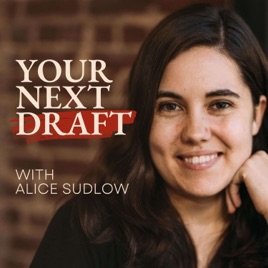
Your Next Draft

Advertise on podcast: Your Next Draft

Rating
★★★★★
4.9
from
77 reviews
This podcast has
102 episodes
Language
English
Publisher
Alice Sudlow
Explicit
No
Date created
2022/11/20
Latest episode
2026/02/03
Average duration
28 min.
Release period
17 days

Description

Supporting fiction writers doing the hard work of revising unputdownable novels. The novel editing process is the creative crucible where you discover the story you truly want to tell—and it can present some of the most challenging moments on your writing journey.  Developmental editor and book coach Alice Sudlow will be your companion through the mess and magic of revision. You’ll get inspired by interviews with authors, editors, and coaches sharing their revision processes; gain practical tips from Alice’s editing practice; and hear what real revision truly requires as Alice workshops scenes-in-progress with writers.  It’s all a quest to discover: How do you figure out what your story is truly about? How do you determine what form that story should take? And once you do, how do you shape the hundreds of thousands of words you've written into the story’s most refined and powerful form?  If you’ve written a draft—or three—but are still searching for your story’s untapped potential, this is the podcast for you. Together, let’s dig into the difficult and delightful work of editing your next draft.

Unlock Your Next Draft podcast Email contact info,
Listeners & Audience details

Email contact information

Direct podcast contact details

Listeners

Audience numbers & engagement insights

Audience details

Podcast Insights

Podcast episodes

Check latest episodes from Your Next Draft podcast


How Will You Know When Your Novel Is Done?
2026/02/03
When will you be truly satisfied with your novel? How will you know when you’ve succeeded? How will you know when you’re done? Will it be when you LOVE your book? When you stop cringing as you read it? When you can’t think of a single change left to make? When beta readers rave about it? When they tell you the romantic scenes made them swoon and the funny scenes made them laugh, the scary scenes gave them nightmares and the sad scenes made them cry? When a reader tells you your book impacted them profoundly? That it changed the way they think about something that matters? Or will it be when an agent requests your full manuscript, then returns with an offer of representation? When an editor offers you a book deal? When your book is published and you see it on bookstore shelves? One of the most difficult editing decisions you’ll face is determining when your book is done. When you have finished, when it’s ready to share with the world, when this project you’ve poured so much of your heart into is complete. In this episode, I’ll help you uncover the factors that matter most to you. You’ll learn: How most writers I talk to define “success”What agents are REALLY looking forWhy you want and NEED external validation—and when external validation becomes harmful, not helpfulWhat you TRULY want for your bookAnd more!Calling your book “done” will always be a challenging decision. After all, art is never finished, only abandoned. But when you know what you value most, you can chase it with clarity and determination, and celebrate when you reach it. Links mentioned in the episode: Interested in working with me? Fill out the form at: alicesudlow.com/contact Share how you’ll know you’re done: alicesudlow.com/101 Send me a Text Message! Support the show Rate, Review, & Follow on Apple Podcasts "I love Alice and Your Next Draft." If that sounds like you, please consider rating and reviewing my show! This helps me support more writers through the mess—and joy—of the editing process. Click here, scroll to the bottom, tap the stars to rate, and select “Write a Review.” Then be sure to let me know what you loved most about the episode! Loving the show? Show your support with a monthly contribution »
6 Reasons to Love Editing (From People Who Actually Do)
2026/01/13
What if editing isn’t drudgery, but the most delightful part of your writing process? So you’re revising yet another draft. You’re hoping against hope that this draft will be your final draft. Which, coincidentally, is also what you hoped for the last draft, and the one before that. Editing is a slog you’re trudging through. You dream of the day when you can escape this drudgery and return to the free-flowing fun of writing the first draft of your next book. But what if editing isn’t an obstacle you have to grit your teeth and bear? What if it’s where the magic happens? It would release the pressure to make this draft your last draft. It would make the process itself more fun, a reward in and of itself. And paradoxically, when you’re working from pleasure rather than pressure, your editing work could become more efficient, because you give the process the space it needs. So I asked six authors, editors, and book coaches the same question: What do you love about editing? The answers they shared vary widely. They’re a whole host of things: everything from puzzle-solving and understanding the mechanics that makes something work to personal development, community building, and meaning-making. In this episode, I’m sharing all their answers with you, in hopes of sparking a little of your own editing joy. Listen for what resonates with you. You might discover one new thing to love—or a whole new perspective on revision. And if you already love editing, well, I think you’ll find this episode an absolute delight. Plus, I want to know what you love about editing! Record a 1-minute voicemail sharing what you love about editing, and I might feature it in a future podcast episode. Tell me what you love about editing here » Links mentioned in the episode: Savannah Gilbo: 91. How to Use Genre as a Revision ToolA.S. King: 82. How Surrealist Pantser A.S. King Revises Award-Winning NovelsCathryn deVries: 76. Scene Workshop: Hook Your Readers in Chapter OneBrannan Sirratt: 80. How to Use Revision Tools Like the Story Authority You Already AreAbigail K. Perry: 86. How Great First Chapters Make Readers CareAbigail K. Perry: 89. How Great First Lines Make Readers Pay AttentionKim Kessler & Cathryn deVries: 78. How Multiple Layers of Editing Combine to Perfect Your StorySend me a Text Message! Support the show Rate, Review, & Follow on Apple Podcasts "I love Alice and Your Next Draft." If that sounds like you, please consider rating and reviewing my show! This helps me support more writers through the mess—and joy—of the editing process. Click here, scroll to the bottom, tap the stars to rate, and select “Write a Review.” Then be sure to let me know what you loved most about the episode! Loving the show? Show your support with a monthly contribution »
What Makes a Story Excellent? (And How to Know When You've Reached It)
2025/12/09
Is story excellence something you "know when you see it"—or can it actually be measured? Is excellence defined by hitting bestseller lists? Filling seats at every book tour stop? Being selected for “Best Books of 2025” lists? Is excellence defined by getting gatekeeper approval? Getting agent representation? Landing a book deal? Winning awards? Is excellence defined by earning money? Getting a big advance? Earning out the advance and bringing in royalties? Or is it something else? How can we measure that a book is good? What is the pinnacle we’re trying to reach, and how will we tell when we achieve it? This is a big, big question, and feels in some ways impossible to answer. But I’m going to try. Because if we want to craft excellent novels, we need to know what we’re aiming for so we can recognize when we reach it and spot when we’re going off course. Come journey with me to discover what excellent stories truly do. We’re going to get lightly philosophical so you can shape your stories to excellence too.  You’ll hear: My current working definition of an excellent novelWhy I am not actually the arbiter of excellence (even though I have really good taste)Why excellent books don’t always receive industry validation . . . and whether all books the industry promotes are excellent (spoiler: no)What readers WANT from storiesWhy stories have been essential to human survival since the beginning of storytelling5 questions to ask yourself to define YOUR OWN standard of excellenceOnce you’ve heard how I’m defining excellence, I’d love to hear your definition! Head to the comments on the blog post and let me know what makes a story excellent to you. Share your standard of excellence in the comments » Links mentioned in the episode: Ep. 65: Why Some Writers Resist Measuring Their Craft (And Why They Shouldn’t)Ep. 84: What If You Do Everything Right and the Book Launch Still Goes Wrong? with A.S. KingEp. 36: Your Story Has Deep Meaning. Do You Know What It Is?Send me a Text Message! Support the show Rate, Review, & Follow on Apple Podcasts "I love Alice and Your Next Draft." If that sounds like you, please consider rating and reviewing my show! This helps me support more writers through the mess—and joy—of the editing process. Click here, scroll to the bottom, tap the stars to rate, and select “Write a Review.” Then be sure to let me know what you loved most about the episode! Loving the show? Show your support with a monthly contribution »
What to Do When Feedback Gets You Stuck
2025/11/25
If you get feedback that grinds you to a halt, there's a problem. But YOU are not the problem—the feedback is. Recently, a writer came to me with feedback she was struggling to implement. She’d written a draft of her story, but she knew it needed revision. So she’d gotten a manuscript evaluation from another editor. And the feedback she got in that evaluation really threw her off. When this writer and I talked, she was so confused. She knew what her vision was for her story, and why she’d made the story structure choices she’d made. But the feedback she’d gotten called some of those foundational structure choices into question. It would be a really big overhaul—a different core conflict and a different genre. The writer was quick to assure me that she was willing to do that work. She was not afraid of a page one rewrite. She was not afraid of getting tough critique. She wanted honest feedback from experts, and she was determined to do whatever it took to revise her manuscript into a story that works. And yet, she was stuck. She had started mapping what it would look like to implement the feedback she’d gotten. And she had this nagging feeling that it would mean walking away from something about her story that mattered to her. So what was she to do? What do you do when feedback gets you stuck? When it seems to make things worse, not better? When you can’t figure out how to implement it, no matter how hard you try? In this episode, I’m sharing what to do with feedback when it doesn’t get you traction, but grinds you to a halt. You’ll hear: What the problem ACTUALLY is (hint: YOU are not the problem!)Why feedback can be true and unhelpfulWhat to do when the feedback just doesn’t workHow to get feedback that gets you traction againAnd more!If you have ever gotten feedback that you just can’t make work, this is what I want you to hear. Links mentioned in the episode: Get feedback that gets you traction again: alicesudlow.com/nrs Send me a Text Message! Support the show Rate, Review, & Follow on Apple Podcasts "I love Alice and Your Next Draft." If that sounds like you, please consider rating and reviewing my show! This helps me support more writers through the mess—and joy—of the editing process. Click here, scroll to the bottom, tap the stars to rate, and select “Write a Review.” Then be sure to let me know what you loved most about the episode! Loving the show? Show your support with a monthly contribution »
3 Non-Obvious Problems Hiding in Well-Developed Drafts
2025/11/11
If the line writing is lovely, but the story still falls flat, check for these surprisingly hard-to-spot problems. You’ve written a draft of your novel. It’s a pretty good draft, actually. Maybe you’ve revised it—once, or twice, or five times. The line-by-line writing is evocative, and a lot of the scenes are exciting and fun. But. Come on, you knew there was a “but” coming. You can feel it in your gut. Your story is just not doing everything you want it to do. There’s something missing. Something not quite right. The ending isn’t paying off the way you want it to. Even though you structured your story with care, crafted the plot and cross-checked it with every story outline you know, something is still falling flat. You’ve taken it as far as you know to go. So why isn’t it working? And what can it possibly still need, when you’ve done everything you know to do? I have met so many writers at this exact moment. And I’ve noticed common patterns cropping up again and again—three incredibly common, surprisingly subtle pitfalls stories tend to fall into without their writers even realizing. I can’t guarantee that your story has any of these problems. But what I can tell you is, if your story isn’t landing the way you want it to yet, these three pitfalls are the first things to check. And the best part is, when you solve even one of them, that solution will cascade down to make so many more things work even better in your story. So if you’ve taken your story as far as you can, and you’re not sure what to do with it, here’s where to go next. Links mentioned in the episode: Get my feedback and find your story’s Next Right Step: alicesudlow.com/nrs Go deeper with these episodes: The Hidden Half of Your Protagonist's Goal (That Makes Story Structure Work)How to Figure Out What Your Character REALLY WantsThe 12 Core Genres That Power Every Great StoryHow to Use Genre as a Revision Tool (with Savannah Gilbo)One Insidious Cause of Disappointing Endings (and How to Fix It)Send me a Text Message! Support the show Rate, Review, & Follow on Apple Podcasts "I love Alice and Your Next Draft." If that sounds like you, please consider rating and reviewing my show! This helps me support more writers through the mess—and joy—of the editing process. Click here, scroll to the bottom, tap the stars to rate, and select “Write a Review.” Then be sure to let me know what you loved most about the episode! Loving the show? Show your support with a monthly contribution »
What Genre REALLY Measures (And Why Every Genre You Try Feels Wrong)
2025/10/28
What do you do when your genre just refuses to work? When you’ve tried every content genre you know—Action, Crime, Horror, Thriller, Performance, Love, Society, and more—and every single one just does not fit your story? Sure, some parts of several of those genres fit your story. Those parts even seem essential. Some parts feel like a stretch, but you can make them work if you squint. And some parts don’t fit at all. If you’re honest, it’s like your story is secretly three genres in a trenchcoat trying to sneak past some gatekeeper rubric. In other words: your genre feels like an utter mess. A confusing mish-mash. Like somewhere, somehow, your story took a wrong turn, and now it’s doing a bunch of things poorly and nothing really well. It simply refuses to check all the right genre boxes at the same time. And when you try to just pick the best-fitting genre and make it work, it feels like you’re ham-fistedly shoving your beautiful, unique, personal creation into a standardized mold it truly doesn’t fit. When genre feels like all of that, what do you do? That’s what I’m exploring in this episode. I’m taking genre deeper than conventions and obligatory moments to show you what it’s really measuring. You’ll hear: A key reason why your story’s genre is so hard to spot (hint: you’re not the problem, and your story isn’t either)How the content genres map onto real life—and how I can take one bike ride with my brother and spin it into four different genresHow knowing your story’s genre helps your readers follow the plot—and derive meaning from your storyAnd more!Plus, I’m taking you on vacation with me. I just got back from the beach, where my brother and I rode bikes along the marsh. And in this episode, I’m bringing you along for the ride. What genre was our bike ride? You’ll have to listen to find out! Links mentioned in the episode: Your primer on content genres: The 12 Core Genres That Power Every Great StoryGet the free Content Genre Overview with resources for every genreSee photos from my bike ride with ThomasListen to peaceful marsh soundsSend me a Text Message! Support the show Rate, Review, & Follow on Apple Podcasts "I love Alice and Your Next Draft." If that sounds like you, please consider rating and reviewing my show! This helps me support more writers through the mess—and joy—of the editing process. Click here, scroll to the bottom, tap the stars to rate, and select “Write a Review.” Then be sure to let me know what you loved most about the episode! Loving the show? Show your support with a monthly contribution »
Where the Turning Point Goes (And How to Know If Yours Is in the Right Place)
2025/10/14
If you’re second-guessing your pacing, give your turning point this two-part check. Where the heck is the turning point? If you’ve ever tried to spot the turning point in a story you love, you’ve probably asked some version of this question. I always feel like I’m playing that old children’s video game: Where in the world is Carmen Sandiego? (In my imagination, the turning point is captured in shadowy profile, wearing a red hat with a wide brim.) (this is also called, tell me you’re a 90s baby without telling me you’re a 90s baby.) Anyway. When you’re analyzing someone else’s story, it feels like a hunt for something you just can’t spot. When you’re analyzing your own story, it feels like second-guessing your pacing. Did you put the turning point in the right spot? Is it happening too early? Too late? Will the reader get bored waiting for it to happen? Or have you rushed something critical? If any of those questions sound familiar, you won’t want to miss this episode. It’s all about where in the story the turning point is located—and yes, this question is complicated enough to require an entire episode to unpack. You’ll hear: 2 guiding principles I use for the location of every turning pointWhere the turning point is located in a novel, novella, and scene—and why those can be different placesWhat happens when you move the turning point earlier or laterWhether the turning point and the midpoint are ever the same pointAnd more!You know what the turning point is—the moment that makes it clear the protagonist cannot achieve their goal in the way they wanted to. You know what it does—it forces the protagonist into a crisis choice. And now, you’ll know where to look for it—and where to put it in your own stories. Links mentioned in the episode: Ep. 94: Turning Point: How to Find and Write the Moment That Changes EverythingSend me a Text Message! Support the show Rate, Review, & Follow on Apple Podcasts "I love Alice and Your Next Draft." If that sounds like you, please consider rating and reviewing my show! This helps me support more writers through the mess—and joy—of the editing process. Click here, scroll to the bottom, tap the stars to rate, and select “Write a Review.” Then be sure to let me know what you loved most about the episode! Loving the show? Show your support with a monthly contribution »
Turning Point: How to Find and Write the Moment That Changes Everything
2025/09/30
It's the hinge your entire story turns on—and one of the hardest story elements to identify and write. Can I be honest? I struggled with turning points for years. I knew they were essential. They’re the moment when everything changes. The moment that forces the character to face a crisis choice. The moment that reveals what the story is really, at its heart, about. And yet . . . I couldn’t see them. I found so many things that weren’t the turning point. I found inciting incidents, and midpoints, and climaxes. The turning point, though? It eluded me. Until I learned a simple framework that finally, finally unlocked them for me. That framework: Reveals why the turning point matters so dang much within the storyTies the turning point perfectly to the inciting incident, climax, and every other element of storyIs objective and straightforward, making it clear to measure (no more guessing at turning points based on gut feeling!)Is wonderfully simple (it’s kind of incredible how simple it is, considering how tough turning points are to spot)That framework marked my turning point in the way I edit turning points. If you have ever struggled to figure out what the heck the turning point is in a story, well, you’re not alone. I hope this framework gives you a breakthrough. It certainly did for me! Further listening: Inciting incident (qualities & traps)Progressive complications (qualities)Progressive complications (traps)Protagonist’s goalContent genresSend me a Text Message! Support the show Rate, Review, & Follow on Apple Podcasts "I love Alice and Your Next Draft." If that sounds like you, please consider rating and reviewing my show! This helps me support more writers through the mess—and joy—of the editing process. Click here, scroll to the bottom, tap the stars to rate, and select “Write a Review.” Then be sure to let me know what you loved most about the episode! Loving the show? Show your support with a monthly contribution »
The Hidden Half of Your Protagonist's Goal (That Makes Story Structure Work)
2025/09/16
If your structure is perfect on paper, but your story still falls flat, this might be what you're missing. Have you ever structured a story with all the right pieces, but something still feels flat? You check all the boxes on paper: ✅ Inciting incident ✅ Progressive complications ✅ Turning point ✅ Crisis ✅ Climax ✅ Resolution And yet it still falls flat. They mostly align, probably, you’re pretty sure. But somehow, they’re not working together the way they should. The turning point doesn’t pack the right punch. The crisis doesn’t feel devastating enough, even though all is technically lost. The climax doesn’t feel like a cathartic payoff, but a gentle womp-womp. All the pieces are there. So what went wrong? Here’s the thing: in order for the six elements of story to work, you have to understand your character’s goal. Most writers have a vague sense of what their protagonist generally wants. But that’s not enough. You need to know specifically the thing that they want—and the thing they don’t want. So in this episode, I’m putting the goal under the microscope. You’ll learn: Why it’s not enough to know what your character wantsA super-simple framework for a character’s goal (seriously, it’s ridiculously easy)How that framework summarizes the meaning of the entire storyAnd how the goal glues all six elements of story together, driving the entire story from inciting incident to resolutionWithout a clearly defined goal, all the structure in the world won’t make your story come alive. With it, everything else falls neatly into place. Dig deeper with these related episodes: Inciting incident (qualities & traps)Progressive complications (qualities)Progressive complications (traps)Content genresSend me a Text Message! Support the show Rate, Review, & Follow on Apple Podcasts "I love Alice and Your Next Draft." If that sounds like you, please consider rating and reviewing my show! This helps me support more writers through the mess—and joy—of the editing process. Click here, scroll to the bottom, tap the stars to rate, and select “Write a Review.” Then be sure to let me know what you loved most about the episode! Loving the show? Show your support with a monthly contribution »
When Should You Work With an Editor? (It's Earlier Than You Think)
2025/09/02
What if you've already done enough to work with an editor—right now? You’ve been working on your novel for so long. Not just months—years, maybe even decades. And yet you have a long way still to go. The day when you have a polished manuscript you’re proud to pitch or publish feels so far away, and you're starting to wonder if you're missing something crucial. And in the back of your mind, you might be wondering: When should you work with an editor? How much more should you do before you start looking? How many drafts should you finish before you reach out? When is your story finally ready for an editor’s feedback? That’s the question I’m answering in this episode—and the answer might surprise you. You’ll learn: The one simple question that tells you it’s time for editorial helpWhy "finished" isn't a prerequisite for working with an editorThe landscape of editorial support available at every stage (from idea to publication)How to find the right type of editor for where you are in your processThe difference between "editor" and "book coach" and what each term suggestsHere's what I've discovered: most writers desperately want editorial support—they just don't know it exists at their stage of the process. So in this episode, I’ll give you a simple metric to evaluate when you are ready for an editor, and show you what to look for when you are. Links mentioned in the episode: Work with me in Next Right Step: alicesudlow.com/nrs Send me a Text Message! Support the show Rate, Review, & Follow on Apple Podcasts "I love Alice and Your Next Draft." If that sounds like you, please consider rating and reviewing my show! This helps me support more writers through the mess—and joy—of the editing process. Click here, scroll to the bottom, tap the stars to rate, and select “Write a Review.” Then be sure to let me know what you loved most about the episode! Loving the show? Show your support with a monthly contribution »
How to Use Genre as a Revision Tool (with Savannah Gilbo)
2025/08/20
Here’s what to DO with your genre once you know which one you’re writing. So you know your story’s genre. It’s an Action story with a Worldview internal genre. Or it’s a Love story with a Status internal genre. You’re, like, 32% sure of it. Which is great, because you’ve studied story enough to know genre is important. You’ve heard that it shapes the foundations of your story, that it has conventions and obligatory scenes, reader expectations that you’ll need to deliver on. Somehow, though, just knowing some words—Action, Worldview, Love, Status—hasn’t magically solved anything. And it’s not a great feeling to have studied story theory so much, and still be stuck on the application. So what now? Now that you have some language for your story’s genre, what do you do with it? How do you actually use it as a revision tool? That’s what I’m exploring in this episode with my friend and fellow writing coach Savannah Gilbo. Savannah is my go-to genre expert, and she shares exactly how to make genre work for you in revision. You’ll hear: Why naming your genre earlier than you think can save you from endless rewritesThe 3 genre mistakes that secretly stall drafts (and how to avoid them)How to turn genre from a rigid list of “must-haves” into a flexible writing toolHow to blend multiple genres like a pro (and without getting lost)And more!Identifying your genre is a great first step. In this episode, Savannah will show you what to actually do with it once you know which one you’re writing. Links mentioned in the episode: Get Savannah’s guidance on your story in Notes to Novel: alicesudlow.com/notestonovel Get the Content Genre Overview: alicesudlow.com/90 Ep. 90: The 12 Core Genres That Power Every Great StoryThe Notes to Novel link is an affiliate link. I wholeheartedly recommend Savannah’s coaching and am delighted to share her resources with you! Send me a Text Message! Support the show Rate, Review, & Follow on Apple Podcasts "I love Alice and Your Next Draft." If that sounds like you, please consider rating and reviewing my show! This helps me support more writers through the mess—and joy—of the editing process. Click here, scroll to the bottom, tap the stars to rate, and select “Write a Review.” Then be sure to let me know what you loved most about the episode! Loving the show? Show your support with a monthly contribution »
The 12 Core Genres That Power Every Great Story
2025/08/05
Genre isn’t what you think it is. Here’s how to use it better. Genre. Let me guess: It’s the bane of your existence. A convoluted soup of arbitrary descriptors that almost but not quite mean the same thing. Sci fi or fantasy? Paranormal or supernatural? Upmarket or book club? Do words even have meaning? Or, it’s a restrictive box with tropes and conventions you feel like you need to cross off a checklist, until your story is more “paint by numbers” formulaic than an original creation unique to your imagination. Or, it’s a necessary evil in your query letter. Your task is to say the right genre words to the right agent to appeal to their interests and make them want to request your manuscript. Get it right, you get a book deal. Get it wrong, you fail. Genre can be all those things, for sure. But what if, first and foremost, it were a tool that works for you? In this episode, I’m throwing out the way we usually talk about genre. And I’m replacing it with an approach to genre that’s actually useful for crafting great stories. Not just useful, actually. Essential. You’ll learn: What “genre” actually meansWhy the genre labels on the shelves at Barnes and Noble won’t help you craft a great storyThe 12 fundamental genres that apply to every great story2 questions to begin identifying your story’s genreThis approach to genre won’t constrain your creativity within someone else’s box. Rather, it will reveal the story you truly want to tell. Links mentioned in the episode: Get the Content Genre Overview: alicesudlow.com/90 Send me a Text Message! Support the show Rate, Review, & Follow on Apple Podcasts "I love Alice and Your Next Draft." If that sounds like you, please consider rating and reviewing my show! This helps me support more writers through the mess—and joy—of the editing process. Click here, scroll to the bottom, tap the stars to rate, and select “Write a Review.” Then be sure to let me know what you loved most about the episode! Loving the show? Show your support with a monthly contribution »
How Great First Lines Make Readers Pay Attention (with Abigail K. Perry)
2025/07/22
It is a truth universally acknowledged that a fiction writer in possession of a brilliant story must craft a captivating opening line. No pressure, right? Your opening line is your story’s first impression. Agents, editors, and even readers decide fast whether they want to keep reading or drop the book altogether. And yes, they can make that judgment in as little as the very first sentence. So your opening line is doing some heavy, heavy lifting. But what, exactly, do great first lines do? What sets an unputdownable first sentence apart from a forgettable dud? How do they capture readers—and agents—in a matter of seconds? I turned to Abigail K. Perry, editor, book coach, and expert in opening chapters, to find out.  You’ll hear: What agents are looking for in the first line of a manuscript (and what makes them stop reading)What makes captivating first lines actually workHow to find the hooks of your story—what only your story can deliverHow to lighten the pressure to get the first line rightAnd more!If you’ve ever worried over the beginning of your book—if you’ve ever written and discarded a dozen different versions of your first sentence, and you’re still stressed that that first line won’t land—well, I think you’re going to love what Abigail has to share. Links mentioned in the episode: Want more first chapter wisdom? Check out the first part of my conversation with Abigail: How Great First Chapters Make Readers Care »Check out a few of Abigail’s “First Chapter Deep Dive” episodes on Lit Match: The Hunger Games by Suzanne CollinsCatching Fire by Suzanne CollinsMockingjay by Suzanne CollinsRemarkably Bright Creatures by Shelby Van PeltFourth Wing by Rebecca YarrosSend me a Text Message! Support the show Rate, Review, & Follow on Apple Podcasts "I love Alice and Your Next Draft." If that sounds like you, please consider rating and reviewing my show! This helps me support more writers through the mess—and joy—of the editing process. Click here, scroll to the bottom, tap the stars to rate, and select “Write a Review.” Then be sure to let me know what you loved most about the episode! Loving the show? Show your support with a monthly contribution »
Where Progressive Complications Go WRONG (and How to Fix Them)
2025/07/08
Are your readers bored? Disappointed? Confused? Here's what that tells you about your story's middle. You’re stuck in the messy middle. Languishing in the doldrums of your story. The inciting incident is long past, the climax is so far ahead you can’t see it over the horizon, and you’re drifting, lost at sea. What is actually supposed to happen here? Where did your plot momentum go? Why do your pages feel full of stuff, and yet nothing ever happens? The answers to all those questions lie in your progressive complications. Specifically, something’s going wrong in your progressive complications. In this episode, I’m digging even deeper into the progressive complications. I’m sharing the seven most common traps I see, the impact they have on your story and your readers, and of course, how to fix them so you can make your story unputdownable from beginning to end. You’ll learn: How to diagnose the problem in your story’s middle based on how your reader feelsHow to spot “fluff” that isn’t moving your story forwardHow coincidences work in stories—and what happens when they don’t workWhat happens when a story has no progressive complications at allAnd more!And don’t miss the free cheat sheet that goes with this episode! Print it and keep it handy as you’re editing. Here’s the thing: the middle of a story isn’t an inscrutable secret. This episode is your guide to spot the most common traps and free your story from them. Links mentioned in the episode: Get the Progressive Complication Revision Cheat Sheet: alicesudlow.com/88 Work with me: alicesudlow.com/contactEp. 87: Make Sense of Your Messy Middle With the Most Underrated Story ElementSend me a Text Message! Support the show Rate, Review, & Follow on Apple Podcasts "I love Alice and Your Next Draft." If that sounds like you, please consider rating and reviewing my show! This helps me support more writers through the mess—and joy—of the editing process. Click here, scroll to the bottom, tap the stars to rate, and select “Write a Review.” Then be sure to let me know what you loved most about the episode! Loving the show? Show your support with a monthly contribution »
Make Sense of Your Messy Middle With the Most Underrated Story Element
2025/06/24
You don’t need more filler. You need better progressive complications. Your inciting incident hooks your readers and promises them a story they’ll love. And then comes the middle. The messy middle. The quiet doldrums of your story, where plot momentum goes to die. Where your characters wander, your conflict blurs, and you start to wonder if any of it is working. So what do you do? Add some “stuff that happens” and hope it holds your readers’ interest? Toss in a random subplot? Describe your character’s breakfast in extreme detail? Nope. This is the space of the progressive complications. And in this episode, I’m showing you exactly how to revise them. Because the middle of your story isn’t filler or unnecessary fluff. It’s 60% of the story, and it has an essential job to do. What progressive complications really are (and what they’re not)How they build momentum and escalate conflictThe 8 qualities I’m looking for when I edit progressive complicationsHow to know if your scenes are working—or just taking up spaceAnd more!And to make it even easier, I’ve created a cheat sheet to help you revise your progressive complications. Print it out, keep it handy, and use it every time you edit a scene. If you’ve ever gotten stuck in the middle of your manuscript wondering how to move forward—this episode is for you. Let’s take your messy middle and make it unputdownable. Links mentioned in the episode: Get the Inciting Incident Revision Cheat Sheet: alicesudlow.com/87Work with me: alicesudlow.com/contactEp. 42: The 6 Essential Elements of Every Novel, Act, and SceneA clip from S1E4 of YoungerSend me a Text Message! Support the show Rate, Review, & Follow on Apple Podcasts "I love Alice and Your Next Draft." If that sounds like you, please consider rating and reviewing my show! This helps me support more writers through the mess—and joy—of the editing process. Click here, scroll to the bottom, tap the stars to rate, and select “Write a Review.” Then be sure to let me know what you loved most about the episode! Loving the show? Show your support with a monthly contribution »

Podcast reviews

Read Your Next Draft podcast reviews


4.9 out of 5
77 reviews
★★★★★
Scotterish 2025/11/12
Great resource
Very helpful for me - first time novelist/developmental editor. My feedback: spoilers are OK if they help me better understand what you’re teaching. D...
★★★★★
Robert G. Alexander 2025/09/19
Scene List is brilliant
I haven’t been writing for a full year yet but I have been giving myself a crash course while writing and have finished a 100,000 word first draft and...
★★★★★
traces25 2025/08/07
So grateful!
I am so grateful to Alice for this podcast. She imparts her editing wisdom clearly, eloquently and with such a kind and generous spirit. As a new wri...
★★★★★
Nopint 2025/05/06
Thank you!
When I’m not in my writing chair, and I have to drive or do some mundane task, it’s such a treat to listen to your podcast. I feel I’m being nurtured...
★★★★★
John Lammers 2025/04/26
Fantastic and treads new ground
I started listening about 6 months ago, working my way, through clusters of related episodes. I now have finished the whole thing. Every episode. I'm ...
★★★★★
Carleton1026 2024/10/15
Great podcast for writers
Alice is a great teacher. She explains concepts in concise and easy to grasp language while providing actionable advice.
★★★★★
sumcgarr 2024/05/23
Extensive and actionable advice
I recommend this podcast to all my fellow writers. When I was staring at my first draft, lost as how to begin the revision process, this podcast gav...
★★★★★
Rhizome stolon 2024/04/26
Fantastic Podcast
I discovered this podcast searching on Google while stuck in my writing process. I write picture books, but the information here is so unbelievably he...
★★★★★
mr190762 2024/03/20
Great insights for those still learning
I enjoy listening to Ms. Sudlow as she teaches writers from an editorial perspective. She builds a mental framework and a vocabulary to understand sto...
★★★★★
SciFiLitGuy 2024/01/02
Excellent Podcast for Novelists
If you have the first draft of your novel written this is the perfect podcast for you. Alice is super passionate about developmental editing (the nex...
check all reviews on apple podcasts

Podcast sponsorship advertising

Start advertising on Your Next Draft relevant audience podcasts


What do you want to promote?