1656309788
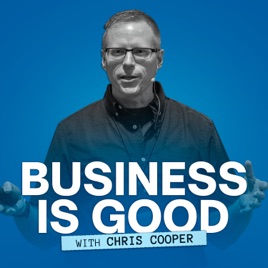
Business is Good with Chris Cooper

Advertise on podcast: Business is Good with Chris Cooper

Rating
★★★★★
5
from
4 reviews
This podcast has
165 episodes
Language
English
Publisher
Chris Cooper
Explicit
No
Date created
2022/11/24
Latest episode
2026/10/06
Average duration
20 min.
Release period
11 days

Description

One on one mentorship saved my business. So I decided to share that process starting with a 200-word blog post. Fast forward to today and my mentorship practice is a 21 million dollar worldwide company with a team of 50 professional mentors. Scaling from a tiny gym business to one of the largest mentorship practices in the world meant developing simple systems that could be taught easily to others. But building a movement requires leading by example, and showing people that business isn’t evil; that building wealth doesn’t require taking it from others; and that creating value lifts us all. It’s always been important to me to succeed the right way: without empty promises or slimy sales tricks. So the purpose of the Business Is Good podcast is to share the models that will scale a business FAST; but, more importantly, to help you build a business you’re proud to own. Visit businessisgood.com for more info and resources from the show.

Unlock Business is Good with Chris Cooper podcast Email contact info,
Listeners & Audience details

Email contact information

Direct podcast contact details

Listeners

Audience numbers & engagement insights

Audience details

Podcast Insights

Podcast episodes

Check latest episodes from Business is Good with Chris Cooper podcast


Why Human Contact Is Becoming A Premium In the Age of AI
2026/10/06
Chris Cooper argues that as AI-generated video, voice, text, and images become harder to detect, people grow more suspicious of anything delivered through screens and phones, making real human interaction increasingly valuable. Citing a 2026 CIRA report that 53% of Canadians have been exposed to deepfakes and 16% have accidentally liked or shared fake content, he explains how distrust and growing isolation raise the premium customers will pay for accountable, in-person help. He introduces the “hands test” (would you trust this person with your body, home, family, or money?) and highlights areas where presence changes outcomes: healthcare and touch professions, trades and home safety, financial planning and legal/accounting reassurance, childcare/coaching/teaching, and gyms where retention depends on coaching relationships, not programming. He advises businesses to automate back-office tasks but protect trust touchpoints, make the human element visible, and price accordingly. 00:00 Sick Of Bots 01:28 AI Tells Disappear 02:13 Deepfakes Breed Distrust 03:54 Isolation Raises Premium 05:10 The Hands Test 06:14 Body Care Wins 07:40 Trades And Safety 08:38 Money Needs Trust 11:13 Family And Coaching 12:35 Gyms Need Humans 15:46 Price The Premium 16:19 Protect Trust Touchpoints 18:09 Make Humans Visible 18:39 Career Paths By Hands 19:23 Weekly Trust Audit 20:13 Closing Thoughts Connect with Chris Cooper: Website - https://businessisgood.com/
Marketing Is Conversations
2026/09/21
In this episode, Chris breaks down the four marketing funnels every business needs — social media, content, referrals, and paid ads — and shows how each one is really a different conversation with a different person. For every funnel, he answers four questions: Who are you actually talking to? How do you start the conversation? Where is it supposed to go? And how do you move it along? Using the social media funnel as the deep-dive example, Chris explains why stopping the scroll isn't enough, why starting an argument is a shortcut to nowhere, and why the real goal of social media is getting people off social media. Then he applies the same framework to content, referrals, and paid ads — showing why treating a warm referral like a cold lead, or nurturing paid traffic like a stranger on Instagram, kills conversations that should already be moving. If your marketing feels like it's going nowhere, this episode gives you the four questions to find out why. Connect with Chris Cooper: Website - https://businessisgood.com/
Being the Best Isn't Enough
2026/09/05
"If I'm the best, I'll get everyone else's customers." It's one of the most comforting myths in small business — and one of the most dangerous. Being excellent at your craft is what gets you started. It's not what keeps your business alive. In this episode, Chris breaks down why skill and business survival are two different games, drawing on Michael Gerber's E-Myth concept of the "technician's trap" — the trained professional who assumes that being great at the work qualifies them to run a company that does the work. Statistics Canada's own research backs this up: the leading cause of small business failure isn't a weak product, it's inexperienced management. Chris walks through what "good at business" actually means in practice — marketing, hiring, selling deeper to your best clients, and managing people — then shows exactly how business skill has beaten better products throughout history. Betamax had the sharper picture and lost to VHS's open licensing strategy. WordPerfect was the better word processor and lost to Microsoft's bundling. Gillette had the superior blade technology and lost market share to Dollar Shave Club's marketing and subscription model. And Kodak invented the digital camera — then chose not to build a business around it, and went bankrupt as a result. If you're excellent at what you do but wondering why the business side still feels shaky, this episode explains exactly where the gap is — and what closes it. Connect with Chris Cooper: Website - https://businessisgood.com/
The Real-World Collab: Get Referrals Forever!
2026/08/21
Every business owner has seen the Instagram "collab" — two brands mashing up their audiences and hoping some of it sticks. What most people miss is that this idea is a hundred years old, and the best version of it doesn't happen on a platform at all. In this episode, Chris breaks down real-world collaboration through the lens of peer leadership — a concept he first wrote about in his book Help First. Find people who could benefit from exposure to your audience, help them first, and only then ask them to reciprocate. Chris introduces a two-part framework for making this work without locking yourself into a limiting exclusive partnership: open multiple pathways to your business, then actively lead people down them, because referrals don't happen on their own. Four real examples, pulled straight from Help First and Chris's own gym, show exactly how this plays out: bringing in outside speakers who cross-promote to their own list, co-promoting events with complementary businesses, selling the ad space you're not using, and building a formal referral system instead of hoping word-of-mouth shows up on its own. Each example comes with a specific action to take this week — no algorithm required. If you've been waiting for the right platform to run a "collab," this episode makes the case that the opportunity has been sitting in your own community the whole time. Connect with Chris Cooper: Website - https://businessisgood.com/
The CEO's Blind Spot (And How to Fix It)
2026/08/07
When Thumbtack scaled from 40 employees to 400 in a single year, its founder realized he only recognized one in five people around the office water cooler. Worse, they didn't know him either, or the mission, or the values that were supposed to guide their decisions. So they stopped making decisions and started just showing up. That's the CEO's blind spot: pouring energy into marketing to strangers, selling to new prospects, and building media for people you've never met, while the people already inside your business, your staff and current clients, quietly disengage. Growth becomes a hamster wheel, new people just barely replacing the ones walking out the back door. In this episode, Chris Cooper breaks down the fix: the One-in-Five Rule. For every five pieces of external marketing, sales, or content, you owe one piece of equal effort internally, to staff and current clients. Chris walks through three real examples, Thumbtack's daily "quick cast," the post-COVID rebuild at his own gym, Catalyst Fitness, and how Two-Brain Business kept mentor churn near zero while scaling from five mentors to sixty. You'll leave with a concrete Golden Hour Task: audit your last ten external actions, find your internal gap, and plan one fix in each of three areas, internal media, internal sales, and internal marketing, before the week is out. Retention is sales over time. Stop selling only to strangers. businessisgood.com Connect with Chris Cooper: Website - https://businessisgood.com/
Starting A Single-Person Business: The Complete Free Course
2026/07/16
This episode walks through a complete nine-module course on starting and running a single-person business with AI — available free, with step-by-step videos, copy-and-paste AI prompts, and downloadable tools in every module. Get the course here: https://businessisgood.com/starting-a-single-person-business-the-complete-free-course/ The course covers defining the problem you solve, building your first product, setting up infrastructure for $32, writing your first marketing post and getting your first clients, building a 30-day content strategy with AI, establishing referral and content funnels, running Meta ads without an agency, and applying the Simple Six framework for compounding growth. AI will create more million-dollar single-person businesses than ever before. It eliminates the barriers that used to require a team — websites, email marketing, content production, ad copy. Whether you love AI or hate it, those using it have a massive time and money advantage. Most young people will need to make their own jobs. Universities in Canada are years behind — their industrial-age structures can't build curriculum fast enough, and many tenured professors refuse to include AI. Students finish four-year degrees already behind peers who spent that time building and learning to leverage these tools. This course is useful for anyone starting a business, running one, or working for someone else. The fundamentals don't change: what you sell, how you sell it, how you deliver it, how you grow. The tools evolve, but the framework is permanent. All nine modules with videos, prompts, and downloads are linked in the show notes. Start at Module 1. Connect with Chris Cooper: Website - https://businessisgood.com/
Starting A Single-Person Business: Part IX - The Simple Six
2026/07/08
The final episode in the series. Over eight episodes, you built a product, a platform, and four marketing funnels. Now: how do you grow without chasing every new trend? The answer is the Simple Six — six metrics that drive every business: client headcount (HEAD), average revenue per client (ARM), length of engagement (LEG), return on investment (ROI), effective hourly rate (EHR), and net owner benefit (NOB). These six multiply each other, creating compounding growth when improved systematically. The process: brainstorm tactics for each metric (the SixStorm), set a 6% improvement goal, focus on one metric at a time for a maximum of one month, execute, then move to the next. If you improve one metric by 6% every month, you double your business in a year — that's math, not motivation. For single-person businesses without staff, the "hold the gains" mechanism is systems and AI. When a tactic works, build it into a repeatable process and automate what you can. Your four marketing funnels are the foundation; the Simple Six is how you improve them, one lever at a time, forever. The episode emphasizes consistency over novelty. Ninety percent execution on what works, ten percent experimentation. Your business is limited by its leadership — you are the ceiling, not the floor. This episode includes three concrete examples across different industries, plus the SixStorm exercise you can complete immediately. This concludes the Starting A Single-Person Business series. Connect with Chris Cooper: Website - https://businessisgood.com/
Starting A Single-Person Business: Part VIII - Your Paid Ads Funnel
2026/07/03
Paid ads are an accelerant, not a foundation — which is why this is Part VIII, not Part I. Most people start with ads, spend $500, get zero clients, and conclude that advertising doesn't work. It doesn't work when it's the first thing you do. With three funnels already built (social media, referrals, content), paid ads become a multiplier. This episode walks through the complete process on screen. Start by boosting your best organic post for $5-10/day for a week. Low-risk testing to learn which message resonates. Then graduate to an Advantage+ Leads campaign in Meta Ads Manager. As of 2026, Meta's Advantage+ AI handles targeting, placements, and budget allocation by default. You provide three creative variations testing different angles on the same problem — problem-focused, story-focused, and direct offer. Meta's AI automatically shifts budget to the winner. Create three variations using the "What Do You Sell?" work from Part I. Use Instant Forms so leads never leave the app. Set a $20/day minimum budget for lead gen. Don't touch anything for 7 days while the AI learns. After two weeks, use Manus AI inside Ads Manager to analyze results — ask plain-English questions about which variation works, which audience responds, which placement converts. Budget framework: $5-10/day to test, $20-50/day for lead gen, then scale when the math supports it. Next episode: Part IX — putting it all together and what comes next. Connect with Chris Cooper: Website - https://businessisgood.com/
Starting A Single-Person Business: Part VII - Your Content Funnel
2026/06/26
Every company is a media company now. If you don't publish content, you're invisible. Most people confuse social media with content. Social media is the amplifier — it pulls people toward your content. Your content (blogs, videos, podcasts) pulls people toward knowing, liking, and trusting you. Social media is a treadmill; content is an asset that compounds over time. This episode introduces the Content Interviewer — a copy-paste prompt for Claude that asks you 10 specific questions about your business, your story, your clients, and your approach. One question at a time, you just talk. Then the AI generates a complete content package: blog post, podcast script, YouTube thumbnail direction, five Instagram carousel slides, podcast summary, and Instagram caption. One conversation. Ten pieces of content. The episode also walks through recording video with nothing more than a phone, natural light, and a quiet room, then producing it in Descript to get a full YouTube video, a podcast audio file, and 2-3 short clips for social media. One recording session. Ten-plus pieces of content. No team, no studio, no excuses. This is the content flywheel: every piece makes you findable (Google, YouTube, podcast apps), builds trust (by the time someone calls, they already feel like they know you), and compounds permanently. A blog post from today generates traffic for years. Download the free Content Interviewer Prompt in the show notes. Next episode: Part VIII — paid advertising without burning money. Connect with Chris Cooper: Website - https://businessisgood.com/
Starting A Single-Person Business: Part VI - Your Referral Funnel
2026/06/21
Referrals are the most powerful marketing channel any service business will ever have. A referred client costs nothing to acquire, arrives pre-sold, and tends to stay longer. Yet most businesses are completely passive about referrals — waiting, hoping, and throwing out discount incentives nobody remembers. The $50-off referral card model works for software companies where signing up means clicking a button. It doesn't work for service businesses, where joining requires trust, time, and a conversation. Your clients aren't salespeople — you can't delegate your sales process to them. This episode covers three strategies for building a referral system. First, recruitment events: create specific "bring a friend" occasions with advance registration, where your goal is capturing contact info and booking consultations, not selling on the spot. Second, ask specifically using the 90-day Goal Review process — measure your client's progress, celebrate their wins, and then make a referral ask based on what you know about their life. Not "do you know anyone?" but a specific suggestion about a specific person. Third, build referrals into your client journey by telling new clients at their first meeting that you'll ask for a referral at 90 days — eliminating awkwardness and getting them thinking early. The episode includes ten industry-specific examples of exactly how to run the goal review and referral conversation, from personal trainers to photographers to financial planners. Download the free Affinity Marketing Worksheet in the show notes. Next episode: Part VII — building your content funnel. Connect with Chris Cooper: Website - https://businessisgood.com/
Starting A Single-Person Business: Part V - Your 30-Day Content Strategy
2026/06/13
Your first marketing post works — but it works once. You need a strategy for showing up consistently, building trust, and moving people through the funnel. This episode shows you how to use AI to build 30 days of content in one sitting. The episode introduces three types of content: story posts that build trust, education posts that demonstrate expertise, and promotion posts that invite action. At least one in every three posts includes a clear CTA. A copy-paste prompt generates the entire 30-day calendar from your specific business details — who you help, what problem you solve, and your current offer. Every post is scripted with captions ready to paste and simple photo/video directions. The 30 days follow a deliberate arc: days 1-10 build trust, days 11-20 show expertise and proof, days 21-30 lean into the offer. The episode also shares six principles from 15 years of coaching content creators: keep it simple and follow the scripts; prioritize momentum over perfection; capture real moments rather than staging content; volume still wins; help first by writing to beginners, your former self, or someone you care about; and curate others' knowledge for your audience to become "50-mile famous." For now, post to Instagram and Facebook. Later episodes will add Google My Business, blog, email, and podcast. Download the free 30-day content strategy prompt in the show notes. Next episode: Part VI — building your referral funnel. Connect with Chris Cooper: Website - https://businessisgood.com/
Starting A Single-Person Business: Part IV - Your First Marketing Post
2026/06/05
You've identified the problem (Part I), defined your product (Part II), and built your collectors (Part III). Now it's time to get people into the funnel and make your first sale. This episode cuts through the marketing noise — the gurus, the lead generation agencies, the funnel wizards — and focuses on what one person can actually do today to sign their first client. It starts with a simple explanation of the marketing funnel: leads (they know you exist), prospects (they've said "tell me more"), and buyers (ready to decide). Your job is moving people from top to bottom. The episode walks through setting up Instagram, Facebook, and Google My Business for your business, configuring Linktree to minimize friction, and then introduces the 5-1-30 — the simplest, most effective first marketing post you can make. The format: "I'm looking for 5 people who want to [one specific result] in the next 30 days. Send me a DM." When someone messages you: invite them to a conversation, listen to their problem, connect it to your offer, and ask if they'd like to start now. Take the payment and begin delivering. This should get you one to three new clients. Start with them and over-deliver, because the referral funnel in Part VI depends entirely on their success. Next episode: Part V — a 30-day content strategy built with AI, designed for one person to execute without making marketing a full-time job. Connect with Chris Cooper: Website - https://businessisgood.com/
Starting A Single-Person Business: Part III - Building Your Collectors
2026/05/30
You've identified the problem you solve (Part I) and defined your first product (Part II). Before you can sell anything, you need to collect an audience. This episode walks through building your "collectors" — the places where potential customers find you, raise their hand, and give you permission to keep talking to them. We build the entire infrastructure live using AI. Five years ago, this setup would have cost $3,000-$15,000 upfront: a web developer, email software like MailChimp, and a marketing consultant. Today, the total cost is about $32 — a $12 domain registration and $20/month for AI tools. Hosting through Vercel or Netlify is free. Email through Resend is free for up to 3,000 emails a month. Facebook groups are free. This episode covers registering a domain name, building a one-page website with an email collector using a copy-and-paste AI prompt, setting up a public Facebook group with a strategic intake question, and defining the one call to action that ties everything together. The deeper benefit: when you build it yourself with AI, you understand every piece. You can change your headline at midnight, update your email sequence without a support ticket, and move at the speed of your own decisions. The barrier to starting a business isn't money or a team anymore. It's willingness to learn the tools. Free website builder prompt and Part II worksheet available in the show notes. Next episode: Part IV — your first marketing post and social media setup.
Starting A Single-Person Business: Part II - Your First Product
2026/05/23
In Part I, you identified the problem you solve. In Part II, you're defining your first actual product — your minimum viable offer. Most people starting businesses make one of two mistakes: they build everything before selling anything, or they try to sell everything to everyone. Both fail. The solution is to define something specific enough to sell, simple enough to deliver quickly, and focused enough that you can tell if it's working. This episode walks through the 5-step First Product Exercise: Download the Worksheet: https://businessisgood.com/starting-a-single-person-business-part-ii-your-first-product/ Step 1: Write your transformation statement — "I help [specific person] go from [current painful state] to [desired outcome]." Step 2: Define your constraint — What's the smallest commitment that still delivers meaningful results? Time constraint (7, 30, 90 days) + scope constraint (one specific outcome). Step 3: Choose your delivery format — Done-for-you service, done-with-you coaching, or DIY program. Pick one based on how people are already trying and failing to solve this. Step 4: Name it and price it — Name describes the outcome, not the process. Price high enough to qualify serious buyers, low enough to validate demand. Step 5: Write the before/after promise — What they have/feel/know before vs. after. This becomes your sales copy and delivery commitment. Your first product will probably change. That's fine. But you can't evolve if you never start. Download the free First Product Exercise worksheet in the show notes. Next episode: Part III - Setting up your platform and building your audience. Connect with Chris Cooper: Website - https://businessisgood.com/
Starting A Single-Person Business: Part I - What Do You Sell?
2026/05/17
This is Part I of a new series on building a single-person business from scratch using AI. Whether you're starting from zero or auditing an existing business, this episode covers the most foundational question you'll answer. Most people starting businesses ask the wrong question. They ask "what am I good at?" or "what should I sell?" The right question is: what problem am I solving? You don't sell a product or service. You sell the solution to a problem. This distinction matters because the thing you DO will change as you grow, but the problem you SOLVE stays constant. In this episode, I walk through two exercises: The Listening Exercise (for people starting from scratch): How to identify problems worth solving by documenting what people complain about, then filtering for frequency, willingness to pay, frustration versus resignation, and your unique advantage. The Product Autopsy Exercise (for existing businesses): How to map every product and service you offer back to the problem it solves, find the pattern, and cut everything that doesn't serve your core problem. If you think you're a personal trainer, you're locked in. If you know you solve the problem of people feeling weak and invisible as they age, you've got options: training, online programs, supplements, community building, coaching, retreats. The product is temporary. The problem is permanent. Next episode: Part II - Testing 2-3 solutions before you commit to building anything. Connect with Chris Cooper: Website - https://businessisgood.com/

Podcast reviews

Read Business is Good with Chris Cooper podcast reviews


5 out of 5
4 reviews
★★★★★
AD Reach 2023/05/24
Superb!
Always concise, tactical content!
check all reviews on apple podcasts

Podcast sponsorship advertising

Start advertising on Business is Good with Chris Cooper relevant audience podcasts


What do you want to promote?