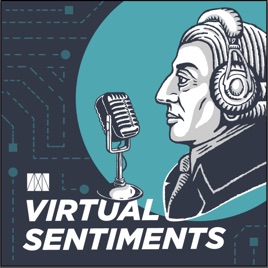
Advertise on podcast: Virtual Sentiments
Rating
4.8from
This podcast has
34 episodes
Language
EnglishExplicit
No
Date created
2022/11/29
Latest episode
2026/09/23
Average duration
90 min.
Release period
41 days
Description
In Virtual Sentiments, Kristen Collins interviews scholars and practitioners grappling with the most pressing problems in political economy today with an eye to the past.
Unlock Virtual Sentiments podcast Email contact info,
Listeners & Audience details
Email contact information
Direct podcast contact details

Listeners
Audience numbers & engagement insights

Audience details
Podcast Insights

Podcast episodes
Check latest episodes from Virtual Sentiments podcast
Why Americans Still Argue About the Founding with Thomas Merrill
2026/09/23
On this episode of Virtual Sentiments, Kristen Collins speaks with Thomas Merrill about the historical tensions within the American founding and their significance for contemporary political life. They discuss the Declaration of Independence, Thomas Jefferson’s views on natural rights and slavery, the Missouri Crisis, and the political coalitions that shaped the early republic. Merrill reflects on Jefferson as a tragic and self-undermining figure whose ideals provided later generations with tools for criticizing injustice, even as his own political commitments often contradicted those ideals. They also consider the importance of historical honesty, disagreement, and liberal education in helping citizens develop the self-knowledge and practical wisdom necessary for a free society.
Dr. Thomas Merrill is an associate professor in the School of Public Affairs. He is the author of Hume and the Politics of Enlightenment (Cambridge, 2015), which won the Delba Winthrop Prize for Best Recent Work in Political Philosophy. He is also the co-editor of three edited volumes, including The Political Thought of the Civil War (University Press of Kansas, 2018) and has held fellowships from Harvard, Princeton, and the American Enterprise Institute. He is an editor of the journal American Political Thought and director of the Lincoln Scholars Program at American University.
**This episode was recorded on August 19, 2026**
Show Notes:
Thomas Merrill, “Wrestling With the Founding in the Culture Wars” (Law & Liberty, 2024)Declaration of Independence: A TranscriptionJefferson's "original Rough draught" of the Declaration of IndependenceAnnette Gordon-Reed, “What was the relationship between Thomas Jefferson and Sally Hemings?” (The British Academy, 2024)Annette Gordon-Reed, “Excerpt: 'The Hemingses of Monticello: An American Family'” (The Pulitzer Prizes)Frederick Douglass, “What to the Slave is the Fourth of July?”If you like the show, please subscribe, leave a 5-star review, and tell others about the show! We're available on Apple Podcasts, Spotify, Amazon Music, and wherever you get your podcasts.
Follow the Hayek Program on Twitter: @HayekProgram
Learn more about Academic & Student Programs
Follow the Mercatus Center on Twitter: @mercatus
Democracy and the Case for a New American Founding with Osita Nwanevu
2026/08/26
On this episode of Virtual Sentiments, Kristen Collins talks with Osita Nwanevu, author of The Right of the People: Democracy and the Case for a New American Founding, about the history, meaning, and future of American democracy. They discuss the distinction between republicanism and democracy, the compromises and contradictions of the American founding, and why the Constitution should be treated as a political document rather than an untouchable artifact. Nwanevu also examines the undemocratic features of contemporary political institutions, including the Senate, the Electoral College, and the filibuster, as well as the relationship between political and economic democracy. The conversation considers the role of unions and civil society in developing democratic capacities and the challenges facing workers in a changing economy.
Osita Nwanevu is the author of The Right of the People: Democracy and the Case for a New American Founding (Random House, 2025). He is a contributing editor at The New Republic, a columnist at The Guardian, the Democratic Institutions fellow at the Roosevelt Institute, and Senior Advisor at the Aspen Institute's Philosophy & Society Initiative.
**This episode was recorded on July 13, 2026**
Show Notes:
Osita Nwanevu’s SubstackOsita Nwanevu, “Who Owns the Declaration of Independence?” (The New Republic, 2026)Nwanevu, “Care Workers Get a Seat at the Table” (In These Times, 2025)Nwanevu, “What Is Political Writing For?” (Columbia Journalism Review, 2021)Virtual Sentiments | Laura K. Field on the Making of the MAGA New RightVirtual Sentiments | Maria Pia Paganelli on 250 Years of Adam Smith’s Wealth of NationsVirtual Sentiments | Glory Liu on Adam Smith's AmericaLiya Palagashvili, “Empowering American Workers” (The Mercatus Center, 2026)The Works of Thomas Jefferson, Federal Edition (New York and London, G.P. Putnam’s Sons, 1904-5). Vol. 6.An Inquiry into the Nature and Causes of the Wealth of Nations by Adam Smith, edited with an Introduction, Notes, Marginal Summary and an Enlarged Index by Edwin Cannan (London: Methuen, 1904). Vol. 1.Gordon Tullock, “The Transitional Gains Trap” (Bell Journal of Economics, 1975)Stephen Ansolabehere, John M. de Figueiredo, and James M. Snyder Jr., “Why is There so Little Money in U.S. Politics?” (Journal of Economic Perspectives, 2003)If you like the show, please subscribe, leave a 5-star review, and tell others about the show! We're available on Apple Podcasts, Spotify, Amazon Music, and wherever you get your podcasts.
Follow the Hayek Program on Twitter: @HayekProgram
Learn more about Academic & Student Programs
Follow the Mercatus Center on Twitter: @mercatus
Demystifying AI with Katharine Jarmul
2026/07/29
On this episode of Virtual Sentiments, Kristen Collins talks with Katharine Jarmul about how transparency, open-source AI, and privacy intersect in today's debates over artificial intelligence. Together they unpack the differences between proprietary, open-weight, and truly open-source AI models. They also explore how AI companies shape user experiences through design choices that often remain invisible, why smaller task-specific models may offer important advantages over increasingly centralized frontier models, and what concepts like data sovereignty and individual autonomy mean in practice. Rather than framing AI as an inevitable force beyond public influence, Collins and Jarmul make the case that curiosity, transparency, and community participation can help people reclaim agency over the technologies shaping their lives.
Katharine Jarmul is a data scientist who focuses her work and research on privacy and security in data science, deep learning and AI. She is the author of the well-received O'Reilly book, Practical Data Privacy, and has more than 10 years’ experience in machine learning and AI, where she has helped build large-scale AI systems with privacy and security built in.
**This episode was recorded on June 24, 2026**
Show Notes:
Probably Private: A newsletter on data privacy by Katharine JarmulYoutube Channel | Probably PrivateHow AI / ML Memorization Happens: RepetitionKatharine Jarmul, Busting AI Myths and Embracing Realities in Privacy & SecurityRobert McMillan, “How Heartbleed Broke the Internet — And Why It Can Happen Again” (WIRED, 2014)Sebastian Raschka, Build a Large Language Model (From Scratch)C. E. Shannon, “A Mathematical Theory of Communication” (The Bell System Technical Journal, 1948)Ken Yeung, “The New Side Hustle for Graduate Students: Training AI” (The AI Economy, 2025)Ruth Fowler, “I Work in Hollywood. Everyone Who Used to Make TV Is Now Secretly Training AI” (WIRED, 2026)Laura Kelley, “The Work of Helping A.I. Destroy Work” (NYT, 2026)Joel Mokyr, "The Intellectual Origins of Modern Economic Growth" (The Journal of Economic History, 2005)If you like the show, please subscribe, leave a 5-star review, and tell others about the show! We're available on Apple Podcasts, Spotify, Amazon Music, and wherever you get your podcasts.
Follow the Hayek Program on Twitter: @HayekProgram
Learn more about Academic & Student Programs
Follow the Mercatus Center on Twitter: @mercatus
Laura K. Field on the Making of the MAGA New Right
2026/07/01
On this episode of Virtual Sentiments, Kristen Collins talks with Laura K. Field about the 250th anniversary of the Declaration of Independence and her recent book, Furious Minds: The Making of the MAGA New Right. The conversation traces how Field came to chronicle the intellectual architecture behind Trumpism between 2016 and 2024. She explains that beneath the populist energy of the MAGA movement lies a smaller but highly influential network of intellectuals who built a deliberate ideological case against postwar liberal internationalism and fusionist conservatism. Together, they explore the different intellectual camps within this "New Right" and their varying and sometimes conflicting visions of the American founding.
Dr. Laura K. Field is an associate with the Illiberalism Studies Program at George Washington University, a nonresident fellow at the Brookings Institution, and visiting scholar in residence at American University. She is the author of Furious Minds: The Making of the MAGA New Right (Princeton University Press, 2025).
**This episode was recorded on May 29, 2026**
Show Notes:
An Introductory Overview of Furious MindsLaura K. Field, “The Intellectual Edgelords of the GOP” (The Atlantic, 2026)Laura K. Field, “The Closing of the MAGA Mind” (NYT, 2025).Thomas W. Merrill, “Wrestling With the Founding in the Culture Wars” (Law & Liberty, 2024)Lincoln, Speech at Springfield, June 26, 1857If you like the show, please subscribe, leave a 5-star review, and tell others about the show! We're available on Apple Podcasts, Spotify, Amazon Music, and wherever you get your podcasts.
Follow the Hayek Program on Twitter: @HayekProgram
Learn more about Academic & Student Programs
Follow the Mercatus Center on Twitter: @mercatus
Glory Liu on Adam Smith's America
2026/06/03
On this episode of Virtual Sentiments, Kristen Collins speaks with Glory Liu about the 250th anniversary of both Adam Smith’s The Wealth of Nations and the Declaration of Independence. Together, they unpack the message of The Wealth of Nations as a critique of Britain's mercantile system rather than a manifesto for laissez-faire economics — illuminating Smith's careful attention to power, class, and state capture. The conversation explores what reception history reveals about the distance between an author's original intentions and what subsequent readers make of their ideas. Glory and Kristen also reflect on what it means to commemorate Smith today, how our current moment of reckoning with concentrated economic and political power is drawing readers back to Smith, and why doing so responsibly requires both historical care and honest self-awareness about what we're really asking Smith to do for us.
Dr. Glory Liu is a Provost’s Distinguished Faculty Fellow and Assistant Professor in the Department of Government at Georgetown University. She is the author of Adam Smith’s America: How a Scottish Philosopher became an Icon of American Capitalism (Princeton, 2022), which was named a Top 5 Biographies of Economists by the Wall Street Journal and received the 2024 Best Monograph Award from the European Society for the History of Economic Thought.
**This episode was recorded on January 22, 2026**
Show Notes:
Glory Liu, “How Adam Smith Inspired America’s Economic System” (WSJ, 2025)Glory Liu, Adam Smith’s America: How a Scottish Philosopher Became an Icon of American Capitalism (Princeton University Press, 2022)If you like the show, please subscribe, leave a 5-star review, and tell others about the show! We're available on Apple Podcasts, Spotify, Amazon Music, and wherever you get your podcasts.
Follow the Hayek Program on Twitter: @HayekProgram
Learn more about Academic & Student Programs
Follow the Mercatus Center on Twitter: @mercatus
Henry Farrell on AI as a Social Technology
2026/05/06
On this episode of Virtual Sentiments, Kristen Collins speaks with Henry Farrell about AI, democracy, and political economy. Farrell argues that large language models are best understood not as emerging individual intelligences, but as “social technologies” that process and reorganize vast stores of human cultural information, much like markets, bureaucracies, and democracies process knowledge. The conversation explores deliberative democracy, civil society, Silicon Valley, AI regulation, and the risks of treating politics as an optimization problem. Farrell emphasizes the messiness of democratic life as essential to resisting authoritarianism and building a better future.
Henry Farrell is the SNF Agora Professor of International Affairs at Johns Hopkins School of Advanced International Studies. He is the author of various books, including Underground Empire: How America Weaponized the World Economy (Henry Holt and Co., 2023) and Of Privacy and Power: The Transatlantic Fight over Freedom and Security (Princeton University Press, 2019), both coauthored with Abraham Newman, as well as The Political Economy of Trust: Institutions, Interests, and Inter-Firm Cooperation in Italy and Germany (Cambridge University Press, 2009).
**This episode was recorded on January 7, 2026**
Show Notes:
Virtual Sentiments | State Capture and the Meaning of Democracy with Samuel BaggHenry Farrell’s Substack, Programmable MutterHenry Farrell and Abraham Newman, The Enshittification of American Power (Wired, 2025)Henry Farrell and Hahrie Han, AI and Democratic Publics (Knight First Amendment Institute, 2025)Farrell, Gopnik, Shalizi, and Evans, Large AI models are cultural and social technologies (Science, 2025)Farrell, Mercier, and Schwartzberg, Analytical Democratic Theory: A Microfoundational Approach (APSR, 2022)Farrell, Where Trump is Vulnerable and How to Act on It (New York Times, 2025)Farrell, The Same Old Fantasies Behind AI and New Technology (Lawfare, 2025)Herbert A. Simon, The Sciences of the Artificial (The MIT Press, 1970)F.A. Hayek, The Use of Knowledge in Society (Liberty Fund, 2013)Cosma Shalizi, The Singularity in Our Past Light-Cone (Three-Toed Sloth, 2010)Andrew Lentini, Reimagining Democracy in the Age of AI (SNF Agora, 2024)Hugo Mercier and Dan Sperber, Why do humans reason? Arguments for an argumentative theory (BBS, 2011)North, Wallis, and Weingast, Violence and Social Orders (Cambridge University Press, 2009)Cory Doctorow, The Bezzle: A Martin Hench Novel (Tor Books, 2025)If you like the show, please subscribe, leave a 5-star review, and tell others about the show! We're available on Apple Podcasts, Spotify, Amazon Music, and wherever you get your podcasts.
Follow the Hayek Program on Twitter: @HayekProgram
Learn more about Academic & Student Programs
Follow the Mercatus Center on Twitter: @mercatus
State Capture and the Meaning of Democracy with Samuel Bagg
2026/04/08
On this episode of Virtual Sentiments, Kristen Collins speaks with political theorist Samuel Bagg about his recent book The Dispersion of Power: A Critical Realist Theory of Democracy (Oxford University Press, 2024). Instead of understanding democracy as an idealized process of collective self-rule, Bagg argues that democracy’s core purpose is to prevent any one group from capturing the state. The conversation explores how this focus on state capture reshapes debates about populism, technocracy, and liberalism, while offering a more realistic account of how power operates in modern societies. Collins and Bagg also discuss the dangers of over-intellectualizing politics, the limits of deliberative democracy, and the role of inequality and private power in shaping political outcomes. The episode closes with a forward-looking discussion of democratic renewal, emphasizing the importance of organizing, civic infrastructure, and building countervailing power in civil society as essential to resisting authoritarianism and sustaining democratic life.
Show Notes:
Virtual Sentiments | Deva Woodly on Civil Society and the Politics of CareAlex Opera, Adam Smith on Political Judgment: Revisiting the Political Theory of the Wealth of Nations (The Journal of Politics, 2022)Paul Sagar, The real Adam Smith (Aeon, 2018)Tyler McBrien, What is ‘State Capture’? A Warning for Americans (New York Times, 2025)Samuel Bagg, Democratic Disenchantment (Boston 50 Review, 2024)Samuel Bagg, Would you sit on a jury to review government regulations? (The Conversation, 2024)Theory of Virtual Sentiments | On Adam Smith's Critique of State Capture**This episode was recorded August 29, 2025.**
If you like the show, please subscribe, leave a 5-star review, and tell others about the show! We're available on Apple Podcasts, Spotify, Amazon Music, and wherever you get your podcasts.
Follow the Hayek Program on Twitter: @HayekProgram
Learn more about Academic & Student Programs
Follow the Mercatus Center on Twitter: @mercatus
Maria Pia Paganelli on 250 Years of Adam Smith’s Wealth of Nations
2026/03/11
On this episode of Virtual Sentiments, Kristen Collins speaks with Maria Pia Paganelli about Adam Smith’s Wealth of Nations on the occasion of its 250th anniversary. Their conversation situates Smith as a sharp moral and political critic of monopoly and empire. Paganelli situates the book in the vibrant world of the Scottish Enlightenment and shows how Smith’s central concern was not wealth for its own sake, but the material conditions that make human flourishing possible. Together, Collins and Paganelli explore Smith’s views on trade, education, public debt, war, and justice, offering a rich and accessible portrait of The Wealth of Nations as both a foundational work of political economy and a deeply normative indictment of the British commercial system in Smith’s time.
Dr. Maria Pia Paganelli is a professor of economics at Trinity University in San Antonio where she teaches classes in the principles of economics, the economics of law, Smithian economics, a study abroad course on the history of Iceland, and more. She is the author of The Routledge Guidebook of Smith's Wealth of Nations (Routledge, 2020), and co-edited the books Adam Smith and Rousseau: Ethics, Politics, and Economics (Edinburgh University Press, 2018), and The Oxford Handbook on Adam Smith (Oxford university Press, 2013).
Show Notes:
Adam Smith’s An Inquiry into the Nature and Causes of the Wealth of Nations (Liberty Fund, 1982), available for free at Liberty Fund’s Online Library of Liberty.Maria Pia Paganelli, “The Adam Smith Problem in Reverse: Self-Interest in Adam Smith’s Wealth of Nations and Theory of Moral Sentiments”Maria Pia Paganelli, “To Intervene or Not to Intervene: This is Smith’s Problem”Maria Pia Paganelli, “Adam Smith the Dissenter”Maria Pia Paganelli, “Adam Smith and the Morality of Political Economy: A Public Choice Reading”Maria Pia Paganelli and Reinhard Schumacher, “Do not take peace for granted: Adam Smith’s warning on the relation between commerce and war.”Maria Pia Paganelli and Reinhard Schumacher, “Smith and Hume at War: The Differing Views of Adam Smith and David Hume on Commerce and International Warfare”If you like the show, please subscribe, leave a 5-star review, and tell others about the show! We're available on Apple Podcasts, Spotify, Amazon Music, and wherever you get your podcasts.
Follow the Hayek Program on Twitter: @HayekProgram
Learn more about Academic & Student Programs
Follow the Mercatus Center on Twitter: @mercatus
Amit Ron and Abraham Singer on What Companies Owe Democracy
2025/08/13
On this episode of Virtual Sentiments, host Kristen Collins speaks with Amit Ron and Abraham Singer, co-authors of Everyone’s Business:What Companies Owe Society (The University of Chicago Press, 2024). Together, Ron and Singer argue that businesses should move beyond profit and stakeholder models to actively protect democratic practices such as inclusion, reflexivity, and public oversight. They reject corporate claims to “civil disobedience” as prone to self-interest and warn against lobbying practices that create only the appearance of public participation. Drawing on the idea of institutional pluralism, they emphasize that democracy’s role is to continually assess and revise the work of different institutions to ensure they serve the public interest.
Dr. Amit Ron is an Associate Professor in School of Social and Behavioral Sciences at Arizona State University, focusing on the history of political economy and democratic theory.
Dr. Abraham Singer is an Associate Professor of Management at Quinlan School of Business at Loyola University Chicago, specializing in business ethics and political theory.
Read more work from Kristen Collins.
Show Notes:
Abe and Amit's book, Everyone’s Business: What Companies Owe Society (The University of Chicago Press, 2024)Virtual Sentiments, S3E1 "Kris Rose on Deliberative Democracy and Meta's Community Forums"Virtual Sentiments, S3E5 "Alice Siu on Deliberative Polling and the Future of Democratic Dialogue"Virtual Sentiments, S1E4 "Jennifer Forestal on Designing Democratic Digital Spaces"Kevin Elliot’s Democracy for Busy PeopleMark Warren’s article, "Political Corruption as Duplicitous Exclusion"Pierre-Yves Néron's Seeing Like a Firm: Social Justice, Corporatiosn and the Conservative OrderScherer and Palazzo's 2007 article, "Toward a Political Conception of Corporate Responsibility: Business and Society Seen From a Habermasian Perspective"If you like the show, please subscribe, leave a 5-star review, and tell others about the show! We're available on Apple Podcasts, Spotify, Amazon Music, and wherever you get your podcasts.
Follow the Hayek Program on Twitter: @HayekProgram
Learn more about Academic & Student Programs
Follow the Mercatus Center on Twitter: @mercatus
Susan Brison on the Aftermath of Sexual Violence and the Remaking of the Self
2025/07/16
**Content Warning** This episode includes discussions of sexual assault and attempted murder, which may be distressing for some listeners. Please listen with care.
On this episode of Virtual Sentiments, host Kristen Collins speaks with Susan Brison, author of Aftermath: Violence and the Remaking of a Self (Princeton University Press, 2002; 20th Anniversary Edition, 2023). In this conversation, Brison reflects on trauma, gendered violence, and the limits of traditional philosophy. She shares the story of her own rape, the trial that followed, and how it shaped her research and philosophy. Their conversation explores the feminist claim that “the personal is political,” emphasizing how trauma disrupts trust and identity, and how recovery requires relational support. Brison also critiques the punitive criminal justice system, advocating for restorative approaches that promote healing over retribution.
Dr. Susan Brison is Susan and James Wright Professor of Computation and Just Communities and Professor of Philosophy at Dartmouth College where she is also Director of the Susan and James Wright Center for the Study of Computation and Just Communities.
Read more work from Kristen Collins.
Show Notes:
APA Studies's special issue on Susan's work, "Feminism and Philosophy"Judith Herman's Trauma and Recovery: The Aftermath of Violence—From Domestic Abuse to Political TerrorNancy Sherman's Afterwar: Healing the Moral Wounds of Our SoldiersJonathan Shay's Achilles in Vietnam: Combat Trauma and the Undoing of CharacterRobin Dembroff's "Real Men on Top"Linda Martin Alcoff's Rape and ResistanceMary Ann Franks's "Democratic Surveillance"If you like the show, please subscribe, leave a 5-star review, and tell others about the show! We're available on Apple Podcasts, Spotify, Amazon Music, and wherever you get your podcasts.
Follow the Hayek Program on Twitter: @HayekProgram
Learn more about Academic & Student Programs
Follow the Mercatus Center on Twitter: @mercatus
Deva Woodly on Civil Society and the Politics of Care
2025/06/18
On this episode of Virtual Sentiments, host Kristen Collins chats with Deva Woodly on her book, Reckoning: Black Lives Matter and the Democratic Necessity of Social Movements (Oxford University Press, 2021), which draw from on-the-ground interviews with leaders in the Black Lives Matter Movement to comment on social movements and their role in democracy. In response to our current political moment, Woodly offers an alternative vision rooted in care, mutual aid, and solidarity economies, and highlights the ongoing erosion of the old order and the emergence of new democratic practices. The episode is both an urgent call to action and a hopeful reminder that democratic reconstruction begins with the small, collective acts of everyday life.
Dr. Deva Woodly is a Professor of Political Science at Brown University. Woodly's work develops the concept of radical Black feminist pragmatism, offering a political vision grounded in care, solidarity, and participatory democracy. Her research and public commentary illuminate how movements like Black Lives Matter are reshaping our political landscape from the ground up.
Read more work from Kristen Collins.
Show Notes:
Robert Putnam's Bowling Alone: The Collapse and Revival of American CommunityAlexis de Tocqueville's Democracy in AmericaErik Olin Wright's How to Be an Anti-Capitalist in the 21st CenturyBernard Harcourt's Cooperation: A Political, Economic, and Social TheoryIf you like the show, please subscribe, leave a 5-star review, and tell others about the show! We're available on Apple Podcasts, Spotify, Amazon Music, and wherever you get your podcasts.
Follow the Hayek Program on Twitter: @HayekProgram
Learn more about Academic & Student Programs
Follow the Mercatus Center on Twitter: @mercatus
Alice Siu on Deliberative Polling and the Future of Democratic Dialogue
2025/05/21
On this episode of Virtual Sentiments, host Kristen Collins chats with Alice Siu on how deliberative polling fosters informed, respectful public dialogue. They discuss the method’s use in both in-person and on AI-assisted virtual forums, its role in shaping policy, and its potential to reduce polarization. Alice highlights the importance of teaching deliberative skills in schools and how real-time, structured conversations can strengthen democracy.
Dr. Alice Siu is an Associate Director at Stanford University’s Deliberative Democracy Lab and a senior research fellow at the Center on Democracy, Development, and the Rule of Law.
Read more work from Kristen Collins.
Show Notes:
Alice’s book chapter, “Reimagining Democracy: The Role of Technology and Deliberation”Alice's paper for the American Political Science Review, "Can Deliberation Have Lasting Effects?"Alice’s paper for the American Political Science Review, “Is Deliberation an Antidote to Extreme Partisan Polarization? Reflections on ‘America in One Room’”Results of Alice’s work with Meta, April 2024, April 2025, “Results of First Global Deliberative Poll® Announced by Stanford’s Deliberative Democracy Lab”New York Times article, “She Is in Love With ChatGPT”S1E4, Jennifer Forestal on Designing Democratic Digital SpacesS3E1, Kris Rose on Deliberative Democracy and Meta's Community ForumsIf you like the show, please subscribe, leave a 5-star review, and tell others about the show! We're available on Apple Podcasts, Spotify, Amazon Music, and wherever you get your podcasts.
Follow the Hayek Program on Twitter: @HayekProgram
Learn more about Academic & Student Programs
Follow the Mercatus Center on Twitter: @mercatus
Hannah Gais on the Far-Right Rallies and Social Media Presence
2025/04/23
On this episode of Virtual Sentiments, host Kristen Collins chats with Hannah Gais on the far-right rallies and social media presence on platforms like Telegram and X. Hannah explores the events of the Unite the Right rally, the storming of the capital on January 6th, the far-right in the wake of the first and second Trump presidencies, and the dangers of expanding domestic terrorism laws.
**This episode was recorded in December 2024.
Hannah Gais is a journalist and researcher focused on the radical right at the Southern Poverty Law Center.
Read more work from Kristen Collins.
Show Notes:
Hannah's work with Cassie Miller, "Capitol Insurrection Shows How Trends On The Far-Right’s Fringe Have Become Mainstream"Hannah’s 2021 New Republic article, "A New 'War on Terrorism' Is the Wrong Way to Fight Domestic Extremists"Brennan Center report co-authored by Mike German, "Fighting Far-Right Violence and Hate Crimes"Hannah’s work drawing connections between more extreme figures and more mainstream figures like Tucker Carlson, "In Rural Pennsylvania, Extremists Declare ‘Victory is Ours’" and "For CPAC Attendees, ‘America Is Under Attack’"Hannah's article, "welcome to america"On Terrorgram indictments, "That's three strikes, run for your life"If you like the show, please subscribe, leave a 5-star review, and tell others about the show! We're available on Apple Podcasts, Spotify, Amazon Music, and wherever you get your podcasts.
Follow the Hayek Program on Twitter: @HayekProgram
Learn more about Academic & Student Programs
Follow the Mercatus Center on Twitter: @mercatus
Eileen Hunt on Mary Shelley's "The Last Man"
2025/03/26
On this episode of Virtual Sentiments, host Kristen Collins chats with Eileen Hunt on her latest book, The First Last Man: Mary Shelley and the Postapocalyptic Imagination (2024), which focuses primarily on Mary Shelley's 1826 novel, The Last Man, the first major modern pandemic novel. Hunt explains the tragic life events that motivated Mary Shelley's darker themes*, how the novel relates to our Covid-19 experience, and more.
*This episode features conversation on topics including suicide, suicidal ideation, and death.
Eileen Hunt is a Professor of Political Science and a political theorist whose scholarly interests cover modern political thought, feminism, the family, rights, ethics of technology, and philosophy and literature. She has published five solo-authored books, including her recent trilogy on Mary Shelley and political philosophy for Penn Press.
Read more work from Kristen Collins.
Show Notes:
60 Words Podcast with Congresswoman Barbara LeeCongresswoman Barbara Lee's Speech on 9/14/01Max Weber's "Politics as a Vocation"Max Weber's The Vocation LecturesIf you like the show, please subscribe, leave a 5-star review, and tell others about the show! We're available on Apple Podcasts, Spotify, Amazon Music, and wherever you get your podcasts.
Follow the Hayek Program on Twitter: @HayekProgram
Learn more about Academic & Student Programs
Follow the Mercatus Center on Twitter: @mercatus
Roos Slegers on the Uncanny Valley, Freud, and Cyborg Science Fiction
2025/02/26
On this episode of Virtual Sentiments, host Kristen Collins chats with Roos Slegers on the uncanny valley, Freud, and cyborg science fiction. They explore the uncanny valley and Freud’s concept of the uncanny, connecting them to ETA Hoffmann’s “The Sandman”, Donna Haraway’s “Cyborg Manifesto”, and contemporary AI debates. While Mori’s uncanny valley describes discomfort with almost-human robots, Freud links the uncanny to repressed fears, particularly around gender and sexuality. Roos critiques Freud’s reading of “The Sandman”, highlighting its deeper commentary on romantic ideals and the preference for submissive, artificial women—paralleling modern AI assistants like those in the American sci-fi film, Her. Haraway’s cyborg offers an alternative, challenging rigid binaries and embracing technology’s potential for transgression and liberation. They critique how today’s AI and transhumanist movements reinforce traditional hierarchies rather than dismantling them, urging a more critical and playful engagement with technology’s role in shaping human identity.
Dr. Roos Slegers is an Assistant Professor of Philosophy at Tilburg University in the Netherlands.
Read more work from Kristen Collins.
Notes:
Masahiro Mori, 1970, “The Uncanny Valley"Sigmund Freud, 1919, “The Uncanny"Donna Haraway, 1985, “Cyborg Manifesto”ETA Hoffman, 1817, “The Sandman” Meghan O’Gieblyn, God, Human, Animal, Machine: Technology, Metaphor, and the Search for Meaning Metaphor, and the Search for Meaning, 2021If you like the show, please subscribe, leave a 5-star review, and tell others about the show! We're available on Apple Podcasts, Spotify, Amazon Music, and wherever you get your podcasts.
Follow the Hayek Program on Twitter: @HayekProgram
Learn more about Academic & Student Programs
Follow the Mercatus Center on Twitter: @mercatus
Podcast sponsorship advertising
Start advertising on Virtual Sentiments relevant audience podcasts
You may also like to advertise on these Podcasts

4.512595664
RedHanded
RedHanded

4.858201918
Sara Gonzales Unfiltered
Blaze Podcast Network
4.922682003
First15 Devotional
First15
4.861421104
The David Pakman Show
David Pakman
4.917101555
DarrenDaily On-Demand
Darren Hardy LLC

4.7106622000
FantasyPros - Fantasy Football Podcast
iHeartPodcasts
4.818392000
The Cabral Concept
Dr. Stephen Cabral

4.9247801444
Unashamed with the Robertson Family
Tread Lively

4.8121071000
Mind Pump: Raw Fitness Truth
Sal Di Stefano, Adam Schafer, Justin Andrews, Doug Egge
4.7292692000
The Michael Knowles Show
The Daily Wire