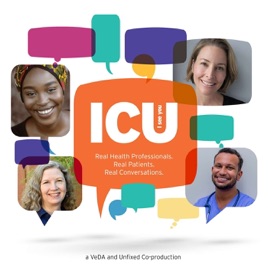
Advertise on podcast: ICU - "I See You" - Vestibular Conversations
Rating
5from
This podcast has
38 episodes
Language
EnglishExplicit
No
Date created
2023/01/09
Latest episode
2026/02/06
Average duration
53 min.
Release period
31 days
Description
In the ICU ("I See You") podcast hosts Cynthia Ryan and Kimberly Warner explore the vestibular experience by facilitating conversations between vestibular patients and the health professionals who care for them. They invite patients to share their stories, and healthcare professionals to ask questions so they are equipped to care for, and truly see their patients. This podcast is a co-production of the Vestibular Disorders Association (VeDA) and Unfixed Media.
Unlock ICU - "I See You" - Vestibular Conversations podcast Email contact info,
Listeners & Audience details
Email contact information
Direct podcast contact details

Listeners
Audience numbers & engagement insights

Audience details
Podcast Insights

Podcast episodes
Check latest episodes from ICU - "I See You" - Vestibular Conversations podcast
Mind-Body Connection
2026/02/06
In this episode of the ICU Podcast, we explore the powerful relationship between the mind and body—and how that connection can be both disrupted and harnessed in life with a vestibular disorder. From the ways stress and anxiety can amplify dizziness to the grounding effects of mindfulness, movement, and self-compassion, we’ll discuss the science and lived experience behind mind-body healing. Through personal stories and expert insights, listeners will discover how cultivating awareness, patience, and inner balance can help restore a sense of control and resilience on the path toward recovery.
Guest Bios
Sandy Brunner describes herself as an awesome stay-at-home mom and an okay housewife. Pre-kid, she was a speech-language pathologist and blogger for Life Without Land Legs. Sandy started her vestibular journey with Mal de Debarquement Syndrome, or MdDS, on a trip to Europe in 2018, adding vestibular migraine, PPPD, and cervicogenic dizziness to her vestibular bingo card along the way. She was in VeDA’s first season of the Life Rebalanced Chronicles docuseries. When she’s not doing mom stuff or at the gym, she is planning parties, going on random adventures, organizing something, reading, or doing crafts.
Donna McArthur, DC has been a chiropractor for thirty years, sharing a wellness-based practice with her husband in the mountains of British Columbia. She provides patient-centered care aimed at restoring function to the neuro-musculoskeletal system, utilizing evidence-based therapies and drawing on her deep knowledge of biomechanical, neurological, and fascial approaches. Her work is grounded in a heart-centered, integrated philosophy of healing.
Donna is passionate about offering people tools and choices that empower their own wellness—something she brings to her clinical practice, writing, and teaching. With a focus on general family practice, she has extensive training and experience supporting both pediatric and geriatric patients.
You can follow Donna on Substack.
Vestibular Migraine
2026/01/09
Welcome to this episode of the ICU Podcast, where we shine a spotlight on the often-overlooked world of vestibular migraine, a condition that affects more than half of all migraine sufferers at some point yet remains frequently misdiagnosed. Vestibular migraine can cause not only headaches but also vertigo, dizziness, imbalance, and sensory sensitivities—making it a formidable challenge for both patients and clinicians. Today, we’re joined by two remarkable guests: a dedicated volunteer with the World Migraine Summit (taking place March 11 – 18) who brings lived experience and advocacy insight, and Dr. Brian Ward, a neurotologist at Johns Hopkins Medicine. Together, we’ll explore how lifestyle management, medication, and other targeted therapies can help restore balance and hope to those navigating vestibular migraine.
Guest Bios
Dr. Bryan Ward is a Neurotologist with Johns Hopkins University who specializes in treating inner ear and skull base disorders that cause dizziness, such as superior canal dehiscence syndrome, Meniere’s disease, and bilateral vestibulopathy. His research interests focus on magnetic resonance imaging (MRI) and interactions between strong magnetic fields and the inner ear. He also works with Dr. Charles Della Santina on the development of a vestibular implant.
Natanya Mandel is a migraine coach, mindfulness facilitator, and passionate patient-advocate whose own journey with frequent migraine attacks and disruptive neurological symptoms inspired her to shift her career and support others living with migraine and chronic pain. Natanya has volunteered with groups like Migraine Canada and the Migraine World Summit, facilitates virtual support groups, and helps people navigate the challenges of chronic migraine with compassion and evidence-informed guidance.
Migraine World Summit
Natanya’s coaching
Yoga for Balance
2025/12/05
In this episode of the ICU Podcast, we explore how yoga can be a powerful, complementary tool for improving balance in people with vestibular disorders. Vestibular conditions disrupt the delicate interplay between the inner ear, vision, and somatosensory systems, often leading to dizziness, instability, and compensatory stiffness. Yoga offers a gentle, embodied pathway to re-train balance by engaging controlled movement, focused breathing, and meditative awareness — all of which can help patients recalibrate their vestibular reflexes, reduce dizziness episodes, and restore coordination and confidence in movement.
Speaker Bios
Emma Rodgers is a certified yoga teacher, originally from the UK and now based in Melbourne, Australia. Emma's journey began after finding yoga and meditation incredibly beneficial for managing her own symptoms of Vestibular Migraine and PPPD, which led her to train as a teacher. She uses her personal experience to inform her teaching style, making it more accessible through safe, gentle practices.
Denise Schneider is a physical therapist who has been practicing in outpatient orthopedics clinics for 23 years. During this time, she has furthered her education to receive a doctorate in physical therapy, a fellowship degree in differential diagnosis and manual therapy, a certificate in vestibular rehabilitation, and a certification in dry needling. She received her 200-hour yoga training certification in 2023. Since then, she has taught various classes and also utilizes this knowledge in her physical therapy practice. Denise is dedicated to providing the utmost patient experience by incorporating evidence-based practice and individualized care to include all aspects of one’s health and well-being. She is a proud ambassador of and contributor to VeDA.
Resources
Yoga for Balance article on the VeDA website.
Pacing with a Vestibular Disorder
2025/11/07
In this episode of the ICU Podcast, we’re diving into the concept of pacing—a vital self-management strategy for people living with vestibular disorders. When dizziness, vertigo, brain fog, and fatigue are part of your daily reality, even routine activities can become overwhelming. We’ll explore how pacing helps individuals with vestibular dysfunction conserve energy, manage sensory overload, and create a more predictable rhythm in an often unpredictable life. Pacing isn’t about giving up—it’s about planning ahead, listening to your body, and protecting your vestibular system from being overstimulated. We’re joined by a patient who has learned to pace their days to avoid symptom flare-ups, and a healthcare professional who supports patients in integrating pacing into their treatment and rehabilitation plans.
Guests:
Tracey Franklin had just started a new job while recovering from a viral flu when she began experiencing fatigue, dizziness, and brain fog. A few months later, she went on sick leave, followed by disability. In 2018, she retired medically from her 30-year career as a publishing professional. Over the next six months, Tracey saw multiple doctors and underwent various tests and was diagnosed with Vestibular Migraine and Persistent Postural Perceptual Dizziness (PPPD). Along with ongoing VeDA support groups, vestibular rehab, cognitive behavioral therapy, and medical treatments, she manages these invisible disorders by getting adequate rest and pacing her commitments and activities. She hopes to build a bridge between the vestibular and medical communities, so others are diagnosed sooner. Tracey loves ice cream, writing, the beach, and snow. She lives with her husband of 21 years and their cat. She believes it’s her faith in God that continues to bless her with managing her conditions and having fewer symptomatic days.
Steph Fowler is a Licensed Clinical Professional Counselor and Certified Alcohol and Drug Counselor (LCPC, CADC). She is also a chronically ill, disabled, and neurodivergent therapist, writer, consultant, and coach who has lived with Long COVID since early 2020. After her health, work, and life were dramatically changed by this condition, she shifted her business and rebranded as Misfit Mental Health. She now focuses on supporting people in the chronic illness, disability, and COVID Conscious communities - as well as their loved ones and care providers. Earlier this year, Steph was featured in TIME Magazine, sharing her personal and professional insights on navigating healthcare and medical gaslighting. When she's not depathologizing non-conformity, she enjoys taking care of her houseplants, building LEGOs, spending time with her partner and their cat Ziggy, and all things macabre. Check out Steph's pacing workshop and other resources here: https://linktr.ee/misfit.mental.health.
Chiropractic Neurology
2025/10/10
In this episode of the ICU Podcast, we’ll discuss how the brain interacts with the body and the specialized type of healthcare provider who studies this interaction. Chiropractic neurology, also known as functional neurology, is a specialty that branches from the traditional chiropractic methods. You might think of a conventional chiropractor as someone who performs manual adjustments on the neck and spine. Chiropractic neurologists aim to optimize neurological functions by leveraging the concept of neuroplasticity, which is the brain's ability to change and adapt. Chiropractic neurology offers a holistic approach for assessment and therapeutic interventions that may benefit patients with vestibular symptoms. By examining how brain function interacts with other bodily systems, chiropractic neurology can begin to unravel complex health conditions.
Menopause and Dizziness
2025/09/05
In today’s ICU episode, we’re exploring an important and often overlooked topic: how menopause can impact people living with a vestibular disorder. Hormonal changes during menopause can affect the inner ear and brain function, often intensifying symptoms like dizziness, imbalance, brain fog, and migraines. For those already managing a vestibular condition, this transition can bring new challenges — but also new opportunities for understanding and support. In this episode, we’ll dive into the connections between hormonal shifts and vestibular health and offer insights on how to navigate this complex time with greater resilience and hope.
Speakers:
Lara Bishop: Lara is a mother of twins who was diagnosed with vestibular migraines in 2012, vestibular neuritis in 2013, and PPPD in 2018 — all of which have been profoundly life-changing. Coping with invisible illnesses has been a challenging journey, often difficult for her family and friends to understand fully. In addition to her vestibular disorders, Lara also lives with Anxiety, panic Disorder, depression, as well as some other chronic conditions. Over the years, she has made significant lifestyle changes to help manage her conditions, including participating in Cognitive Behavioral Therapy (CBT) and Vestibular Rehabilitation Therapy (VRT), adopting a regular routine of daily exercise such as biking and weight training, and making critical dietary adjustments.
Lara is passionate about raising awareness of debilitating vestibular conditions, supporting fellow sufferers, and educating both the general public and medical professionals. Despite the many challenges she faces, she maintains a positive outlook on life and is determined to share her optimism and motivation with others.
See Lara’s presentation to the British Association of Audiovestibular Physicians on Vestibular Migraine in women - The Hormone Connection here: https://youtu.be/cVsVhtISFB8?si=VSUm2AB4NnIrOATg.
Heather Bartos: Dr. Heather Bartos is an OB/GYN, menopause specialist, author, and speaker, recognized as one of the nation’s top five experts in menopause by Oprah Winfrey and Maria Shriver. Her mission is to dismantle the taboos surrounding menopause and sexuality, empowering women through transformative midlife transitions. Her latest book, Quickies: 100 Little Lessons to Living Sexily Ever After in Midlife, is out to rave reviews. Her diverse background, spanning PR, medicine, and Reiki practitioner, as well as her service in the Navy, underscores her holistic and personalized approach to healthcare. Featured in Shape, Glamour, Refinery29, ABC News, and more, her insights are pivotal in changing the narrative around midlife and menopause. Cosmo magazine celebrates her as a ‘supremely badass gyno,’ highlighting her significant impact on women’s health advocacy.
Learn more about Heather Bartos at https://heatherbartosmd.com.
Balance Awareness Week
2025/08/08
Welcome to the ICU podcast, where we illuminate invisible chronic illnesses and the people who live with them. In this episode, we’re spotlighting Balance Awareness Week, an annual event hosted by the Vestibular Disorders Association each September. This global campaign raises awareness about the impact of vestibular disorders—conditions that affect balance, dizziness, and spatial orientation—and connects patients, caregivers, and healthcare professionals through education and advocacy. In this episode, we talk with Paul Morris, VeDA’s Development Director, about how people can get involved in Balance Awareness Week, as well as Christian Chabbert, a French neurophysiologist who engages healthcare professionals across Europe in this event, and is spearheading a global walk for balance.
Speaker Bios
Paul Morris has over 30 years of experience in nonprofit fundraising, helping a wide spectrum of organizations raise millions of dollars to support their missions. He has led successful development efforts in direct health services at the state and national levels. He’s also helped raise funds for organizations that work in regional theater, architectural preservation, offering chess to low-income students, and more. For Paul, fund development isn’t just about raising money, but building relationships with people in your community so that they feel heard, valued, and are excited about supporting their shared mission.
Christian Chabbert is a French neurophysiologist and Research Director at the French National Centre for Scientific Research. He is developing research on balance disorders at the Research Center in Psychology and Neurosciences at Aix-Marseille University. Since 2015, Dr. Chabbert has directed GDR Vertige, a national research consortium uniting clinicians, scientists, and industry partners to advance the understanding and treatment of vestibular disorders. His expertise in sensory neuroscience and molecular electrophysiology has contributed to over 90 scientific publications and the founding of two biotech companies—Sensorion Pharmaceuticals and Vertidiag—focused on developing therapies for balance-related conditions. Dr. Chabbert also plays a key role in the European PROVIDE network, promoting translational research and innovation in neuro-otology across Europe.
How Sleep Affects Vestibular Symptoms
2025/07/11
In this episode, we’re diving into a crucial yet often overlooked part of vestibular recovery: sleep. If you’re dealing with vestibular dysfunction, getting high-quality sleep isn’t just a nice-to-have—it’s a vital part of healing. When you're well-rested, your body is better equipped to handle treatment and manage symptoms. On the flip side, sleep deprivation can actually trigger or worsen dizziness, imbalance, and other vestibular issues. In this episode, we’ll explore how developing strong sleep habits—from setting a consistent bedtime to managing light and noise in your room—can become a powerful tool in your recovery toolkit. So grab a cozy blanket, and let’s talk about why it’s time to take sleep seriously.
Speakers:
Tiffany Kopp
In June 2021, Tiffany woke up to her world spinning. It took 2 weeks for her to be diagnosed with BPPV, two months to be diagnosed with vestibular migraine, and a month later, she was also diagnosed with PPPD. It took almost six months to find a doctor who prescribed a treatment plan that works for her. She discovered VeDA’s website early on in her search for answers to her symptoms and connected with several VeDA Ambassadors, who helped her during her vestibular journey. Now she hopes that she can do the same for someone else. She volunteers as a VeDA Ambassador and believes that advocating is the best way to get the word out and help “make vestibular visible.”
Nicole Acerra
Nicole Acerra earned her psychology and physiotherapy degrees at Queen’s University. After working as a neurological physiotherapist in Canada, the United States, and Australia, she completed doctoral studies in neuroplasticity at the University of Queensland and post-doctoral studies at the University of British Columbia. She has 25 years of clinical experience in neurological and vestibular physiotherapy in acute and private practice. She enjoys working closely with patients and families to develop a customised treatment plan, which may include hands-on therapy, home-based exercises, management techniques, and coping skills. When not at work, Nicole enjoys spending time with her family and friends, road cycling, skiing, hiking, gardening, travelling, reading, and doing yoga.
Sleep Assessments
Pittsburgh Sleep Quality IndexSleep Quality ScaleInsomnia Severity Scale
Memoir Writing for Chronic Illness
2025/06/06
In this episode we explore the power of storytelling and the profound impact it can have on making sense of our lives. Our guests are a memoir expert and our very own co-host, Kimberly Warner. You don’t have to consider yourself a writer to gain something valuable from this conversation. We’ll delve into the stories that shape us, how we find meaning in them, and the transformative potential of sharing these stories with others.
Kimberly Warner is a film director, producer, author, and a medical school drop-out who traded prescriptions for cameras in pursuit of narrative medicine. She founded Unfixed Media in 2019 to share stories of people living with chronic or rare conditions and how adversity can broaden our definition of what it means to live a “good life.”
Christine Wolf is a trauma-informed memoir coach, developmental editor, and the traditionally published co-author of Politics, Partnership and Power -- a biography about one of the first 50 women to serve in the United States Congress. She runs a workspace for women writers and teaches about writing and entrepreneurship. An award-winning journalist and live storyteller, Christine regularly leads workshops and retreats centered around the science-backed benefits of expressive writing for emotional healing.
Persistent Postural Perceptual Dizziness (PPPD)
2025/05/08
Persistent Postural Perceptual Dizziness. That’s a mouthful! No wonder we call it PPPD! This relatively new vestibular diagnosis helps explain why some people continue to experience vestibular symptoms when test results are normal. PPPD typically starts shortly after an event that causes acute vertigo, dizziness, or some other disruption of balance, but it may also occur for unknown reasons. PPPD causes dizziness without vertigo, and fluctuating unsteadiness provoked by environmental or social stimuli, such as crowded places. Some critics question whether this is a “garbage” diagnosis for people with unexplained vestibular-like symptoms. In a separate interview with Professor Jon Stone we learn that this is not the case, and indeed, that PPPD can co-exist with other vestibular disorders. In this episode of the ICU Podcast we’re going to talk with a patient who struggles with PPPD and a physical therapist who treats this complex condition.
Speaker Bios:
Susan Blount is a college professor, publishing and media executive, and certified health and wellness coach who has dedicated her career to education and well-being. After developing Persistent Postural Perceptual Dizziness (PPPD) following a trip to Alaska, she faced life-changing challenges. Yet, through vestibular rehab, cognitive behavioral therapy, and a commitment to strength training, she has redefined what it means to live fully. Now, Susan empowers others with the message that being both healthy and chronically ill is possible. With the support of the VeDA community, she continues to navigate life with resilience, purpose, and joy.
Dr. Megan Daly is an experienced Vestibular Physical Therapist and Health Coach. She has her own physical therapy and coaching practice to help people address the root cause of their symptoms, navigate the healthcare system, and modify their lifestyle. She also runs Dizzy Coaches, a vestibular mentoring program for clinicians of all levels. She helps patients with dizziness, migraines, concussions, and balance issues manage their conditions so they can have fewer dizzy days. She has experienced many vestibular conditions personally and brings this empathy to all her patient interactions.
Pediatric Vestibular Disorders
2025/04/10
Did you know that vestibular disorders affect children as well as adults? There are increasing reports of vestibular deficits in children. One study suggests that as many as 1 in 5 children in the United States have problems with dizziness or balance. Pediatric vestibular disorders result in vertigo, gaze instability, delayed motor development, and problems with reading. These symptoms are difficult for anyone to cope with, but are especially challenging for children and their families. Pediatric vestibular healthcare specialists are hard to find, it can be difficult for a child to describe their symptoms, and delayed diagnosis can have devastating results. In this episode of the ICU Podcast we’re going to talk to a pediatric vestibular specialist and the mother of a young child who bravely battled vertigo, hearing loss, and a host of other vestibular symptoms.
Guests:
Andi Gilkey - Andi is a Licensed Clinical Social Worker and the proud mom of a
vestibular warrior. Her son is an amazing 11-year-old who loves baseball, music, video games and his friends. He has bilateral sensorineural hearing loss, a unilateral Enlarged Vestibular Aqueduct, childhood vertigo, PPPD and vestibular migraines. His hearing journey has been well supported by an incredible team, but his vestibular journey has been one of the biggest challenges Andi has encountered as a mother. She says it felt like an endless roller coaster full of ups and downs since he was a toddler. Through hard work and the creation of an incredible vestibular team, she is proud to say that her son has been in remission of vestibular symptoms for 10 months. Her ongoing goal is to share her family’s story with others to provide hope and support to the vestibular community.
Jennifer Braswell-Christy, PT, PhD, FAPTA: Dr. Jennifer Christy is a Professor in the Department of Physical Therapy at The University of Alabama at Birmingham. Her primary area of research is in the development of innovative intervention methods to improve gaze stability and balance in children with vestibular-related impairments. Related to this area of research, Dr. Christy teaches numerous continuing education courses in the U.S. and abroad.
Brain Fog
2025/03/07
In today’s episode of the ICU Podcast, we’re going to talk about brain fog. It kind of sounds like some sort of weather pattern. What is brain fog, and why do so many vestibular patients experience it? Some people describe it as forgetfulness, confusion, a lack of focus, difficulty concentrating or making decisions, or just a vague sense of blurry thinking, like your head is in the clouds. When the brain is dedicating a great deal of energy to maintaining equilibrium and staying steady, activities such as recalling details or short-term memory may become more difficult, and thinking might seem slow. First, I want you to know that this is NORMAL. Today we’ll talk to a patient who knows about brain fog all too well, and a doctor who has helped thousands of women learn to manage this frustrating symptom.
Dr. Kathleen Jordan is the Chief Medical Officer at Midi, a virtual care clinic for women going through menopause and perimenopause. She has personally experienced the struggle to find a healthcare provider she can consider a partner in her journey toward wellness. She created Midi to put high-quality, patient-centered care within reach for all women at midlife. As an expert in women’s health, Dr. Jordan is very familiar with brain fog, otherwise known as “menopause brain”, and has some great suggestions for how to recognize and manage it.
Ann Walder has struggled with migraines all her life. The word Vestibular Migraine entered her vocabulary after an illness that damaged her inner ears when she was 48. Early on Ann says her brain fog was fierce. She was blessed to connect with the vestibular community and find qualified healthcare providers early in her journey. Her family has been very supportive, and she’s found many friends among VeDA’s Ambassadors. She currently works as an activity specialist with the elderly and says that helping others brings her true happiness.
Visually Induced Dizziness
2025/02/14
For many people who have a vestibular disorder, a trip to the grocery store can turn into a battle with dizziness. The bright lights, rows of shelves, patterns on the floor, and crowds of people can trigger symptoms such as dizziness, nausea, and light-headedness. Bending down or turning your head to scan for the items you need. All this can take a lot of energy to navigate. Visually induced dizziness is an umbrella term for a group of symptoms. It can also be referred to as visual vertigo, space and motion discomfort, supermarket syndrome or visual vestibular mismatch. Researchers think it is caused by a conflict between different parts of the brain’s balance system. In this episode of the ICU podcast, we’re going to talk to Elizabeth, who struggles with visual disturbances as a result of her vestibular disorder, and Dr. Morgan Kriz, a physical therapist who specializes in treating this condition.
Elizabeth Schneider has been living with a Vestibular Disorder for 21 years. She was first diagnosed at age 36, when she lost her balance and experienced severe visual disturbances. She had to retire from her job as a Registered Nurse because she could no longer work due to her vestibular symptoms. Elizabeth knows what it’s like to struggle with career, money problems, and family stress, especially when you first get sick. Like many of you, she had to navigate through the medical system to get help, which is a taxing effort at best. She decided to become a VeDA Ambassador to bring awareness to this diagnosis and to help others get the help they need!
Dr. Morgan Kriz has been practicing vestibular physical therapy for more than 10 years. She understands the journey that many vestibular warriors endure to get a proper diagnosis, obtain a supportive care team, and feel like they are on the right track to get their lives back. She is co-owner of Vestibular Therapy Specialists, with clinics in Seattle, WA and Bend, OR, where she resides with her family. She is also a consultant for Blue Marble Gaming Company, which is developing online home programs and protocols for Vestibular Rehabilitation. She’s a content creator and presenter for Vestibular IQ, a Continuing Education Platform for healthcare providers, and the volunteer director for a support group series called “Boost Your Brain’s Balance.”
How Hearing Loss Impacts people with vestibular conditions
2025/01/15
In this episode we’re going to talk about silence. The silence that happens when you lose your hearing. Whether it comes on all of a sudden or gradually, losing your hearing is a life changer. It starts when you have to ask your friends and family to repeat what they just said. Eventually you stop asking, and you begin to feel separate, apart, not included in the conversation. Although there is no cure for hearing loss, fortunately, there are very effective tools and treatments that can help people remain engaged with the hearing world around them.
Our guests are:
Lynn Johnson: Lynn's life became unbalanced in 2015. She had been feeling off, and out of the blue woke up with imbalance and loud tinnitus (ringing) in her right ear. As days passed, her symptoms continued to get worse. Five months and four doctors later, she was diagnosed with Autoimmune Inner Ear Disease (AIED) and Bilateral Vestibular Hypofunction. Her symptoms include bilateral profound deafness, tinnitus, oscillopsia (jumping vision), and imbalance. Lynn says that if she had been given the correct diagnosis in the beginning, there might have been a chance to save her hearing. Lynn is a VeDA Ambassador and co-leader of a support group for vestibular patients with hearing loss.
Molly Smeal: Dr. Molly Smeal is a clinical audiologist in the Head and Neck Section of the Integrated Surgical Institute at the Cleveland Clinic, and is an adjunct professor for the Northeast Ohio AuD Consortium. Dr. Smeal specializes in diagnostics and auditory implantable devices. She also participates in clinical research related to implantable devices. In her career, she has led and participated in several initiatives focused on clinical quality control. She is a published author and invited national and international presenter. Dr. Smeal is currently a participant of the American Cochlear Implant Alliance.
Bilateral Vestibular Hypofunction
2024/12/11
In this episode of the ICU Podcast we’re going to talk about what happens when we lose function in our inner ear completely, when the vestibular system on both your right and your left sides is not working. Bilateral vestibular loss, also called hypofunction, can be devastating. It results in severe difficulty maintaining balance, especially when walking in the dark or on uneven surfaces, and a decrease in your ability to see clearly when moving your head. This can lead to an increased risk of falling, blurry vision, dizziness, imbalance, and can eventually lead to other types of physical deconditioning. How does a person cope when their internal gyroscope is essentially turned off, and what medical miracles are available to help them?
Our guests today are Dr. Charley Della Santina, one of the foremost researchers in this area, and Donna McKinney, a vestibular patient with bilateral vestibular loss.
Guest Bios
Dr. Charles Della Santina, MD, PhD
Dr. Charley Della Santina specializes in surgery for treatment of otosclerosis, acoustic neuroma, and other problems that cause hearing loss or abnormal vestibular sensation. He is a neurophysiologist with PhDs in biomedical and electrical engineering. Dr. Della Santina founded and directs the Johns Hopkins Vestibular NeuroEngineering Lab. His research group focuses on developing a vestibular implant to treat chronic unsteadiness and oscillopsia caused by gentamicin ototoxicity and other causes of bilateral vestibular hypofunction.
Donna McKinney
Donna McKinney is a mom of three and a proud grandma. Since her diagnosis of bilateral vestibular loss in 2014 she has had to retire from her physically active career as a youth and senior fitness director. She has become a certified health coach and a diabetes prevention coach and is hoping to return to work on a part-time basis.
Donna enjoys cooking, spending time with her family, and going for long rides and day trips with her partner, Alec, who has been by her side through every dizzying step of this diagnosis.
In May of last year Donna received the multichannel vestibular implant as part of a study at Johns Hopkins University.
Podcast reviews
Read ICU - "I See You" - Vestibular Conversations podcast reviews
Podcast sponsorship advertising
Start advertising on ICU - "I See You" - Vestibular Conversations relevant audience podcasts
You may also like to advertise on these Podcasts

4.4371061566
The Megyn Kelly Show
SiriusXM

4.888901269
Fearless with Jason Whitlock
Blaze Podcast Network

4.8118931000
Mind Pump: Raw Fitness Truth
Sal Di Stefano, Adam Schafer, Justin Andrews, Doug Egge
4.8102131585
Tara Brach
Tara Brach

4.541561215
Something You Should Know
Mike Carruthers | OmniCast Media

4.513841343
Strictly Anonymous Confessions
Kathy Kay

4.8292781897
Fantasy Footballers - Fantasy Football Podcast
Fantasy Football

4.62382612
Football Weekly
The Guardian

4.45387666
Two Judgey Girls
Two Judgey Girls
3.8258501152
The Viall Files
Nick Viall