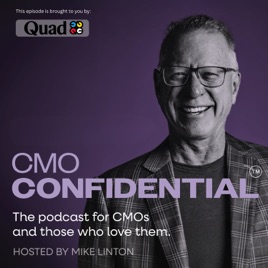
Wonder what it's like to control millions of dollars of marketing budget? Manage hundreds of people? Make the decisions on which ideas get to market?
The CMO Confidential podcast shares how it feels to be in that chair of the shortest-tenured position on the C-suite.
We detail the long, hard road most ideas take to get to market & how challenging it is to get the best ones through.
Hosted by Mike Linton -- the former P&G Brand Manager who went on to be the Chief Marketing Officer of Best Buy, eBay, and Farmers Insurance, as well as the Chief Revenue Officer of Ancestry.com and the head marketer at Remington -- this show serves as an ongoing lesson plan for how to get, do, keep, and handle the pressures of the CMO job.
Advertise on CMO Confidential
Advertise on CMO Confidential to promote your brand to thousands of podcast listeners
Check latest episodes from CMO Confidential podcast
James Shira | What Your CIO Wants to Tell You But Won't | Principal, Global CIO and Global CISO, PwC
2026/02/03
A CMO Confidential Interview with James Shira, Principal, Global and US CIO and Global CISO at PwC. James details how @PwC is running an "AI marketplace" within the company which features a number of models, his focus on scale, security, and user experience, and the case for approaching AI with a "humility" mindset. Key topics include: how the CISO (Chief Information Security Officer) balances rapid enablement and security needs; why CMO's should have a working knowledge of the technology roadmap; and tips for aligning with your CIO. Tune in to hear how to "go rogue" if you must and a story about socks.
Sponsored by Scrunch AI: learn more here → https://www.scrunchai.com/cmo
Global CIO & CISO James Shira joins Mike to decode what your CIO wishes you knew—AI adoption, security trade-offs, model “marketplaces,” and how CMOs should really partner with IT. Concrete guidance on prioritization, tech stack decisions, legacy constraints, and when “going rogue” is justified. Practical, senior-level playbook for winning with AI without lighting money—or trust—on fire.
**Chapters**
00:00 – Welcome & setup: “What your CIO wants to tell you, but won’t”
01:15 – The AI era: pace, complexity, stakeholder pressure
03:24 – Humility first: why being late to AI isn’t OK
04:09 – Designing for scale, security, and real user adoption at PwC
06:00 – Building a model “marketplace” (40+ models) & minimum bars
07:27 – Guardrails: encryption, data governance, and safe experimentation
09:32 – Adoption reality: super-users, skeptics, and moving the middle
11:00 – What “leading” looks like: C-suite prioritization & high-value use cases
13:00 – CISO shift: from gatekeeper to enabler; managing Kobayashi-Maru choices
16:59 – How marketers help: anticipate CIO/CISO problems, simplify choices
19:00 – MarTech the smart way: align to architecture, reduce sprawl, bring options
22:00 – No IT dance partner? Work with COO/CFO; standardize and choose fit over “sexy”
24:33 – Legacy estates: outsource vs. “AI-ify” retained work; show ROI math
26:29 – When to go rogue—and how not to get fired doing it
31:00 – Free advice to agencies: do the work, bring substance, not spam
32:00 – Closing & funniest story (Zurich board-meeting socks)
CMO Confidential,Mike Linton,James Shira,PwC,CIO,CISO,AI,GenAI,AI adoption,AI governance,cybersecurity,enterprise IT,MarTech,marketing technology,tech stack,cloud strategy,data governance,model marketplace,digital transformation,change management,prioritization,COO,CFO,CapEx,legacy modernization,outsourcing,automation,meeting summaries,audit,experimentation,go rogue,executive leadership,marketing strategy,enterprise software,boardroom,CMO tips
See Privacy Policy at https://art19.com/privacy and California Privacy Notice at https://art19.com/privacy#do-not-sell-my-info.
Rob Ward | A Top Venture Capitalist Analyzes the AI Landscape | Co-founder GP | Meritech Capital
2026/01/27
A CMO Confidential Interview with Rob Ward, co-founder and General Partner of Meritech Capital, a top Silicon Valley venture firm. Rob shares his take on what he calls a "super terrifying and exciting time" and provides perspective on AI receiving the most capital of any technology in history, the "durability of revenue" and how quickly start-ups are now reaching $100 million in revenue. Key topics include: why VC's focus on growth vs. profitability; the risks associated with massive long-term capital investment; why marketers should pick a "trusted advisor" as their AI partner; and why your data strategy needs "context. Tune in to hear how Astronomer handled the "Coldplay Concert Incident" which immediately became a PR classic and the "VC Foie Gras Effect."
What happens when a top venture capitalist pulls back the curtain on AI, valuations, hype cycles, and what’s actually working?
In this episode of CMO Confidential, host Mike Linton sits down with Rob Ward, Co-Founder and General Partner at Metech Capital, to unpack the realities behind the AI boom. Rob has spent more than 26 years investing in category-defining companies like Facebook (Meta), Snowflake, NetSuite, Zipcar, and Cloudera — and he brings a rare, grounded perspective to today’s AI frenzy.
Together, they explore:
• Why AI adoption is still early — despite explosive growth
• The real risks behind inflated valuations and “AI-washing”
• How VC decision-making changes during platform shifts
• What marketers and executives should actually look for when choosing AI partners
• Why data strategy, change management, and trust matter more than tools
• What layoffs, productivity, and the future of work really look like beneath the headlines
• A masterclass in crisis communications, featuring Ryan Reynolds, Gwyneth Paltrow, and Coldplay
If you’re a CMO, CEO, board member, founder, or agency leader trying to make sense of AI without getting swept up in the hype — this is a must-listen conversation.
New episodes of CMO Confidential drop every Tuesday.
Subscribe for insider perspectives on the most misunderstood role in the C-suite.

⸻
Chapter Markers
00:00 – Welcome to CMO Confidential
00:19 – Introducing Rob Ward and today’s AI conversation
01:13 – Where we really are in AI adoption
02:26 – Explosive AI growth: what’s real vs hype
03:35 – Why enterprise AI adoption is still a slog
04:37 – Vendor spend, hyperscalers, and the trillion-dollar buildout
06:12 – Is this an AI bubble? Public vs private market realities
07:20 – Accelerating investment rounds and lack of diligence
08:12 – AI-washing and durability of AI businesses
09:46 – Proof-of-concepts, switching costs, and fragile loyalty
10:55 – Big Tech vs startups: why this cycle is different
11:40 – Why VCs chase platform shifts despite the risks
13:05 – How AI is changing profitability and headcount math
16:11 – “FOGRA” investing and capital distortion
17:00 – Circular investing and data-center risk
18:23 – Data centers, GPUs, and betting on the wrong future
19:38 – Credit default swaps and financial warning signs
21:45 – How executives should choose AI vendors
22:58 – Change management and why culture matters most
24:09 – Why data strategy is the real AI strategy
26:36 – “Frequently wrong, never in doubt” and AI hallucinations
27:01 – Practical AI use cases for marketers
30:00 – Layoffs, productivity, and what’s really happening to jobs
33:05 – The best questions to spot real AI fluency
35:00 – AI safety, geopolitics, and long-term risks
36:38 – Crisis management masterclass: Astronomer, Coldplay & Ryan Reynolds
39:58 – Final advice and closing thoughts
⸻
Comma-Separated Tags
CMO Confidential, AI strategy, artificial intelligence, venture capital, Rob Ward, Metech Capital, AI adoption, AI hype, AI bubble, enterprise AI, generative AI, AI in marketing, CMO leadership, marketing leadership, venture investing, AI vendors, data strategy, change management, AI readiness, tech valuations, AI infrastructure, data centers, future of work, AI layoffs, crisis communications, brand crisis management, Ryan Reynolds marketing, Gwyneth Paltrow Astronomer, Coldplay controversy, Silicon Valley, marketing podcast, C-suite leadership
See Privacy Policy at https://art19.com/privacy and California Privacy Notice at https://art19.com/privacy#do-not-sell-my-info.
Dissecting Compensation - A Primer on Understanding, Negotiating and Managing Pay
2026/01/20
"Dissecting Compensation - A Primer on Understanding, Negotiating and Managing Pay"
A CMO Confidential Interview with Richard Sanderson, the Marketing, Sales, and Communications Practice Leader at Spencer Stuart. Richard starts with the basics of salary, bonus and equity and branches out to compensation mix, the various types of equity, negotiating best practices, and the "other" elements of an offer. Key topics include: why the devil is in the details; when and how to discuss compensation; the difference between dumb luck and bad luck; and why everyone should do a "multi-year cash flow analysis." Tune in to hear why you should always read the proxy statement and the importance of being prepared to explain how you are using AI.
*Dissecting CMO Compensation with Richard Sanderson (Spencer Stuart) — Salary, Bonus, Equity & Negotiation Playbook*
What’s “market” for a modern CMO, and how do you actually negotiate it? Richard Sanderson, who leads Spencer Stuart’s Marketing, Communications & Sales Practice, breaks down the three pillars of pay (salary, bonus, equity), compensation mix by ownership model, and the real rules of negotiating offers, severance, and forfeitures. We also tackle vesting, RSUs vs. options vs. PSUs, what to ask recruiters (legally) about pay ranges, how to manage your team when equity is underwater, and why every CMO needs crisp AI impact stories in interviews. Actionable, candid, and built for executives who make or take offers.
*Chapters*
00:00 Intro — Welcome to CMO Confidential & Richard’s background
01:50 Why comp is hard to decode (and why it matters)
02:12 The building blocks: salary, bonus, equity
03:21 The data gap: only ~4% of F1000 list marketing leaders as NEOs
04:26 Salary basics, bands, and industry norms
05:35 Bonus mechanics & the one question to ask (3-year payout history)
06:38 Equity 101 — long-term incentives and where value really accrues
07:25 Compensation mix: public, PE, private, nonprofit
08:25 Geography effect — US vs. Europe on equity weighting
09:23 RSUs explained (and why they always have some value)
10:19 Options & strike prices — upside vs. “underwater” risk
10:57 PSUs — performance gates, accelerators, and board metrics
12:17 Vesting types: time, performance, and event-based triggers
13:15 Forfeitures if you leave early (and what’s negotiable)
15:09 Negotiating framework — timing, laws, posture
16:34 When to talk comp without signaling “it’s just the money”
17:58 Pay transparency laws — expectations vs. history; what recruiters can ask
20:23 Forfeitures checklist: bonus timing, unvested equity, make-wholes
21:36 Know your company’s rules (eligibility dates, presence requirements)
22:36 Smart pushback: asking for the range and reducing info asymmetry
23:47 Your moment of max leverage: the verbal offer
27:58 Beyond pay: severance, sign-on, relocation, start date, perks
29:00 CMO tenure math and why severance matters
32:31 “Am I underpaid?” How to build a real case
34:34 Managing your team through pay angst & proxy transparency
36:29 Underwater equity — empathy, vision, and refresh cycles
38:22 Timing luck: annual grants & market swings (“Liberation Day” example)
40:00 Do the 5-year cash-flow comparison (and bridge Year 1–2)
42:04 The new relocation math (mortgages & cost deltas)
43:06 Titles, reporting lines, non-competes, and day-one docs
43:50 Should you ever turn down a written offer?
45:23 The reputational risk of reneging
47:05 Be ready: the AI question in every CMO interview
48:32 Wrap
*Tags*
CMO Confidential, Richard Sanderson, Spencer Stuart, CMO compensation, executive pay, salary bands, bonus plans, equity RSUs, stock options, PSUs, vesting, severance, negotiation, forfeitures, compensation mix, private equity, public companies, proxy statements, pay transparency laws, marketing leadership, executive recruiting, board compensation, make-whole bonus, cash flow analysis, AI in marketing
See Privacy Policy at https://art19.com/privacy and California Privacy Notice at https://art19.com/privacy#do-not-sell-my-info.
Alex Schultz | CMO at Meta | Marketing at Meta - The View From the Eye of the Storm"
2026/01/13
"Marketing at Meta - The View From the Eye of the Storm"
A CMO Confidential Interview with Alex Schultz, the Meta CMO and VP of Analytics, and author of Click Here: The Art & Science of Digital Marketing and Advertising. Alex details why he believes in decentralized analytics and the importance of focusing on core results vs vanity metrics, why AI is a "threshold technology", and why and how the company transitioned to Meta. Key topics include: the barbell distribution of AI competency (native users and very senior experienced leaders); why he believes so strongly in "incrementality measurements"; how he and his team handle the emotional impact of being in the center of political discussions and; why marketers should be thinking about 2027. Tune in to hear a story about affiliate marketing incentives gone wrong and the eBay/Google "Tea Party" incident.
What’s it really like to be CMO at one of the most scrutinized companies in the world?
In this episode of **CMO Confidential**, host Mike Linton sits down with **Alex Schultz**, CMO and VP of Analytics at Meta, for a wide-ranging, unfiltered conversation on marketing leadership inside the eye of the storm. Alex breaks down how Meta structures marketing and analytics at global scale, why marketing must be centralized while analytics should not, and what most companies get wrong about “one source of truth.”
The conversation goes deep on navigating nonstop political and cultural pressure, shortening negative news cycles, and keeping teams emotionally grounded when the brand is under fire. Alex also shares some of the clearest executive thinking we’ve heard on AI as a *threshold technology* — where it truly creates leverage, where humans must stay in the loop, and how CMOs should assess AI talent today.
The episode closes with inside stories from the Facebook-to-Meta rebrand, hard-earned lessons from eBay on incrementality measurement, and practical advice for preparing your organization for 2027 and beyond.
If you’re a CMO, CEO, founder, or senior operator responsible for growth, measurement, and brand under pressure — this is required listening.
New episodes of **CMO Confidential** drop every Tuesday.
---
## Chapters & Timestamps
00:00 – Welcome to CMO Confidential
00:01 – Alex Schultz’s role: CMO & VP of Analytics at Meta
00:03 – Why marketing is centralized but analytics are decentralized
00:06 – “One source of truth” and killing vanity metrics
00:09 – Marketing while constantly in the global spotlight
00:11 – Managing crisis cycles, truth, and comms alignment
00:12 – AI’s real impact on marketing productivity
00:15 – AI as a threshold technology (precision vs. recall)
00:17 – How AI is reshaping analytics, creative, and teams
00:18 – Hiring for AI: the barbell talent distribution
00:22 – Preparing for 2027: information flow and AI philosophy
00:25 – How B2B marketing is (and isn’t) changing
00:28 – Inside the Facebook → Meta rebrand
00:32 – Lessons from eBay: incrementality over last-click
00:36 – What downturns reveal about leadership talent
00:37 – Why Alex wrote his book on digital marketing
00:40 – Affiliate marketing, incentives, and unintended consequences
00:43 – Final advice for CMOs and marketers
---
CMO Confidential, Alex Schultz, Meta marketing, Facebook Meta rebrand, marketing leadership, CMO podcast, executive marketing, analytics strategy, marketing analytics, AI in marketing, artificial intelligence marketing, incrementality measurement, digital marketing strategy, B2B marketing, growth marketing, brand under pressure, crisis communications, marketing measurement, performance marketing, last click attribution, marketing org design, marketing podcast
--
See Privacy Policy at https://art19.com/privacy and California Privacy Notice at https://art19.com/privacy#do-not-sell-my-info.
DJ Patil | An Update From the Front Lines of AI - A Perspective From Spock on the Bridge
2026/01/06
A CMO Confidential Interview with DJ Patil, Great Point Ventures investor and former U.S. Chief Data Scientist in the Obama Administration. DJ discusses why AI adoption is "lumpy" like unbaked cake mix, the difference between large models and focused applications, and why consultants are probably not the best way to make progress. Key topics include: Maslow's Hierarchy of AI with power, data and water as the foundation; a timeline juxtaposition of AI evolution versus culture and policy change; and his belief that marketers have a unique position to add "human connectivity" in to the mix. Tune in to hear a view on AI and health care as well as how Waymo almost ruined a date night.
What does AI adoption *really* look like inside large organizations—and why does it feel so uneven?
In this episode of **CMO Confidential**, host **Mike Linton** sits down with **DJ Patil**—former U.S. Chief Data Scientist, AI leader at eBay and LinkedIn, and longtime advisor and investor—for a clear-eyed update from the front lines of AI.
DJ explains why AI progress feels “lumpy,” why culture—not technology—is the biggest blocker to ROI, and what boards, CEOs, and CMOs must do now to avoid falling behind. From autonomous warfare and small models to Wall Street hype cycles, job displacement, and what AI means for the future of marketing, this is a practical, executive-level conversation about what’s real, what’s noise, and what comes next.
If you lead a company, manage a brand, sit on a board, or are building a career in marketing, this episode will recalibrate how you think about AI adoption, investment, and organizational change.
🎧 New episodes of **CMO Confidential** drop every Tuesday.
---
Chapters / Timestamps
00:00 – Welcome to CMO Confidential
00:32 – Introducing DJ Patil and today’s AI focus
01:26 – Where are we really on the AI adoption curve?
02:54 – Why AI progress feels “lumpy” across industries
03:35 – AI fluency vs. AI-native talent
05:22 – AI in education: banning it vs. embracing it
05:57 – AI on the battlefield: Ukraine, drones, and autonomy
07:50 – Big models vs. small models and open source AI
08:12 – The AI investment landscape and industry chaos
09:12 – AI breakthroughs in math and problem-solving
10:52 – Where AI is actually delivering value today
11:50 – ROI, hype cycles, and Amara’s Law
13:46 – When AI savings really show up on the balance sheet
15:17 – Why culture is the biggest blocker to AI success
16:03 – AI speed vs. slow-moving organizations and policy
18:13 – Why executives can’t delegate AI leadership
19:56 – The limits of traditional consulting for AI
22:41 – Job cuts, automation, and what AI is really replacing
25:48 – Why AI isn’t “ready” yet—but is getting close
26:32 – AI as the biggest prize in the history of capitalism
27:18 – Where DJ Patil is investing in AI
29:00 – AI opportunities in healthcare and government
30:27 – What AI means for marketers and marketing careers
34:10 – A Waymo story: the promise and imperfections of AI
35:12 – Final thoughts and where to find more episodes
---
CMO Confidential, DJ Patil, Mike Linton, AI adoption, artificial intelligence strategy, AI for executives, AI and marketing, AI ROI, AI investment, AI leadership, AI culture, future of marketing, chief marketing officer, CMO podcast, executive podcast, boardroom strategy, AI transformation, AI jobs, AI and automation, AI in healthcare, AI governance, enterprise AI, AI fluency, AI native, tech leadership, data science, digital transformation
See Privacy Policy at https://art19.com/privacy and California Privacy Notice at https://art19.com/privacy#do-not-sell-my-info.
Dick Satterfield | Could I, Would I, Should I Leave? - A Career Management Discussion
2025/12/30
A CMO Confidential interview with Dick Satterfield, the founder of Satterfield Rezenbrink Search and former P&G sales leader. Dick discusses career management under the framework of "successful and happy" and outlines why you should constantly be thinking about and evaluating your career. Key topics include why career progression is defined as continuous learning and getting promoted, tips for networking, when is too early or too late to leave, and why counter offers almost always fail . Listen in to hear why you should view the "next job" as a stepping stone versus the perfect landing.
Dick Satterfield, veteran executive recruiter and former P&G sales leader, breaks down when to leave, how to create real options, and what it takes to land (and succeed in) your next role. We cover the “successful and happy” framework, real vs. faux promotions, how to run a stealth search while employed, the truth about counteroffers, and why marketers must present as business leaders driving revenue and efficiency. Practical, no-nonsense advice for CMOs, aspiring CMOs, and any exec managing a high-stakes career.
Chapters
00:00 Intro: CMO Confidential + today’s topic
00:00:43 Meet Dick Satterfield + why this conversation matters
00:02:11 Framework: “Are you successful and happy?”
00:03:39 What recruiters really scan first: promotions and scope
00:05:38 Real vs. “quasi-fake” promotions (one direct report ≠ management)
00:05:59 Could I leave? Too early vs. too late; the commuting rule of 3
00:08:12 Knowing when your learning curve has flattened
00:10:24 Would I leave? How to search while employed (and build leverage)
00:12:25 Target list → warm intros → the right recruiters
00:14:31 Time management for the search (30 minutes a day)
00:15:14 If you’re in transition: process, momentum, and managing home life
00:17:21 Offers: optimize for where you’re most likely to succeed
00:19:31 Interview the company: decision speed and what success looks like
00:21:00 Counteroffers: why ~85% don’t stick
00:22:38 Negotiating severance (and when it actually gets set)
00:24:00 Biggest career mistake: not managing your career like a project
00:25:00 For marketers: be a business leader, not “just” marketing
00:26:13 Practical closer: return recruiter calls—before you need them
00:26:55 Wrap
Tags
CMO Confidential,Mike Linton,Dick Satterfield,executive search,career management,career strategy,CMO career,marketing leadership,job search,career progression,promotions,scope of responsibility,learning curve,commuting rules,hybrid work,networking,warm introductions,recruiters,retained search,counteroffers,severance negotiation,compensation,offer negotiation,interview tips,decision rights,success metrics,marketing as investment,top line growth,cost efficiency,business leader,P&G,Procter & Gamble,board ready,executive transitions,VP marketing,chief marketing officer,senior leadership,career mistakes,practical advice
See Privacy Policy at https://art19.com/privacy and California Privacy Notice at https://art19.com/privacy#do-not-sell-my-info.
The Top 5 Mistakes CEOs and Boards Make When Hiring CMOs | Kate Bullis - David Wiser | ZRG Partners
2025/12/23
A CMO Confidential Interview with Kate Bullis and David Wiser, Managing Partners and Global Marketing Practice Leaders for ZRG Partners. Kate and David translate their extensive search experience to classify common mistakes into "movie themes" and share tips on how to recognize if you are directing or reading for a part in a disaster film. From "Play It Again, Sam," to "No, No, It's Really A CMO Role!" to "Death by Committee!" they describe the all-too-familiar plotlines and how to tear apart the hype from the facts. Hints: Look at the dashboard, listen to the questions and beware of the "Hands on the keyboard" role. Tune in to hear why companies should focus on outcomes versus qualifications and why you should always check your Zoom background.
What are the five bad “movies” CEOs and boards keep remaking when they hire CMOs—and how do you avoid starring in one? Mike Linton sits down with ZRG Partners’ Kate Bullis and David Wiser to unpack 2025’s CMO market, why early-stage hiring should rebound, and how capital and IPO activity reset expectations from “profit at all costs” back to growth. They break down the most common failure modes—chasing a playbook, hiring an “orchestra,” titling a demand-gen job as “CMO,” forcing marketing to “stay in its lane,” and letting committees kill momentum—and the exact questions candidates and CEOs should ask to surface scope, KPIs, authority, and alignment.
You’ll hear red flags like “hands-on keyboard,” why the KPI dashboard effectively *is* the job description, and how cross-functional interviews reveal whether a CMO will be a strategist or an order taker. David and Kate close with urgency discipline for searches and a three-year business-back plan for defining the role.
CMO Confidential, Mike Linton, ZRG Partners, Kate Bullis, David Wiser, CMO hiring, marketing leadership, executive search, CEO, board of directors, hiring mistakes, KPI dashboard, hands-on-keyboard, demand generation, brand vs performance, org design, stay in your lane, death by committee, playbook vs framework, 2025 job market, private equity, IPOs, marketing strategy, B2B marketing, growth vs profitability
---
Chapters
00:00 – Welcome & show setup
01:08 – Meet Kate Bullis & David Wiser (ZRG Partners)
01:32 – 2025 CMO job market outlook
02:56 – Where hiring rebounds first (startups vs. public)
04:24 – From profitability snapback to growth focus
05:35 – Theme 1: “Play it again, Sam” (playbook thinking)
06:48 – Frameworks over playbooks: why “fetch” fails
08:16 – KPIs as the real scope: the dashboard test
10:08 – Theme 2: “I want the orchestra” (do-it-all CMO)
12:44 – Red flag: “hands-on keyboard” and checkbox hiring
14:19 – Theme 3: “No, really, it’s a CMO role” (but it’s demand gen)
15:31 – B2B trap: title inflation and scope mismatch
18:25 – Measure what matters: aligning title, work, and KPIs
19:00 – Theme 4: “Stay in your lane” (the Yes Center)
20:20 – Sales/product-driven constraints and influence
22:00 – Theme 5: “Death by committee” (misalignment & vetoes)
23:18 – Fixing alignment: who decides and how
25:26 – Why bad movies still get made: urgency and drift
27:54 – The other mistake: lack of urgency in searches
28:43 – Funniest recruiting moments (Zoom era)
30:21 – Practical advice: define the next 3 years, then the role
31:29 – Wrap and where to listen
See Privacy Policy at https://art19.com/privacy and California Privacy Notice at https://art19.com/privacy#do-not-sell-my-info.
Tom Stein and Jann Schwarz | The Truth Behind the Curtain in B2B Marketing
2025/12/16
A CMO Confidential Interview with Tom Stein, the Chairman and founder of Stein and Jann Schwarz, Senior Director of Marketplace Innovation at LinkedIn and founder of Think tank, The B2B Institute, who join us to discuss the 2025 Brand-to- Demand Maturity and the B2B Buyability studies. Tom and Jann share results showing the need to integrate brand and performance marketing in an era when the marketing funnel has collapsed needs fundamental re-thinking and Marketing Qualified Leads (MQLs) are still a key measure (in spite of data showing they've lost their usefulness). Tom and Jann explain why nearly all survey respondents acknowledge a problem but only 20% are taking action. Key topics include: why a good product or service are now "table stakes”; how buyer confidence, human connection and customer experience have become key Buyability differentiators; and the belief that B2B creative is way behind B2C on average. Tune in to hear why “demand-focused marketing" was one of the greatest brand misdirects of all time and a fabulous story of an alter boy accidentally dropping the Baby Jesus.
The Truth Behind the Curtain in B2B: Brand + Demand, MQLs, and “Buyability” with Tom Stein & Jan Schwartz
Description:
Mike Linton sits down with Tom Stein (Stein) and Jan Schwartz (LinkedIn’s B2B Institute) to unpack new ANA research on brand–demand maturity and a bold operating model they call “buyability.” They cover why 80% of marketers say integration matters but aren’t doing it, why MQLs are failing modern buying groups, how to financialize creative and brand, and what CEOs/boards should actually measure to accelerate revenue.
Chapters:
00:00 Intro & guest setup
02:36 Why a brand–demand maturity study now
05:36 The 80% integration gap
07:17 Org design: why teams move slowly
09:36 MQLs under fire (and better alternatives)
10:45 Creative quality in B2B: reality check
13:34 ServiceNow, Idris Elba, and distinctive assets
15:01 The CEO/CFO/Board disconnect
19:00 “Buyability” explained: becoming easier to buy
22:12 Brand as a full-funnel commercial driver
23:40 The funnel is broken; AI ups the stakes
26:59 Playing offense: fewer, better buyer-group leads
28:20 Financializing the case for change
29:56 The budget stat that shocked everyone
31:41 What to do now: category fame, trust, real metrics
34:41 Funniest stories and practical parting advice
37:35 Wrap & where to find more episodes
Tags:
B2B marketing,brand and demand,buyability,MQL,pipeline velocity,CMO Confidential,Mike Linton,Tom Stein,Jan Schwartz,LinkedIn B2B Institute,ANA,B2B brand,B2B demand gen,marketing measurement,go to market,Salesforce,ServiceNow,Idris Elba,B2B creative,category fame,board metrics,CFO,CEO,CRO,sales alignment,MarTech,lead gen,buyer groups,brand strategy,revenue growth
See Privacy Policy at https://art19.com/privacy and California Privacy Notice at https://art19.com/privacy#do-not-sell-my-info.
Dr. Joel Shapiro | Kellogg School | What an NFL Injury Analysis Can Teach Business About Resilience
2025/12/09
A CMO Confidential Interview with Dr. Joel Shapiro, Managerial Economics & Decision Sciences Professor at the Kellogg School of Management at Northwestern, formerly Varicent Chief Analytics Officer. Joel discusses his NFL study including why some teams handle injury better then others, the idea of finding variables which can't be seen by the naked eye, and his conclusion that resilience has a lot to do with planning, resource deployment and the foresight to think about potential problems. Key topics include: the importance of back-ups; the ability to find business problems that can be solved with data; and how to use data and AI to predict "bad stuff." Tune in to hear about the "percent cash wasted measure," and how Joel's class beat Las Vegas on predicting last year's NHL playoff teams.
**What NFL Injury Data Teaches Business About Resilience — with Joel Shapiro (Kellogg)**
Northwestern Kellogg’s Joel Shapiro returns to CMO Confidential to unpack a surprising finding: predicting player injury isn’t a “failed use case” — and the lessons translate directly to how leaders design resilient organizations. We cover the data model behind injury prediction, Joel’s “percent cash wasted” metric, the real effect of injuries on winning (including offense vs. defense), why backups matter, and how to build purposeful resilience across sales, supply chain, and leadership. Plus: a student project that beat Vegas and a fearless (and funny) Super Bowl take.
Chapters
00:00 Intro — Why this episode matters for executives
01:10 Joel’s remit: turning data & AI into business outcomes
03:19 Injury prediction isn’t a failed use case
05:45 Why the NFL: clean injury data and an 11-year dataset
07:32 What the model outputs: games likely to be missed
08:51 “Percent Cash Wasted”: paying for injured players
10:15 Do injuries really impact winning? The curve is flatter than you think
12:19 Offense vs. defense: wasted cash effects aren’t equal
13:47 Healthy one year, injured the next: who stays good?
14:36 The lever that breaks teams: losing a highly paid QB
15:25 Purposeful resilience vs. “toughing it out”
16:34 Backups matter — translating roster depth to business
18:29 If you can’t prevent every injury, recruit for availability
19:17 Business translation: resilience in sales, supply chain, and leadership
21:42 Treat resilience as strategy, not back-office insurance
24:22 Which companies are structurally resilient (and why scale helps)
24:49 Joel’s bold pick: the Bears’ weird start and a playful prediction
25:36 Data, betting, and integrity — what changes as information improves
27:25 Students vs. Vegas: NHL playoff models that won
28:20 How much data it really takes (rows, columns, and what matters)
29:54 Wrap and where to find more CMO Confidential
Tags
CMO Confidential, Mike Linton, Joel Shapiro, Northwestern Kellogg, data science, AI, predictive analytics, NFL injuries, sports analytics, resilience, business resilience, risk management, leadership, percent cash wasted, roster construction, backups, quarterback, offense vs defense, supply chain, sales teams, machine learning, predictive modeling, DraftKings, FanDuel, NHL, Kansas City Chiefs, Chicago Bears, C-suite, marketing leadership, podcast, YouTube chapters
See Privacy Policy at https://art19.com/privacy and California Privacy Notice at https://art19.com/privacy#do-not-sell-my-info.
Michael Treff, CEO Code and Theory | B2B Marketing - The Year in Review & the Year Ahead
2025/12/02
A CMO Confidential Interview with Michael Treff, the CEO of Code and Theory joins us for our 150th Show to share observations on the major forces impacting the B2B space. Michael details how "empowered buyers" are forcing sellers to increase focus on customer value creation and transforming marketing and sales from "leads to information" which is also shifting spending to capital expense. Key topics include: why the next AI frontier is customer experience; the need for companies to have both a long and short-term AI plans; why budgeting won't get any easier and; the gap between the CX problems and CX actions. Tune in to hear why you need to have an "AI plan for your humans" and learn if you need " a personalized relationship with your mustard."
CMO Confidential #150: Michael Treff on B2B’s Year-In-Review, What’s Next, and How AI Will Actually Drive Growth**
B2B is being rebuilt from the core. Michael explains why budgets are shifting from media to infrastructure, how the funnel is being rewritten by agentic search, and where AI must move from efficiency to growth. We also cover the KPIs that matter, budgeting realism for 2026, and three things every CMO should know by the end of next year. Sponsored by Typeface—the agentic AI marketing platform helping brands turn one idea into thousands of on-brand experiences. Learn more: typeface.ai/cmo.
**Chapters**
00:00 Intro + show setup
01:00 Sponsor: Typeface — agentic AI marketing, enterprise-grade & integrated
02:00 Guest intro: Michael Treff, CEO of Code and Theory
03:00 B2B landscape: investment shifts, changing journeys, disintermediation
07:00 From MQLs to value: sales enablement and end-to-end outcomes
10:00 Mid-roll: Typeface ARC agents & content lifecycle
11:00 Why suites win: implementation and value realization after the sale
15:00 AI phases: Wave 1 (efficiency) → Wave 2 (growth) pressures on agencies
17:00 CX as the bridge: measure outcomes, not vanity metrics
22:00 Roadmaps, humans, and culture—planning beyond point tools
26:00 Budget reality check: deliberation, polarization, and trade-offs
29:00 Personalization vs. business impact—what to fund and measure
33:00 By end of 2026: know your human plan, AI maturity, and new journeys
35:00 2026 prediction: the ROI vice tightens—agencies must be consultative
36:00 Closing advice: “Interrogate everything yourself.”
38:00 Wrap + where to find past episodes
39:00 Sponsor close: Typeface—see how ASICS & Microsoft scale personalization
**About our sponsor, Typeface**
@typefaceai is the first multimodal, agentic AI marketing platform that automates workflows from brief to launch, integrates with your MarTech stack, and delivers enterprise-grade security—named AI Company of the Year by Adweek and a TIME Best Invention. Learn more: typeface.ai/cmo.
**Tags**
B2B marketing, enterprise marketing, customer experience, AI marketing, agentic AI, marketing ROI, sales enablement, Code and Theory, Michael Treff, Mike Linton, CMO strategy, marketing budget, personalization, Martech, Typeface
See Privacy Policy at https://art19.com/privacy and California Privacy Notice at https://art19.com/privacy#do-not-sell-my-info.
Evan Wittenberg | Chief People Officer, VuMedi | What HR Really Thinks About Marketing
2025/11/25
A CMO Confidential Interview with Evan Wittenberg, Chief People Officer of VuMedi formerly CPO of Ancestry and Box, Google's Head of Leadership Development, and a Saturday Night Live Page. Evan discusses why HR has become a much tougher position over the last 5 years, AI's negative impact on leadership development, and the similarities between marketing and HR. Key topics include: his belief that every function should have a dedicated people partner; why "the burden of proof" is often higher for marketers; why he always interviews for "learning agility;" and why "doing the job you are hired for is better for your career than trying for "the next job." Tune in to hear questions marketers should ask in an interview and a great behind the scenes story from SNL Season 18.
**What HR Really Thinks About Marketing — Evan Wittenberg (CPO) on CMO Confidential**
Four-time Chief People Officer Evan Wittenberg sits down with host Mike Linton to unpack the real relationship between HR and Marketing: decision rights, how DEI evolves, AI’s impact on entry-level careers, why hybrid work threatens apprenticeship, and what great CMOs do differently at the exec table. Evan also shares hiring signals (what CPOs look for now), the right way to use engagement surveys, and a live-from-8H SNL story you won’t forget.
**Guest:** Evan Wittenberg — CPO (VuMedi; ex-Box, Ancestry, Pivot Bio; Google/Wharton leadership)
**Host:** Mike Linton — former CMO (Best Buy, eBay, Farmers), CRO (Ancestry)
**Chapters**
00:00 – Welcome + sponsor message (Typeface)
02:00 – Evan’s background and today’s HR reality
03:30 – “Seat at the table” meets burnout and intractable problems
04:40 – Inside the COVID pivot: who owned it and why HR took point
06:10 – Should HR own cross-functional crises? Coordination vs. ownership
07:10 – HR ↔ Marketing parallels: everyone has an opinion, few have the brief
09:00 – Sponsor break (Typeface)
10:00 – DEI after the backlash: belonging, equity, and business need
11:30 – Pay parity and what still isn’t fixed
12:00 – AI’s real risk: erasing entry-level ladders and craft-building
13:30 – Hybrid work, lost apprenticeship, and how leaders must respond
15:10 – “People are our #1 asset” (or not): how to actually tell
16:10 – HR nirvana: solutions that serve both the company and the person
18:00 – How HR sees Marketing: service vs. business driver
21:10 – What great CMOs do: range (data ↔ creative) and business framing
22:40 – At the exec table: problem → data → options → choice → execution
24:20 – The higher burden of proof for HR and Marketing
24:40 – Should Marketing have a dedicated HR/People partner?
26:10 – What CPOs now screen for: learning agility
28:00 – AI fluency: no tourists, hands-on only
29:10 – Real collaboration vs. heroics and end-runs
30:40 – Due diligence for candidates: decision rights & cross-functional buy-in
33:00 – Extra interview questions worth asking (on both sides)
34:10 – SNL cold open rescue: the Rob Schneider story
38:30 – Career advice: do the job you have at 120%
40:00 – Sponsor close + sign-off
CMO Confidential, Mike Linton, Evan Wittenberg, Chief People Officer, CPO, HR strategy, Marketing leadership, DEI, diversity equity inclusion, belonging, employee engagement, pay parity, hybrid work, return to office, mentorship, apprenticeship, AI in HR, AI in marketing, entry-level jobs, recruiting, learning agility, collaboration, decision rights, org design, people partner, HRBP, Box, Ancestry, Pivot Bio, Vmed, Google leadership, Wharton, SNL story, Rob Schneider, executive team, business outcomes, brand vs performance, Typeface, marketing operations, C-suite leadership, career advice
See Privacy Policy at https://art19.com/privacy and California Privacy Notice at https://art19.com/privacy#do-not-sell-my-info.
Brand U - Building Your Personal Brand as a Marketing Leader | Kip Knight | CMO Coaches Founder
2025/11/18
A CMO Confidential Interview with Kip Knight, founder of CMO Coaches, former CMO of Taco Bell and H&R Block USPresident. Kip lays out the case for marketers to build their brands based on trust, authenticity and personal core principles along with an objective understanding of "what you are really famous for being able to accomplish." Key topics include: why executive presence matters; the combination of emotional IQ and curiosity; the need for resume "proof points;" and why role models matter. Tune in to hear networking tips, why you want to know what "they say about you when you aren't in the room" and the power of a handwritten thank you note.
Kip Knight (Founder, CMO Coaches; former Taco Bell CMO & H&R Block US Retail President) joins Mike Linton to get practical about building a durable *personal brand* as a marketing leader. We cover a three-step framework (self-assessment - positioning - activation), executive presence (IQ + EQ + CQ), how to lead with truth during tough calls, and why handwritten notes still matter.
Sponsored by Typeface — the agentic AI marketing platform that turns one idea into thousands of on-brand assets. Learn more: typeface.ai/cmo.
**Key points**
• Personal brands aren’t accidental: in today’s AI-accelerated market, being findable and consistent is table stakes for senior roles.
• The framework: start with a rigorous self-assessment (360s, reviews, assessments), then define positioning around your true superpowers, and finally activate with proof points.
• Be objective: ambition without a strategy and measurable evidence sets you up to fail; build real proof points before you sell your story.
• Executive presence = IQ + EQ + CQ (curiosity). Lean into new tech (e.g., GenAI) and stay relentlessly curious.
• Truth is better than spin in crises: define reality, be transparent, and your team will follow you through hard decisions (e.g., headcount cuts).
• Culture is the stories told when you’re not in the room; leaders are “always on,” so model consistency and principle-led behavior.
• CMOs as business integrators: convene IT, Legal, Finance, HR, and the CEO to make the right GenAI bets with clear success criteria.
• Power move: send handwritten notes on high-quality stationery; the impact far exceeds email.
**Chapters**
00:00 Welcome + sponsor: Typeface — why brand still wins in the age of AI
03:00 Why your personal brand matters more than ever
06:00 Being findable & consistent in an AI world
07:00 The 3-part framework: self-assessment - positioning - activation
10:00 Doing an honest self-assessment (360s, reviews, Working Genius)
14:00 Turning strengths into positioning; knowing your kryptonite
16:00 Executive presence: IQ, EQ, and CQ (curiosity quotient)
20:00 Truth-telling vs. vulnerability during layoffs and tough calls
23:00 Role models, “always on” leadership, and culture as stories
29:00 CMOs as business integrators on GenAI — how to run the process
32:00 Networking that works: “How can I help you?”, warm intros, no ghosting
34:00 Elite habit: handwritten notes on great stationery (why it lands)
36:00 Wrap + where to find more CMO Confidential
Tags
CMO,marketing leadership,personal brand,executive presence,brand strategy,career development,marketing careers,AI in marketing,agentic AI,Typeface,leadership,coaching,CMO Coaches,Kip Knight,Mike Linton,GenAI,networking,culture,trust,authenticity,handwritten notes,frameworks,positioning,activation,EQ,CQ,P&L,growth,enterprise marketing,YouTube podcast
See Privacy Policy at https://art19.com/privacy and California Privacy Notice at https://art19.com/privacy#do-not-sell-my-info.
AI - The Year in Review & The Year Ahead | Andy Sack and Adam Brotman | Forum3
2025/11/11
A CMO Confidential Interview with Andy Sack and Adam Brotman, Co-Founders and Co-CEO's of Forum 3, authors of the book AI First, previously at Microsoft and Starbucks. Adam and Andy discuss the exponential growth of LLM's in the 3 years since the Chat GPT launch, the rapid pace of consumer adoption and "why there's never been a bigger prize in capitalism." Key topics include: why the circular tie-ups between the models and chip providers may make sense, their belief that only 5% of companies are well underway; why you should use AI at least 10 times a day; and how the "current way of doing business" is the biggest blocker to progress. Tune in to hear 2026 predictions, why you should have a "family password," and how an AI Zoom scam resulted in a $20 million loss for the company.
AI: The Year That Changed Marketing | Andy Sack & Adam Brotman on CMO Confidential
Former Starbucks Chief Digital Officer Adam Brotman and investor/operator Andy Sack return to break down AI’s wild 2025—and what’s next for marketers and the C-suite in 2026. We cover the rise of reasoning models and agents, chip-and-model tie-ups, who’s winning (and who’s falling behind), why only ~5% of companies are truly “underway,” and how consumer behavior is racing ahead of most enterprises. Adam and Andy deliver pragmatic guidance for boards, CEOs, and CMOs: where to lean in, how to organize, and what to build now.
What you’ll learn:
• The real story on model advances, agents, and the chip/energy bottlenecks
• Why supply-lock deals aren’t “circular nonsense” and how they’ll shape winners/losers
• Enterprise reality check: 5% vs. 95%, and why CEO/board sponsorship determines lift-off
• Consumer adoption, zero-click search, and how discovery is shifting under your feet
• Marketing beyond efficiency: ideation, synthetic testing, and creative at production speed
• 2026 predictions: Apple’s big AI move, the year of consumer agents, and new AI devices
• Risk & resilience: deepfake fraud, the “family password,” and change management that sticks
Actionable takeaways:
• Use AI 10×/day; turn on voice and select a “thinking/reasoning” model for complex work
• Treat AI as a company-wide transformation, not an IT pilot; pick a few high-value use cases and own them from the top
• Experiment with agentic workflows and AI video to compress cycle time from storyboard to launch
Sponsored by @typefaceai
Typeface helps the world’s biggest brands go from brief to fully personalized, on-brand campaigns in hours—not months. Their agentic AI marketing platform automates workflows across ads, email, and video, integrates with your MarTech stack, and includes enterprise-grade security. Adweek named Typeface “AI Company of the Year,” TIME listed it among the Best Inventions, and Fast Company called it the next big thing in tech. See how brands like @ASICSGlobal and @Microsoft are transforming marketing with Typeface: typeface.ai/cmo
About CMO Confidential
Hosted by five-time CMO Mike Linton, CMO Confidential goes inside the decisions, politics, and trade-offs of one of the most scrutinized jobs in the C-suite. New episodes every Tuesday on Spotify, Apple, and YouTube.
00:00 Intro & Sponsor: Typeface
02:00 Topic & Guests — Adam Brotman and Andy Sack
03:00 Three-year AI surge: usage, video, geopolitics
06:00 Reasoning models, long-duration agents, chip/energy demand
10:00 Midroll: Typeface
12:00 Capital tie-ups: supply lock vs. “circular money”
15:00 Winners & losers: the AGI race and consolidation
16:00 Enterprise adoption: board/CEO-led change vs. IT pilots
18:50 Reality check: 5% “well underway,” 95% early
22:00 Consumer adoption: everyday use, underutilization
25:00 Can companies keep up? Why most are lagging
27:00 Search is shifting: AI overviews, assistants everywhere
29:00 Marketing beyond efficiency: ideation, automation, CX
31:00 AI video examples to study (Kalshi ad, IAm8)
33:30 Agencies & consultancies adapting (Accenture, BCG, McKinsey)
34:30 2026 predictions: Apple’s big move, year of agents, new devices
36:00 2026 tensions: labor disruption, backlash, “bumpy” progress
38:00 Practical tips: use AI 10×/day, voice mode, “thinking” models
41:00 Tools & safety: @lovable family/business passwords
42:00 Deepfake/Zoom heist cautionary tale
44:00 Wrap-up: subscribe & episode library
44:30 Closing Sponsor: Typeface
—
CMO Confidential,Mike Linton,Adam Brotman,Andy Sack,Typeface,agentic AI,AI marketing,marketing strategy,chief marketing officer,CMO,CEO,board strategy,enterprise AI,reasoning models,AI agents,AGI,LLMs,generative AI,Claude,Gemini,ChatGPT,NVIDIA,semiconductors,MarTech,creative automation,personalization,zero click search,search disruption,media buying,advertising,brand vs performance,organizational design,change management,digital transformation,customer experience,synthetic personas,AI video,SOA,Sora,Replit Agent,Apple AI,Perplexity,security,deepfakes,family password,go to market,content at scale,ASICS
See Privacy Policy at https://art19.com/privacy and California Privacy Notice at https://art19.com/privacy#do-not-sell-my-info.
AI Is Smashing the Marketing Funnel & It Might Crush CMO's in the Process | Mike Walrath | Yext
2025/11/06
A CMO Confidential Interview with Mike Walrath, Chairman and CEO of Yext, Inc., formerly CEO of Right Media, and SVP at Yahoo! Mike discusses what he believes is the collapse of the marketing funnel, the need to understand how AI consumes data while judgement stays with consumers, and how an "influence marketing" mindset is emerging. Key topics include: why CMOs will need to be both great brand strategists as well as scientists, the need to constantly distribute information and "tend it like a garden," and why Reddit is great for training AI, but not as important in building brand influence. Tune in to hear a story about why you shouldn't let ChatGPT talk in an unsupervised forum and why Land Rover should send me a polo shirt.
This week, Mike Linton sits down with Mike Walrath, Chairman & CEO of @yext (and founder of WGI Group), to unpack why the classic awareness–consideration–conversion funnel is collapsing—and what CMOs must do next. From zero-click discovery and AI agents “front-ending” consumers to why structured first-party data now beats pretty websites, Walrath maps the new rules for brand, distribution, and measurement in an AI-led marketplace.
We cover: how consideration gets outsourced to AI, why marketers will “market to agents” (without controlling the ad copy), the coming arms race in citations and data distribution, and what organizational fixes boards and CMOs should make now. If you own brand, growth, or P&L accountability, this is a playbook for the next chapter.
**Sponsor — @typefaceai
Typeface helps the world’s biggest brands move from brief to fully personalized campaigns in hours, not months. With its agentic AI marketing platform, one idea scales into thousands of on-brand variations across ads, email, and video—integrated with your MarTech stack and secured for the enterprise. See how brands like ASICS and Microsoft are transforming marketing: typeface.ai/cmo.
Highlights
* Why “zero-click” compresses awareness and consideration inside AI experiences—and how to win the AI bake-off.
* The end of marketer-controlled ad copy; influence shifts to data quality, recency, and distribution.
* Memory and context change everything: agents know the consumer—and your brand—better than you think.
* Brand matters more, not less; without brand salience you won’t make the answer set.
* From content to data: make every spec, price, menu, inventory, policy, and promo machine-readable and syndicated.
* Citations, not vibes: first-party sites and listings dominate AI references; keep them fresh and authoritative.
* Org design: hire the data athletes, upgrade infrastructure, and instrument real conversion milestones (tests, visits, units).
New episodes every Tuesday on YouTube, Apple, and Spotify. If you find this useful, please like, subscribe, and share with your team.
**Guests**
Mike Walrath — Chairman & CEO, Yext; Founder, WGI Group.
Host: Mike Linton — former CMO of Best Buy, eBay, Farmers Insurance; former CRO, Ancestry.
CMO Confidential,marketing,CMO,chief marketing officer,AI marketing,agentic AI,marketing funnel,zero click,search,SEO,GenAI,LLM,brand strategy,performance marketing,Yext,Mike Walrath,Mike Linton,customer journey,personalization,content at scale,structured data,citations,data strategy,MarTech,go to market,GTM,board strategy,enterprise marketing,retail,automotive marketing,restaurants,media,advertising,Typeface sponsor,Typeface AI,typeface.ai/cmo
See Privacy Policy at https://art19.com/privacy and California Privacy Notice at https://art19.com/privacy#do-not-sell-my-info.
The AI Application Layer - The Good, The Bad, And The Ugly | Jim Lecinski, Northwestern-Kellogg
2025/10/28
A CMO Confidential Interview with Jim Lecinski, Clinical Professor of Marketing at the Kellogg School of Management, author, and former Google VP. Jim discusses why he believes marketers are often overly focused on using AI for productivity improvements versus business growth, the gaps between marketers and the C-Suite highlighted by recent Gartner research, and the difference between "big frontier models" and "shiny objects." Key topics include: why you should avoid "gray market AI", how to manage the 5 AI risks (privacy, accuracy, regulatory, personnel, and reputation), and the false precision that accompanies a focus on intermediate measures like Click Through Rate (CTR). Tune in to hear why he's not a fan of Cannes and how AI helped figure out a wedding invitation calling for "casual to semi-formal beach attire."
What should CMOs actually do with AI right now—and how do you avoid chasing shiny objects? Mike Linton sits down with Jim Lecinski, Professor of Marketing at Northwestern’s Kellogg School (and author of The AI Marketing Canvas and Winning the Zero Moment of Truth) to unpack the AI application layer: the good, the bad, and the ugly. Jim explains why CEOs-CFOs obsess over growth (not merely efficiency), how to reframe marketing dashboards around business outcomes, and his simple two-by-two for AI use cases (internal productivity vs. external value creation). We cover privacy, legal/regulatory, personnel, and reputational risks—and how to mitigate them—plus a pragmatic roadmap: center on a leading frontier model and layer vetted apps instead of stitching together fragile point solutions. Jim also shares candid takes on Cannes vs. Effies and ends with a challenge: personally build something with AI before year-end.
You’ll learn:
* Growth over cost-cutting: aligning with CEO-CFO priorities and measuring ends, not means
* The AI use-case 2×2: internal productivity vs. external, customer-facing value creation
* Practical examples (e.g., apparel personalization) that lift CSAT, CLV, and revenue
* The 5 risk buckets (privacy, accuracy, regulatory-IP, personnel, reputation) and guardrails
* How to choose core models (GPT, Gemini, Claude) and avoid “tool soup”
* Why awards that honor outcomes beat awards that celebrate activity
Guest: Jim Lecinski — Professor of Marketing, Northwestern Kellogg; former VP Customer Solutions (Americas) at Google; author of The AI Marketing Canvas (2nd ed.) & Winning the Zero Moment of Truth.
Host: Mike Linton — former CMO of Best Buy, eBay, Farmers Insurance; CRO of Ancestry.com.
Sponsor: Better marketing is built on Quad. See how better gets done at (https://www.quad.com/resources/research-and-tools/return-of-touch-consumer-engagement-has-an-omnichannel-revival?utm_source=cmoconfidential&utm_medium=paid&utm_campaign=001_brand&utm_id=podcastnl1031&utm_content=a-paidemail&utm_vp=)
If you’re enjoying the show, please like, subscribe, and share with your leadership team. New episodes every Tuesday; companion newsletter on Fridays.
See Privacy Policy at https://art19.com/privacy and California Privacy Notice at https://art19.com/privacy#do-not-sell-my-info.
Podcast reviews
Read CMO Confidential podcast reviews
4.7 out of 5
28 reviews
★★★★★
Jake11144 2024/12/14
Good
Good
★★★★★
Kip Knight 2024/06/25
The CMO who has seen it all!
I have known Mike for a number of years since we started at P&G in brand management. He is an outstanding marketing leader who is great to work with ...