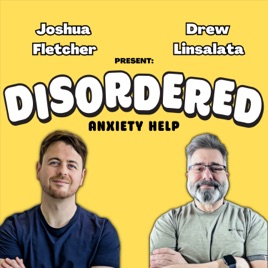
Advertise on podcast: Disordered: Anxiety Help
Rating
4.9from
This podcast has
145 episodes
Language
EnglishPublisher
Josh Fletcher and Drew LinsalataExplicit
No
Date created
2023/03/27
Latest episode
2026/02/06
Average duration
41 min.
Release period
9 days
Description
Disordered is the podcast that delivers real, evidence-based, actionable talk about anxiety disorders and anxiety recovery in a kind, compassionate, community-oriented environment. Josh Fletcher is a qualified psychotherapist in the UK. Drew Linsalata is a therapist practicing under supervision in the US. They're both bestselling authors in the anxiety and mental health space. Josh and Drew are funny, friendly, and they have a knack for combining lived experience, formal training, and professional experience in an encouraging, inspiring, and compassionate mental health message.
Unlock Disordered: Anxiety Help podcast Email contact info,
Listeners & Audience details
Email contact information
Direct podcast contact details

Listeners
Audience numbers & engagement insights

Audience details
Podcast Insights

Podcast episodes
Check latest episodes from Disordered: Anxiety Help podcast
The Golden Rules of Anxiety Recovery and Desensitization (Episode 143)
2026/02/06
This episode of Disordered examines the fundamental "Golden Rules" of anxiety desensitization. Josh and Drew break down two core principles designed to guide long term desensitization for those struggling with panic disorder, agoraphobia, OCD, and health anxiety. They move away from promising cures or quick fixes, focusing instead on changing the listener's relationship with discomfort.
Rule One: Do what non-anxious you would do while anxious. The guys explain that this involves engaging in life tasks regardless of the presence of fear.
Rule Two: Don’t make anxiety the most important thing in the room. While anxiety is allowed to be present, it should not sit at the top of the decision making tree. Desensitization happens when values and intentions are prioritized over the urge to monitor internal feelings.
Acceptance vs. Control: Josh and Drew discuss the necessity of recognizing that attempts to control or escape anxiety are often ineffective. They advocate for psychological flexibility, where a person learns to be with difficult internal experiences rather than fighting them.
The Power of Agency: The guys emphasize that even in highly sensitized states, individuals retain agency over their attention. They describe how to tolerate physical symptoms without letting those sensations govern behavior.
"Did It Anyway" Stories: The episode features community members who applied these rules during high stakes moments like public speaking or travel. These stories serve to encourage others to face fears that are uncomfortable but not dangerous.
Josh and Drew frame desensitization as a journey requiring patience and persistence rather than a destination reached through "hacks" or secret solutions. This episode provides a practical framework for listeners ready to stop avoiding their feelings and start moving forward.
---
The Disordered Guide to Health Anxiety is now available. If you're struggling with health anxiety, this book is for you.
---
Want a way to ask questions about this episode or interact with other Disordered listeners? The Disordered community space is nearing release! Visit our home page and get on our mailing list for more information..
---
Struggling with worry and rumination that you feel you can't stop or control? Check out Worry and Rumination Explained, a two hour pre-recorded workshop produced by Josh and Drew. The workshop takes a deep dive into the mechanics of worrying and ruminating, offering some helpful ways to approach the seemingly unsolvable problem of trying to solve seemingly unsolvable problems.
How Do We Overcome Worry and Rumination? (Episode 142)
2026/01/30
In this episode of Disordered, guest co-host Kimberley Quinlan joins Drew to pull back the curtain on one of the most persistent hurdles in anxiety recovery: rumination. Whether you call it overthinking, worry, or mental "problem solving," the process is a universal constant across panic disorder, OCD, health anxiety, depression, and other related issues.
We examine why rumination feels like a productive tool when it is actually a mental compulsion designed to avoid the discomfort of uncertainty. Kim and Drew break down the "tax" that rumination imposes on your life, specifically the deep physiological and emotional exhaustion that leaves you without the energy to make the actual changes you want.
What You’ll Learn This Week:
The Process vs. The Content: Why the specific thing you are worried about matters less than the fact that you are stuck in a circular thinking process.
The "What If" Statement: How to recognize that "what if" is a statement of fear, not a question that requires an answer.
Problem Solving vs. Rumination: Identifying the moment thinking stops being an investment and starts becoming a drain.
Beliefs About Worry: Challenging the "positive" beliefs we hold, such as the idea that worrying makes us a better parent or more prepared for disaster.
Attention Control Training: Practical ways to re-engage with the present moment, even when your brain is screaming for certainty.
Recovery is about learning to put the thoughts down and returning to whatever is next in your day. It is hard work, and you might "suck at it" initially, but managing rumination is a skill for life that reduces suffering and brings you back to your own experiences.
Find Kim's podcast here:
https://www.youtube.com/@youranxietytoolkit
Kim's courses and workshops:
https://cbtschool.com
Kim's Instagram
https://instagram.com/YourAnxietyToolkit
---
The Disordered Guide to Health Anxiety is now available. If you're struggling with health anxiety, this book is for you.
---
Want a way to ask questions about this episode or interact with other Disordered listeners? The Disordered app is nearing release! Visit our home page and get on our mailing list for more information..
---
Struggling with worry and rumination that you feel you can't stop or control? Check out Worry and Rumination Explained, a two hour pre-recorded workshop produced by Josh and Drew. The workshop takes a deep dive into the mechanics of worrying and ruminating, offering some helpful ways to approach the seemingly unsolvable problem of trying to solve seemingly unsolvable problems.
The Truth About Crazy Anxiety Cures (Episode 141)
2026/01/23
In this episode, Drew and Josh discuss the world of anxiety cures and the "miracle" solutions often marketed to those struggling with panic, OCD, and health anxiety. They share personal stories of the various methods they tried during their own recoveries and explain why many popular trends fail to provide long-term relief.
The Magnetism of the Miracle Cure: Why we are drawn to supplements like magnesium or specialized "breathing devices" when we are desperate to feel better.
Control vs. Acceptance: How many anxiety cures are actually just hidden control strategies that prevent true psychological flexibility.
The Reality of "Natural" Supplements: A look at the laxative effects of magnesium and the empty promises of "science-based" miracle powders.
The "Secret" Rituals: Why techniques like EFT tapping or specialized humming might feel helpful in the moment but often reinforce the idea that anxiety is a danger to be managed.
The Risks of "Gurus" and Online Cults: How to identify predatory marketing and why a "lived experience" qualification does not replace professional, evidence-based training.
The guys break down why the search for an external fix often leads to more discouragement. They discuss how true recovery is found in learning to tolerate and be with difficult internal experiences rather than trying to engineer them away with bracelets, essential oils, or "secret" techniques.
If a solution is marketed as a "miracle" or "what nobody tells you," be cautious.
Recovery is an internal process of building distress tolerance, not an external process of finding the right product.
Support people are there to cheer you on through the fear, not to keep you "safe" from a feeling.
About Disordered: Drew Linsalata and Joshua Fletcher are therapists and authors who have both recovered from severe anxiety disorders. They use evidence-based principles from ACT, CBT, and mindfulness to help you navigate your recovery journey without the empty promises of "magic" cures.
---
The Disordered Guide to Health Anxiety is now available. If you're struggling with health anxiety, this book is for you.
---
Want a way to ask questions about this episode or interact with other Disordered listeners? The Disordered app is nearing release! Visit our home page and get on our mailing list for more information..
---
Struggling with worry and rumination that you feel you can't stop or control? Check out Worry and Rumination Explained, a two hour pre-recorded workshop produced by Josh and Drew. The workshop takes a deep dive into the mechanics of worrying and ruminating, offering some helpful ways to approach the seemingly unsolvable problem of trying to solve seemingly unsolvable problems.
"Temping Fate" In Anxiety Recovery? (Episode 140)
2026/01/16
Have you ever felt anxious about admitting you're doing better? Like saying "I'm okay" out loud might somehow jinx your progress or tempt fate?
In this episode, Drew and Josh explore that uncomfortable feeling when someone asks "How are you doing?" and you're caught between wanting to acknowledge improvement and being afraid that talking about it will make everything fall apart again.
What we discuss:
Why the question "How are you?" can feel triggering when you're recovering from an anxiety disorderThe superstition around "tempting fate" and what's really happening beneath itHow different contexts change what we mean by "doing okay" (spoiler: anxiety can be present while you're still doing okay)The authenticity trap - feeling like you're lying either wayWhy "I'm doing okay at the moment" might be the most honest answer you can giveHow this fear shows up in OCD, health anxiety, panic disorder, and agoraphobiaThe difference between attention-driven fear and superstitious fearWhy letting go of control can feel like tempting fate (and why that's exactly the practice)Featured segments:
Community "Did It Anyway" stories highlighting real progress without promising outcomesDiscussion of how exposures work when they feel risky or recklessPractical suggestions for navigating social questions about your wellbeingThis episode may be helpful for anyone struggling with the fear of acknowledging improvement, or who finds themselves avoiding conversations about their anxiety recovery.
---
The Disordered Guide to Health Anxiety is now available. If you're struggling with health anxiety, this book is for you.
---
Want a way to ask questions about this episode or interact with other Disordered listeners? The Disordered app is nearing release! Visit our home page and get on our mailing list for more information..
---
Struggling with worry and rumination that you feel you can't stop or control? Check out Worry and Rumination Explained, a two hour pre-recorded workshop produced by Josh and Drew. The workshop takes a deep dive into the mechanics of worrying and ruminating, offering some helpful ways to approach the seemingly unsolvable problem of trying to solve seemingly unsolvable problems.
Anxiety Questions From The Audience (Episode 139)
2026/01/09
In this listener participation episode, Drew and Josh tackle your questions about recovery while celebrating inspiring stories from the community.
Questions explored in this episode:
Why does my anxiety disorder feel like it's protecting me? When you're struggling with OCD, panic disorder, or health anxiety, your threat response can feel like a cult leader in your head—insisting it has your back, showing you "the truth," and making it incredibly risky to walk away. We break down why this happens and what you can do about it.
What about rolling panic attacks? One listener shares their experience of a vacation derailed by cascading panic attacks that wouldn't stop. We explain why panic attacks can roll from one into the next, what fuels this cycle, and how following anxiety's instructions in the moment keeps the wheel turning.
How do I handle competing voices in my head? As you progress in recovery, you may notice different voices—one saying "freak out now" and another saying "wait, let's see what's happening here." We discuss what these voices represent and how to work with them.
Other topics: Managing health anxiety when you're actually sick, dealing with rejection without letting it fuel future anxiety, and why thinking about "what could have been" isn't grief—it's just overthinking.
Did It Anyways from listeners include:
Changing medication brands without obsessing over side effectsDriving four hours alone to a camping trip despite agoraphobiaSitting through a three-hour movie after a year of avoidanceGrocery shopping while anxiousSharing romantic feelings despite fear of rejection
Key takeaway: The simplest description of anxiety disorder recovery? Getting really good at leaving it the hell alone. That means resisting the urge to fix, control, or prevent uncomfortable feelings, and instead doing what non-anxious you would do—even while you're feeling scared.
---
The Disordered Guide to Health Anxiety is now available. If you're struggling with health anxiety, this book is for you.
---
Want a way to ask questions about this episode or interact with other Disordered listeners? The Disordered community is nearing is opening day! Visit our home page and get on our mailing list for more information..
---
Struggling with worry and rumination that you feel you can't stop or control? Check out Worry and Rumination Explained, a two hour pre-recorded workshop produced by Josh and Drew. The workshop takes a deep dive into the mechanics of worrying and ruminating, offering some helpful ways to approach the seemingly unsolvable problem of trying to solve seemingly unsolvable problems.
Anxiety and Not Feeling The "Right" Emotions (Episode 138)
2025/12/26
When you're at your child's birthday party, your wedding day, or on a much-anticipated vacation, do you find yourself feeling anxious instead of joyful—and then getting frustrated with yourself for "not feeling the right way"? In this episode, Drew and Josh explore one of the most common traps in anxiety recovery: judging yourself for having the "wrong" emotions.
You'll hear about how people struggling with panic disorder, agoraphobia, OCD, and other anxiety challenges often add a second layer of suffering by criticizing themselves for not feeling grateful, happy, or calm in moments when they think they "should" be. Josh and Drew discuss how this pattern shows up during holidays, special events, and everyday situations, and why trying to control or optimize your emotions typically backfires.
The conversation covers:
Why "all feelings are welcome" is more than just a nice phrase—it's a practical recovery principleHow fighting against the emotions you're experiencing makes it less likely you'll move through them naturallyThe difference between desensitized and sensitized responses to anxietyWhy your brain is a prediction engine, not a reaction machine, and what that says about emotionsHow willful tolerance applies even before anxiety shows upWhy comparing yourself to others around you ("they're all relaxed and I'm not") keeps you stuck
You'll also hear inspiring "Did It Anyway" stories from listeners who pushed forward despite uncomfortable feelings, including someone who hadn't left their house in days but went to a holiday event anyway, and a new mother who faced her lifelong fear during an emergency C-section.
This episode may be particularly helpful if you're heading into holiday gatherings, family events, or any situation where you're putting pressure on yourself to feel a certain way. The guys remind us that recovery isn't measured by the absence of symptoms—it's measured by your willingness to be with them.
---
The Disordered Guide to Health Anxiety is now available. If you're struggling with health anxiety, this book is for you.
---
Want a way to ask questions about this episode or interact with other Disordered listeners? The Disordered app is nearing release! Visit our home page and get on our mailing list for more information..
---
Struggling with worry and rumination that you feel you can't stop or control? Check out Worry and Rumination Explained, a two hour pre-recorded workshop produced by Josh and Drew. The workshop takes a deep dive into the mechanics of worrying and ruminating, offering some helpful ways to approach the seemingly unsolvable problem of trying to solve seemingly unsolvable problems.
-----
Want to ask us questions, share your wins, or get more information about Josh, Drew, and the Disordered podcast? Send us an email or leave a voicemail on our website.
Anxiety Disorders and the Fear of Insanity (Episode 137)
2025/12/19
One of the most terrifying fears in anxiety disorders is the fear of losing your mind. In this episode, Drew and Josh explore dementophobia - the fear of insanity - and why it's so common among people experiencing panic disorder, OCD, agoraphobia, and health anxiety.
The guys discuss how the brain's threat response can turn inward when it can't find an external danger, creating the believable (but inaccurate) story that you must be going crazy. They explore why symptoms like depersonalization and derealization can fuel this fear, and how the disorder creates a "checking state" where you're constantly scanning for signs of mental deterioration.
In this episode:
Why feeling like you're losing your sanity is such a common fearHow panic and anxiety symptoms can feel like evidence of insanityThe difference between being afraid and being in actual dangerCommon compulsions that keep the fear alive (checking, avoiding, reassurance seeking)Why combat veteran comparisons miss the markHow experience, not reassurance, changes the brain's predictions"Did It Anyway" stories of facing fearsKey principle: Your brain only needs to find a believable story - it doesn't have to be accurate. The intensity of your fear only confirms that you're afraid, not that the danger is real.
Remember that while this fear is genuinely terrifying, there is no path from anxious to insane. Recovery involves learning to move through these frightening moments rather than compulsing against them.
---
The Disordered Guide to Health Anxiety is now available. If you're struggling with health anxiety, this book is for you.
---
Want a way to ask questions about this episode or interact with other Disordered listeners? The Disordered app is nearing release! Visit our home page and get on our mailing list for more information..
---
Struggling with worry and rumination that you feel you can't stop or control? Check out Worry and Rumination Explained, a two hour pre-recorded workshop produced by Josh and Drew. The workshop takes a deep dive into the mechanics of worrying and ruminating, offering some helpful ways to approach the seemingly unsolvable problem of trying to solve seemingly unsolvable problems.
-----
Want to ask us questions, share your wins, or get more information about Josh, Drew, and the Disordered podcast? Send us an email or leave a voicemail on our website.
Health Anxiety: The Disordered Guide to Health Anxiety (Episode 136)
2025/12/12
Drew and Josh announce the release of their first co-written book, The Disordered Guide to Health Anxiety, and dive deep into the many faces of health anxiety. From the resource gatherer constantly Googling symptoms to the optimizer obsessing over perfect health metrics, they explore how health anxiety shows up differently for different people - and why it's fundamentally about the anxiety, not the health itself.
You'll hear real stories from listeners navigating health anxiety, including someone who faced their driving fears while expecting a second child, and discussions about the difference between panic disorder's health fixation and health anxiety disorder. Drew and Josh tackle tough questions about managing anxiety while waiting for actual medical test results, explaining why the emotions are justified but the compulsions aren't helpful.
The episode covers the compulsive behaviors that keep health anxiety alive - from fitness watch monitoring to constant symptom checking - and why overcoming health anxiety doesn't mean achieving certainty about your health. It means learning to respond differently when those fears arise. The guys also discuss the role of courage in recovery and why turning your back on health-based compulsions can feel reckless and irresponsible, even when it's the right move.
Whether you're the person who can't stop researching symptoms or the one too terrified to see a doctor, this episode offers a realistic look at what health anxiety actually is and how people move forward with it.
Get The Disordered Guide To Health Anxiety:
https://disordered.fm/bluebook
---
The Disordered Guide to Health Anxiety is now available. If you're struggling with health anxiety, this book is for you.
---
Want a way to ask questions about this episode or interact with other Disordered listeners? The Disordered app is nearing release! Visit our home page and get on our mailing list for more information..
---
Struggling with worry and rumination that you feel you can't stop or control? Check out Worry and Rumination Explained, a two hour pre-recorded workshop produced by Josh and Drew. The workshop takes a deep dive into the mechanics of worrying and ruminating, offering some helpful ways to approach the seemingly unsolvable problem of trying to solve seemingly unsolvable problems.
Anxiety Symptoms: Dizziness & Lightheadedness (Episode 135)
2025/12/05
In this episode of Disordered, the guys delve into the common anxiety symptoms of dizziness and lightheadedness. They share personal experiences, discuss the impact of these symptoms on daily life, and explore coping mechanisms such as interoceptive exposure and mindfulness.
The conversation also highlights community wins, listener questions, and the importance of awareness in managing anxiety. The hosts encourage listeners to challenge their fears and practice being present in their experiences.
Takeaways
Dizziness and lightheadedness are common anxiety symptoms.The threat response often amplifies feelings of dizziness.Changing behaviors due to dizziness can reinforce anxiety.Mindfulness practices can help in recognizing anxiety triggers.Interoceptive exposure can desensitize the fear of dizziness.Community support plays a vital role in recovery.Challenging the narrative of anxiety is crucial for progress.Practicing being dizzy can reduce fear over time.Awareness of thoughts and feelings is key to managing anxiety.It's important to focus on what matters most in life.
---
Want a way to ask questions about this episode or interact with other Disordered listeners? The Disordered app is nearing release! Visit our home page and get on our mailing list for more information..
---
Struggling with worry and rumination that you feel you can't stop or control? Check out Worry and Rumination Explained, a two hour pre-recorded workshop produced by Josh and Drew. The workshop takes a deep dive into the mechanics of worrying and ruminating, offering some helpful ways to approach the seemingly unsolvable problem of trying to solve seemingly unsolvable problems.
-----
Want to ask us questions, share your wins, or get more information about Josh, Drew, and the Disordered podcast? Send us an email or leave a voicemail on our website.
Agoraphobia & Fear of Open Spaces (Episode 134)
2025/11/28
Agoraphobia. Is it fear of open spaces? Do people with agoraphobia always fear open spaces? What even is agoraphobia and how to I overcome it?
This week we're looking at the complexities of agoraphobia, exploring its definitions, connections to panic disorder, and the fear of open spaces. We're sharing some personal experiences and insights on how navigate through these challenges, emphasizing the importance of exposure therapy (what a surprise) and understanding that specific triggers mostly don't matter.
We also include a few great did-it-anyways, including flying with an anxiety disorder, a primary fear for many struggling with agoraphobia.
Takeaways
Agoraphobia is the fear of losing control outside of a safe zone.Many agoraphobics plan their lives around safe zones.Distance does not equate to increased anxiety; it's about perception.For some, wide open spaces can trigger feelings of anxiety and fearHypervigilance makes it difficult to cope in unfamiliar environments.Exposure therapy is essential for overcoming agoraphobia.Specific triggers (like open spaces) are largely irrelevant in the recovery equation.Anxiety can distort perceptions of safety and control.
---
Want a way to ask questions about this episode or interact with Josh, Drew, and other Disordered listeners? The Disordered app is nearing release! Visit our home page and get on our mailing list for more information..
---
Struggling with worry and rumination that you feel you can't stop or control? Check out Worry and Rumination Explained, a two hour pre-recorded workshop produced by Josh and Drew. The workshop takes a deep dive into the mechanics of worrying and ruminating, offering some helpful ways to approach the seemingly unsolvable problem of trying to solve seemingly unsolvable problems.
-----
Send in a question, comment or Did-It-Anyway that we might use on Disordered.
Doing It Anyway - While Hurting And Challenged (Episode 133)
2025/11/14
Sometimes life throws real challenges at you. Medical issues. Loss. Uncertainty. The kind of stuff that makes anxiety feel completely justified. So how do you move forward when you're genuinely scared AND dealing with actual difficult circumstances?
In this episode, we share some of the most powerful "did it anyway" stories we've ever received. From someone facing serious health challenges to a marathon runner dealing with panic attacks, these listeners show us what it really means to engage with life even when things are legitimately hard.
We talk about why waiting to "fix yourself" before living your life doesn't work, how to handle the reality that feelings don't always indicate actual danger, and what it means to let both the good and difficult parts of life exist at the same time. You don’t have to be fearless. But you can do what matters even while you're afraid.
If you're struggling with the gap between how you feel and what you want to do with your life, this episode might help you see that moving forward is possible, even when it feels impossible.
---
Want to interact with Josh, Drew, and other Disordered listeners? The Disordered app is nearing release! Visit our home page and get on our mailing list for more information..
---
Struggling with worry and rumination that you feel you can't stop or control? Check out Worry and Rumination Explained, a two hour pre-recorded workshop produced by Josh and Drew. The workshop takes a deep dive into the mechanics of worrying and ruminating, offering some helpful ways to approach the seemingly unsolvable problem of trying to solve seemingly unsolvable problems.
-----
Want to ask us questions, share your wins, or get more information about Josh, Drew, and the Disordered podcast? Send us an email or leave a voicemail on our website.
Anxious About Feeling ... Calm? (Episode 132)
2025/11/07
Panicogenic Relaxation: Why You Feel Anxious When Feeling Calm
You're finally feeling better. The anxiety has lifted. You're relaxed and calm for the first time in months or even years. So why does that feel so weird? And why are you suddenly anxious about feeling calm?
In this episode, Drew and Josh explore "panicogenic relaxation". This is a common experience in anxiety disorder recovery where feeling normal, neutral, or relaxed can trigger concern or even high anxiety and panic. When you've been anxious for so long, that heightened state becomes your predictable default. The absence of anxiety can feel unfamiliar, strange, or even threatening.
In this episode, we discuss:
Why feeling calm or relaxed can feel uncomfortable or even scary during recoveryHow your brain's scanning mechanisms continue even when you're no longer anxiousWhy anxiety becomes a "predictable pillar" after long periods of struggleThe importance of practicing being relaxed, not just practicing being anxiousHow the shock-attention-resistance cycle continues even when you're feeling betterWhy all emotional states - including calm - need to be permissibleHow to recognize when you're still checking and monitoring even during neutral states
We also share inspiring "Did It Anyway" stories from the community, including someone who kept pushing through fatigue to go to new places, and another who took their first step away from 13 years of self-medication.
---
Want a way to ask questions about this episode or interact with other Disordered listeners? The Disordered app is nearing release! Visit our home page and get on our mailing list for more information..
---
Struggling with worry and rumination that you feel you can't stop or control? Check out Worry and Rumination Explained, a two hour pre-recorded workshop produced by Josh and Drew. The workshop takes a deep dive into the mechanics of worrying and ruminating, offering some helpful ways to approach the seemingly unsolvable problem of trying to solve seemingly unsolvable problems.
Anxiety Recovery - Learning To Believe In Yourself Again (Episode 131)
2025/10/31
When anxiety and its relentless inner critic take hold, one of the most profound losses is the belief and trust in your own capability. In this episode, Drew and Josh explore how to rebuild self-trust after anxiety disorders erode your confidence in handling life's challenges.
The conversation centers on stories from listeners who confronted their worst-case scenarios—from emergency medical situations while struggling with agoraphobia and panic disorder, to managing health anxiety during actual illness, to facing feared social situations despite OCD. Each story illustrates a crucial truth: the anticipation is almost always worse than the actual experience, and we're far more capable than anxiety tells us we are.
The guys discuss why simply deciding to believe in yourself doesn't work, and what actually does: the unglamorous, minute-by-minute work of doing the scary things anyway. They examine how anxiety functions like a conspiracy theory about yourself, predicting catastrophic outcomes that rarely materialize. The hosts also explore how well-meaning but misguided advice to avoid difficult situations or regulate away uncomfortable feelings can actually undermine self-belief rather than restore it.
This episode emphasizes that rebuilding confidence isn't about making anxiety disappear—it's about discovering through lived experience that you can handle difficult emotions, uncomfortable sensations, and challenging situations. The path back to self-belief requires compassion, patience, and a willingness to challenge the loud but ultimately unreliable predictions of fear and doubt.
Grounded in acceptance and commitment therapy (ACT) and mindfulness-based approaches, this conversation offers a realistic, evidence-based perspective on recovery that honors both the difficulty of the journey and the resilience we all possess.
---
Want a way to ask questions about this episode or interact with other Disordered listeners? The Disordered app is nearing release! Visit our home page and get on our mailing list for more information..
---
Struggling with worry and rumination that you feel you can't stop or control? Check out Worry and Rumination Explained, a two hour pre-recorded workshop produced by Josh and Drew. The workshop takes a deep dive into the mechanics of worrying and ruminating, offering some helpful ways to approach the seemingly unsolvable problem of trying to solve seemingly unsolvable problems.
-----
Want to ask us questions, share your wins, or get more information about Josh, Drew, and the Disordered podcast? Send us an email or leave a voicemail on our website.
Craig The Critic (Episode 130)
2025/10/17
In this episode, Drew and Josh explore the powerful role of the internal critic—affectionately named "Craig"—in maintaining anxiety disorders and interfering with recovery. They discuss how this nagging inner voice criticizes, questions, and doubts us, often telling us we're doing things wrong or that we'll never be who we hope to be.
Let's examine where Craig the Critic comes from, including family dynamics, conditional affection, societal pressures, and social media comparisons. The episode explains how this critical voice drives us toward impossible standards and fuels the "should" statements that keep us stuck: "You should be feeling this," "You should be better by now," or "You should be like everyone else."
The guys discuss how Craig the Critic shows up across different anxiety presentations—from OCD to agoraphobia to panic disorder—and how this voice can block the learning that happens during exposure work. They explore how the internal critic constantly demands we fix, control, and change our anxiety rather than learning to respond differently to it.
A key theme in this episode is compassion as the antidote to self-criticism, how moving toward what matters to us—guided by our values rather than Craig's demands—helps us break free from the cycle of criticism and avoidance. We're also tackling the common misconception that we need harsh self-criticism to keep us in check, when in reality, it often keeps us trapped in disordered patterns.
The episode features inspiring "Did It Anyway" stories from listeners who faced their fears despite Craig's objections, including someone starting a new job, another taking their children on challenging outings, and a future firefighter who completed a demanding physical fitness test while experiencing panic symptoms.
Topics Covered:
Understanding the internal critic and where it originatesHow self-criticism maintains anxiety disordersThe difference between helpful self-evaluation and destructive criticismWhy comparing yourself to your "pre-anxious" self backfiresThe role of compassion in anxiety recoveryHow Craig the Critic interferes with exposure work and learningPractical ways to recognize and respond differently to the critical voiceThis episode may be particularly helpful for those who struggle with perfectionism, harsh self-judgment, or feeling like they're failing at recovery.
---
Want a way to ask questions about this episode or interact with other Disordered listeners? The Disordered app is nearing release! Visit our home page and get on our mailing list for more information..
---
Struggling with worry and rumination that you feel you can't stop or control? Check out Worry and Rumination Explained, a two hour pre-recorded workshop produced by Josh and Drew. The workshop takes a deep dive into the mechanics of worrying and ruminating, offering some helpful ways to approach the seemingly unsolvable problem of trying to solve seemingly unsolvable problems.
-----
Want to participate in an episode of Disordered? Send us an email or leave a voicemail on our website.
Anxiety Symptoms - AIR HUNGER (Episode 129)
2025/10/10
In this episode of Disordered, Drew and Josh tackle one of the most frightening anxiety symptoms: air hunger - that terrifying feeling that you can't get a deep enough breath or fully fill your lungs.
Drew and Josh draw from both their clinical expertise and personal recovery experiences to explain why this sensation happens, why trying to "fix" your breathing often makes things worse, and how the compulsive need to control your breath can actually create the problem you're trying to solve.
They explore how air hunger connects to stress, anxiety disorders, and OCD, discussing why breathing techniques and breath work - while potentially helpful for general stress - can become problematic compulsions when you're dealing with disordered anxiety. The hosts emphasize a key principle: there's a critical difference between feeling like you can't breathe and actually not being able to breathe.
The episode includes inspiring "Did It Anyway" stories from listeners who faced their fears - from pushing through panic during a music gig, to driving 40 minutes despite intense anxiety, to confronting her OCD fears, and a transformation from being unable to stay in a room alone to enjoying solo time at home.
Drew and Josh offer practical guidance rooted in acceptance-based approaches: get out of your own way, let your body regulate itself naturally, and resist the urge to constantly check, control, or perfect your breathing. As they remind listeners, your body has successfully kept you breathing your entire life - it doesn't need micromanagement now.
Topics covered:
What air hunger is and why it happensThe connection between stress, anxiety, and breathing sensationsWhy breathing techniques can become compulsionsThe role of interoceptive exposure in treatmentHow to respond when you notice air hunger (hint: not by trying to control it)Why sleep proves your body knows how to breathe on its ownWhether you're experiencing air hunger yourself or supporting someone who is, this episode offers a compassionate, reality-based approach to one of anxiety's most unsettling symptoms.
Podcast reviews
Read Disordered: Anxiety Help podcast reviews
Susan A Bowman 2026/01/23
Episode 141
You guys are an absolute God send!
I prefer doing the uncomfortable and yes terrifying work that is absolutely necessary to knock this monkey off my ...
phyliciahannah 2026/01/02
The best anxiety help
I’ve been in counseling for years and have gained more from this podcast in the last 5 months then I have in counseling. Embarrassing but true. I REAL...
Sanfransarah 2026/01/19
My anxiety no longer rides shotgun
I have dealt with health anxiety and OCD for most of my life. Perimenopause has amplified my fears and compulsions. After finding your podcast and lis...
Mhsavoy 2025/12/05
The best!
The best podcast for anxiety and OCD! Absolutely love the way they talk through anxiety and the symptoms that come with it. Super helpful!
sally1 1 2025/12/05
Life changing
Your podcast has truly changed my life and given me my strength back. Thank you guys 🙏🙏
Redgohst4682 2025/11/19
The Best
The best podcast for anxiety and OCD. Josh and Drew, thank you so much for sharing your time, experiences, and expertise! You’re giving people their l...
Tashatank 2025/10/28
The best anxiety podcast
This show is so helpful. It does not offer you a magical switch to turn on or off, it offers you a realistic true approach to anxiety. I am grateful I...
YesJulz 2025/09/04
Genuinely Helpful
I’ve had panic attacks for almost 20 years now and pretty much resigned myself to being “broken”. Stumbled upon this podcast and within months it has ...
RubyKait 2025/07/19
Thank you!
I am so grateful for this podcast. I have struggled with anxiety for as long as I can remember. I found this podcast after 10 years of therapy and a l...
Deckert1 2025/06/22
10/10
So happy I found this show on my journey. Very helpful with great actionable, effective strategies/ ideas!
Podcast sponsorship advertising
Start advertising on Disordered: Anxiety Help relevant audience podcasts
You may also like to advertise on these Podcasts

4.4371061566
The Megyn Kelly Show
SiriusXM

4.888901269
Fearless with Jason Whitlock
Blaze Podcast Network

4.8118931000
Mind Pump: Raw Fitness Truth
Sal Di Stefano, Adam Schafer, Justin Andrews, Doug Egge
4.8102131585
Tara Brach
Tara Brach

4.541561215
Something You Should Know
Mike Carruthers | OmniCast Media

4.513841343
Strictly Anonymous Confessions
Kathy Kay

4.8292781897
Fantasy Footballers - Fantasy Football Podcast
Fantasy Football

4.62382612
Football Weekly
The Guardian

4.45387666
Two Judgey Girls
Two Judgey Girls

3.8258501152
The Viall Files
Nick Viall