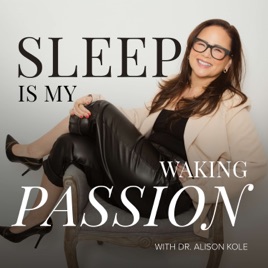
Advertise on podcast: Sleep is My Waking Passion
Rating
4.8from
This podcast has
127 episodes
Language
EnglishPublisher
Alison KoleExplicit
No
Date created
2023/04/27
Latest episode
2026/10/14
Average duration
36 min.
Release period
9 days
Description
Hosted by Dr. Alison Kole—a triple-boarded pulmonary critical care and sleep medicine physician, reformed chronic insomniac, devoted mom, and unapologetic sleep health creator—this hit podcast takes you on the real, unfiltered journey inside the science and soul of sleep. Each week, with wisdom forged from the trenches of night shifts and the chaos of motherhood, Alison sits down with top-tier experts and ordinary people with extraordinary sleep stories, unraveling how sleep shapes happiness, health, and destiny. If you want the 360° truth—the wins, the setbacks, the breakthroughs—about why every hour of sleep could be the most important hour of your life, this is the show that will change how you see your pillow forever. Sleep isn’t just her passion—it’s the key to waking up to your potential. Hit subscribe and transform your nights, days, and dreams.
Unlock Sleep is My Waking Passion podcast Email contact info,
Listeners & Audience details
Email contact information
Direct podcast contact details

Listeners
Audience numbers & engagement insights

Audience details
Podcast Insights

Podcast episodes
Check latest episodes from Sleep is My Waking Passion podcast
Will Sleep Apnea End My Military Career? CPAP, Deployment & the Truth About Getting Tested
2026/10/14
Afraid that a sleep apnea diagnosis will cost you a promotion, a deployment, or your career? You’re not alone. That fear keeps many service members quiet, tired, and untreated for years.
In this episode of Sleep Is My Waking Passion™, I sit down with Jesse J. James, a retired U.S. Army Chief Warrant Officer with 20 years of service, a respiratory therapist, and Director of Military Healthcare Initiatives at Quality DME. Jesse has seen the system from the inside, both operationally and clinically. His message is clear: the old career-ending rumors about sleep apnea are outdated, and leaving it untreated is the bigger risk.
In this episode:
Why sleep is the first thing sacrificed in high-tempo military life, and what that does to judgment, mood, and safety
What “readiness” actually means, and why chronic fatigue erodes it even when you can still perform
The “barracks lawyer” myths that keep soldiers from getting a sleep study
How referrals, TRICARE handoffs, and PCS moves break the path to diagnosis and treatment
Why “no” from one referral desk often gets repeated as official policy
A better model: home sleep testing at the primary care level, with complex cases sent to sleep clinics
Why getting treated now, not right before you retire, protects your health and your career
Who this is for: active-duty service members, veterans, military families, and clinicians who treat them.
Sleep is not a luxury. For those who serve, it’s infrastructure.
Connect with Jesse J. James: [email protected]
Ask The Sleep MD: askthesleepmd.com/workwithme
This episode is for educational purposes and is not individual medical, legal, or VA benefits advice. Send your questions my way! Leave a comment or send me a DM and I will answer them in socials or a new episode!
Sleep Like an Astronaut: NASA's Sleep Scientist on Body Clocks, Shift Work & Sleep Apnea in Space
2026/10/07
Ever feel jet-lagged on a Monday without leaving your house? Or notice that a few night shifts can scramble your sleep for a week?
Now imagine a sunrise every 90 minutes.
That's life on the International Space Station, where astronauts circle the Earth on a loop of 45 minutes of light and 45 minutes of dark. So how does NASA get them to sleep? Not with a gadget. With a bedtime.
On my birthday (yes, really), I sat down with Dr. Erin Flynn-Evans, director of the Fatigue Countermeasures Laboratory at NASA Ames Research Center, who helps keep astronauts rested on everything from the space station to the Artemis missions. Her work reaches far beyond orbit, to pilots, physicians, and every shift worker trying to sleep while the world is awake.
Ever feel jet-lagged on a Monday without leaving your house? Or notice that a few night shifts can scramble your sleep for a week?
Now imagine a sunrise every 90 minutes.
That's life on the International Space Station, where astronauts circle the Earth on a loop of 45 minutes of light and 45 minutes of dark. So how does NASA get them to sleep? Not with a gadget. With a bedtime.
On my birthday (yes, really), I sat down with Dr. Erin Flynn-Evans, director of the Fatigue Countermeasures Laboratory at NASA Ames Research Center, who helps keep astronauts rested on everything from the space station to the Artemis missions. Her work reaches far beyond orbit, to pilots, physicians, and every shift worker trying to sleep while the world is awake.
The takeaway for those of us on Earth: you don't need a supplement or the newest tracker. Keep a regular bedtime and wake time, give yourself a real wind-down routine, and stop treating exhaustion as normal. Sleep is not a luxury. Even NASA builds the mission around it.
Learn more about Dr. Flynn-Evans's lab: https://www.nasa.gov/human-systems-integration-division/human-performance/fatigue-countermeasures-laboratory
Connect with Ask The Sleep MD: [add website + socials]
This episode is for educational purposes and isn't medical advice. If you're struggling with sleep, talk to a board-certified sleep physician.
Always Tired With COPD? It Might Not Be Your Lungs
2026/09/30
Doing everything right for your COPD and still exhausted, foggy and short of breath? It might not be your lungs.
In honor of World Oxygen Day (October 2, also my birthday!), I'm joined by fellow pulmonary, critical care and sleep medicine physician Dr. Saema Tahir, the NYC Sleep Doctor. We talk about what happens when COPD and obstructive sleep apnea overlap, why it's so often missed, and what you can do about it.
Oxygen therapy is life-changing when you need it. But if sleep apnea is part of the picture, oxygen alone won't fix it.
🔗 Connect with Dr. Saema Tahir
Instagram: @thenycsleepdoctor
Website: drsaematahirmd.com
🔗 Connect with me
Ask The Sleep MD | Sleep Is My Waking Passion™
This episode is for educational purposes only and is not medical advice. Please talk with your own doctor about your care.
19 Years Tired. It Was Narcolepsy. | Lindsay Scola
2026/09/24
Ever been told your exhaustion is "just stress"?
Lindsay Scola spent 20 years at the center of politics and entertainment, advancing events for President Obama and working the Emmys, while secretly fighting to stay awake. It took 19 years, two "normal" sleep studies, and a meltdown in her doctor's office to finally hear the words: narcolepsy type 1.
Dr. Alison Kole and Lindsay talk about the narcolepsy symptoms that hide in plain sight, why home sleep tests can miss what's really going on, how to push for a referral to a sleep specialist, and the everyday strategies that keep Lindsay thriving today.
If you're tired of being tired, this one's for you. You are allowed to ask.
Find Lindsay at lindsayscola.com and watch her TEDx talk on YouTube.
More from Dr. Kole: askthesleepmd.com
Your Skin Knows You Didn't Sleep: Sleep, Skin Aging & the Truth About Korean Skincare with Dr. HeeJin Kim
2026/09/16
Have you ever looked in the mirror after a bad night and thought, my face did not sign up for this?
You're not imagining it. That dullness, the sunken eyes, the fine lines that look a little deeper than they did yesterday — that's your skin talking. And when a few bad nights turn into a few bad months, it stops being about looking tired and starts being about accelerated aging.
In this episode, I'm joined by Dr. HeeJin Kim — a physician trained in Pulmonary, Critical Care, and Geriatric Medicine who has since become a skincare expert and beauty educator. She and her sister founded PureenMD, with locations in Fort Lee, New Jersey and Seoul, Korea. She blends dermatology-informed routines, evidence-based ingredients, and Korean skincare philosophy into strategies real people can actually follow.
We get into what's real and what's hype — including the part where she tells me, on the record, that half of what I've been buying doesn't do what I thought it did.
In this conversation:
Why HeeJin asks every patient how they sleep before she talks about products
What one bad night does to your skin — and what chronic poor sleep does that's structurally different
The cortisol–acne connection that doesn't stop when you leave your twenties
Collagen 101: why production peaks around age 28 and what actually slows the decline
Oral collagen — where the evidence is thin, where it isn't, and why she takes it anyway
Topical collagen: the honest answer (it's not what the label implies)
Korean vs. American sunscreen — the regulatory reason they feel different, and why "made in Korea" on Amazon may not mean what you think
Why anti-sunscreen content goes viral and why it's wrong
The short list: gentle low-pH cleanser, moisturizer, SPF — then vitamin C and retinol after 30
Retinol vs. retinal vs. tretinoin, and how to start without wrecking your barrier
PDRN, "salmon sperm," and which serums are worth it
Is eye cream a scam? (Her answer surprised me.)
Gwanri — the Korean philosophy of maintenance, and why barrier preservation beats aggressive lasers and peels
The one habit she'd change for every woman listening — and the overnight window most of us are scrolling straight through
And a bonus cameo from my daughter's drum practice, because this is real life. --> may need to get removed if not including.
If you take away one idea about how your nights are showing up on your face in the morning, do something kind for your future skin: protect your sleep tonight.
Sleep is not a luxury. It may also be the most underrated skincare product that exists — and it's free.
Fix Your Circadian Rhythm | Dr. Olivia Walch, PhD
2026/09/09
If you've ever typed "why can't I sleep" or "how do I fix my circadian rhythm" into a search bar at 2 a.m., this episode is for you.
Most of us have been taught to think about sleep in one dimension: how many hours did I get? But there's a second dimension almost nobody talks about — rhythm. And when your rhythm is off, more hours in bed won't save you.
This week I'm joined by Dr. Olivia Walch, PhD, a mathematician and sleep scientist, author of Sleep Groove, and CEO of Arcascope, the company behind the circadian health app Clairoe. Olivia studies the biology most of us are unknowingly fighting every single day — and she explains it in a way that finally makes it usable.
We get into what light actually does to your body at different times of day, why the outdoors can be 100 to 1,000 times brighter than your living room without you noticing, and whether blue-light-blocking glasses do anything at all. We talk about red light at night and the cells in your eye that talk directly to your circadian clock. We cover meal timing, the clock in your digestive system, and why eating on a schedule can quiet nighttime hunger without willpower. And we take on one of the most common things I hear in my office: "I've always been a short sleeper." The genetics say four in 100,000 people. The math says it's probably not you.
Olivia also shares the study that finally fixed her own sleep — and why the secret ingredient was accountability, not information.
In this episode:
Why sleep rhythmicity matters as much as sleep duration
What light does at morning, midday, night, and 3 a.m. — and why timing changes everything
The honest answer on blue blockers, brightness, and wavelength
Red light at night: real mechanism, realistic expectations
Meal timing, the digestive clock, and finding your "food groove"
The short sleeper myth and why tired brains can't grade their own performance
How the Clairoe app translates wearable data into personalized light timing for shift workers, travelers, and everyone in between
About the guest: Dr. Olivia Walch, PhD, is a mathematician and sleep scientist, the author of Sleep Groove, and the CEO of Arcascope. Her app, Clairoe (C-L-A-I-R-O-E), uses circadian science to predict your biological time and tell you when to seek and avoid light.
Connect with Olivia: clairoe.io · arcascope.com
Connect with Dr. Alison Kole: Website: askthesleepmd.com Podcast: askthesleepmd.com/simwp Newsletter — Diary of a Sleep Doctor: alisonkole.substack.com Instagram & YouTube: @askthesleepmd Work with me: askthesleepmd.com/workwithme
If this episode helped you better understand your sleep, please rate, review, and share it with someone who needs to hear it.
This podcast is for educational purposes and is not a substitute for individualized medical advice. If you are struggling with your sleep, please speak with a qualified sleep provider.
National Sleep Foundation Talks Kids Sleep
2026/09/02
Your kid is bouncing off the walls at 7 p.m., melting down over the wrong-colored cup, and you're standing there thinking: how are they not tired?
Here's what nobody tells you. When adults are sleep-deprived, we run out of battery — slow, foggy, flat. When kids are sleep-deprived, the system doesn't drain. It glitches. They speed up. Which means the child who looks least tired is often the one who needs sleep most.
New data says this is happening in almost half of American homes.
I'm joined by Dr. Joseph Dzierzewski, PhD, Senior Vice President of Research and Scientific Affairs at the National Sleep Foundation, to unpack the 2026 Sleep in America® Poll: 44% of U.S. children aren't consistently getting the sleep they need, and most parents underestimate how much their child needs by more than an hour a night.
We cover the updated NSF sleep duration guidelines hour by hour, why tired kids look hyperactive instead of sleepy, bed-sharing and the social side of sleep, and what you can change tonight.
Read the full poll at thensf.org.
Share this with one parent or pediatric provider you know. Until next time — sleep well.
Back To School Sleep Reset featuring Dr. Sujay Kansagra
2026/08/26
The Back-to-School Sleep Reset Every Family Needs Right Now
Summer let everyone drift. Later bedtimes, slower mornings, no alarms. Then the school calendar shows up and suddenly you're asking a kid whose body clock is set to midnight to be alert at 7 a.m.
You are not alone, and you are not a bad parent. This is biology.
This week Dr. Alison Kole sits down with Dr. Sujay Kansagra — pediatric neurologist and sleep medicine specialist at Duke, the voice behind @thatsleepdoc, and the inventor of Lullabee, a smart crib mattress built on actual infant sleep science. He is one of the clearest communicators in sleep medicine, and this conversation is packed with things you can start doing tonight.
In this episode:
How much sleep kids actually need at every age, so you can measure how far off you really are
Why summer drift isn't automatically harmful, and the two things that matter more than a perfect schedule
Toddlers are larks. Teenagers are owls. Why fighting either one is a losing strategy
The "robotic return to bed" technique for bedtime battles, and why Dr. Kansagra once used it 213 times in a single night
How to tell the difference between a child pushing limits and a child who is anxious, especially when they can't name the feeling themselves
The 10 to 15 minute rule for shifting a teenager's clock back before day one of school, plus the light, dim, and meal-timing levers that make it stick
Where melatonin actually has evidence behind it as a clock-shifting agent, why the dose is far smaller and the timing far earlier than most people assume, and why this is a conversation for your provider and not the gummy aisle
Why a consistent wake time matters more than a consistent bedtime
The counterintuitive weekend fix: don't sleep in, take a strategic midday nap instead. Twenty to thirty minutes or a full ninety, and why the middle is the worst place to land
Why this nap advice is not for chronic insomniacs
Permanent standard time vs. permanent daylight saving time: the morning-light argument, the school-bus safety argument, and what happened the last time this country tried it in the 1970s
How school start times and daylight saving stack the deck against developing teenage brains
The story behind Lullabee: how it soothes, how it weans itself as a baby's sleep matures, and why it re-engages during regressions
Sleep is not a luxury. It's a vital sign. And for your kids, it's the foundation the whole school year is built on.
About the guest Dr. Sujay Kansagra is a pediatric neurologist and sleep medicine specialist at Duke University Medical Center, the creator behind @thatsleepdoc, and the inventor of Lullabee.
Find him: @thatsleepdoc on Instagram, TikTok, Facebook, YouTube, and Threads Lullabee: lullabee.com
Connect with Dr. Alison Kole Website: askthesleepmd.com Instagram: @askthesleepmd
If this episode helped you build your back-to-school sleep plan, follow the show, share it with one parent who needs it, and leave a review so more families can find it.
Great days start the night before. Sleep well.
This podcast is for educational purposes and is not medical advice. Talk with your own clinician about your family's situation.
Sleep Like a Pro: Stealing the Elite Athlete Playbook with Dr. Abhinav Singh, "The Sleep Vigilante"
2026/07/29
What if waking up refreshed wasn't luck — but strategy?
Elite athletes don't leave sleep to chance. They treat it like training, nutrition, and recovery — because at the pro level, the margins are a game of inches. This week, Dr. Alison Kole is joined by Dr. Abhinav Singh — better known as "The Sleep Vigilante" — sleep physician for the Indiana Pacers and WNBA Indiana Fever, Medical Director of the Franciscan Sleep Disorders Program, Associate Clinical Professor at Marian University, and author of Sleep to Heal.
Together they translate elite-level sleep strategy into something you can use in real, everyday life — whether you're a road-warrior executive, a weekend athlete, or just tired of being tired.
In this episode:
The "Athlete Sleep Paradox": why the people who need the most sleep get the leastWhy a bad night isn't "just tired" — it's under-recovery, with real consequences for injury, repair, and performance"Tomorrow starts tonight": protecting your sleep window like a standing appointment with your future selfThe PACE method: Predictable timing, Air, Calm, EnvironmentSleep banking, jet lag strategy, and why melatonin is "the dinner bell, not the dinner"Travel non-negotiables: sun before screen, a digital last call, and a portable sleep kit (mask, earplugs, a familiar scent)What actually happens during deep sleep and REM — muscle repair, growth hormone, memory filing, and mood regulationWhy consistently sleeping 5-6 hours is chronic under-recovery — "cooking your body on a slow crock pot burner"Napping done right: the 20-30 minute midday recharge (a healthy snack, not a meal)Process over perfection: why chasing a perfect sleep score will drive you crazy — and what to do insteadDr. Singh's bottom line: treat sleep like a standard, not a suggestion. Don't go chasing sleep — set the stage, and let it come to you.
⚠️ And remember: if you're doing everything right and still waking unrefreshed, don't sleep on your sleep disorders. Talk to a professional sooner rather than later.
📖 Dr. Singh's book: Sleep to Heal 🧭 Alison's jet lag tool mentioned in the episode: Timeshifter app
If this episode changed the way you think about sleep — even a little — share it with someone who needs to hear it. Like, follow, subscribe, and help spread the message!
What if your political stress is quietly wrecking your sleep — and your relationships?
2026/07/22
In this episode, I sit down with Dr. Beth Ann Malow — neurologist, sleep medicine specialist, and 2026 AASM Sleep Health Advocate Award recipient — to discuss her bold new book, Beyond the Politics of Contempt.
We explore how outrage-driven culture, social media algorithms, and the 24-hour news cycle are affecting our mental health, cardiovascular risk, and sleep quality. From "doomscrolling insomnia" to fractured family relationships, we dig into the real consequences of living in constant political tension — and the practical, evidence-informed strategies that help.
You'll learn how to break free from the outrage cycle, protect your sleep from stress and media overload, rebuild relationships even when you strongly disagree, and communicate with empathy without compromising your values.
We also tackle daylight saving time: why the science strongly supports permanent standard time, and why public buy-in is so hard — a masterclass in science communication and listening across differences.
If you've ever lost sleep after watching the news, avoided conversations because of politics, or felt stuck between speaking up and protecting your peace, this episode is for you.
About Dr. Beth Ann Malow: Neurologist, sleep medicine specialist, and former director of the Vanderbilt Sleep Division, Dr. Malow is a national leader in sleep health, autism research, and civil discourse. She co-authored Beyond the Politics of Contempt, a practical guide to bridging divides while standing firm in your beliefs.
Resources:
Book: Beyond the Politics of Contempt (Amazon, Barnes & Noble, and more)
Website: https://beyondthepoliticsofcontempt.com
Substack: https://togethernow.substack.com
If this episode resonates, share it with someone you care about — even someone you disagree with. And subscribe for more conversations at the intersection of sleep, health, and real life.
How Your Gut Controls Your Sleep featuring Marissa Sharkey
2026/07/08
Registered dietitian Marissa Sharkey — aka the Gutsy Dietitian — returns to unpack the gut-sleep connection and why so many busy adults feel exhausted, bloated, and stuck. From simple meal-prep swaps to the daily habits quietly sabotaging your rest, this is a practical playbook for feeling better from the inside out.
In this episode, you'll learn:
How gut health and sleep quality feed each other — and where most people go wrongRealistic meal-prep strategies for busy schedules (no all-day Sunday cooking required)The everyday nutrition habits worth changing first if you want more energy and better restCTA:
Loved this one? Follow Sleep Is My Waking Passion so you never miss an episode, and share it with a friend who's tired of being tired. You can find Marissa on Instagram @thegutsy_dietitian, grab her free meal-prep guide via her bio link, or reach her at marissa-sharkeynutrition.com.
PTSD Is Treatable — Even 65 Years Later
2026/07/01
Most people think trauma is something you just have to live with. It isn't.
In Part 2 of my conversation with Dr. Courtney Worley — board-certified clinical psychologist and diplomate in behavioral sleep medicine — we break down the evidence-based therapies that actually treat PTSD and the sleep it steals. If you or someone you love struggles with nightmares, insomnia, or trauma, this one's for you.
What you will learn:
It's never too early — and never too late.
PTSD is a problem in recovery, not a life sentence. Dr. Worley has treated trauma 65 years after the event. Older vets in their 80s and 90s get better. That capacity to heal never closes.
2. Five sessions can change everything.
Written Exposure Therapy treats trauma in as few as five sessions, with no between-session homework. Alongside Cognitive Processing Therapy and Prolonged Exposure, 60–80% of people see real symptom reduction. Three paths, same mountain.
3. Don't wake someone from a nightmare.
Sleeping through a disturbing dream helps the brain process and store the trauma. Waking them interrupts the healing. And nightmares themselves? Treatable — most people just never knew to ask.
Sleep isn't a luxury. It's part of healing. 💙
Nightmares in Narcolepsy Are Way Worse Than You Think (And We Can Rewrite Them)
2026/06/24
Narcolepsy isn’t just about “falling asleep at the wrong time.” For many patients, the scariest part is what happens inside their sleep—long, vivid, emotionally intense nightmares that can blur into sleep paralysis, hallucinations, and even waking life.
In this episode of Sleep Is My Waking Passion, Dr. Alison Kole sits down with clinical psychologist and sleep researcher Dr. Jennifer Mundt (University of Utah) to unpack a symptom almost no one is talking about: nightmares in narcolepsy—and how cognitive behavioral therapy for nightmares (CBT-N) and imagery rehearsal techniques may help rewrite them.
You’ll learn:
How narcolepsy nightmares differ from typical “bad dreams”Why dream-reality confusion and lucid dreaming can make these episodes feel dangerously realWhat current research suggests about nightmare burden in narcolepsy, type 1 and type 2, and idiopathic hypersomniaHow CBT-N and imagery rehearsal therapy work, step by step, and how they can be adapted for excessively sleepy patientsHow to learn more about Dr. Mundt’s DAWN Study and remote participation optionsThis episode is essential viewing for:
Clinicians treating narcolepsy, idiopathic hypersomnia, or trauma-related sleep disordersResearchers interested in REM dysregulation, dream phenomenology, and behavioral sleep medicinePatients and families living with narcolepsy, sleep paralysis, and disturbing dreamsIf you’re ready to look beyond medications and explore how behavioral treatment might change the dream landscape in narcolepsy, start here.
👉 If this topic fascinates you, hit Subscribe, so you don’t miss upcoming episodes!
Yes, Nightmares Are Treatable featuring Dr. Courtney Worley, PhD.
2026/06/17
Nightmares aren’t just “bad dreams”—and you don’t have to live with them.
In this episode, Dr. Alison Kole sits down with behavioral sleep medicine expert Dr. Courtney Worley to break down what actually defines a nightmare disorder, why nightmares happen (far beyond trauma), and—most importantly—how to treat them.
They dive into the gold-standard, evidence-based therapy you’ve probably never been offered (imagery rehearsal therapy), how your brain can be retrained to stop recurring nightmares, and when it’s time to seek professional help. If you—or your patients—are struggling with persistent nightmares, this episode is a must-listen.
LinkedIn Post
Nightmares are common. Nightmare disorder is not—and it’s highly treatable.
In this episode of Sleep Is My Waking Passion, I sat down with Dr. Courtney Worley, a clinical psychologist and behavioral sleep medicine specialist, to unpack one of the most overlooked sleep conditions: nightmares.
Here are 3 key takeaways:
Nightmares are a transdiagnostic symptom: They’re not just about trauma. Nightmares can show up in insomnia, narcolepsy, depression, anxiety, medication effects, and more—making proper evaluation essential.There is a first-line, evidence-based treatment: Imagery Rehearsal Therapy (IRT) helps patients “rewrite” their nightmares using neuroplasticity—and it works in as little as 4–6 sessions.Not all “nightmares” are the same: Distinguishing between REM nightmares, non-REM parasomnias, and conditions like obstructive sleep apnea can completely change management.Most patients never report nightmares—and many clinicians don’t ask.
That needs to change.
Listen to the full episode to learn how to recognize, treat, and rethink nightmares in your patients (and yourself).
Live from London with ENT Sleep Apnea Surgeon Dr. Ryan Cheong
2026/06/10
Live from London, Sleep Is My Waking Passion joins forces with multi‑award‑winning ENT and specialist sleep surgeon Dr. Ryan Chin Taw Cheong to break down how obstructive sleep apnea is managed in the UK versus the USA. From earlier ENT involvement and airway‑focused surgery in the NHS to faster access to sleep testing and PAP in many American settings, we highlight what each system gets right—and where patients still fall through the cracks.
We cover recognition gaps, long wait times (up to a year for some UK pathways), CPAP and BiPAP, oral appliances, nasal and upper‑airway surgery, and the latest wave of “mask‑free” and metabolic treatments that everyone is Googling right now. If you or your patients are navigating sleep apnea care in the US or UK—or looking for real‑world guidance on when to see an ENT sleep surgeon—this episode is your practical, evidence‑based starting point.
Podcast reviews
Read Sleep is My Waking Passion podcast reviews
bikerguest159 2023/05/10
Excellent medically sound sleep podcast
This is a “must-listen” for those with sleep problems or those like me who help those with sleep disorders. Congratulations on your first episode Dr A...
DrClown Mona 2023/05/07
Sleep is my Waking Passion
I cannot wait for this!! I’ve personally suffered from chronic lifelong insomnia and even chose the pathway to a career of “required insomnia”(neonata...
Podcast sponsorship advertising
Start advertising on Sleep is My Waking Passion relevant audience podcasts
You may also like to advertise on these Podcasts

4.4503509
Warfare
History Hit

4.8296551979
Fantasy Footballers - Fantasy Football Podcast
Fantasy Football

4.712831546
True Crime All The Time
Emash Digital

4.8160021996
Watch What Crappens
Ben Mandelker & Ronnie Karam

4.638801158
Modern Wisdom
Chris Williamson

4.66177305
True Crime with Kendall Rae
Mile Higher Media & Audioboom Studios

4.73412776
The Ancients
History Hit

4.89093310
The Why Files: Operation Podcast
The Why Files: Operation Podcast

51088171
Middle Children
Jessie Jolles and Chris Burns

4.9264982000
Morning Wire
The Daily Wire