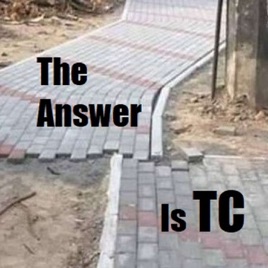
Advertise on podcast: The Answer Is Transaction Costs
Rating
4.8from
This podcast has
88 episodes
Language
EnglishPublisher
Michael MungerExplicit
No
Date created
2023/05/10
Latest episode
2026/09/27
Average duration
40 min.
Release period
11 days
Description
"The real price of everything is the toil and trouble of acquiring it." -Adam Smith (WoN, Bk I, Chapter 5) In which the Knower of Important Things shows how transaction costs explain literally everything. Plus TWEJ, and answers to letters.If YOU have questions, submit them to our email at [email protected] There are two kinds of episodes here: 1. For the most part, episodes June-August are weekly, short (20 mins), and address a few topics. 2. Episodes September-May are longer (1 hour), and monthly, with an interview with a guest.Finally, a quick note: This podcast is NOT for Stacy Hockett. He wanted you to know that.....
Unlock The Answer Is Transaction Costs podcast Email contact info,
Listeners & Audience details
Email contact information
Direct podcast contact details

Listeners
Audience numbers & engagement insights

Audience details
Podcast Insights

Podcast episodes
Check latest episodes from The Answer Is Transaction Costs podcast
Renta Vitalicias: Pension Promises Only Work When Politics Honors Them
2026/09/27
Send us Fan Mail
We walk through how Chile converts retirement savings into lifelong income and why inflation protection and competition make the design work. Then politics collides with contract law as COVID-era withdrawals test credible commitment and raise transaction costs across the financial system.
• how AFP accounts build national savings and deep capital markets
• why a pension is more than a savings account, especially under longevity risk
• how the renta vitalicia life annuity works and why it is irrevocable
• what the UF inflation-indexed unit of account does for long-term contracts
• programmed withdrawal versus annuities, including inheritance and market exposure
• how the 2004 electronic quotation system reduces shopping costs and corruption
• how 2019 unrest and COVID pressures drive the 10% retiro laws
• why the third retiro for annuitants functions like breaking a sold contract
• what “credible commitment” means for pensions, insurers, and bond markets
• how the 2025 reform and a court ruling help restore trust
• economics jokes, a listener letter on data center side payments, and the book pick
Links:
Assessing Chile's Pension SystemChile makes major changes to pension system
If you have questions or comments, or want to suggest a future topic, email the show at [email protected] !
You can follow Mike Munger on Twitter at @mungowitz
God Speaks Hebrew But Understands Yiddish
2026/08/25
Send us Fan Mail
We trace how Hebrew goes from a “museum language” to a living vernacular by treating language as a coordination good with huge network effects and real transaction costs. We follow Eliezer Ben-Yehuda’s strategy for lowering those costs, then watch the Technion language fight prove Hebrew can carry science, not just prayer.
• Hebrew’s revival as a rare case of full language reboot at scale
• Jewish linguistic diversity and why German, French, Russian, Polish, and Yiddish create coordination barriers
• Spoken language as a network effect and why “no one wants to go first”
• Inframarginality and Ben-Yehuda providing a public good as a private mission
• Hebrew as a neutral focal point that no faction fully “owns”
• Building missing vocabulary through roots, grammar, and standardization bodies
• Bootstrapping with a native-speaking child as proof of concept
• Newspapers as distribution channels that reduce divergence in word choice
• Backlash from religious authorities and the real enforcement costs of change
• The 1913 Technikum decision and the Technion language war over German vs Hebrew
• A listener extension connecting Rawls, insurance, and the veil of ignorance
• Book recommendation on American founding ideals and proclaiming liberty
If you have questions or comments, or want to suggest a future topic, email the show at [email protected] !
You can follow Mike Munger on Twitter at @mungowitz
The Main Course was Transaction Costs: Milton's Dinner with Ronald
2026/08/19
Send us Fan Mail
We tell the story of the Chicago dinner where Ronald Coase walks into a hostile room, and by the end everyone votes with him, led by Milton Friedman changing his mind in real time. Along the way, we unpack why transaction costs, not moral blame, often explain when law and institutions shape outcomes.
• the Aaron Director dinner and the vote that flips
• why Milton Friedman becomes a political symbol and lightning rod
• critiques from the right and left on markets, shareholder value, trade, and Chile
• Pigouvian externalities versus Coase’s reciprocal harm framing
• the Coase theorem as a benchmark and why real transaction costs make institutions decisive
• the “twedge” on comparative advantage and the “no free lunch” remix
• listener question on tax horizons, regime uncertainty, and the permanent income hypothesis
LINKS:
Who's afraid of Milton Friedman (a video)Milton Friedman Lives (a blog post)Steve Medema, "What Happened on Blackstone Ave?"Mary Roach, BONKIf you have questions or comments, or want to suggest a future topic, email the show at [email protected] !
You can follow Mike Munger on Twitter at @mungowitz
Regime Uncertainty: Political Risk is Transaction Cost!
2026/08/11
Send us Fan Mail
We walk through the weirdly powerful math that makes a stable $10,000 profit stream worth $50,000 in one world and $1,000,000 in another. Then we apply the same present value logic to politics and show how unpredictable rules raise transaction costs, inflate the effective discount rate, and freeze long-term investment.
• the discount rate as the hidden driver of valuation
• why the consol bond makes present value intuitive
• P = X / R as a shortcut for long-lived assets
• how low interest rates mechanically boost asset prices
• discount rates as opportunity cost plus inflation plus risk
• regime uncertainty as political risk priced into investment
• how New Deal “experimentation” can prolong a downturn
• modern examples through tariffs tax policy and regulation
• a listener puzzle on why Coke concentrate costs more
Tell me what the answer is.
If anybody knows of a recording of the George M. Cohan play, Broadway musical, I would certainly like to be able to find it.
Michael Munger, "How Interest Rates Set Asset Prices: One Weird Trick," The Daily Economy, May 28, 2025
Robert Higgs, "Regime Uncertainty: Why the Great Depression Lasted So Long and Why Prosperity Resumed after the War," The Independent Review, Spring 1997
Amity Shlaes, The Forgotten Man: A New History of the Great Depression (HarperCollins, 2007)
Franklin D. Roosevelt, Oglethorpe University commencement address, May 22, 1932
Book o-da-week: Robert Higgs, Depresssion, War, and Cold War, (reprint) Independent Institute.
If you have questions or comments, or want to suggest a future topic, email the show at [email protected] !
You can follow Mike Munger on Twitter at @mungowitz
The Senate Is The Enemy And Other Friction Stories
2026/08/04
Send us Fan Mail
We argue that “friction” is not always a flaw and can be a deliberate shield against bad collective decisions. We use Buchanan and Tullock’s public choice framework to show why supermajorities, veto points, and other transaction costs can protect rights while still leaving room for day to day governing.
• contrasting cheap outrage with intentional institutional friction
• explaining why constitutional amendment rules use supermajorities
• breaking down external costs versus decision-making costs
• applying the framework to routine policy versus foundational rules
• linking cancel culture to collapsed coordination costs and lost buffers
• spotting designed friction in bicameralism, vetoes, jury unanimity, central bank independence, corporate charters, and treaties
• testing objections about minority rule, the filibuster, and who classifies “big” decisions
• discussing ballot initiatives, referenda, and easy-to-amend constitutions
• sharing listener letters, egg market notes, and a book recommendation
Links:
Shruti Rajagopalan on TAITCThe Senate is the Enemy... (claims it comes from "The West Wing," but this is a story that I heard in the 1980s. West Wing just used it. Strange that people think a TV show is a SOURCE. It was just the MEDIUM, people!)Book-o-da-week: Benjamin Labatut, THE MANIACIf you have questions or comments, or want to suggest a future topic, email the show at [email protected] !
You can follow Mike Munger on Twitter at @mungowitz
Two Bakers Walk Into A Cartel
2026/07/28
Send us Fan Mail
We test a simple bakery price-fixing pact and watch it unravel, then use that failure to explain how transaction costs shape institutions, from unenforceable contracts to the rise of the corporate trust. We connect the common law doctrine of restraint of trade to the Sherman Act, modern merger fights, and a real-world egg pricing controversy where evidence is hard to untangle from supply shocks.
• a two-baker cartel that collapses as soon as cheating pays
• why courts historically refuse to enforce restraint of trade agreements
• how the trust device unifies control and removes the need to “trust” rivals
• how the Sherman Antitrust Act targets trusts and criminalizes collusion
• why merger discretion creates power and invites rent seeking
• why high prices and parallel pricing are not proof of conspiracy
• how price indexes can reduce transaction costs and also enable coordination
• two antitrust “twedges” that poke at efficiency arguments
• a listener letter on lateness norms and why uncertainty matters
If any listeners have some ideas about it, please do write in.
Links:
Egg producers settleBartholomae, T.C. (1923). “The Common Law on Restraint of Trade.” University Journal of Business, 1(4), 451–466. Munger, M.C. (2021). “Giants among us: do we need a new antitrust paradigm?” Constitutional Political Economy. https://doi.org/10.1007/s10602-021-09350-wSherman Antitrust Act (1890)William Baxter Joke Robert Bork, Antitrust ParadoxIf you have questions or comments, or want to suggest a future topic, email the show at [email protected] !
You can follow Mike Munger on Twitter at @mungowitz
Contracting with Yourself: Akrasia and Transaction Costs
2026/07/21
Send us Fan Mail
We start with a simple mystery: how the same person can make a proud plan at night and break it in the morning, even while still believing the plan is good. We connect akrasia, free will, and moral responsibility to transaction costs, treating self-control as a contracting problem between competing versions of ourselves.
• Jordan I and Jordan II as a model of divided preferences over time
• Hard determinism, libertarian free will, and compatibilism as the main philosophical map
• Responsibility and punishment as social conventions that reduce coordination costs
• Aristotle on voluntary intoxication and why blame can attach upstream
• Akrasia defined as wanting to want the right thing
• Plato’s knowledge-based denial of akrasia versus Aristotle’s acceptance of weakness of will
• Paul and Augustine on the internal conflict of the will
• Time-inconsistent preferences and hyperbolic discounting as a behavioral explanation
• Commitment devices as credible commitments and transaction cost engineering
• Odysseus and the sirens as the classic precommitment story
• Listener letter on military punctuality as costly signaling and institutional discipline
• Listener letter on recycling labels as regulation creating new transaction costs
Links and Sources
1. Ainslie, G. (1992). Picoeconomics: The strategic interaction of successive motivational states within the person. Cambridge University Press. Link: Cambridge University Press — Picoeconomics
2. Aristotle. (1999). Nicomachean ethics (W. D. Ross, Trans.). Batoche Books. (Original work published ca. 350 B.C.E.) Passage: Book VII (on incontinence/akrasia). Link: Nicomachean Ethics, trans. W. D. Ross (free PDF)
3. Augustine. (1838). The confessions of Saint Augustine (E. B. Pusey, Trans.). John Henry Parker. (Original work written ca. 397–400 C.E.) Passage: Book VIII, Chapters 8–9 (§§20–21). Link: Confessions, Book VIII, Pusey translation (free full text)
4. Davidson, D. (1970). How is weakness of the will possible? In J. Feinberg (Ed.), Moral concepts (pp. 93–113). Oxford University Press. Link: Oxford Academic — "How Is Weakness of the Will Possible?" (in Essays on Actions and Events) (gated — subscription/institutional access)
5. Dennett, D. C. (1984). Elbow room: The varieties of free will worth wanting. MIT Press. Link: MIT Press — Elbow Room (gated — purchase; excerpts free)
6. Dennett, D. C. (2003). Freedom evolves. Viking. Link: Internet Archive — Freedom Evolves (gated — free with Internet Archive lending account)
7. Hume, D. (1999). An enquiry concerning human understanding (T. L. Beauchamp, Ed.). Oxford University Press. (Original work published 1748) Passage: Section VIII, "Of Liberty and Necessity." Link: Hume Texts Online — Section 8 (free full text)
8. King James Bible. (2017). King James Bible Online. https://www.kingjamesbibleonline.org/ (Original work published 1769) Passage: Romans 7. Link: Romans, Chapter 7 (KJV) (free full text)
9. Plato. (1967). Protagoras (W. R. M. Lamb, Trans.). Harvard University Press. (Original work published ca. 380 B.C.E.) Link: Perseus Digital Library — Protagoras (Lamb trans.) (free full text)
10. Schelling, T. C. (1984). The intimate contest for self-command. In Choice and consequence: Perspectives of an errant economist. Harvard University Press. Link: National Affairs — "The Intimate Contest for Self-Command" (original 1980 essay, free full text) · Harvard University Press — Choice and Consequence (book page, gated)
11. Strawson, P. F. (1962). Freedom and resentment. Proceedings of the British Academy, 48, 1–25. Link: The British Academy — Freedom and Resentment (official publisher page, may be gated)
12. Vaihinger, H. (1925). The philosophy of 'as if': A system of the theoretical, practical and religious fictions of mankind (C. K. Ogden, Trans.). Harcourt, Brace. (Original work published 1911)
Link: Internet Archive — The Philosophy of 'As If' (free full text)
Book-o-da-Week: Emily Wilson’s translation of Homer’s THE ODYSSEY, 2018, WW Norton.
If you have questions or comments, or want to suggest a future topic, email the show at [email protected] !
You can follow Mike Munger on Twitter at @mungowitz
When Mass Outrage is Cheap: TC Origins of Cancel Culture
2026/07/14
Send us Fan Mail
We trace a straight line from a 1697 blasphemy execution to modern cancel culture by focusing on one variable: the cost of turning speech into coordinated punishment. We break down how social media creates common knowledge at near-zero cost, making outrage faster, bigger, and harder to control.
• Thomas Aikenhead’s case as a story about information and enforcement costs
• Transaction costs as the hidden limiter on persecution and social punishment
• The First Amendment limiting state coercion while leaving private sanctions intact
• Social media as a collapse in the cost of broadcasting accusations
• Common knowledge as the trigger for coordinated action by strangers
• Justine Sacco as the early template for modern cancellation dynamics
• Brendan Eich, Emmanuel Cafferty, James Damore, and PyCon “donglegate” as repeating patterns
• John Cleese on offense and the urge to control others’ behavior
• Listener letters on healthcare markets, consolidation, and transaction costs
• Certificate of need laws and price systems that shape competition
Amy Poehler's super bowl ad (Dongle!):John Cleese on cancel cultureLetters:
Dr. Anthony Digiorgio, UCSF, Graphic Novel Claim Denied, Off Label IdeasSurgery Center of OklahomaBook-o-da-week:
Steven Pinker’s When Everyone Knows That Everyone Knows . . .: Common Knowledge and the Mysteries of Money, Power, and Everyday Life Scribner, 2025. If you have questions or comments, or want to suggest a future topic, email the show at [email protected] !
You can follow Mike Munger on Twitter at @mungowitz
You are NOT "Sorry I'm Late"!!
2026/07/07
Send us Fan Mail
We tell a story about German academic quarter hours-- akademische Viertel-- and use it to argue that lateness is an economics problem of coordination, incentives, and transaction costs, not just manners. We lay out five rules that predict who shows up late, why the pattern spreads, and how to spot it before you commit to a recurring meeting.
• the “academic quarter hour” as a rule that makes lateness predictable
• lateness as a transaction cost that blocks group goals
• platonic travelers and the habit of leaving no buffer
• five rules of lateness and what each predicts
• why meetings drift into equilibrium lateness over time
• lateness as an externality and prisoner’s dilemma
• incentive fixes from social sanctions to financial penalties
• watch setting quirks and backwards induction as a practical test
• listener letter on medical insurance hiding prices from consumers
• why hospitals were small before 1935 and how sulfa drugs changed that
• letter on permitting payments for solar projects and why people call them bribes
• book recommendation for the punctually challenged
Links:
Munger, Chron of Higher Ed, 5 Rules of Lateness in Academe Munger, Econlib, The 5 Sorry Rules of LatenessNew York Times article on "Time Personality"U of Michigan's version of the academic quarter hour
Book-o-da-week: Never Be Late Again: 7 Cures for the Punctually Challenged
by Diana DeLonzor and Gerry DeLonzor. Post Madison Publishing May 19, 2026.
If you have questions or comments, or want to suggest a future topic, email the show at [email protected] !
You can follow Mike Munger on Twitter at @mungowitz
Transaction Costs Killed the Medical Stars
2026/06/30
Send us Fan Mail
We try to make sense of a real problem many of us feel: paying a lot for U.S. healthcare while still waiting months to see a doctor. We trace how engineered transaction costs, from the Flexner Report to modern residency caps, restrict physician supply and protect price power while leaving clinicians overworked and patients stuck.
• getting “fired” by a health system and what it reveals about access
• why shortages don’t clear when prices rise, and how transaction costs block entry
• the Flexner Report as quality reform and supply restriction
• evidence of conflicts of interest and rushed methods behind the Flexner narrative
• Ruben Kessel’s puzzle on persistent price discrimination in medicine
• hospital privileges and county medical societies as cartel discipline
• why advertising bans and professional norms can function as anti-competition tools
• how residency caps and accreditation keep the bottleneck in place today
• a listener letter on data center payments as compensation versus bribes
• book of the week recommendation and a few parting thoughts
**************************************
As I note in the episode, thanks to Dr. Lance Stell, Davidson College Department of Philosophy (emeritus). Lance offered this note about the epidsode:
There's a footnote to the Flexner report. It killed the Davidson medical college - NC"s first. The school was founded by a DC faculty as a proprietary school. After 10 years operating on campus, it moved to Charlotte where it had a clinical relationship w/ the Good Samaritan Hospital - a black hospital, becoming the first medical school in the country to have such a relationship. I can send you an article about it written by Dr. Eddie Hoover, MD, a surgeon and Editor of NC"s black medical journal. Flexner execrated proprietary medical schools and it was his goal to "close them." His damning review of the Davidson medical School, renamed The NC Medical College, was successful.
Thanks, Lance, I did not know that! I added that link, below.
****************************************
Links:
The infamous Flexner Report: http://archive.carnegiefoundation.org/publications/pdfs/elibrary/Carnegie_Flexner_Report.pdfHiatt and Stockton on the Flexner Report: "The Impact of the Flexner Report on the Fate of Medical Schools in North America After 1909"Hiatt: "Around the Continent in 180 Days." Hiatt: "The Amazing Logistics of Flexner's Fieldwork."Kessell, Journal of Law and Economics, 1958: "Price Discrimination in Medicine." Eddie L Hoover, Catherine R Lewis. 2006. Journal of the National Medical Association. "Good Samaritan Hospital and the North Carolina Medical College circa early 1900: the first major affiliation between a black hospital and a white medical college." Ernest Jones, "The God complex" in Essays in Applied Psycho-Analysis. Earliest source I could find for the TWEJ: https://www.netfunny.com/rhf/jokes/old89/godplay.840.html
PA data center story: https://www.thecentersquare.com/pennsylvania/article_3b615fd8-5d36-45c4-bfb6-4a3162104f0b.html
Book-o-da-week: Daniel Hannan, Inventing Freedom, Broadside Press. https://www.amazon.com/Inventing-Freedom-English-Speaking-Peoples-Modern/dp/006223174X/
If you have questions or comments, or want to suggest a future topic, email the show at [email protected] !
You can follow Mike Munger on Twitter at @mungowitz
Parasites And Property Rights
2026/06/23
Send us Fan Mail
BIBLIOGRAPHICAL NOTE: The information in this episode comes from Red Flags Press. Their main web site is very useful for research purposes, and I recommend it!
We follow the idea of the “social parasite” through socialist writing and show how it shifts from moral accusation to an enforceable legal category once society claims ownership over individual labor. We argue that the transaction costs of monitoring effort and assigning “socially useful” work push real-world socialism toward surveillance, coercion, and punishment.
• socialist critique of wage labor as work or starve
• transaction costs as defining, monitoring, and enforcing property rights
• the property rights switch from self-ownership to society owning labor
• “from each according to their ability” as an obligation backed by force
• socialist writers labeling middlemen and many professions as parasites
• the party as the decision-maker when prices are suppressed
• Joseph Brodsky’s trial as a real anti-parasite enforcement example
• why the parasite problem expands and becomes politically arbitrary
• how similar labor-claim logic shows up in authoritarian socialism and fascism
• why Scandinavian social democracy is capitalism, not classical socialism
The book of the week is Lenin’s What Is to Be Done? Burning Questions of Our Moment, and I strongly recommend it.
Links:
Red Flags, "Why Socialism Says Slacking is Theft."
Moments in Soviet History: The Trial of Joseph Brodsky
Leo Huberman, The ABCs of Socialism.
"Soviet Era 'Parasites'" https://www.themoscowtimes.com/2016/05/20/soviet-era-parasites-return-to-todays-russian-a52934
If you have questions or comments, or want to suggest a future topic, email the show at [email protected] !
You can follow Mike Munger on Twitter at @mungowitz
Books Don't Bet, They Match
2026/06/16
Send us Fan Mail
We break down how sportsbooks function as brokers that match contracts, set prices through the point spread, and earn their living through the vig. Kevin Braig joins us to explain how law, technology, and property rights shape whether sports betting markets stay clean or slide toward corruption and bad incentives.
• five reasons people gamble, from dopamine to positive skewness
• what a sports bet is as a contract and why a book exists as a broker
• how the 11-to-10 price and the vig work in practice
• why point spreads are a pricing technology and a marketing tool
• how street-level enforcement and local political capture governed bookmaking
• why Nevada legalized betting and how phones and smartphones changed everything
• the Coasean case for clearly assigned property rights between leagues and books
• how prop bets and inside information can erode trust in games
• why extreme taxes and licensing fees raise transaction costs and distort markets
Judge Kevin Braig's book, "Bookmakers vs. Ballowners"
RH Coase, "The Problem of Social Cost"
Gustavo Dudamel's opera, "Wealth of Nations"
If you have questions or comments, or want to suggest a future topic, email the show at [email protected] !
You can follow Mike Munger on Twitter at @mungowitz
Hereditary Monarchy: At Least You Know Which Idiot Is Next
2026/06/09
Send us Fan Mail
Hereditary monarchy seems like a ridiculous way to pick a leader, yet it dominates most of human political history. We argue the reason is transaction costs: succession systems survive when they settle “who rules next” cheaply enough to prevent recurring civil war.
• Why hereditary monarchy is historically prevalent compared with democracy and universal suffrage
• Why “divine right” stories often rationalize a choice people already find tolerable
• Thomas Paine’s critique of hereditary succession and what it misses
• Hobbes on the state of nature as what happens when sovereignty is contested
• Succession as the master coordination problem of political order
• Transaction costs applied to elections, enforcement, legitimacy, and rent seeking
• Why elective monarchy can become an armed auction for total power
• Bright line rules versus discretionary selection and why speed can beat “better”
• How constitutional design lowers the cost of leadership transition when it works
• The legitimacy problem and why dynasties converge on endogamy
• The genetic consequences of endogamy and the Habsburg cautionary tale
• Twedges, book recommendation, and a listener letter on board game “math trades”
LINKS:
Thomas Paine, Common Sense, February 1776
Michael Munger, The Ugly Pig, 20224
A.P. Martinich, Thomas Hobbes: A Biography, 1999.
Thomas Hobbes, Leviathan, 1651.
Neal Schultz, Suicide Kings: Hereditary Monarchy, 2025
Tbadel Barter App
Cosmos Institute, Coasian Bargaining at Scale, 2025
UPDATE: An interesting, and more clearly articulated, application of the reasoning here.... https://aminga.substack.com/p/how-transaction-cost-economics-explains
If you have questions or comments, or want to suggest a future topic, email the show at [email protected] !
You can follow Mike Munger on Twitter at @mungowitz
Swollen Permits? Call Chile!
2026/05/31
Send us Fan Mail
Permits feel like “just paperwork”, until they quietly become the biggest barrier to building, investing, and even basic economic growth. We use Chile’s fight with “permisologia” to show how bureaucracy creates delay, uncertainty, and political risk even when the stated goal is safety or environmental protection.
• permits as transaction costs that quietly tax projects and entrepreneurship
• why bureaucracy is not the same thing as government and why it crowds out market coordination
• “permisologia” in Chile and how a one-stop shop becomes many counters
• parallels to India’s license raj and the logic of rent seeking choke points
• Dominga as a case study in shifting rules, scandal, and investment held hostage
• documented GDP and jobs costs from permitting delay and collapsed processing capacity
• Chile’s LMAS reform plan including deadlines, digitization, and sworn declarations with sanctions
• Parkinson’s Law, bike shedding, and why committees obsess over trivial items
• listener letter on commune life and how transaction costs show up inside “one big firm”
Links:
What is "Permisología"? https://comentarista.emol.com/2294117/27242033/Emol-Social-Facts.html
Framework Law (LMAS): https://www.bluefieldresearch.com/research/chile-takes-another-step-towards-mining-reform/
Parkinson's Law and the "Law of Triviality": https://fs.blog/parkinsons-law/
Twin Oaks Community: https://www.twinoaks.org/
If you have questions or comments, or want to suggest a future topic, email the show at [email protected] !
You can follow Mike Munger on Twitter at @mungowitz
Honor Among Thieves: Anja Shortland and Ransomware
2026/04/28
Send us Fan Mail
A talk with Dr Anya Shortland about the economics of ransomware and the gray-zone institutions that let extortion markets function when nobody can truly enforce trust. We dig into how cyber insurance quietly becomes a form of governance, why data leaks change the game, and what national security risks emerge as everything gets connected.
• criminal markets that sit between legal firms and underworld gangs
• insurance as governance through protocols, repeat play, and incident response packages
• why victims amplify risk when they throw money at crises
• the origin story of early ransomware and the transaction costs that made it fail
• step-by-step ransomware mechanics from phishing to exfiltration to encryption
• how gangs price ransoms by reading cash flow and insurance certificates
• leak sites, privacy regulation, and third-party liability as bargaining leverage
• why cyber insurance is fragmented and slow to enforce security standards
• deductibles, coverage caps, and market hardening that push better cybersecurity
• AI-enabled phishing and the asymmetric arms race between attackers and defenders
• state-linked ransomware, impunity jurisdictions, and critical infrastructure threats
• efficiency versus resilience in smart cities and the Internet of Things
Anja Shortland at Kings College London
Shortland's book, Dark Screens: https://www.amazon.com/Dark-Screens-Hackers-Shadowy-Ransomware/dp/1541705750Shortland's first TAITC episode: "Deals with shadows"
Links mentioned in podcast:
Alex Danco's pirate puzzle
Pete Leeson's book, The Invisible Hook
David Deutsch's book, The Beginning of Infinity
If you have questions or comments, or want to suggest a future topic, email the show at [email protected] !
You can follow Mike Munger on Twitter at @mungowitz
Podcast reviews
Read The Answer Is Transaction Costs podcast reviews
Artpope420 2026/03/11
Listen every episode!
The Adam smith series has been great. And I love the emphasis on the TWEJ even though it’s never very funny. Quite avant garde
Buchangus 2025/08/06
Magnificent Munger
Love his passion and ability to communicate economic ideas and theory so transparently.
Agmcvet 2025/06/03
Love the Show; Don’t Change a Thing
Love the show, Mike. And don’t listen to anyone who says you or your guests get too far off in the economic weeds sometimes: I learn so much and get a...
jjiusbbbdhag 2024/08/19
Hunger for the munger
I would love to see an avengers-style buddy action hero movie starring Mike Munger and Russ Roberts fighting against… well I don’t even know what but ...
Vance Ginn 2023/12/31
Munger Transactions Are Best
You don’t want to miss this show with Munger making concise arguments for the importance of transaction costs in all we do.
johnson bros 2023/11/22
DIAMONDS in a coal mine
Nothing against coal mines, but how great it’s been to run across this gem while regularly exploring my staple listenings. Rewarding
BrevityRules 2023/08/09
Audio quality in this week’s show was bad
I like the show but the audio was very low grade and it didn’t provide for good listening. I’m sure the transaction cost of good audio is worth bearin...
nickname taken 102938 2023/07/05
A Gem
Munger has that unique ability to translate his expertise in political economy into lessons for policymakers and ordinary citizens alike and make you ...
Joey Ken 2023/07/05
Love this guy
I consume everything he puts out including his amazing interviews on the Econ talk podcast. He is great at explaining things in a simple way which hel...
HDieterD 2023/06/25
Too fun to be price theory, and yet that and more
A great approach to analyzing complex economic interactions because it might be more entertaining that educational.
Podcast sponsorship advertising
Start advertising on The Answer Is Transaction Costs relevant audience podcasts
You may also like to advertise on these Podcasts
4.916151617
The Kristian Harloff Show
Kristian Harloff

4.853512000
Men In Blazers
Men In Blazers
4.847052000
Pat Gray Unleashed
Blaze Podcast Network
4.920391996
Brant & Sherri Oddcast
Brant Hansen
4.92001923
The Wright Report
Bryan Dean Wright
4.6432771245
Verdict with Ted Cruz
Premiere Networks

4.619772871
All Ears English Podcast
Lindsay McMahon and Michelle Kaplan

4.814621637
The Big Honker Podcast
Andy Shaver & Jeff Stanfield
4.662832000
The Dr. Laura Podcast
Dr. Laura Schlessinger & SiriusXM

4.723662000
Everything Everywhere Daily
Gary Arndt