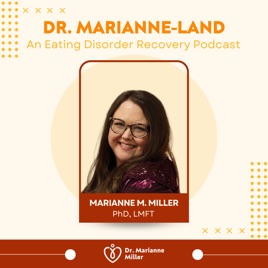
Welcome to this mental health and eating disorder podcast by Dr. Marianne Miller, who is an eating disorder therapist and binge eating and ARFID course creator. In this podcast, Dr. Marianne explores the ins and outs of eating disorder recovery. It’s a top podcast for people struggling with anorexia, bulimia, binge eating disorder, ARFID (avoidant restrictive food intake disorder), and any sort of distressed eating. We discuss topics like neurodiversity and eating disorders, self-compassion in eating disorder recovery, lived experience of eating disorders, LGBTQ+ and eating disorders, as well as anti-fat bias, weight-neutral fitness, muscularity-oriented issues, and body image. Dr. Marianne has been an eating disorder therapist for 13 years and has created a course on ARFID and selective eating, as well as a membership to help you recover from binge eating disorder and bulimia. Dr. Marianne has been in mental health for 28 years. Dr. Marianne is neurodivergent and works with a lot of neurodivergent folks. She has fully recovered from an eating disorder that lasted 25 years, and she wants to share her experience, knowledge, and recovery joy with you! Her interview episodes with top eating disorder professionals drop on Tuesdays. You can also tune in on Fridays when Dr. Marianne’s SOLO episodes that come out. You’ll hear personal stories, tips, and strategies to help you in your eating disorder recovery journey. If you’re struggling with food, eating, body image, and mental health, this podcast is for you!
Advertise on Dr. Marianne-Land: An Eating Disorder Recovery Podcast
Advertise on Dr. Marianne-Land: An Eating Disorder Recovery Podcast to promote your brand to thousands of podcast listeners
Unlock Dr. Marianne-Land: An Eating Disorder Recovery Podcast podcast Email contact info, Listeners & Audience details
Email contact information
Direct podcast contact details
Listeners
Audience numbers & engagement insights
Audience details
Podcast Insights
Podcast episodes
Check latest episodes from Dr. Marianne-Land: An Eating Disorder Recovery Podcast podcast
Self-Criticism in Eating Disorder Recovery: Why the Inner Voice Gets Louder & How to Respond
2026/02/06
When self-criticism ramps up during eating disorder recovery, it can feel confusing or discouraging, especially when behaviors are beginning to change. This episode explores why that intensification is often part of the healing process rather than a sign that recovery is going wrong.
In this solo episode, Dr. Marianne Miller explains why the inner critical voice often gets louder as eating disorder behaviors decrease and familiar control systems loosen. Instead of framing self-criticism as simply negative self-talk, this episode examines it as a regulatory strategy shaped by nervous system threat, social pressure, and internalized ableism.
Internalized Ableism in Eating Disorder Recovery
Recovery often collides with a world that expects bodies and minds to function efficiently, consistently, and quietly. In this section, Dr. Marianne names how those expectations become internalized as harsh self-judgment, especially for neurodivergent people, people with chronic illness, and those navigating long-term eating disorders.
You’ll hear how internalized ableism fuels self-criticism when recovery requires pacing, support, repetition, or accommodation, and why needing these supports does not mean recovery is failing.
The Inner Critic and Nervous System Threat
Many people try to argue with or silence self-critical thoughts in recovery. This episode explains why that approach often backfires and intensifies the inner voice instead.
Dr. Marianne explores how the inner critic functions as a response to perceived threat and why understanding its role is more effective than trying to eliminate it.
Responding to Self-Criticism Without Shame
This episode offers compassionate, neurodivergent-affirming ways to respond to self-criticism without turning recovery into another performance. The focus is on reducing threat, supporting regulation, and loosening the critic’s authority rather than suppressing it.
A brief clinical vignette illustrates how self-criticism rooted in internalized ableism can show up even when healing is actively underway.
Nonlinear Eating Disorder Recovery
For people with long-term or chronic eating disorders, progress often looks different than expected. This section reframes recovery as a process that prioritizes safety, accommodation, and sustainability over efficiency or perfection.
Loud self-criticism does not mean failure. It often signals that a system is reorganizing in response to change.
A Gentle Reminder
Recovery is not about proving you can function the way the world demands. It is about building a life that supports your nervous system, your needs, and your humanity.
Related Episodes
This Is Body Grief: How Ableism, Intersectionality, & Eating Disorders Shape Our Body Experiences With Jayne Mattingly on Apple & Spotify.
Size Inclusivity & Ableism: Why Body Acceptance is More Than Just "Loving Your Curves" on Apple & Spotify.
Ableism and Common Myths About Diabetes with Kim Rose, RD @the.bloodsurgar.nutritionist on Apple & Spotify.
Work With Me and Learn More
If this episode resonated and you want structured, neurodivergent-affirming support, you can learn more about my self-paced ARFID course. The course is designed for teens and adults navigating avoidant and restrictive eating patterns and focuses on sensory needs, nervous system safety, and realistic, sustainable change without shame or pressure.
Anorexia & Bulimia After 40: Understanding Midlife Recovery & Change
2026/02/04
Eating disorder recovery in midlife often looks very different than recovery earlier in life. For many adults over 40, anorexia and bulimia are not new struggles but long standing patterns shaped by decades of survival, responsibility, and adaptation. This episode explores why recovery after 40 requires a different lens and why difficulty healing is not a personal failure.
In this solo episode, Dr. Marianne Miller examines how anorexia and bulimia persist into midlife and what actually supports healing at this stage of life. Rather than focusing on willpower or symptom control, this conversation centers nervous system safety, autonomy, grief, and the cumulative impact of stress and systemic harm.
You will hear how hormonal changes, aging bodies, chronic stress, caregiving roles, and identity related oppression all shape midlife eating disorder recovery. This episode also addresses why traditional treatment models often fall short for adults over 40 and how neurodivergent affirming, weight inclusive, and harm reduction oriented care can offer a more sustainable path forward.
Recovery after 40 is not about catching up or starting over. It is about choosing care that fits the life you are living now.
In this episode, we cover:
Anorexia and bulimia in midlife and why recovery changes after 40.
Why long standing eating disorder patterns often reflect adaptation, not resistance.
How the body communicates differently in midlife through hunger, fatigue, pain, and stress.
The role of grief, fear, and ambivalence in midlife eating disorder recovery
Intersectionality in recovery, including the effects of weight stigma, racism, ableism, and anti-queer and anti-trans bias.
Neurodivergence, sensory sensitivity, and why many adults were never supported earlier in life.
Why harm reduction and pacing often support recovery better than urgency.
What weight inclusive, autonomy centered therapy can look like for adults over 40.
Who this episode is for:
Adults over 40 navigating anorexia or bulimia.
People with long term or recurring eating disorder patterns.
Neurodivergent adults and those with sensory sensitivities.
Fat people and others harmed by weight stigma in healthcare.
Anyone who has felt left behind by traditional eating disorder treatment.
Related episodes:
The Hidden Pain of Midlife Anorexia: Why Coping Breaks Down & What Heals on Apple & Spotify.
Why Is Anorexia Showing Up Again in Midlife? You're Not Imagining It on Apple & Spotify.
Midlife Bulimia Recovery: Coping With the Internal Chaos on Apple & Spotify.
Welcome to the Jungle: Eating Disorders in Midlife & Our Personal Recovery Stories with Amy Ornelas, RD on Apple & Spotify.
About working with Dr. Marianne Miller
Dr. Marianne Miller is a licensed marriage and family therapist specializing in eating disorder therapy for adults, including anorexia, bulimia, binge eating disorder, and ARFID. Her work centers neurodivergent affirming, weight inclusive, and harm reduction approaches that honor safety, agency, and lived context.
Dr. Marianne works with adults in California, Texas, and Washington DC. Therapy is grounded in an understanding of how trauma, systemic oppression, and nervous system overwhelm shape eating struggles across the lifespan.
Learn more about working with Dr. Marianne and current therapy availability by visiting her website drmariannemiller.com.
Content note
This episode discusses eating disorders, recovery, and midlife body changes. Listener discretion is advised.
Eating Disorder Recovery With Chronic Illness: When Restriction Is Prescribed, Not Chosen With Vanessa Connelly, RD @grainandgreen.kidneys
2026/02/02
When you live with a chronic illness, food restriction is often framed as “medical,” “necessary,” or “just being responsible.” But for many people, especially those with eating disorder histories, that kind of guidance doesn’t support health. It fuels fear, shame, isolation, and disordered eating patterns that are hard to unwind.
In this episode, Dr. Marianne is joined by Vanessa Connolly, a registered dietitian nutritionist and board-certified kidney nutrition specialist, for a grounded, compassionate conversation about what happens when restriction is prescribed rather than chosen and why that matters so deeply for eating disorder recovery.
Together, they unpack how diet culture shows up in chronic illness care, how weight stigma and medical bias shape food advice, and why many people are quietly harmed by guidance that prioritizes control over nourishment.
In This Conversation, We Explore
This episode looks at how chronic illness care can unintentionally recreate the same dynamics that drive eating disorders, especially for people who have already spent years being told their bodies are the problem.
We talk about how fear-based food rules around labs, numbers, and diagnoses often strip people of cultural foods, social connection, and bodily trust. You’ll hear why blanket dietary restrictions are rarely neutral, how they can worsen food fear and disordered eating, and what a more supportive, humane approach to nutrition can look like.
Vanessa also explains why focusing on what can be added rather than taken away, including fiber, balance, and satisfaction, supports both physical health and psychological safety. This episode names the emotional cost of food policing, family surveillance, and medical dismissal, especially for people in larger bodies and those navigating multiple marginalized identities.
Topics Covered
We discuss eating disorder recovery alongside chronic illness, including chronic kidney disease, diabetes, and high blood pressure, without defaulting to diet culture or weight-centric care.
This conversation includes medical gaslighting and delayed diagnoses, how lab values like GFR are often misunderstood or minimized, and why many patients are never fully informed about what’s happening in their own bodies.
We also explore anti-fat bias in healthcare, intersectionality, cultural food loss, and how shame and restriction can isolate people from their communities at the very moment they need support the most.
Why This Episode Matters
If you’ve ever felt afraid to eat after a diagnosis, confused by conflicting medical advice, or worried that “doing everything right” is actually making things worse, this episode is for you.
This is not a conversation about willpower, compliance, or perfect eating. It’s about restoring agency, reducing harm, and finding ways to care for your body that don’t require sacrificing your relationship with food.
About the Guest
Vanessa Connolly is a registered dietitian nutritionist and board-certified kidney nutrition specialist with over 20 years of experience supporting people with chronic kidney disease. Her work centers on helping clients preserve kidney function without unnecessary restriction, food fear, or shame. She is deeply committed to accessible, weight-inclusive, and judgment-free care.
You can find Vanessa on Instagram and TikTok @grainandgreen.kidneys, where she shares practical, anti-diet education about kidney health and chronic illness.
Related Episodes
The Real Talk on Kidney-Friendly Diets & Disordered Eating With Vanessa Connelly, RD @grainandgreen.kidneys on Apple and Spotify.
Chronic Illness, Wellness Culture, & Eating Disorder Recovery: Taking an Anti-Diet Approach With Abbie Attwood, MS, @abbieattwoodwellness on Apple and Spotify.
Anti-Fat Bias in Healthcare & Chronic Illness: Healing Body Image in a Marginalized Body With Ivy Felicia @iamivyfelicia on Apple and Spotify.
Support Beyond This Episode
If eating feels complicated, unsafe, or overwhelming after years of restriction, diagnosis-driven food rules, or medical trauma, you don’t have to navigate that alone.
Dr. Marianne offers eating disorder therapy and support for people navigating binge eating disorder, ARFID, anorexia, bulimia, and long-term eating struggles, including when chronic illness or medical advice is part of the picture. Services are available in California, Texas, Washington, D.C., and worldwide. Go to drmariannemiller.com for more information.
ARFID in Adults: Why It’s Missed, Misdiagnosed, & Often Treated Too Late
2026/01/30
Avoidant Restrictive Food Intake Disorder does not end in childhood. Many adults live for years, even decades, with ARFID that goes unnamed, misunderstood, or incorrectly treated. In this solo episode, Dr. Marianne Miller explores why ARFID in adults is so often missed, how misdiagnosis shapes harmful care pathways, and what adult-appropriate support actually requires.
This conversation centers adults who never felt seen in eating disorder spaces, who were told their struggles were anxiety, habits, or personality traits, and who learned to adapt quietly rather than receive care that fit.
Why ARFID in Adults Is Frequently Missed
ARFID still gets framed as a childhood diagnosis in many clinical settings. When adults present with long-standing food avoidance, fear of adverse consequences, or limited food variety, providers often overlook ARFID entirely. This section explores how outdated training and pediatric-focused models contribute to delayed recognition and missed diagnosis.
Common Misdiagnoses That Delay ARFID Treatment
Adults with ARFID are frequently misdiagnosed with anorexia, generalized anxiety disorders, gastrointestinal conditions, or trauma responses. Dr. Miller explains how weight-centered assumptions and surface-level assessments obscure the nervous system and sensory drivers of ARFID, leading to treatment that does not address the real issue.
Why So Many Adults Go Untreated for Years
Many adults with ARFID become highly skilled at adapting. They plan their lives around food access, avoid social eating, and manage significant cognitive and emotional labor behind the scenes. Because this adaptation often looks like functioning, providers underestimate the depth of distress and delay appropriate intervention.
Neurodivergence, Trauma, and Medical History in Adult ARFID
ARFID in adults frequently overlaps with neurodivergence, chronic illness, trauma, and complex medical experiences. This episode discusses how sensory processing differences, interoceptive challenges, and past food-related or medical harm shape adult eating patterns and must be addressed in care.
What Adult-Appropriate ARFID Care Actually Looks Like
Effective ARFID treatment for adults requires flexibility, collaboration, and respect for autonomy. Dr. Miller outlines why rigid eating disorder models often fail adults with ARFID and what support looks like when it centers nervous system safety, lived experience, and real-world practicality.
Late Diagnosis Does Not Mean Failure
If you received an ARFID diagnosis later in life, or are only now recognizing yourself in this conversation, this section offers validation. Delayed diagnosis reflects systemic gaps, not personal shortcomings. There is no expiration date on care, understanding, or support.
Related Episodes
When PDA Drives ARFID: Understanding Food Refusal, Control, & Safety on Apple & Spotify.
ARFID Explained: What It Feels Like, Why It’s Misunderstood, & What Helps on Apple & Spotify.
Why Sensory-Attuned Care Matters More Than Exposure in ARFID Treatment on Apple & Spotify.
Complexities of Treating ARFID: How a Neurodivergent-Affirming, Sensory-Attuned Approach Works on Apple & Spotify.
Support and Resources
Dr. Marianne shares information about her virtual, self-paced, ARFID and Selective Eating course, designed for adults seeking neurodivergent-affirming, trauma-aware support that does not rely on pressure, shame, or one-size-fits-all approaches.
You can find information about ARFID therapy on her website at drmariannemiller.com. Also check out her blog on ARFID topics.
If this episode resonated, consider sharing it with someone who has struggled to find language or care for long-standing eating challenges. ARFID in adults deserves recognition, respect, and treatment that fits.
Wanting Recovery AND Fearing It: How Dialectical Thinking Supports Chronic Eating Disorder Recovery
2026/01/28
Living with a chronic eating disorder often means wanting recovery and fearing it at the same time. Many people feel torn between change and safety, hope and grief, relief and loss. This solo episode explores why that ambivalence is not a failure, but a meaningful part of chronic eating disorder recovery.
In this episode, Dr. Marianne Miller explains how dialectical thinking from DBT supports people with long-term eating disorders by allowing two truths to exist at once. Rather than forcing either-or recovery narratives, dialectics centers the AND. It helps people work with fear, attachment, and survival strategies without shame.
This episode focuses on the internal experience of recovery, not just behavior change. It is not a safety systems episode or a harm reduction overview. It is about how people live inside ambivalence and how radical acceptance creates space for movement without forcing certainty.
Dialectical Thinking and the AND in Eating Disorder Recovery
Dialectical thinking recognizes that two things can be true at the same time. In eating disorder recovery, this might look like wanting relief while still relying on eating disorder behaviors to feel regulated. These experiences are not contradictions to fix. They reflect adaptation, nervous system learning, and lived reality.
Rigid recovery binaries often increase shame and disengagement, especially for people with chronic or long-standing eating disorders. Living in the AND supports flexibility, honesty, and continued engagement in care.
Why Ambivalence Is Not Resistance
Ambivalence is often misinterpreted as resistance in eating disorder treatment. This episode challenges that belief directly. Ambivalence is information from a nervous system that learned how to survive.
For many people who are fat, disabled, neurodivergent, BIPOC, LGBTQIA+, chronically ill, or medically harmed, recovery fear is shaped by real systems. Weight stigma, medical trauma, racism, ableism, and lack of access to affirming care all matter. Fear does not mean failure.
Radical Acceptance Without Giving Up
Radical acceptance does not mean liking what is happening or giving up on recovery. It means naming reality so shame stops driving the process. When people stop fighting themselves for being ambivalent, curiosity, flexibility, and choice become more possible.
This episode reframes radical acceptance as a tool for supporting sustainable change in chronic eating disorder recovery.
Redefining Success in Chronic Eating Disorders
Recovery does not have to mean certainty or symptom elimination. It can mean increased tolerance for uncertainty, moments of choice, and the ability to say, “I am struggling and still worthy of care.”
Dialectical thinking offers a compassionate, realistic framework for long-term eating disorder recovery.
Related Episodes
Chronic Eating Disorders in 2026: What Hope Can Actually Look Like on Apple and Spotify.
Why Some Eating Disorders Don’t Resolve: Understanding Chronic Patterns & What Actually Supports Change on Apple and Spotify.
When an Eating Disorder Becomes Chronic: Recovery Tools for Persistent Anorexia & Bulimia on Apple and Spotify.
Support and Resources
Dr. Marianne Miller offers a self-paced, virtual ARFID and Selective Eating course grounded in neurodivergent-affirming, trauma-informed care. The course focuses on safety, flexibility, and realistic change over time for people with restrictive, avoidant, or long-standing eating struggles.
Links and details are available in the show notes.
Work with Dr. Marianne in therapy if you live in California, Texas, or Washington D.C. Go to drmariannemiller.com to schedule a free, 15-minute consultation call.
You do not have to choose one truth. You can want recovery and fear letting go. You can live in the AND.
Eating Disorders & ADHD: Neurodivergent-Affirming Recovery With Taylor Ashley, RP @taylorashleytherapy
2026/01/26
Why do eating disorders and ADHD so often overlap, and why does standard eating disorder treatment frequently fail neurodivergent people?
In this episode of Dr. Marianne-Land, I’m joined by Taylor Ashley @taylorashleytherapy, Registered Psychotherapist based in Guelph, Ontario, who specializes in eating disorders, ADHD, trauma, body image, and neurodivergence. Taylor brings both professional expertise and lived experience to this conversation, offering a deeply honest look at how eating disorders can function as coping and regulation systems for neurodivergent brains.
Together, we unpack why recovery often looks different for people with ADHD, why hunger cues may never fully return for some, and how approaches like mechanical eating, HAES-informed care, and trauma-informed therapy can make recovery more accessible and sustainable.
In This Episode, We Discuss:
Eating Disorders and ADHD
We explore why ADHD and eating disorders frequently co-occur, including how dopamine regulation, anxiety, and nervous system overload shape behaviors like restricting, purging, and binging.
Neurodivergent-Affirming Eating Disorder Recovery
Taylor explains why traditional eating disorder treatment models often miss neurodivergent needs and how affirming care prioritizes sensory safety, autonomy, and individualized support.
Mechanical Eating vs Intuitive Eating
We talk openly about why intuitive eating is not realistic or safe for many neurodivergent people and how mechanical eating can be a supportive, valid recovery strategy.
Sensory Processing, Clothing, and Body Image
From sports uniforms to fabric textures, we discuss how sensory sensitivities and body shame intersect and how these experiences can quietly drive eating disorder behaviors.
Brain Chemistry, Dopamine, and Regulation
Taylor breaks down how restricting, purging, and binging can temporarily regulate dopamine and serotonin, especially for people with ADHD, and why this makes eating disorders feel grounding and hard to let go of.
Trauma-Informed and IFS-Informed Approaches
We explore Internal Family Systems (IFS) and how understanding the protective role of eating disorder behaviors can reduce shame and support long-term change.
HAES-Informed and Weight-Inclusive Care
We discuss why Health at Every Size–informed treatment matters, how weight-focused care can cause harm, and what to look for when building a neurodivergent-affirming outpatient treatment team.
When Inpatient Treatment Is Not the Right Fit
Taylor shares why inpatient programs can be unsafe for neurodivergent people when they lack sensory awareness and flexibility, and how intensive outpatient support can sometimes be a better option.
Who This Episode Is For
This episode is for:
People with ADHD and eating disorders
Neurodivergent adults navigating recovery
Clinicians and therapists working in eating disorder treatment
Anyone who feels like standard recovery advice has never fit their brain or body
About Taylor Ashley, RP
Taylor Ashley is a Registered Psychotherapist based in Guelph, Ontario, specializing in eating disorders, ADHD, trauma, neurodivergence, and body image. Her work centers neurodivergent-affirming, trauma-informed, and HAES-aligned care. Taylor brings lived experience, deep compassion, and clinical insight to her work with individuals seeking recovery that actually fits their nervous system.
Follow Taylor on Instagram: @taylorashleytherapy
Learn more: taylorashleytherapy.com
Related Episodes
Unmasking, Embodiment, & Trust: A Neurodivergent Approach to Eating Disorder Recovery With Dr. Emma Offord @divergentlives via Apple & Spotify.
Unmasking in Eating Disorder Recovery: What Neurodivergent People Need to Know About Safety & Healing via Apple & Spotify.
Recovering Again: Navigating Eating Disorders After a Late Neurodivergent Diagnosis (Part 1) With Stacie Fanelli, LCSW @edadhd_therapist via Apple & Spotify.
Final Note
If eating disorder recovery has felt inaccessible, overwhelming, or unsafe in the past, this conversation offers validation, language, and concrete reframes that may finally make things click.
Chronic Eating Disorders in 2026: What Hope Can Actually Look Like
2026/01/23
What does hope really mean when an eating disorder has lasted for years or decades? In 2026, many people with chronic eating disorders feel left out of recovery conversations that prioritize fast change, early intervention, and visible transformation. This episode offers a different framework. One that respects long-term patterns, nervous system survival, neurodivergence, and harm reduction.
This conversation is for anyone who has wondered whether recovery is still possible for them, or whether traditional recovery models ever truly fit in the first place.
Understanding Chronic Eating Disorders
Chronic eating disorders are often misunderstood as failures or lack of motivation. In reality, long-term eating disorder patterns usually develop as adaptive responses to unmet needs for safety, regulation, autonomy, or predictability. These patterns persist not because someone is resistant to change, but because they once worked.
In 2026, more clinicians are beginning to recognize eating disorders as learned survival systems rather than character flaws. This shift changes how care is offered and how hope becomes possible.
Why Traditional Recovery Hope Often Falls Apart
Many people with long-term eating disorders have been harmed by how hope is framed in treatment. When hope depends on symptom elimination, linear progress, or compliance with rigid models, it becomes fragile. Setbacks then feel like proof that recovery has failed.
For chronic eating disorders, hope cannot be conditional. It must be able to coexist with fluctuation, stress, and ongoing vulnerability without turning into another source of shame.
What Hope Can Actually Look Like for Long-Term Eating Disorders
Hope in chronic eating disorder recovery often looks quieter and more realistic than cultural narratives suggest. It may involve increased choice instead of total freedom, fewer all-or-nothing spirals, or the ability to pause before acting on urges. For many people, hope shows up as nourishment that feels neutral rather than terrifying, or as eating with accommodations that respect sensory and nervous system needs.
This kind of hope does not erase struggle. It changes how much control the eating disorder has over daily life.
Progress Beyond Symptom Elimination
Progress in long-term eating disorder recovery often happens beneath the surface. It can appear as quicker nervous system recovery after distress, reduced intensity of urges, or increased ability to name internal experiences instead of dissociating from them.
These changes matter. They reflect learning, regulation, and increased safety, even when symptoms remain present. Measuring progress by lived experience rather than symptom checklists allows hope to grow more sustainably.
Neurodivergence, Trauma, and Treatment Fit
Many people with chronic eating disorders are neurodivergent, trauma-exposed, or both. Historically, eating disorder treatment has often failed to account for sensory needs, autonomy, and nervous system regulation. When care does not fit, people are frequently blamed rather than supported.
In 2026, more neurodivergent-affirming and trauma-informed approaches are emerging. These frameworks recognize eating disorder behaviors as attempts at regulation and protection, not defiance. When care adapts to the person instead of forcing conformity, change becomes more possible.
Harm Reduction and Chronic Eating Disorders
Harm reduction plays a critical role in supporting people with long-term eating disorders. Rather than demanding full recovery as the only acceptable outcome, harm reduction focuses on reducing risk, increasing stability, and supporting safety in the present moment.
For many people, harm reduction offers a form of hope that does not collapse under pressure. In 2026, this approach is increasingly recognized as legitimate, ethical eating disorder care.
Letting Go of Cure-Based Recovery Models
One of the most hopeful shifts for chronic eating disorders is releasing the idea that cure is the only meaningful goal. People deserve care, dignity, and support regardless of whether they reach full symptom remission.
Many individuals experience greater peace when they stop chasing recovery narratives that were never designed for them and begin building lives that work with their nervous systems rather than against them.
You Are Not Too Late
If an eating disorder has been part of your life for a long time, you are not behind and you are not broken. You did not miss your chance at support. Hope does not require erasing your history or minimizing what you have survived.
Hope can exist alongside chronicity.
Related Episodes
Why Some Eating Disorders Don’t Resolve: Understanding Chronic Patterns & What Actually Supports Change on Apple and Spotify.
When an Eating Disorder Becomes Chronic: Recovery Tools for Persistent Anorexia & Bulimia on Apple and Spotify.
Work With Me
I offer eating disorder therapy, consultation, and educational resources that center chronic eating disorders, neurodivergence, trauma-informed care, and harm reduction. My work is designed for people who have already tried standard recovery paths and need something more humane and realistic.
You deserve support that meets you where you are in 2026. Check out my website at drmariannemiller.com for info about therapy, coaching, and virtual, self-paced courses.
Egosyntonic vs Egodystonic Eating Disorder Behaviors in Neurodivergent People: Where’s the Line?
2026/01/21
Not all eating disorder behaviors feel distressing. For many neurodivergent people, certain eating patterns can feel calming, organizing, or regulating rather than intrusive or unwanted. This solo episode explores the often misunderstood difference between egosyntonic and egodystonic eating disorder behaviors, with a specific focus on neurodivergent experiences.
Dr. Marianne Miller breaks down why distress is not a reliable indicator of risk, how soothing routines can still create long-term concerns, and how clinicians and individuals can assess eating behaviors without pathologizing neurodivergence. This conversation centers nuance, consent, and nervous system safety rather than urgency or moral judgment.
What Does Egosyntonic vs Egodystonic Mean in Eating Disorders?
Egodystonic eating disorder behaviors feel unwanted and distressing. They often clash with a person’s values or sense of self and can feel out of control. Egosyntonic behaviors, on the other hand, feel aligned with the self. They may feel logical, helpful, or necessary, even when others express concern.
This episode explains why egosyntonic does not mean harmless and why egodystonic does not automatically mean more severe. These terms describe internal experience, not medical or nutritional risk.
Neurodivergence, Regulation, and Eating Disorder Behaviors
Neurodivergent nervous systems often rely on structure, predictability, and repetition for regulation. Food routines, sameness, timing, or tracking can reduce sensory overload and cognitive demand. What feels regulating internally may look concerning externally.
Dr. Marianne explores how clinicians and loved ones often misread neurodivergent regulation as pathology, or dismiss concern when distress is absent. This section highlights why both reactions miss the full picture.
Why Distress Is Not a Reliable Marker of Risk
Many eating disorder assessments rely too heavily on visible distress. This episode explains why distress can fluctuate and why the absence of distress does not equal safety. Neurodivergent people may feel calm and regulated even as food variety narrows, rigidity increases, or nourishment decreases.
The episode emphasizes the importance of looking beyond how a behavior feels in the moment and instead examining how it shapes health, flexibility, and daily life over time.
Where Is the Line Between Regulation and Harm?
This episode directly addresses the question many people ask but rarely get answered clearly. The line is not about whether a behavior feels soothing. It is not about motivation or readiness for change. It is about what the behavior requires and what it takes away over time.
Dr. Marianne outlines how to evaluate eating behaviors through function, sustainability, and long-term consequences without shaming, coercion, or urgency.
A Neurodivergent-Affirming Approach to Care
This conversation is not about taking away coping strategies or forcing change. Removing regulation without replacement can destabilize neurodivergent people and increase risk. Instead, this episode discusses how to preserve safety while reducing long-term harm through added supports, sensory accommodations, and gradual expansion.
The focus stays on consent, autonomy, and respect for identity.
Who This Episode Is For
This episode is for neurodivergent teens and adults who feel confused when eating behaviors feel helpful but raise concern from others. It is also for clinicians who want to assess eating disorders without relying solely on distress or external appearance.
If you have ever thought, this does not feel like a problem to me, but other people seem worried, this episode speaks directly to that experience.
Related Episodes
Unmasking, Embodiment, & Trust: A Neurodivergent Approach to Eating Disorder Recovery With Dr. Emma Offord @divergentlives via Apple & Spotify.
Unmasking in Eating Disorder Recovery: What Neurodivergent People Need to Know About Safety & Healing via Apple & Spotify.
Autism & Anorexia: When Masking Looks Like Restriction, & Recovery Feels Unsafe via Apple & Spotify.
Recovering Again: Navigating Eating Disorders After a Late Neurodivergent Diagnosis (Part 1) With Stacie Fanelli, LCSW @edadhd_therapist via Apple & Spotify.
Work With Dr. Marianne Miller
Dr. Marianne Miller is a licensed marriage and family therapist specializing in eating disorder recovery with a neurodivergent-affirming, trauma-informed approach. She works with teens and adults navigating ARFID, binge eating disorder, and long-term eating disorder patterns.
Go to her website at drmariannemiller.com for information on therapy and online, self-paced courses.
Anti-Fat Bias in Healthcare & Chronic Illness: Healing Body Image in a Marginalized Body With Ivy Felicia @iamivyfelicia
2026/01/19
What happens when medical care reduces a whole human being to a number on a scale? In this episode of Dr. Marianne-Land, I’m joined by Ivy Felicia, Body Relationship Coach and founder of Luxuriant Life, for a deeply grounding conversation about anti-fat bias in healthcare, chronic illness, and what it actually takes to build peace with your body in a system that often causes harm.
Ivy shares her lived experience as a Black woman of size navigating PCOS, autoimmune illness, thyroid disease, and repeated medical dismissal. We talk openly about the moment a provider told her weight loss surgery was the only option and what it meant to be treated as disposable when she declined. That moment became a turning point that reshaped her relationship with her body and ultimately led to the creation of her Body Relationship Method, a size-inclusive, weight-neutral approach grounded in compassion, self-trust, and holistic wellness.
Throughout this conversation, we explore how chronic illness, medical trauma, and anti-fat bias intersect, and why body positivity is not always accessible or supportive for people living in pain, disability, or marginalized bodies. Ivy explains why she centers body peace rather than body love, and how choosing neutrality and non-violence toward your body can be a more realistic and healing place to start.
We also discuss the role of spirituality and surrender in healing a relationship with your body. Ivy describes how prayer, connection to nature, journaling, and honoring ancestors support her through periods of overwhelm, and why taking healing one breath at a time can feel far more attainable than one day at a time when you live with chronic pain or illness.
This episode also dives into internalized anti-fat bias and internalized ableism. Ivy shares how listening, witnessing, and affirming someone’s lived experience can be profoundly reparative, especially for people who have spent years being dismissed or erased by medical systems. We talk about visibility, self-advocacy, and how being truly heard can help people reclaim their voice and their worth.
If you’ve ever felt disconnected from your body because of chronic illness, eating disorder recovery, medical trauma, or weight stigma, this conversation offers a gentler way forward. There is no finish line here. There is no pressure to love your body. There is space to move toward peace, at your own pace, one breath at a time.
About Ivy Felicia
Ivy Felicia is a Body Relationship Coach, certified holistic wellness practitioner, speaker, and founder of Luxuriant Life, LLC. She is the creator of the Body Relationship Method, a trademarked, size-inclusive, weight-neutral approach that helps people heal body image, navigate chronic illness with compassion, and rebuild self-trust. Through coaching, community, and education, Ivy supports people in marginalized bodies in cultivating peace with their bodies without dieting, scale-based wellness, or toxic positivity.
Work With Ivy Felicia
Ivy offers support through her Body Relationship Circle membership, group coaching programs, and one-on-one coaching. You can learn more and sign up for her newsletter at ivyfelicia.com.
Follow Ivy on Instagram and Threads at @iamivyfelicia.
Content Note
This episode includes discussion of anti-fat bias in healthcare, chronic illness, medical dismissal, and weight loss surgery recommendations.
Want More Support?
If anti-fat bias, chronic illness, or medical trauma has impacted your relationship with food or your body, you’re not alone. I offer eating disorder therapy and recovery support with a liberation-oriented, neurodivergent-affirming, trauma-informed approach. I work with clients in California, Texas, Washington, D.C., and globally via coaching and education.
You can learn more about working with me and explore my courses and resources at drmariannemiller.com.
Listen in, take a breath, and remember: peace is allowed to come before love.
When You Feel the Urge to Binge, Purge, Restrict: A Supportive Message
2026/01/16
If you are in an activated state right now, this episode meets you where you are. You do not need to make decisions or figure anything out while you listen. The focus is on calming the body first, not fixing the behavior.
Dr. Marianne guides you through simple, accessible grounding and nervous system regulation that can help reduce urgency without judgment or pressure. This episode is designed to be replayed during urge peaks and listened to in real time.
Urges Are Signals, Not Commands
Urges often show up when something feels overwhelming, unsafe, or out of control. This episode reframes urges as signals from the nervous system rather than failures or moral flaws. You will hear reminders that urges are learned responses meant to create relief, even when they no longer serve you.
This compassionate perspective can help soften shame and create space for choice, even when the urge still feels loud.
Support for Restricting, Bingeing, and Purging Urges
Whether your urge is to restrict, binge, purge, compensate, avoid food, or delay eating, this episode centers safety and connection. It offers reassurance that you are not broken for having urges and that even small shifts in support can matter.
This is a listen for one minute at a time. Five percent safer still counts.
Listen When You Need Support Right Now
You can return to this episode whenever urges spike. Let it keep you company. Let it remind you that this moment has edges and that you are not alone in it.
If you need additional support beyond this episode, working with an eating disorder therapist can help you build more tools for navigating urges with care and compassion. Check out drmariannemiller.com for more resources.
#EatingDisorderRecovery #UrgeSupport #NervousSystemRegulation
When PDA Drives ARFID: Understanding Food Refusal, Control, & Safety
2026/01/14
When ARFID is shaped by a PDA profile, eating challenges are not simply about sensory preferences, fear foods, or appetite. PDA, or a pervasive drive for autonomy, means the nervous system experiences demands as threats. Even gentle encouragement around eating can trigger shutdown, panic, or refusal. In this episode, Dr. Marianne Miller explains why PDA fundamentally changes how ARFID shows up and why traditional explanations often miss what is really happening beneath the surface.
Food Refusal Is a Nervous System Safety Response
Food refusal in PDA-driven ARFID is not defiance or manipulation. It is a protective response rooted in survival. When autonomy feels compromised, refusal becomes the fastest way to restore safety. This episode reframes refusal as communication and explores how control is not the goal, but a tool the nervous system uses to stay regulated.
How Eating Becomes a Threat Instead of Nourishment
For PDA nervous systems, eating can shift from a neutral or pleasurable act into a moment of danger. Being observed, reminded, praised, or monitored can turn food into a demand. Dr. Marianne breaks down how this happens in both children and adults with ARFID, and why eating often becomes harder the more support is applied.
Case Examples of PDA and ARFID Across the Lifespan
This episode includes clinical case examples that illustrate how PDA-driven ARFID can look very different on the surface while operating from the same nervous system logic. One example focuses on a child who eats until attention is placed on them. Another highlights an adult who deeply wants recovery but feels trapped by structured treatment approaches. These examples help clarify why motivation alone does not resolve PDA-related eating challenges.
Why Traditional ARFID Treatment Often Fails PDA Nervous Systems
Many standard ARFID interventions rely on structure, goals, exposure, and accountability. For PDA profiles, these tools can unintentionally increase threat and shutdown. Dr. Marianne explains why treatment plans that ignore autonomy often backfire and how mislabeling this response as resistance can cause harm.
What Actually Supports PDA-Affirming ARFID Care
Supportive care for PDA and ARFID prioritizes safety, consent, and flexibility. This does not mean removing all structure, but changing how structure functions. The episode explores what real choice looks like, why opt-out options matter, and how slowing down can create conditions where eating feels safer over time.
A Neurodivergent-Affirming Reframe for Caregivers and Adults
If ARFID has felt impossible to “fix,” this episode offers a compassionate reframe. PDA-driven eating challenges are not failures of willpower or commitment. They reflect a nervous system doing its best to survive. Understanding this opens the door to approaches that are more humane, effective, and sustainable.
Related Episodes on ARFID and PDA
ARFID Explained: What It Feels Like, Why It’s Misunderstood, & What Helps on Apple & Spotify.
Why Sensory-Attuned Care Matters More Than Exposure in ARFID Treatment on Apple & Spotify.
ARFID, PDA, and Autonomy: Why Pressure Makes Eating Harder on Apple & Spotify.
Complexities of Treating ARFID: How a Neurodivergent-Affirming, Sensory-Attuned Approach Works on Apple & Spotify.
Work With Dr. Marianne Miller
Dr. Marianne Miller is a licensed marriage and family therapist who specializes in ARFID, binge eating disorder, and long-term eating disorder recovery. She offers therapy, consultation, and a virtual, self-paced ARFID course grounded in neurodivergent-affirming, sensory-attuned, trauma-informed care.
Learn more at drmariannemiller.com
“Slips” in Eating Disorder Recovery in 2026: Why Setbacks Are Part of Progress, Not Failure (With Mallary Tenore Tarpley, MFA)
2026/01/12
What if eating disorder recovery was not defined by a clean, linear arc, but by honesty, self-compassion, and forward movement even when setbacks happen? In this January 2026 conversation, Dr. Marianne Miller welcomes back journalist, author, and professor Mallary Tenore Tarpley, MFA, to reflect on how readers have responded to her book SLIP: Life in the Middle of Eating Disorder Recovery, and how the language of “slips” is quietly reshaping how people understand recovery.
Mallary shares what has surprised her most since the book’s release, including the volume of messages from readers who finally feel seen in what she calls the “middle place,” the gray space between acute illness and full recovery. Many readers describe relief in having language for a recovery that is still in progress, one that allows for growth without demanding perfection.
Throughout the conversation, Mallary and Dr. Marianne explore why slips are not evidence of failure, but often signs that someone is actively engaging in recovery. They unpack how shame around setbacks can cause slips to turn into longer slides, and how naming them openly can interrupt that cycle. This reframing is especially important in 2026, as diet culture and resolution-driven thinking continue to dominate January narratives around control, discipline, and self-improvement.
Mallary also discusses how the “middle place” framework has resonated far beyond eating disorder communities. Readers have applied it to grief, addiction, chronic illness, and other long-term healing processes where vulnerability remains even as life becomes fuller. She reflects on the power of shared language in helping loved ones understand ongoing recovery, including parents and partners who may struggle to grasp why symptoms can persist for years.
The episode also touches on under-discussed risks during life transitions, including pregnancy and postpartum experiences, where socially reinforced behaviors can quietly reawaken eating disorder patterns. Mallary explains why speaking openly about these realities helps both individuals and clinicians respond with more nuance and care.
As the conversation turns toward the new year, Mallary offers a gentler way forward. Instead of setting rigid, all-or-nothing goals, she encourages curiosity, small steps, and values-based intentions that support recovery over time. Slips, she reminds us, can coexist with progress, and often do.
This episode is for anyone who feels caught between wanting change and fearing it, for those exhausted by perfectionism, and for anyone who needs permission to keep moving forward without pretending to be “all better.”
Follow Mallary on Instagram: @mallarytenoretarpley
Learn more about her book: SLIP: Life in the Middle of Eating Disorder Recovery
Check out another episode with Mallary on Apple or Spotify.
If Recovery Feels Unsafe Right Now: A Guided Moment for Eating Disorder Recovery Fear
2026/01/09
This brief guided episode is designed for moments when eating disorder recovery feels unsafe, overwhelming, or frightening. It is meant to be listened to when fear spikes, urges intensify, or doubt about recovery takes over.
Rather than offering education or advice, this guided moment focuses on nervous system support. Dr. Marianne gently names why fear can surge when eating disorder behaviors loosen and why this response does not mean recovery is failing. The episode centers the experience of being in the middle of recovery, when the body is adjusting to change and searching for safety.
Listeners are invited to pause, slow down, and orient to the present moment without needing to make decisions, take action, or push through discomfort. This guided listen affirms that fear during recovery often reflects protection, not weakness, and that safety can come alongside change.
This episode can be replayed as often as needed. It is especially supportive for people in eating disorder recovery who experience panic, urgency, or nervous system overwhelm when behaviors begin to shift.
Content Caution
This episode discusses eating disorder recovery and fear responses. No weights, numbers, or specific behaviors are described. This is a gentle, non-instructional guided listen.
How to Use This Episode
This guided moment is best used during periods of heightened anxiety, uncertainty, or fear related to eating disorder recovery. Listeners may choose to listen while seated, lying down, or moving gently. There is no requirement to follow instructions or reach a particular outcome.
Who This Episode Is For
This episode is for adults in eating disorder recovery who feel unsafe when change begins, people experiencing recovery anxiety or fear of letting go, and anyone who needs nervous system support rather than information. It may also be helpful for clinicians and providers to share with clients during acute moments of distress.
About Dr. Marianne Miller
Dr. Marianne Miller is a licensed marriage and family therapist, eating disorder specialist, and host of the Dr. Marianne-Land podcast. Her work centers neurodivergent-affirming, trauma-informed, and liberation-focused approaches to eating disorder recovery. Dr. Marianne also offers a self-paced course on ARFID and selective eating designed to prioritize safety, autonomy, and nervous system care. Learn more at drmariannemiller.com.
Eating Disorders as Safety Systems: Why Letting Go Can Trigger Fear
2026/01/07
Why does eating disorder recovery sometimes feel more frightening after change has already begun? In this solo episode, Dr. Marianne Miller explores a critical but rarely discussed phase of eating disorder recovery: the point where behaviors start to loosen, yet fear, panic, and urges intensify instead of easing.
This episode reframes eating disorders not as irrational habits to eliminate, but as safety systems shaped by the nervous system. Dr. Marianne explains how restriction, binge eating, purging, rigidity, and food avoidance can reduce threat, create predictability, and manage sensory or emotional overwhelm. When those behaviors begin to shift, the body may respond with alarm, even when recovery is wanted.
Rather than focusing on early recovery or long-term outcomes, this conversation stays inside the middle of recovery. The place where letting go feels destabilizing, progress triggers panic, and people begin to question whether healing is actually safe. Dr. Marianne unpacks why fear at this stage does not signal failure, lack of motivation, or resistance, but reflects survival-based nervous system logic.
This episode also centers how neurodivergence, trauma histories, and intersectional oppression amplify fear during recovery. For autistic and ADHD individuals, transitions, loss of structure, and sensory changes can intensify nervous system activation. For people with chronic trauma or marginalized identities, eating disorder behaviors may have provided protection in a world that felt unsafe long before recovery began.
Listeners will hear why the belief that “safety comes after behaviors stop” often backfires, and why scaffolding, autonomy, pacing, and compassion are essential when eating disorder behaviors start to loosen. This episode is especially relevant for adults with long-term eating disorders, people feeling stuck in recovery, and clinicians seeking trauma-informed, neurodivergent-affirming approaches to eating disorder treatment.
Content Caution
This episode discusses eating disorders, recovery-related fear, and nervous system responses to change. No weights, numbers, or explicit behavioral instructions are included. Listener discretion is advised.
What This Episode Covers
Dr. Marianne discusses eating disorders as safety systems, fear of recovery, anxiety during eating disorder treatment, and why symptom spikes often occur after progress begins. The episode explores the role of the nervous system, trauma, neurodivergence, and intersectionality in eating disorder recovery, and explains why grief, panic, and doubt can emerge when behaviors that once felt protective start to loosen. This conversation also highlights why safety, autonomy, and nervous system support must come alongside behavior change, not after it.
Who This Episode Is For
This episode is for adults with eating disorders who feel afraid to let go of behaviors, people experiencing recovery anxiety or fear of change, and anyone who feels stuck in the middle of eating disorder recovery. It is also for therapists, providers, and caregivers who want to better understand why eating disorder behaviors can feel necessary, and why fear does not mean someone is failing at recovery.
Related Episode
An Open Letter to the Body: Listening to the Part That Fears Getting Better on Apple and Spotify.
About Dr. Marianne Miller
Dr. Marianne Miller is a licensed marriage and family therapist and eating disorder specialist offering therapy, consultation, and education rooted in neurodivergent-affirming, trauma-informed, and liberation-focused care. She is the host of the Dr. Marianne-Land podcast and the creator of a self-paced course on ARFID and selective eating for adults and providers. Learn more at drmariannemiller.com.
Low Heart Rate in Athletes: When “Fit” Can Signal REDS or an Eating Disorder With Dr. Megan Hellner & Dr. Katherine Hill, MD (AthleatMD)
2026/01/05
What does a low heart rate really mean in athletes? When is it a normal adaptation to training, and when is it a sign that something is medically wrong?
In this interview, Dr. Marianne Miller speaks with Megan Hellner, RD and Katherine Hill, MD, co-founders of AthleatMD, about one of the most misunderstood issues in athlete health. Together, they unpack how low heart rate, underfueling, and performance pressure can intersect in ways that are often minimized or missed entirely in both sports medicine and eating disorder care.
Content Caution
This episode includes discussion of eating disorders, Relative Energy Deficiency in Sport (REDS), medical instability, low heart rate, weight loss, body image pressure, and athletic injury. Listener discretion is encouraged.
What Is Relative Energy Deficiency in Sport (REDS)?
Relative Energy Deficiency in Sport occurs when an athlete’s energy intake does not meet the demands of training, daily functioning, and, for young athletes, growth and development. Dr. Hill explains that REDS can occur with or without an eating disorder and that many athletes develop REDS unintentionally due to intense schedules, high training loads, or lack of accurate nutrition guidance.
Although REDS is a relatively new diagnostic framework, its medical consequences are not new. Energy deficiency affects nearly every system in the body, including the heart, bones, hormones, digestion, immune function, and mental health. Importantly, many athletes with REDS do not appear thin, which contributes to how frequently the condition is overlooked.
Low Heart Rate in Athletes: Fitness or Medical Red Flag?
A low resting heart rate is often praised as evidence of elite fitness, yet this episode challenges that assumption. Dr. Hill and Dr. Hellner explain the difference between mild athletic bradycardia and dangerous cardiac suppression related to undernutrition.
They discuss why heart rates in the low 40s or 30s should never be automatically dismissed as “normal for athletes,” particularly when fatigue, injury, missed periods, or hormonal suppression are present. The conversation highlights how REDS and malnutrition can compound athletic adaptations, leading to serious medical risk while athletes are reassured that nothing is wrong.
Where Eating Disorder Care and Sports Medicine Fall Short
Athletes often exist in a gray area where eating disorder treatment programs and sports medicine settings fail to fully meet their needs. Drs. Hellner and Hill describe how eating disorder programs may underestimate the importance of athletic identity, while sports environments frequently minimize eating disorders and REDS altogether.
This disconnect can result in rigid activity bans, delayed diagnosis, or false reassurance that prolongs harm. The episode emphasizes the need for individualized, multidisciplinary decision-making that considers medical stability, psychological safety, and the athlete’s relationship with sport.
Body Image Pressure and the Athletic Aesthetic Myth
The conversation also explores how appearance-based expectations shape athlete health. Dr. Hellner introduces the concept of the athletic aesthetic myth, which falsely assumes that performance requires a specific body type.
Dr. Marianne and her guests discuss how coaching culture, social media trends, and gendered body ideals increase risk for REDS and disordered eating. They also highlight the growing visibility of elite athletes across a wide range of body sizes, challenging the belief that leanness equals success.
How AthleatMD Supports Athletes With REDS and Eating Disorders
AthleatMD provides virtual medical and nutrition care for athletes across many states, serving competitive, recreational, and former athletes. Dr. Hellner explains how assessment focuses on weight history, growth patterns, labs, training load, injury history, and relationship with food and sport, without assuming intentional restriction.
Treatment centers on nutrition restoration, medical stabilization, and education, with approaches tailored to the athlete’s sport, goals, and developmental stage. For many athletes, restoring adequate energy intake improves both health and performance in ways they did not expect.
Who This Episode Is For
This episode is especially relevant for athletes experiencing fatigue, injury, or declining performance, as well as parents of young athletes, coaches, therapists, dietitians, and medical providers. It is also an important listen for anyone questioning whether “fit” always means healthy in sport.
Related Episode
Eating Disorders & Athletes: The Pressure to Perform on Apple & Spotify.
About Today’s Guests
Dr. Megan Hellner and Dr. Katherine Hill are the co-founders of AthleatMD (@athleatmd), a virtual, multidisciplinary practice specializing in medical and nutrition care for athletes with eating disorders and Relative Energy Deficiency in Sport (REDS). Their work focuses on bridging the long-standing gap between sports performance and eating disorder treatment.
About the Host
Dr. Marianne Miller is a Licensed Marriage and Family Therapist and the host of Dr. Marianne-Land: An Eating Disorder Recovery Podcast. She provides neurodivergent-affirming, trauma-informed care for eating disorders, including anorexia, bulimia, binge eating disorder, and ARFID, and works with clients in California, Texas, and Washington, D.C. Learn more about working with Dr. Marianne and explore her courses and podcast at drmariannemiller.com.
Podcast reviews
Read Dr. Marianne-Land: An Eating Disorder Recovery Podcast podcast reviews
5 out of 5
20 reviews
★★★★★
KM_RD 2025/11/18
A must listen!
A must listen for all interested in ED recovery, disordered eating and all aspects of having a healthy relationship with food. Dr Marianne is a skille...
★★★★★
Mallary T 2025/11/17
One of my favorites
Marianne’s podcast is one of my favorite companions on my commute! Marianne is a guiding light in the field of eating disorders, and her insights are ...
★★★★★
CLevy06 2025/11/15
Trusted Source and resource
I highly recommend Dr. Marianne Land: An Eating Disorder Recovery Podcast by Dr. Marianne Miller. As a fat-positive, weight-inclusive clinician, I val...
★★★★★
Therapistwhopods 2025/10/23
Amazing podcast
This podcast is FULL of incredible interviews and great content that is both informative and entertaining. Dr. Marianne is a skilled interviewer and b...
★★★★★
jelliefroots 2025/08/11
Excellent Support for Long-Term Healing
Huge thanks to Dr. Marianne for this podcast and for her social media presence. I’ve found this to be a wonderful source of support as my recovery fro...
★★★★★
anxiousandmakingit 2025/03/19
Wonderful Podcast and Resource!
I have had the privilege of knowing and working with Dr. Marianne in a professional capacity, and I can confidently say she is a true expert in the fi...
★★★★★
jsoloff 2024/02/23
Invaluable resource!
As an eating disorder dietitian, I have had the privilege to work alongside Dr. Miller for years and so grateful she is sharing all of her wisdom and ...