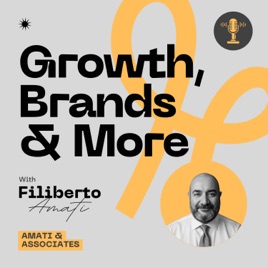
Advertise on podcast: Growth, Brands and More
This podcast has
100 episodes
Language
EnglishPublisher
Filiberto AmatiExplicit
No
Date created
2024/03/27
Latest episode
2026/09/21
Average duration
42 min.
Release period
11 days
Description
"Growth, Brands, and More" is your go-to podcast on how to up your game from brand strategy to marketing execution www.filibertoamati.com
Unlock Growth, Brands and More podcast Email contact info,
Listeners & Audience details
Email contact information
Direct podcast contact details

Listeners
Audience numbers & engagement insights

Audience details
Podcast Insights

Podcast episodes
Check latest episodes from Growth, Brands and More podcast
FMCG Portfolios in a K-Shaped Economy - Live with Filiberto Amati & Todd Wirk
2026/09/21
The K-shaped economy didn't create the barbell in FMCG portfolios. It accelerated a trend already twenty years in the making, and most manufacturers still measure it wrong.
In this episode of Growth, Brands and More, I'm joined by Todd Kirk of Middlegame, an FMCG marketing analytics firm. They build market structure models on Nielsen IQ data, increasingly with AI in the loop.
Todd worked both sides of that data. He started at IRI (now Circana), then moved client-side to Coca-Cola's brand teams. Today he applies that lens at Middlegame, built specifically for FMCG.
We open with the shrink-to-grow thesis and why the mainstream is being pinched from both ends. Then Todd walks through a live case study: a decomposition of sparkling wine sales in Ireland. It separates real incrementality from transfer demand, and shows exactly where a 2.3% retail value gain actually came from.
We close on why revenue growth management and commercial teams keep talking past each other. And on where AI genuinely earns its place in this kind of analysis.
If you manage a portfolio that's being pulled toward value on one side and premium on the other, this one is for you.
In this episode:
00:03:49 — Welcome back: Todd Kirk and Middlegame's read on the "first moment of truth"
00:07:54 — Defining the K-shaped economy:
00:13:48 — Beyond price: multi-banner shopping and the private label upgrade
00:16:02 — From price-pack architecture to portfolio interactions
00:26:06 — Case study: decomposing sparkling wine sales in Ireland
00:40:44 — RGM vs. commercial, market structure as a Rubik's cube, and where AI fits
This is a public episode. If you'd like to discuss this with other subscribers or get access to bonus episodes, visit www.filibertoamati.com/subscribe
International Brands & Polish Supermarkets | Dominik Wilk
2026/09/07
How can international brands enter the ‘hot’ Polish Supermarket scene? What kind of insights should they use, and which should they dismiss?
Host Filiberto Amati interviews Dominik Wilk, now Poland country manager for German wholesaler Crevel Europe, on what international brands need to know to enter Poland's modern trade. He covers logistics, trade promotions, currency and payment-term variability, and how listings often begin as “in-and-out” supported by leaflets and social media before permanent placement. Key mistakes include pitching only product quality, ignoring shopper differences and geography, and treating listing as success; Winning requires ongoing support, preparation, patience, and a consistent strategy.
00:00 Polish Retail P&L Basics
07:19 Logistics, Pricing and Competition
14:37 Listings, Promotions and Retail Maze
23:27 Route To Market Playbook
29:16 Pitching And Listing Mistakes
35:13 Promotions, Trends And Final Advice
This is a public episode. If you'd like to discuss this with other subscribers or get access to bonus episodes, visit www.filibertoamati.com/subscribe
Health as a Board Risk for F&B | AJ van Triest
2026/08/24
Is nutrition the next board-level risk for food and beverage companies? Do we need to install a Chief Nutrition Officer?
Aart Jan recounts a career spanning Unilever (including roles in Singapore, China, and leading the tea division), a Coca-Cola/Nestlé joint venture, and FrieslandCampina. In the latter, he served as corporate CMO and developed a nutrition policy distinguishing daily versus occasional products to grow healthier sales.
After leading fitness and nutrition platform fitchannel.com and selling it to investors, he now consults on applying marketing to public health, arguing health harm is driven more by consumption frequency and usage intensity than by penetration.
AJ goes to the core of his vision of a shift from ingredient accountability to impact and outcome-driven nutrition, enabled by wearables and glucose monitoring. For our guest, health is an emerging board-level portfolio risk alongside shifts in consumer demand and regulation.
Finally, we discuss GLP-1’s effects on cravings, category volumes, and family repertoires, and propose a chief health officer and portfolio KPIs focused on product role, frequency, and health outcomes.
00:00 Career Journey in FMCG
02:45 Health Platform Lessons
09:56 Health as Corporate Risk
37:45 GLP-1 and Demand Shifts
49:09 Chief Health Officer Future
This is a public episode. If you'd like to discuss this with other subscribers or get access to bonus episodes, visit www.filibertoamati.com/subscribe
Olivier Rouche: a spirits industry veteran on RTDs and trends
2026/08/10
What is happening in Spirits? Why are RTDs growing while the rest of the categories are not?
Filiberto hosts a discussion with Chris Maffeo and spirits veteran Olivier Rouche. Olivier recounts his 35 years at Pernod Ricard in commercial strategy & negotiation and his new consultancy, training, and coaching work. They examine the spirits industry’s rapid transformation as premiumization stalls, consumption slows in traditional markets, and demand shifts toward lower-alcohol options.
The group highlights operational and margin challenges for spirits companies entering RTDs, including reliance on third-party production, canning and small-format constraints, best-before dynamics, promo pressure, and retailer assortment tightening.
They distinguish multiple RTD sub-markets (value retail, grab-and-go, multipacks, premium on-trade cocktails) and expect more partnerships with bottlers/distributors. Olivier advises aligning RTDs with company strategy, quantifying margin dilution versus volume-driven value expansion, and ensuring sustainable long-term operations, while warning against rushed launches, cost-driven pricing, and ignoring local consumer differences.
00:00 Meet the Guests
01:12 Olivier's Career Shift
04:17 Spirits Industry Shakeup
13:27 RTDs Strategy and Execution
24:08 RGM Mistakes and Wrap-Up
This is a public episode. If you'd like to discuss this with other subscribers or get access to bonus episodes, visit www.filibertoamati.com/subscribe
The Art and Science of Water | Ganesh Iyer
2026/07/27
What is a water sommelier? Selling water is both an art and a science.
In this Growth Brands and More episode, host Filiberto interviews beverage veteran and water sommelier Ganesh Iyer, who recounts entering the beverage industry before focusing full-time on water sommelier work. Iyer defines the role of the water sommelier and explains the art of pairing meals and beverages. He argues that water education lags in India compared to Europe due to a lack of cultural respect and hospitality training. He highlights common branding mistakes (such as generic messaging or an unclear value proposition) and emphasises tailored on-premise training, moving conversations from procurement to revenue, and future opportunities like water menus, culinary pairing, and meaningful functional benefits, and advises new entrants to define an uncopiable “moat.”
00:00 Welcome and Guest Intro
01:00 Ganesh Career Origins
04:59 Water Sommelier Explained
09:16 Key Water Attributes
16:42 Premium Water Positioning
25:34 Common Branding Mistakes
36:21 Training That Actually Works
47:35 Future Opportunities in Water
51:01 Final Advice and Wrap Up
This is a public episode. If you'd like to discuss this with other subscribers or get access to bonus episodes, visit www.filibertoamati.com/subscribe
Beyond Carbon | Adam Pawelas | Part 2
2026/07/13
What if sustainability needed to go beyond Carbon management to become a strategy?
In this episode, Adam discusses sustainability in FMCG, with an emphasis on localised water risk management. He touches on technologies for water efficiency and closed-loop systems, which are constrained by regulation in some regions, and highlights India’s zero liquid discharge practices. Water savings can also strengthen the business case through energy recovery and loss reduction, with wastewater serving as a bioindicator of inefficiency. He points to regenerative agriculture, intermodal transport, supplier engagement to decarbonise scope 3, growing customer demands for sustainability data, and future trends including nature metrics, risk pricing maturity, shorter supply chains, financial instruments, digital traceability, and collaborative action.
00:00 Water Risk Hotspots
02:25 Mitigation and Closed Loops
06:01 Resilience in Supply Chains
13:27 Scope Three and Supplier Pressure
18:39 Future Trends and Leadership
This is a public episode. If you'd like to discuss this with other subscribers or get access to bonus episodes, visit www.filibertoamati.com/subscribe
The Strategic Evolution of Sustainability | Adam Pawelas | Part 1
2026/06/29
What if sustainability were not about doing good or looking good? What if it were about risk management??
In this episode, Filiberto interviews sustainability professional Adam Pawelas - a sustainability veteran in food and beverages - about how sustainability has evolved over 20+ years from compliance to operational excellence, CSR, and now ESG embedded in business strategy and finance. They discuss universal sustainability practices across industries: mapping stakeholders, identifying material topics, and clarifying internal and external motivations, with leaders differentiating themselves through future-proof asset design, portfolio choices based on product footprints, responsible sourcing for scope 3 impacts, embedding sustainability in risk frameworks, and resourcing commitments via incentives tied to sustainability KPIs. They address myths that sustainability is only a cost or is fading, arguing it is becoming more structured and important for resilience amid extreme weather and geopolitical shocks. The conversation highlights packaging complexity, regional differences in recycling systems and recycled content, and the growing role of EU reporting frameworks and peer pressure in driving action.
00:00 Welcome and Guest Intro
03:04 Sustainability From CSR to ESG
10:57 What Comes Next: Resilience
14:07 Leaders vs Laggards in Practice
20:53 Packaging Regulation and Reporting
This is a public episode. If you'd like to discuss this with other subscribers or get access to bonus episodes, visit www.filibertoamati.com/subscribe
Navigating Complexity in FMCG | Pierre-Yves Parant
2026/06/15
Do large organisations really understand complexity? Or do they underestimate it?
The discussion argues that operations exist to manage organisational complexity but are often overlooked unless disruptions occur, making end-to-end understanding hard in large companies. On AI, it’s described as a buzzword whose operational impact is often oversold: automation isn’t new, and effective AI requires deep process knowledge, high-quality standardised data, documentation, and governance, plus costly model building, training, and controls, making business cases difficult in FMCG operations today; however, AI pressure may accelerate data standards and enable more end-to-end supplier-to-consumer data exchange. For growth strategy, the key operational advice is to start by asking why a “white space” exists, identify execution barriers early, and make explicit trade-offs (e.g., distributor vs creating a legal entity) based on timeline, control, capabilities, and scalability. On barbell portfolios, premium and entry-level require different production, logistics, skills, and standards, risking underutilised assets unless execution is deliberate and guided by a clear playbook. The concluding advice is to involve an operational “buddy” early and stay close to day-to-day operations to sense-check ideas and improve predictability.
00:00 Ops and Complexity Reality
03:49 Why AI Hype Meets Data
11:17 AI Governance and Standards
14:26 Making Growth Plans Executable
26:14 Barbell Strategy and Final Advice
This is a public episode. If you'd like to discuss this with other subscribers or get access to bonus episodes, visit www.filibertoamati.com/subscribe
Perils of Transformation | Pierre-Yves Parant
2026/06/08
Why is there a disconnect between commercial objectives and operational ability to deliver those objectives?
In this episode, our guest, Pierre-Yves Parent, a transformation and operations veteran from Procter & Gamble, Diageo, and Coty, discusses why growth strategies often fail in execution due to mismatches with a company’s operating model. Parent explains end-to-end physical and data flows, highlighting how interfaces and human interpretation create instability and how the biggest tension arises when moving from design to implementation. Using RTDs as an example, he describes a structural misalignment in commercial operations timelines driven by seasonality, weather volatility, supply constraints, artwork/regulatory variations, retailer codification delays, and inventory/scrap and reporting impacts. The conversation also covers large transformations and carve-outs/mergers, noting early design tradeoffs, legal/IT separation limits, shared services complexity, and how weak governance and undisciplined change management can derail benefits by leaving unresolved resistance and incomplete execution.
00:00 Why Strategies Fail
05:30 Execution Meets Reality
10:40 RTD Supply Chain Chaos
20:24 Inside Big Transformations
34:33 Where Transformations Break
This is a public episode. If you'd like to discuss this with other subscribers or get access to bonus episodes, visit www.filibertoamati.com/subscribe
Decoding Consumers: RTDs Beer and GLP-1 | Andy O'Brien | Part 2
2026/06/01
Is premiumness in RTD as important across demographic segments?
How should an Aldi Private Label compete with Guinness? And what would happen if GLP-1 were available in an oral format?
The second part of the discussion between Andy and Filiberto begins with how conjoint analysis reveals which packaging, price, size, and format cues consumers use in split-second FMCG decisions, highlighting ABV as a simplified signal of value, quality, strength, and flavour intensity, and warning that label “communication architecture” can unintentionally drive choice. It contrasts cans (mainstream, larger scale, often requiring partners) with glass (more premium, niche), and argues that innovation expectations should align with the chosen format’s scale. Research shows willingness to pay varies by demographic and market (e.g., French women and younger Spanish males paying premiums for glass), creating tension between segmentation opportunities and supply-chain de-complexification, while “shrink-to-grow” can open white space for smaller brands and even cross-category competitors.
Finally, Andy presents more insights from Epic’s previous research: 1) a UK study on Aldi’s Guinness-like stout found that alternative design choices (e.g., a glossy gold can and a distinct icon); 2) a separate study on oral GLP-1 formats
00:00 Conjoint Research Setup
01:42 Format Choices And Scale
04:40 Segmentation Versus Supply Chain
19:30 Packaging Signals And Copycats
28:49 GLP-1 Oral Disruption Wrap
This is a public episode. If you'd like to discuss this with other subscribers or get access to bonus episodes, visit www.filibertoamati.com/subscribe
RTDs, Conjoint and Consumer Choices | Andy O'Brien | Part 1
2026/05/25
Can we model consumer choices in a timely fashion?
Shouldn’t we test product-related design choices before launching them into the market?
The episode features Andy O’Brien, FMCG & RETAIL VP at Epic Insights, discussing his FMCG background and Epic’s software-driven, decision-based research, which delivers faster insights. They emphasise the need for rapid data to support innovation, challenge assumptions, and keep pace with retailer and internal decision timelines, noting procurement and organisational volatility as barriers and arguing that better tools should reduce high new-product failure rates. The conversation presents Epic-sponsored conjoint research on alcoholic RTDs in Germany, France, and Spain: product is the main choice driver, packaging is second, and their interaction shapes decisions, with price reinforcing expectations. Findings also suggest premium glass packaging complements rather than replaces mainstream cans, with cans driving volume while glass supports higher-value occasions and specific cohorts (e.g., female consumers in France).
00:00 Welcome and Preview
01:49 Meet Andy and Epic Insights
04:17 Fast Conjoint Research at Speed
08:22 RTD Study Insight One Drivers
20:05 Insight Two Packaging Premiumisation Wrap
This is a public episode. If you'd like to discuss this with other subscribers or get access to bonus episodes, visit www.filibertoamati.com/subscribe
The Relevance Blueprint | Magda Adamska
2026/05/18
Why do brands follow trends and waves, embracing change when it is not needed?
Why aren’t they obsessing about brand relevance, which is potentially the mother of all brand problems?
In this Growth Brands and More episode, Philippo interviews brand strategist Magda Adamska, who moved from agency planning (Nike, T-Mobile) to operator roles at MTV/Viacom and Pearson, then became a consultant and built Brand Struck, a database tracking 250 brand positioning analyses. Adamska contrasts the agency's focus on communication and creativity with client-side realities of the full marketing mix, citing Kinder Bueno’s repositioning, which tripled share. She describes shifts from fun/rebel branding to purpose and sustainability, and now “cultural relevance,” warning that fundamentals and measurement matter most. She argues relevance is the key driver of resilience (Uber, Instagram), while decline can stem from lost relevance (Bud Light) or bad business decisions despite relevance (Nike’s DTC shift). They discuss brands travelling internationally (Liquid Death in the UK), the importance of fame/awareness and investment, and why brand architecture projects start from portfolio messes driven by short-term incentives, acquisitions, and weak CEO stewardship.
00:00 Meet Magda Adamska
05:25 Brand Trends and Relevance
22:32 Brand Architecture Fixes
29:40 Short-Termism and Fake Innovation
32:43 CEO Stewardship and Brand Splits
40:45 Future Priorities and Value
This is a public episode. If you'd like to discuss this with other subscribers or get access to bonus episodes, visit www.filibertoamati.com/subscribe
Avoiding Toxic Growth | François Bazini
2026/05/11
Growth at any cost is still a mantra. But toxic growth creates more problems than it solves.
In part two of the chat with François Bazini, the host continues a conversation about “toxic growth” and why CMOs fail, arguing that marketers often chase glamorous, short-term levers, flavour “innovations,” promotions, ill-conceived category moves, or new consumer targets that look good on paper but poison brands, instead of doing the harder work of growing the core. François illustrates toxic growth through Ribena’s decline from a top UK brand in 2015 to outside the top 100 by 2022 after shifting away from families, launching non-credible flavoured water and sparkling RTDs, and becoming promotion-dependent. They discuss how companies mismanage brands, avoid postmortems, and misread success, citing Celsius’ growth as driven largely by a competitor’s delisting and a COVID-era shift to no-sugar. He also predicts that successful CMOs must both strengthen core brand growth and build disruptive new brands.
00:00 The types of Growth
00:43 Fake Innovation and Incentives
02:26 Defining Toxic Growth
06:33 Ribena Case Study Breakdown
26:46 Future of the CMO
This is a public episode. If you'd like to discuss this with other subscribers or get access to bonus episodes, visit www.filibertoamati.com/subscribe
Goodbye CMO. Hello Chief Growth Officer | François Bazini
2026/05/04
From Chief Marketing Officer to Chief Growth Officer.
New Label or New Reality? What’s the future of marketing?
Filiberto interviews François Bazini, former CMO Europe at Suntory, about how the CMO role is changing and why some companies relabel it as a Chief Growth Officer. François recounts his global FMCG career (Danone, PepsiCo, Suntory) and contrasts functional marketing leadership with P&L general management, arguing that strong CMOs act as “brand CEOs” who own trade-offs across top line, bottom line, capital, and time horizons. He says CMOs often fail by avoiding ROI discussions or shifting spend to only what’s easily measurable, overemphasising short-term activation over long-term brand building. He also argues that CMOs must be brand stewards while improving ROI credibility by reframing returns around equity and pricing power, and advises marketers to build both “PowerPoint and Excel” skills and to speak the finance, supply chain, HR, and commercial languages.
00:00 Meet François Bazini
02:42 From CMO to P&L Leader
06:00 Brand CEO Mindset
10:56 ROI Trap and Brand Stewardship
23:08 Chief Growth Officer: The Future
This is a public episode. If you'd like to discuss this with other subscribers or get access to bonus episodes, visit www.filibertoamati.com/subscribe
The Blurring Boundaries of Nicotine | Joel Rubenstein
2026/04/27
Nicotine Products are not a smoking cessation category anymore.The Blurring Boundaries of Nicotine. And that changes everything.
Nicotine pouches show this shift clearly.
They look less like medicine and more like mints.
Consumers prefer formats that don’t make them feel like patients.
In this episode, Filiberto interviews Joel Rubenstein, an LBS alumnus and consumer health veteran, about his career in consumer health and the evolution of nicotine products. Rubenstein explains why tobacco companies are moving into cessation/harm reduction: nicotine is both the addictive problem and the cessation ingredient, it is hazardous to manufacture, and cigarette sales are declining. He contrasts highly regulated pharmaceutical players with rapidly innovating non-pharma products (vapes, gums, strips, and especially nicotine pouches), predicting recreational products will outcompete pharma’s. He stresses policymakers often wrongly equate tobacco with nicotine, notes inconsistent regulation (e.g., marijuana legalisation vs pouch bans), and warns unethical marketing, teen targeting, and ultra-strong pouches could trigger backlash, arguing for stronger retailer/supply-chain accountability and self-policing.
This is a public episode. If you'd like to discuss this with other subscribers or get access to bonus episodes, visit www.filibertoamati.com/subscribe
Podcast reviews
Read Growth, Brands and More podcast reviews
Podcast sponsorship advertising
Start advertising on Growth, Brands and More relevant audience podcasts
You may also like to advertise on these Podcasts
4.714083346
Bad Friends
Bobby Lee & Andrew Santino

4.7124668
10 to Life
Annie Elise

4.76746460
Criminology
Emash Digital & Mike Ferguson, Mike Morford
4.87488968
The Dr. John Delony Show
Ramsey Network
4.9247491432
Unashamed with the Robertson Family
Tread Lively
4.6652292197
The Charlie Kirk Show
Charlie Kirk
4.830862000
The Quote of the Day Show | Daily Motivational Talks
Sean Croxton
4.7292562000
The Michael Knowles Show
The Daily Wire
4.7277922000
The Matt Walsh Show
The Daily Wire
4.8120961000
Mind Pump: Raw Fitness Truth
Sal Di Stefano, Adam Schafer, Justin Andrews, Doug Egge