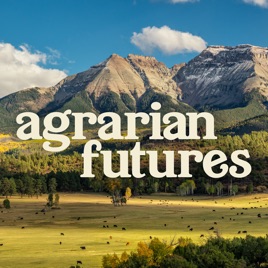
Advertise on podcast: Agrarian Futures
Rating
4.9from
This podcast has
50 episodes
Language
EnglishPublisher
Agrarian FuturesExplicit
No
Date created
2024/04/22
Latest episode
2026/10/02
Average duration
46 min.
Release period
16 days
Description
Join hosts Emma Ractliffe and Austin Unruh as they explore what’s broken in our food system, and what it looks like to build something better. Visit agrarianfuturespod.com to join our email list for a heads up on upcoming episodes and bonus content. Agrarian Futures is produced by Alexandre Miller, who also wrote our theme song. Instagram: @agrarianfuturespod Twitter: @agrarianfutures LinkedIn: https://www.linkedin.com/company/103857304/
Unlock Agrarian Futures podcast Email contact info,
Listeners & Audience details
Email contact information
Direct podcast contact details

Listeners
Audience numbers & engagement insights

Audience details
Podcast Insights

Podcast episodes
Check latest episodes from Agrarian Futures podcast
Building a Cooperative Food System Pt. 1: Land Access with Fordhall Community Farm
2026/10/02
If we're serious about building a better food system, we have to start with land.
Across the world, land is getting more and more expensive. In the United States, farmland values have nearly doubled since 2011. What we're witnessing is an unprecedented land rush — one that's driving prices to levels simply unattainable by farmers and ranchers and the people we're actually asking to grow our food. As land is sold to development, we are losing an estimated 2000 acres of farmland every single day.
But the bigger story is what's coming. More than 40% of American farmland is owned by people over the age of 65. What this means is that roughly 370 million acres, an area larger than Texas and California combined, is expected to change hands over the next twenty years. Who ends up owning it will shape our food system for decades.
This mini-series is about what a food system built on cooperative principles could actually look like. In a world where land is becoming a speculative asset owned by distant investors, what would it look like to take land back - to hold it in common, to make sure the people actually farming it can afford to be there?
We need alternatives. And one of the clearest working answers I've come across is Fordhall Community Farm. It’s an almost unbelievable underdog tale that has a lot to teach us about the future of land access in our food system.
More about Charlotte and Fordhall Community Farm:
After having fought hard to save their family home from development, Charlotte settled into her dream job managing the FCLI as their General Manager.
Charlotte is passionate about communities connecting with nature, our landscape and the nutritious food it provides. Her work guiding the Fordhall Community Land Initiative as the General Manager, supports this journey for us all. In-line with the FCLI's commitment to inspire others, Charlotte offers consultancy to other land-based community groups across the country who want to learn from Fordhall and follow in our footsteps.
With this in mind, Charlotte and Ben published a book in 2007, The Fight for Fordhall Farm, which charts their lives at Fordhall from childhood to community-ownership. The book was sold in bookstores across the country and there was even a musical based on it, which toured Shropshire in 2008.
Charlotte is also one of the Community Leaders driving forward the campaign for a Community Power Act.
————-
Agrarian Futures is produced by Alexandre Miller, who also wrote our theme song. This episode was edited by Drew O’Doherty.
Season 3 Trailer: Building a Cooperative Food Future
2026/09/25
We often talk about how the food system is broken, but what would it look like to build one that is better?
In Season 3 of Agrarian Futures, we reimagine a food system rooted in cooperative principles. What if we didn't live in a winner-takes-all economy, but one where cooperatively owned enterprises worked in partnership with each other across the food supply chain?
Through deep dives into examples on the ground, we'll chart a path from our present moment to a better food future. Launching October 2nd!
Rethinking Our Relationship with Land (Feed Drop: How to Change the World)
2026/09/11
Hi everyone - Emma here. We're deep in prep for our new miniseries on Agrarian Futures where we will be exploring the potential for a better food system rooted in cooperative principles.
In the meantime, we’ve got a special announcement: Agrarian Futures is joining the World Within Studios Podcast Network!
World Within is a non-profit that invests in solutions and stories that are building an economy that's owned by the many, not just the few. We are delighted to be adding Agrarian Futures to that effort!
Today, we’re cross-posting an episode of our fellow World Within Studios show: the How to Change the World Podcast.
In this episode, my friend Rostam Zafari sits down with Cooper Hibbert, co-founder of Old Salt Co-Op - a cooperative of Montana ranchers pushing back against big beef. His co-founder Cole Mannix was on a previous episode of Agrarian Futures and I think this conversation today adds even more to the picture of what it will take to build a better food system.
-------
Agrarian Futures and the How to Change the World Podcast is produced by Alexandre Miller, who also wrote our theme song. This episode was edited by Eve Weston and Martin McGreevy.
What Big Agriculture is Hiding with Will Potter
2026/08/28
Our guest today Will Potter’s new book, Little Red Barns, started as a tale about censorship in journalism around industrial agriculture, but became something much bigger: a 10 year investigation look at how factory farming, an ages old mythos of family farms, and the rise of authoritarian politics have all worked in tandem to produce social, economic, and ecological disaster.
Will is an investigative journalist and author of Green Is the New Red. In this conversation, we talk about what he found writing Little Red Barns, from the industry's efforts to keep cameras out of factory farms to what that secrecy is really protecting.
In this episode, we explore:
The story of the “little red barn” that masks a darker truth about industrial agriculture What led Will to spend a decade investigating factory farms and how the project grew beyond ag gag laws How ag gag laws work, and how they've been used to prosecute journalists and whistleblowers Competing visions for what comes next: What role animals play, and should play, in our food system How Will connects factory farming to the broader rise of authoritarian politicsMore about Will:
Will Potter is an award-winning investigative journalist and TED Senior Fellow who exposes political repression and the erosion of civil liberties. His reporting and commentary have appeared in The Washington Post, Foreign Policy, and Rolling Stone, and has helped overturn prosecutions and challenge censorship laws. He has been invited to testify before the U.S. Congress, the Australian Parliament, and the Council of Europe, advocating for protest rights and press freedom. His landmark book Green Is the New Red revealed how governments and corporations have labeled nonviolent activists as “terrorists.” Counter Terrorism Unit surveillance documents described it as “compelling and well-written.” His new book, Little Red Barns, is the result of a 10-year investigation into factory farms and rising fascism, and was recently named one of Publishers Weekly’s most-anticipated releases and a starred review.
Will’s journalism and scholarship have been heavily influenced by growing up in the hardcore punk scene, and he has collaborated with bands including Rise Against. He was previously a Knight-Wallace Fellow and visiting professor at the University of Michigan, and was named the distinguished journalist-in-residence at the University of Denver Sturm College of Law. He was born and raised in Fort Worth, Texas.
————-
Agrarian Futures is produced by Alexandre Miller, who also wrote our theme song. This episode was edited by Drew O’Doherty.
The Common Ingredients of Success in the Regenerative Movement
2026/08/14
Enjoy Part 2 of Emma and Austin's reflections on 2.5 years of Agrarian Futures. In this episode, they highlight the commonalities they see in the big success stories of the regenerative movement, including cooperative economics, finding the right niche in the food system, learning to tell your story, and much much more.
————-
Agrarian Futures is produced by Alexandre Miller, who also wrote our theme song. This episode was edited by Drew O’Doherty.
The Big Lessons from Agrarian Futures with Emma and Austin
2026/07/29
Hi all! This time, we're doing something a bit different.
In this episode, Emma and Austin - hosts of Agrarian Futures - sit down to tell their own story, and share some of their key takeaways of 2.5 years of talking with brilliant farmers and thinkers about the future of our food system. Enjoy!
————-
Agrarian Futures is produced by Alexandre Miller, who also wrote our theme song. This episode was edited by Drew O’Doherty.
Permaculture and the Case for Hope with Geoff Lawton
2026/07/14
In this conversation, Geoff Lawton offers us something rare: a genuinely hopeful and rigorously grounded vision of how humanity can become a reparative rather than destructive force on this planet.
As one of the world's leading permaculture designers and educators, Geoff has built demonstration sites and trained practitioners across six continents, from the Jordan Valley to the Australian bush. At Zaytuna Farm in New South Wales, he has spent over two decades transforming bare, degraded land into a thriving food forest with 32 bodies of water, hundreds of tree species, and a model for what regenerative living can look like at every scale.
In this episode, we dive into:
How permaculture redefines wealth, from money to clean air, clean water, clean food, and community Why the biggest missing element in modern agriculture is trees How soil organic matter holds the key to our water crisis What Zaytuna Farm looks like today after 25 years of regeneration Why our economy needs to shift from extraction to deposition How permaculture projects in Jordan, Hungary, and Spain are proving this works at scale Why Geoff believes humanity may be on the verge of a new kind of consciousnessMore about Geoff Lawton, Zaytuna Farm, and Discover Permaculture:
Geoff Lawton is a world renowned permaculture consultant, designer and teacher. He took his PDC in 1983 with Bill Mollison, widely considered the “father of permaculture.” Geoff has specialized in permaculture education, design, implementation, system establishment, administration and community development since 1985. Working in over 50 countries, Geoff has taught more than 15,000 students, he established the Permaculture Research Institute of Australia and Zaytuna Farm which is Geoff and Nadia’s family home. As an award winning Permaculture Designer, Geoff’s main aim is to drive the establishment of self-replicating educational demonstration sites across the globe.
Agrarian Futures is produced by Alexandre Miller, who also wrote our theme song. This episode was edited by Drew O’Doherty.
The Future of Regenerative Agriculture with Gabe Brown
2026/06/26
Gabe Brown didn't set out to revolutionize agriculture. He set out to survive it.
After four consecutive years of crop disasters left him $1.5 million in debt, he had no choice but to question everything he'd been taught. What emerged from that reckoning became one of the most influential farms in the regenerative agriculture movement, and eventually two organizations working to spread those lessons globally: Understanding Ag, now consulting on over 37 million acres worldwide, and Regenified, a verification company built to cut through the greenwashing.
In this episode, we look forward. Where is regenerative agriculture headed? Who's driving it, and what's standing in the way?
In this episode, we dive into:
How four years of disaster became the foundation of a regenerative farming philosophy What it actually means to farm in synchrony with nature, and why it works anywhere Why farmers care more about the land than they're given credit for How to become a price maker instead of a price taker The role of banks, insurers, and major brands in accelerating the regenerative transition Why Gabe thinks regenerative will be the norm within 25 years What the next generation of farmers looks like, and where they're coming fromMore about Gabe Brown:
Gabe, along with his wife Shelly, and son Paul, own and operate Brown's Ranch, a diversified 5,000 acre farm and ranch near Bismarck, North Dakota. The ranch consists of several thousand acres of native perennial rangeland along with perennial pastureland and cropland. Their ranch focuses on farming and ranching in nature's image.
Over 2,000 people visit the Brown's Ranch annually to see this unique operation. They have had visitors from all fifty states and twenty-four foreign countries.
Gabe and Brown's Ranch have received many forms of recognition for their work, including a Growing Green award from the Natural Resource Defense Council, an Environmental Stewardship Award from the National Cattlemen's Beef Association, and a Zero-Till Producer of the Year Award, to name a few. Gabe has also been named one of the twenty-five most influential agricultural leaders in the United States.
Gabe recently authored the book, “Dirt to Soil, One Family’s Journey Into Regenerative Agriculture.”
Links to Gabe’s Work:
Brown’s Ranch
Regenified
Understanding Ag
Agrarian Futures is produced by Alexandre Miller. This episode was edited by Drew O'Doherty.
The Farm Bill Explained with Judith McGeary
2026/06/12
You can't understand the modern food system without understanding the policy that shaped it. And you can't understand US food policy without understanding the Farm Bill.
Judith McGeary is an attorney, farmer, and the founder of Farm and Ranch Freedom Alliance, a national organization that supports independent family farmers and fights corporate consolidation of the food system. In this conversation, Judith breaks down what's actually in the Farm Bill, adds some needed nuance to the subsidy debate, and explains what's at stake as the bill moves through the US Senate right now - and how you - yes you! - can help shape it.
In this episode, we dive into:
What the Farm Bill actually is and why it touches nearly every aspect of our food system Why the Fam Bill has become a divisive political issue after years of bipartisan support The pesticide liability shield and what corporate overreach looks like in practice Opportunities for regenerative funding through direct farmer advocacy Where the Farm Bill stands right now and what's at stake in the Senate Concrete ways you can show up and influence the outcome before it's too lateMore about Judith McGeary and Farm and Ranch Freedom Alliance:
Judith McGeary is an attorney, activist, and sustainable farmer. After earning her BS from Stanford University and her law degree with high honors from the University of Texas at Austin, she clerked for a Federal Appeals Court and went on to private law practice. After seeing how government regulations benefit industrial agriculture at the expense of family farms, she founded the Farm and Ranch Freedom Alliance to promote common-sense policies for local, diversified agricultural systems. She and her husband raise sheep, chickens, and cattle on their farm outside of Austin, Texas.
Find more and take action at the links below:
Farm Bill Action Hour Toolkit — get involved now News about the House-passed version of the Farm Bill: Farm Bill UPDATE: A Major Win & Setbacks - Farm and Ranch Freedom Alliance Deep dive into the issue of fair prices/ price supports for farmers from National Family Farm Coalition: Fair Prices for Farmers - National Family Farm Coalition IATP for deep dives into several Farm Bill topics: Agriculture & Food Systems | IATPAgrarian Futures is produced by Alexandre Miller, who also wrote our theme song. This episode was edited by Drew O’Doherty.
What Animals Teach Us About Caring for the Land with Fred Provenza
2026/05/26
Our guest today, Fred Provenza, has spent his career listening to what animals can teach us: about landscapes, about food, about the deep intelligence woven into the living world.
Fred is professor emeritus of Behavioral Ecology at Utah State University, where he directed an award-winning research program that pioneered our understanding of how early experience, family, and landscape shape the foraging wisdom of animals. He is the author of over 300 scientific papers and three books, including Nourishment: What Animals Can Teach Us About Rediscovering Our Nutritional Wisdom, Foraging Behavior: Managing to Survive in a World of Change, and The Art & Science of Shepherding, co-authored with French herder Michel Meuret.
In this conversation, Fred draws on a lifetime of ranching, research, and wide-ranging inquiry, taking us from the pastures of Utah to the pre-alps of France. Together we reflect on what we've lost, what endures, and what it might mean to come home to a more intimate relationship with the land.
In this episode, we dive into:
His childhood in small town Colorado and how it cultivated a deep sense of community that has since largely vanished from American rural life Seven years working on Henry De Luca's ranch, and what that experience revealed about the irreplaceable knowledge embedded in intimate relationships with land and animals What the concept of epigenetics tells us about the deep, inherited intelligence of locally adapted herds The extended family lives of livestock, and what shepherds in France have long understood about nutritional wisdom, plant diversity, and the art of moving animals across a landscape What Buddhism, near-death experiences, and quantum physics have in common, and why Fred believes consciousness is our truest nature The local food economy as a web of interdependence. And much more…More about Fred:
Fred Provenza is professor emeritus of Behavioral Ecology in the Department of Wildland Resources at Utah State University, where he directed the BEHAVE program — an international network of scientists, ranchers, farmers, and land managers integrating behavioral principles with local knowledge. His books include Nourishment, Foraging Behavior, and The Art & Science of Shepherding. He has published over 300 research papers and spoken at more than 600 conferences around the world.
Find more of Fred's work: Nourishment The Art & Science of Shepherding
Agrarian Futures is produced by Alexandre Miller, who also wrote our theme song. This episode was edited by Drew O’Doherty.
How Land Heals with Judith Schwartz
2026/05/08
Our guest today - Judith Schwartz - has spent her career showing us that the natural world is more resilient than we think, and that we have more power to restore it than we have been led to believe.
Judith is a journalist and author whose books, Cows Save the Planet, Water in Plain Sight, and The Reindeer Chronicles, have taken readers from the degraded hillsides of China's Loess Plateau to the Arctic tundra of Norway.
In this conversation, Judith shares stories from around the world of people healing land, rebuilding community, and rediscovering a sense of meaning in the process. It was lovely to sit with Judith and remember that restoration is closer than we think.
In this episode, we dive into:
Why the climate crisis is, at its root, a people problem and what that means for how we respond to it The Loess Plateau in China: how an area the size of the Netherlands was brought back from ecological collapse, lifting 2 million people out of poverty Common Land and the "four returns" model, and what a business designed to serve the land actually looks like The Sami reindeer herders of Norway, and what their ancient practice reveals about the intelligence hidden in animal and land relationships Why photosynthesis, not money, may be the truest measure of wealth The rights of nature movement and the stop ecocide movement as legal pathways toward a different relationship with the living world What it means to slow down as a communicator, and why listening has become more central to Judith's work than publishingMore about Judith (check out her substack!):
Judith D. Schwartz is an author and speaker who looks at our environmental crises, including climate change, through the lens of nature. Not nature as a “thing”, but how natural systems “work”, creating the conditions for life to thrive. Her books include The Reindeer Chronicles, Water In Plain Sight, and Cows Save the Planet. Home base is a gentle mountain slope in southwest Vermont.
Find more of Judith at the links below:
www.judithdschwartz.com
https://judithdschwartz.substack.com/
Agrarian Futures is produced by Alexandre Miller, who also wrote our theme song. This episode was edited by Drew O’Doherty.
Life on the Range with Glenn Elzinga
2026/04/20
Many of us have lost the thread that connects us to our food. Glenn Elzinga is spending his life trying to pick it back up.
Glenn is the founder of Alderspring Ranch, a certified organic grass-fed beef operation in the remote Salmon River country of central Idaho. But describing it as a beef operation barely scratches the surface. Each summer, Glenn and his family, along with a rotating crew of interns, ride on horseback across 70 square miles of mountain range, living alongside their cattle for months at a time, following the melting snow and the greening grass. It is, as Glenn describes it, an ancient practice of shepherding that modern agriculture has all but forgotten.
In this conversation, Glenn challenges some of the deepest assumptions embedded in how we raise animals and grow food. What does it mean to be a caregiver rather than a caretaker? What happens when we let a cow be a cow? And what is lost when we reduce agriculture to a production equation?
In this episode, we dive into:
How Glenn's model revives an ancient, nearly lost practice of herdsmanship The difference between productivity and profitability, and why it matters for the land What cows can teach us when we actually pay attention to them Why 400 young people applied for unpaid, grueling ranch internships, and what they found there The caregiver versus caretaker distinction, and what it reveals about our relationship to animals, land, and each other Why Wendell Berry's diagnosis of American agriculture is as relevant today as it was 60 years ago Why getting people to cook again might be one of the most radical things we can doMore about Glenn and Aldersping:
Glenn Elzinga is the head guy (aka CEO), and with Caryl, co-founder of Alderspring. Twenty-four years ago, he left his 9-5 forestry job, bought 7 cows and a small ranch, and began producing beef with his wife Caryl. Today, he owns and manages Alderspring (1650 deeded acres and 46,000 rangeland acres) while raising his 7 daughters and producing grass fed organic beef. His passion for wellness as an interconnected web of soil, land, animal, and human health led him and Caryl to create their "inherding" grazing paradigm. Glenn also currently speaks as a guest in both podcasts and regenerative agriculture conferences.
Agrarian Futures is produced by Alexandre Miller, who also wrote our theme song. This episode was edited by Drew O’Doherty.
Blending Forest and Field with Steve Gabriel
2026/04/01
Steve Gabriel joins us to unpack one of the most consequential myths shaping how we grow food in America: the separation between forest and field.
As a co-steward of Wellspring Forest Farm in Mecklenburg, New York, author of Silvopasture, and researcher at the Cornell Small Farms Program, Steve has been listening. Through a SARE-funded project called Farming with Trees, he's been in conversation with over 120 farmers, from Bronx-raised beginners to multi-generational stewards, exploring not just how to plant trees, but why it matters and what gets in the way.
What he's found is that the barriers to agroforestry aren't just technical. They're cultural, historical, and deeply personal, rooted in a Eurocentric agricultural paradigm that told farmers to clear the land and never look back.
In this episode, we dive into:
How personal relationships with trees in childhood shape a farmer's vision for the land The paradigm shift required to move from stark field or stark forest toward something in between How indigenous land stewardship modeled a working tree landscape long before "agroforestry" was a word What livestock farmers, vegetable growers, and flower farmers each need from trees and why those needs are so different Why starting with willow and poplar might matter more than starting with chestnuts and apples The role of community, craft traditions, and living fences in rebuilding our relationship with treesMore about Steve (links below):
Steve Gabriel is an ecologist, farmer, and educator from the Finger Lakes Region of New York. Throughout his career spanning 20 years, Gabriel has taught thousands of farmers and land stewards about land planning, mushroom growing, and agroforestry. His experience working in academic research and extension, as a teacher and lecturer, and managing several working farm landscapes has built a unique balance of knowledge and practice which he brings to his work.
With his family, Gabriel co-stewards Wellspring Forest Farm, which is an agroforestry demonstration farm that produces mushrooms, nursery trees, pastured lamb, maple syrup, and elderberry in Mecklenburg, New York. He also collaborates with diverse individuals and organizations through the Farming with Trees Collective.
Gabriel previously served for 12 years as Extension Specialist for the Cornell Small Farm Program, focused on research and education on agroforestry and mushroom production. Steve co-authored Farming the Woods with Ken Mudge (2014) and is the author of Silvopasture (2019).
www.MycenaTrees.org -- his new non profit working on social aspects of agroforestry
www.FarmingWithTrees.org -- report on listening sessions with farmers and nursery stewards
www.WellspringForestFarm.com -- Steve's farm website
Agrarian Futures is produced by Alexandre Miller, who also wrote our theme song. This episode was edited by Drew O’Doherty.
The Economics of the Other Half with Jim and Mark Kleinschmit
2026/03/19
Regenerative agriculture isn’t just about how we raise animals. It’s about whether the entire system around them makes sense.
Smaller, regenerative producers with meat businesses, have traditionally lacked an economic outlet for hides and other byproducts. That missing piece can be the difference between a system that works for regenerative farmers and one that doesn’t.
Jim and Mark Kleinschmit are working to rebuild that piece. Through Other Half Processing, they’re creating new pathways for regenerative hides and reconnecting ranchers to a leather economy that reflects the full value of the animal.
In this episode, we dive into: • Why whole-animal thinking is essential to regenerative systems • How value from hides and byproducts has been pulled out of local economies • What that means for the economics of regenerative ranching • What it takes to rebuild regional leather and processing infrastructure • The role of tanneries, brands, and partnerships in closing the loop • Where they see real opportunity to make these systems work again
More about Other Half Processing:
Jim & Mark Kleinschmit. Brothers that grew up on a family farm in Northeast Nebraska. Raised by parents who were early adopters and champions for sustainable and regenerative agriculture.
OHP works directly with farmers/ranchers and small and medium sized meat processors to verify and buy traceable hides and other meat processing byproducts from regeneratively raised, organic, grassfed and other ethically raised animals. We aggregate and sell raw and finished products to apparel, food and pet sector companies.
Their business model is centered on providing shared economic returns to producer and other value chain partners, and fair pricing for customers and market partners.
Agrarian Futures is produced by Alexandre Miller, who also wrote our theme song. This episode was edited by Drew O’Doherty.
The Dark Miracle of the Supermarket with Benjamin Lorr
2026/02/27
We walk into our local grocery store and most likely barely consider what’s on display in front of us. Forty thousand items. Stacked, uniform, produce. Cuisine from around the globe. Open often 24 hours.
As author Benjamin Lorr points out, that can be considered a miracle.
In The Secret Life of Groceries, Ben dives deep into the hidden machinery behind that miracle. He spent years inside the system, working behind a Whole Foods fish counter, riding cross-country with long-haul truckers, and tracing supply chains all the way to shrimp boats in Thailand. What he found is a system that delivers abundance, convenience, and quality at historically unprecedented levels. But it does so by squeezing every inefficiency out of the chain, and often squeezing workers and ecosystems along with it.
In this episode, we dive into: • Why the modern supermarket truly is miraculous • How deregulation reshaped trucking and the invisible logistics backbone of food • What “just-in-time” efficiency means for grocery workers • The hidden labor dynamics behind ultra-cheap shrimp and other commodities • Why certifications and labels often can’t fix systemic incentives • The tension between convenience, price, and ethics • Whether we actually have the food system we’ve chosen
More about Benjamin:
Benjamin Lorr is the author of Hell-Bent, a critically acclaimed exploration of the Bikram Yoga community that first detailed patterns of abuse and sexual misconduct by guru Bikram Choudhury, and The Secret Life of Groceries, called “a titanic achievement of reportage, insight, humor, and humanity” examining the American supermarket from all angles. Lorr is a graduate of Montgomery County, Maryland public schools and Columbia University. He lives in New York City.
You can buy Benjamin’s books online here or for audiobooks, here.
Follow him on Instagram.
Agrarian Futures is produced by Alexandre Miller, who also wrote our theme song. This episode was edited by Drew O’Doherty.
Podcast reviews
Read Agrarian Futures podcast reviews
Mehggubfrigffvg 2025/08/01
Great guests so far!
You’re getting all the leading and emerging voices in this area, which is great. The challenge will be keeping the topic fresh after you’ve moved thr...
Panda pooh bear 2025/03/13
Great motivating and inspiring content
I have thoroughly enjoyed each of the conversations with innovative producers.
Charlotte Maria Smith 2024/10/04
Amazing podcast
Worth a listen!
Isabelle Annette Williamson 2024/10/04
Fascinating podcast about farming
This is a great podcast. I have learned a lot about all the different initiatives going on in organic and regenerative agriculture. The hosts intervi...
Judy biggs 2024/09/21
Amazing podcast
Incredible listen! Made me shift my mindset and reconsider so many things about how insee food and agg
Podcast sponsorship advertising
Start advertising on Agrarian Futures relevant audience podcasts
You may also like to advertise on these Podcasts
4.9554072194
The MeidasTouch Podcast
MeidasTouch Network

4.639655
Only Murders in the Building Podcast
Straw Hut Media

4.7830518
The Home Service Expert Podcast
Tommy Mello: $200 Million Founder|Forbes, Inc., Entrepreneur Columnist

4.443461356
Something You Should Know
Mike Carruthers | OmniCast Media
4.7906254
Everything is Fine
Jennifer Romolini and Kim France

4.610836573
Serialously with Annie Elise
Annie Elise & Audioboom Studios
4.41171483
The Outlier Health Podcast
Matt Frazier, Matt Tullman, Isabelle Caputo, and Doug Hay

4.616141358
Giggly Squad
Hannah Berner & Paige DeSorbo
4.8219787
Imperfect Action
Steph Taylor
4.727535588
This Past Weekend w/ Theo Von
Theo Von