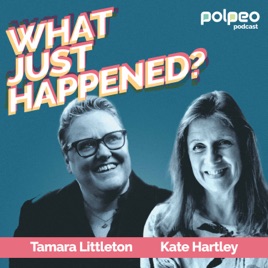
Advertise on podcast: What Just Happened? A Polpeo Podcast
This podcast has
33 episodes
Language
EnglishPublisher
Kate Hartley & Tamara LittletonExplicit
No
Date created
2024/05/22
Latest episode
2026/09/24
Average duration
20 min.
Release period
18 days
Description
The podcast that looks at the biggest brand crises of our time.
Unlock What Just Happened? A Polpeo Podcast podcast Email contact info,
Listeners & Audience details
Email contact information
Direct podcast contact details

Listeners
Audience numbers & engagement insights

Audience details
Podcast Insights

Podcast episodes
Check latest episodes from What Just Happened? A Polpeo Podcast podcast
WJH Shorts: The Grand Theft Auto 6 Leak
2026/09/24
What happens when one of the most anticipated entertainment launches in the world is compromised by a major leak? How should a brand respond when confidential content starts circulating online, misinformation makes it harder to distinguish fact from fiction, and those responsible attempt to profit from the chaos? And can staying relatively quiet actually be the smartest crisis communication strategy?
In this episode of What Just Happened?, Kate Hartley and Tamara Littleton examine the leak surrounding the forthcoming Grand Theft Auto release, exploring not only what happened, but also the wider implications for brands dealing with cyber breaches and confidential information.
When clips showing apparent new features in GTA6 began appearing online, shared by an individual or group calling themselves CyberLeak, Take-Two Interactive responded with copyright takedowns and legal action aimed at uncovering those responsible. Genuine leaked footage became mixed with potentially AI-generated material, creating further uncertainty over what was authentic and what could legally be removed.
Kate and Tamara discuss why the restrained response may have worked in its favour, how gaming companies approach communications differently from many other industries, and why public anger appears to have focused on the leakers rather than the company itself.
A full transcript of today’s show is available to read here.
Direct Action in the Age of Angst
2026/09/10
When conventional protest appears powerless, what makes people turn to direct action against organisations? How should leaders respond when anger becomes disruption, criminal damage or violence? And could anxiety about artificial intelligence create the next flashpoint for public protest?
In this episode of What Just Happened?, Kate Hartley and Tamara Littleton are joined by crisis communications expert Rod Cartwright to examine why direct action is rising up risk registers and what organisations can do about it.
The discussion traces direct action from the Luddites, suffragettes and civil rights movement to Occupy, Extinction Rebellion, Just Stop Oil and Palestine Action. It explores how moral mandates and ‘in-group leniency’ shape perceptions of acceptable protest, and why companies can become targets through financing, investments or supply chains even when they are not directly involved in a contentious industry.
The conversation offers practical, timely guidance for organisations facing boycotts or disruptive protests: understand the wider risk environment, stress-test security and communications plans, protect employees, respond firmly to illegality, and show empathy for the concerns driving the action. It also considers whether organisations should speak out on divisive issues – and why any position must be grounded in business, strategy and brand reality.
A full transcript of today’s show is available to read here.
WJH Shorts: Evri Sues BBC
2026/07/23
What happens when a company challenges damaging media coverage in court? Can legal action restore commercial confidence, or does it simply revive the allegations and expose them to a much wider audience? And in an age when AI systems continually resurface past controversies, can a brand ever truly move on from a reputational crisis?
In this episode of What Just Happened?, Kate Hartley and Tamara Littleton examine Evri’s reported £1.2 million legal action against the BBC following a Panorama documentary broadcast in December 2025. The programme raised concerns about delivery standards, customer dissatisfaction and working conditions, while Evri’s owners argue that the coverage caused serious financial damage.
We explore whether the case could draw renewed attention to claims that many people may previously have missed, and consider how the dispute could influence the information surfaced by search engines and generative AI, which can preserve associations between brands and controversies long after public attention has moved elsewhere.
We also discuss the potential tension between legal, commercial and communications priorities and whether the outcome could influence Evri’s ability to win major retail contracts. The key question is whether securing a legal victory will outweigh the long-term reputational cost of bringing the original allegations back into public view.
A full transcript of today’s show is available to read here.
The HelloFresh Pride Post
2026/07/16
What happens when a brand makes a bold Pride statement and refuses to retreat when criticism follows? Can humour create genuine connection with LGBTQ+ audiences, or does it risk reducing a diverse community to a stereotype? And when opposition becomes loud and hostile, should organisations apologise, stand firm or reconsider how they demonstrate their values?
In this episode of What Just Happened?, Kate Hartley and Tamara Littleton examine the reaction to HelloFresh’s cheeky Pride Month social media post and explore what the controversy reveals about corporate inclusion, brand values and crisis preparedness.
Along with Structural DEI consultant Ashley Alleyne, they discuss why the post attracted disproportionate international attention, why much of the outrage misunderstood the joke, and how HelloFresh responded without apologising or abandoning its position. The conversation also considers why inclusion cannot simply be added to a campaign at the final stage. Instead, it must influence how organisations collect data, brief teams, approve ideas, choose partners and prepare for potential backlash.
The episode also explores cultural differences, employee divisions and harm reduction, asking organisations to focus not merely on what their campaigns say, but on what their actions materially achieve.
A full transcript of today’s show is available to read here.
WJH Shorts: Starbucks Korea ‘Tank Day’ Backlash
2026/07/02
How does a global brand make a mistake so culturally insensitive that it triggers boycotts, political condemnation, police scrutiny and store closures?
In this episode of What Just Happened?, Kate Hartley and Tamara Littleton discuss Starbucks Korea’s ‘Tank Day’ promotion, launched on the anniversary of the 1980 Gwangju Uprising, when tanks were used to suppress pro-democracy demonstrations. They look at what happens when a local marketing campaign ignores historical trauma, and how far can accountability travel when a franchise relationship sits between the incident and global headquarters?
The discussion covers the speed and severity of the response, including the firing of Starbucks Korea’s CEO, a reported 26% sales drop in the first week, public boycotts, government criticism and formal apologies from both Shinsegae Group and Starbucks in the US. Kate and Tamara also consider reports around AI-assisted slogan development, weak sign-off processes and the dangers of assuming that a campaign can be judged without historical context.
Starbucks Korea made a decision to close around 2,000 stores for mandatory history and social sensitivity training, raising important questions about accountability, trust rebuilding and whether brand recovery requires visible sacrifice.
A full transcript of today’s show is available to read here.
The HMV Live Tweet Meltdown
2026/06/18
What happens when employees turn a company’s own communication channels against it? How should organisations handle redundancies in an era where every meeting can be recorded, every internal message can be leaked and every disgruntled employee has a platform?
In this episode of What Just Happened?, Kate Hartley and Tamara Littleton revisit the 2013 HMV redundancy crisis, one of the most famous social media crises of the digital age, and examine why its lessons remain just as relevant today. When employees who were being laid off live-tweeted the process from the company’s official Twitter account, what began as a shocking social media incident quickly became a landmark case study in crisis communication, internal culture and employee trust.
The discussion traces HMV’s decline from high street giant to administration, before exploring how a failure to remove social media access allowed departing staff to publicly expose the redundancy process. It explores how employee activism has evolved, from rogue tweets and leaked internal communications to anonymous platforms such as Blind, Glassdoor reviews and viral TikTok videos.
Leadership coach Jane Fordham joins the discussion to argue that incidents like HMV are fundamentally culture issues rather than technology failures. She explains how organisations can identify declining employee trust, rebuild damaged relationships and manage redundancies with greater transparency, planning and humanity.
A full transcript of today’s show is available to read here.
WJH Shorts: Spygate
2026/06/04
Ahead of the recent Championship playoff final, with the winners promoted to the Premier League and also set to benefit to the tune of £200 million, Southampton admitted to spying on Middlesbrough’s training sessions in an attempt to gain a competitive edge. What began as a bizarre story involving an analyst intern hiding behind a tree with a camera quickly escalated into a full-scale reputational disaster, culminating in Southampton being expelled from the playoffs by the EFL.
In this episode of What Just Happened?, Kate Hartley and Tamara Littleton unpack the fallout that followed one of the most extraordinary and damaging football PR crises in recent memory. They discuss how the story exploded so rapidly, thanks in large part to the aggressive media strategy employed by Middlesbrough, and why Southampton’s response failed to rebuild trust. They also examine the wider consequences beyond football, including furious fans, potential lawsuits, damage to sponsorships and player earnings, and the long-term impact on the club’s reputation.
The episode dives into the communications lessons behind the crisis: why apologising while simultaneously disputing punishment undermines credibility, how culture issues often start at leadership level, and the ethical concerns surrounding the use of a junior analyst in the scandal. This is a look at the consequences of trying to gain an unfair advantage when the stakes are high.
A full transcript of today’s show is available to read here.
The Art of the Apology
2026/05/28
What makes an apology believable? And what turns an apology into a crisis of its own?
In this episode of What Just Happened?, Kate Hartley and Tamara Littleton revisit themes from their conversation with crisis communications expert Abby Mangold, exploring the messy, highly human territory of public apologies, CEO misconduct and organisational redemption.
The discussion looks at the difference between a real apology and a non-apology, reflecting on the work of Dr Harriet Lerner and Brené Brown about why people apologise, what they are really trying to repair and why certain phrases often make things worse. A genuine apology, they argue, requires humility, accountability and meaningful action.
The episode also addresses how organisations should prepare for senior leaders behaving badly ahead of time and a focus on culture, values, whistleblowing routes and clear processes. And it examines the role of the board when a crisis involves the executive team.
A full transcript of today’s show is available to read here.
The CrowdStrike Outage
2026/05/14
In July 2024, a faulty software update to cybersecurity firm CrowdStrike’s Falcon platform caused around 8.5 million Windows devices to crash. The incident disrupted airlines, hospitals, banks, broadcasters and public services, with the UK economy alone estimated to have lost around £2 billion.
In this episode of ‘What Just Happened?’, hosts Tamara Littleton and Kate Hartley are joined by managing partner at Clarity Kristin Ingraham to look at the reputational and legal fallout, including Delta Airlines’ $500 million lawsuit, CrowdStrike’s controversial $10 Uber Eats voucher gesture to vendors, and the wider debate about liability, accountability and apology.
We discuss how a small flaw in an update created a major operational crisis, forcing affected machines into the “blue screen of death” and requiring many to be fixed manually. We also explore how Microsoft and CrowdStrike responded, contrasting Microsoft’s collaborative and clear messaging with CrowdStrike’s initially corporate and unemotional statement.
The episode explores how crisis communication must balance legal caution with humanity, and discusses how legal, communications, IT and leadership teams must build trust before a crisis hits. We debate how much preparedness, empathy and cross-functional collaboration are essential to reputation recovery.
A full transcript of today’s show is available to read here.
WJH Shorts: Lululemon v Mumumelon
2026/04/30
When a fake pop-up shop called Mumumelon appeared just five doors away from a Luluemon store in London, eyebrows were raised. It turned out to be a climate-focused activist campaign focused on exposing a perceived gap between Lululemon’s sustainability messaging and its actual environmental impact. And it left the company in somewhat of a dilemma: start legal action and invite scrutiny, or risk trying to engage constructively with a provocative campaign?
In this episode of WJH Shorts, Tamara Littleton and Kate Hartley dissect an emerging crisis for Lululemon and how it should respond. The stunt is intentionally provocative, openly inviting legal action while framing itself as parody. However, the activists are not attempting to compete commercially; instead, they aim to “embarrass” the brand and push it towards meaningful change. Tamara and Kate discuss how this form of activism represents a shift from traditional protest to more strategic, media-savvy tactics designed to force corporate responses.
Similar past cases show public opinion often sides with activists when brands appear heavy-handed, and this presents a significant challenge to Lululemon. The situation presents both a reputational risk and an opportunity, particularly with a new CEO in place. Rather than reacting defensively, the company may need to engage constructively and consider whether the campaign highlights legitimate areas for improvement.
A full transcript of today’s show is available to read here.
Boeing: Too Big to Fail?
2026/04/16
Reputational damage rarely stems from a single incident, but from patterns of failure that expose deeper cultural issues. In 2024 a door blew out on an Alaska Airlines flight and, while not fatal, this reignited concerns rooted in 2018 and 2019 crashes involving Boeing aircraft that killed 346 people and were linked to design flaws and failures in safety processes. What emerged was not just a technical problem but a systemic one, where safety concerns were known, raised, and in some cases ignored.
In this episode of ‘What Just Happened?’, hosts Tamara Littleton and Kate Hartley are joined by aviation expert Dirk Singer to discuss the reputational impact of repeated safety issues for Boeing across a number of years. Subsequent investigations into the company revealed misleading communication with regulators, weak oversight, and a culture where commercial pressures appeared to outweigh engineering judgement.
Despite a 2021 deferred prosecution agreement intended to enforce reform, Boeing later breached its terms, pleading guilty in 2024 and paying further fines. Leadership changes followed, alongside commitments to restructure reporting lines and invest heavily in safety and compliance. But did Boeing’s position as one of only two major global aircraft manufacturers mean it was effectively “too big to fail”?
The central lesson is clear: crises of this scale are rooted in culture. Organisations must prioritise safety, empower whistleblowers, and ensure that critical risks are never subordinated to profit.
A full transcript of today's show is available to read here.
WJH Shorts: The BrewDog Controversy
2026/03/26
After going into administration on 2nd March, the fallout for BrewDog's investors, employees and reputation has been rapid and calamitous. The collapse led to the company being acquired by US beverage firm Tilray, saving some jobs but leading to 484 redundancies and the closure of 38 UK bars. Crucially, the “equity punks” - around 200,000 crowdfunding investors - have lost their investments, while co-founders James Watt and Martin Dickey had already exited with significant personal gains after selling shares in 2017.
In this episode of WJH Shorts, Tamara Littleton and Kate Hartley explore the broader impact of an ever-growing gap between BrewDog's original narrative and its eventual reality. Once positioned as a disruptive, community-driven brand, it later faced allegations of toxic culture, misleading PR tactics and broken promises. Tamara and Kate discuss early warning signs, including staff whistleblowing and a BBC documentary that exposed deeper issues within the business.
The crisis is now unfolding publicly, particularly on LinkedIn, where Watt has been actively responding to criticism and engaging in a visible dispute with Tilray’s CEO. This reflects a broader shift in how corporate crises are now communicated and contested in real time, and the question of the disconnect between words and actions, and who bears the real cost when a brand’s story unravels, need to be addressed.
A full transcript of today's show is available to read here.
WJH Shorts: The Anthropic Trump Feud
2026/03/12
On 27th February, President Donald Trump ordered the US Government to stop using technology from AI company Anthropic, developer of the Claude LLM. "We don't need it, we don't want it, and will not do business with them again!" he wrote in a post on Truth Social.
The issue arose when Anthropic refused to accept new terms from the US Department of Defence that would have granted the military unrestricted access to its AI tools. According to Anthropic’s CEO, Dario Amodei, the company drew “red lines” around the potential use of AI for domestic mass surveillance and fully autonomous weapons, citing both ethical concerns and the current limitations of AI technology.
In this episode of WJH Shorts, Tamara Littleton and Kate Hartley explore the broader implications of the decision. While companies have the right to define their values and choose who they work with, refusing a government contract can carry significant costs, which may include financial losses, damage to relationships with government clients, and the risk of being labelled a supply chain risk. At the same time, competitors willing to accept the terms may face criticism or boycotts from those who disagree with their decision.
Tamara and Kate highlight how quickly business decisions can become politicised, and the importance of organisations preparing for public scrutiny, and understanding the reputational risks that come with major ethical decisions.
A full transcript of today's show is available to read here.
My CEO Did WHAT?!
2026/02/12
The Coldplay kiss cam incident in July 2025 was a great example of what can happen when a CEO is inadvertently caught in the line of fire for behaviour that is misaligned with company values. Leadership scandals can attract huge and intense public attention, and organisations need to prepare for such time as one of their senior leaders behaves badly.
In this episode of ‘What Just Happened?’, hosts Tamara Littleton and Kate Hartley are joined by crisis communications expert Abby Mangold to discuss how CEOs are often placed on pedestals as symbols of organisational values, making their fall from grace feel personal and emotionally charged. Scandals become modern morality tales, amplified by social media, where judgement, memes and commentary unfold in real time.
The episode highlights why predicting specific behaviour is impossible, and why organisations should instead prepare for the impact of leadership misconduct. Scenario planning, clear governance, and agreed decision-making processes are essential to avoid hesitation that can worsen reputational damage. Speed matters in a crisis, but panic does not; establishing the truth and clearly separating individual behaviour from organisational values is critical.
A full transcript of today's show is available to read here.
The M&S Cyber Attack
2026/01/29
In April 2025, Marks & Spencer suffered a significant ransomware cyber attack that severely disrupted its operations for several months and cost the company an estimated £300 million in lost profit. Among the impacts were the theft of customer data, the failure of online sales and empty store shelves.
In this episode of ‘What Just Happened?’, hosts Tamara Littleton and Kate Hartley are joined by crisis management expert Jonathan Hemus to discuss how M&S handled communications, particularly the prominent role played by CEO Stuart Machin. While generally praised for being visible, personal and accountable, the conversation highlights tensions between reassuring investors and showing empathy to affected customers. Machin’s description of the incident as a “bump in the road” sparked debate about tone, trust and perception during a crisis.
The delayed disclosure of stolen customer data was heavily debated and criticised, but a strong argument can be made that M&S’s strong pre-existing reputation was critical in sustaining trust and enabling a relatively quick recovery in share price. The conversation emphasises the importance of clear strategic intent, rapid and frequent communication, and leadership courage.
The episode also explores ransom payments, industry cooperation during crises, and why competitors may support one another. And the key takeaway is clear: organisations that invest in reputation, planning and leadership before a crisis are far better positioned to withstand one when it inevitably arrives.
A full transcript of today's show is available to read here.
Podcast reviews
Read What Just Happened? A Polpeo Podcast podcast reviews
Podcast sponsorship advertising
Start advertising on What Just Happened? A Polpeo Podcast relevant audience podcasts
You may also like to advertise on these Podcasts

4.82503178
Smosh Reads Reddit Stories
Smosh

4.975152746
Small Town Murder
James Pietragallo, Jimmie Whisman

4.71275594
Bulwark Takes
The Bulwark

4.8583398
Didn't I Just Feed You
Stacie Billis and Meghan Splawn

4.4503509
Warfare
History Hit

4.8296551979
Fantasy Footballers - Fantasy Football Podcast
Fantasy Football

4.712831546
True Crime All The Time
Emash Digital

4.8160021996
Watch What Crappens
Ben Mandelker & Ronnie Karam

4.638801158
Modern Wisdom
Chris Williamson

4.66177305
True Crime with Kendall Rae
Mile Higher Media & Audioboom Studios